|
Publisher's Note:
We at Siliconeer have always championed the role of science and technology and its role in improving the quality of life. India’s breathtaking strides in information technology is something we have taken pride in celebrating.
However, technology is only a tool. Just how well it does — or doesn’t — serve society is defined by how society decides to use it, and that in turn depends on what values guide society itself.
The continuing fallout from the world’s greatest industrial disaster this month in 1984 in India’s Bhopal is a harrowing and outrageous example of how science and technology, with potential to make our lives better, became a terrifying hazard. This particular witches’ brew is the result of science married to unbridled corporate greed, as our cover feature explains. Bhopal was supposed to benefit from state-of-the-art technology; Union Carbide’s malfeasance proves that at the end of the day only social justice can guarantee social benefits from scientific advance.
This issue also carries a touching tribute to Bangladeshi Priscilla Raj, an associate with the British Channel Four television team who has been jailed by Dhaka. Chitra Aiyer, an Indian American of Tamil descent, puts a poignant, human face on the ugliness of government repression, and her article is a refreshing example of South Asian camaraderie all too rare in today’s political and nationalist schisms.
Activist and educator Angana Chatterjee calls U.S.-based India Relief and Education Fund a front for the Sangh Parivar’s prejudiced agenda; IDRF denies that charge. However, with top U.S. academics publicly joining in a campaign against the non-profit, IDRF has its work cut out.
|TOP|
Main Feature
Die Another Day
Bhopal’s Killing Fields – By Indira Singh
Decades after the world’s largest industrial disaster claimed 8,000 deaths in three days this month in 1984, Union Carbide’s killing fields continue to claim new victims as the multinational’s new owner Dow continues to shirk responsibility, writes Indira Singh.
Only last month secret papers belonging to the multinational Union Carbide, (now acquired by Dow Chemical) obtained by a legal “discovery” process during an ongoing class action suit in New York brought against the company by Bhopal survivors, revealed for the first time how Carbide had employed comprehensive double standards in the design, maintenance and operations of its plant in Bhopal, India — which became the site of the world’s largest industrial massacre in 1984, during which 8,000 people perished within the first three days.
The papers (http://www.bhopal.net/poisonpapers.html), which have never before been made public, clearly show that right from the beginning, the company imposed cost-cutting on its Indian subsidiary. To satisfy the number-crunchers, the company used inferior technology in Bhopal, failed to train its workers, took no remedial action when repeatedly warned that the plant was unsafe, provided inadequate waste disposal facilities, heavily contaminated the soil and water within the plant, knew that its poisons would spread beyond its boundaries, and for ten years knew the danger to local drinking water, yet issued no warning and did nothing to stop it.
From the day that Union Carbide set foot in Bhopal, it let loose poisons that are still flowing, still bleaching the life from the local communities — in the ravaged lungs of its 1984 methyl-isocyanate victims; in the breast milk of women who live near the plant and were not warned that their water was being poisoned; in the aquifer itself, deep underground, and massively difficult to restore; and in the bile of local government officials whom, as we now know, the corporation regarded with contempt, and who were made to look like monkeys by its trickery.
Near the close of 2002, eighteen years after the disaster caused by the Bhopal factory, it is estimated that one person dies each day from the after-effects of gas poisoning. As you read this, twenty thousand people local to the Bhopal factory, seventy percent gas affected, too poor to live anywhere else, are being drip-fed volatile organic chemicals and mercury from their tube wells.
Carbide promised state-of-the-art, delivered state-of-the-ark
Under the terms of Union Carbide’s contract with the Madhya Pradesh government, the factory was supposed to embody state-of-the-art science. Union Carbide led the Indian authorities and public to believe that the Bhopal factory shared identical technology with their MIC plant at Institute, West Virginia. The documents tell a different story. (http://www.bhopal.net/unproventechnology.html) They show that Carbide installed inferior systems in Bhopal, knowing they were untested in service and likely to cause production difficulties, delays and problems.
The fatal MIC production unit was built to circumvent a government ruling limiting foreign equity in Indian enterprises, except in cases where foreign technology was indispensable. Carbide had been formulating its Sevin pesticide, using MIC imported from the U.S. But any fool could do that. So the company decided to manufacture MIC in Bhopal. This would enable them to slide through the loophole. The new MIC unit was deliberately under-funded, to fulfil only the minimum requirement. No thought was given to potential risks to the heavily populated communities next door, but Carbide, which was determined “not to accept any conditions which would dilute our equity under 51%,” ended up retaining 50.9% of Union Carbide India Limited.
Here is the critical issue: groundwater pollution, waste disposal systems were different in the U.S. and India. Bhopal’s effluent was not, as at Institute, purified until it was clean enough to be discharged to a river. The company just shoved it all into huge “solar evaporation ponds,” despite being warned by their own experts that a rupture of the liners would pose a serious threat to ground water. To prevent this, new ponds would need to be dug every two or three years. Of course they were not. It was not long before the existing ponds were leaking.
Before the gas leaked in December 1984, the supposedly state-of-the-art factory was in a bad way. Pipes and metalwork were corroding, valves were leaking. Gauges did not work. Waste was piled high. Union members complained about hazardous working conditions, but nothing was done.
An operational safety survey conducted by U.S. Carbide engineers in May 1982 reported: “The house keeping in and around the entire (Sevin) area was found to be poor. The Napthol spillage is difficult to control but the general pile of old oily drums, old pipe, pools of oil on ground etc., create unnecessary fire and access problems.” The same report, commenting on the Bhopal factory as a whole, went on to warn of the potential for “a major toxic release.”
As a result of this report, safety changes were made at the company’s U.S. plant in Institute, West Virginia. Nothing was done in Bhopal.
Certain union members, who were by now convinced that the factory was a time bomb, warned a journalist, Rajkumar Keswani. He wrote an article pleading, “Please Save this City.” (Rawat Weekly, September 1982) Still nothing was done. The following month the factory leaked a combination of methyl-isocyanate (which two years later would kill thousands), hydrochloric acid and chloroform. The cloud drifted beyond the factory into the local community. There were no deaths and management proclaimed that it had been a trifling affair and that the factory was safe. The outraged unions took it upon themselves to make posters in Hindi which they distributed throughout the community:
“Beware of fatal accidents: Loves of thousands of workers and citizens in danger because of poisonous gas. Spurt of accidents in factory, safety measures deficient.”
As the union continued to issue warnings and management continued to ignore them, Keswani continued his lone crusade, writing further articles with such grimly prophetic titles as “Bhopal Sitting on Top of a Volcano” and “If You Do Not Understand This You Will Be Wiped Out.” Five months before the tragedy, he wrote his final article: “Bhopal on the Brink of a Disaster.”
Since the accident in 1984, time has stood still in the Bhopal factory. Many things are just as they were on “that night.” In the MIC control room, the pressure gauge of tank 610 is still jammed on overload. Papers litter the floor. Outside, wind and weather are patiently destroying what is left of the plant. Structures are rusting and giving way. A tank has rotted, discharging a slide of reddish brown Sevin in huge rock-like lumps, onto the ground. If this were to catch fire it would release MIC, the gas that did the killing in 1984. And there have already been two major fires at the factory inside the last three years, the last stopping 100 yards from the decaying toxic piles due to a saving wind.
Carbide said our water was safe, they already knew it was poisoned.
The first fears about water contamination began long before the 1984 disaster, when cattle died after drinking from the solar evaporation ponds. By the late eighties, people living in the bastis near the factory knew that something was seriously wrong with their drinking wells. The water in them had begun to smell horrid and taste worse. It caused a burning sensation in the mouth.
People were getting ill. The symptoms associated with drinking the contaminated water include abdominal pain, skin lesions, dizziness, vomiting, constipation, indigestion, and burning sensations in the chest and stomach. The majority of children in the Atal-Ayub Nagar community are today born seriously underweight, weak, with discoloured skin, as well as suffering from other multi-systemic health problems. Women complain of suppression of lactation and some stop lactating within one month of giving birth. Which is just as well, because a 2002 fact finding report (http://www.bhopal.net/documentlibrary/survivingbhopal.doc) by the independent scientific agency Shristi found traces of mercury and organochlorines in the breast milk of nursing mothers living here.
Thirteen years ago the Bhopal Group for Information & Action took water samples and sent them for analysis to the Citizens Laboratory in Boston, U.S. By 15 May 1990 the news was out. Dichlorobenzene and trichlorobenzene had been found in the water. The former causes anaemia, skin lesions, appetite loss, damage to liver and changes in blood and the latter changes in liver, kidneys and adrenal glands. (Source, U.S. Environment Protection Agency)
Questions were asked at Union Carbide’s May Annual General Meeting and the local manager in India, Subimal Bose, soon began to feel the heat. He dashed off a letter to Babulal Gaur, then Gas Relief Minister of Madhya Pradesh, quoting a 1990 study by the National Environmental Engineering Research Institute, an agency that had been called in by the state government. Union Carbide knew the minister would accept NEERI’s report and was content to let him believe it.
“We believe the conclusion of their study is that no contamination of soil and ground water was observed...,” the company said.
Next Bose lashed out at the survivors’ organisations who had collected their own water samples and found the di- and tri-chlorobenzenes.
“We strongly feel that the press reports circulated in the newspapers are mischievous and meant to cause panic in the minds of the citizens of Bhopal. We feel this situation requires immediate clarification by the Government of Madhya Pradesh in order ... to avoid any unnecessary agitation by interested parties.”
Carbide did not tell Minister Gaur two important things. First, it privately knew the NEERI data was worthless. Second, it had known for almost a year that the soil and water at the plant were massively polluted. Water samples taken from pits near the boundary of the factory produced “instant 100 percent mortality” in fish. It would not take a genius to realise that the ground water, and therefore drinking water wells on the other side of the boundary, were threatened.
Despite all it knew, Union Carbide was still claiming as late as 1997 that local drinking water was safe — a claim for which it was privately rebuked by its consultant, Arthur D. Little, promulgators of the sabotage-by-a-single-disgruntled-worker public relations diversion.
Carbide promised to clean up, then cleared off and said “it’s your problem”
Almost from the day of the accident, Union Carbide was desperate to rid itself of its embarrassing Bhopal factory. There was a snag. The terms of the lease required the land to be thoroughly cleaned and detoxified before it could be handed back to the lessor, the government of Madhya Pradesh.
Carbide and its proxy Eveready Industries, continued to control the site until 1998. During that time they tried to effect a cosmetic clean up — just enough to fool the state government into thinking the place was safe. Then they could hand it over.
Only cheap, quick methods were considered. All were inherently dangerous. Incinerating the Napthol and Sevin tars would have spread toxic smoke over the same neighbourhoods whose water was being poisoned, but was at one point strongly recommended. Burial in a landfill created from one of the solar evaporation ponds — this had been discussed in 1993 and rejected because one of Carbide’s own experts warned that that hydraulic pressure could cause the liner to split. There was a suggestion to mix it with clean topsoil in an effort to dilute the poisons, then growing crops on top (bon appetit!). Even more bizarre was the idea of baking the toxic sludge into bricks, which would presumably be used to build homes.
Meanwhile state government officials were growing impatient to know when the promised clean up would actually happen. Carbide pumped all the wastes into one of the solar ponds, wrapped it in a thin liner, bulldozed soil over the top and told the state government that this was enough, that all was well, problem solved. If the state government did not like it, Carbide (by this time renamed Eveready) would simply wash its hands of the whole business. Poison? What poison? The lease was duly relinquished.
No attempt had been made to protect the ground water, or clean up wells, or remove chemicals lying around in drums, or pick up wastes spilled on the ground. Waking up at last to the toxic chaos Carbide had created and left behind, the state government begged a court to force Union Carbide to pay for cleaning-up the mess.
But it was too late. Carbide no longer had any assets in India, and not the slightest intention of turning up in any court proceedings. In the nicest possible way, it told the Madhya Pradesh government to go f*** itself.
The company ceased to be the occupier of the site on and from 9.7.98. The state government as the rightful occupier of the premises and having full knowledge of the status of the site is expected to do whatever is required to be done in regard to the site.
If no one else will stop our water being poisoned, we’ll have to do it ourselves.
In 1999 Greenpeace tested soil and water in and around the plant. Levels of mercury and other toxic substances were alarming (in one place the mercury level was six million times higher than expected). Cancer- and birth-defect-causing chemicals were found in drinking water.
To the people of areas like Jayaprakash Nagar and Atal-Ayub Nagar, this is like being attacked twice. Many lost family members on that night in 1984, too terrible to remember. The chemicals corroding their bodies have anyway made each hour of life a struggle with chronic pain and the terror of an unknown disease. Now the same factory again endangers their lives, and their children’s lives.
On Monday, Nov. 2, 2002, under the banner of the International Campaign for Justice in Bhopal, a large group of local people entered the factory to begin a citizen’s clean-up. With them were 30 foreign decontamination experts, among them Greenpeace members from 16 countries and local people who had been specially trained in waste disposal.
The plan was to pack the loose chemicals into drums, store the drums safely in a warehouse on the site, and hand the key to the authorities.
The team was professionally trained and organised into four groups, each with a specific task. They wore biochemical suits and breathing apparatus. Planning was meticulous. The ICJB organisers had made models of the plant to help explain to local people what was being done and why. There were even kites for the children — red diamonds bearing the Dow logo and the legend “Life Poisoned Daily.”
People had been inside the plant about 45 minutes when the riot police turned up with their rifles and lathis. With them came reserve inspector P.S. Chouhan, who told the crowd, fatuously, that the activists were “Hindu fundamentalists,” come to stir up trouble between the communities. Not so, the people informed him, we are Hindus and Muslims together. The crowd began chanting “We are humans, we are Indians.”
Watch the ICJB video at www.bhopal.net/bhopal.mov. It’s a long download, but worth the wait. You will hear the strangely uplifting cry of “Jhadoo Maro Dow Ko!” (Hit Dow with a Broom!) and see Champa Devi Shukla, from whose broom Dow’s European CEO Respini recently fled, leading the chanting. You will see Chouhan enter camera left, barge his way towards Rashida Bi and push her over. After this, the police swarm all over, arresting people. Cut to inside a police van where a clean-up team member is thrown. Chouhan waddles in and throws vicious punches at our friend’s head (perhaps the fool thought he couldn’t be seen). Then the video cuts back to the chanting group. We see an activist being dragged away and Chouhan kicking him in the back. Then slapping another.
The police confiscated all the team’s equipment. One wonders whether they even snatched the kites from the hands of small children to parade as “evidence.” About 70 people were arrested and taken to the city’s Shahjahanabad police station, outside which a crowd of about 500 survivors soon gathered to demand their release. All 70 were eventually charged with criminal trespass. It was later that police chief Arun Pratap Singh announced the additional charge of rioting.
“Let’s make the survivors pay for clean up!”
It is tragic when those who are supposed to protect us do just the opposite. There was talk in June this year from the Indian government of using the undistributed $280 million out of the $470 million settlement fund intended for gas victims, to pay for cleaning up the factory. It makes the blood run cold just to think of it.
Lurking behind all of this is Union Carbide, now part of Dow Chemical of DDT, napalm, and dioxin fame. A month before the idea was mooted by Indian officials, Dow’s CEO Michael Parker had suggested the very same to a survivors’ delegation impertinent enough to attend Dow’s annual shareholder meeting.
What, in any case, has emerged from Union Carbide’s “poison papers” is a crime far more wicked than environmental pollution. Union Carbide knew in 1989 that water from its plant had caused instant 100% mortality among fish. Barbed wire fences and cement walls don’t go deep enough to stop underground seepage. What sort of human beings continued to assure people that their drinking water was safe, while knowing all along that poisons were slowly killing them? What kind of people are also comfortable knowing that the people they were allowing to be poisoned were the very same people whose lives their 1984 gas leak had already devastated?
This time there was no accident. The decision to hide the true situation from local people and from the Madhya Pradesh government was cold, deliberate and pre-meditated.
When even one person can be shown to have died from drinking water poisoned by Union Carbide’s plant, this becomes a case of murder. When a corporation commits cold, premeditated and remorseless murder, not only should its top executives be charged with that crime, but the company itself should be condemned to death — the revocation of its charter.
And when people try to stop murder, they should be helped, not beaten with sticks and boots and fists.
Join Us in Helping Mehboob Bi
The $100 author fee for this article is being donated to Bhopal gas disaster survivor Mehboob Bi, whom the author first met three years ago. Mehboob Bi has so far lost eight members of her family to the gas, including her one and a half year old son on the night itself, and her much loved husband after 14 years of dreadful suffering. During the course of her husband’s illness Mehboob Bi amassed debts of 25,000 rupees, causing her to lose their family home. “He used to say to me ‘don’t spend this money on my illness, I’m going to die anyway. Keep it. There’ll be nobody to look after you when I’m gone.’ And he was right – he left me all alone.”
Chand Mia, Mehboob Bi’s husband, had been a worker at the Carbide plant. There was no compensation from the company for what had happened to him. After losing her house, Mehboob Bi, her two remaining daughters, two sons and mother, moved to a hovel on the margins of the community. The structure sits on land that the locals use as a toilet. A huge sewage channel runs right behind the house. For six months the house had no roof. Mehboob Bi is the sole breadwinner, earning 1 rupee per sweater that she stitches. “I lost my husband, I lost my house and property, I lost my money — look, look at my condition. Sometimes we sleep only with a glass of water. If my hands and feet work I earn and we eat our roti (bread) or else we eat nothing.”
Three months ago Mehboob Bi’s mother died, after eighteen years of breathlessness and mental illness. “I am waiting, beta (daughter), I am just waiting to goÖ I am so tired. But who will look after these children? The debt collectors will tear them apart. The least I can do is spare them from debt, before I go.”
Mehboob Bi’s debt amounts to a little more than $500.
If you can help with this in any way, please send a donation to Pesticide Action Network North America (PANNA), 49 Powell Street #500, San Francisco, CA 94102. Please make your check out to PANNA, and indicate “Mehboob Bi - Bhopal Tragedy” in the notes. Or call (1) 415.981.1771 x349 to make a donation by credit card. PANNA is the fiscal sponsor for and a member of the ICJB coalition. PANNA is a registered non-profit and donations are tax deductible to the fullest extent allowed by law.
Interested readers will find Web links to more information and supporting documents on our online edition at www.siliconeer.com. Readers can find more information on the campaign at the Web site www.bhopal.net
– Indira Singh, a freelance writer
who lives in the United Kingdom,
is volunteer editor of www.bhopal.net.
|TOP|
Infotech India
Piracy Hits Revenue
About Rs. 338 billion was lost in revenue during the last three years due to software piracy, the Lok Sabha was informed Dec. 4.
These figures were according to NASSCOM estimates, Minister of State for Communications and Information Technology Sanjay Paswan said in a written reply in the Lok Sabha.
Detailing the measures taken by the government to curtail software piracy, he said the intellectual property rights of software was covered under Copyright Act, violation of which attracts both “fine and punishment.”
Besides, the Information Technology Act was expected to deal with software piracy, as also the Enforcement Advisory Council which reviews the progress of enforcement of the Copyright Act.
To another question, Paswan said a proposal to rationalize service charges under the Software Technology Park scheme was under consideration.
Oracle to Recruit 1,500
Buoyed by its current business growth in India, Oracle Corporation Dec. 2 said it will recruit about 1,500 IT professionals in India by the end of the next calendar year.
“We have currently 2,500 people on our rolls and based on our current capacity and growth rate, we will increase it to 4,000 by the end of the next calendar year,” Keith Budge, Oracle’s regional managing director for South Asia told reporters in Kolkata.
Budge, who was speaking on the sidelines of Infocom 2002, said the new recruitments would be for both software developers as well as service people.
Oracle’s operations in India were wide, starting from development centre, customer support, back office to internal people at Bangalore and the establishment of a front office at Hyderabad, he said.
That the country was on Oracle’s priority list could be gauged from the fact that of the four major software development centers worldwide, one was in Bangalore, a city in south India, Budge said.
IT Hub in Navi Mumbai
Software giant Wipro Dec. 3 said it was partnering with City and Industrial Development Corporation of Maharashtra to transform Navi Mumbai into a preferred destination for IT companies.
Wipro will implement the module of SAP along with SAP’s real estate module, a company statement said in Bangalore. Implementation of the real estate module of SAP was the first of its kind done for a government agency, the statement said.
Wipro, it said, would also implement the geographical information system for CIDCO which would help it and its customers view data online when it was working on its housing projects.
The customer management, data warehousing and HR modules of SAP for CIDCO would also be implemented as part of the project, the statement said.
New UNIX Servers
Strengthening its UNIX server portfolio, Hewlett-Packard India Dec. 3 introduced 05 series, a new range of servers spanning from 1 to 8 processors running the HP-UX operating environment.
The two new servers unveiled are: rp2405 and rp5405, and senior company executives said the 05 series servers deliver the “most comprehensive enterprise-class high availability” in the UNIX market.
They told reporters in Bangalore that designed for departmental and data centre environments, the new servers deliver a combination of enterprise-class performance, availability, manageability and investment protection with reduced start-up costs for low total cost of ownership.
According to Pallab Talukdar, director of business critical systems, enterprise systems group, HP-India, the series supports state-of-the-art core high availability technologies, such as dynamic processor and memory resilience, memory chip spare, as well as integration of HP MC/Serviceguard with business applications.
The new servers, a company release said, also include “unparalleled manageability capabilities for optimizing the management of multiple applications with dynamic partitioning and goal-based HP Workload Manager software.”
The prices range from Rs. 280,000 to Rs 8.90,000 for rp2405 and Rs 1.42 million to Rs. 2.9 million for rp5405, it said.
Precision Workstations
Dell Nov. 27 introduced Dell Precision 650 and 450 workstations that incorporate Intel’s new 7505 chipset for Intel Dual Xeon processor technology.
Along with the recently launched Dell Precision 350, (with support for single processor Intel Pentium 4), these products offer customers a “new generation of high-performance desktop workstations,” a Dell release said in Bangalore.
“Our Dell Precision workstations are designed to meet the complicated performance needs of our customers in areas like computer-aided design and digital creation,” said K.S. Vishwanath, managing director of Dell India. “These three new workstations and our mobile Dell Precision M50 give customers a full range of certified and supported hardware,” he said.
“The Dell Precision 650 and 450 support the latest advances in dual processor Xeon architecture that enable a 533 MHz front side bus, AGP 8X graphics, Hyper-Threading Technology and Dual PCI expansion featuring 64-bit PCI-X,” it was stated.
Logica Wins Deal
Logica Dec. 2 announced in Bangalore that it had signed a deal worth $9 million to implement the Real Time Gross Settlement System and the Scripless Securities Settlement System for the Central Bank of Sri Lanka.
“The overall system will enable banks and financial institutions to make secure, high-value, inter-bank payments virtually instantaneously across the country, and also to deal in real-time trading and settlement of government securities,” a Logica release said.
According to CBSL, with this RTGS initiative, it planned to implement a world-class national payments infrastructure for Sri Lanka.
State-of-the Art Radar
The Defense Research and Development Organization has developed a lightweight battery-powered radar to detect infiltration on the borders.
The all-weather electronic short-range battlefield surveillance radar, called BFSR-SR, was capable of spotting infiltration of enemy troops in a specified sector while scanning for multiple targets, a DRDO release said Dec. 1 in Allahabad.
It was capable of detecting, tracking and assisting in identification of moving targets, the release said.
The radar system, weighing 27 kg, could be carried by two soldiers and set up for use within six minutes to meet the speed and requirement of the users.
It has a detection range of up to 500 meters for a crawling man, two km for a walking man, five km for a group of people or light vehicles and eight km for heavy vehicles.
The radar was equipped with built-in software to detect and track movement of flying helicopters as well, the release said.
The multi-purpose utility of the equipment was approved by the Army during a recent drill in plains and mountains, it said.
The equipment could also be used for surveillance in big industrial units, defense installations and airports, the release added.
NIIT Outreach
NIIT Dec. 2 kicked off a mass computer literacy program in Tamil Nadu on the occasion of World Computer Literacy Day, offering among other things free computer education to disabled, underprivileged children, government school principals, teachers and students and the state legislators.
Formally launching the program, IT Minister Jayakumar said computer literacy was fast spreading in the entire state both in the urban and rural areas thanks to the initiatives taken by the government.
He said over Rs. 1.10 billion was being spent on the ongoing computer education program in over 1,900 government higher secondary schools in the state.
Speaking on the occasion, P.H. Rao, managing director of Bharti Mobinet, said his company would be coming out with SMS facility in eight Indian languages in Tamil Nadu soon, adding that the company had plans to provide exclusive SMS mobile handsets to 100 physically handicapped in the state every year.
NIIT’s mass computer literacy program, launched all over the country Dec. 2, aimed at initiating at least 200,000 people into the world of computers, company vice-president Sudha Raju said.
Debit Cards
Public sector Dena Bank is to come out with free international debit cards for its customers by early January, bank chairman and managing director A. G. Joshi said in Chennai Nov. 28.
“The idea is to introduce debit cards to begin with and the same would be converted into a debit-cum-ATM card for all regular customers subsequently,” he said after inaugurating the bank’s third ATM facility in the city.
Joshi said the bank’s ATMs would go up from the present 43 to 100 by March 31 next. The bank which had its own interconnecting switch was in talks with other banks for sharing its ATMs with them as a better business proposition.
In Chennai, where the bank already had three ATMs, would be adding another three in the current fiscal, he said adding that the bank had completely utilized the Rs. 760 million availed from World Bank for technology upgradation.
The bank proposed to spend another Rs. 800 million in the next one year for computerization and technology upgradation, Joshi said. Of the total 1,135 branches of the bank, 758 had already been computerized covering around 80 per cent of the total business of the bank.
The multi-branch banking facility of the bank presently enabled customers to have access to their accounts from any of its 182 network connected branches at 39 centers across the country, he said.
Wipro Center in Finland
Software giant Wipro Nov. 29 announced the opening of its new development center in Finland, its first in the Nordic countries.
Wipro is the first technology company to invest in Finland, a company statement said.
The opening of the center in Tampere is part of an agreement on the expansion and diversification of bilateral economic cooperation which the Finnish Minister for Foreign Trade Jari Vilen signed with the Indian government on his recent trip, it said.
The center, the statement said, would complement Wipro’s services by addressing issues which need local presence. Typically, it said, Wipro conducts 70 percent of its work for European customers in India and the other 30 percent at more local development centers.
Apart from Tampere, there are two other European development centers in Kiel, Germany, and Reading, Britain, it noted.
Sudip Nandy, head of Wipro EMEA, said the northern European investment was the first of its kind from an India-based IT services company and said it was part of the company strategy to offer a global execution model by combining a next door presence with the cost savings associated with India.
|TOP|
An Ode for Priscilla
A Prisoner of Conscience – By Chitra Aiyar
Bangladeshi Priscilla Raj has been jailed for helping two Western journalists working on a TV documentary for Britain’s Channel Four. Dhaka has made dark, vague charges about “anti-state activities,” but Chitra Aiyar argues nothing could be further than the truth.
At the end of November, I was approached by an acquain-tance who was planning on visiting Bangladesh in December for some research work. He wanted some recommendations — places to visit, people to see. I told him that if he really wanted to learn about Bangladesh in a short three-week period, he definitely needed to meet one person — my closest friend in Bangladesh, a woman who is a sister to me, Priscilla Raj. A day later, I received an email from a friend in Bangladesh, informing me about the detention of the Channel 4 journalists. And to my shock and horror, I learned that Priscilla was being detained with them.
In December, 1999, I arrived in Bangladesh as a Fulbright Scholar to research Bangladesh’s success in providing primary education to poor, rural girls. My first priority was to learn Bangla and I went looking for a teacher. Someone recommended Priscilla Raj and I went to meet her. At that point, I knew the alphabet and basic reading and writing and felt fairly proud of myself at what I considered to be my fast progress. I met Priscilla at Alliance Francaise and from there we walked to the Art College and Dhaka University. Everywhere we went, Priscilla knew people and our lesson was constantly interrupted by friends coming for a chat. At the end of a few hours, I was extremely excited. I told Priscilla that I was thrilled for her to be my teacher, but even more thrilled to have my first Bangladeshi friend. Priscilla was less enthusiastic. She told me she wanted to think about whether or not she wanted to have me as a student; she wanted to know how serious I was about learning Bangla and how serious my interest was in Bangladesh.
I came to Bangladesh determined to do my best to live like a local. Yet, I was lonely when I first arrived and there initially was a temptation to live the expatriate life in Banani or Gulshan, spending nights at the American Club discussing “development.” And then I met Priscilla and I knew that she would refuse to have me as a student if I lived life in Bangladesh as a foreigner. So I moved into a simple flat on the outskirts of Dhanmondi near Jigatala — a flat with no overhead fan, no refrigerator, no telephone, no television. People asked me how I managed and I said that I wanted to learn about Bangladesh.
After that first lesson, I stayed up all night trying to improve my Bangla. Priscilla accepted me as her student, but she was a strict taskmaster. More than teaching me Bangla, Priscilla taught me about Bangladesh, and what it means to love Bangladesh. With Priscilla, I went to Shaheed Minar at midnight to pay my respects to the martyrs and in her mother’s dining room, I learned to appreciate a good meal of bhat, dal, and mach (rice, lentils and fish). I learned to sing Rabindra Sangeet and the songs of Lalon.
As my research on BRAC schools progressed, I began to think about writing a book. Although my Bangla had developed, it was not proficient enough to conduct in-depth interviews. And Priscilla began to work as my interpreter. I do not know much about the Channel 4 journalists, but I know they were lucky to have Priscilla translating for them. Priscilla would carefully tape-record her interviews and transcribe them word for word. When I wanted to ask questions which she felt were too simple or would offend the interviewee, she would explain to me that my questions were inappropriate. There were definitely times when I felt frustrated with Priscilla; I thought she was being too critical of me. I wanted some quick simple answers, some good quote I could just insert into a chapter, but Priscilla would speak to people for a long time, making sure she understood all the facts, all the different sides of the story. Priscilla is committed to telling the truth, to getting the full story. I don’t know whether to laugh or cry when I read in some newspapers that Priscilla is part of a propaganda scheme operated by foreigners to make Bangladesh look bad.
I know Priscilla Raj and I know her love for her country. I know her irritation with me when I would be lazy and speak to her in English instead of Bangla. Or her frustration with any generalization I made about Bangladesh. I remember riding in rickshaws through villages and Priscilla identifying all the different trees, flowers, and birds we saw and making sure I knew their correct Bangla names. I remember her constant lectures about the importance of knowing your culture and your history.
Many people I met in Bangladesh had pride in their country. There is a beauty in the kind of nationalism that you find in Bangladesh. At least that is how I tried to explain to my South Indian family in the U.S. that I wanted to spend a year in Bangladesh. But the fierce pride that Priscilla has is unique — her idealism and enduring commitment to the upliftment of her country is a rare precious quality that should be safeguarded rather than questioned.
Anyone who knows Priscilla knows that she is always working on a number of projects. Once she interviewed some girls who had been lost their garment factory jobs due to their youth. They were supposed to be in vocational school, but the plan had fallen through. Priscilla convinced a friend who ran an electronics factory to provide training and jobs for six girls. In the evenings, Priscilla would sit with her mother’s servant-maid, Sharmin, teaching her to read and to do math so that she could sit for her class exams. Anyone who knows Priscilla knows that she will walk for hours without tiring. After long days of fieldwork, I would collapse on the floor, exhausted, but Priscilla would always be in action; cooking in the kitchen, painting a picture, or singing beautiful Rabindersangeet while cleaning the house. I always felt a bit lazy in her presence and I am still trying to live up to the standard she set.
I spent this past summer in my mother country, India, in Tamil Nadu. About a week before I was scheduled to depart, I felt something calling me to Bangladesh. So I took the 36-hour train ride from Chennai to Kolkata and crossed the border by jeep and then traveled from the border to Dhaka by bus. At the border, I was stopped because my American passport stood out among the Bangladeshi and Indian passports. The guards asked me if I was Bangalee. I said no, I was a Tamilian Indian, born in America, but with my heart in Bangladesh. I said I was dreaming of some good bhat dal and mach and the best place in the world to eat that meal was at my friend Priscilla’s house in Dhaka. And so I spent a whirlwind 48 hours in Bangladesh, at Priscilla’s place, comfortable to be back at home.
I love Bangladesh — I love the green of the villages, the friendliness of the people, the brilliance of the monsoon, and the art, music, and poetry that pervades daily life. After spending a year and a half in Bangladesh, I behave like a public relations officer with my family in the U.S. and India. I try to convince everyone I know to travel to Bangladesh and witness the beauty of the country firsthand. It pains me when I read articles that paint Bangladesh in a bad light.
I know Priscilla well and I know that she would not knowingly participate in any anti-state activities. Her loyalty to her country is unquestionable. If she was serving as the translator to the Channel Four reporters, be assured that she was making sure that the foreigners received all the facts about the situation.
I know that Priscilla has been detained and denied contact with her family and her lawyers. I urge the concerned authorities to please grant her the basic rights under the Bangladesh Constitution.
HELP PRISCILLA AND HER ASSOCIATES
Join Drishtipat’s campaign in support of jailed journalists. The U.S.-based Bangladeshi human rights activist group Drishtipat has started a petition campaign to express “concern at the latest clampdown by our government on press freedom” following the arrest of two foreign journalists and their two Bangladeshi associates.
British reporter Zaiba Malik, Italian Bruno Sorrentino and their two Bangladeshi associates, Priscilla Raj and Saleem Samad, have been held by the Bangladesh government. You can join their petition campaign by visiting http://www.petitiononline.com/dp002/petition.html. For more information on Drishtipat visit www.drishtipat.org
Post Script:
On December 3rd, I was shocked to read in a Bangladeshi newspaper that Priscilla had signed a confessional statement. I was confused at behavior that I would never expect from Priscilla and I prayed that her confession was not induced through torture. Unfortunately, my prayers proved futile. On December 5th, when Priscilla was finally permitted to meet with her lawyers, she told them that she had been subjected to interrogation and electric shocks. Her lawyers could see the marks on her arms and legs where the electric shocks had been applied. It is the biggest holiday in Bangladesh today, Eid, and Priscilla remains in detention. I urge everyone who reads this to take action on her behalf. You can find out more information on the case at www.drishtipat.org.
Chitra Aiyar, a Fulbright Scholar
in Bangladesh from 1999 to 2001,
is currently attending law school in New York City.
|TOP|
Unholy Alliance
IDRF & Hindutva – By Angana Chatterji
Hindutva-driven extremism is an assault on tolerance and democracy, and the India Development and Relief Fund is complicit, writes Angana Chatterji.
Majoritarian communalism and religious intolerance holds captive human rights in South Asia. Shared commitments to democracy and civil liberties do not yet connect us as nations. It is, instead, repressive forces of religious nationalism and cultural intolerance that incapacitate nation building in the region. In Pakistan, draconian blasphemy laws persecute minorities and appease Islamic fundamentalists. In Sri Lanka, inequities of religion and ethnicity haunt Sinhalese, Tamil Hindus and Muslims. In Bangladesh, enduring conflicts brutalize minority Hindus and Christians. In India, the fascistic ascent of Hindutva ravages society.
Tolerance and inclusion is the sine qua non of Indian democracy. Hindu extremists contend that national commitments to secular religious tolerance have been a tactic for undermining the “truth” of India as a pure, glorious and exclusively Hindu tradition and culture. This “truth” demands an unquestioning commitment to India as a Hindu nation. The Hindutva, Hindu supremacist, movement uses the vehicle of the state to cement Hindu religious majoritarianism into the foundation of a national culture. Such enterprise rewards the dominant community and is intolerant of minority groups and faiths. Hindutva understands itself as “secular,” in that it is not based on faith, but the conversion of faith into culture. It declares tolerance for minority faiths to be “pseudo-secularism.” It undermines the cultural and religious profusion that is central to conceiving the nation, and asserting the separation of religion and state.
The contradictions between Hinduism and Hindutva must be emphasized. Hinduism is an ancient religion. Hindutva is the utilization of Hinduism to foment a supremacist movement. Hindutva, like other extremist movements, uses terror to dominate. Non and dissenting Hindus are perceived as threats to the unity of the nation. Hindutva is supported by organizations that fund raise abroad. The India Development Relief Fund is one such registered charity in the Untied States that sustains the Sangh Parivar, the network of Hindutva organizations. IDRF was established in 1989, ostensibly to fundraise for organizations in India that assist in development and tribal well-being. IDRF has emphatically maintained that it has no connections with the Sangh Parivar. A scrutiny of financial records, and the profile, actions and associations of the organization disclose instead IDRF’s intimate connections to the Parivar. The Parivar uses religion as a nationalistic weapon to empower the Hindutva movement. IDRF, through its relationship with the Sangh, fortifies the hatred and violence that divides India.
The use of force is not restricted to Hindu extremists. The Indian State is vigilant in policing and repressing oppositional activities, especially those of minority communities. The Government of India introduced the Prevention of Terrorism Ordinance, a security law that empowers the state to torture and detain political opponents, revoke civil liberties, and suppress actions it deems threatening to the nation. Yet the national government tolerated the Sangh Parivar’s crimes in Gujarat this year. The Citizens Tribunal on Gujarat has held the Sangh Parivar co-responsible for the orchestrated post-Godhra massacre of Muslims. It must be incumbent on IDRF to prove that it is not in support of such depravity. In a climate where Hindutva is sanctioned and vindicated by an increasing army of henchmen and the state, it is imperative that citizens speak out against the collaboration between government and Parivar organizations in the promulgation of terror. Citizens’ initiatives must demand accountability of international groups that finance the apparatus of Hindutva.
It is deceptive for IDRF to claim on its Web site that it raises money to “serve economically and socially disadvantaged people irrespective of caste, sect, region or religion,” and utilize such funds in a sectarian manner. IDRF has raised about 5.5 million dollars during the past decade. Nearly 69 percent of IDRF’s funds go to organizations in adivasi (tribal) and rural areas. A large segment is allocated for educational projects of Hinduization, the disintegration of adivasi (and other non Hindu) cultures through their incorporation into Hindutva. Sewa Bharti, an associate of the Sangh, funded by IDRF, organized a Hindu Sangam in Madhya Pradesh in January 2002. The Citizens Tribunal has charged that such efforts facilitated the mobilization of adivasis against other minorities in Gujarat. Vanvasi Kalyan Parishad and Vivekananda Kendra, funded by IDRF, were both held complicit in the communalization of adivasis. The sporadic participation of Hinduized adivasi and Dalit communities in the brutalization of Muslims was a sad and unexpected distinction of the recent violence in Gujarat. Divide and conquer, effectively realized. IDRF has been conspicuously silent about Gujarat, Godhra and after, and did not raise funds in support of the victims.
Development is critical to India’s empowerment. It cannot be undertaken by organizations that promote hate. IDRF allocates 80 percent of its funds to Sangh Parivar organizations and those affiliated or controlled by them. Of the 67 IDRF affiliate organizations, 52 are associated with the Sangh. Secular freedoms confirm the right to proselytize, but do not permit the use of religion or culture to cultivate hate. IDRF does not directly orchestrate campaigns of violence. IDRF’s funding to Sangh organizations aids the spread of the ideology and practice of Hindutva. Such activity produces the very conditions for social violence that are detrimental to India’s national interest.
The practice of conscience, not of genocide, must determine who belongs to a nation. India is made most vulnerable by the Hindutva movement’s xenophobic commitments to tear apart the promises of history. In Gujarat, a fetus of an unborn Muslim, carved from a pregnant woman’s stomach, was tossed in the air. Triumphant annihilation, reminiscent of Nazi Germany. Tomorrow as a day of justice and peace is made impossible. The state of the nation demands sustained interventions in dissent of religious extremism. It is irrelevant to claim innocence. Until we prevent rape, horror, and unnecessary death in the name of nation building, history will find us complicit. Amidst the complex desires that fuel India’s becoming, habitual contempt for minorities must not power our future. Nor must we allow religion to be held captive to violent nationalist agendas.
MORE INFORMATION ON THE CAMPAIGN
“The Campaign to Stop Funding Hate,” a loose organization of predominantly Indian Americans, has launched “Project Saffron Dollar to bring an end to the electronic collection and transfer of funds from the U.S. to organizations that spread sectarian hatred in India.” It says U.S.-based non-profit India Development and Relief Fund is complicit in promoting the Sangh Parivar’s agenda, and backs its allegations with a detailed report, “The Foreign Exchange of Hate: IDRF and the American Funding of Hindutva,” prepared by Mumbai-based Sabrang Communications and France-based South Asia Citizens Web.
Interested readers can find more information about The Campaign to Stop Funding Hate at www.stopfundinghate.org and can look at “The Foreign Exchange of Hate” report at www.stopfundinghate.org/sacw/
Angana Chatterji is a professor of
social and cultural anthropology
at the California Institute of Integral
Studies in San Francisco.
A Leftist Canard
IDRF Responds – By Mukund M. Kute
IDRF’s Mukund M. Kute says the campaign against India Development and Relief Fund is untenable and made by communist activists.
We’re not saying IDRF is directly involved in communal violence,” Angana Chatterji, one of the authors of the report, has said. “We’re saying that IDRF supports a movement that provokes communal violence.”
This statement by Angana Chatterji is an admission that they have no proof that can prove beyond reasonable doubt the charges leveled in their report.
Faced with the hard scrutiny, these communist activists probably realized that if they continue to harp on untenable charges on IDRF, they would loose whatever little advantage of first strike they enjoyed so far. When challenged with facts, leftists usually throw another set of charges. Without falling for this trap however, let’s see why they retracted the charge of funding hate and violence.
Funding Hate? Since they don’t have even a shred of direct evidence, the report used a convenient formula. First, link as many IDRF NGOs to Sangh Parivar as possible by hook or crook. Second, use unsubstantiated and re-circulated media reports as an evidence to prove that Sangh Parivar spreads hate.
What are the facts? IDRF NGOs are legally operating and have never been banned. They have been approved by governments but never have been held guilty by any court or judicial commission for crimes like spreading hate or inciting violence. So where is proof? See now the lies. The report willfully misleads when it claimed that the Madhya Pradesh government revoked the license of IDRF’s NGO Sewa Bharti. Sewa Bharati of MP never lost its license. The report further hides the fact that so called RSS-affiliated NGOs (e.g. Jnanprabodhini, Seva Bharati, Aparna etc.) have also been supported by their favorite charities like ASHA, AID and Maharashtra Foundation. Many of IDRF’s NGOs have received numerous awards e.g. Bharat Vikas Parishad by the Andhra Government, Sewa Bharati by MAMATA Health institute, Swaroopwardhinee by FIE Foundation, Ramakrishna Mission by UNESCO, Aparna by WHO and many more.
Links with RSS Does Not Prove Any Wrong Doing. Yes, many IDRF-supported NGOs are run by people inspired by RSS zeal of selfless humanitarian service. But, do we see any evidence in this report of any wrong doings by IDRF NGOs that (a) funds are diverted to RSS, VHP or Bajrang Dal or (b) funds are used for inciting violence? Not even iota of evidence has been given. The fact is, IDRF never gave any funds to RSS, VHP or Bajrang Dal. Sorry folks, naming few IDRF volunteers with RSS background or showing IDRF’s Web site links found on Web sites of other organizations cannot be taken as an evidence of any wrongdoing. In-depth information on humanitarian projects of so-called RSS-affiliated NGOs has been always there on IDRF’s Web site.
Data Cooking, a Favorite Leftist Weapon. To cover the flimsy nature of evidence on first two counts, the report cooks data using perfected formula. First, label as many IDRF NGOs as “religious” or RSS-affiliated as possible by hook or crook. Second, ignore the documented project objectives found on IDRF’s website and re-label them as “Hinduisation” “Shuddhi/reconversion” or “religious.”
So the report writers list even Christian organization like Miraj Medical Center as RSS-affiliated. In the same convoluted way, organizations like Aparna that fights AIDS is listed as religious NGOs. Organizations like Krishi Prayog Parivar that encourages organic farming are labeled as engaged in RSS activities. Regarding many IDRF NGOs rated R/H by the report writers, no information is available online, to establish, even prima facie, that they are really RSS-affiliated. Let alone prove that they are spreading “hate.”
IDRF never funded any project that involves religious reconversion/shuddhi. These are false charges. At the same time, projects providing non-formal education wherein the syllabus includes reading/writing languages, mathematics, general knowledge, science, health education, handicrafts, physical exercises like yoga, village sports etc., have been cunningly labeled as “Hinduisation” because it includes small parts like teaching moral values, respecting the elders, saying prayers etc.
Sectarian Charity? Essential condition of receiving IDRF funds is that the NGOs must not discriminate because of religion, caste or race of the beneficiary. When IDRF donated funds to help 911/WTC victims or when IDRF sent funds to Army Welfare Fund to help families of fallen soldiers, it did so without any discrimination towards the Sikh, Muslim or Christian victims. In Orissa and Gujarat Earthquake relief operation, IDRF NGOs helped people from all faiths without any bias. Numerous NGOs runs by Christian, Jain, Sikh, and Muslims are supported by IDRF. Schools runs by IDRF NGOs (e.g. Swaroopwardhinee, Saraswati Shishu Mandirs) benefit Muslims, Hindus and other minority students alike.
In their desperate effort to prove IDRF as a sectarian organization, the report shows total economy with truth with their charge that IDRF helped Hindu riot victims from Bangladesh.
It is a fact that IDRF does not conduct relief operations during any riot because of communally charged atmosphere prevalent for weeks and other practical difficulties.
Now that Angana Chatterji has leveled a new charge on IDRF, let us ask her to come up with any evidence or just shut up. IDRF and its NGOs enjoy a good standing with IRS and Indian government agencies.
Interested readers can find more information about IDRF at their Web site at www.idrf.org.
– Mukund M. Kute is east zone media
coordinator for the India Development and Relief Fund.
|TOP|
Academics Against IDRF
U.S. Professors’ Petition
The following petition signed by 250 U.S. college faculty urges corporations to end matching funds to the India Development Relief Fund:
We the undersigned South Asia faculty and South Asian studies scholars write in support of the conclusions reached by the report on the “Foreign Exchange of Hate: IDRF and the American Funding of Hindutva” and ending corporate sponsorship of the India Development Relief Fund (IDRF) and its associated Sangh Parivar charities. We encourage corporate accountability from companies like CISCO, Sun, Oracle, PayPal and AOL Time Warner.
Funds to the IDRF are being channeled to support sectarian organizations that have been linked to the Sangh Parivar’s platform of communal hate and violence in India. We believe it is important to let the business community and South Asian community at large know that those of us in universities who are entrusted with educating South Asian youth do not support the violent sectarian activities of the Sangh Parivar.
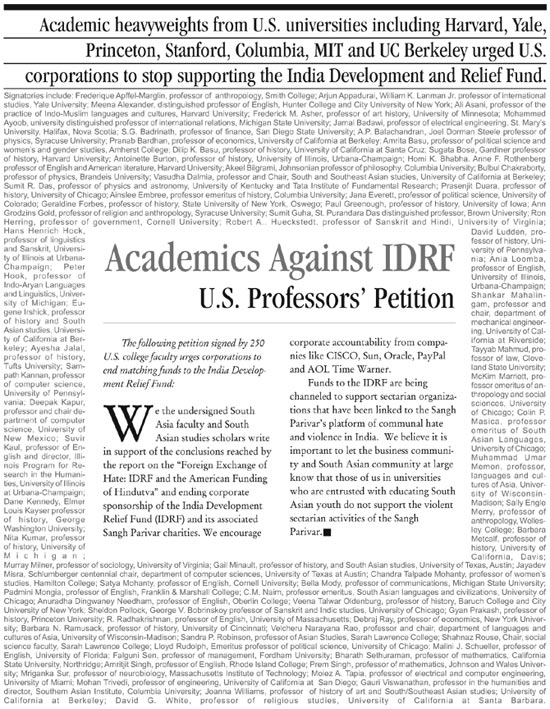
Signatories include: Frederique Apffel-Marglin, professor of anthropology, Smith College; Arjun Appadurai, William K. Lanman Jr. professor of international studies, Yale University; Meena Alexander, distinguished professor of English, Hunter College and City University of New York; Ali Asani, professor of the practice of Indo-Muslim languages and cultures, Harvard University; Frederick M. Asher, professor of art history, University of Minnesota; Mohammed Ayoob, university distinguished professor of international relations, Michigan State University; Jamal Badawi, professor of electrical engineering, St. Mary’s University, Halifax, Nova Scotia; S.G. Badrinath, professor of finance, San Diego State University; A.P. Balachandran, Joel Dorman Steele professor of physics, Syracuse University; Pranab Bardhan, professor of economics, University of California at Berkeley; Amrita Basu, professor of political science and women’s and gender studies, Amherst College; Dilip K. Basu, professor of history, University of California at Santa Cruz; Sugata Bose, Gardiner professor of history, Harvard University; Antoinette Burton, professor of history, University of Illinois, Urbana-Champaign; Homi K. Bhabha. Anne F. Rothenberg professor of English and American literature, Harvard University; Akeel Bilgrami, Johnsonian professor of philosophy, Columbia University; Bulbul Chakraborty, professor of physics, Brandeis University; Vasudha Dalmia, professor and Chair, South and Southeast Asian studies, University of California at Berkeley; Sumit R. Das, professor of physics and astronomy, University of Kentucky and Tata Institute of Fundamental Research; Prasenjit Duara, professor of history, University of Chicago; Ainslee Embree, professor emeritus of history, Columbia University; Jana Everett, professor of political science, University of Colorado; Geraldine Forbes, professor of history, State University of New York, Oswego; Paul Greenough, professor of history, University of Iowa; Ann Grodzins Gold, professor of religion and anthropology, Syracuse University; Sumit Guha, St. Purandara Das distinguished professor, Brown University; Ron Herring, professor of government, Cornell University; Robert A.. Hueckstedt, professor of Sanskrit and Hindi, University of Virginia; Hans Henrich Hock, professor of linguistics and Sanskrit, University of Illinois at Urbana-Champaign; Peter Hook, professor of Indo-Aryan Languages and Linguistics, University of Michigan; Eugene Irshick, professor of history and South Asian studies, University of California at Berkeley; Ayesha Jalal, professor of history, Tufts University; Sampath Kannan, professor of computer science, University of Pennsylvania; Deepak Kapur, professor and chair department of computer science, University of New Mexico; Suvir Kaul, professor of English and director, Illinois Program for Research in the Humanities, University of Illinois at Urbana-Champaign; Dane Kennedy, Elmer Louis Kayser professor of history, George Washington University; Nita Kumar, professor of history, University of Michigan; David Ludden, professor of history, University of Pennsylvania; Ania Loomba, professor of English, University of Illinois, Urbana-Champaign; Shankar Mahalingam, professor and chair, department of mechanical engineering, University of California at Riverside; Tayyab Mahmud, professor of law, Cleveland State University; McKim Marriott, professor emeritus of anthropology and social sciences, University of Chicago; Colin P. Masica, professor emeritus of South Asian Languages, University of Chicago; Muhammad Umar Memon, professor, languages and cultures of Asia, University of Wisconsin-Madison; Sally Engle Merry, professor of anthropology, Wellesley College; Barbara Metcalf, professor of history, University of California, Davis; Murray Milner, professor of sociology, University of Virginia; Gail Minault, professor of history, and South Asian studies, University of Texas, Austin; Jayadev Misra, Schlumberger centennial chair, department of computer sciences, University of Texas at Austin; Chandra Talpade Mohanty, professor of women’s studies, Hamilton College; Satya Mohanty, professor of English, Cornell University; Bella Mody, professor of communications, Michigan State University; Padmini Mongia, professor of English, Franklin & Marshall College; C.M. Naim, professor emeritus, South Asian languages and civilizations, University of Chicago; Anuradha Dingwaney Needham, professor of English, Oberlin College; Veena Talwar Oldenburg, professor of history, Baruch College and City University of New York; Sheldon Pollock, George V. Bobrinskoy professor of Sanskrit and Indic studies, University of Chicago; Gyan Prakash, professor of history, Princeton University; R. Radhakrishnan, professor of English, University of Massachusetts; Debraj Ray, professor of economics, New York University; Barbara N. Ramusack, professor of history, University of Cincinnati; Velcheru Narayana Rao, professor and chair, department of languages and cultures of Asia, University of Wisconsin-Madison; Sandra P. Robinson, professor of Asian Studies, Sarah Lawrence College; Shahnaz Rouse, Chair, social science faculty, Sarah Lawrence College; Lloyd Rudolph, Emeritus professor of political science, University of Chicago; Malini J. Schueller, professor of English, University of Florida; Falguni Sen, professor of management, Fordham University; Bharath Sethuraman, professor of mathematics, California State University, Northridge; Amritjit Singh, professor of English, Rhode Island College; Prem Singh, professor of mathematics, Johnson and Wales University; Mriganka Sur, professor of neurobiology, Massachusetts Institute of Technology; Moiez A. Tapia, professor of electrical and computer engineering, University of Miami; Mohan Trivedi, professor of engineering, University of California at San Diego; Gauri Viswanathan, professor in the humanities and director, Southern Asian Institute, Columbia University; Joanna Williams, professor of history of art and South/Southeast Asian studies; University of California at Berkeley; David G. White, professor of religious studies, University of California at Santa Barbara.
|TOP|
Estate Planning
Myths and Reality – By Raja Ahluwalia
There are misconceptions about wills which need to be dispelled if you wish to plan for the proper distribution of your assets after death, writes attorney Raja Ahluwalia.
Estate planning helps you distribute your assets according to your wishes after death. Successful estate planning transfers the assets to one’s beneficiaries quickly and usually with minimal tax consequences. The process of estate planning includes making an inventory of assets and making a will and/or establishing a trust, often with an emphasis on minimizing taxes.
Without proper and effective estate planning, and if the value of the estate is over certain dollar amount, the estate is transferred to one’s beneficiaries through a court process called probate. Probate is the process of determining if the deceased person left a valid will and admitting that will to probate, if any, so that the court can transfer the property to legal and qualified beneficiaries. It is long, cumbersome, expensive and public process, which not only takes time but money.
One’s estate consists of all the movable and immovable property. In order to provide information about estate planning in these articles, we will first start with discussion on wills, the basic document that forms the basis of estate planning.
There are probably few subjects in law which are surrounded by more myths and misinformation that the subjects of wills and the distribution of estates. Many people believe that not having a will allows the state to take part of the estate (not true), that having a will automatically reduces taxes (also not true), or that having a will means that a lawyer gets to take a big fee out of the estate (also not true). And, of course, there are the stereotypes of little old ladies writing long wills to direct who gets the silver spoons.
If you die with assets in your name, and without a will:
- The division and distribution of your estate is governed by a statute, called an “intestate” law. If a spouse and children survive you, your estate is usually divided between your spouse and children. There are other alternatives in the case of other survivors.
- The person (or persons) who inherits your estate is usually appointed to serve as the administrator of your estate, to collect your assets and settle your estate.
- If you have minor children who inherit from you, a court will appoint a guardian for their estates until they reach the age of eighteen.
- If you have minor children and your husband or wife did not survive you, a court will appoint a guardian for them.
A will can help dictate what the person wants to do in terms of distribution of assets, property, taking care of minor children, among other things.
Most people assume that, if a husband or wife dies, everything goes to the surviving spouse. However the distribution rules do not allow that. The spouse gets half and the children get the other half. Your husband or wife could therefore be very surprised to find, after your death, that half of your property has passed to your children. (If your children are minors, insult can be added to injury, because the court must appoint a guardian for the property passing to the children). That means that the children get one half of your property, your husband or wife is still responsible for raising them, but your husband or wife has no control over their half of your property.
If you are married and want your husband or wife to own everything after your death, it is usually a good idea to have a will that says that and avoid any possible confusion or surprise.
If you have minor children, you have the right to appoint the guardians who will take care of your children upon the deaths of you and your husband or wife. (Upon the death of only one parent, the surviving parent obviously continues as the natural guardian, so the problem only arises if both parents die in a common accident, or if one parent has already died.)
If you have minor children, you also have the right to appoint a guardian of their estates. (A guardian of the estate invests and takes care of the property that a minor inherits, while a guardian of the person takes the place of the parent in caring for the minor.) However, it is usually better to appoint a trustee and put specific directions in the will for applying the child’s inheritance for support and education, and specific directions for the age at which the child may receive the balance of the inheritance outright, free of trust.
Although the job of an executor (or administrator) of an estate is usually not as important as many people think (it’s really just a matter of finding the assets, paying the debts, paying the taxes, and distributing whatever is left), there are sometimes disputes about who should be the administrator when there is no will, or there are disputes among the administrators if more than one is appointed. Having a will that names an executor can eliminate these kinds of problems.
Having a will does not, in itself, save any taxes. If your estate would pass to your children without a will, and you write a will leaving everything to your children, the death taxes (state inheritance tax and federal estate tax) will be exactly the same with or without the will.
By a will, you can also make gifts of your body for transplants or research, or provide instructions on where and how you wish to be buried. However, these are poor reasons to have a will. In most cases, no one looks at the will until after the funeral and burial, so it is quite likely that your instructions for the disposition of your body will be found too late to do anything about them.
The information provided in this article is general in nature. Consult your attorney, CPA or tax advisor for additional guidance for your specific situation.
– Raja Ahluwalia is a business
and immigration attorney based in
San Francisco, Calif.
Auto Review: Lexus SC 430
Full-bodied Beauty – By Al Auger
When the road is as alluring as the driving machine, automotive editor Al Auger waxes poetic, as he does after taking the Lexus SC 430 down the sinuous bends of Highway 1.

Like a full-bodied, rich Chianti, a mountain smothered in powder snow, or a beautiful woman who loves you, there are roads not forgottenÖand the chariot that dominated the road. The first time I snaked down Highway 1’s notorious Devil’s Slide south of Pacifica on my way to Half Moon Bay is just as enduringly imprinted on my mind as the last time. The sheer cliffs drop precipitously to the foaming, wild ocean crashing on the monster rocks below that has seduced many errant drivers. The air is chilled,†clean and invigorating. Our dominator was the sensual Lexus SC 430 retractable hardtop roadster in deep, luxuriant black with rich fawn leather seating. The retractable hardtop of the Lexus SC 430 is the perfect setup for the capricious weather of this wild and unruly world. A tightly sealed coupe for the worst of the worst, an open air seat to all the passion and ever-changing moods.
The drama is only as fulfilling as the machine you’re manipulating through the pretzel bends haunted by the nothing that lies just beyond the low barriers. At our command was a muscular 300-horsepower V8 and rear-wheel-drive. The only missing ingredient was an alternative manual shifter joined at the hip of the 5-speed automatic. Designed at Toyota’s European design center and inspired by the French Riviera, the new Lexus SC 430 is not a set of wheels for the philistine.
Even though I have been visiting this lovely outpost of tradition and small-town charm since the age of ten, this was my first visit back in over 20 years. When we entered Half Moon Bay from Highway 1 it was as if being swallowed up in an All-American-ugly-town of the kind that has been springing up all across the U.S.
As I sat at the signal, surrounded by fast food emporiums, strip malls and multi-faceted signal lights, we braced ourselves for the degradation that all this “progress” must have foisted on the once charming Half-Moon Bay’s downtown along Main Street. Against all odds, the malo mojo that modern society is hell-bent on worshipping has left Main Street untouched. Lo and behold, Main Street is thriving with fine dining establishments, boutiques, even the historical Cunha Country Store is as much of a throwback as ever with modern conveniences nicely hidden. Main Street is a little brighter, a bit glitzier, but all the up-to-date visitor expediencies are softened by traditional businesses and commerce.
Traveling in style embraced in the luxuriant ambience of the SC 430 is parasitism, a sharing of sybaritic pleasures and endeavors with similar venues. We chose to share the finery of our chariot with the glorious surroundings and floral magic of the Mill Rose Bed and Breakfast Garden Suites on Mill Street just off Main. There’s not an open space at the Mill Rose that isn’t occupied by riots of floral color and the air is filled with the mingling perfume of the garden. Some people have green thumbs and some, as co-owner Terry Baldwin, have green fingers and toes. Responsible partner and wife Eve handles the beautiful flower arrangements, interior decorating and every day affairs of running the inn. No one will forget the first storm of this new winter season and it turned out to be a double-sided coin for the SC 430 and us. The rains and winds came down on us as if Armageddon was upon us and the oils deep in the road surfaces rose up and made for some slick going. But the SC 430 carried the day with great enthusiasm and nary a shiver. After checking into the elegant Renaissance Rose Suite and a mind-massaging soak in the flower gazebo’s hot tube, we walked downtown to the warm and inviting Cetrella Bistro and CafÈ on Main Street.
The Cetrella has been a dream of owner Paul Shenkman since he opened the Pasta Moon years ago in Half Moon Bay. Just two years old, Cetrella imparts words one uses to describe the soft light and warmness of Tuscany. Caught in a town-wide blackout due to the horrendous storm buffeting outside, we had the pleasure of dining in romantic candlelight while four fireplaces blazed forth. The Northern Mediterranean villages of France, Italy and Spain inspire food. There are three dining rooms of dark woods, stone and umber walls plus a cafÈ bar featuring tapas. Their extensive and award-winning wine cellar encompasses over 3500 bottles and 400 labels from around the world.
After a filling Mill Rose breakfast of artichoke frittata, butter with triple sec, apple crunch with sour cream and champagne from the local Obester Winery we deemed it time to let the SC 430 stretch its long legs. One of the most lovely and bucolic country vistas†on the coast side of the Bay Area is the south run down Highway 1 to Pescadero and the Pescadero State Preserve. Together, the car and road become a visceral thing — you’re running strictly on instinct and the seat of your pants.
Reminiscent of our earlier Highway 1 North excursion exercising the then brand new Jaguar S-Type, we found the southern portion just as empty of travelers. The SC 430 is no lightweight at nearly 4,000 pounds, yet the steroidal, easy-breathing, 4-cam, 300-horsepower V8 launches 0-60 in 5.9 seconds and a chip-limited top speed of 156 mph, according to Toyota figures. Under the deep black finish of the sheet metal is a cornucopia of mechanical and electronic wonders such as 4-wheel independent double wishbone suspension coil springs, gas-filled shocks and obese stabilizer bars. All this coupled to 18x8 Dunlop tires. Braking is on a dime with anti-lock brakes and electronic brake force distribution (EBD). Helping all this is an alphabet soup of electronic wizardry such as vehicle skid control (VSC); the VSC integrates traction control (TRAC).
The top was down, Cajun rhythms matching the undulating winds and waves around us pounded from the stereo. The interior of the SC 430 is an eye-pleasing combination of woods, soft leathers, great seats and minimal buffeting in the cab from outside forces. Naturally, the SC 430 is loaded with all the bells and whistles that such exotic machinery must have. Two such conveniences are the sound system which automatically raises the volume as the top opens and lowers as the top is closed and the superb dual climate control system that adjusts flow and direction depending on the top location.
Back up Highway 1 and time for home as the sun exploded through the dark and forbidding overcast. One last repast at the iconoclastic Moss Beach Distillery Restaurant in Moss Beach. Here you dine in an inviting aura of dark wood and large windows facing the fierce, battering of the waves against the shore. But the distillery is more than dramatic views and large portions of good food. Its history, originally known as Frank’s Roadhouse, goes back to the Roarin’ 20’s and the days of loose women, gangsters, prohibition and rum running when it was an off-loading point for the illegal hooch coming in by boat.
And we can’t forget the ghost that is said to haunt the venerable building for some 70 years. Actually, there are reportedly five ghosts roaming the building and the grounds, but the most famous is the “Lady in Blue.” The story says she was the wife of a bootlegger but in love with the roadhouse’s piano player. Caught in the arms of her lover, she was mistakenly stabbed by her lover during a scuffle on the beach. The story became a nationwide one when it was featured on “Unsolved Mysteries” with Robert Stack.
Nothing ephemeral about the sturdy food served. Oyster shooter, tender and tasty crab cakes with cilantro, dijon mustard, lemon beure and seasonal veggies. A quiet meal while we conjured up a vision of the beautiful “Lady in Blue” floating somewhere, searching for her lover and all the other tortured souls spending eternity forever searching. More importantly, the SC 430 beckoned with the call of many miles of enticing bends and arcs that still remained of Highway 1 before we turned east towards home.
Today's Test Drive:

MILL ROSE GARDEN INN
615 Mill Street
Half Moon Bay, CA 94019
Phone: (650) 726-8750
Fax: (650) 726-3031
Toll-free: (800) 900-7673
Location: On Highway 1 South 35 minutes from San Francisco and Highway 92 East 20 minutes from San Mateo.
Rates: Six beautifully created and distinctive rooms and suites that ranges from $190 to $360. Amenities include full breakfast, outdoor gazebo with hot tub and guaranteed serenity. Main Street is two blocks away populated with restaurants, lounges, boutiques, antique shops, etc.
e-mail: info@millroseinn.com
www.millroseinn.com
Al Auger, our automotive editor has been writing about cars for over 30 years.
He has spent 20 years as a race driver and public relations specialist.
Guftugu
Happy Akshay
Akshay Kumar is on a roll. The beefcake hero is not just making ladies swoon, producers are lining up to him as well, and some are even putting up with his whims. While Akki smiles, superstitious gossips are saying his newborn son has brought him luck.
Whatever it is, it’s strong stuff, because even the Big B is smiling on him, with the Bollywood icon working on three upcoming films with him.
What’s the secret, you ask? Well, insiders say it’s actually pretty mundane: Akshay has become a really good boy, and in the volatile world of Bollywood dependability is worth its weight in gold.
Now, only if he could act! But hey, you can’t have everything in life.
Present Perfect
The sultry Bengali beauty Bipasha Basu has a lot more going for her than oomph. Guess who she wanted to join her when she was invited to the television show Jeena Isi Ka Naam Hai? Heartthrob models Dino Morea, Milind Soman and John Abraham, that’s who.
Now all of these wouldn’t be more than mildly interesting but for the fact that all three were her former boyfriends. Apprehensive show producers were on tenterhooks about what might happen on the show but Bipasha breezily shrugged off any worries.
True to her word, she was in great form, smiling and giggling during the taping of the show. “They are still very good friends,” she said. Our Bipasha has better things to think about than failed relationships: with 10 films on hand, she is one hot commodity in Bollywood now.
Brawn, Brains and Heart
If you thought Sunil Shetty is all brawn and no brains, think again. So what if his best known assets on screen are his fists rather than his acting? This guy is not only smart — this savvy businessman has a slew of entertainment enterprises including a chain or restaurants— behind all those gorgeous pecs beats a caring heart, believe you me.
After being involved in a campaign to promote the cause of street kids of Mumbai, he has now anchored two short film spots to create awareness about AIDS. Bollywood’s Mahesh Manjrekar and Sonali Bendre have pitched in the effort.
None of this comes as a surprise to those who know Sunil. After all, he is almost unique among Bollywood stars who refuses to flee to the suburb because he says his roots are in Mumbai’s downtown. A devoted family man who proudly lives with his parents, he loves to hang out with his childhood buddies almost weekly. Now there’s a few lessons for some other Bollywood candyfloss stars.
Birds of a Feather
Bollywood stars may be notorious for their fragile egos, uninhibited envy and dislike for their competitors, but in Kareena Kapoor we seem to have a refreshing exception.
When J.P. Dutta decided to make LOC, he pulled out all stops. Now in Bollywood that’s saying something. He has lined up 10 heroes, and now he needs 10 heroines. You would think that would be an occasion for one maha catfight, but when he roped in Kareena, she herself agreed on condition that J.P. Dutta would sign Esha Deol.
Dutta was only too happy to oblige. When he reached the Deols, all it took was a phone call and Esha was in. Kareena and Esha are thrilled, because now they have another meeting place to exchange first-hand hearsay evidence, pick up on the latest gossip and bitch about common enemies — in a word, do what nice girls do.
And they may soon have another friend joining in. Apparently Kareena is trying to rope in another buddy, Rani Mukerjee. Look likes it’s going to be one long picnic shoot. One just hopes Dutta manages to throw in a few moments of shooting in the mix.
Unfunny Comedy?
The beauty queen has a plum role in a comedy, but naysayers are laughing for all the wrong reasons. Alas, gone are the days of beauty pageant glamour for the hapless Diya Mirza, whose films have had a terrible run in the box office.
But the Hyderabadi beauty has a lot of spunk, and she is not ready to go quietly. She can draw some hope in the fact that she is working on films by Govind Nihalini and Mahesh Manjrekar, but it’s the latter film that is raising eyebrows and drawing hisses and sneers. Manjrekar’s film, you see, is Padmashree Laloo Prasad Yadav, hardly the most promising comeback vehicle for a bruised starlet.
Diya is unfazed. “It’s a very interesting film and I get to attempt comedy for the first time,” she says.
As for her long screen absence, she is bracingly blunt: “I want to just kick *** and enjoy myself for the time being.”
Arclights Beckon
After setting male hormones on fire during her salad days, Zeenat Aman now has her own creative juices flowing. (Take your mind out of the gutter!)
She is going to act in Chupkay Chupkay, a play directed by Ramesh Talwar. Now Zeenat was never known for her acting skills, but this play should be a piece of cake. She plays Lady Lalkuvar, Sir Amarsinh Narottam’s concubine, who cons her man into marrying her, pretending to be unwell and about to die. Sir Narottam isn’t very pleased when she “recovers.”
Zeenat is delighted to get back under the arclight, and judging from her role, the audience won’t be disappointed either.
|TOP|
Hindi Film Review:
Uneven, Copycat Thriller
Nitin Manmohan ‘s
DEEWANGEE
Director: Anees Bazmee
Starring: Ajay Devgan, Akshaye Khanna, Urmila Matondkar, Seema Biswas,
Suhasini Mulay, Farida Jalal, Suresh Oberoi
Music: Ismail Darbar
Lyrics: Salim Bijnori and Nusrat Badr
Originality has never been Bollywood’s strongest suit, but then, Hindi movie buffs are not known for being fastidious. A phoren-“inspired” Bollywood film is like a pair of fake Levi’s jeans: If it looks good, feels good, never mind whether it’s been lifted off somebody else’s work.
Anees Bazmee’s Deewangee has Hollywood’s Primal Fear (Richard Gere, Ed Norton) written all over it, but if it’s slickly made and tells a good story well, nobody is going to be fussy about it.
So the question now becomes is Deewangee slickly made, and does it tell a story well? Here’s where things get a bit sticky. Slickly made? Maybe. A story well told? Not entirely, but that’s relative. Given the dreadful stuff that passes for cinema in Bollywood, Bazmee isn’t half bad, really.
With apologies to those who have seen Primal Fear, here’s how the story goes. Raj Goyal (Akshaye Khanna) is a successful criminal attorney who is smitten by playback singer Sargam (Urmila Matondkar) whom he meets at a music party and the workaholic turns loverboy.
It is through Sargam that Raj meets Tarang Bharadwaj (Ajay Devgan), a struggling music composer, who is a childhood acquaintance and mentor of the singer.
Tarang, it turns out, gets into serious trouble very soon. He gets caught red-handed (this is not a clichÈ, he has blood in his hands, literally) in a gruesome murder scene. Music magnate Ashwin Mehta is found dead following a horrible stabbing. The police, dear simple-minded folks that they are, figure they don’t need to look far. Music magnate stabbed, Tarang found with blood, end of story.
Not quite, it turns out. Sargam pleads Raj, hotshot lawyer that he is, to take up the case of Tarang, who is facing a murder rap. Now Raj can’t say no to Sargam, can he? As he takes on the case, though, he finds Tarang’s claims of innocence plausible, and pulls all stops to defend him.
However, Tarang is a complicated person: He is compassionate and talented, but there is a darker side to him which becomes clearer as the film progresses.
If all this sounds like Primal Fear in Hindi, then it should, because Bazmee is sincere in his flattery, if you get my drift. And the benefit for the Hindi viewer is the interesting plot twists.
Director Anees Bazmee, of course, has been protesting that his film is different. That it is. The silly contrivance of a love-triangle is slapped on the film, and of course any Hollywood filmmaker would be driven out of town for the obligatory trademark Bollywood song-and-dance sequences which can only be called fabulous — and that is not a compliment. I use the word as a rebuke, in its literal sense: fabulous, as in “like a fable,” utterly removed from reality.
The film’s second half hangs loose and limp like the sagging belly of an aging heifer. The taut thrilling suspense of the first half gives way to predictable, cliched situations and an excruciatingly prolonged climax which lacks punch because it lacks surprise.
The film’s saving grace is superb, natural acting by Akshaye Khanna, who appears to be consolidating his reputation as a talented actor. Ajay Devgan is great in the first half, but someone should tell this guy that his taciturn, dour persona is getting a bit old. After a while, what seemed like brilliant restraint can appear to be simply a lack of histrionic range.
And Urmila! She sizzles in the dance scenes and fizzles everywhere else. Her acting is so bad at times that one’s toes curl in embarrassment. Other actors are adequate in bit parts, with Seema Biswas doing an interesting cameo as a psychiatrist.
This is not to say that Bazmee is totally lacking in filmmaking talent. Even if lifted from Primal Fear, the film does create surprise and gripping moments of suspense which may owe most to the purloined storyline, but still a fair amount of credit must go to solid filmmaking skills.
That brings us back to the question we raised in the beginning of this review. Do we care if the film isn’t original if it’s well made? Well, since the film is well-made only in parts, Bazmee deserves a little rap on his knuckles for borrowing so heavily.
It’s not just Primal Fear. There are shades of Darr, which again stole stuff from Cape Fear and Sleeping with the Enemy.
Bollywood is truly a make-believe world. You had Sanjay Leela Bhansali insisting his Devdas was based on Sarat Chandra Chattopadhyay’s novella when its links with the Indian classic novel were minimal; here you have Anees Bazmee serving a buffet of borrowed plots and insisting his film is different. Who can blame Bappi Lahiri, the has-been copycat composer extraordinaire, for filing a lawsuit against Truth Hurts for using one of his songs that nobody knew existed?
There is a price for these shenanigans, and Bollywood is paying through its neck. This year has been the worst box office year ever for Hindi cinema. Wake up, folks, and get your act together before it’s too late.
|TOP|
Tamil Film Review:
Disappointing Attempt
SOLLA MARANTHA KATHAI
Director: Thangar Bachan
Cast: Cheran, Rathi, Pyramid Natarajan, Satish, Janakaraj, Manivannan, Kalairani, Yuvarani, Pushpavanam Kuppusamy and Baby Saraswathi
Azhagy, starring Partibhan, Devayani and Nandita Das, had been one of the best films one had seen in recent times. Masterfully handled and scripted, it marked cinematographer-turned-director Thangar Bachan as a filmmaker with rare sensitivity and sensibility, someone who could perhaps lift Tamil cinema from the abyss of mediocrity that it had fallen into. But that is not to be. Bachan’s second release Solla Marantha Kathai disappoints, falling far short of his earlier attempt in every department including scripting, treatment and characterization. It’s an oft told tale retold without any freshness.
Here is how the story goes: Chockalingam, attracted by Sivathanu’s honesty and business sense, offers the youth his daughter’s hand in marriage — on condition that he leave his house and stay at his wife’s place. Sivathanu, an unemployed post-graduate who worked as a field hand and did menial jobs to support his family in penury, declines but parental pressure forces him to concede to their wishes. A series of unpleasant incidents in his in-laws’ place and the taunts and jibes by his father-in-law strengthens his resolve to take up a job. And when he gets one in Neyveli he leaves. His next trip to see his newborn baby turns out to be an even more unpleasant occasion, what with the clash with his in-laws resulting in him being literally thrown out of the bungalow. It’s two years later that Sivathanu gets to visit the neighborhood to attend a marriage. The challenge of reconciling with his wife amidst tense family hostility forms the rest of the story.
For director Cheran who had hitherto guided actors from behind the scene, it must be a new experience to be in front of the camera. It’s a role of the harassed common man, and it suits him. He acquits himself well without any great heroics. It’s a debut where one cannot fault him much. He plays fairly convincingly the hapless husband forced to live on the largesse of his wife’s family, bearing it all for her sake, till he can take it no longer. As for Rathi it’s only her second film, but she has handled her role like a veteran, showing sensitivity and maturity as the timid Parvathy caught in the crossfire between her father and husband. Pyramid Natarajan as Rathi’s father, Saraswathi as their domestic help and Satish as Cheran’s brother perform their roles well. Pushpavanam Kuppusamy’s antics in the name of comedy is a bit over-the-top at times. As for music, Illaiyaraja does not seem particularly inspired.
— Malini Mannath
In association with Chennai Online
|TOP|
Recipe:
Vegetarian Turkey – By Seema Gupta
What’s a vegetarian to do for Thanksgiving and Christmas? Simple, bake a vegetarian turkey, says Seema Gupta.
Ingredients
- 5 large potatoes (boiled)
- 1/2 cup canned peas
- 2 tsp finely chopped cilantro
- 6-7 chopped green chillies
- 2 tbsp lemon juice
- 2” piece of fresh ginger (grated)
- 4 carrots (2 grated, two whole)
- 1 cup of finely chopped mixture of french beans, carrot and bell pepper, diced paneer
- 1 tsp garam masala
- Salt to taste
- 1 tsp coriander powder
- 2 tsp corn starch
- 1/2 tsp mustard seeds
- 2 cloves
- 1 tbsp cooking oil
- Butter to grease pan
Method
For “turkey:”
Mash 3 boiled potatoes. Add peas, green chillies, coriander leaves, grated ginger and corn starch and salt. Mix well.
For stuffing:
Mash 2 remaining potatoes. Add oil to heated pan. Add mustard seeds. Add potatoes. Add 1 cup of vegetables. Add salt, garam masala, green chillies, grated ginger, coriander powder and mix well for five minutes. Switch off the stove.
To decorate and bake:
Grease a baking dish. Spread the “turkey” mixture of that there is a hollow space in the middle. Put stuffing in the center. Close and cover stuffing with “turkey” mixture. For decoration, shape covering potato into bird’s head and body. Insert cloves for eyes, garnish with grated carrots on top of body. Cut longitudinal slices of bell paper, decorate body and “tail.” Prop up each “wing” with whole carrot tucked underneath.
Brush top of the item with melted butter.
Preheat oven 250 degrees . Put item in oven for 30 minutes. Serve hot.
– Seema Gupta is a homemaker
based in Sunnyvale, Calif.
|TOP|
December Horoscope
ARIES (March 21 to April 20): You will be relaxed. You will get good advice on tackling issues that can affect you in the long run. Speculation will be profitable, try your luck at lottery.
TAURUS (April 21 to May 20): You may overlook essential elements and end up getting less than what you deserve. Property issues could become a pain. Money will come but expenses will be high.
GEMINI (May 21 to June 20): You will be working on a great plan that could change your life. Selling recently purchased stocks at a lesser profit is advised. A close past associate may want to rekindle new relationship. Competition will dissolve. You will enjoy good health.
CANCER (June 21 to July 22): Avoid any conflicts with the law. You may loose money through speculation and may end up paying hefty fines to the government. You will make good friends. Home improvement tops the list of chores this month.
LEO (July 23 to August 22): Get ready for an exciting trip. You may need to negotiate hard for a new job. It is a good time to start a business. A business trip will be very profitable. A great month for brokers and agents.
VIRGO (August 23 to September 22): Credit cards will incur heavy expenses as you prepare for a trip. Important papers may arrive when expected. New projects will show slow development. You may meet old friends.
LIBRA (September 23 to October 22): Career issues will be stressful. Communicating and paperwork will take a lot your time. Watch your health. You will have to reply to a government agency.
SCORPIO (October 23 to November 22): Professional fame and respect will grow. Delicate situations and important work will test your diplomatic skills. You will sign an important contract. Watch out for emotional blackmailers. Speculation will be profitable.
SAGITTARIUS (November 23 to December 22): You may suffer minor skin rashes. Get ready for a long distance trip. Prioritize governmental issues. An invitation to an important event should come soon.
CAPRICORN (December 22 to January 19): Positive career development is foreseen. It’s time to relax. Last minute travel preparations will gain priority as you head for a vacation. An important property issue will be resolved to your satisfaction.
AQUARIUS (January 20 to February 18): You will go on a business trip. Negotiations will fall through at the last minute. Expenses will mount. You will get what you wished for as you cut through the red tape at a government agency.
PISCES (February 19 to March 20): Slow developments may cause concern. Spouse will constrain spending. You will visit a sick elderly relative. Children will expect your attention and time. Although you have everything, you will lack peace of mind.
|
|
 !-- Start Alexa Certify Javascript -->