|
Publisher's Note:
The Silicon Valley has been reeling from the aftershocks of the dot-com bust for a while now. As information technology professionals look over their shoulders constantly to wonder if their jobs are going to be the ones that go tomorrow, it’s a good time to reflect on what was wrong and what was right about the whole dot-com phenomenon. We at Siliconeer are less keen to burden our readers with a complicated analytical essay that critiques the dot-com bubble. Instead, we turned to Anirvan Chatterjee, CEO of BookFinder.com, the company that hosts the most popular online book search engine. Chatterjee’s story exemplifies not only what is the right way to go about a dot-com business, but also what was the wrong way that led to the disaster.
He didn’t run to the venture capitalists with cap in hand, didn’t devise slick “business plans” and “exit strategies,” the sole aim of which is to manipulate circumstances to extract a quick financial windfall.
Rather, he developed an idea that sprang from his love of books, and went about it the old-fashioned way. He kept a sharp eye on the bottom line, strategized and worked tirelessly to make the idea work and streamline it as his company grew.
His success is an inspiring tale which could have been written by the Greek didactic fabulist Aesop. BookFinder.com shows that with the right idea and with old-school business values, the Internet can be a big tool for success. The fault of the dot-com bust, his story suggests, lies more with the IT hucksters and the mindless cheerleaders rather than the Internet itself, which remains not only mankind’s most powerful tool of communication and dissemination of information, but also a potent business tool. Just expect no short-cuts.
|TOP|
Main Feature
The DotCom That Could
The Success of BookFinder.com – By Anirvan Chatterjee
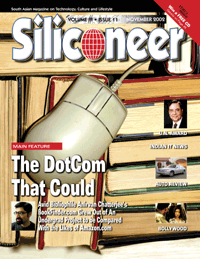
Anirvan Chatterjee was all of 19 years when he came up with the idea of a search engine for books. The class project grew into BookFinder.com, which not only withstood the dot.com crash, but went from strength to strength as some critics put this site right up there with Jeff Bezos’ online goliath Amazon.com. It completed five years this year, and here is Anirvan’s story, in his own words.
Winter 1996-1997: Class Project
I didn’t really have a sense of what might happen when I first started working on the project. I was a 19-year-old UC Berkeley undergraduate in January 1997, when I put my new book search engine online. It was a simple tool; you’d enter an author and a title, twiddle your thumbs for a while, and the software would return the prices for that book at a half dozen bookstores online. You could then buy the book directly from the bookstore with the lowest price.
By this point, I had actually been tinkering with the system for a few months. I’d taken a seminar on network agent software the previous fall; as a voracious reader, I’d decided to build a prototype book search engine as my final project for the class. I got an A on the project, and decided to keep working on it outside of class. Following the launch of what I initially named “MX BookFinder,” I emailed some friends, submitted the new search engine to Yahoo, and went on with my life — I had homework to finish, friends to hang out with, books to read.
The emails started arriving within a few weeks’ time. Folks were discovering BookFinder. Using it. Some of them were raving about it. It soon became evident that what had begun as a class project was rapidly taking on a life of its own.
Summer 1997-Summer 1998: Growth
The BookFinder search engine was initially running on an old server — a used 486DX/120 system that my high school buddy Charlie had helped me rebuild the previous summer. The Web site had always been slow, running on the 486, but at it least it didn’t crash. Not until it started getting some attention. I was spending the summer in rainy Redmond, Washington, interning for Microsoft, which was where I was when someone emailed me to let me know that my site had been mentioned in Yahoo! Internet Life magazine, and USA Today. Traffic on the site immediately increased to the point that the old 486 just couldn’t handle it anymore. I blew my savings on a pricey new server (a then-nifty dual processor Pentium Pro), and realized that it just wasn’t feasible for me to keep the site running by paying for expenses out of pocket. I briefly tried making the site shareware (and to my surprise, satisfied users did indeed send in their checks). And I did a happy little dance when I sold my first web ads. My labor aside, the site was starting to pay for itself.
My internship came to an end that fall. I had one year of college left to go, and grad school applications were looming. After returning to Berkeley, I continued working on the site out of my tiny dorm room. BookFinder searched more and more bookstores. From six to eight, then ten, and soon, new partnerships meant that BookFinder could search the inventories of literally thousands of bookstores. Somewhere along the way, a focus on used, out of print, and antiquarian books started dominating.
By early 1998, I was fielding several dozen emails a day from BookFinder.com users. Everything was accelerating: site traffic, media mentions, inquiries from potential investors, costs, workload. Even when visiting my grandparents in Kolkata, I felt compelled to check up on the site and scan user email several times a week from cybercafes (a journey by foot, rickshaw, and subway, before Internet cafes were prevalent). Email from users, though voluminous, was usually worth reading; a typical day would bring into my inbox messages like “I’ve been looking for this book for twenty years, and I found it in five minutes on your site” or “You helped me save $200 on college books.” It was pretty rewarding for an afterschool hobby. I got into the grad school of my choice (UC Berkeley’s School of Information Management and Systems, sort of a cross between computer science and library science), and spent the summer working on the website.
In the meantime, BookFinder was starting to build up a user community. Word of mouth from fans helped others find out about the site. Through personal email with me, and on the newly-formed “BookFinder Insider” mailing list, users were making their opinions known, offering suggestions, throwing out tips and tricks for better searching, helping the site grow. By late 1998, the BookFinder Insider mailing list’s users had transformed it from a stale tech support forum into a vibrant online community of booksellers and bibliophiles, and turned it into one of the few major forums for online booksellers to discuss the industry.
Fall 1998 - Spring 2000: Startup
When launching the site, I’d made the mistake of calling it “MX BookFinder,” and hosting it at www.mxbf.com. The name and URL had always been cumbersome and hard to remember, but I hadn’t realized the role of good naming practices starting out. I finally made up for my naming mistake by spending $1,500 on buying the “bookfinder.com” domain name — possibly the best purchase I’ve ever made. The site relaunched as “BookFinder.com” in December 1998.
By late 1998, it was clear that BookFinder.com couldn’t be run by a single person anymore — not if it were to grow. I was in graduate school, spending forty hours a week on the site. As a tech geek living in the San Francisco Bay Area, I was surrounded by dot.com dreamers; turning BookFinder.com into a startup seemed the obvious route. Feelers were put out, and classmates from graduate school expressed interest, as did my high school friend Charlie (who was completing his degree in computer science at the University of California, Davis).
We incorporated in April 1999, took on a round of private financing, and started working on changing the way online shoppers looked for books. Ideas were flowing. We were a small group of earnest twenty-somethings scrawling madly across whiteboards, brainstorming away on trends in the online book industry, network architecture, usable design. The UC Berkeley contingent would head over to our office after classes; Charlie would drive down from Davis to Berkeley in the evenings, work till 2 AM, and drive back home in time for classes the next day. Our months of usability testing made it evident that in the real world, the best deals could show up on either new or used books, that people ended up running poor quality searches if given too many flashy options, that ISBNs were not the best way to search when you had inconsistent data to work with. Our ideas gelled.
By the end of summer, our team was working furiously to translate its concept for a better book search engine into reality. But as the workload increased, we realized that one could either run a startup or attend graduate school, but not do both simultaneously. I decided to take a leave of absence from academics, while most of my classmates opted to leave the business to complete their degrees. Charlie, recently graduated, stayed on. Sixty-hour weeks were punctuated by long phone calls to new partners, obsessive programming trances, database development headaches, negotiations with site advertisers, and more than a few nights spent sleeping on the ancient orange couch that had been purchased from a friend who’d left town. And above all this chaos stood a life-size cardboard cutout of Yoda, who quickly became the group mascot.
On the business end of things, we resolved to stay conservative. We had an existing product to build on, and profitability was in sight. We weren’t going to throw it away on dot.com hype. Potential investors pressured us to move towards e-books, print on demand, just in time document delivery, and strategic partnerships with online retailers with questionable business models. Besieged by buzzwords, we worked even harder to take on the market for used and rare books, putting twenty-first century tools to help bibliophiles navigate a nineteenth century industry.
January 2000 saw the final release of the all-new BookFinder.com website, featuring many more booksellers, completely redesigned interfaces, expanded search criteria, and significantly improved search software running in the background. The Better Book Search Engine (or at least our team’s best stab at it) had finally seen the light of day.
Summer 2000 - Fall 2002: Beyond the Shakeout
Starting in 2000, the online bookselling industry entered a spiral of shutdowns and consolidations, much in line with the shakeout affecting the rest of the dot.com economy. Some of our partners that either shut down, were acquired, or had to deal with massive business restructurings included: 21 North Main, Bibliocity, Bibliofind, BigWords.com, Books.com, Borders.com, ClassicForum, Global Book Mart, KingBooks, JustBooks, usedbooks.com, VarsityBooks.com, and yourbooks.com. It was a difficult time in the industry, but BookFinder.com was well positioned to weather the storm, due to our conservative planning (“happy customers and profits good; buzzword compliance and dot.com business models bad”) and low-budget, low-overhead, and debt-free operation.
We’ve been busy on a number of fronts since 2000 — partnerships, increasing searchable inventory, marketing, internationalization, etc. — but the most important change we’ve made since our launch as a company isn’t a deliverable, but a change in thinking. We’ve come to realize that we’re not an ecommerce company with a narrow vertical focus on books, but a book company with a strength in ecommerce. Delving into the book industry allows us to better position ourselves with regard to the various constituencies we serve and interact with — booksellers, book shopping sites, trade organizations and consortia, and publishers. The technology’s not the point; it’s just a tool in our larger mission to help connect readers with the books they’re looking for.
BookFinder.com started off as an underground phenomenon; online bibliophiles would discover the Web site and tell their friends about it. Even after launching the site as a business, we never enjoyed the kind of VC-driven largesse that would allow for outspend-your-way-to-the-top saturation marketing. Excellent media coverage amply filled in the gaps; the site may not have been in the same league as an Amazon.com style juggernaut, but the critics seemed to like it. In fact both Newsweek and Money magazines called it the best book shopping site online (tied with Amazon.com both times). MSNBC.com called it one of their top ten shopping sites. The site has gotten great mentions in a variety of publications, including The New York Times, PC World, Time Digital, USA Today, and InStyle. Why the good press? The reason is simple: journalists are readers, passionate about books; a useful tool to help them expand their bookshelves has obvious appeal.
As a business, BookFinder.com has grown by orders of magnitude since the days when I ran it out of my dorm room, but it still remains a tiny operation. My friend Charlie and I are still the only two full-time employees; we work with a number of part-time employees and outside consultants to fill in the gaps. The multiplicative power of IT allows us to grow our business without bogging down in our workload (which gives us more time to do what we enjoy most—read).
Endnote
Looking back, I’m still surprised to see my after-school hobby survive five years, spawn a business, and turn into a heavily-used Internet resource. As a high school student, I imagined that I would spend my career working in a stultifying Dilbertesque cubicle farm in the bowels of some Silicon Valley tech company. As an accidental entrepreneur, I’m thankful that I’ve gotten a chance to run a business with friends, and draw from my passion for both books and computers.
Anirvan’s Favorite Reads This Year
Berkeley at War: The 1960s
by Rorabaugh, W.J. (1989)
Bombay-London-New York
by Kumar, Amitava (2002)
The Years of Rice and Salt by Robinson, Kim Stanley (2002)
Jerusalem Calling by Schalit, Joel (2002)
The Barbarians Are Coming by Louie, David Wong (2000)
Global Pop: World Music, World Markets
by Taylor, Timothy D. (1997)
The Diagnosis by Lightman, Alan (2000)
Anirvan’s Reads This Year
69 by Murakami, Ryu (1993)
Memento Mori by Spark, Muriel (1959)
The Information by Amis, Martin (1995)
Disgrace by Coetzee, J. M. (1999)
Are You Experienced? by Sutcliffe, William (1997)
The Great Hedge of India by Moxham, Roy (2001)
You Shall Know Our Velocity by Eggers, Dave (2002)
Southern Music / American Music
by Malone, Bill C. (1979)
The Asian Gang: Ethnicity, Identity, Masculinity
by Alexander, Claire E. (2000)
Step Across This Line: Collected Nonfiction
1992-2002 by Rushdie, Salman (2002)
Sewer, Gas & Electric by Ruff, Matt (1997)
The Politics of Disablement: A Sociological Approach by Oliver, Michael (1990)
Burnt Bread and Chutney by Delman, Carmit (2002)
Letters to Nanette by Biderman, Bob (1982)
The Collected Stories
by Singer, Isaac Bashevis (1982)
Caste and Outcast by Mukerji, Dhan Gopal (2002)
Maximum Light by Kress, Nancy (1998)
A Grave Talent by King, Laurie (1993)
Double Fold by Baker, Nicholson (2001)
Cheese by Elsschot, Willem (2002)
Fraud by Rakoff, David (2001)
Altars in the Street
by Chavis, Melody Ermachild (1997)
As She Climbed Across The Table by Lethem, Jonathan (1997)
Kissing in Manhattan by Schickler, David (2001)
War Against the Planet by Prashad, Vijay (2002)
The Circle of Reason by Ghosh, Amitav (1986)
Real Time by Chaudhuri, Amit (2002)
The Chandler Apartments by Hill, Owen (2002)
The Second Tree From the Corner
by White , E.B. (1984)
Mirabilis by Cokal, Susann (2001)
Ode to Lata by Dhalla, Ghalib Shiraz (2002)
A General Theory of Love by Lewis, Thomas &
Amini, Fari & Lannon, Richard (2000)
Mother of 1084 by Devi, Mahasweta (1997)
Possession by Byatt, A. S. (1990)
Were You Always An Italian?: Ancestors and Other Icons of Italian America by Laurino, Maria (2000)
The Rushdie Letters: Freedom to Speak, Freedom to Write by MacDonogh, Steve (ed.) (1993)
Subject to Debate: Sense and Dissents on Women, Politics, and Culture by Pollitt, Katha (2001)
A Princely Impostor?: The Strange and Universal History of the Kumar of Bhawal
by Chatterjee, Partha (2002)
The Diagnosis by Lightman, Alan (2000)
Cannery Row by Steinbeck, John (1945)
On My Honor: Boy Scouts and the Making of American Youth by Mechling, Jay (2001)
Where the Bodies Are Buried
by Dawson, Janet (1998)
An African in Greenland
by Kpomassie, Tete-Michel (1983)
The Impressionist by Kunzru, Hari (2002)
Diamond in the Buff by Dunlap, Susan (1990)
The Bessie Blue Killer by Lupoff, Richard (1994)
Love in the Time of Cholera
by Garcia Marquez, Garcia (1988)
The House of Blue Mangoes by Davidar, David (2002)
A Credible Threat by Dawson, Janet (1996)
The Comic Book Killer by Lupoff, Richard (1989)
About A Boy by Hornby, Nick (1998)
The Night Listener by Maupin, Armistead (2000)
Desis in the House: Indian American Youth Culture in New York City by Maira, Sunaina Marr (2002)
The History of the Siege of Lisbon
by Saramago, Jose (1989)
Bloodchild and Other Stories
by Butler, Octavia (1995)
To Play the Fool by King, Laurie (1995)
Radical Son by Horowitz, David (1997)
The Trouble With Testosterone
by Sapolsky, Robert (1997)
It’s Been a Good Life by Asimov, Isaac &
Asimov, Janet Jeppson (ed.) (2002)
Asylum, USA by Desai, Boman (2000)
The Cornel West Reader by West, Cornel (1999)
How to Get Balled in Berkeley
by Steinhardt, Anne (1976)
Sweet Like Saltwater by Deonandan, Raywat (1999)
A Sin of Colour by Gupta, Sunetra (1999)
Second Front: Censorship and Propaganda in the Gulf War by MacArthur, John R. (1992)
M.N. Roy: The Great Radical Humanist
by Johari, J. C. (1988)
Blanche on the Lam by Neely, Blanche (1992)
The Stolen Blue by Van Gieson, Judith (2000)
Interested readers can find more information about BookFinder at www.BookFinder.com.
– Anirvan Chatterjee is CEO of BookFinder.com,
a company that hosts the most popular book search engine online.
He lives in Berkeley, Calif.
|TOP|
Infotech India
Laws in Cyberspace
The government has made available on NICNET and the Internet the Constitution of India and all other laws of the country for the benefit of the people.
The Web site address is http/indiacode.nic.in, an official release said.
The entire code including the Constitution of India, Manual of Election Laws, central acts till date, index of the central acts and chronological table have been made available on the government Web site which is intended to help legal professionals, courts, law students, media, academics, corporate sector and others, it said.
Meanwhile, the old India Code containing Acts of Parliament up to 1970 have been updated in 31 volumes and 16 volumes have been published and made available for sale, the release said.
Annual volumes of the Acts of Parliament for the years 1999 and 2000 have been published and for the year 2001 are under print, it said, adding that the pocket size edition of the Constitution of India in digital form has been published.
In the area of maintenance of state acts, the legislative department is compiling the chronological table of all the state acts and ordinances enacted by state governments, with their cooperation. This is expected to be placed in electronic form as well as published by the end of current financial year, the release said.
Lehman Brothers Deal
IT giants Tata Consultancy Services and Wipro have bagged a major multi-million dollar annual outsourcing order from blue chip global investment banker Lehman Brothers, a top Wipro official said Nov. 7.
The deal came a week ago, Girish S. Paranjpe, president, finance and insurance, Wipro Technologies, said in Bangalore.
He said the investment banker would outsource IT work annually to both TCS and Wipro and it would be split between the two.
Paranjpe declined to comment on reports that it was a $50 million to $70 million annual order, saying, “It’s an internal matter” of Lehman.
TCS sources said it was an open-ended agreement and the potential was huge, noting that TCS had been working with Lehman Brothers for a while. But the sources declined to comment on the value of the deal.
Naidu, Bill Gates
Andhra Pradesh Chief Minister Chandrababu Naidu will make a presentation on IT reforms in his state to Bill Gates, chairman, Microsoft Corporation, during his one-day visit to the city Nov. 14.
The IT-savvy chief minister will also have a one-to-one meeting with Gates, who is being honored as a state guest.
Inaugurating the NASSCOM regional office in Hyderabad Nov. 7, Naidu said when Gates visited India in 1999 he sought an interview with the Microsoft chief.
The U.S. embassy, however, informed him that he could meet Gates for 10 minutes. But, when he made a presentation on reforms being brought in various sectors, Gates patiently spent about 40 minutes uninterruptedly, Naidu added.
Gates’ schedule includes meeting with captains of IT industry, a visit to Hitec City and Satyam Computers.
IT Goes to Frankfurt
Frankfurt Economic Development GmBH, a nonprofit organization, Nov. 7 announced the opening of offices by three Indian IT companies in Frankfurt.
Ivega Corporation, Kshema Technologies and Dexterity Business Analysts have opened the offices in Frankfurt, Sibylle Herforth, executive director of the Frankfurt organization, told reporters in Bangalore.
Frankfurt, where 37 leading Indian software companies had their subsidiaries, had emerged as a number one business location for Indian IT companies, she said.
She said Frankfurt had become the gateway to continental Europe for Indian software companies and added, “We see a huge potential for them to do business here.”
She said more than one third of Indian green card holders in Germany are from South India and about 12,000 work permits had been issued to Indian IT and telecommunication professionals.
Sunil Nair of Ivega Corporation said their company was focussed on banking and financial services for which Frankfurt was a “big center.”
Srinath Gopalakrishna of Kshema Technologies said they had set up their first office in London and wanted to expand their reach in Europe.
E-mail for Dubai Indians
Poor Indians in a labor camp in Dubai can now stay in touch with their loved ones through a new free e-mail service.
The facility was inaugurated by Indian Consul General George Joseph as a gift to the people on the occasion of Kerala Day Nov. 2.
The laborers can now submit their letters to an e-mail facility set up at the camp by a team of entrepreneurs led by Prasant Gulati. The letters will then be scanned and sent to a dedicated e-mail box run in Kerala by the popular Malayalam daily Malayala Manorama.
Manorama has taken up the responsibility of downloading and printing the messages and sending them to their destinations after affixing postage. The service is not restricted to Malayalees.
A computer institute in Dubai, run by NIIT, the leading computer training company in India, trained some of the 700 laborers of the camp on how to scan and send the mail to Kerala.
The facility may be extended to other camps for the benefit of a larger number of workers.
Women Leaders’ Meet
Over 100 of IBM India’s women leaders met in Bangalore Nov. 6 to share their ideas, experiences and challenges, at a day-long “Women’s Leadership Conference.”
“The conference directly addresses the need for women to create stronger peer networks, so essential in an environment of dynamically evolving technologies and increasing needs,” a company release said earlier.
“Designed to increase the impact of women on the company and enhance the positive effect of a diverse and rewarding work environment on the lives of women, the one-day forum will provide an unparalleled opportunity for over 100 of IBM India’s women leaders to share ideas, experiences and challenges in an open, relaxed atmosphere,” the release added.
Based on the theme “Let’s Create Value: You are the Key,” it was formulated to be a mix of panel discussions, networking sessions and informal conversations covering workplace equality, mastering change and the business challenges women have yet to face working in the high arena. Kiran Bedi, joint commissioner of police, special branch, spoke on “Women as great leaders — The key to creating value.”
The meet featured several key women executives from IBM and the Indian IT industry and they shared their insights on how they balance work and life schedules, besides women leaders from outside the IT industry like Roopa Kudva, executive director and chief rating officer, CRISIL, and Vijaya Mohanram, chief commissioner, Income Tax, Bangalore.
BSNL Cuts Charges by 50%
Bharat Sanchar Nigam Limited Nov. 6 announced a 50 per cent reduction in night time dial-up access charges for Internet connectivity, effective from the next day.
“BSNL is pleased to announce 50 percent reduction in PSTN call charges from 2230 hrs to 0630 hrs for all Internet dial-up users for any service provider using access code 172xxx,” a BSNL statement said.
According to the amended rates, for Internet access local calls made from 2230 hrs to midnight and midnight to 0630 hrs, the revised pulse rate would be for 360 seconds as against the existing duration of 180 seconds, it said.
BSNL had earlier received the telecom regulator’s approval for slashing night-time dial up access charges by 50 percent for Internet connectivity, announced by Communications and IT Minister Pramod Mahajan in October.
In October, Mahajan had announced that the state-owned BSNL and MTNL would soon seek TRAI’s approval for slashing nighttime dial-up charges for Internet access.
A large number of Indian consumers use dial-up connectivity for accessing the Internet, and subscribers currently pay about Rs. 25 per hour. The move by BSNL and MTNL proposed to reduce the nighttime charges by 50 per cent to Rs. 12.50 per hour.
Motorola to Invest $13M
Motorola Nov. 6 announced that it plans to set up one of India’s largest captive research and development facility here with an investment of $13 million.
The 280,000 square feet facility is being set up for the Motorola Global Software Group to integrate its two existing centers in Bangalore under one roof and address its expansion plans in the next few years, a company release said.
The new facility would require an investment of $13 million and would be ready by January 2004, it said.
Motorola, a global leader in providing integrated communications solutions and embedded electronic solutions, currently has two development centers in Bangalore and one in Hyderabad.
The centers produce software for Motorola’s infrastructure, subscriber and semiconductor products.
HAL, French Tie-up
India’s aviation giant Hindustan Aeronautics Limited was close to floating a joint venture company with French giant Snecma to manufacture engines for the domestic and world market, a top HAL official indicated Nov. 2.
HAL chairman and managing director N.R. Mohanty said in Bangalore that the company’s board had already given the go-ahead for forming the joint venture and Snecma was also keen to join hands with the state-owned defense company.
“If the terms and conditions are agreeable to both sides, we are going to have a joint venture in Bangalore. It’s most likely to be a 50:50 JV,” he told reporters after attending a function.
Mohanty said the joint venture company, if it became a reality, would not only meet the requirements of India but also lead to export of the engines, both in the military and civil side.
India, Israel Defense Ties
India will soon join hands with Israel for joint marketing of indigenously produced Advance Light Helicopter in the world market, a top aviation official said Nov. 2.
Chairman and managing director of Indian aviation giant Hindustan Aeronautics Limited N.R. Mohanty said in Bangalore that HAL would sign a memorandum of understanding with the Israel aviation industry in a couple of days.
Mohanty told reporters after attending a function that many countries had come forward for joint marketing of ALH but the Bangalore-headquartered, Rs. 27.75 billion firm decided to go with Israel. “Israel would push their avionics in our ALH platform and we will jointly do world marketing,” he said.
Back from a recent air show in Greece, Mohanty said India today was held in high esteem in the defense sector, adding that the country’s relationship with foreign collaborators had moved away from being a supplier-customer one to equal partners buying from each other.
HAL, a defense public sector undertaking, produced seven ALHs during 2001-02 and was manufacturing 11 more in the current financial year. “We are increasing our capacity for ALH production,” he added.
|TOP|
Molecular Computing
World's Smallest Computer Circuit – By Ketaki Shah
IBM scientist Jay Gupta and associates have pushed the envelope to the limit in computer miniaturization, writes Ketaki Shah.
How small can computers get? Think molecules. At a time when the breathtaking miniaturization of computing is about to hit a physical limit, IBM researcher Jay Gupta and fellow researchers have just pushed the envelope to the limit. They have built and operated the world’s smallest working computer circuits using individual molecules that move across an atomic surface like toppling dominoes.
The new “molecule cascade” technique enabled these IBM Almaden Research Center scientists to make working digital-logic elements some 260,000 times smaller than those used in today’s most advanced semiconductor chips. The center is located in San Jose, Calif.
Researchers made circuits by creating a precise pattern of carbon monoxide molecules on a copper surface. They moved a single molecule, initiating a cascade of molecule motions, just as toppling a single domino can cause a large pattern to fall in sequence. The scientists then designed and created tiny structures that demonstrated the fundamental digital-logic OR and AND functions, data storage and retrieval, and the “wiring” necessary to connect them into functioning computing circuitry.
The most complex circuit they built — a 12 x 17-nanometer three-input sorter — is so small that 190 billion could fit atop a standard pencil-top eraser 7mm (about 1/4-inch) in diameter. A nanometer is a billionth of a meter; the length of five to 10 atoms in a line.
“This is a milestone in the quest for nanometer-scale computer circuitry,” said Andreas Heinrich, an IBM physicist and one of the lead authors of the research article published in the Oct. 4 edition of Science magazine, Science Express. “The molecule cascade is not only a novel way to do computation, but it is also the first time all of the components necessary for nanoscale computation have been constructed, connected and then made to compute. It is way smaller than any operating circuits made to date.”
“Molecule cascades show how we are learning to harness the properties of very small structures,” added IBM Fellow and co-author Don Eigler. “I was amazed at how rapidly we progressed from initial discovery to design and operation of functional circuitry.”
This molecule cascade and the quantum mirage that Eigler and colleagues discovered two years ago are intriguing examples of novel nanoscale science and information-processing approaches that also yield new insights in the properties and interactions of atoms, molecules and surfaces.
Heinrich, Eigler and co-author colleagues Christopher Lutz and Gupta are continuing their exploratory research to find additional nanometer-scale computing systems based on the cascade mechanism.
IBM’s molecule cascade works because carbon monoxide molecules can be arranged on a copper surface in an energetically metastable configuration that can be triggered to cascade into a lower energy configuration, just as with toppling dominoes. The metastability is due to the weak repulsion between carbon monoxide molecules placed only one lattice spacing apart.
This situation is analogous to placing tennis balls next to each other in an egg carton. Since the tennis balls are slightly larger than the lattice spacing of the carton, they push against each other and can’t nestle down into the hollows of the carton as deeply as they could if they were more widely separated. Just as placing three tennis balls in a row of an egg carton is unstable, Heinrich and Lutz learned that a triad of carbon monoxide molecules arranged in a chevron-shaped pattern on the copper surface would spontaneously rearrange by the outward motion of the central molecule. They then designed ways to link pairs of molecules so the rearrangement of an initial chevron formed a new chevron, and so on, in a cascade of molecular motion.
What enables computation is that each cascade carries a single bit of information. By analogy, a toppled domino can be thought of as a logical “1,” and a untoppled domino can be thought of as a logical “0.” Similarly, a cascaded or non-cascaded molecular array can represent a logical “1” or “0,” respectively.
The logic AND and OR operations and other features needed for complex circuits are created by cleverly designed intersections of two cascades. Heinrich and Lutz designed molecular arrangements that acted as crossovers (allowing two cascade paths to cross over each other) and fanouts (splitting one cascade into two or more paths).
These molecule cascades are currently assembled by moving one molecule at a time using an ultra-high-vacuum, low-temperature scanning tunneling microscope. It takes several hours to set up the most complicated cascades. Since there is no reset mechanism, these molecule cascades can only perform a calculation once. While these initial cascades rely on the motion of a molecule, Eigler envisions that it should be possible to make nanometer-scale cascades using other fundamental interactions, such as electron spin. Such cascades may also be resettable, allowing repeated calculations, similar to ordinary computer circuitry.
Features of Molecule Cascades
Energy. An intriguing aspect of molecule cascades is their minuscule energy consumption. The three-input sorter is estimated to expend only 1 electron-volt of energy — 100,000 times less than the equivalent semiconductor circuit.
Temperature. IBM’s initial cascades were created and operated a 4-10 degrees above absolute zero. In their paper, the scientists show how cascades operate faster at higher temperatures.
Precision construction. IBM’s molecule cascades were created by positioning carbon monoxide molecules one at a time, a lengthy process. Other cascade mechanisms may not need to be built so precisely.
Ketaki Shah is a freelance writer.
She lives in San Lorenzo, Calif.
|TOP|
Down and Dirty
Political Campaigning in California – By Jaya Padmanabhan
Public relations expert Jaya Padmanabhan reflects on California’s bitter gubernatorial campaign.
In the aftermath of the recent elections, most media companies will sit down and analyze the effectiveness of campaigns launched by political contestants. With the race for the governorship in California resulting in a close finish, after a rather nail-biting few months, one has to wonder which campaign was the most successful.
The finger-pointing took an unexpectedly exciting turn when Simon declared that he had proof that Governor Gray Davis had accepted a campaign contribution within his office premises. A photograph was flourished showing Davis holding one end of a $10,000 check along with Al Angele, executive director of California Organization of Police and Sheriffs’. This was in 1998, when Lt. Gov. Davis was running for governor for the first time. (Since the photograph, however, COPS did a volte face and now fervently supports Bill Simon. Fickle, you say?) State law prohibits giving or receiving of campaign contributions in state buildings.
The barrage of TV ad spots that Gray Davis launched at a cost of close to $20 million tweaked viewers sensibilities constantly. One such advertisement focused on the civil fraud case against Bill Simon’s investment firm. But with the state judge throwing out the fraud verdict, the Davis ad spot had to be pulled. However, Davis refused to cry off claiming that 12 jurors had believed that Davis had indulged in fraudulent practices. Hence, the people have spoken.
Bill Simon’s rather cagey response when asked to reveal his previous tax statements added grist to the fraud rumor mill. Finally when he did capitulate, it was done rather grudgingly with limited time offered to the reporters to flip through his tax statements with no copies allowed of any documents. It would strain anyone’s credulity to believe that anyone can peruse through several years of rather cumbersome tax returns and be able to come up with problems in a short span of time(an hour?)
Simon’s campaign had stumbled since the primary. Much restricted from launching an all out blitzkrieg due to lack of funds, Simon had to resort to presidential support and support of America’s heroes: Rudy Giuliani! Simon’s TV spot introduced Giuliani within the first 5 seconds of the advertisement: Simon casually strolls up to the camera and says “Do you know me? I survived millions of dollars of Gray Davis’ lies and distortions. I was a federal prosecutor under Rudy Giuliani! I’m not a politician, but I will clean up Sacramento. I’m Bill Simon.” The suggestiveness and manipulation within this advertisement is testimony to a good advertisement. By refusing to be a politician, Simon is subtly messaging that unlike Davis who is in office and therefore is a politician, he, Simon, is not. The very word politician these days seems to imply certain negative undertones that the advertisement seems to recognize.
Not least of all was the bandying of words between the campaign managers of the two candidates. “And isn’t it amazing that after 4 months of negative advertising, Gray Davis has the lowest re-elect numbers in any polls of any governor in America?” Simon campaign manager Sal Russo remarked to reporters. The Davis campaign manager, Garry South, not to be outdone, remarked derogatively about Bill Simon coming from a wealthy family. When Russo countered with reminders of the backgrounds of Kennedy and FDR; Garry South remained silent for a while and then replied that Bill Simon still had to grow politically into a Kennedy.
The most interesting of all the contentious issues between Davis and Simon was the TV debate organized by the Los Angeles Times. Simon requested that the Green candidate, Peter Camejo be included in the debate. Davis vehemently opposed Camejo’s appearance, going so far as to say that if Camejo is in, he is out. L.A. Times then announced that since Peter Camejo did not have the requisite 15 percent in the polls, he will not be included in the debate. Simon lobbied back by including Camejo as his guest and inviting him into the audience with him. Davis, of course, rejected this by threatening to leave if Camejo should come!
I have had several problems with this whole situation:
(i) Why did Davis not want Camejo in the audience? (ii) Why did the Los Angeles Times concede? Is the newspaper run in the same way? When journalism capitulates to political brawn, what impartiality are they bringing to the playing field? (iii) Why did Simon concede? (iv) What use is a debate if it is not relatively open-minded?
Gray Davis did not win by a double digit majority like he claimed he would: he had a slimmer margin of 5 percentage points. What does this say about the media campaigns of both parties? I think when viewers are subjected to the kind of debased mudslinging that both Davis and Simon practiced, a slow intolerance builds up, regardless of the party, the candidate and the politics. Going by the low voter turnout, media companies should take note of the fact that negative campaigning does not bring in the votes. It is not negative campaigning that brings about branding. It is not the volume of ad spots that bring any level of influence on people. It is not the 30 seconds of “he said this; I said that” that brings about awareness. In fact in California, it has pushed people into a corner. The poor voter turnout shows that California voters believe neither candidate is worth the effort of voting at all.
Jaya Padmanabhan is president of
inMedya Productions, a multi-media
solutions company in Sunnyvale, Calif.
Healthcare & Ethnic Groups
California’s Challenge – By Anjali Parekh
Over 6.2 million California residents have limited proficiency in English. This presents a challenge in proper healthcare delivery, writes Anjali Parekh.
Dennis Hunt and Alice Chen of The California Endowment, a statewide foundation, met representatives of California’s ethnic media to discuss the issue of limited English proficiency in the delivery of health care to California residents who belong to ethnic minorities Nov. 8. The event was organized by New California Media, an umbrella organization that supports California’s ethnic media.
According to U.S. Census statistics the number of California residents with limited English proficiency jumped to 6.2 million in 2000 from 4.4 million in 1990. Nationwide, about 21 million U.S. residents have limited proficiency in the English language.
Although both federal and state law provide safeguards for limited English proficiency patients, the law isn’t always followed for a variety of reasons. With 100 different languages, the lack of resources trained interpreters mean the law is not enforced effectively. Patients and doctors are also not adequately aware of the law.
Lack of skilled interpreters can seriously jeopardize healthcare delivery for limited English proficiency patients. Untrained interpreters may leave out, change or add information, and lead to misdiagnosis and misunderstanding of medication.
This challenge can be best addressed by taking steps to create more trained bilingual staff, which may provide services in person, or through telephone interpreter agencies. Other possible solutions include remote simultaneous interpretation and videoconferencing medical interpretation. Trained interpreters should be fluent of in two languages, be familiar with medical terminology in both languages, and be knowledgeable of cultural concepts.
Created in 1996 as a result of Blue Cross of California’s creation of WellPoint Health Networks, a for-profit corporation, The California Endowment is a private, statewide health foundation with approximately $3 billion in assets. Since its inception, The Endowment has awarded more than 3,400 grants totaling over $988,000,000 to community-based organizations throughout California.
– Anjali Parekh is a freelance writer
based in Atherton, Calif.
|TOP|
Community News in Brief
Activist to Speak
Dr. Jayprakash Narayan, national convener of the Lok Satta (People Power) movement and the coordinator of the National Campaign for Electoral Reforms is traveling to the U.S. this month and will be speaking at several places around the country on the extensive research and work being done in the area of electoral and governance reforms.
He will be speaking in Cupertino Nov. 16 (Call 510-676-0142 / 408-366-2490 for info). He will be speaking at the Malibu Temple Hall Nov. 17 in Los Angeles. For information and other nationwide venues readers can visit the following Web site www.ncpri.org.
Narayan, a physician by training, was ranked at the top in the IAS exams in 1980. Regarded as an outstanding administrator, he worked in the rural districts of Prakasam and East Godavari in Andhra Pradesh, creating the impetus for new small-scale irrigation schemes under the control of the farmers themselves, benefiting about 100,000 farmers. He was instrumental in the initiatives that resulted in development of Hyderabad as a hi-tech hub.. Narayan served as the personal secretary to both the chief minister and governor of AP. However, his search for solutions to India’s problems led him to resign from the IAS and pursue democratic and governance reforms as a private citizen.
He has been recently honored with the Rotary Manav Seva Award 2002 and Yudhvir Memorial Award for his relentless crusade against corruption. Dr. Narayan
In 1996, he, along with other like-minded eminent public figures, founded the non-partisan Lok Satta (People Power) movement. Lok Satta has been making working on electoral, governance and constitutional reforms in AP and nationally.
Lok Satta’s Election Watch program includes verification of the electoral rolls, which demonstrated that up to 40 percent of the names of voters were in error. In 1999 assembly and parliament elections, Lok Satta stunned the political parties in AP by publicly identifying the nominees with known criminal history. Lok Satta’s forthright televised candidate debates before elections and criminal background checks on candidates are now part of the election landscape in AP.
Lok Satta’s other activities include promoting a Citizens’ Charter educating citizens on how to get services from government; drafting legislation and educating the public and the opinion leaders on key governance issues, promoting sanitation inducing the building of 100,000 public toilets and fighting corruption in many ways from preventing shortchanging at the petrol pumps to eliminating extortion in high offices. Interested readers can find more information by visiting the organization Web site at www.loksatta.org.
25 Years of Nethralaya
On occasion of the 25th anniversary of Sankara Nethralaya, its chief general manager Chandran will be visiting the Bay Area from Nov. 6 through Nov. 8. Chandran has been involved with the eye hospital since 1989. He has seen the growth of Sankara Nethralaya into an institution of international repute.
The eye hospital was inaugurated in 1978 by Dr. S.S. Badrinath with the objective of extending expert ophthalmic care to both the haves and the have-nots. From the beginning, Sankara Nethralaya was committed to performing 15 percent of eye surgeries free at their hospitals. Today, 46 percent of all surgeries performed are free of cost for the economically underprivileged. Sankara Nethralaya is renowned for the same standard of care for paying and non-paying patients. Even complicated surgeries are performed free of cost. The hospital has performed close to 5 million surgeries — 2 million of them have been free of cost to people earning less than $55 a month.
Recently, Outlook magazine published an opinion poll on the best hospitals in India and Sankara Nethralaya was listed as the best hospital for eye care. Dr Badrinath did extensive research at the hospitals in Berkeley, Calif., and with the help of people like the former dean of optometry at the University of Berkeley, created a hospital that is equipped with state-of-the-art technology.
He won the Padmabhushan in 1999 and the Padmashree in 1983 for his devotion to the cause of eye care in India, In 1999, President K.R. Narayanan honored Dr Badrinath with the Padma Bhushan. Recently, he was awarded the FRCS Ad Hominem degree by the Royal College of Surgeons in Edinburgh.
Interested readers can visit the hospital Web site for more information at www.sankaranethralaya.org
Fiji Deepawali
The Fiji Deepawali Committee along with JK Brokers celebrated Deepawali with an evening of cultural festivity Nov. 2 in Union City, Calif. The third annual event featured Indian dance performances, live music and a traditional Indian feast to celebrate the festival of lights.
“This event showcases the diversity of Indian culture as we gather to celebrate Diwali and share the beauty of Indian heritage and values with the Bay Area community,” said Kulmit Judge, an organizer of the event. More than 500 people attended the Diwali event.
The evening program began with an opening ceremony puja in which prayers were offered to invoke the blessings of Lakshmi, the goddess of wealth.
The evening ended with Ram Leela performed by the Fijian community in a traditional style that portrays the defeat of Ravana at the hands of Ram. Sikhs celebrate Diwali to commemorate the return of their 6th Guru Hargobind Singh. He was held captive along with 52 Hindu Kings by Mughal emperor Jehangir, who eventually set them free. People in Amritsar celebrated the return of their Guru by lighting their houses with diyas.
The cultural program included a traditional ladies’ giddah dance by a group of women and girls from Hayward, bhangra by Sikh youths to the beats of live dhol. The evening’s cultural performances included solo dance performances by Sanjeev Chahal and a dance by girls from Tennyson High School, Hayward.
|TOP|
Blending Business, Social Activism
U.N. Prize-winner Ashok Khosla – By Urmi Ghosh-Dastidar
Urmi Ghosh-Dastidar pays tribute to award-winning Harvard-educated environmental activist and social worker Ashok Khosla.
From the hallowed halls of academe to the humblest of villages, Ashok Khosla has been there, and touched the lives of millions with his innovative ideas that have combined a conscientious commitment to environmentally sustainable development that benefits the underprivileged with sound business practices.
Last month, he got international recognition for it. Khosla has won this year’s prestigious United Nations Environment Programme Sasakawa Environment Prize. The $200,000 prize is considered to be one of the most prestigious environmental awards in the world, and he will receive the award at the American Folk Art Museum in New York Nov. 19.
“Dr. Khosla’s unique contribution to environmental thought and action is as a result of his focus on dealing with the root causes of environmental problems through the organizations he has created,” UNEP executive director Klaus Toepfer said.
“These have offered pragmatic, sensible and life-changing solutions to the burning issues we face: namely, how to achieve economic development that respects people and the environment. One of his great achievements has been to bring government institutions on board, creating partnerships that last and rural programmes that endure.”
Khosla has worked tirelessly to demonstrate both the theory and practice of “sustainable development” through his teaching and fostering of environment-friendly and commercially viable technologies. These range from village power plants which use agricultural wastes as fuel to mini-factories that recycle paper and local enterprises that make low-cost roofing tiles.
In 1983 he founded Development Alternatives, a group of organizations headquartered in New Delhi, to help bring people and nature directly into the design and implementation of his nation’s development strategies.
State-of-the-art telecommunications technology and Indian villages that are the home of the poorest of the poor may seem opposite poles of the socio-economic spectrum, but Khosla’s latest program to integrate the two is typical of his ability to put radically novel ideas into practice to further his key aim of promoting socio-economic development that benefits those least likely to benefit from conventional development practices.
“By their very nature, these new telecommunications technologies have multiple entry points and can be tailored to local needs,” he explained. “So they cannot easily be centralized or hijacked by the rich and the powerful. Knowledge, ideas, distance learning and working, can become available equally to the very well off and those not so well off in poorer countries and rural areas. There is still much to be done, not least the investment needed to wire and connect the remote areas of the poorer countries in Asia, Africa or Latin America.
“But in comparison with the building of roads, ports, factories and whole cities, these new technologies can provide huge development benefits at a fraction of the cost, financially or environmentally,” he added.
“This award is really for the work of the many, many partners and collaborators with whom I have been privileged to work over the last 40 years,” Khosla said. “It is a wonderful, if unexpected, tribute to their efforts at the desk, in the laboratory and out in the field, courageously experimenting with ideas and action that were mostly unfashionable and often directly opposed to conventional development thinking.
“We set out to improve life in the villages of India and the journey led us to new ways for creating sustainable livelihoods – jobs that use local resources to produce goods and services for the local market, thus generating purchasing power, satisfying basic needs and regenerating the ecosystem, all at the same time. Mini-enterprise was the means we found most effective to create these livelihoods and good science, technology and management support systems the best instruments for helping these enterprises meet their triple bottom line imperatives: financial, social and environmental sustainability.
“In the rare cases that conventional development practice has addressed the needs of the poor, it has largely treated them as being unable to take care of themselves. I think we have proved that, in reality, they are well able to stand on their own feet provided they have access to even a few of the things that society freely provides to the rich: basic infrastructure, simple livelihood opportunities, locally adapted technologies, commercial credit and effective marketing channels.
“The Development Alternatives model may well have wider applicability in other parts of the developing world. One of our latest ventures, TARAhaat.com, the Internet Portal for rural India, is already beginning to pave the path for such worldwide replication of the more successful of our development initiatives.”
“Dr. Khosla has been a tireless defender of the environment for more than three decades. His work has had a large ripple effect, not only in India but around the world”, said Lord Clinton-Davis, Chairman of the Selection Committee.
Khosla’s central commitment from the start has been to raise the quality of life of India’s rural poor and to improve the quality of its environment, he has been a key player in the policy and decision-making bodies of many of the largest environmental organizations in the world, including the World Conservation Union-IUCN, the World Wildlife Fund, the International Institute for Sustainable Development, the United States Academy of Sciences, the Club of Rome and a dozen others - always championing the wider issues of environmentally sustainable development.
He was a leading member of Professor Roger Revelle’s team at Harvard University that designed and taught the first undergraduate course on the environment in the early 1960s. Many features of the complex interactions between the environment and economic systems, human population and natural resources were recognized and explored in this ground-breaking course - some of the impacts of which are documented in the book “The Earth in Balance,” written by one student of the course, former United States Vice-President Al Gore.
In 1972, he became the founding director of the Government of India’s Office of Environmental Planning and Coordination, the first national environmental agency in a developing country. Over the next five years, he pioneered the design and implementation of the basic systems and structures needed to integrate the environment into the development process of a developing economy and to set and meet national environmental goals.
The mission of Development Alternatives, an aforementioned umbrella group of organizations that he founded, is to help make national development strategies in India become more environmentally and socially sustainable. Today, DA, the first major NGO specifically dedicated to environmentally sound development and one of the first major international NGOs headquartered in a developing country, is one of the leading environmental agencies in the country and is recognized as a premier institution concerned with the environment and sustainable development.
“Given the growing sense of helplessness everywhere generated by the failures and disasters that permeate the news everyday”, said Dr. Khosla, “the Sasakawa Award is an extraordinarily valuable contribution by UNEP and the Nippon Foundation to restore a feeling of hope by recognizing some of the myriad attempts all over the world to make our planet a better place for all. I feel most fortunate to be considered one of them.”
The UNEP Sasakawa Environment Prize
Sponsored by the Nippon Foundation and founded by the late. Ryoichi Sasakawa, this prize has been awarded annually since 1984 to individuals who have made outstanding global contributions to the management and protection of the environment.
Past winners include: Nobel laureate Professor Mario J. Molina for discovering a new reaction sequence involving chlorine peroxide, which accounts for most of the ozone destruction in the Antarctic; Chico Mendes, the rubber tapper from Brazil who died leading the fight against cattle ranchers’ destruction of the rainforest; Lester Brown, former director of the Worldwatch Institute, whose writings were instrumental in alerting the world about the threats to the biosphere; Dr. M. S. Swaminathan of India, father of the economic ecology movement; and Ian Kiernan of Australia, founder of the Clean Up the World campaign in which more than 120 countries participate.
The 2002 Prize winner was selected on 2 July 2002 by an independent and distinguished panel of international leaders and environmentalists chaired by Lord Clinton-Davis, Chairman of Europe 21, joint president of the Society of Labour Lawyers, a Life Peer of the House of Lords and former minister of state, Department of Trade and Industry in the United Kingdom.
Development Alternatives: Achievements
- Introduction into the market of more than 15 new environmentally sound and commercially viable technologies. These include machines for weaving handloom textiles, making recycled paper and fabricating low-cost roofing materials, devices that use renewable energy for cooking, lighting and electricity, and the construction of low-cost housing;
- The provision, directly and indirectly, of products, technologies and job opportunities to several hundred thousand people spread over all the states of India;
- The reclamation of some 5,000 hectares of degraded land with innovative reforestation, watershed management and ground water recharge;
- The development of a fully operational Global Information System facility and innovative products for regional planning;
- The establishment of the first Internet Portal for rural India, TARAhaat.com, and a rapidly growing network of cyber cafes to provide access to up-to-date environmental information for villagers; and
- The installation of several decentralized power stations based on renewable biomass, leading to multiple environmental benefits.
– Urmi Ghosh-Dastidar is a freelance writer
who lives in Berkeley, Calif.
Auto Review: 2003 Lincoln Town Car Cartier L
Luxurious Spa on Wheels – By Al Auger
Our automotive editor Al Auger waxes eloquent on Ford’s latest offering for the discerning rich.

The past two weeks have been a bag of serendipity, karma and metaphors literally falling from the sky. It all began with a redux run within the emotion-expanding confines of the 2003 Mercury Marauder. That was followed up by the emotional experience with the 2003 Lincoln Town Car Cartier L series.
Built on the same platform as the Marauder, the Town Car is the sensual black power machine’s kinetic antithesis. The Town Car wheelbase has been extended 6 inches adding to the visual effect, plus the Executive L and Cartier L body has also been stretched another 6-inches. Excuse the play on words, but the Town Car is a power play on wheels. More a feeling than a physical experience, explaining the TC’s existence goes beyond the mechanical hi-jinks as deployed in the Marauder. And that brings us to the literal metaphor.
During the days we were evaluating the luxurious Cartier L series (no diamonds discreetly appointed), we were treated to a writer’s meeting at the toney Sandra Caron European Spa in San Mateo. As the speaker rolled out one sugary example of the Spa’s services after another, it dawned on me this posh set of wheels, too, is a spa of sorts. While the Caron client is being wrapped and stroked with lush emollients, the Town Car driver is enveloped in embracing quietude, offering almost complete isolation from gritty road noises and interruptive wind sounds.
Sound is also an important element in both scenarios. Subtle mind-settling music joins Yoga exercises or a soak in a gentle water-massaging bath. In the Town Car the driver and passengers are kept in a soft mood with the cab-filling sound system that finely delineates the notes of a Mozart “Magic Flute” or a masterful flamenco guitar pass by Montoya. The emotions are put on hold as the mind enjoys the luxury and ambience of the Lincoln Town Car with the Cartier signature.
The 2003 Lincoln Town Car Cartier L is, of course, the flagship of the Town Car admiralty, consisting of the Executive Series, the Executive L Series, the Signature Series, the Cartier Series and the Cartier L Series. Each leap is a bigger and bigger basket of sybaritic pleasures. These begin with the dual front climate control with rear controls, a real analog clock, Homelink system, lustrous wood accents, auto-dimming interior mirror and heated exterior mirrors.
When you reach the thin-air altitude of the Cartier L you have added such exotica as automatic trunk pull-down, interior mirror with memory, extended rear parking assist, Alpine Audiophile Sound System with 6-CD changer, 17-inch 9-spoke chrome wheels, and the beat goes on. The power play begins with 239 horsepower, SOHC, V8 engine, 4-speed automatic transmission, all speed traction control, rear air suspension, rain-sensing wipers, 4-wheel ABS disc brakes,
The Town Car Cartier L is not your soccer mom transportation or for a drive to the AM/PM for a quart of milk. Perish the thought — please. This is a vehicle to cruise the autobahn to your favorite spa or 5-star hostelry. Or the back roads to a bit of tasting the latest boutique winery issue. You need time to soak in all the subtle and ingratiating pleasure points. Of course, having the Dunne and Bradstreet portfolio that can afford such a chariot you have a right to nitpick a little. Like my favorite grunt with Ford (and some others) that still utilize those archaic trunk-located CD changers. And one must hold them accountable for not having 4-window automatic up-and-down. Small and nattering concerns, I admit, but nothing’s perfect.
Being one of the few rear-wheel drive autos built today, the 2003 TC isn’t all that shabby of a handling vehicle. In town it takes all the snaking in and out in stride with nary a complaint. The power steering is light but responsive and reflective of what’s happening between the steering wheel and the road. It’s big and roomy but friendly in its applications. It just won’t let you get tired or out of sorts — unless that’s your natural condition. And, as a final surprise, this large package meets the government demands as an Ultra Low Emissions Vehicle.
Today's Test Drive:

Al Auger, our automotive editor has been writing about cars for over 30 years.
He has spent 20 years as a race driver and public relations specialist.
Guftugu
From West to East
Move over Raj Kapoor, here comes the Khan. It’s a very different Khan that is all set to hit the land of Kublai Khan. We mean China, of course, and we are talking of Aamir. He tried his luck in the West with Lagaan, but did not quite manage to hit the finish line.
Although Lagaan was the first Indian film to win the Oscar nomination for Best Foreign Language Film in 40 years, the film was beaten by the Bosnian film No Man’s Land. Ever the gentleman, he recently told the London Guardian that the Bosnian film was “very good.”
Now he is all set to release Lagaan in China with Chinese subtitles. Bollywood has largely passed by the largest nation of the world, some of whom still think of Awaara when they think of Indian cinema. Raj Kapoor may be a distant memory to teenyboppers in Mumbai, but his immortal “Awaara Hoon” still moves many a Beijing citizen.
Well, it’s about time the Chinese learned that much has happened in Bollywood since the days of a young roguish Raj Kapoor, and Lagaan isn’t such a bad place to start, wouldn’t you say?
Love Beckons
Remember we told you the sad story about poor Sushmita Sen? Her career was headed south, and her love life wasn’t anything to write home about, either. Bollywood insiders sneer that there was no southward direction go to as far as her career was concerned, because it has always been there.
Now, that’s not a nice thing to say, and we would rather dwell on more pleasant matters. After her relationship with restaurateur Sanjay Narang had gone kaput, the glamorous Bengali beauty didn’t have to wait long. She met Randeep Hooda (Monsoon Wedding) and romance sparked. Now they are being seen in public, and Sen isn’t shy about letting the world know how much she cares about Randeep.
Of course, this is Bollywood, so the term they are still using is that they are “seeing” each other. Commitment is still a bit far into the future, but we are more concerned about the present, and we like what we see. It’s nice to see that things are looking up for the Bollywood starlet who has been through a rough patch lately.
Truth Hurts
Bappi Lahiri is angry. And the roly-poly singer/ composer isn’t just complaining about it. He has taken the U.S. pop group Truth Hurts to court. We are talking U.S. federal court here.
Bappi is miffed because Truth Hurts has lifted four minutes of the original recording by Lata Mangeshkar of the song “Thoda Resham Lagta Hai,” his lawyer says.
“Addictive,” the Truth Hurts top 10 hit which uses Lata’s song, has sold 600,000 copies since its June release, and it’s played on radio stations pretty much all the time.
“It’s our opinion that the label simply took it for granted that Hindi music was something they didn’t need pay for, that it could be used simply at will,” Lahiri’s lawyer Anthony Kornarens told Reuters.
Come again? Isn’t it a bit rich, coming from Bollywood’s plagiarist par excellence? Now being at the top of a Bollywood list of composers who are “inspired” by somebody else’s creation is no mean feat, because lifting each other and Hollywood’s story line and Western tunes is pretty much a universal pastime. Really, Bappi. You’ve been borrowing for years now. If someone does the same with your stuff, you can’t be mad just because someone is copying your copying habits.
Engaged at Last
So what if one star couple failed to announce their engagement? Another star took up the slack, with much dramatic effect, at Big B’s birthday bash recently. Romance is in the air, it would seem.
Here’s the story: Abhishek and Karisma were supposed to announce their engagement on that special day, but not for nothing is Bollywood considered a world of maya. For unspecified reasons, their engagement announcement was put on hold.
However, romantics have no reason to give up hope. Svelte siren Sonali Bendre popped up with the announcement of her engagement with producer Goldie Behl on stage and the dancing floor was invaded by the lovebirds to celebrate the happy occasion. The Bachchan family joined in for good measure.
Goldie and Sonali had been together for a while and Bollywood gossips had been darkly hinting for a while that the relationship was on the rocks with Goldie figuring that it simply wasn’t going anywhere. Love ultimately triumphed, insiders say, with Goldie eating humble pie and telling Sonali she was the one for him.
Whether the triumph will endure is another question, but they can cross that bridge when it comes. Right now, Cupid rules, and who are we to complain?
Unlikely Shayar
Govinda and poetry? If you had thought you would never hear the two words together in one sentence, then you are not alone. However, everybody’s lovable tapori Hero no 1 has taken up the pen to write down his finer emotions. We can almost hear the sneering response of cynics who believe it will be a rather slim book. Well folks, Govinda begs to disagree, and let’s not rush to judgment too fast. We hear that the hero who is better known for his clowning than his sonnets is planning to write 1,000 poems before he publishes.
Not just that. He says a reader of his poems loved it so much she cried. Okay, it may not be the most unbiased reader in the world, because the reader was Chi Chi’s wife Sunita.
As for fans who worry less about the quality of Govinda’s poetry than the grim prospect of losing the old, fun-loving mischievous Chi Chi to a pensive, morose poet have no reason to worry at all. For all his shayari, Chi Chi is always going to remain Chi Chi, it seems.
Recently talking about his wife crying after reading his poetry, he commented: . “I thought she cried because she was forced to listen to them.” Now that sounds like the Govinda we all know, doesn’t it?
Oscars, Here We Come
Now it’s official. Devdas, Sanjay Leela Bhansali’s much ballyhooed lavish musical extravaganza continues its dream run of hype and media frenzy with the announcement that the film will be India’s entry for the Academy Awards in the Best Foreign Language Film category.
Bhansali is already making a beeline for Aamir Khan and Ashutosh Gowarikar to get a few tips on how to go about making the best possible pitch to Hollywood. He says he is delighted and honored, and a pox on the critics who carped about his film, saying it was loud and unlike the original one, and never mind the odd snooty Bengali who whined that Sarat Chandra Chattopadhyay’s immortal novel got buried in all that masala and costume.
Swindling Sunny
When you think crooks in Bollywood, you think Bharat Shah or Nasim Rizvi. But Sunny Deol? Apparently the man is just a two-bit crook, if you believe irate NRI Surjit Pandher. The London-based NRI apparently shelled out a cool 100,000 pounds after Sunny agreed to be in his film. Now there’s no Sunny and no money. Pandher has a few choice adjectives to describe Sunny, but we can’t print any of them here.
Kishore Kumar Award
Big B has become such an entertainment icon that these days if he gets an award, it’s the award that is graced. We don’t know if that was on the minds of the Madhya Pradesh government when it gave Amitabh Bachchan its prestigious Kishore Kumar award, but we are glad they did it. Bachchan won the award for the year 2002-03 for excellence in acting and significant contribution to the film industry.
Chief Minister Digvijay Singh Oct. 29 presented the Rs. 100,000 award and a citation to the 60-year-old Bachchan at a colorful function held at an open air theatre in the multi-arts complex Bharat Bhavan in Bhopal.
|TOP|
Hindi Film Review:
Suspenseful, Gripping Thriller
ROAD
Producer: Ram Gopal Varma
Director: Rajat Mukherjee
Music: Sandesh Shandilya, Nitin Raikwar
Starring: Manoj Bajpai, Vivek Oberoi, Antra Mali, Makhrand Deshpande, Rajpal Yadav, Vijay Raaz, Raj Zutshi and Ganesh Yadav. Special Appearances by Ganesh Acharya and Koena Mitra
Films like Satya and Company have established the credentials of Ramgopal Varma in the box office. Some critics justifiably flay his penchant for violence, but no one can deny that on a good day, Varma is capable of delivering the goods. Of course, one is not talking about international art film standards here, but given the abysmal depths to which Bollywood films can descend, it is a relief for Bollywood masala movie fans that here is a director who can make films that are not terminally dependent on the most hackneyed, lachrymose story lines.
In fact, Varma’s world of imagination can be far removed from the conventional Bollywood fare of cavorting nymphets in the vales of Switzerland. (Or is it New Zealand now? Scotland? Bollywood settings, free of any constraints of plausibility, keep globetrotting with dizzying speed.)
In Satya and Company, Varma took viewers to the dark underworld of the urban Mafia. The violent, gruesome milieu wasn’t for the feeble-hearted, and there were valid complaints that Satya, in particular, appeared to glorify violence and crime. But the public loved Satya because of its realism and Varma’s solid, skilled filmmaking skills which he used to tell a gripping story well.
Varma brings some of those skills in Road, and these stand him in good stead. Of course, substantial credit should go to director Rajat Mukherjee, who is impressive in ensuring exceptionally good technical values. This is a suspense thriller which actually does create suspense and actually thrills, and that’s no trivial compliment for a Bollywood film, where thrillers can have inane plots. (Remember Aankhen? A disgruntled former bank executive plans to rob his old bank, a busy place always full of people, with three blind men. Talk about inane. ) Most of the time it’s hard to take the story of a Bollywood thriller seriously. And if you can’t take the story seriously, where is the suspense?
Road is different. It’s a story about Babu, a sinister stranger (Manoj Bajpai in a superb performance), who makes the lives of a young couple Arvind (Vivek Oberoi) and Lakshmi (Antra Mali) miserable. The suspense in the film is often convincing, even if the story is an unoriginal mish mash of The Hitcher, Breakdown and the Steven Spielberg classic Duel.
Arvind and Lakshmi have eloped, and on the way they run into Babu, who, they assume, is a hitchhiker. However, it turns out that he is a hitchhiker with an attitude. Once he gets on the car, Babu reveals himself to be first overbearing, then sinister. He wants to have his way all the time with scant regard for anybody else’s wishes, and soon starts hitting on Lakshmi. Lakshmi is not thrilled, but pretty soon she realizes she has no choice. Babu brings out a gun, leaves Arvind stranded in the middle of nowhere, and takes off with Lakshmi.
Luckily for Arvind, he is rescued by a good-hearted truck driver, and so the chase begins. The tables are turned when Lakshmi is rescued and it is Babu’s turn to be left stranded, but Babu appears to have a supernatural ability to get out of a hole and become a threat again. The rest of the film tracks this battle of wits larded with heavy doses of violence. This is, after all, a Ram Gopal Varma film.
Sometimes credibility suffers, but by Bollywood standards, Varma and Mukherjee acquit themselves well. Mukherjee deserves special credit in the technical department. The film has some pretty gripping chase scenes, Sudeep Chatterjee’s beautiful cinematography creates the stark ambiance of a Rajasthan desert very well, and Mukherjee gets superb performances out of the main stars. Vivek Oberoi is very good, if neglected in the second half of the film, Antra Mali is quite impressive, though she will make frontbenchers squirm with desire with her skimpy clothing, and Manoj Bajpai breathes life into the demonic character he plays, even if the hamming is bit over the top at times.
The end is not highly original, and intelligent viewers will not be surprised. (If you are willing to accept that such a species as an intelligent Bollywood buff exists, that is.)
In the end, while the film is not going to make film festival juries swoon, it is nevertheless an entertaining, gripping film with pretty good technical values.
God knows Bollywood needs films like these to rescue the industry, which has been having a terrible year in the box office, in no small measure due to the asinine drivel it has been dishing out.
|TOP|
Tamil Film Review:
Kaveri, In All Her Glory
KAVERI
Director: N. Lognath Rajaram
Cast: Prabhu Deva, Upendra, Priyanka Trivedi, Kavitha and Pandu.
The film, a remake of the original Kannada version, H20, is supposed to be a symbolic depiction of the Cauvery water crisis which has the two neighboring states Karnataka and Tamil Nadu at loggerheads. The original Kannada film had raised a lot of hackles, and the producers had been forced to make changes to placate irate critics. This should come as no surprise, because the Cauvery water dispute hits the economic bottom line of many people who depend on the river’s waters for their livelihood.
In this dubbed version, the Kannada dialogues have been dubbed, with the Tamil ones intact. In his allegorical tale, director N. Lognath Rajaram tells the story of two men, one a Kannadiga, the other a Tamilian, who live in two villages on either side of the Cauvery. Both seek the affection of a village belle named — you guessed it — Kaveri, who is born of mixed parentage.
Their rivalry is fanned by a mischief monger who attempts to use their feud to power his political ambitions. Both men are determined to get Kaveri, and are implacably opposed to the other. Their competition takes many an ugly turn as each tries to outdo the other, leading to a lot of violence. Finally a sage advises the two to quit their violent ways and sit together and talk things out to resolve their dispute.
You have to say it’s not the world’s most terribly original storyline, but with a smidgen of cinematic skill and just a wee bit of commitment, Rajaram had in his hand the makings of a perfectly serviceable film which could both entertain and edify.
Well, just forget it. Priyanka Trivedi’s Kaveri is dressed in attire so revealing, that the male audience is apt to too titillated to have any room left for any sober reflection. Prabhu Deva and Upendra ham with such atrocious loudness that it assaults the senses, that is when you are not reeling at the sight of their bizarre costumes.
Even director Rajaram is not entirely immune to Priyanka’s voluptious charms, one suspects, otherwise why is such an important socio-political issue debased by such cheap, shoddy direction?
You have to say one thing, though. Whether the director had managed to put across his message or not, he has definitely managed to show Kaveri in all her glory.
— Malini Mannath
In association with Chennai Online
|TOP|
Recipe: Paneer Tikka
Spicy Tea-time Snack – By Seema Gupta
Want a quick, veggie snack? Here’s a simple but spicy addition to make your afternoon tea more exciting,
says Seema Gupta.
Ingredients
- 1 1/2 cup plain yogurt
- 1/ 4 tsp red color
- 1/2 tsp red chilli powder
- 2 tbsp crushed ginger
- 2 tbsp garlic
- 1/2 tsp salt
- 1 tsp cooking oil
- 1 tsp chaat masala
- 1/4 tsp garam masala
- 1 medium onion
- 1/2 lb paneer
Method
Chop half of the onion into fine rings and save for garnish. Make a paste of the other half of the onion. Mix with ginger and garlic in the blender. Cut paneer in 1” cubes. Add paste, garam masala, red chilli, red color and paneer to the yogurt. Keep standing for two hours. Preheat oven to 150 degrees. Heat and grease and oven-safe Corning ware container. Pour contents and bake in oven for 15 minutes. Add chaat masala. Garnish with onion rings.
– Seema Gupta is a homemaker
based in Sunnyvale, Calif.
|TOP|
November-December Horoscope
ARIES (March 21 to April 20): Things will move slowly as you focus on finances and explore ways to improve your present situation. Legal issues will bend to your advantage. You may make new travel plans. Children will cause concerns.
TAURUS (April 21 to May 20): You will focus on career related issues. You will make a good investment. You will frequently calls overseas as you prepare for a trip. Watch out for a jealous relative who may back-stab you.
GEMINI (May 21 to June 20): You will devote extra time to career, the results for which will be very promising. Your will help a friend with good advise. Much of your time will be spent with children who will love to have you around. Spouse will make an exciting plan. You will mail out invitations for a get together.
CANCER (June 21 to July 22): Sun’s favorable position can help you make money through speculation or lottery. You will make big changes in diet. You will be very aggressive in your dealings and conversation. Try to settle the issues. Avoid legal battles. You will be traveling to another state soon.
LEO (July 23 to August 22): You need to resolve career related issues. You may be forced to go on a trip. Expenses will mount. A loan application will go through without any difficulty. You will touch base with old friends.
VIRGO (August 23 to September 22): Money matters seem to be very rewarding. You will hustle and get your work done fast. Watch your health. Spouse will be very supporting. Work worries will diminish.
LIBRA (September 23 to October 22): Your eyes may seem to get weaker. You will stay cheerful as you enjoy life with family and friends. You will be writing a check to government. Pressures at work will keep mount with no relief in sight. You will purchase a long-desired electronic item.
SCORPIO (October 23 to November 22): You will make a smart move in career. A trip will be delayed at the last minute. Do not neglect any health complication at this time or you end up with a surgery later. You will do well professionally.
SAGITTARIUS (November 23 to December 22): You will plan an overseas trip. Spouse will make several changes at home. You will visit a government agency for an important work. You will benefit a lot from a female. Do not take any chances with the weather.
CAPRICORN (December 22 to January 19): A relationship may go bad as you start thinking of ending it without hurting the other person. People in business will have to cut down on their profits to fight competition.
AQUARIUS (January 20 to February 18): Problems will be followed by excellent solutions. Luck favors you every step of the way. You will earn fame in the professional circle. A promotion with lots of authority is foreseen. You will meet old friends. A child will need attention.
PISCES (February 19 to March 20): An old problem will haunt you. Money owed will come soon. Property and car may need some repairs. A good business deal will come through a long time acquaintance.
|
|
 !-- Start Alexa Certify Javascript -->