!-- Start Alexa Certify Javascript -->
|
|||||||||||||||||||||||||||
|
|||||||||||||||||||||||||||
|
|
|||||||||||||||||||||||||||
|
|||||||||||||||||||||||||||
|
|
|
|
|
|
|
|
||||||||||||
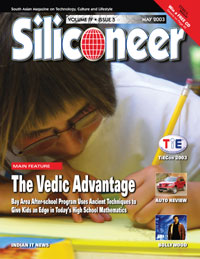
MAY 2003 |
IN THIS ISSUE
MAIN FEATURE The Vedic Advantage : After School Program A Siliconeer Report NETWORKING Survival Skills : TiECon2003 By Zitin Bazaz Dhawan READING The Other Bestseller List : Bookfinder.com Report By Anirvan Chatterjee Publisher’s Note • Infotech India Community News in Brief: Kid Tycoons... Spotlite on India... InMedya Award... SARS Response... Principal Hall of Fame Auto: 2003 Mitsubishi Outlander XLS Bollywood • Tamil Cinema Recipe: Dum Aloo Palak • Horoscope |
|||||||||||
|
Publisher's Note:
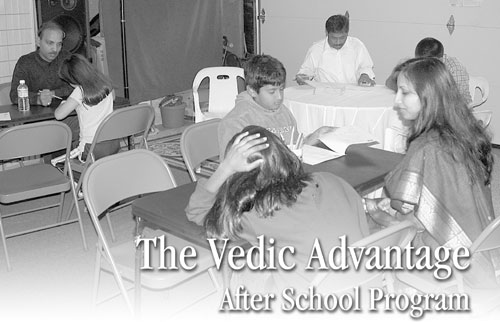
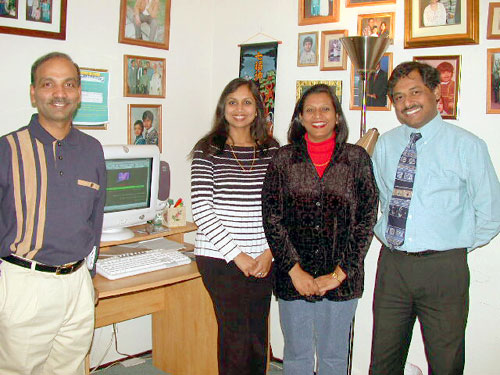
Every Indian knows about the glory of ancient Indian mathematics. But the world has moved on, we are wont to think, and notwithstanding India’s great contemporary visibility in information technology and IT-related services, there isn’t perhaps an Indian role in high school pedagogy. Well, that’s not at all true, say a group of young techies in the Bay Area, and they are determined to make their case. In a garage in Santa Clara, Calif., they have started an after-school program called Mathevedics, which applies the ancient mathematical wisdom of the Vedas to improve the high school mathematical skills of today’s students. The hope of the Mathevedics team is that in time their program will catch on and they will then franchise this after school program. This month, Siliconeer takes a look at their work. Away from the marketing hype of predatory publishing houses and the profusion of loudmouth celebrity bestsellers, the Internet company Bookfinder.com has come up with a list that seems more substantive. Anirvan Chatterjee, the youthful bibliophile and the company’s CEO, writes about the new list that tracks the most popular out-of-print books that readers are searching. No marketing hype here, thank goodness. Main Feature So we know India has a distinguished history in mathematics. But that’s all ancient history. Or is it? A bunch of Bay Area Indian Americans think otherwise, and they have solid proof to back their claim. Founders of Mathevedics (www.mathevedics.com), an after-school program to improve high school mathematics skills, say there are many ancient techniques that can dramatically improve both the skill and speed of doing math. Already avid parents are sending kids to the Santa Clara, Calif. garage where classes have begun, and the initial feedback is quite impressive. Here’s an example of a Vedic technique. Suppose you are asked to multiply 45 by 45. Using common mathematical knowledge you would take a couple of minutes, right? Applying a Vedic sutra, relevant for 2-digit problems, however, the computation can be performed in a fraction of the time. Step1: Multiply the last digits of the multiplicand (5) and multiplier (5). The product 5x5=25 forms the right-most digits of the answer. Step 2: Next multiply left hand digit of the multiplicand (4) with the left hand digit of the multiplicand incremented by 1 i.e. (4+1=5). Hence 4x5=20 forms the left hand most portion of the answer. Placing the solutions obtained from step 1 and step 2 yields a final answer of 2025. Now how long did that take? “This is one example, and only a glimpse of how Mathevedics can change how math is taught,” says the Evergreen Times, a local U.S. newspaper. “The U.S. has borrowed a number of ideas from India over the last half century,” the newspaper adds admiringly. “If someday we look back at the beginning of this millennium as the era of educational changes, a small Santa Clara County company called Mathevedics could be credited with leading the movement.” The Mathevedics Web site explains: “Our method is a combination of the succinctness ancient Vedic mathematical methods taught through Vedic sutras and the structure of modern mathematics curricula. “A big part of our method is learning the recognition of patterns — numbers , letters or pictures. Once the student has learnt efficiently how to find symmetry and pattern of numbers or objects, learning mathematics becomes fun and simple! “Our curriculum includes all mathematical manipulation taught in the school including arithmetic, algebra, trigonometry, geometry and elements of calculus. “Most importantly our method of teaching and curriculum helps the students not only inside the class room or traditional academics, but it also enhances the IQ by enhancing the analytical skills and thought processes.” The first class started March 15. Interested parents are inquiring, and registration for the first session was closed within few days, the Mathevedics team says. “First-generation Indian immigrants are generally aware of Vedic mathematics and are familiar its advantages,” says the Web site. “Mathevedics, however, is not only and exactly Vedic mathematics. Our uniqueness is in the application of Vedic mathematics to the school curriculum. Add to it the individual attention and you have a recipe for improved grade in the school.” Mathevedics founders add that students with exposure to other systems like Kumon find the Vedic system much more fun. “It is very satisfying to see young children’s eyes brighten when they see and learn our techniques,” says the Web site. Miguel, a 3rd grader at a Catholic school, was able to apply the Mathevedic technique on the very first day of his school. Alberto Rocha, a 10th grader learnt the Mathevedics technique of multiplying two-digit numbers and was able to solve 80 problems in less than 20 minutes on the very first day, the Mathematics team says. “The Mathevedics team was awed at Alberto’s performance,” says the Web site. “Alberto was awed too.” Considerable amount of work went into preparing the lessons, according to Mathevedics founders. Vedic mathematics isn’t exactly everybody’s bedtime reading. It can be quite abstract, even abstruse. The shlokas are not always detailed, and sometimes the examples are inscrutable. The Mathevedics team brought books on Vedic mathematics from India, and then went very thoroughly through the high school curriculum of the U.S. Then they looked at the relevant Vedic mathematic techniques, and when applying them to the U.S. math curriculum, asked themselves a simple question: How would a high school teacher teach this stuff? The answer was simple enough: He or she would have to teach the students step by step. So the team developed in-between steps which are missing in the relevant Vedic sutras, and developed over a thousand exercises. When a student comes to a Mathevedics class he or she takes an entrance test. It covers three levels: level 0, level 1 and 2. Based on the aptitude, the student is placed in one of these levels. Suppose the student has been placed on level 1. On the first day he/ she will get a level 1 lesson. The team spends about 15 minutes with the student who is given one concept. Once the student has grabbed the concept, he/ she gets exercises between 50-80 exercises and 45 minutes. Yes, you read that right, and Mathevedics developers say the technique is so sound that students take it in stride. Students fly through the concepts of mathematics, they say. Mathevedics organizers say if Kumon can teach school kids math, there is no reason why they cannot do it, because they have more interesting things in India instead of repeating things like Kumon does. Vedic Mathematics is something that once people come to know about it, they will really love it, they say. “Mathevedics applies ancient methods to all disciplines of modern mathematics curriculum — arithmetic, algebra, geometry, trigonometry and calculus,” the Evergreen Times reported. “The curriculum is designed to help the students learn to apply these tools to their current school curriculum. Another important aspect of this method is learning to recognize patterns of numbers or letters. “Different methods can be applied to solve problems involving numbers or letters with different patterns. This helps the students develop something that goes far beyond mathematics or sciences, enhancing the IQ by enhancing the analytical skills and thought processes.” “We realize that students need to be good in their respective school curricula,” Santosh Kumar told the Evergreen Times. “Therefore we have designed our curriculum that enables our students to stay motivated. Mathevedics students become more successful in their respective grades, because essentially they learn how to apply specific tool to their school curricula. Infotech India SAI specializes in Intelligent Transportation Systems – a field that utilizes advanced technologies in computer and communication systems to decrease congestion, delay and to improve mobility, air quality and safety on our nation’s three million miles of freeway and arterial streets. The project is a joint effort between SAI, Caltrans and the University of California at Berkeley. Venu Sarakki, president of SAI, is originally from Bangalore who was educated at BMS College of Engineering and Indian Institute of Technology, Madras. The project involves completely automating 37.5-mile segment of freeway with one exclusive truck lane in each direction. A platoon of three trucks will use adaptive cruise control and lane tracking algorithms to travel up to speeds of 75 miles per hour with only five feet distance (spatial headway) between each truck. Drivers can take their hands off the steering wheel and legs off the gas/brake pedals and read a newspaper or sip coffee along the entire segment of the freeway. The project initial feasibility and concept design is expected to be completed by December of 2003. Emagia delivers Enterprise Cash Flow Management Solutions that help manage cash inflow and outflow performance efficiently, to optimize working capital. The company has created an entirely new kind of financial platform Collaborative Finance to help companies achieve better fiscal performance in the new world of Internet business. Emagia has an office in Hyderabad with a current workforce of thirty-five people. The corporation has clients in Coca-Cola, Network Associates and others. Sigma Partners, with more than $1 billion under management, has previously invested in companies such as Cascade, Vignette and Storage Networks. The company also signed an MoU with Microsoft Malaysia to create IT outsourcing capability to meet the “growing demands in the region.” The partnership is likely to train over 200 IT professionals in two years. Managing director of the Indian IT giant Satyam, B. Rama Raju, said Malaysia was an attractive location because of its world-class infrastructure, strategic location in the region and proximity to India. Indian High Commissioner Veena Sikri said the increasing presence of Indian IT companies in Malaysia would further strengthen ties between the two countries. She also complimented the Malaysian government in dealing with the incident last month, when police detained Indian IT professionals despite having valid documents, in Kuala Lumpur. Inaugurating the center, Malaysian Minister of Energy, Communication and Multimedia, Amar Leo Moggie sought to bury the incident and said Malaysia continues to welcome “knowledge workers.” The formation of such a key directorate is under discussion in the ongoing weeklong Army Commanders Conference which is going to lead to the formation of the Army’s first such directorate at its headquarters here. The directorate, official sources said, would seek information flow as a force multiplier, as witnessed during the Kargil crisis. Besides formation of such a directorate, the Army commanders are also framing an operational mandate for the Rashtriya Rifles, the Army’s counter insurgency arm in Jammu and Kashmir, which would then be placed before the Cabinet Committee on Security for approval. The absence of such a mandate, sources said, was often leading to friction between various security force units engaged in operations against militants in the border state. It has also become essential as Rashtriya Rifles, from a fledgling force of a few battalions in the early nineties, has now become almost 64-battalion strong. The award is presented annually to Sun Microsystems’ top marketing alliance partners in each time zone, an Infosys release said. Infosys Technologies won the award for South Asia in recognition of its innovation in jointly creating a global retail banking reference architecture, excellence in sales and commitment to Sun’s technologies, it said. The award was presented to Infosys by Stuart Wells, senior vice-president, market development organization, the release added. Wipro said it expects the transaction, subject to adjustments, to be completed in the quarter ending June 2003. NerveWire Inc, which is serving financial services clients, has a team of over 90 domain experts and IT consultants primarily in the U.S. It addresses clients in the security services, private client, trading/investment management, banking, insurance and hi-tech industries. According to a Wipro statement, NerveWire brings to Wipro more than 40 client relationships with over 20 active engagements. Commenting on the acquisition, Wipro Technologies president Girish Paranjpe said the team of 90-plus consultants from NerveWire brings in deep domain knowledge and strong customer relationships. “We believe this acquisition will be a strong catalyst for growth by creating better customer value.” Communications Minister Arun Shourie said during question hour that BSNL’s feat was remarkable in view of the fact that Bharti, which is the biggest cellular company in the private sector, has a total of 3 million subscribers. He admitted there had been shortcomings at times in the cellular service offered by the BSNL as the demand was large, especially for the post-paid services which was against market trend. Even as Prakash Paranjapey alleged that contractors of Reliance mobile were obstructing the services of BSNL by cutting wires and wanted stern action in this regard, the minister could not respond as Speaker Manohar Joshi had proceeded to the next question. In reply to the main question by Subodh Mohite on the problems faced by Garuda mobile service of MTNL, the minister said Rs. 340 million of the total Rs. 900 million to be given to Fujitsu, which had supplied the handsets for the service, had been withheld as also Rs. 90 million of performance guarantee. In a written reply, however, Mookherjee said the National Task Force Team set up to study a proposal for an unmanned orbiting spacecraft mission to the moon has submitted its report. The proposal is to send an unmanned spacecraft to orbit the moon at the height of 100 km, he said, adding that the spacecraft would be launched using India’s own launch vehicle. The mission is planned for the scientific objective of high-resolution remote sensing of the lunar surface in visible, near-infrared, low-energy X-ray and high-energy X-ray spectra, Mookherjee said. To another question about the achievements of the Indian Space Research Organization, he said they include launch and operationalization of INSAT-3C satellite in January 2002, augmenting the communication, broadcasting and information infrastructure of the country and testing of the indigenously-developed cryogenic engine for the full-flight duration. Replying to questions, he said MLAs, who are now undergoing a computer training program, could continue it from their native places as SSI, which is providing the course, has branches all over Tamil Nadu. During the debate, CPI member V. Sivapunniyam said lessons in computer training program for legislators began with instructors teaching them to enter the word amma, a respectful word used by AIADMK members to refer to Chief Minister Jayalalithaa. He was immediately countered by Jayakumar as to what was wrong with that. He quoted a song from an MGR movie that said without mother nobody could shine on earth. Generally, initiation to Tamil alphabet also starts with the word amma (mother) for the first letter “a.” However, cutting across party lines, MLAs welcomed the training program, saying it was useful to them. Sivapunniyam said MLAs were now well versed to paint their party symbols on computer. “We must develop these capabilities ourselves and we must also develop shields and firewalls in this regard,” Communications and Information Technology Minister Arun Shourie said, winding up a debate on the working of his ministries in the Rajya Sabha. The government, he said, has set up a Working Group on Cyber Law and Cyber Forensics, another on Encryption Policy, besides those on Critical Infrastructure Protection, Cyber Security Assurance and Cyber Security Education and Awareness. In his 50-minute reply, Shourie referred to the other side of IT as pointed out by former Army Chief Gen. Shanker Roy Chowdhury, who observed that during the Gulf and Iraq wars not just individual weapons but the entire system depended on communication technology and IT. Asserting that key technologies could not be sourced from outside, he cited an example of an Internet provider giving services at a mere Rs. 5 per hour. Intelligence agencies found that the company was linked to a Mauritian firm which was a subsidiary of a Hong Kong company with connections to the People’s Liberation Army of China and the Chinese intelligence, he said.
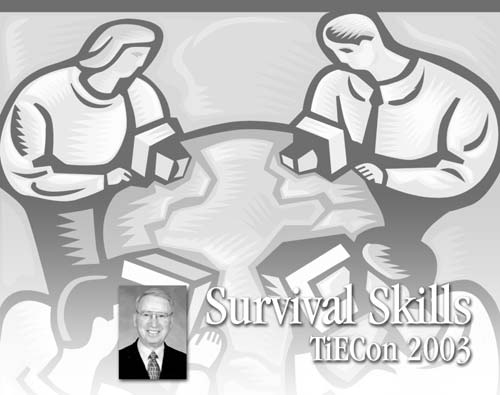
The explosive growth in the last decade in Silicon Valley brings to mind Fed chief Alan Greenspan’s famous remark of “irrational exuberance.” It all came crashing town with an ultimate correction of the market in technology — be it the ubiquitous Internet, the telecom sector or bio-tech. While other cities around the world scramble to replicate the Valley’s technology proliferation, the Silicon Valley itself is shrinking. What do the creators of the Silicon Valley phenomenon think of this retrenchment? Where do the plan to take our Valley from here? Veterans of several economic cycles in the Valley will gather May 16-17 at TiECon 2003 to give their views, engage in debate and exchange war stories, and here is a summary of what they will talk about. The event will be headlined by Irwin Mark Jacobs (above, inset) , co-founder, chairman and CEO of Qualcomm. Thought leaders share insights and enter into lively debates on the state of this upcoming industry. High-level executives that make purchase decisions for wireless products share their focus and their spending priorities in the field of mobile wireless with some of the industry leaders among wireless vendors today. A dynamic panel comprising wireless vendors, carriers and client companies chalk out the lay of the land across the value chain by addressing issues like: What are the most critical challenges facing mobile wireless carriers? Is anyone really buying wireless products and services? If so, where do their dollars go? Which customer needs are paramount for the next 2-3 years? Moore’s law – the raison d’etre of Silicon Valley -predicts a billion transistors on a single chip in the next generation, enabling a host of breakthrough applications. Experts at the session debate the very real concerns of whether we are reaching the limits of materials used and whether this will seriously hamper industry growth in the near term. IDC predicts that the market for security hardware, software and services will hit $ 45 billion by 2006. Today, however, companies struggle to handle the existing volume of alerts, measure the efficacy and hence ROI of security investments and make customer guarantees based on vendor software performance. This session explores what problems clients are seeking to solve and why VC’s consider this a hot area of investment. STORAGE There will also be sessions on enterprise software, software infrastructure and tools, digital media, life sciences and nanotechnology. Zitin Bazaz Dhawan is director of business |TOP| READING The other book trade continues quietly in thousands of used bookstores across the country. Readers are searching for out-of-print books years, sometimes decades, after the desired titles were last mentioned in a print review or featured at an author signing. In this obscurity, almost entirely ignored by the media and absent from the public consciousness, the out-of-print book business has developed, thrived, stratified. This activity goes on under the radar, out of the spotlight. We’re changing that. The BookFinder.com Report is a different kind of bestseller list: it’s a measure of the most sought after out-of-print titles in America. We’ve been online since 1997, enabling individuals, libraries, and book dealers to track down and purchase books, new or used, in- or out-of-print, rare or readily available. Volume 1 of the BookFinder.com Report is based on our analysis of aggregate trends for out-of-print book searches between July and December of 2002.
Biography
Children's
Crafts and Hobbies
Fiction and Literature
History
Mysteries and Thrillers
Poetry
Popular Science & Technology
Science Fiction, Fantasy & Horror
Anirvan Chatterjee is CEO of BookFinder.com, |TOP|
Community News in Brief:
Kid Tycoons... Spotlite on India... InMedya Award... SARS Response... Principal Hall of Fame Kid Tycoons A new concept in Refrigerating, Another India Community Center, Talking Navigational Disposable Map, Cloning Company, Car Boosters — all sound like new released titles of books or projects at a Science Symposium? Well, think again. These are the names of the businesses that the young entrepreneurs of the Silicon Valley envision themselves starting. The event, spread over three days (April 19, 20, 27) and jointly sponsored by ICC and TiE (The Indus Entrepreneurs), brought the Silicon Valley kids together at the India Community Center (ICC), Milpitas. Said Raj Desai, TiE executive director, “The reason we chose ICC as the venue is because this organization represents our community and specially with the kids of the Bay Area. We wanted to ensure that all kids participate in this unique event.” The event let the kids and the youth in the age group of 6-18 express their thoughts on the meaning of entrepreneurship through art. The kids were asked to create a picture and write a few lines on “If someone gave you a million dollars to start a company, what would you do?” The innovative ideas of the young entrepreneurs ranged from creating a new line of Space Age Furniture to starting a Save the Tiger project or creating a new world with The Subconscious Touch by Anshul or creating research papers in an Animal Research Center by Tara. The event attracted over 100 kids and youths. Glimpses:
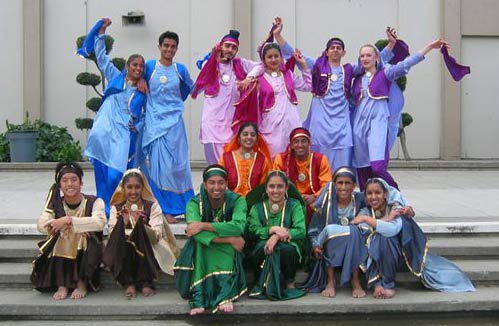
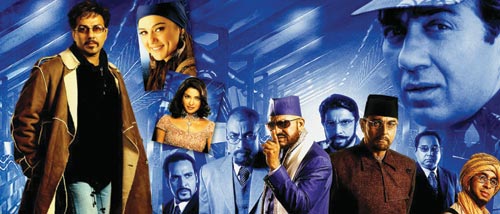
Readers can find more information about TiE at www.tie.org. The ICC Web site is www.indiaCC.org. |Back to Community News| |TOP| Spotlite on India The event opened with A.R. Rahman’s rendition of “Vande Mataram.” Groups like “Desi Divas,” “Mast,” “Paanch Pariyan,” “Taarein” and “Jalwa” presented performances to Bollywood hits. Classical performances of bharatanatyam and kuchipudi as well as tabla, folk dances like daandiya raas and bhangra added to the diversity of performances. A welcome cross-cultural ambiance was evident with names like Dene Chen, Cameron Ketchum, Katya Orlova and Alvin Hsing popping up among the performers, and the presence of many members of the school faculty strengthened the mood of cross-cultural understanding. As the Indian and American national anthems ended the evening on the appropriate note, organizers Meera Patel and Priya Sridhar and their associates deserve credit for putting together a show of impressive elan which is generally seen only in shows presented by college student associations. Thanks also to school faculty member Mr. Joshi, whose support made the event possible. As a parent, it’s great to see our children develop a cultural identity deeply influenced by the rich heritage of India. — Chanchal Sahai |Back to Community News| |TOP| Award for Inmedya This was announced in Lexington, Ky., where Media Corp. Inc. announced the Omni Intermedia 2003 Awards that recognize outstanding production, design and content in the converging fields of television, film, video, internet, interactive media and 3D animation. The Omni awards committee honored inMedya’s entry for quality and content which achieved the highest standards of excellence. Omni Intermedia Awards have been presented to many different companies, including Dreamworks SKG, Discovery Channel, Animal Planet, Learning Channel, Arthur Andersen, Eastman Kodak, Ford, TV, VH1, Telemundo, Warner Brothers, WFAA-TV, CNN, Phillips Design Group, PBS, U.S. Army, Canon USA, Drury Design Group and the National Gallery of Art. Generally dominated by media giants like Disney and Pixar, an award for a small company like inMedya is testimony to the strides the South Asian community has taken in terms of credibility, creativity and acceptability, the press release pointed out. Response to SARS • Prior to departure, Singapore Airlines’ airport staff actively monitors the physical condition of all passengers and will question any passenger exhibiting flu-like symptoms. • All aircraft are equipped with HEPA (High Efficiency Particulate Arrestor) filters, which effectively remove most viruses, bacteria and particulate matter from cabin air. The aircraft air quality management system replaces all aircraft cabin air approximately once every three minutes, as opposed to twice an hour in a typical office building. • The airline’s cabin crew has been trained to take appropriate measures to care for and isolate any suspected SARS case onboard the aircraft to minimize the risk of exposure to other passengers. • The airline has also enhanced the disinfection procedures for its aircraft on routes involving locations where SARS has been identified as a concern — using a disinfectant designed specifically for aircraft, which meets guidelines recommended by the WHO. For updates and more information, readers can visit the Singapore Airlines Web site at www.singaporeair.com/usa or the WHO Web site at www.who.int/csr/sars/en/. Principal Hall of Fame Thornton earned his induction into the Management Hall of Fame for his consistent excellence as a leading agency managing director. He is noted for building the size and sales growth of the Business Center, attracting and retaining productive associates and effectively managing Business Center goals. He is just one of eight managers in the history of The Principal to receive this distinction. The Principal Financial Group offers businesses, individuals and institutional clients a wide range of financial products and services, including retirement and investment services, life and health insurance and mortgage banking through its financial services companies. The Fortune 500 firm has $111.1 billion in assets under management and serves 13 million customers worldwide from offices in Asia, Australia, Europe, Latin America and the United States. Auto Review: What makes the automobile such a fascinating product to pursue, both philosophically and crassly commercially, is the broad brush the industry uses to paint its message in the marketplace. Each marque, each model has its target consumer group and individual mindset to aim for. Mitsubishi, practically across the board, has put the “cool generation” in its crosshairs as best demonstrated by its quick-cut, hip music TV commercials. Visually, the 2003 Mitsubishi Outlander 5-door AWD is certainly cool and hip. Designers have achieved a long, low look to a genre that has been, for the most part, bulky and boxy. The front-end fascia is bold and aggressive with a large airscoop imbedded in the bumper. This attitude continues with 225/60 R16 mud and snow tires mounted on handsome 16-inch alloy wheels. A sturdy air rack is standard as is the integrated front bumper fog lights. Another plus is the lustrous Lofty Green Pearl paint job; Lofty Green looks more like pearlescent British Racing Green. Befitting the XLS’ position as the top of the line badge, the interior bespeaks the hip intention with a long list of optional people stuff like the Sun & Sound Package ($1500) with 210 watt, 6 speaker system and power sunroof and the Luxury Package ($1,450) including leather seating, front seat heaters, auto-dimming rearview mirror, compass an temperature display, heated side mirrors and front side airbags. It may seem a small thing, but having a manual emergency brake is a most important element of an SUV. Even though only about 6 percent of SUV owners actually take their vehicle in true off-road adventures, many do get into snow and mud conditions where the manually operated hand brake can be a big help in traction emergencies. This sense of security is enhanced by the big, serious tires and full-time all-wheel-drive. Mitsubishi has managed to sensibly marry a snappy in-line 4-cylinder engine with high fuel figures. The 16 valve, SOHC, MPI powerplant is “torque-rich” at 140 horsepower and 157 lb.-ft. of torque. The torque begins its’ peak curve at a low 2500 rpm and that makes the Outlander a snappy performer, unexpected in a “big-bore,” 2.5-liter powerplant. With no manual transmission available, the joys of being boss at the wheel is covered with Mitsubishi’s Sportronic automatic/manual transmission. Much of what Mitsubishi calls a “car-like” handling perception is due to its 4-wheel suspension and unibody construction based on the Lancer platform. This gives the Outlander a rigid feel at speed or on rough roads with quick steering responses and palpable road sensitivity. All in all, the 2003 Mitsubishi Outlander XLS is a competitive addition to the ever-growing segment of mid-size sport utility genre. Both the handling and the interior features of the genus are becoming more sedan-like and, with the also ever-growing questionable prices at the pump, a lot more easy on the pocketbook. Al Auger, our automotive editor has been writing about cars for over 30 years. Guftugu Director Prem Soni says the film will be in Hindi and Spanish, no less, the Bengali belle will play a woman who runs a coffee shop in Spain.” For those of you who are scratching their heads and looking in vain around the world for any sign that Spanish speakers have said bienvenida to Bollywood, Soni replies that that’s not what his film is targeting anyway. Coffee, you see, will have both Spanish and Indian film stars, and will be shot in both Spain and India because Soni wants to make a mark in Spain as a filmmaker, where he lives. His track record is a bit thin with just a few television serials under his belt, so we wish him and Mahima a sincere buena suerte. Which, Soni will tell you, is Spanish for “Good luck.” Scorned Nandita Nandita was selected to play the central role in Chokher Bali, award-winning filmmaker Rituparno Ghosh’s adaptation of Rabindranath Tagore’s novel. But before she could say dhonnobad (Bengali for thanks) guess what? She realizes the rug’s been pulled from under her by Rituparno who has roped in Aishwarya Rai. Of course, Nandita is maha-miffed at it all. Well Nandita, don’t fret too much. Maybe you can take heart from the fact that what goes around comes around. Did you know that Aishwarya has been dropped by Sanjay Leela Bhansali’s Bajirao Mastani? It’s the same story: Bhansali had signed her for the film, but with Salman Khan around, things looked sticky for Aish, and in comes Kareena Kapoor to take her place. Maybe we should paraphrase Shakespeare: Frailty, they name is Bollywood! Bad Boy, Lover Then comes a huge fight with upcoming macho star Vivek Oberoi. The tamasha of a press conference that follows with Vivek Oberoi spouting file is a yellow journalist’s wet dream. Now all this would have made you think that the fairer sex would make a rush to the opposite direction at the sight of Salman Khan, wouldn’t it? Well, think again. Hot model Katrina Kaif begs to differ. If Bollywood busybodies are to be believed, Sallu and Katrina are one hot item these days. The two were spotted romancing on a holiday together, proving anew, if proof were needed, that either Salman has that dangerous edge about his character that makes women weak on their knees, or there’s no accounting for taste. Bollywood crones have an even more cynical take. Katrina, an aspiring actress, is one ambitious woman, it is being said, and she will not stop at anything to go to the top. Now easy does it, Katrina. Make sure you don’t rub Salman the wrong way, because the consequences can be bruising. Literally. Just ask Aish. For once though, Salman was breezy and debonair when asked about his relationship with Katrina. As he hopped off a flight after coming back from the U.S., this is what he had to say about it all: “She is a close friend and we are very fond of each other.” Yeah, tell us something we don’t know. Stork Visits This is the first child for the couple, and it will be a welcome relief for them, considering the fact that Kajol has had a miscarriage before. Her film career hasn’t been exactly great either after their marriage, and their film together, Raju Chacha, has been a disaster. With the little girl lighting up their lives, the two can take a much-needed break from the worries of Bollywood. Hello, Shakespeare Only instead of being called Macbeth, it will be called Mian Maqbool. The man behind the film is Vishal Bharadwaj. And the key role of the power hungry Lady Macbeth will be played by our very talented Tabu, so all things going well, the film should be a treat. Tabu may not always have the box office ringing, nor may she have the sex appeal of the sexier set, but her talent is unmistakable, and it appears serious filmmakers are beginning to notice. She has just finished Abar Aranye a Goutam Ghose remake of Satyajit Ray’s Aranyer Din Ratri. The film is ready for release, as is Meenaxi—A Tale of Three Cities. That film is made by the lovable, star-struck painter M.F. Husain. As for Mian Maqbool, Tabu has just returned to Mumbai after a month’s shooting with Naseeruddin Shah, Om Puri, Irfan Khan and Pankaj Kapoor. She hasn’t read Macbeth, and she doesn’t plan to start now. “I don’t want to be influenced or confused by the original version,” she adds slyly. Hot Radio Radio Mirchi already broadcasts in Mumbai, Pune, Ahmedabad and Indore. All stations are on 98.3 Fm, and it’s the most popular radio station in these cities. Kolkata and Chennai soon get to bit into the mirchi, we are told. We mean the radio station, not Kareena, so don’t get any ideas. Devdas Rules Saroj Khan (choreography), Binod Pradhan (cinematography), Bela Saigal (editing), Ismail Darbar (music) and Sanjay Leela Bhansali (screenplay) also got awards for the same film. Malayalam film Sesham won the silver medal and Jagmohan Mundra’s Bawandar won the bronze medal. T.K. Rajiv Kumar got the silver medal for best direction for Sesham while Bharati Raja got the bronze medal for best direction for the Tamil film Kadal Pookal. Puga Zendhi received best debut direction award for Tamil film Kaatrukkella. The best male artist award went to Jayaram for his portrayal in Sesham, while Vivek Oberoi was honored with best debut male artist for his role in Hindi film Company. Gauri Karnik received the best female debut artist award for her performance in Sur — The Melody of Life. The Shantaram awards were set up in 1993 to honor veteran filmmaker V. Shantaram. Former Maharashtra Chief Minister Deshmukh, Deputy Chief Minister Chhagan Bhujbal and film personalities including Vijay Anand, Jitendra, Ramesh Sippy, Ashutosh Gowarikar, Khaiyyam, Preity Zinta and Pooja Batra handed out the awards.. Can Chi Chi Add? What’s more, they seem to be able to convince producers that they still retain their magic touch, despite scant signs of it in recent times. Take producer Sajid Nadiadwala, who has just signed up the two for another film. It really is carrying optimism a bit too far. What exactly are Sajid Nadiadwala, Govinda and David expecting? That they will be all laughing to the bank? To do that, they will first have to make the audience laugh. And Govinda and David’s recent track record doesn’t inspire a lot of confidence. The last time we looked at the box office, Ek Aur Ek hardly added up to Gyarah. It was more like shunya or zero. Will next time be any better? Lucky, Lucky Fans Of course, discerning viewers know the multi-talented Ali is no mean actor either. His cameo role in Kaante was an impressive performance where he held his own quite well in the huge star cast, and although Sur did not do awfully well, his soulful, wrenching performance drew wide praise. A lot of that soul also goes into his singing, and the fact that Lucky has decided to take a break from acting in Bollywood will be great news for his music fans. Hindi Film Review So what’s new? Get real, this is Bollywood. Masala movie fans will doubtless retort: Since when has a Hindi film adhered to an exacting standard of logic? Or flexible standards, come to that. The film begins with Major Arun Kumar (Sunny Deol) sitting on a plane in a deep funk about his lost love Reshma (Preity Zinta.) Arun has nabbed terrorists and rescued of hundreds of innocents in Toronto, Canada, but this has come at a price. He has narrowly escaped death, and has had to sacrifice Reshma, a Kashmiri Hindu girl brought up by Muslims who is the love of his life. A spy and master of disguises, he is pitting wits against ISI chief Isaq (Amrish Puri). It all starts in Kashmir, where Arun, masquerading as Major Batra, meets Reshma, and trains her to go on a vital spying mission. (They also fall in love in the process, but this being a Hindi movie, that’s a redundant statement.) Reshma completes the mission, but a furious Isaq bombs the engagement party of Reshma and Arun, and both end up thinking the other is dead. For professional reasons, Arun allows news of his “death” to be widely believed so he can track down Isaq. It turns out Isaq is in Canada trying to build a nuclear bomb with the help of Zakaria (Kabir Bedi), an expat ISI sympathizer with deep pockets. Now Zakaria’s daughter Shaheen (Priyanka Chopra) happens to be treating Reshma. Talk about coincidence. Well, the movie will have you believe that Reshma’s body was carried in a stream to the Pakistani side where she happened to be rescued by Salman/ Solomon (more about this later) who happens to have contacts in Canada and so ends up sending Reshma to be treated by Shaheen who happens to be the daughter of a the biggest crony of Arun’s arch rival Isaq—you get the picture. Well, matters come to a head in more ways than one. For the greater good, Arun disguises himself as an Indonesian (odd choice, that) who is a Pakistani sympathizer and decides to romance Shaheen. Reshma is baffled by what’s going on, but Arun explains what he is trying to do, and though it breaks her heart, she accepts it. So we have a scene designed to break our hearts: Arun and Shaheen are getting married, and Reshma performs a song to congratulate the happy couple. Which is all very touching, only you can’t help but wonder whether Isaq is blind: the ace Pak spy fails to recognize Reshma with whom he had a violent altercation before. All of this leads to a climactic finale—I won’t give away the ending—and the audience will likely go home feeling they got paisa vasool entertainment. Those of a more cerebral bent may ponder a few questions: How can Arun cross the border and save Reshma without army back-up? How come later on the action is in Jungfrau, Isaq mentions Europe, and Arun is honored in Canada? Why is Reshma’s Pakistani savior called Salman once and Solomon at another time? This spy thriller borrows in equal measure from Rambo and James Bond thrillers, and director Anil Sharma could say what the heck, do Rambo or Bond movies make a lot of sense? Touche. Fastidious viewers—admittedly rarer than hen’s teeth among Hindu movie buffs—will be uncomfortable with the vitriolic Paki-bashing, but to the filmmaker’s credit, the movie makes distinctions between Pakistani people and the government, and fundamentalist extremists and ordinary Muslims. For all its flaws, it is a competently made film with a taut script, good performances and excellent production values. As Bollywood films go, not bad at all. Rating: *** (Good) |Return to Bollywood Index| |TOP| Tamil Film Review: Sujith’s film seems similarly hypocritical. The film is supposed to convey the message that violence does not pay—but the film is simply awash in blood and gore. Clearly, he thinks violence doesn’t pay for crooks, but the faux version on screen can do so handsomely for him. The film’s eponymous character Sena takes to violence at a young age, and the tied rationale is filial affection. He wants his younger brother Vikram, the apple of his eye to have the very best in life. After local don Masthan Bhai takes Sena under his wings, Sena proves to be a loyal and effective foot soldier for crime and soon rises to be Bhai’s favorite henchman. Meanwhile, after returning from abroad, Vikram is all set to marry his sweetheart Charu. Charu’s brother is Sathya, a close family friend and a police officer. Sathya, aware of Sena’s underworld links, advises him to leave Bhai, but Sena refuses to listen. However, Bhai gets to hear about this, and is furious at Sathya’s interference. Unknown to Sena, Bhai has Sathya killed. Sena realizes what Bhai is up to, and joins hands with Naga, a rival of Bhai, to destroy Bhai’s empire. In the bloodshed that follows Sena achieves his aim. But many lives are lost, and Sena realizes that violence doesn’t pay. The role that gives Sathyaraj ample scope to re-establish his credentials, and he has made good use of the opportunity. While Anandraj makes a convincing Masthan Bhai, Chandrasekhar as Naga cuts a sorry figure. Aravind and Raksha play Vikram and Charu without fuss, though a little more expressive acting on Aravind’s part would give his acting much-needed vitality. Blood and gore abound in the script. It’s ironic that in order to convey his message that violence doesn’t pay, the director uses extreme forms of violence on the screen. — Malini Mannath |TOP| Recipe:
Method Boil spinach and grind with half a cup of water till it becomes a smooth liquid. Heat margarine in a pan add green and red onions, remainder of the diced tomatoes and green chili and deep fry till the onions are brown. Add salt to taste. Add the masala paste. Add the liquefied spinach. Pierce the potatoes with a fork to allow the flavor to reach inside the potatoes. Add potatoes to the spinach in the pan. Stir on low flame to cook for about ten to fifteen minutes. Cover the pan with a lid so the boiling spinach does not spill. Stir occasionally to prevent the spinach from sticking in the pan. Garnish with chopped coriander leaves. Serve hot with chapati or crispy rotis. – Seema Gupta is a homemaker |TOP| May-June Horoscope Bay Area-based astrologer Pandit Parashar can |TOP| |
||||||||||||
|
|
|
|
|
|
Advertise in Siliconeer | Home | Subscribe PRINT Issue | About Us (FAQs) | Contact | Locations | Staff Login | Site Map
© Copyright 2000-2013 Siliconeer • All Rights Reserved • For Comments and Questions: info (AT) siliconeer.com |
|