!-- Start Alexa Certify Javascript -->
|
|||||||||||||||||||||||||||
|
|||||||||||||||||||||||||||
|
|
|||||||||||||||||||||||||||
|
|||||||||||||||||||||||||||
|
|
|
|
|
|

NOVEMBER 2003 |
IN THIS ISSUE
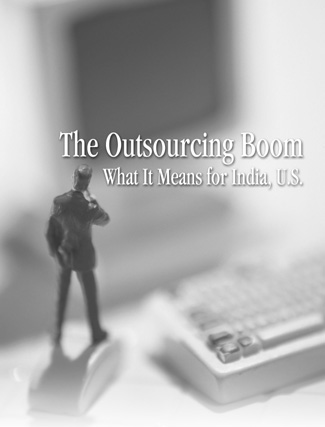
MAIN FEATURE The Outsourcing Boom : What It Means for India, U.S. By Ashok Deo Bardhan & Cynthia A. Kroll REPORT Indian Healthcare : Next Big Thing after IT? By Siddharth Srivastava OPINION Outsourcing Irony : Payback for the British Raj? By George Monbiot Publisher’s Note • Infotech India • Super Cheap Supercomputer NCM Awards & EXPO • White House Honor • Choosing a Trustee NeoCenter Opens • XOOM: New Money Transfer Service Finance: Securing Your Future • Diwali 2003 at Sunnyvale Auto Review: 2003 Pontiac Vibe • Bollywood • Tamil Cinema A Different Diwali • Recipe: Dhokla • Abhinaya Concert Sikh Community Center • Horoscope |
|||||
|
Publisher's Note
The big buzzword today is outsourc-ing, and India has become one of the key beneficiaries. What started with information technology has spread into a wide range of fields—from call centers to accounting to medical transcription to state-of-the-art animation—as the West passes on services, India is looking at a possible exponential boom of opportunity and jobs. However, misgivings are already being voiced in the West that includes bitter criticism from the British trade unions, irate complaints from white collar IT professionals in the U.S. Could this pose a political challenge to the outsourcing bonanza? Ashok Deo Bardhan and Cynthia A. Kroll are economists at the University of California at Berkeley who have looked at the phenomenon and its possible ripple effect. They dwell on this issue in their forthcoming book, “Globalization and a High Tech Economy,” co-authored with Dwight Jaffee of the UC Berkeley’s Fisher Center for Real Estate and Urban Economics. In our cover story, they present a detailed look at what outsourcing could mean for India and the U.S. MAIN FEATURE
It’s not rocket science. As newspaper reports and economic news highlight the layoffs of thousands of people in U.S. high-tech, software and service sector companies, practically simultaneously, seemingly coordinated establishment of offices and development centers, most often in India, are resulting in hiring of thousands of new employees in that country. Worried folks are putting two and two together. We tabulated reports in Indian newspapers and business journals for the month of July 2003 alone and found 25,000 to 30,000 new outsourcing related jobs announced by U.S. firms. In the same month, there were 2,087 mass layoff actions carried out by U.S. employers resulting in a loss of 226,435 jobs. The jobs being created in India and elsewhere are in a wide range of services sectors, such as geographic information systems services for insurance companies, stock market research for financial firms, medical transcription services, legal online database research, and data analysis for consulting firms, in addition to customer service call centers, payroll and other back-office related activities. In addition to cost advantages similar to those offered by the manufacturing centers of East Asia, the ongoing outsourcing of business services jobs to India, Malaysia, Philippines and South Africa is also due to the widespread acceptance of English as a medium of education, business and communication in these countries; a common accounting and legal system (at least in some of the countries), the latter based on the common law structure of the Anglo Saxon world; general institutional compatibility and adaptability; the time-differential determined by geographical location leading to a 24/7 capability and overnight turnaround time; simpler logistics than in manufacturing, and a steady and copious supply of technically savvy graduates. India’s information technology enabled services (ITES) sector, the primary destination of business services outsourcing from Western countries, now directly employs over 200,000 people with around $2.3 billion in exports, of which over 70 percent are to the U.S. While the sector is still small, it is growing at a rate of 60 percent per annum. The software services sector overall has exports of approximately $9.5 billion, of which over $7 billion are to the U.S. India’s National Association of Software and Service Companies forecasts that exports would hit the $50 billion mark in the next five years. By that time, the business process/ business services outsourcing segment would employ over 2 million people, and the total exports of the IT industry would support over 8 million jobs. The growth of the IT sector in general and the BPO segment in particular is not confined to India. Firms involved with software services outsourcing and BPO are rapidly gaining ground in Philippines and Malaysia (call centers and other back-office BPO), China (embedded software, financial firm back-office BPO, some application development), Russia and Israel (high-end customized software and expert systems), and Ireland (packaged software and product development). Tentative evidence suggests that business process outsourcing and software outsourcing have together generated at the very least over a million jobs in the 1990s and hundreds of thousands more since the turn of the century. Between 1987 and 1997, the share of imports in inputs used in U.S. manufacturing increased from 10.5 percent to 16.2 percent and in high-tech manufacturing, such as computers and electronics, from 26 to 38 percent. This continues a long history of foreign outsourcing in U.S. manufacturing and the associated loss of blue-collar jobs in many industrial sectors. The motivation, on the part of U.S. firms, has been driven by the low costs of manufacturing abroad, primarily in the East Asian countries, such as Taiwan, China, South Korea, Malaysia and others, as well as the availability of skilled labor, the promotion of a business-friendly environment and the existence of production and supply networks in those countries. At the same time, the higher value-added, better paying jobs in management, finance, marketing, research and development have been retained in the home country. Most of the job loss is due to the technology downturn, the dot-com bubble, and the cyclical downturn in the U.S. economy. However, outsourcing that began as a response to very tight labor markets in the U.S. in 1999-2000 has continued, becoming a factor in the “jobless” or “job-loss” recovery of 2003. As in the last downturn in the early nineties, recession-based cost cutting by firms may end up as the permanent loss of jobs that remain abroad even during the subsequent recovery. The laid-off U.S. workers must then be absorbed either in new sub-sectors, brought about by innovation, or in other lesser-paying non-tradable services jobs. Vulnerability to outsourcing extends well beyond these sectors. The employment services sector, for example, lost over 300,000 jobs between June 2000 and January 2001 and over 150,000 between January 2001 and June 2003 (again a mix of recession-based losses and outsourcing). Links to outsourcing in this sector come through temporary employee agencies, which provided short-term employees to many of the industries. Outsourcing also has the potential to affect diverse segments of retail and wholesale trade, utilities and healthcare, to the extent that record keeping, accounting, sales, and information aspects of these sectors can be performed separately from other functions. The three major emerging market economies—China, India and Russia—have a sizeable higher education sector. While Russian expertise in many basic sciences and engineering subjects has been justly famous for decades, both the annual output and quality of science and engineering graduates from India and China have been increasing rapidly and are now comparable to the advanced countries. These countries face some constraints in exploiting this ongoing opportunity. India’s inability to provide education at the basic school level could stifle further growth in highly trained graduates. Russia faces growth constraints from a combination of institutional underdevelopment, erratic reforms and the gradual deterioration of the higher education system. The overpowering Chinese success in manufacturing may well be replicated later in the services sectors, but as yet business services outsourcing faces heavy language, institutional and cultural barriers. Rising wages and costs in these countries may spur secondary outsourcing to still less developed countries, but from the point of view of the U.S. labor markets that is no consolation. One possible scenario is that services job outsourcing proves more costly to the economy than the earlier round of manufacturing outsourcing. As centers of skilled high-tech professionals build up in other parts of the world, the U.S. and California may no longer dominate the next wave of innovations, and we would observe slower growth of high wage jobs within the U.S. and California. In this extreme situation, economic adjustment, in the absence of continuing innovation originating in the US, first might take the form of prolonged unemployment. Then, workers losing their jobs to outsourcing would finally be absorbed in lesser-paying services jobs. Alternatively, there could be a downward adjustment of salaries and wages, making the outsourced occupations internationally competitive again. As an alternative to this troubling scenario, a backlash against globalization could occur, both worldwide and within the U.S., slowing down the process of business services outsourcing. Opponents of globalization are already discussing protectionist measures and regulatory roadblocks in the form of restricting the kind of jobs that can be outsourced. If successful, this kind of protectionism, although inefficient from the point of view of the economy, may result in the retention of some of the outsourceable jobs. In the short run, this would moderate the negative impact on the real estate sector. A third possibility is that the industry shrinkage may come in part from domestic outsourcing. Instead of Bangalore or Beijing, jobs may move to Atlanta or Austin, thus avoiding a net loss of U.S. jobs. Finally, the most positive scenario is that the U.S. and California economies continue to fashion their outsourcing activities in light of the new production paradigm, keeping the “cream” of the new development at home, while the more routine activities are outsourced. Under this scenario, innovation would lead to a continuing stream of new service and manufacturing activities, and hence new jobs and occupations, while competition and the need for lower-cost supply would force more mature services operations overseas. Depending on their education and skills, individual workers might still find it difficult to find replacement employment at similar wages, but overall, the jobs lost to outsourcing would be replaced by higher wage jobs in the new sub-sectors brought about by innovation. But it is by no means clear that this will happen, so fasten your seatbelts for a bumpy ride. Further in formation on outsourcing trends in high-tech nonmanufacturing sectors and more generally on globalization and the high-tech economy is available in Bardhan and Kroll’s forthcoming book, “Globalization and a High Tech Economy,” co-authored with Dwight Jaffee of the Fisher Center for Real Estate and Urban Economics. - Ashok Deo Bardhan is senior research associate and |TOP| INFOTECH INDIA “We are expecting a 30 percent to 35 percent growth in exports over last year. The growth is above the national average and indications are it is on an upward swing,” Naidu told reporters here at the curtain raiser of Bangalore IT.COM 2003, to be held here between November 1 and 5. Attributing the growth to increased interest by foreign firms to leverage IT skills in India for improving their efficiency, he termed this as a “second IT wave”. Naidu said 44 of the 66 IT firms started since April this year were with foreign equity and had invested over Rs. 6.42 billion, a 44 percent jump over last year. “This year, we did not need to hard-sell Bangalore as earlier. Bangalore has become the chosen destination for global corporations who want to improve their efficiency from India,” he said. He said the software exports in the first six months this year were over Rs. 72 billion, a 65 percent growth over the same period last year. Bangalore, India’s Silicon Valley, has about 1,186 IT and BPO firms and employs 110,000 software professionals and 55,000 in the BPO sector, Naidu said. “We have taken an aggressive step towards branding our company to comprehensively differentiate ourselves in the marketplace,” Caritor global head of group strategy, marketing and products, Phani Nagarjuna, told reporters in Bangalore. “While our initial thrust in India was on offshore development, we are now looking at significantly increasing our marketing presence in India. To this end, we are investing in people and infrastructure,” he said. U.S.-based Caritor, which has five development centers in Chennai and Bangalore, plans to open one more in both the cities and add new sales offices in metro cities in addition to the existing offices in Mumbai and Delhi. “This will strengthen Caritor’s initiatives to target large Indian corporates in the healthcare, education and retail verticals,” Nagarjuna said. The company has among its Indian clients Metro Cash and Carry, EID Parry’s, TVS Motors and Sundaram Clayton. “The new systems provide what today’s data-intensive enterprises demand from their storage systems: affordable reliability, centralized management, simplified backup and disaster recovery capabilities, scalability and serviceability—and starting at a price point around $10,000,” the company said in a statement. The new systems also feature a unique approach hardware design that puts the massive power of NetApp into a 3U form factor fully integrated within the disk shelf unit, while retaining classic NetApp simplicity, the statement said. These features translate into low total cost of ownership and high flexibility, enabling customers to quickly and easily deploy the new systems pervasively throughout their organization (even in remote locations with little or no IT support) and to seamlessly upgrade to additional and/or larger NetApp storage systems as their data needs change without migrating their data, the company said. Infosys was first assessed at CMMI Level 5 for its onsite and offshore operations in June 2002, the company said in a statement. “The appraisal, conducted by Edward Weller, lead appraiser of U.S.-based Software Technology Transition, is yet another step in a journey of continuous improvement and global benchmark,” it said. The appraisal was conducted from Bangalore, New Jersey and Chicago, covering projects from 14 client locations in the U.S. and seven Infosys development centers. The appraisal, mainly conducted at onsite locations, is a one-of-its-kind for the industry, Infosys said. CMMI is an enhanced version of the Capability Maturity Model that integrates various other frameworks created by the Software Engineering Institute. CMMI enables not only the strengthening of software engineering processes, but also risk management and structured decision-making. It also facilitates the effective integration of people capability maturity aspects with software engineering discipline, the statement said. Revenues in the July-September 2003 quarter went up by 30.5 percent to Rs. 367.6 million from Rs. 281.5 million, the company said in a statement. On a sequential basis, the company’s net profit and revenues increased by 106 percent and 8.4 percent respectively, it said. Company CEO Madhukar Dev said it witnessed significant growth in software development and services in the quarter during which it added more than 10 clients in this segment. Suggesting a single license for basic landline and cellular telephony, TRAI said Reliance should pay additional penalty over and above the entry fee for already offering mobility services almost similar to cellular mobile services. TRAI Oct. 27 suggested to the government a single license for basic and cellular telephony services. While the cellular telephony service providers are not required to pay any additional license fee for acquiring the single license called unified license, the basic operators would have to pay the difference of fee they paid and that of fourth cellular operator. The penalty on Reliance would be over and above this entry fee, TRAI said. Announcing the quarterly results in Chennai Oct. 29, company director Gopal Srinivasan said the total revenue rose to Rs. 676.1 million as against Rs. 575.4 million in the same quarter last year. With the range of products for printing, computing and power management, the company was positioning itself to emerge as a dominant player in providing products and solutions for automating the point of retail transactions, he added. India, China to Lead Brahmos Test-fired The missile roared into the sky at 11:20 a.m. The Defense Research and Development Organization sources said that this flight had the primary objective of establishing precision guidance capability in surface-to-surface version. The flight trial had met all the mission objectives, they said. The ground range instrumentation from ITR and ships located near the impact point tracked the mission trajectory and monitored all the missile parameters from launch to impact, the sources said. The missile, jointly developed by India and Russia, was test fired to a range of 290 km with precision impact on the desired target point. This flight was intended to evaluate the precision guidance system and improved fire control system, Dr A S Pillai, chief controller, R&D, DRDO, and CEO, Brahmos, said after the test-firing of the missile. Though it was primarily an anti-ship missile, it also had the capability to engage shore-based radio-contrast target, they said. Brahmos could be fired from multiple platforms which included ship, land, submarine and air. President Dr. A.P.J. Abdul Kalam and Defense Minister George Fernandes had congratulated the scientists of DRDO and participating agencies on the successful test firing of the missile, the sources said. While multinationals look to India as an outsourcing hub, citizens of advanced countries are increasingly making this country their medical destination of choice. The reasons are the familiar buzzwords: high quality, whether in terms of people, expertise or state-of-the-art equipment. And, cost which could work out to be a tenth for similar procedures abroad. Medical experts have been talking of India as a major health-care destination for quite some time now. Long queues of patients from neighboring countries like Bangladesh, Pakistan, Malaysia and Middle East and Africa are a regular affair. The recent past has seen a sudden burst of patients from Western countries. A delegation of Indian doctors was recently invited to London to brief Tony Blair’s medical advisors about India’s healthcare advantages. The British government is desperate to break the logjam of over a million National Healthcare Service patients on waiting lists. One solution is to fly them over to Indian mega cities, Mumbai or Delhi with quality hospitals. At the Apollo Group of hospitals, one of the best in the country with 30 hospitals across the country, over 60,000 foreign patients from 34 countries have been treated in the last decade. Half have arrived in the last few years. Over 70,000 visitors arrive annually to India from the Gulf countries. “India has truly emerged as a healthcare destination of choice,” says Pratap Reddy, chairman of Apollo Hospital, which is negotiating with NHS to treat exceptional cases. Two areas in heart-care—angiography and angioplasty—are keenly sought. In the last year more than 60 foreigners from the U.S. and U.K. were treated at the Escorts Heart Hospital in Delhi. Lasik laser eye surgery, a popular area, costs almost six times abroad. Cosmetic dentistry, kidney transplants, bypass surgery and cancer treatment are the other areas of interest. Indeed, it has been a multitude of factors that have combined to make India, labeled as a third world developing country, as an attractive destination. The foremost is the proven record of Indian doctors abroad and adequate supply of similar brains here. There are more than 35,000 highly sought doctors in the U.S., which has strengthened Western confidence in the Indian medical system. An equally important facet is cost. Private sector specialty-hospitals in India offer treatment and facilities that meet international standards at 10 to 20 percent of the cost of treatment abroad. The average cost of a cardiac surgery at the best hospital in India is $4,500, with a success rate of 98.5 percent. Open-heart surgery in the U.K. can cost more than $20,000 and double that in the U.S. A single tooth filling costs $10 here against $300 in the U.S. Further, there is no waiting period for major medical procedures. In keeping with their international clients and big business, corporate hospitals have adopted the latest medical technology in order to plug the gap vis-à-vis the rest of the world. According to Gurmit Singh Chugh, marketing manager, cardiology, of Boston Scientific International BV, a subsidiary of the $3 billion Boston Scientific Corporation, “Medical technology used to be a differentiator between us and the developed countries. But this gap doesn’t exist anymore today because corporate hospitals in India offer the same technology as their counterparts in the rest of the world.” The Indian government has recognized the enormous potential of the global health care industry. A series of tax concessions and incentives for private investment in private hospitals have been announced. Import duty on life-saving equipment has been reduced from 25 percent to five percent to encourage hospitals to import the latest equipment The government estimates that the Indian health care industry is valued at $17 billion, which is 4 percent of India’s GDP and growing at over 10 percent every year. It is expected to reach $60 billion by 2012. A study by CII and McKinsey said that by 2012, India can earn over $2 billion a year from healthcare tourism alone “Like information technology, this sector will create millions of jobs and will earn huge foreign exchange,” says Reddy. However, experts also warn that a majority of the Indian population does not even have access to basic medical facilities which is a cause for concern. “It is important that a section of the money earned by the private hospitals be channelized into building infrastructure which will benefit the poor and the downtrodden,” says Arvind Bhardwaj, a physician who works for the Naz Foundation. The real face of Indian healthcare is pitiable. Villages and entire districts often don’t have primary healthcare facilities. According to the latest Human Development Report 2003, public health expenditure as a percentage of GDP stood at a paltry 0.9 percent. High-end hospitals should be nurtured not just to satisfy the health and lifestyle needs of a privileged few but ultimately there should be a discernible trickle-down effect on healthcare for the masses. - Siddharth Srivastava is a freelance journalist |TOP| INNOVATION  (Inset, top): Srinidhi Varadarajan (l) and the supercomputer cluster. Bang for Your Buck: Super Cheap Supercomputer – By Deepak Goyal Researchers under Srinidhi Varada-rajan at Virginia Tech have used off the shelf compo-nents and 1,100 Apple G5 computers to build the world’s fourth fastest super-computer, writes Deepak Goyal. Fancy a supercomputer? Many universities would love to have the heavy duty computing power that a supercomputer brings, but at $100 million a pop, it isn’t as if you can go to your local grocery store and pick up one. What if somebody slashed the price to $5 million? If you are doing a double take, you are in distinguished company. In a development that has stunned the entire computer industry, Virginia Tech computer science professor Srinidhi Varadarajan and his team have joined together 1,100 Apple G5 computers, and created a “home-built” supercomputer which could be the fourth fastest in the world, according to the New York Times. It is capable of 17.6 trillion floating point operations per second, with a combined storage capacity of 176 terabytes. The network is linked using 2,900 cables and runs at about 100 times faster than an average corporate network. Research areas that can benefit from the heft of a supercomputer include nanoscale electronics, quantum chemistry, computational chemistry, aerodynamics through multidisciplinary design optimization, molecular statics, computational acoustics, and the molecular modeling of proteins. Linking computers is the easy part, what’s hard is to ensure the computer cluster is stable. Varadarajan wrote a special program called Deja Vu to ensure that if an individual computer crashed in the middle of a calculation lasting weeks, if not months, another computer would take over seamlessly. “This is pretty much like open heart surgery because you’re working on a computer and moving an application while it still continues to run,” Varadarajan told the BBC. “You cannot stop the program, actually, and that’s the specialty of this system.” So now Varadarajan has one hot computer on his hands. Literally. Running 1,100 computers in a 3,000-square-foot area sends the air temperature well over 100 degrees Fahrenheit. The heat is so intense that ordinary air conditioning units would have resulted in 60-mph winds. Specialized heat exchange cooling units were built that pipe chilled water into the facility. Then there was the challenge of power supply. The supercomputer uses the same amount of electricity as 3,000 average sized homes. The guys who have done this also have a sense of humor. They have christened the supercomputer—unofficially, of course—Big Mac. It was built from scratch in three months, racing against a National Science Foundation deadline. Missing that deadline would have meant automatic disqualification from the NSF’s global supercomputer rankings, and the college would lose any chance of competing for top scientific research projects worth hundreds of millions of dollars per year. In early September, as G5s started arriving by the truck load, technicians rushed to install the hundreds of computers. “We did 238 machines in little under two hours, so we were humming along as an assembly line,” said Jason Lockhart, director of high performance computing, told the BBC. In techie jargon, what they have created is a world-class 64-bit InfiniBand supercomputing cluster using existing, off-the-shelf industry components. “The Virginia Tech team of engineers, computer scientists, and officials selected Apple’s new Power Mac, the G5, as the framework for the cluster,” the university said in an announcement. “For months, the university worked with Apple to purchase and adapt the new machines, the world’s fastest personal computers, as they rolled off the manufacturing line in August. “As they waited for the machines, the team identified Mellanox, the leading provider of the InfiniBand semiconductor technology, to supply the primary communications fabric, drivers, cards, and switches for the project. The university asked Cisco Systems to join the enterprising effort. Cisco’s Gigabit Ethernet switches were the choice for the secondary communications fabric to interconnect the cluster. Cisco provided a significant educational discount to support the project.” Weekly conference calls between the various players were organized in order to build the supercomputer at a record pace. Geographically, the operation was international in scope, with experts as far away as Israel and Japan taking part in the project. Varadarajan and Jason Lockhart, director of the College of Engineering’s High Performance Computing and Technology Innovation, initiated the venture at Virginia Tech. Varadarajan is an expert in reliability, a key issue in successfully exploiting terascale computing. “A system of this size generally sees its best application in what is known as big science research; massive simulations, models, computational engineering systems,” said Varadarajan. “Examples of these include things like nanoscale electronics; if you’re trying to invent computer chips 30 years from now you’re looking at atomic levels with a single atom acting as a switch.” Terascale computing—what a supercomputer does—is motivated by the needs of problems too large to be solved by any individual computer. The majority of these problems arise in the context of computational science. Until recently, progress in science and engineering has relied on a combination of theory and experiment. In recent decades, however, a third paradigm has emerged, namely computational science. The idea of computational science is to use computers to simulate the behavior of natural or human-engineered systems, rather than to observe the system or build a physical model of it. “Arguably Virginia Tech has revolutionized the world of supercomputing with a simplistic setup that can be duplicated around the globe by other institutions,” said BBC’s Ian Hardy. “It has documented how it did this from start to finish so if others want to follow suit, they can send off for a kit that tells them how to do it.” - Deepak Goyal is a freelance writer |TOP| OPINION 
Britain’s industrialization was secured by destroying the manufacturing capacity of India. In 1699, the British government banned the import of woolen cloth from Ireland, and in 1700 the import of cotton cloth (or calico) from India. Both products were forbidden because they were superior to our own. As the industrial revolution was built on the textiles industry, we could not have achieved our global economic dominance if we had let them in. Throughout the 18th and 19th centuries, India was forced to supply raw materials to Britain’s manufacturers, but forbidden to produce competing finished products. We are rich because the Indians are poor. Now the jobs we stole 300 years ago are returning to India. Last week the Guardian revealed that the National Rail Enquiries service is likely to move to Bangalore, in south-west India. Two days later, the HSBC bank announced that it is cutting 4,000 customer service jobs in Britain, and shifting them to Asia. BT, British Airways, Lloyds TSB, Prudential, Standard Chartered, Norwich Union, BUPA, Reuters, Abbey National and Powergen have already begun to move their call centers to India. The British workers at the end of the line are approaching the end of the line. There is a profound historical irony here. Indian workers can outcompete British workers today because Britain smashed their ability to compete in the past. Having destroyed India’s own industries, the East India Company and the colonial authorities obliged its people to speak our language, adopt our working practices and surrender their labor to multinational corporations. Workers in call centers in Germany and Holland are less vulnerable than ours, as Germany and Holland were less successful colonists, with the result that fewer people in the poor world now speak their languages. The impact on British workers will be devastating. Service jobs of the kind now being exported were supposed to make up for the loss of employment in the manufacturing industries which disappeared overseas in the 1980s and 1990s. The government handed out grants for cybersweatshops in places whose industrial workforce had been crushed by the closure of mines, shipyards and steelworks. But the companies running the call centers appear to have been testing their systems at government expense before exporting them somewhere cheaper. It is not hard to see why almost all of them have chosen India. The wages of workers in the service and technology industries there are roughly one tenth of those of workers in the same sectors over here. Standards of education are high, and almost all educated Indians speak English. While British workers will take call centre jobs only when they have no choice, Indian workers see them as glamorous. One technical support company in Bangalore recently advertised 800 jobs. It received 87,000 applications. British call centers moving to India can choose the most charming, patient, biddable, intelligent workers the labor market has to offer. There is nothing new about multinational corporations forcing workers in distant parts of the world to undercut each other. What is new is the extent to which the labor forces of the poor nations are also beginning to threaten the security of our middle classes. In August, the Evening Standard came across some leaked consultancy documents suggesting that at least 30,000 executive positions in Britain’s finance and insurance industries are likely to be transferred to India over the next five years. In the same month, the American consultants Forrester Research predicted that the U.S. will lose 3.3 million white collar jobs between now and 2015. Most of them will go to India. Just over half of these are menial “back office” jobs, such as taking calls and typing up data. The rest belong to managers, accountants, underwriters, computer programmers, IT consultants, biotechnicians, architects, designers and corporate lawyers. For the first time in history, the professional classes of Britain and America find themselves in direct competition with the professional classes of another nation. Over the next few years, we can expect to encounter a lot less enthusiasm for free trade and globalization in the parties and the newspapers which represent them. Free trade is fine, as long as it affects someone else’s job. So an historical restitution appears to be taking place, as hundreds of thousands of jobs, many of them good ones, flee to the economy we ruined. Low as the wages for these positions are by comparison to our own, they are generally much higher than those offered by domestic employers. A new middle class is developing in cities previously dominated by caste. Its spending will stimulate the economy, which in turn may lead to higher wages and improved conditions of employment. The corporations, of course, will then flee to a cheaper country, but not before they have left some of their money behind. According to the consultants Nasscom and McKinsey, India—which is always short of foreign exchange—will be earning some $17 billion a year from outsourced jobs by 2008. On the other hand, the most vulnerable communities in Britain are losing the jobs which were supposed to have rescued them. Almost two-thirds of call centre workers are women, so the disadvantaged sex will slip still further behind. As jobs become less secure, multinational corporations will be able to demand ever harsher conditions of employment in an industry which is already one of the most exploitative in Britain. At the same time, extending the practices of their colonial predecessors, they will oblige their Indian workers to mimic not only our working methods, but also our accents, our tastes and our enthusiasms, in order to persuade customers in Britain that they are talking to someone down the road. The most marketable skill in India today is the ability to abandon your identity and slip into someone else’s. So is the flight to India a good thing or a bad thing? The only reasonable answer is both. The benefits do not cancel out the harm. They exist, and have to exist, side by side. This is the reality of the world order Britain established, and which is sustained by the heirs to the East India Company, the multinational corporations. The corporations operate only in their own interests. Sometimes these interests will coincide with those of a disadvantaged group, but only by disadvantaging another. For centuries, we have permitted ourselves to ignore the extent to which our welfare is dependant on the denial of other people’s. We begin to understand the implications of the system we have created only when it turns against ourselves. Interested readers can find more information about George Monbiot at www.monbiot.com This article originally appeared in the London Guardian.
© George Monbiot. - George Monbiot is a columnist for the London Guardian. He has taught at the universities of Oxford (environmental policy), Bristol (philosophy), Keele (politics) and East London (environmental science). His Web site is www.monbiot.com. |TOP| EVENT:  Celebrating Ethnic Media: 2003 NCM Awards & EXPO – By Rama Mehra The New California Media Expo will showcase immigrant and minority media in all its rich diversity, writes Rama Mehra. The New California Media Expo and Awards Nov. 18-19 will be headlined by “the first hip-hop media mogul” Russell Simmons, founder of Def Jam Music Group, San Francisco Mayor Willie Brown, and House Minority Leader Nancy Pelosi. The event will take place in San Francisco. “The EXPO is like a one-day tour of ethnic media, all in one place,” says NCM executive director Sandy Close. “It is the best opportunity for advertisers, marketers, civic leaders, mainstream media and the general public to partner with America’s most diverse media and get a better feel for their reach and impact.” The EXPO, with an estimated 2,000 attendees and 150 exhibitors, will showcase the news organizations that serve immigrant and traditional minority populations across the U.S. General Sessions and workshops will explore themes like “Media consolidation vs. fragmentation – the stakes for ethnic media,” “Use it or lose it – the media that deliver swing votes in 2004,” “Corporate branding, diversity recruitment, grassroots marketing – advertisers share success stories,” and “The voices you can no longer ignore – from multilingual polling to culturally competent health care.” There will also be briefings on the nuts and bolts of how each media segment serving specific ethnic audiences work. The awards reception and banquet, dubbed “the Ethnic Pulitzers,” will take place the evening of Nov. 18 at the Westin St. Francis Hotel, and the Expo will run from 9 a.m. to 5 p.m. Nov. 19 at the Concourse Exhibition Center. “The NCM EXPO puts the spotlight on ethnic media,” adds Close. “They’re the real stars, despite being in the shadows of mainstream media while they’re exploding with growth. The ethnic media are invisible at most marketing conferences even while they’re the very vehicles on which more and more marketers now depend.” New California Media is an association of over 600 print, broadcast, and online ethnic media organizations founded in 1996 by the non-profit Pacific News Service. NCM’s goal is to raise the visibility of ethnic media, expand its access to the advertising dollar and promote inter-ethnic editorial exchange. - Rama Mehra works for the New California Media in San Francisco. |TOP| AWARD: 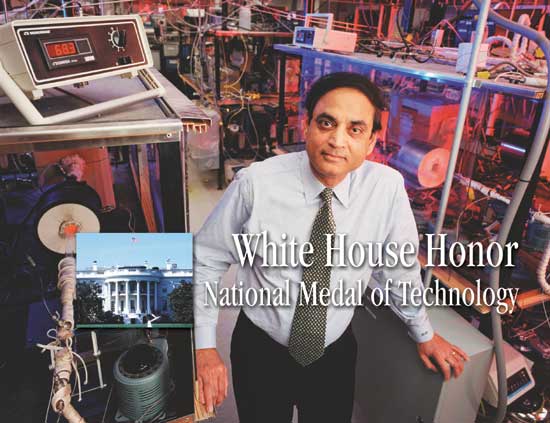 Haren Gandhi (Ford Motor Company photo) White House Honor: National Medal of Technology Haren Gandhi, a pioneer in cutting toxic emissions of automobiles, has won a top U.S. accolade. A Siliconeer tribute. Ford Motor Company researcher Dr. Haren Gandhi has won the 2002 National Medal of Technology for research, development and commercialization of automotive exhaust catalyst technology, which converts toxic exhaust gases into harmless products. The National Medal of Technology is the highest honor bestowed by the president of the United States to America’s leading innovators. This marks the first time a researcher for Ford Motor Company, or any automotive manufacturer, has won this prestigious award. Past winners include Steven Jobs and Stephen Wozniak of Apple Computer; Edwin Land, the inventor of instant photography; Wilson Greatbatch, the inventor of the cardiac pacemaker; and Bill Gates the founder of Microsoft. Gandhi is receiving the award for his work in shaping the automotive exhaust catalyst industry from its very beginning and continually pushing to improve the quality of the air we breathe. Gandhi was cited for his work to reduce the use of precious metals in the automotive industry, including his research into conservation measures such as recycling spent converters and technological advances in precious metal utilization. “This is quite fantastic and exciting to receive an honor that most scientists and engineers can only dream of,” said Gandhi. “I am very proud to be associated with a great automotive company like Ford that allowed me to carry out fundamental and applied research that eventually led to cutting-edge technology for eliminating vehicle emissions.” Gandhi joined Ford Motor Company in 1967. Among Gandhi’s many scientific contributions is the development of the monolithic three-way catalyst, a discovery that has revolutionized the way the automotive industry approaches emissions control. “The industry has witnessed so much progress in emissions reduction over the last 30 years, and Ford has been at the forefront,” Gandhi added. “It is gratifying to know that our work has resulted in people breathing cleaner air throughout the world.” Gandhi has also conducted pioneering research in the areas of catalysts for alternative fuels, oxygen storage components in three-way catalysts, poisoning of automotive catalysts, and novel catalyst formulation strategies. His work has resulted in more than 70 technical publications and more than 40 U.S. patents in automotive exhaust catalysis and related areas. Many of the advances in catalyst technology he has commercialized at Ford have subsequently been adopted throughout the industry, setting him apart as one of the most influential persons in the history of automotive exhaust catalysis. |TOP|
LEGAL ISSUES Estate planning can avoid this terrible situation, and so take time plan for it. During the estate planning process, certain difficult decisions have to be made. One of such decisions is choosing a trustee. A trustee is a person or a licensed corporation that owes a special duty of care to the beneficiaries of a trust. The primary job of your trustees is to follow your instructions. That is why the instructions in your trust must be clear and well written. If your instructions are sparse, incomplete, or ambiguous, your trustees will have to rely on their own judgment. The result may be that what you intended may not happen, defeating the main purpose of your trust. Each state has statutes that detail the powers and duties of a trustee in carrying out the management of the trust estate. It may be necessary for the trustee to seek professional management or investment advice if such expertise is not within the trustee’s experience. Some of the general duties of a trustee include:
There are advantages of choosing a family-member trustee such as:
However, there are some disadvantages of family-member trustees, as follows:
A corporate trustee, in contrast, would charge fees for acting as trustee and will have much more formalities required. However, a corporate trustee can be very beneficial since they have experience as trustee and do not act out of emotions. A trustee has a lot of accountability. It is a position of utmost trust and confidence. A trustee can be removed under certain conditions. Even if a trust instrument does not define the circumstances under which a trustee can be removed, a court can exercise its discretion to remove a trustee if the trust or trust property is in jeopardy. Recognized grounds for removing a trustee include the trustee’s non-residence in or absence from the jurisdiction if the trustee’s presence in the jurisdiction is necessary for the administration of the trust; antagonistic or hostile relations created by conflicts between the trustee’s individual interests and the interests of the beneficiaries; situations in which a trustee’s insolvent financial condition jeopardizes the administration of the trust funds; or situations in which the trustee lacks personal competence to administer the trust by reasons of ill health, intemperance, mental infirmity, old age, or dishonesty. Similarly, a trustee may be removed in the court’s discretion for misconduct and mismanagement in execution of the trust, including abandonment or neglect of the trust, disobedience as to court orders, failure to pay principal or income when due, failure to file an oath or give security, improprieties with respect to investments, commingling of trust funds with non-trust assets, and filing of defective reports and accounts. As a general rule, a trustee of a revocable living trust is not initially subject to court supervision. If grounds exist for removal of a trustee, the beneficiaries would have to initiate legal action for removal if the trustee fails to resign voluntarily at their request. Courts are generally reluctant to remove a trustee who is specifically designated by a trust maker because they naturally want to give great weight to the faith placed in the trustee by the trust maker. - Raja Ahluwalia is an attorney based in San Mateo, Calif. |TOP| PROFESSIONAL BUILDING The center is a three-story building with a floor plate of approximately 6,500 square feet and a basement of approximately 13,000 square feet for vehicular parking. Its simple and provocative design consisting of gray metal composite panels and blue-green glass. To enhance the efficiency of its staff, the center is equipped with a voiceless communication system. NeoCenter houses NeoVision Eye Center which consists of an Eye Clinic, Optical Store, and Laser Facility. The eight examination rooms of the center are fully equipped with state-of-the-art technology to diagnose and treat the patient’s eye needs. The fully automatic vision testing system provides the patient with the best possible vision. The advanced camera system can take a picture of inside an eye without dilation. A digital photograph of the eye is used to document and monitor the progression of serious eye diseases such as diabetes, glaucoma, and macular degeneration. An HRT system displays a three-dimensional image of the eye to monitor the development of certain eye conditions like glaucoma. The surgery room is equipped with a microscope, cryosurgery, and radio surgery units. The surgical room is eligible for hosting laser surgery systems. Radio surgery and laser surgery are used to perform many cosmetic eyelid procedures such as eyelid skin tags, moles, etc. LASIK surgery is available. The Optical Store contains the latest available frames and contact lenses. The attached optical laboratory is equipped with instruments to provide quick service. The Eye Center is under the constant surveillance of cameras for the safety of patients and staff members. The whole center is equipped with occupancy sensor lights for energy conservation. The medical director of this eye center is Shobha Tandon M.D., Ph.D. Dr. Tandon is a board-certified ophthalmologist who was trained at Stanford University. Dr. Tandon has received her professional education at the University of Texas at San Antonio. She has a Ph.D. in biochemistry. -Atul Tandon, Ph.D. is founder president |TOP| BUSINESS: “The worldwide Non-Resident Indian community will now be able to send money home instantly and securely via www.xoom.com,” according a Xoom press release. “The cash will be available immediately to recipients at any national Wall Street Instant Cash location, seven days a week. Door-to-door, direct deposit and bank draft delivery service will be offered later this year.” “With over 25 years of experience in global remittance, we recognize the importance of simplifying the process of sending money home,” said Praveen Chandiramani, chief operating officer of Wall Street Instant Cash. “We are pleased to partner with Xoom to offer this new service.” India marks Xoom’s third market, after the Dominican Republic and Jamaica. Service to more Asian and Latin American markets are planned in 4Q2003 and 1Q2004, as Xoom continues to expand its instant money transfer service around the world. Xoom Corporation is an online-to-offline international money transfer service. Xoom currently offers a secure, swift, and inexpensive means to send money from 38 countries to recipients in the Dominican Republic, Jamaica, and India. Transactions are processed securely through PayPal, an eBay company. FINANCE When market volatility tempts you to pull your 401(k) investment out of stock funds, take a step back and remember why you invested in the first place: long-term growth of your retirement savings—exactly what stock funds may bring you in the long run. Sticking with your investments, known as “buying and holding,” gives your money full-time earning potential. If you pull out of the race during a declining, or bear, market, you may miss a possible upswing and sacrifice the good days along with the bad. Rather than minimizing risk, timing the market only increases your risk. As a market falls, you could end up selling low and buying high—the exact opposite of your intentions. For example, if you invested $100 per month for two months and purchased 20 shares for $5 one month and 10 shares for $10 the next month, your average cost per share was less than $7. However, the average price of your shares was $7.50. Dollar-cost averaging “eases” your money into the market, eliminating the need to watch market trends and time your investment just right. You won’t be at risk of buying too many shares at peak price. And, if you’re using payroll deductions to fund your 401(k) plan, you’re already doing it! But keep in mind, dollar-cost averaging doesn’t guarantee a profit or protect against a loss in declining markets. Just like those decisions, the decision to invest also involves risk, including the possible loss of money. However, making an informed decision to assume some risk also creates the opportunity for increased rewards. The higher the risk, the higher the potential for reward. The lower the risk, the lower the potential for reward. What investments are right for you depends on your:
Why Diversify? So how did these hard working, retirement-conscious people lose their entire nest egg in the blink of an eye? The answer is simple. They didn’t diversify. The participants who lost everything invested 100 percent or a majority of their retirement assets in one investment option or a single investment like company stock. In other words, they put all of their eggs in one basket. Therefore, when the investment fell in value, so did their entire retirement account. However, if these employees had diversified their investments (if permitted by their plan,) the impact on their retirement savings would not have been so significant, and so devastating. So, what exactly is diversification? Diversification, or investing in a variety of different asset classes (stocks, bonds, etc.), helps to spread risk and helps you to avoid putting all of your eggs in one basket. Experts agree that a balance of different asset classes is the best route to meet your retirement goals. Studies show that over 90 percent of the total return variation of your portfolio is determined by your asset allocation decisions. If you answered yes, you’re not alone. The recent turmoil has created uncertainty and anxiety for many investors. Especially those who haven’t experienced a bear market—witnessing only very short-lived market downturns. Relieve your stock market jitters. Follow the three time-tested recipes for successful investing: focus on the long-term, invest regularly, and diversify. Focus on the long-term. If you watch the ups and downs of the market over a short time period, you’ll often see large fluctuations. But if you watch the markets over a longer time, you’ll find the movements much less dramatic. The key is not to become too overly concerned with the movement of the market in one- or even two-year periods, if your investment time horizon is at least five to seven years. History has shown that the longer you remain invested, the greater your chances for success. Invest regularly and consistently. Doing so will let you take advantage of swings in stock prices. When stock prices decrease, you purchase more shares and when prices are higher, you purchase fewer shares. Though no investment program can assure a profit or protect against loss, investing consistently can help you ride out market ups and downs. Diversify. Don’t put all your eggs in one basket. Spread your risk by dividing your money among a variety of asset classes—stocks, bonds, etc. This way, if one investment performs poorly, it only affects part of your total investments. Studies have shown that the greatest single factor affecting investment results is how you allocate your assets. There you have them…the three keys to successful investing. While you have no control over how much the value of your investments change, your understanding of these three keys should help you make it through the tough times. - Ashok Gupta is a financial advisor |TOP| FESTIVITIES AUTO REVIEW Pontiac has blurred the lines even more with its brand-new for 2003 Vibe. It’s a sprightly car with DNA plucked from the sports car, sports wagon and SUV genres. It also has some attributes of a minivan, although I think Pontiac’s press materials purposely avoided that word for the stigma it carries. But, the truth is, the Vibe is a fun and well-appointed car with versatile seating and a good-sized cargo area. It is also available in all-wheel drive. So, however you chose to classify it is your call. The Vibe’s exterior design — with cat-like head lamps, a roof rack, wide-track stance, large wheels and overall aerodynamics — sends off a sporty look. Peek inside and that wide stance is translated into a good-sized interior for a car of this size. In fact, because the seats are set down a bit, there’s an unexpected amount of extra head room in here. While that may be a pleasant surprise for tall drivers and front seat passengers, you might want the kids to test out the back seat, to see if they will be able to comfortably see out the windows. The driver is treated to a stylishly designed dashboard, where essential gauges are ringed in silver circles and back-lit in a bright red. Everything is within easy reach. The seats on the test car were covered in a heavy-duty cloth, and the seats themselves were designed to be versatile. The front passenger seat can fold into a worktable, and the rear passenger seats fold flat with a one-touch function. There are two 12-volt power outlets inside, one in the dash and one inside the front console, which allows you to charge your cell phone in a concealed spot. There’s also a 115-volt standard power outlet with a wall-type plug located in the front console. Pontiac’s press materials suggest you can use this power outlet to run your laptop, an electric shaver or even a portable vacuum. Promise you won’t operate any of these items while also trying to drive. The Vibe is very nicely equipped with several advanced safety features, such as dual-stage front air bags, daytime running lights, anti-lock brakes with the all-wheel drive system, a large safety cage and crumple zones, seat belts with pretensioners and force limiters. Side air bags are available. Other safety features that are options include GPS navigation, remote keyless entry, anti-theft system, and delay entry lighting. The Vibe’s engine, whether on the base model or the GT upgrade, is a 1.8-liter, four-cylinder with variable valve timing. It is a surprisingly gutsy engine and you won’t find it hesitating or lacking in power when trying to get on the freeway or avoiding traffic hazards. On the road, you’ll find the Vibe handles very well and is actually quite fun to drive. The 2003 Pontiac Vibe may be aimed toward younger buyers, but don’t let that stop you. If you’re looking for a car that moves, gets good mileage, is easy on the eyes and the budget, and even offers minivan-size attributes, you’ll want to check this one out. - Sally Miller Wyatt is a freelance writer Guftugu Take an advertisement starring the sultry Bengali belle Bipasha Basu. Oozing oomph, the sensuous beauty makes her rounds among a gaggle of hunks and makes the declaration that she would go out with the guy who had the “smallest one.” Come again? One guy has the guts to move up to her that he indeed has the “smallest one.” He proves it, too, as he digs into his pockets to retrieve a—now get your minds out of the gutter—cell phone. “I almost fell off my chair when I saw that ad,” spluttered Kher. “Times are changing, we need to usher in liberal policies,” he concedes. “But we also need to keep the Indian audience in mind.” He is also appalled by some of the stuff on television. “Look at the stuff on television today,” he fumes. “The serials are not an issue, but music videos are. And a few of them are outright vulgar.” Amitabh Bachchan and Hema Malini have essayed the roles of a charming, loving middle-aged couple that is so captivating that it towers over all other performances. Neither are young anymore, but they bring alive the warmth and romance of a long-standing relationship that is incandescent—and audiences are swooning over it. So is it any surprise that a rumor is making the rounds that Yash Chopra is planning to rope in Big B and Hema in his next directorial venture? Other stars in the film include Shah Rukh Khan and Preity Zinta. Rani Mukherji is supposedly going to get a good role as well. The Chopras are being tightlipped about it all, but if they are indeed roping in Big B and Hema, they are betting on a sure thing. And the audience might well be in for a treat, too. Who was this guy? Forget the clean, shaven fastidious hero of yesteryear. Our Aamir appeared in his latest persona, the freedom fighter Mangal Pandey, which he plays in the upcoming film The Rising. The neatly cut coiffure of Bollywood’s fastidious star had given way to wavy locks of long hair, and he had grown a bushy moustache to boot. Ladies are already swooning and fashionistas are saying that the dashing Aamir might bring long hair into fashion again. That’s Aamir for you. Whether it’s the rustic protagonist in Lagaan, or the hip youth in Dil Chahta Hai with the sporty tuft of beard lurking under his lip, Aamir completely inhabits any role he plays. Aishwarya Rai, or rather her pretty face, is smiling from newsstands all over Asia from the cover of a recent of the Asia edition of Time magazine. The magazine calls her a modern girl with traditional values, and the cover story of the magazine announces the arrival of crossover movies and bold themes in Indian cinema, which could give Bollywood a worldwide acceptance. That’s all very nice, but folks, let’s not get carried away, okay? Except Shekhar Kapur, the much ballyhooed Bollywood invasion in Hollywood never really materialized, and in the West, Bollywood films still make their moolah from NRIs. Will this change in the future? We can only wait and see, but premature self congratulation won’t get us there. Now comes the news that Amitabh Bachchan has now been appointed the official brand ambassador of Uttar Pradesh. Family and friends were present in Uttar Pradesh when Bachchan was appointed for the post. Good friend and chairman of the state’s Industrial Government Council Amar Singh said that Bachchan’s appointment as a brand ambassador would improve the industrial outlook of Uttar Pradesh. To which a wag responded: Maybe, but what will Uttar Pradesh do to the Big B brand? Touché. When she turned up at a bash to mark the music release of Tehzeeb, the party was studded with stars—Amitabh Bachchan, Abhishek Bachchan, Shabana Azmi, Diya Mirza, Arjun Rampal—but all attention focused on her. “I had a great time working in this film,” she said. “The role I portray is something I haven’t attempted in my career so far.” What a far cry it is from Rangeela, where her acting, or lack thereof, got hidden behind sizzling sensual pelvic gyrations. You’ve come a long way, baby. And now he is getting it in spades. Take Jogger’s Park. The off beat film is slowly but steadily making the cash registers ring, and here’s the icing on the cake: warm critical acclaim. The film, after all, is different from the mindless masala fare as it sensitively portrays the romantic friendship between a vivacious, young woman (Perizaad Zorabian) and an aging retired judge (Victor Banerjee). Not only has Deputy Prime Minister L.K. Advani praised the film, Jogger’s Park has opened the Cairo Film Fest. And that’s not all. The film festival will host a Subhash Ghai film festival. I kid you not. No wonder the ebullient filmmaker is in seventh heaven. No sooner had the news sunk in than we heard that Kareena Kapoor was also going to work in a Bengali film. Now news comes in that Manisha is talking to two top Bengali filmmakers—Aparna Sen and Rituparno Ghosh. Sen is talking about a film to be produced by Pritish Nandy Communications, and Ghosh is discussing a script about a housewife whose husband is forced to remarry to get an heir to the family. It seems that after years of Bengali stars going to tinseltown, now it’s Bollywood that is going to Bengal. Nothing like a touch of glamour to light up the moribund film industry in the land of rasogollas. The next few months are going to be critical for the Bollywood hunk. There’s Ishq Hai Tumse (with sizzling Bengali beauty Bipasha Basu), Plan, Gumnaam—The Unknown (with Mahima Chaudhry) and Chehra (with Bipasha). Friends are telling him to lighten up. After all, he already has his hands full with assignments even before Sssshhh! has released. It says a lot of his talent that the film’s producers Cinevista have already signed him up for three more films. There’s more. Cinevista apparently have signed Dino’s younger brother Santino as well. It appears that Dino is not only determined to succeed himself — he wants his family to join in. Ashmit has debuted with Inteha, and Amisha will talk of little else. She’s telling anybody who will listen what a wonderful actor her brother is and a little bird tells us that her hold over beau Vikram Bhatt played no small role in making sure the director gave Ashmit all the breaks he needed. The big question now is will this all work out for Ashmit in the box office. That alas, isn’t up to loving sis Amisha, but a fickle, finicky audience which can be brutal if they don’t like a performance. For Ashmit’s sake as well as Amisha’s, one hopes the audience takes a shine on the newcomer. Hindi Film Review Gripping Murder Mystery 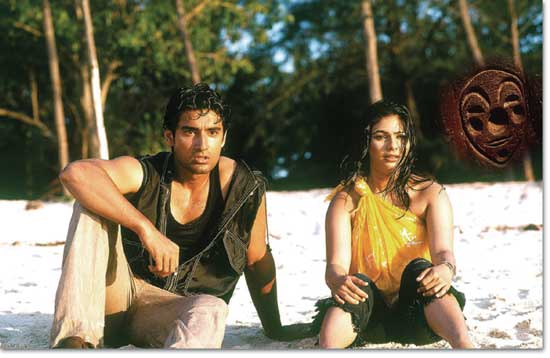 Sssshhh! Directed by: Pavan Kaul Music: Anu Malik Starring: Dino Morea, Karan Nath, Gaurav Kapoor, Kushal Punjabi, Tina Choudhury, Suvarna Jha, Aly Khan, Shivaaji Satam and Introducing Tanisha Give credit where credit is due—Bollywood is always willing to try something new. It may welcome new ideas, but execution is something else again. Who ever heard of a Hindi slasher movie? Well, now you have. This gory murder mystery, despite some (mostly minor flaws), isn’t half bad, and has some good technical values (more about this later.) Of course, giving the celebrity craze and Bollywood’s avid love of gossip, more people are interested in Kajol’s sister Tanisha’s debut than how the film does. Interestingly, the verdict on both Tanisha and the film is uncannily similar: well above average, but with a few flaws. We’ll come to Tanisha in a second, but first here’s how the story goes. Mahek’s (Tanisha) sister Malini (Simone Singh) is one of the victims of a gruesome double murder, which wrecks the peace of a sleepy hilly township. A murderer who wears a joker’s mask stalks her in college, at home, and in the streets. Mahek hardly lives a sheltered life; her father had dumped them earlier, and she lives with her mother live alone. Things get scarier after a college professor is murdered in the ladies’ restroom. Mahek is attacked again at home. Is her college friend Suraj (Karan Nath) the killer? After all, he wears a wristwatch that Mahek saw on the killer’s hand. However, Suraj has an ironclad alibi. In fact, when the killer attacks Mahek again in a few days, it is Suraj and investigating officer Kamat (Shivaji Satam) who rescue her. The murderous joker is shot, and he falls into the river and presumably drowns. End of story? Not so fast. When Mahek’s friends see her teetering on the brink of a nervous breakdown, they decide she needs a break, and a whole group goes to—get this—Thailand! This reviewer couldn’t suppress a sigh of resignation when this happened. Apparently the Bollywood flight of fancy is alive and well, and the film, till now fairly within the ambit of plausibility, simply takes off on this point. But hey, this is Bollywood, where suspension of logic is a moviegoer’s basic survival skill. In any case, things start to get sticky in Thailand. For starters, Mahek’s mom is killed while she is abroad, then her friends are knocked off one by one until only two are left—Rocky (Dino Morea) and Suraj. The climax of the film, of course, resolves the mystery and—unusually for a Hindi film—the solution is intelligent and plausible. Of course the film isn’t perfect—the romance occasionally distracts, the film is littered with minor absurdities here and there, but it is nevertheless a gripping, suspenseful whodunit made with style and élan. Director Pavan Kaul deserves a big pat on the back for making a watchable, entertaining film with excellent production values (cinematographer Hiroo Keswani’s camera is simply magical). For once, composer Anu Malik gives value for money, and Salim-Suleiman’s background music creates just the right mood of menace. However, don’t think the film is made from an original story. Bollywood being the great Xerox machine of concepts and plots—Kaul keeps the tradition going with a canny mix of several Hollywood films. You know the drill: A table spoon of I Know What You Did Last Summer, a generous helping of Scream, and voila! You have a screenplay. One can forgive Kaul for this, because his film is miles ahead of two more recent films of the same genre—Kucch To Hai and Samay. And now, a word on Tanisha. Yes, it is true that like mother Tanuja and sister Kajol, she has a spontaneity and natural ease in front of a camera—no mean asset, that—but this alone is not going to cut it. When it comes to acting, she still has some ways to go. She’s new, and clearly needs to get a handle on this aspect. The most important thing is that she certainly shows promise. Rating: *** (Good) |Return to Bollywood Index| |TOP| Tamil Film Review: Freshly-told Love Story IYARKAI Cast: Shaam, Arun Kumar, Radhika, Seema Biswas Director: S P Jhananathan Music Director: Vidyasagar Iyarkai, initially scheduled to be a Deepavali release, has been held back for November first week, the producers perhaps not willing to take on the films of big stars like Vikram and Surya in Pithamagan or Arjun in Ottran. However, as the title suggests, Iyarkai has a freshness about it that has its own appeal. A love story, told in a refreshing way, without an overdose of melodrama, fanfare and artifice, Iyarkai could make a big difference to the career of Shaam, who hasn’t had hits of late. Radhika, a new face from Kannada films, is the heroine of the film who prefers to wait for the sailor (Arun Kumar) lost in the sea but finds herself slowly drawn towards Shaam, who sets out to help find Arun Kumar (who turns in a good performance). Shot in the Andamans, the film has a slow but effective pace, allowing the viewer to savor the richness of the locales and the gripping dilemma faced by Radhika as she has to choose between accepting the hand of Shaam or waiting for the sailor who could well be dead. Debutant director S.P. Jhananathan has handled the build up to the climax effectively. The end is stunning and unexpected for a Tamil movie, moving away from the traditional clichés or melodramatic parting of ways. The film ends without any dialogue but makes subtle use of visuals which leave a lingering impact. The last time a film as intelligent as this was done was the Kamal Hassan-Jayapradha starrer Sagara Sangamam. One hopes movies like these do well at the box-office to encourage the more intelligent filmmakers to make a break from the Dhool-Samy song-dance-fights routine that seems to comprise the so-called winning formula which then is foisted upon young, creative minds in the film industry. Producer V.R. Kumar deserves a pat on the back for standing by this team which includes camera work by Ekambaram, Sabu, art directors Cyril- Selvam and editor V.T. Vijayan. Arun Kumar and Seema Biswas, too, impress in their brief roles. The songs are few in number, and thus do not take attention away from the narrative. Music director Vidyasagar provides a helping hand with some good re-recording, allowing the influx of natural sound to a large extent. The fate of Iyarkai will soon be in the hands of the viewers, who, like the heroine, will have to choose. So will it be a decision to support good cinema or to wallow in brash trash? For the sake of Tamil cinema buffs as much as the producers, one hope it is the former rather than the latter. — R. Rangaraj |TOP| ESSAY  A Different Diwali: Past Memories, Present Reality – By Ranjini Nellore Non-resident Indians with frozen, childhood memories of Diwali festivities decades ago will find many changes when they return today, writes Ranjani Nellore. Ask any non resident Indian what he or she misses most about being away from the home country and you will hear one unanimous answer. “We miss the festivals, the fun, the food and colorful celebration,” they say. In secular India, where religion is intimately mixed into the flavors of daily life, it is impossible to go through any month of the year without a significant religious celebration of some sort. Towards the end of October, when darkness starts creeping into the day and the air holds a slight chill within its folds, it is time for the annual Hindu festival of Diwali, the festival of lights. My images of Diwali, frozen in my memory for more than a dozen years, are comprised of many traditional rituals. After a thorough cleaning, each home is involved in the concoction of several mouth-watering, Diwali-specific delicacies. Elaborate designs, rangoli, are drawn outside the door and decorated with myriad colors. Small clay pots, with cotton wicks dipped in oil, are arranged in and around the house for illumination. The sounds of Diwali celebrations arise from the lighting up of fireworks or as they are called in India, crackers. As a long-time U.S. resident who has recently returned to India, I eagerly anticipated my first Diwali back home. I looked forward to introducing some of these traditions to my daughter as a hands-on orientation to the festival. My new home, Hyderabad, located in south-central India, is famous as the city of pearls. It is well known for its unique multi-cultural heritage inherited from its long Mughal history. Today it is the self-touted new cyber capital of India. As Diwali approached, I saw strings of lights wrapped around tree-trunks that lined wide roads bearing gigantic billboards proclaiming “Hitec City” and “Genome Valley.” As residents cleared their houses in preparation for the impending festival, even the city looked clean and litter-free. I naively presumed that this effort was meant for a public celebration of Diwali. Then I chanced upon a caricature of a young lion dressed in a yellow t-shirt and black sneakers with a huge head of frizzy hair any rock-star would be proud of, at several intersections in the city. “It’s Sheroo,” my daughter shouted excitedly, pointing to the inflated plastic behemoth. Sheroo is the official mascot for the first Afro-Asian games that the city is hosting this week. It struck me then that the lights were meant not so much for Diwali but for the hundreds of participants and delegates who would be descending on the city for the games. I shopped around for diyas, shallow clay pots of a size that fit snugly in the palm of your hand. It took me a while to figure out that it was easier to buy colored candles instead. “This is what people want these days,” explained the check-out clerk in the brightly lit department store. “It’s not fragile like the clay pots, no need to mess with wicks and oils. If you really want diyas, I have some fancy painted ones with wax already poured in. Just light the wick and you’re done,” he insisted. So much for the traditional lamps for illuminating the festival of lights. Another unique aspect of Diwali is the tradition of lighting up a range of fireworks. As a child, I remember quarreling with my brother to ensure my fair share of the firecrackers purchased for the family. I veered towards the attractive flower-pots which spewed out a sparkling fountain of light while my brothers preferred the so-called rockets and the ear-splitting bombs. With rising levels of environmental pollution, a small but significant movement is afoot to inform lay people about the harmful effects of firecrackers which add to the dust, smoke and noise. This movement is being targeted towards the education of school children who are the main consumers of these products. On the other hand, there was a counter move by some parties to encourage people to light up fireworks as part of a community fumigation effort to eliminate mosquitoes and other disease carrying vectors by the sulfurous fumes. Given this situation, it was no longer a simple task to indulge in the familiar task of purchasing firecrackers. The spirited family debate pretty much took most of the fun out of lighting up. As my list of traditional activities shrunk in size, I considered the one item that appeared to be untouched by modern India. An amazing array of sweets, both home-made and store-bought, were still within my reach. Although children today prefer candy bars and sodas, recent news reports about worms in candy and pesticides in Pepsi turned out to be a boon for shops specializing in traditional goodies. I have had my fill of Diwali sweets. I think I will worry about the warnings of high-calorie, high-sugar foods after the festival season ends. - Ranjani Nellore, a scientist and former Bay area resident, |TOP| RECIPE:  Fast Veggie Snack: Dhokla from Gujarat – By Seema Gupta Seema Gupta shows you how to make one of the most popular snacks of Gujarat. Ingredients
Method: Boil water in a pan. Add baking soda to the paste and pour the paste in a greased bowl. Put the bowl in the pan with boiling water and cover the pan with a lid to steam for 15 minutes. Heat cooking oil, add mustard seeds, bay leaves, sliced green chili and one tea spoon water. Fry for a minute. Cut steamed dhokla in square pieces, garnish with above mentioned fried mix, grated carrots, coriander leaves, coconut as shown in the picture. Serve with tamarind chutney and mint chutney available at your local Indian grocery store. – Seema Gupta is a homemaker |TOP|  Colors of Bharatanatyam: Abhinaya Dance Concert - By Shobha Hiatt Mythili Kumar will be joined by other bharatanatyam dancers and exponents to both highlight the different schools of bharatanatyam as well as present a collaborative performance, writes Shobha Hiatt. The Abhinaya Dance Company of San Jose will present “Varna-Mala: The Colors of Bhara-tanatyam” Nov. 22 at the Mexican Heritage Theater with two shows. Along with two guest bharatanatyam dancers, Mythili Kumar, artistic director of the Abhinaya Dance Company, portrays in this concert the different Schools of Bharatanatyam, a traditional South Indian dance form. Guest dancers Indumathy Ganesh, artistic director of Nrityollasa Dance Academy and Vidhya Subramanian, artistic director of Lasya Dance Company will represent the Vazhuvoor School while Kumar will present the aesthetics of the Pandanallur School. At the matinee performance, a demonstration of the existing stylistic variations will be presented with additional guests, K.P. Kunhiraman and Katherine Kunhiraman, directors, Kalanjali Dances of India, representing the Kalakshetra School. The highlight of the concert will be a varnam or collaborative piece jointly choreographed by the three artists — Kumar, Ganesh, and Subramanian — depicting the glory of Ganesha. Kumar will perform additional collaborative numbers with each guest artist. Repertory pieces will be presented by Abhinaya dancers. Musical accompaniment will be provided by composer and vocalist Asha Ramesh, accompanied by percussionist N. Narayanan (mridangam), Shanthi Narayanan (violin), Vidya Ramakrishnan and Malavika Kumar (nattuvangam), Raja Sivamani (veena) and Raghavan Manian (flute). Interested readers can call Abhinaya Dance Company at (408) 983-0491 or e-mail: abhinaya_sj@yahoo.com - Shobha Hiatt is a freelance writer based in Berkeley, Calif. |TOP| COMMUNITY: The trustees, Madan Ahluwalia and Kamal Gill, have described the evening of Oct. 24, 2003 as a super success. “After tonight’s program and turnout, it is clear that our vision of a Sikh Community Center will turn into reality very soon”, assured Kamal Gill, trustee of SCC and long-time Saratoga, Calif., resident, after she commenced the pledge marathon in the evening, which raised over $10,000. “We had expected a good response, but this is amazing, since the event was sold out 1 week prior,” Gill said. The evening scheduled opened at 8:15 p.m. sharp with a “shabad prayer” composed to a contemporary film tune from the movie Sur. The “Opening Ardaas,” a blessing prayer was recited by Bhai Jagjit Singh, founder of the Sikh Missionary Society. Guests were treated to a vegetarian meal/non-alcoholic evening catered by Chandni Restaurant. A fashion show, “Beauties of Punjab,” was presented by sponsors Sagar Emporium and MotorSport, followed by an energetic upbeat Bhangra dance by Genius Kids/Safari Kid, and short skits presented by many youth. The skits projected the urgent need for a Sikh center for youths, families and senior citizens. Guest of honor Ujjal Dosanjh, former premier of British Columbia, told the crowd how importance this center was for the community, and also spoke about the problems of caste system which is still a major issue amongst the community. Madan Ahluwalia, Trustee for SCC, honored Judge Dana Marks Keener for her contributions and service to the various Sikh issues at stake. “We do not want to remain a minority in the great ocean, and need to create a pool to be decision makers for our own issues,” said Rennu Dhillon, stressing the need for an independent Sikh Center. The project has had its naysayers from within the community and without, many questioning whether the Sikh Community population in the Bay Area is large enough to support such a cause. “The philosophy of Sikhism is that our religion is open to all, so even though the center will be named as Sikh Community Center, the purpose is to welcome all the communities into our programs” stressed Kamal Gill. The powerful Power Point presentation said that Sikhism is the fifth largest religion in the world with a following of over 23 million people. Ranvir Singh, Dr. Bhupinder Johal and Smitha Jandaur, all volunteers for the project, presented their own reasons for coming forth to help. “Where do our senior citizens go when they want to meet others and socialize and bond with the youth?” asked Ranvir Singh. The Sikh Community Center, still very much in its inception stages, plans to have a simple infrastructure of trustees, a board of directors/advisory board and committees. “Our goal is to be non-political, and we are open to working with other organizations and centers in the Bay Area as long as we maintain our own independence and structure,” emphasized Rennu Dhillon. The evening was well organized with its entertainment and format, and the highlights was the Outstanding Sikh Community Awards presented to several Sikh Citizens recognized for their professional achievement and community service: Ravinder Dhillon, Lovely Dhillon, Dr. Jagjit Raju, Dr. Hundal, Dr. Sandhu, Robin Singh, Dr. Narinder Singh Kapany, Dr. Amarjit Singh Marwah, Jasvir Gill, Kavita Singh, Bhai Jagjit Singh. One of the interesting points that has drawn a lot of attention to this project from many other organizations is that the majority of the volunteers and organizers are women. One of Sikhism’s main principles is that woman is equal to man and this center is going to stress that strategy, encouraging young women to come forth and take responsibility, say Kamal and Rennu. “Our immediate plan is to start programs in Punjabi language and programs for women/senior citizens, and we have received calls offering us use of free office space at the weekends to launch these programs,” said Kamal. Interested readers can call Rennu Dhillon at (510) 713-2431 or visit www.sikhcc.org for more information. |TOP| November-December Horoscope |
||||||
|
|
|
|
|
|
Advertise in Siliconeer | Home | Subscribe PRINT Issue | About Us (FAQs) | Contact | Locations | Staff Login | Site Map
© Copyright 2000-2013 Siliconeer • All Rights Reserved • For Comments and Questions: info (AT) siliconeer.com |
|