!-- Start Alexa Certify Javascript -->
|
|||||||||||||||||||||||||||
|
|||||||||||||||||||||||||||
|
|
|||||||||||||||||||||||||||
|
|||||||||||||||||||||||||||
|
|
|
|
|
|
OCTOBER 2003 |
IN THIS ISSUE
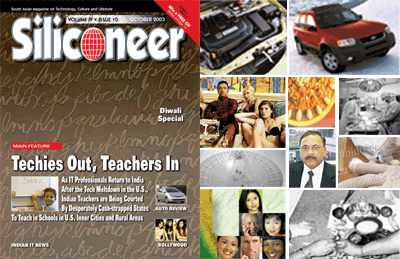
MAIN FEATURE Techies Out, Teachers In : U.S. Woos Indian Educators By Siddharth Srivastava INNOVATION Healthcare for Everyone : Satellite Communication By S. Rangarajan ETHNIC ISSUES A Rainbow of Opinions : 2003 Multilingual Poll PACIFIC NEWS SERVICE Publisher’s Note • Infotech India • Language and Sickness Finance: A Holistic Approach to Financial Planning Legal Issues: The Benefits of a Living Will Auto: Hybrid Cars • Bollywood • Tamil Cinema Special Diwali Essay Recipe: Gajar ka Halwa • Horoscope |
|
|
Publisher's Note
We step aside a bit from the gloomy tech world and look at a new trend: the increasing number of Indian teachers who are U.S.-bound to take up the task of teaching this country’s children, something people in this country seem to be tiring of. As our cover story notes, thanks to a strange confluence of economics and circumstance, U.S. educators and schools are taking a close look at what India has to offer, and they like what they see. The better Indian teachers are competent, hardworking and speak excellent English. For Indian teachers, it’s a great opportunity, because the pay that Americans consider appalling gets quite a facelift after adding a few zeroes and putting a Rupee sign. It’s just a trickle yet, but who knows where it will lead? And while it’s great to see Indian excellence in another field internationally recognized, what it may mean for Indian schools remains to be seen. India, the land of contrasts, offers state-of-the-art medical care in its biggest metropolitan cities, yet its rural hinterland might as well be living centuries ago. All this could change with an innovative new technique: direct digital satellite communication to disseminate medical information and training. We present an article on this development. We also take a moment to step outside the desi ethnic ghetto. A fascinating multilingual poll by New California Media reveals how varied and different the opinions are among the California minorities, and another article presents a poignant vignette to emphasize the necessity of competent interpreters to ensure effective health care. We wish all our readers a very happy Diwali. This issue carries a special essay on this most beloved of Indian festivals. Main Feature 
Techies Out, Teachers In
U.S. Woos Indian Educators - By Siddharth Srivastava After IT professionals, high school teachers could be India’s next big export to the U.S., writes Siddharth Srivastava. As the hi-tech bust has companies laying off employees by the thousands, Indian tech workers in the U.S. are homeward bound. However, another area is opening up, with opportunities beckoning Indian teachers. Unnoticed in the fury of the tech meltdown is the fact that estimates in the U.S. put the shortage of instructors to the tune of over 700,000. And here too, educators and school managements are looking to plug the gap by hiring from India. The reasons are the same that doctors and engineers are sought — Indians provide quality, are hardworking, prepared to work for much lower salaries and their knowledge of English is good enough to teach American kids. George Noflin, principal of a high school in a Mississippi town, was in India recently. “The quality of teachers in India is unbelievable,” he says. Noflin interviewed 85 teachers while he was here and hired three for his school. The high demand for teachers comes at a time of downturn in the tech sector and the consequent job losses and instability, with thousands of Indian H1-B visa holders in the U.S. returning home. Furthermore, the number of tech workers heading to the U.S. is perceptibly down compared to the previous years. The shortage of teachers in the U.S. is attributed to the low regard, dismal pay scales and high turnover in a profession that was once admired across the country. “No one wants to teach these days,” says Noflin. According to the National Commission on Teaching and America’s Future, a third of new teachers leave the profession within three years — and 50 percent leave after five years. Although there has not been a stampede of people from India, just as it was in the case of outsourced jobs in call centers and the business and processing industry, the reverberations of hundreds of schoolteachers heading ashore and many more seeking fresh avenues are beginning to be felt across the country. Survesh Rudra, a middle-level government official, recently returned with his son after a year-long scholarship to the U.S. His wife has chosen to stay back after she was offered a job to teach in Texas. “As she has more than five years’ experience her salary is more than $35,000 which is dismal by U.S. standards but great by Indian,’’ says Rudra. The economics works out like this: In India, Mrs. Rudra’s annual salary would not be more than $2,400, with hardly any savings each year. Even if one accounts for the higher cost of living in the U.S., given the fact that her school will provide for food and lodging, Mrs. Rudra could save a minimum of $12,000 a year, if not more, as Indians, specially women, are great savers. If Mrs. Rudra manages to hold on to her job for three years, her savings kitty can jump manifold and her family will be able to afford a reasonably good lifestyle for the rest of their lives. Unlike the tech workers who headed west looking to garner green cards, U.S. citizenship and possibly American wives, the profile of teachers headed to the U.S. is somewhat different. They are predominantly housewives who take up teaching jobs, not as much for the money, as accompanying their kids to school as well as keeping themselves mentally occupied. It is a different story now. “There is a new-found respect for the teaching community,” says Sunita Saxena who teaches at Delhi Public School, a school in the tony New Delhi suburb of Vasant Vihar. Saxena has been on several stints to the Middle East. “For many of us who have been seen as people who barely contributed a supplementary income, the prospect of earning dollars opens new vistas,” she adds. However, there’s reason for caution. Trends can change, and then employees caught in the middle of a fall in demand can be in trouble. Just ask hi tech workers. It can happen to teachers, too. A few years ago, a shortage of teachers in the U.K. encouraged a large number of recruitment agencies to employ teachers from India to solve the classroom crisis. Then the demand dried up and the teachers found themselves without jobs and appalling working conditions as they tried to find other employment to support families back home used to the largesse from abroad. Many teachers ended up washing dishes while others were deported. An often-quoted instance is of Jean, a teacher, who left her family in India, found herself in a small flat in Birmingham clearing tables and washing dishes in a café for a living, despite 15 years’ experience in a primary school and a master’s degree in history. Meanwhile, Indian tech workers in the U.S. who have returned to India are finding it difficult to adjust to the much lower pay and more spartan lifestyles. Indian salaries are a quarter of the money they earned in the U.S. Despite emotional talk of being back among family and friends, given half a chance they will head back to the U.S. With the outsourcing trend in full bloom, it’s unlikely that they will get the chance anytime soon. Indian teachers, however, have nothing to worry about for the time being. The estimates of shortages in the U.S. are astronomical. The writing is there on the blackboard for all to see — techies out, teachers in. - Siddharth Srivastava is a freelance journalist |TOP| Infotech India The GoM, which met here under the chairmanship of Finance Minister Jaswant Singh, was attended by Defense Minister George Fernandes and Information and Broadcasting Minister R S Prasad. Communication and IT Minister Arun Shourie and Law Minister Arun Jaitley could not attend the meeting as they were out of town. “We have discussed the modalities on how to make the spectrum available for the telecom service providers,” Prasad told reporters after the meeting, adding that Singh had briefed Fernandes about the previous meeting of the GoM and the decision taken. Prasad said the Ministry of Defense and Department of Telecommunication would also work out ways to use the spectrum most efficiently and judiciously. At present the Defense Ministry has given 35 Mhz spectrum for telecom services and 25 Mhz is additional requirement, sources said. Top sources said the finance minister had agreed to provide budgetary support to Defense Ministry for releasing the required spectrum. The alliance will provide Sutherland’s customers even more compelling business propositions, Dang Lang, senior vice-president, global marketing development, Sutherland Group, said in a release in Chennai. “With an Avaya-powered voice and data network, we believe we are operating the most advanced private commerce network linking India with the U.S.,” he said. The Sutherland Group had recently announced the expansion of its operations in India to add around 1,500 employees. “IBM Software products are designed and developed in tune with customer needs and the Solution Architecting Group will further leverage the in-depth knowledge and competencies that IBM India Software Labs’ team has gained from developing and supporting IBM Software Group products and IBM technologies,” a company release said. Linux Asia 2004 will be held Feb. 11-13 at the India Habitat Centre, New Delhi. It is the largest ever event on Linux in India. Rahul Chopra, editor of the magazine, said, “Linux Asia 2004 will play a path-breaking role in making Linux and Open Source Software more popular in common applications. It will give a platform for sharing domestic and international expertise in Linux.” The event will feature conferences on trends, deployment issues and case studies. It will also have a series of workshops on software development, system administration and handling migration from Windows platform to Linux platform. Some of the tracks that have already been finalized include: E-governance and Social Implications — How Linux/OSS can affect us socially; TrendZ — What are the latest technology trends in the Linux domain; Techies — How to handle Linux development and administration; Enterprise — Why and how should the corporate sector start switching to Linux/Open Source. One of the key features of the event will be the practical demonstrations of the power of Linux and Open Source Software. Linux Asia will feature “The Hub,” a network of 50-100 Linux systems. There will also be demonstrations of LiFY@Hindi, LiFY@Education and the upcoming LiFY@Office. Linux Asia will also have the e-governance centre where solution providers, including government departments, will get to display their solutions for e-governance. The event will give a forum to the Indian Linux community to share insights and gain expertise. “About 1.1 lakh MS Office suites are sold in the country annually. We are aiming at a 10 percent of that market share,” Sun Microsystems’ country manager K.P. Unnikrishnan told reporters here Sept. 30. Sun plans to target only the corporates (enterprises) for the desktop solution, which it claims is secure, that would be leased to customers at $50 per user, per annum, which includes upgrades and maintenance, Sun’s Asia south director of sales for software, Terence Ng, said. “We are not targeting the individual consumer...they can download bits and pieces and integrate on the desktop or can access it through informal channels. But, what we offer to corporates is total ‘indemnity’ supported by Sun,” Terence said. He said Sun was in discussions with PC manufacturers to integrate the software for its customers. Terence said Sun had launched Java Enterprise System, where the company leases its software to corporate customers at a fee of $100 per user per annum. The target firms include media companies, retail, financial institutions, telecom firms, government and transport sector. Aiming to snatch a slice of the estimated $ 241.94 million software spent in India, he said, “The Java Enterprise System is serious software made simple — simplified product, operation and price.” “Our initiatives for the manufacture of CDMA technology have resulted in your company signing a TOT agreement with Global leader ZTE of China. Another MoU signed recently will similarly pave the way for manufacture of GSM equipment,” ITI chairman and managing director Y.K. Pandey told shareholders at the company’s 53rd annual general meeting in Bangalore. He said the viability of manufacturing GSM handsets was being currently assessed. Besides rejuvenating ITI’s production activity, Pandey said it would increase its value addition by way of equipment required for mobile services, thereby “augmenting the bottom line.” He said ITI had bagged orders worth Rs. 2.4 billion for supply of CorDECT fixed wireless access system at two locations. Stating that manufacturing infrastructure was being upgraded to execute electronic manufacturing services, Pandey said an exclusive production line was being planned for export of electronic equipment, “(which) should keep our revenue streams flowing.” Announcing this in Kolkata Sept. 25, IT Minister Manabendra Mukherjee said Ganguly would promote the state’s Information Technology industry to woo investors. “Kolkata and West Bengal are proud of Sourav. It is a great honor that he has agreed to become the IT industry’s brand ambassador,” Mukherjee said at an auction function to raise funds for a children’s hospital. Chief Minister Buddhadev Bhattacharjee said Ganguly had also shown keen interest in revival of the industrial atmosphere in the state. “He has keenly studied the industrial climate in the state and has assured us help in taking up the cause for creation of a better environment here,” Bhattacharjee said. Member of Parliament and chairman of the West Bengal Industrial Development Corporation Somnath Chatterjee said negotiations were also on with Ganguly to make him the corporation’s brand ambassador. The center, besides focusing on software development, will also test systems of Juniper’s portfolio of products, Juniper Networks product development executive vice-president Ashok Krishnamurthi told reporters. He said the firm has also expanded its technical certification program in India for training and certification for a wide range of Juniper Networks qualifications. Krishnamurthi said Juniper had about 19 customers in India including BSNL, Data Access, BSES Telecom, Dishnet DSL and HCL Infinet. Wipro is working closely with the Maskati Commercial Services, headed by Adel Maskati, as its local partner to address the IT needs of customers in Bahrain. “West Asia is a critical component of our global expansion strategy, as it is a rapidly growing IT service market. We are committed to building a strong business base here in Bahrain as well as the rest of the region,” Wipro chairman Azim Premji, who is in Bahrain, said in a statement in Bangalore. “Coupled with a vision of being a regional telecommunications and information technology hub in West Asia, I expect Bahrain to be the key IT growth enabler in the region,” he said. Wipro, which has over 200 professionals working on various projects across West Asia, has among its customers Saudi Polyolefins, Al Haya Medical Company and Riyadh Pharma in Saudi Arabia, Dubai e-Government, Dubai Municipality and Dubai Dry Docks in UAE and Doha Bank and Qatar Vinyl Company in Qatar, the statement said. With this LAM firing, INSAT-3E perigee (closest point to the earth) has been raised from 14,960 km to 33,000 km, Indian Space Research Organization said in a statement. The apogee (farthest point to earth) is at 35,750 km and the inclination of the orbit with respect to the equatorial plane has been reduced from 1.9 deg. to the present 0.14 deg., it said. INSAT-3E now has an orbital period of 22 hours, 40 minutes, ISRO said, adding, the satellite will now be in the continuous radio visibility of the MCF. “All systems on board INSAT-3E are functioning normally. The third apogee motor firing is planned in the next few days,” the space agency said. INSAT-3E was launched by Ariane-5 of Arianespace Sept. 28 from Kourou in French Guyana, and the first orbit-raising maneuver was carried out from MCF Sept. 29. ISRO said the satellite came within the radio visibility of MCF Sept. 30 morning, and all the necessary operations like earth acquisition and gyro calibration were carried out before the second orbit-raising maneuver was started. Singh told reporters here that ground surveillance radars, unattached ground sensors, unarmed air vehicles with cameras and satellite imagery were some of the latest equipment being used in gathering information and strengthening intelligence inputs. He said the intelligence set up at various levels was also being looked into and better co-ordination between various intelligence agencies being ensured. Referring to the alleged human rights violations by the Army, the general said the Army was sensitive about it and did not approve of any human rights violation anywhere. Singh said action had been taken against a large number of Army personnel found guilty of even the slightest violations, adding utmost care was exercised during anti-insurgency operations to ensure that no civilian was harassed or harmed. These awards will be given to top organizations and individuals in the electronics industry. The final winners of the award will be announced at EFY Awards Nite, to be held at the India Habitat Centre, New Delhi, Feb. 13. Ramesh Chopra, MD, EFY Enterprises, said, “EFY Awards is an attempt to give recognition to the leading enterprises and individuals in the Indian electronics industry. Being the leading publication in the electronics industry, we have taken the initiative to identify the leading companies and individuals in the industry, with the inputs of the electronics fraternity.” The awards will be finalized via two-stage process. The first part of the process will involve taking feedback of EFY readers and taking up to five nominations in each category. The winners will be finalized by a panel of eminent personalities. The awards will recognize efforts and contributions of individuals and organizations spread across over 25 different categories. The awards are the first of their kind where the entire process is totally transparent. The feedback of each user is kept in public domain for an open scrutiny. A professional research agency is being used for assessing the research process to ensure that the results are totally unbiased. The nominations will be based on the feedback of only tech-savvy EFY readers instead of a general opinion poll. The Department of Company Affairs has initiated an ambitious computerization drive which envisages a paperless DCA by 2004, secretary M.M.K. Sardana told reporters here. “By making our office paperless and offering companies the facility of filing their results through the Internet, we want to make it clear that man hours otherwise lost in such paperwork can be put to more productive use,” he said. Considering the fact that the department was short of manpower and was in fact keen to outsource inspections, Sardana said this process would enable companies located in remote areas and outside state capitals to spend minimal time and resources in filing their annual results. A crisis of public health haunts the developing world. Pervasive poverty and a lack of medical facilities expose large portions of Africa and Asia to diseases like malaria, influenza and severe diarrhea that disproportionately kill the youngest and most vulnerable. Faced with great needs and terribly limited resources, here’s something that has immense potential for improving the health of developing countries: widespread distribution of information. Supplying information on hygiene and nutrition to all will empower people to take better care of themselves and their families. Delivering specialized information to medical practitioners will make them more effective in their difficult work. The question is how to accomplish this important objective. With a dearth of broadcast stations and insufficient networks for transmitting data, how can developing countries economically distribute information to everyone? The answer is to employ bold new methods to face an enormous challenge. Imagine hundreds of physicians in remote settlements across Africa getting medical advisories via a compact receiver that gets programs directly from a satellite in space. Picture daily bulletins on diagnostic techniques going to clinics throughout India and Pakistan, even in areas where Internet service is sporadic or nonexistent. The far-flung clinics use a small, inexpensive device that gets satellite transmissions and downloads the information to a personal computer. Finally, imagine millions of people across Africa and Asia using satellite radio to get information about nutrition, hygiene and practices to stop the spread of HIV/AIDS. Receivers for this system — identical those used by the physician in the Serengeti and clinics in India and Pakistan — would be inexpensive, easy to operate and would run off mains power, batteries or even solar cells. Abundant Medical Information from the Skies. Envisioning these possibilities might be an act of imagination but not fantasy. A satellite radio system is now in operation for all of Africa and Asia. WorldSpace Corporation, the world leader in satellite radio, has created this system, which uses satellites in space to broadcast digital audio and multimedia programs directly to compact, portable receivers. Founded in 1990, the Washington-based firm operates two satellites: AfriStar™, serving Africa, the Middle East and Europe, and AsiaStar™, which serves Asia. Together, the two craft reach a potential audience of over three billion people. WorldSpace designed its system expressly to serve the developing world. Satellites provide vast coverage. Digital transmission ensures quality and reliability. Plus, digital technology gives the WorldSpace system versatility far beyond traditional radio. Anything that can be perceived with ones eyes or ears can be delivered via WorldSpace, including text, data, images and even streaming video. Connect a WorldSpace receiver to a personal computer and that receiver becomes a wireless modem, capable of downloading hundreds of megabytes an hour. This data transmission capability has critical importance where Internet access is expensive, unreliable or simply nonexistent. With an ability to surmount barriers of geography, ethnicity and poverty, the WorldSpace system holds great potential for improving clinical practice and public health across Africa and Asia. To realize this potential, WorldSpace Corporation is working with leading international organizations to launch a Health Channel. As a curtain raiser to the Health Channel, several pilot programs are taking place. Two recent efforts are of particular interest: an audio/multimedia conference held in August 2002 that linked three continents and a live debate session that took place in September 2002. Innovative Application for an Ingenious System. CLASS — Combined Live Audio and Slide Show — is an innovative solution developed to apply the capabilities of the WorldSpace system for distance education in developing countries. The CLASS service from WorldSpace is unique in its ability to economically merge content creation and delivery to vast territories. It uses the WorldSpace system to provide error-free digital transmission of presentations, lesson plans and other multimedia material. CLASS technology facilitates a smooth integration of media to support education across vast territories. The result is an array of valuable capabilities:
Besides CLASS delivery, the WorldSpace system, of course, provides digital audio with fade-free, crystal-clear reception across vast territories. Reception requires a WorldSpace radio. These units are reasonably priced and available from vendors throughout Africa and Asia. CLASS in Action. CLASS was put to the test Aug. 8, 2002 at a seminar on “Prevention of HIV Transmission from Mother to Child.” Leading medical experts from three locations — London, Washington, D.C. and Atlanta — spoke to an audience of doctors, nurses and public health authorities at A.I.C. Kijabe Hospital in Kijabe, Kenya. The seminar opened with a presentation from Dr. Nathan Shaffer, director, Maternal-Child Transmission Program for Africa, Centers for Disease Control. From his office in Atlanta, Georgia, Dr. Shaffer gave a presentation using 25 PowerPoint slides. Throughout, he annotated his slides in real time. The WorldSpace system and CLASS enabled participants in Kenya and London to listen to Dr. Shaffer, look at his slides and ask questions using the CLASS “chat” mode. Dr. Shaffer’s presentation was followed by an audio conference of high-level medical practitioners from Africa, Europe and North America, chaired by Dr. H. W. McConnell of the London-based Interactive Health Network, addressing the subject of preventing HIV transmission from mother to child. As a keynote for the audio conference, Dr. J. Volmik of the Global Health Council presented the lecture, “Extracts from Clinical Evidence.” Dr. Luis Gabriel Cuervo of the British Medical Journal then converted Dr. Volmik’s lecture to 13 PowerPoint slides and presented them to all participants. An extensive Q&A session followed. In response to questions, additional material — in the form of three .pdf documents — was transmitted to participants using the “Send File” option of CLASS. CLASS Assessed. Medical professionals know the importance of assessing the success of a procedure. To gauge whether the Aug. 8 WorldSpace/CLASS broadcast was successful, Dr. Bruce Dahlman, medical education director at Kijabe Hospital, assembled a detailed questionnaire and distributed it to all participants in Kenya. Among the responses, the Kenyan participants observed:
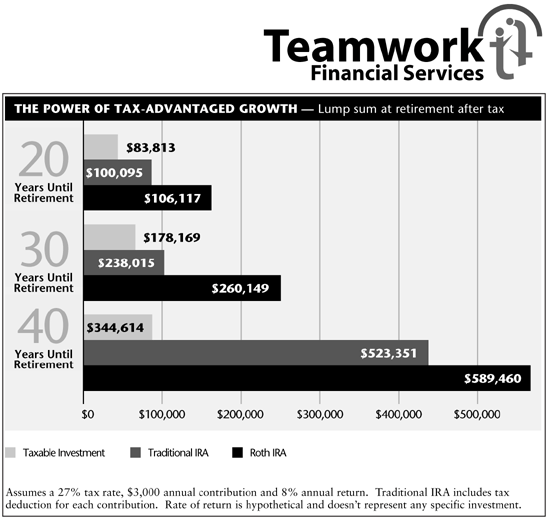
Technology on Trial. A second pilot for the Health Channel took place on Sept. 18 2002. The International eHealth Association was holding its annual meeting in London. On of the meeting’s feature events was a debate on the right of health information for primary care providers in low-income countries. The debate followed the format of a court proceeding. The “judge” was Dr. Richard Smith, editor-in-chief of the British Medical Journal, with medical authorities taking positions for and against the proposition. Cross-examinations took place and people cast their votes and a final judgment was rendered. The two-hour session was carried live by transmitting the debate to the WorldSpace uplink site in London. There was live audio from two other sites summarizing the views of the participants at those locations. Listeners from any of the locations were able to send questions or comments by e-mail to a specific address to contribute their views to the closing session. From Pilot Stage to Permanent Phase. The seminar in August and the debate in September were two convincing demonstrations of the WorldSpace system and the CLASS methodology to serve medical professionals and the general public. Other pilot programs are now in development as WorldSpace and its partners work to make the Health Channel a reality for Africa and Asia. This article originally appeared in the online magazine of Bytes for All, a South Asian initiative to bridge the digital divide. Readers can reach the Web site by visiting www.bytesforall.org - S. Rangarajan is senior vice president of Washington, D.C.-based WorldSpace. WorldSpace is the pioneer of direct satellite delivery of digital radio and multimedia services and serves Africa, the Middle East, Asia and Western Europe. |TOP| Report:  Language and Sickness The Story of Ms. Rivera – By Dr. Alice Chen A bilingual child had to choose between going to school and interpreting for a sick sister. Non-English speaking patients must not be forced to make such a terrible choice, writes Alice Chen. Ms. Rivera, a patient of mine in her late twenties, was in my office for her regular check up. She had her three-year-old boy with her, who was busy playing with a tongue depressor. Her older child was already in elementary school. I was not aware that she never finished high school. After congratulating her, I asked what had prevented her from finishing. She told me that her little sister had sickle cell anemia. When they were young, her sister spent much of her time either in the doctor’s office or in the hospital. Because her parents didn’t speak much English, Ms. Rivera’s parents would bring her along to serve as an interpreter every time her sister became sick. As a result, she missed so much school that she wasn’t able to graduate with her friends. Now, more than 10 years later, after having two children of her own, she had finally earned her high school diploma. I wondered what it was felt like for a child to assume such a responsibility. I thought of the children I see, who often ask their parents what this or that word meant. How many children know what “red blood cell,” “sickle cell anemia,” or “oxygen therapy” mean, let alone how to say these words in two languages? I thought back to one of my medical school professors, who had said that in the first two years of medical school future physicians learn so many new terms that in effect they are learning a new language. If this is true, medical interpreters need to know at least four languages – English, a foreign language and also medical terminology in English and the other language. Ms. Rivera was proud that she was able to help her family, but also described the pressure she felt serving as her parents’ ears and voice, and her uncertainty about what she was interpreting. She also remembered feeling a little resentment at having to devote so much energy to interpreting during hospital visits. Ironically, her little sister, who focused on studying as a way to cope with her illness, had done well in school and became a successful accountant. Using children as medical interpreters is unfair for both the child and the parents. In Ms. Rivera’s case, it robbed her of her schooling. For her parents, it meant having an interpreter who offered inaccurate and incomplete translations. Luckily for the family, Ms. Rivera’s little sister did well. In cases where the outcome is not so good, guilt and blame can arise over misinterpretations. There are alternatives to using children as interpreters. There are local and state laws that require public institutions, such as public hospitals and clinics, to hire bilingual staff for certain languages. There is a state law that requires hospitals to provide interpreter services to their patients. And if you are covered by public insurance, such as Medi-Cal and Healthy Families, you have a right to an interpreter whenever you call your health plan, see your doctor, or go to the hospital. Other insurance companies are also starting to provide trained medical interpreters for their members. So next time you go to the doctor or hospital, think twice before using a child as a medical interpreter. It could be hazardous to your health – and bad for your child. If you have encountered language barriers in seeking health care for yourself or a family or friend, and you need advice about how to deal with them, write Dr. Alice, care of Language Access, New California Media, 275 9th St., San Francisco. Mention where you read this article. - Dr. Alice Chen is Soros advocacy physician fellow with the |TOP| Business: 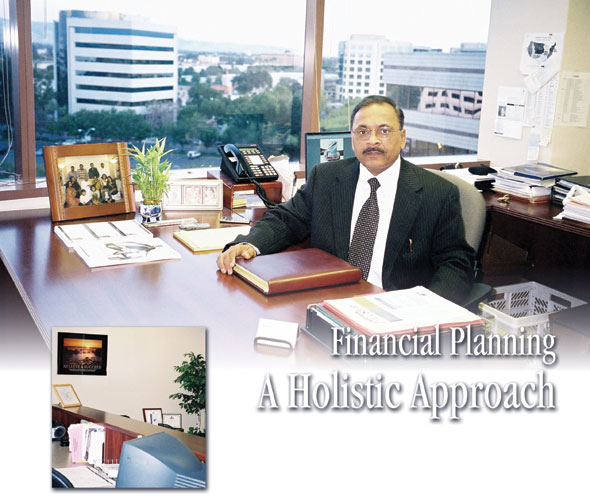 Financial adviser Ashok Gupta at his office at Teamwork Financial Services. Financial Planning: A Holistic Approach – By Urmi Ghosh-Dastidar A San Jose, Calif. firm provides in-depth, holistic financial planning, writes Urmi Ghosh-Dastidar. Planning a financially secure future is more than doing some basic math and jotting down some numbers. A financial advisor could help you draw a general plan or strategy, but you may need more, different expert help. Are you planning for documents to transfer assets to the next generation? You need legal advice. Working through the ever changing, bewildering tax thicket? Only an accountant or CPA can crunch the numbers for you. San Jose, Calif.-based Teamwork Financial Services works with a team of professionals to provide financial, legal, tax and expert accounting advice so that a business or an individual can access a comprehensive suite of services. “We work in a team,” says financial adviser Ashok Gupta of Teamwork. The financial adviser, the CPA and the attorney—these three people are the main part of a financial plan for any individual, small business or corporate sector. “Everybody is not perfect in everything. For migraine you go to a neurologist, if you have chest pain, you would see a cardiologist.” There are trust officers, realtors and other experts to provide assistance in different stages of your financial strategies. What’s more, Teamwork is willing to work with the client’s attorney, CPA and other professionals. Financial planning is a must. Times are tough, the job market is wobbly, money worries reign supreme. Businesses worry about cash flow, family’s worry about retirement, junior’s college, beti’s shaadi. Will everything work out in the end? That answer may not be known until the future, but experts say two issues are as certain as death and taxes. And it affects you all the same whether you are rich, poor, black, Hispanic male or female. Issue no 1. If you aren’t planning ahead, you are almost certainly losing money. What would you think of a guy who threw away several hundred dollars every year? Or a lot, lot more? Crazy? Well, the funny thing is many perfectly reasonable, sensible people procrastinate on the one most important thing they could do to add money to their business and family expenses—planning your finances. Here’s a quick but telling example of the advantage of saving early. Suppose Mr. Patel and Mr. Khan both have a working life of 30 years. Let’s say Mr. Patel saves $2,000 each year for the first 10 years, but doesn’t save a penny after that. Mr. Khan starts 10 years later, and saves $2,000 for the last 20 years of his life. Do the simple math and you know that though a late starter, Mr. Khan has saved $40,000 which is double of Mr. Patel’s $20,000. Here’s the shocker: assuming their money is invested at 10 percent compounded interest, its Mr. Patel who comes out ahead, with $235,882 against Mr. Khan’s $126,005. See what I mean? Issue no. 2 How do you get there? This is where many people make the error of being penny wise, pound foolish. Sure it will cost you money to go to a financial planner, but it is virtually certain that the expert help you get will save you what you spend many, many times over. Most people yawn at the thought of large series of numbers and math, but think about it for a moment. At the end of the day, financial planning is subjective, because different people have different goals, and different incomes. You might want to splurge on your daughter’s wedding, but you might expect your kids to attend state colleges. Or the other way round. You may expect your kids to go through the public school system, or you might prefer to send them through private schools. With the resources you have at your command, you also have to save something for your retirement. Would a modest income satisfy you? Or do you wish to maintain the same standard of living after retirement. Your financial strategy will differ according to what you wish. Here’s where expert help is invaluable. Who but a professional accountant can walk you through the maze of complex tax law—which keeps changing—to figure out how to match your resources to your wishes to the maximum extent. Teamwork helps clients through a six-step process:
Even after a strategy is planned and set in motion, Teamwork people sit with client and review solutions on a periodic basis. “It’s like when you go to a doctor,” Gupta said. “The doctor takes all your personal health related information, sends you off to a lab to investigate. When he has the information, he plans treatment. He finds a solution and follows it up.” Interested readers can find out more about Teamwork Financial Services at their Web site at www.teamworkfinancial.com. - Urmi Ghosh-Dastidar is a freelance writer |TOP| Ethnic Issues:  A Rainbow of Opinions: 2003 Multilingual Poll – PACIFIC NEWS SERVICE A new multilingual poll in California shows racial, ethnic splits among California voters on recall, replacement ballot, Proposition 54, race relations. A Pacific News Service report. The California electorate is sharply split along racial and ethnic lines with Latino, African American, Asian American and white voters expressing distinctly different views of the recall, of Gov. Gray Davis’ performance in office, of the candidates seeking to replace him and of the racial classification initiative (Proposition 54). These are among the major findings of the 2003 Multilingual Survey of California Voters, an in-depth survey of registered voters with large samples of racial and ethnic groups that typically represent small fractions of respondents in statewide polls. The survey was conducted Sept. 6-16, 2003, by the public opinion firm Bendixen & Associates for a partnership of four organizations: USC Annenberg’s Institute for Justice and Journalism, the Pew Hispanic Center, New California Media and The Tomás Rivera Policy Institute. The Recall Election. Hispanics (45 percent support vs. 47 percent oppose) and Asian Americans (44 percent support vs. 46 percent oppose) are closely split on whether Gov. Gray Davis should be removed from office, while blacks oppose the recall by a wide margin (65 percent vs. 23 percent) and whites favor the recall (56 percent vs. 35 percent). In the contest to replace Davis, should the recall succeed, Latinos (57 percent) were more than twice as likely as whites (22 percent) or Asian Americans (25 percent) to say they will vote for Lt. Gov. Cruz Bustamante and more than three times as likely as African Americans (17 percent). A similar split emerged when respondents were asked whether they had a positive or negative attitude toward Bustamante, with 41 percent of African Americans expressing negative views, while 67 percent of Latinos expressed positive views. Support for Arnold Schwarzenegger varied widely. Asian Americans (22 percent) and whites (20 percent) said he would get their vote in about equal measures—at about the same level as Bustamante—while support among Latinos (13 percent) and blacks (7 percent) was significantly lower. “Some very clear differences along racial and ethnic lines emerge from this survey, notably between Latinos and blacks,” said Pew Hispanic Center director Roberto Suro. “Whether they are peculiar to this election or reflect more fundamental divides will be critical to California’s political future.” The Views of Latinos. By including interviews with a large sample of Latinos in both English (48 percent of the sample) and Spanish (52 percent), the survey was able to explore the range of views within this segment of the electorate. Substantial differences emerged between English- and Spanish-speaking Latinos. For example, English speakers were more than twice as likely (40 percent vs. 16 percent) as Spanish speakers to say Davis is doing a poor job as governor. English speakers also were more likely to say they would vote to recall Davis (51 percent vs. 39 percent). Bustamante drew greater support among Spanish speakers (66 percent) than among English speakers (47 percent). And more Spanish speakers had negative views of Schwarzenegger (65 percent) than did English speakers (52 percent). In contrast, no substantial differences according to language preferences emerged in Latinos’ views of Proposition 54. Nearly half (49 percent) of Latinos said that Schwarzenegger’s support for Proposition 187—the 1994 initiative that would have denied social services to undocumented immigrants—and his alliance with former governor and Prop. 187 backer Pete Wilson affected their opinion negatively, with Spanish speakers (59 percent) more likely to express that view than English speakers (37 percent). “Contrary to the pundits’ prediction that Schwarzenegger’s support among Latinos will come from the male youth vote, the poll reveals that his support among likely Latino voters (13 percent) comes primarily from those registered as Republicans,” said Harry Pachon, president of The Tomás Rivera Policy Institute, citing his institute’s further analysis of the survey findings. Proposition 54. Substantial numbers of California voters are still undecided or say they are not aware of Proposition 54, a ballot initiative that would amend the California Constitution to prohibit the collection and use of various kinds of racial and ethnic information by the state, local governments and schools. However, Latinos (46 percent), African Americans (41 percent) and Asian Americans (42 percent) are expressing more support for Prop. 54 than whites (31 percent). The presentation of three arguments on each side of the debate did not produce any significant shifts in respondents’ views. “The message for opponents of Proposition 54 is loud and clear. They’re not getting across to the very groups that they’re counting on most to defeat the measure,” said Sandy Close, executive director of New California Media. Race Relations. Views of race relations also reveal substantial divisions, with Latinos and Asian Americans seeing improvement but whites and blacks expressing more pessimism; 44 percent of both Latinos and Asian Americans said race relations in California are improving, but only 34 percent of whites and 24 percent of African Americans expressed similar views. A majority of Latinos (57 percent) and Asian Americans (59 percent) also see prospects for economic improvement, while African Americans are notably less optimistic: 29 percent said opportunities are worsening, and 45 percent said they are staying the same. Asked whether they need government protection against discrimination, substantial majorities of blacks (81 percent), Latinos (76 percent) and Asian Americans (69 percent) say they do. “Race and language both matter, and discrimination remains an important issue in California, but the real significance of this kind of polling is its value as a tool for hearing and understanding the full range of voices that will shape California’s future,” said Steve Montiel, director of USC Annenberg’s Institute for Justice and Journalism. Use of the Media. Significant percentages of Latinos (30 percent) and Asian Americans (39 percent) say they prefer receiving their news in a language other than English. Among Spanish-speaking respondents, 57 percent said they prefer Spanish-language media, while 31 percent said they prefer English-language media, indicating substantial bilingualism in this segment of the Latino population. At least two-thirds of all respondents say they depend on some form of television for news that shapes their voting decisions, with about 15 percent of Latinos, African Americans and whites and only 8 percent of Asian Americans saying they rely on newspapers. More than half of all respondents rate media coverage of the recall and issues important to them as good or excellent.
Quotas were established for the Asian sample so that it is representative of the major Asian American ethnic groups in California’s electorate. Respondents of Japanese, Filipino and Asian Indian heritage were interviewed in English only. All Asian American and all Hispanic respondents chose their language of preference for the interview. All survey respondents are currently registered to vote and have voted in at least one of the last two statewide elections. Legal Issues:  A Matter of Life and Death The Benefits of a Living Will – By Raja Ahluwalia The living will can ensure harmonious, mutually agreed decisions at times of terminal or disabling illness, writes attorney Raja Ahluwalia. Typically, the first reaction an estate planning attorney gets is: “I don’t need estate planning.” Ordinary people are often totally unaware of what is included in estate planning. Normally, people think that they have to have a huge estate to need estate planning. The reality is somewhat different: An estate planning attorney has many tools in his toolbox and different tools are used depending upon the client’s situation and objectives — personally, financial and emotional. One of the tools in estate planning, which is universal and is recommended for every one, is a living will. A living will, or advanced medical directive, is a legal document, which directs your physician to discontinue life-sustaining procedures if you are in a terminal condition or in a permanently unconscious state. It is considered a final expression of your right to refuse medical treatment, which should be followed by your physician. Many people execute living wills so that family members or other loved ones are not put in the position of having to decide whether to terminate or continue life-sustaining treatment when there is no hope of recovery. It is true that during a healthy, productive life, issues of death and illness seem distant and morbid. However, the failure to prepare for death and terminal illness can not only put children or caregivers under severe emotional stress, it may also lead to decisions that you may not have necessarily approved yet are unable to influence. Take the sad case of Harish. An 80-year-old retiree, he did not want to handle these issues and kept on postponing. During a trip to India, he contracted cough, which upon return turned into pneumonia, then progressed to acute pneumonia and then caused blood infection because of old age and his body’s inability to resist ailment. He was hospitalized, was under sedatives and in coma throughout and due to medical complications died within nine days. He otherwise lived a healthy life but during his last days, his son and daughter had make some tough decisions and actually pulled the plug for him. Had he himself made those decisions, the family would not have to take those difficult decisions and wonder what he himself would have liked. A living will would have resolved this situation in a much more satisfactory manner. A living will is now recognized in virtually all states. Most states have very detailed laws setting forth the language that must be included in order for the document to be valid. As each state has different laws, it is a good idea to check with an attorney in your state to get more information on your state’s requirements. You should be aware that most major hospitals have created ethics panels or independent review boards which consist of physicians, nurses, and other personnel not currently involved in the treatment of the individual in question. These panels or boards review the situation and give the treating physician(s) direction. You should ask your local hospital (or the hospital where you may be taken if you have a severe or terminal condition) what its policies are in regard to living wills. Beyond expressing your wishes as to life-sustaining issues, you may also express your wishes with regard to courses of medical treatment. In a power of attorney for health care, you name a surrogate or attorney-in-fact to make medical decisions for you if you are unable to do so yourself. For instance, if major surgery or long-term treatment is proposed and you are too ill to make your feelings known, your surrogate would invoke the power of attorney to facilitate your wishes. Some of the issues you may want to address specifically are terminal conditions or illnesses (such as certain types of cancer, stroke, and major heart problems), vegetative states, and the types of treatments you may want to have withheld (such as tube feeding, artificial nutrition, hydration—in all their various forms). Your personal medical concerns may dictate other issues that should be included. Be sure to address quality-of-life issues and make an express statement of your desire and philosophy regarding your right to die with dignity. It is impossible to create the perfect document when you cannot know what the specific situation will be at the time help is needed. With comprehensive medical directives, however, you should have some peace of mind that your wishes have been made known and will be carried out. — Raja Ahluwalia is an attorney based in San Mateo, Calif. |TOP|
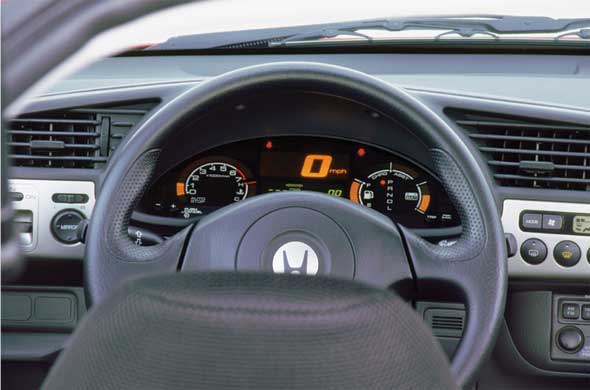
Auto Review: Humpty Dumpty sat on wall —Nursery Rhyme In this case, Humpty Dumpty is the years of hype and disingenuous postures of the automobile industry over electric cars as the answer to zero pollution. The validity of the genre was constantly on the edge of falling off its perch. The final shove came recently when the California Air Resources Board rescinded, by a vote of 8-0, the statute that regulated the percentage of zero emission cars sold by the carmakers in the state. The fact that the industry never took the electric car seriously became more pronounced as time went on. Unlike the King’s men and horses, the industry is now seriously putting their own Humpty Dumpty back together. And when he is whole again, the roads should be populated by a strange sounding mélange of names, alphabet soup and power sources. The Japanese industry has already begun the healing process with the introduction of Toyota’s Prius and Honda’s Insight and Civic Hybrid. All three models are what are today defined as hybrids, meaning they are powered by a traditional internal combustion engine augmented by an electric motor. Now the American giants are joining the parade, led by Ford Motor Company. Detroit is also seriously reaching further with research and development of the latest genus, fuel cells.
Rated as an SULEV (super-ultra low emission vehicle) and PZEV (partial zero emission vehicle), the Escape Hybrid SUV will accelerate and perform on the same level as the traditional 201 horsepower, V6-powered Escape. The engine generates 148 horsepower and 152 lb.-ft. of torque. Mileage has been computed at 35-40 miles per gallon. According to John Clinard, Ford western region public affairs manager, the Escape Hybrid will be offered in both front-wheel and all-wheel drive systems. Pricing for both models, said Clinard, won’t be announced until “close to (the) on-sale date in second half of 2004. Low volume production of fleet models will begin at the end of 2003 and the retail models will begin production in the latter half of 2004. Next up will be a 2006 Ford Futura sedan slated to be on the showroom floor in 2005 as a 2006 model. The Futura will be the first of ten Ford, Lincoln and Mercury products from the same flexible architecture. According to a Ford spokesperson, the Futura will be powered by the same 2.3-liter I-4 and 65-kW electric motor installed in the Escape. Ford’s hybrid system was co-developed by Ford, Volvo and Aisin AW. Stretching even wider is the ongoing R&D of fuel cell technology. In 2002 Ford Motor Co. built 15 FCV (fuel cell vehicle) Focus cars as test modules for future production models. The FCV Focus vehicles are classified as “hybridized fuel cell vehicles” that combine the latest hybrid and fuel cell technology. One of Ford’s main targets is to produce an FCV that can offer a range of up to 200 miles, as opposed to current maximum ranges of 100 miles or less. Ford is working along with DaimlerChrysler and Ballard Power Systems of Vancouver to form a Fuel Cell Alliance to advance this technology. When Humpty Dumpty is released from ICU, he looks to be a potential force in the automotive industry for the 21st century…finally.
VARIOUS HYBRID MODELS Honda Civic Sedan Hybrid: 1.3-liter I-4 cylinder engine with 10 kW permanent magnetic electric motor. Engine generates 8 5 horsepower and 87 lb.-ft. of torque. Estimated fuel consumption: 46 city; 51 highway (5-sp. manual transmission); 48 city; 47 highway (CVT automatic). Honda Insight Coupe: 1.0-liter, I-4 cylinder engine with 10 kW permanent magnetic electric motor. Engine generates 67 horsepower and 66 lb.-ft. of torque. Estimated fuel consumption: 61 city; 68 highway (5 sp. manual transmission); 57 city; 56 highway (CVT automatic). Toyota Prius Sedan: 1.5-liter, I-4-cylinder engine with 33 kW permanent magnetic motor. Engine generates 70 horsepower and 82 lb.-ft. of torque. Estimated fuel consumption: 52 city; 45 highway (CVT automatic-no manual available). Al Auger, our automotive editor has been writing about cars for over 30 years. Guftugu In Samay, Sushmita Sen plays an assistant commissioner of police without uniform. “One of the main reasons for my doing the film is that a woman is doing a man’s role. Imagine an entire screenplay written with a man in mind, his body language, his dialogue delivery, his presentation. And now you have a woman doing exactly that, it’s a rocking idea,” Sushmita says about debutant director Robby Grewal’s thriller. This, coming from the actress unkindly dubbed silicone valley by Bollywood wags who darkly speculated on the bonafides of her you-know-what. We wish the Bengali belle well, particularly considering the fact that she hasn’t had a great time lately. Her film career hasn’t done terribly well, and her personal life hasn’t been much to write home about, either. She has drawn snickers for doing “item” songs—Bollywood shorthand for brief appearances with no relation to the main story—but she is unapologetic about it. “I will not differentiate between these things as an artist,” she said. “I believe whatever you do you have to do with a certain amount of integrity.” Well said, dear Sush, but all the integrity in the world won’t do you much good if you can’t act. Let’s hope for our sakes as well as hers, Sush breaks new ground here as well. Those who did got a genuine, king-size helping of the real thing—it doesn’t get more authentic Bollywood than films like Dil To Pagal Hai, Kabhi Khushi Kabhie Gham, Dilwale Dulhania Le Jayenge and Lagaan. “A Beginner’s Guide to Bollywood” festival director Mitu Lange says that it’s not just Indians who came. “We’ve seen a really healthy rise of interest within the Australian community,” she says. “I would say 35 percent of our typical audience is mainstream Australians, another quarter are from the subcontinent and the rest are of Indian heritage.” Kerry Casey brought her daughter to see Dil To Pagal Hai, and she was delighted. “Indian cinema is so exotic,” she told PTI. “The music, the culture, the costumes. They tend to go overboard, but that is what I like about it. Here in Australia, there is a need for diverse cinema as we are bored with Hollywood.” Just when Hrithik is ready to sit back and enjoy a much-needed boost to his career with the smashing success of Koi Mil Gaya, the only-in-Bollywood combo of sci-fi and musical, this ugly dispute raises its head. Like most things in Bollywood, it’s about money. Jayantilala Gada of Popular Entertainment Network has slapped six lawsuits against the three, accusing them of cheating. Roshans had made deals with Popular Entertainment Network for merchandizing their past and future films, including Kaho Na Pyar Hai. J. Omprakash also made an agreement with the company for marketing films made by him. However, a dispute arose over payments. The High Court told the bickering parties to kiss and make up, and they met on Aug. 6, but they are still at loggerheads. The matter is now going to drag on forever in court, it seems. But his international reputation is growing now. First it was Bombay Dreams with Andrew Lloyd Webber, who took the Indian whiz-kid composer under his wing to write a musical that borrowed equally from the West and Bollywood. Now Rahman is coming to test his luck at the Oscars, via China. Talk about circuitous route. His first-ever Chinese film, Warriors of Heaven and Earth, will be the 2004 official entry to the Oscars. The period saga is directed by Hei Peng. Rahman is the first Indian to work behind the Great Wall with the ace director who had earlier directed Red Firecracker Green Firecracker and wrote the screenplay for Swordsman in Double Flag. What now? “I am considering a couple of Hollywood offers. I refused one of Miramax’s films as I found the theme very dark.” No kidding. However, Bollywood apparently has cottoned on to Hollywood’s dirty secret, i.e. hit pay dirt with a hit, and then keep milking it for all it’s worth. It’s a bad idea whose time has come. So masala phillum-loving bhaiyon aur behnon, brace yourselves for a flurry of second installments of a whole bunch of characters that you have seen before, whether you want to or not. N. Chandra, thrilled with the success of Style is getting ready with Xcuse me, and is telling anyone who will listen that his Kyonki Dil Bola Re is actually Style III. Excuse me? Nagesh Kukunoor is about to start Hyderabad Blues II, and even arty director Govind Nihalini is getting on the bandwagon. His Dev, he says, is a sequel in spirit (whatever that means) to Ardh Satya, his critically acclaimed film where Om Puri gave a memorable performance as a cynical cop. The last word must go to Ram Gopal Varma, whose sequel to Darna Mana Hai succinctly captures the feelings of apprehensive film buffs. It’s called Darna Zaroori Hai. We couldn’t agree more. Handing out cassettes to soldiers on both sides, Urmila said she is tired of currying favor to the baser instincts of hatred just to make a quick buck. “The film does not indulge in applause-drawing Pakistan-bashing. It does not take sides but rewinds to the terrors of that time,” she says. Is Sunny Gadar Deol listening? One wonders what Punjab da puttar have to say about this love fest. Equally smart, feisty and down-to-earth in real life, Perizaad is basking in the adulation of critics following the surprise success of Jogger’s Park. But a cool head rests on those pretty shoulders. She isn’t keen on signing all offers that come her way, she says. “I am being offered roles that most heroines would love, but I am choosy,” she says. “I sat home after Bollywood Calling, my successful debut, because I didn’t want to do trashy films. “After Joggers Park, I can afford to do films I want to. Most mainstream heroines are dying to do art house, so you can call me progressive and smart.” She wants to do the masala stuff too, but she is just a bit careful about what films she chooses to do. And who can blame her? Look at Big B, who seems to have a peculiar talent for choosing absolute horrors, and his fans have to go through the agony of seeing arguably Bollywood’s biggest star make a total ass of himself in some of the most trashy films in recent times. Hot Vegetarian Well, the online contest took place and Amitabh Bachchan and Czech-born supermodel Yana Gupta have won. Bachchan retained his crown from last year, edging out Hollywood star Richard Gere, top model John Abraham, south Indian heartthrob Madhavan, industrialist Anil Ambani and cricketer Anil Kumble, a PETA release said Sept. 17. Not all nominees would make women drool, though, so it’s not just about flesh. President A.P.J. Abdul Kalam was a very popular nominee, and he came a close second in the running, PETA said. Among the women, first-time winner Yana Gupta finished ahead of Liv Tyler, Shania Twain, Pamela Anderson and last year’s winner, Esha Deol, in the online contest, which drew over 37,000 total votes at PETA’s Web site. Speaking to PETA after she won the contest, Bollywood newcomer Yana attributed her beautiful complexion to her vegetarian diet. “If others learn about the benefits of vegetarian diet as a result of this, then this contest will have many winners,” she added. Bachchan said he was a vegetarian by choice. The shooting of his film was cancelled by the actor himself Sept. 14 after police said they could not provide security and asked them to stop shooting. The actor tried to shoot some scenes inside a wedding hall in Batalagundu early Sept. 14 evening but police officials who arrived on the scene said they were not in a position to provide security and “in view of the risk involved” asked the film crew and actors to leave. Earlier Puthia Tamizhagam party leaders had protested against the name. Kamal, after a meeting with the chief minister, said he would change the name of the film following which PT relented. Meanwhile, Kamal appealed to the media not to add “political or terrorist color” to the issue. Yeah, sure. Blame the media for your hassles Kamal, it’s the easy way out. Hindi Film Review Show Bust, and Go Bust  Gulshan Grover with Western Models in "Boom" Quest Films’ BOOM Written and directed by: Kaizad Gustad Kaizad Gustad’s outrageously appalling skin-flick looks like a horny adolescent boy’s wet-dream, what with the camera acting like a lecherous male, and any semblance of a storyline is buried beneath mounds of cleavage, dreadfully vulgar language and kinky sexual hijinks. Three supermodels, Anu [Madhu Sapre], Sheila [Padma Lakshmi] and Rina [Katrina Kaif], rule the international world of fashion. Anu trips on the ramp at a glitzy fashion show, and gets into a catfight with another model where her two pals join in (a scene, like many others in the film to numerous to mention, calculated to titillate the frontbenchers), and the trouble begins. The model with whom the lissome threesome fight is Michelle, who uses an admittedly innovative technique to smuggle diamonds. She hides them in her hair. Her tactic is exposed—literally—as during the fight hundreds of stolen diamonds fall out, much to the glee of the celebrities and paparazzi who jump into the fracas like kids at a piñata party. Glee is hardly the word to describe the reaction of the gangster trio, Dubai-based don Bade Mian (Amitabh Bachchan), Salim (Gulshan Grover) and Chhote Mian (Jackie Shroff). Their carefully laid out plans to have the jewels smuggled out to Dubai fail, and they are hopping mad about the lost diamonds. As far as they are concerned, it’s all the fault of the three models, and they are determined to teach them a lesson as well as get back the diamonds that is rightfully—rather wrongfully—theirs. With a good director and a modicum of skills and conscientious effort, the story had the elements of a dark, stylish spoof. What we end up with is a puerile apology for a film that shares company with some of the worst stuff ever to come out of Bollywood. And trust me, that’s saying something. First, let’s start with the dons. Why exactly Bollywood has this love-affair with violent crooks is a mystery, but Gustad doesn’t even attempt the gritty, realistic style of portraying the underworld like Ram Gopal (Satya, Company), Mahesh Manjrekar, (Vaastav, Hathyaar) or Hansal Mehta (Chhal)]. What he does instead is quite bizarre. Boom’s dons are weird buffoons with odd names Chhote Mian is Abdul 50/50, so named for getting 50 percent out of every deal, Saleem is Cut-Piece Saleem Suiting-Shirting for his kniving proclivities and as for Bade Mia (Amitabh Bachchan), based in Dubai, well don’t even get me started. One wishes to hold Amitabh by the scruff of his neck and ask him: What’s his problem? Even by his terrible standards of script judgment, this film is a dreadful choice. Give the devil its due, Gustad is a public relations artist par excellence. Not only did he manage to create a big hoopla around the film, he also managed to sucker in some of the best talent in Bollywood. He roped in Big B, talented Jackie Shroff and the redoubtable Seema Biswas, and pity poor Zeenat Aman for choosing this atrocious film to be her comeback vehicle. She can kiss any hopes of making a comeback goodbye. Himman Dhamija’s superb cinematography, Guruji Brothers splendid art direction and crisp editing by Rewa Childs is all in vain, it’s like putting lipstick on a pig. God knows what Gustad thought. Maybe he saw the success of Jism and thought all he had to do is show some tits and ass, and the moolah would flow in. Guess what, Mr Director? The Indian audience, like audiences around the world, let it be said, likes the occasional titillation, but you do have to have a well-packaged, crisp story to bring the film buffs in. If you thought desi audiences are a bunch of jokers who could be easily gulled, the joke’s on you. Latest news is that Boom has gone bust at the box office. Seldom in the history of Bollywood has a film so richly deserved this fate. You may well ask why we wasted precious space on it. Let’s put it this way: We reviewed this film as a public service health advisory. This film is poison. Rating: * (Awful) |Return to Bollywood Index| |TOP| Tamil Film Review: Same Old Story ALAI Director: Vikram Cast: Silambarasan, Trisha, Abhijit, Kuralarasan, Raghuvaran, Vivek, Saranya. Aadhi meets Meera. Aadhi hates Meera and Meera hates Aadhi. A few scenes later, Aadhi falls in love with Meera and likewise Meera falls in love with Aadhi. Meera’s friends tell her to act a little hard to get, so Meera ignores Aadhi and takes a shine on his kid brother. Aadhi soon catches on to her act, and in a tit-for-tat gesture ignores her. A few scenes later, the duo give up their act and reaffirm their love for each other. Now it’s Aadhi’s father’s turn to put a spanner in the romantic works. Citing a slump in business, the father suggests Aadhi marry his new business partner’s daughter. Aadhi decides to play martyr, till the partner’s real motive is exposed. So, to nobody’s surprise all loose ends are tied and the director seeks the clichéd comfort in the Shakespearean adage: “All’s well that ends well.” Quite honestly, the film appears to me a walking advertisement of the pathetic paucity of story ideas among our filmmakers. What compounds matters is the fact that no attempt is made to spruce up a hoary old tale with any degree of freshness in treatment. Director Vikram’s script is uninspiring, the treatment is lackadaisical. Trisha apparently thought she was playing a zombie in a horror film: she has a listless, walking-in-a-dream demeanor most of the time. To do herself and hapless viewers any favors at all, she needs to put more energy and life in her performance. Silambarasan goes to the other extreme. A bit too energetic and enthusiastic for comfort, he could do with a little more control, and in any case, all his energy wasted in a lackluster role. Younger brother Kuralarasan is plump, cute and endearing. Vivek tries to add some life with his comic antics, but you can’t flog a dead horse to life. What a total washout! Commercial filmmakers do not seem to learn. How long are they going to take Tamil film buffs for granted? They better wake up and take a quick look around themselves. Satellite and cable TV channels are multiplying like rabbits and the choice of entertainment is becoming wider by the day. Bollywood is already reeling after producing shoddy fare that today’s discerning audience refuse to accept. If they don’t get their act together, Tamil cinema could get a similar jolt. — Malini Mannath |TOP| Special Feature: 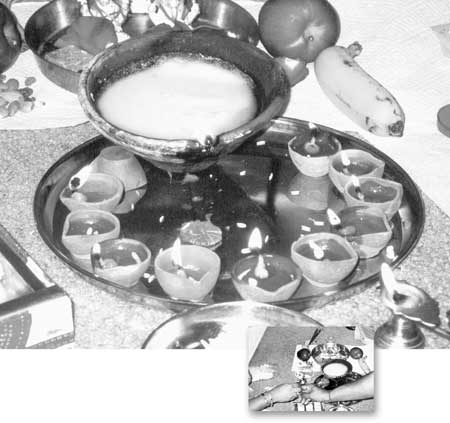 Legends and Tradition of Diwali – A Siliconeer Essay The rows of flickering lamps, their flames quivering in the dark, is surely the most vivid image of Diwali or Deepavali, India’s festival of lights, which brings together this diverse nation’s teeming millions together. Traditionally courtyards, gardens, verandahs, window sills, walls built around the home and even roof tops are lined with small lamps—diyas—to mark the five-day festival. In the cities, candles are also used, and some illuminate their houses with elaborate electric lighting. Like all major festivals in the world, Diwali’s significance is in the outpouring of warmth and camaraderie the festival brings with it. People dress in new clothes, exchange sweets, youngsters burst firecrackers, and old and young, men and women, rich and poor come together to celebrate.. According to the Ramayana, King Dasharatha had three wives: Kaushalya, Keykayee and Sumitra. The three wives bore four sons: Rama, Bharat, Lakshman and Shatrughan. Rama was the son of Queen Kaushalya; Bharat was the son of Queen Keykayee. Keykayee wanted Bharat to be the next king of Ayodhya, but Dasharatha wanted Rama, his eldest son, to inherit the throne. When Dasharatha grants Keykayee two wishes, she asks him to send Rama to exile for 14 years and to crown Bharat king. Bharat, the loyal brother, refuses to accept the throne, and when Rama is sent to exile, kept his footwear on the throne to express his symbolic allegiance to his elder brother. In exile, Rama fought and won a fierce battle against Ravana to rescue his kidnapped wife Sita. Ravana had earlier masqueraded as a deer to create circumstances where Sita, was left alone. Ravana had come and kidnapped Sita. Diwali marks Rama’s victorious return to his kingdom along with Hanuman, the monkey god who helped him achieve success. According to Hindu tradition, it took 20 days for Rama to return to his kingdom after defeating Ravana. This diversity notwithstanding, Diwali is one of the most joyous and favorite festival in India, uniting young and old, rich or poor, and even people of different faiths. It also marks the beginning of the Hindu New Year with the hope of a brand new beginning for all, as businessmen and traders open their new accounts. The festival is celebrated for five days, each day with its own significance, rituals and myths. Legend has it that King Hima learned that his 16-year-old son according would die on the fourth day of his marriage by snakebite, according to the prince’s horoscope .So on the fourth day of his marriage, his worried wife lighted lamps all over the place and laid all her ornaments with lots of gold and silver coins in a big heap at the entrance of her husband’s chamber. She did not stop there, she went on to tell stories and sang songs through the night. Yama—the god of death— arrived there masquerading as a snake. The brilliant lights blinded his eyes and he could not enter the prince’s chamber. So he climbed on the heap of ornaments and coins. There he sat all night listening to the melodious songs sung by the queen. In the morning, he quietly went away. The wife saved her husband and so the day of dhanteras is also known as the day of Yamadeepdaan. With his first step, Vishnu covered the entire heaven and with the second step the earth and asked Bali where to keep his third step. Bali offered his head, and putting his foot on his head Vishnu pushed him down to the underworld. But for his generosity Vishnu allowed him to return to earth once a year to light millions of lamps to dispel darkness and ignorance and spread love and wisdom. There is another story about this day. A small boy called Nachiketa used to believe that Yama, the god of death, was as black as the dark night of amavasya. On this day he met Yama in person. Yama’s calm countenance and dignified stature puzzled him. Yama explained to Nachiketa on this day of amavasya that by only passing through the darkness of death does man see the light of highest wisdom and only then can his soul escape from the bondage of his mortal body to commune with the supreme power. Recipe:  Perennial Favorite: Gajar Ka Halwa – By Seema Gutpa Traditional taste meets high tech convenience as Seema Gupta shows you how to make the most traditional of sweets with the help of the microwave. Ingredients
Method – Seema Gupta is a homemaker |TOP| Aries (March 21-April 20): The area of marriage and partnerships is in the spotlight for you. These circumstances could affect your personal resources and it could cause you agitation. A learning experience of an emotional nature is possible that will make you think about protecting your job and future earnings and this will be very lucky for you in spite of all your worries and concerns. Taurus (April 21-May 21): There are some positive circumstances surrounding your workplace as you seem to be content with the things the way they are, but some things around you could cause very vague concern. However your wish to see them in one way is due to the fact that you do not get a holistic perspective. You may receive favorable news about income. Gemini (May 22-June 21): You could have a great desire to take a pleasure trip, but this will be only in the wishing stages right now. Your mate or partner will be giving you encouragement toward making this a reality. This could also give you a chance to think about future plans and what you have learned in the past about your mate or relationship. Cancer (June 22-July 23): You could be spending a lot of your time this month at your home. You could be dreaming about how to invest some of your shared resources in beautifying your surroundings. Some news concerning your workplace could cause you some tension. Leo (July 24-August 22): You may share ideas with your mate or partner concerning how you could resolve your differences in a positive way. You are getting new ideas about how to increase your personal resources in the future. You have many personal limitations that you are keeping to yourself and this could cause you tension and put some obstacles concerning your relationship. Virgo (August 23-September 23): Your personal resources and values are in the spotlight this month. Certain highly positive incidents at your work place is nevertheless causing you a certain amount of uncertainty. A friend could cause some worries at work. Your mate will give a lot of emotional support and constructive ideas about plans connected to a far away place or a short trip. Libra (September 24-October 23): Lots of activity regarding investment or speculation as rapid changes in this area are happening right now. You will have to follow your intuition as confusion prevails. Your emotions are getting in the way of communication and could cause you some confusion in the matter of your shared resources. Scorpio (October 24-November 22): You will realize what is of value in your life. Harmony and luck will prevail at home. Changes are still happening. You will learn how to make adjustments toward the future with your mate. Interchange of ideas with a friend or close relative could be helpful. Sagittarius (November 23-December 21): Matters concerning friends are will occupy your attention. You could be receiving some communication of a pleasant nature. Your future at work seems to be full of good news and you will have much exchange of ideas that could affect your future in a very advantageous way. Control your emotions. Capricorn (December 22-January 20): Your career will come into sharp focus. This is all connected to your area of personal income. This could cause you concern regarding future investments. You need to be open-minded and learn from what is surrounding you. You might make some monetary gain. Encouragement will come from an old friend. Aquarius (January 21-February 19): Desire to take a far away trip is great but there are some obstacles connected to your responsibilities at work. Issues for the future at home are very harmonious right now but at the same time you are doing some emotional learning connected to all this. Your thoughts center around shared income issues. Pisces (February 20-March 20): Issues connected to your outside resources are on the agenda. Your dream of increasing your shared income could become to a lucky reality. Lines of communication with your mate or partner are wide open and of a very favorable nature. Your future is bringing you all kinds of emotional lessons connected to your career and goals. |TOP| |
||
|
|
|
|
|
|
Advertise in Siliconeer | Home | Subscribe PRINT Issue | About Us (FAQs) | Contact | Locations | Staff Login | Site Map
© Copyright 2000-2013 Siliconeer • All Rights Reserved • For Comments and Questions: info (AT) siliconeer.com |
|