!-- Start Alexa Certify Javascript -->
|
|||||||||||||||||||||||||||
|
|||||||||||||||||||||||||||
|
|
|||||||||||||||||||||||||||
|
|||||||||||||||||||||||||||
|
|
|
|
|
|

SEPTEMBER 2003 |
IN THIS ISSUE
MAIN FEATURE Westward Ho! : Indian IT Firms in Wales By Deepak Goyal COMMENTARY Dr King's Dream : A Latin American Perspective By Ariel Dorfman TECHNOLOGY Bengali Unleashed! : Free Bornosoft Download By Ashfaque Swapan Publisher’s Note • Infotech India • Indians Helping UN Vote No! on Prop 54 • Photo Essay: Celebrating India Healthcare and Language: Accidental Interpreter Legal Issues: Choosing Your Attorney Community: Cricket Academy... Little India... Andhra Fest... State Capitol Auto: 2003 Acura MDX • Bollywood • Tamil Cinema Recipe: Kalmi Vada • Horoscope |
||||
|
Publisher's Note
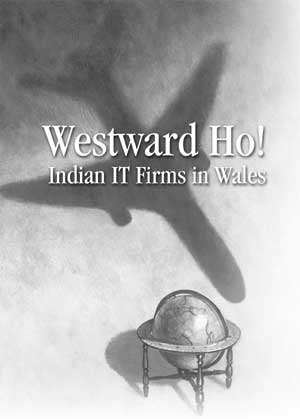
The IT boom in India has had a ripple effect that continues, culminating in the truly surreal spectacle of the Wales Development Agency being overjoyed that Indian companies like GTL Limited—India’s leading telecom infrastructure company—BPL Telecom—the country’s top provider of mobile telephony—Infrasoft Technologies—a financial software specialist and Elan—a company which is developing a unique laser technology for use in heart surgery—are willing to invest there. Quite a different scene from Indian leaders flocking to the West to woo investors. This month’s cover story focuses on the welcome development of the growing international reputation of Indian companies in the wake of India’s IT prowess. Main Feature
You bet you never thought you would live to see the day when the opposite would happen, i.e. a Western agency would woo Indian companies and be thrilled when Indian IT giants decided to take them up on their offer. This is exactly what’s happened and I am not making this up. Here’s what the Welsh Development Agency said in a press release: “India is one of the world’s leaders in biosciences and information and computer technology and is seen by the WDA as a prime source of investment by growth-minded Indian companies looking to expand into the European market.” WDA chief executive Graham Hawker said: “India has developed remarkable strengths in these sectors and many Indian companies are now looking for new opportunities in Europe. “We believe that there is a tremendous opportunity for Wales to benefit from joint ventures and partnerships with Indian entrepreneurs.” Hard to believe, but true. India’s sustained excellence in knowledge-based, value added skills is now blossoming into a powerhouse of corporate firms led by the likes of Wipro and InfoSys, and the world is sitting up and taking notice. The Indian invasion in Silicon Valley, the German Green Card carrot dangled before desi IT professionals and the huge trend of outsourcing of IT and IT enabled services like call centers and back office work are now passé. The new wrinkle in global business is the emergence of Indian firms which are beginning to go out and invest. “Four leading companies from India’s world-class computer technology and bioscience sectors are taking part in a new Welsh Development Agency project aimed at making Wales a major base for high technology Indian investment in Europe,” the WDA happily announced. The companies will establish operations initially employing some 300 people in North and South Wales when negotiations with the Welsh Assembly Government and the WDA are completed. The four include GTL Limited, India’s leading telecom infrastructure company, BPL Telecom, the country’s top provider of mobile telephony, Infrasoft Technologies, a financial software specialist and Elan, a company which is developing a unique laser technology for use in heart surgery. GTL head of European operations Deepak Rao said: “We are delighted to take part in this exciting venture. It will provide a number of very exciting propositions and avenues to us which we believe will build a long term partnership with Welsh organizations in our approach to European markets.” An essential aspect of the program is an undertaking by the WDA—working with partnership with Dina Dattani, a London-based corporate lawyer specializing in fast growth Asian companies—to help the companies establish themselves in business in Wales. Said Dattani: “We are now working to embed these first four companies in Wales, and to provide them with services such as advice on all legal and regulatory matters. Based on the success of this first phase we are planning to work with another 30 companies by the end of the year.” WDA is believed to be keen on bringing smaller companies to Wales after the dramatic failure of electronics giant LG Philips to bring thousands of jobs to Newport, the BBC reports. The closure of the LG Philips factory last month, with the loss of 870 jobs, was the final chapter in a story which began with grants of £220m and promises of 6,000 jobs. Brian Morgan, former chief economist at the WDA, said the new wave of companies would boost the hi-tech sector in Wales. “These firms that are coming in will be competing with firms we have already got here - it will be very helpful to bring in some new blood,” he told the BBC. Turning the table around the practice of Indian state governments taking their roadshows to Western capitals to bring in foreign investment, WDA’s pilot project with Indian companies stems from Welsh participation in one of India’s most important trade fairs. For the past three years, the WDA has been a main sponsor of the annual Nasscom conference at Mumbai. Feedback from the conferences and contacts made with businesspeople and intermediaries prompted the WDA to launch the pilot program earlier this year to gauge reaction from leading Indian businesses to a new, collaborative approach to investment in Europe. “We’re delighted with the progress which the pilot has already achieved and we believe that our involvement with Nasscom has been a very worthwhile investment of Welsh resources,” said WDA international executive director Hilary Hendy. “More and more world-class technology companies in India want to internationalize their activities. So far, these companies have been targeting the London area to start up in the UK or Europe.” To borrow the title of Charles Kingsley’s poem, “Westward Ho!” - Deepak Goyal is a freelance writer. He lives in Kolkata. |TOP| Infotech India “Already, over 50 Indian IT companies are operating in Germany, mainly in Bavaria which currently has 20,000 IT companies and 2.4 lakh employees in the multimedia and IT sector,” he told reporters here. Peter Englert was in the city in connection with his agency’s ongoing road show in Indian cities soliciting IT investors into Bavaria. He said Bavaria offered the least cumbersome entry for Indian IT companies to set up joint ventures in the state in areas like health care. “Bavaria is a premier location to exploit the European market by Indian companies,” he said. Announcing the deal at a joint conference with the company, Konsortium Logististik Bhd, Ramalinga Raju, chairman of Satyam Computer Services, said this was a milestone development, not just in terms of the technological competencies but also for the company’s strategy to grow operations in Malaysia and the region. “We are quite committed to this market place. We believe that there is enormous opportunity for the growth of business. We find government and economy here very responsive to the dynamics of market environment. This growth will be fuelled by the use of technology and knowledge based approaches,” he said. This is the first major business contract for Satyam since it firmed up operations in Malaysia in April last year with the launch of a Global Development Centre. The company expects a large growth from Malaysia. “By the end of the current financial year, we expect to earn around two million US dollars,” Virender Aggarwal, Satyam’s senior vice-president, Asia Pacific, told reporters, referring to the company’s Malaysian operations. “We already have about 40 professionals based here and around 35 in India are dedicated to the Malaysian operations,” Aggarwal said, adding that this will be further enhanced as the business increases. With the expertise gained by developing the indigenous multi-role LCA, an indigenous AJT could be developed in about six to eight years, he said here Sept. 5 night. He was giving a talk on: “Can it be a boom time for Indian Aerospace?” at an interactive session organized by Prasthutha, a student body of the Indian Institute of Science. Indian scientists, he said, two decades ago had an option of building either an indigenous AJT or LCA, but chose to develop the latter as they did not have adequate technical resources and manpower for both the projects. “We then decided to go for the LCA and the expertise gained over the last two decades has helped in Hindustan Aeronautics Ltd developing the Intermediate Jet Trainer in about 22 months... which was unthinkable even a decade ago,” Narasimha said. He said India had no option, but to buy AJTs from abroad given the urgency on the part of IAF to train its pilots. He asserted that if Indian aerospace industry should see a boom time, the government and policy makers should play a larger role. There should be larger orders for the LCA and the Advanced Light Helicopter from the armed forces. This significant expansion and additional capital investment in product development will allow Aventail to meet the growing demand for its EX-1500 SSL VPN family of appliances, a company statement said in Bangalore. “This is an exciting time in Aventail’s story and we are putting a stake in the ground to extend our market and technology leadership worldwide,” Aventtail Corporation president and chief executive officer Evan Kaplan said. “We expect this investment to help us more fully extend our technology leadership to take advantage of the surging SSL VPN market, which is expected to grow to $1 billion in 2005,” he said. “The India team would accelerate the development of new cutting edge technology to meet the future demands of the company’s expanding customer base,” he said. The initiative is designed to provide ISVs with technical and marketing support to help meet the needs of SMB customers, an IBM statement said. As part of the initiative it said ISVs work with IBM India to port their applications to IBM’s open infrastructure, with a special focus on IBM WebSphere Express and IBM DB2 Express running on Linux, as well as IBM WebSphere and IBM DB2 Universal Database. IBM India intends to broaden the scope of ISV advantage program over time to include new IBM Express software, hardware and services offerings as they become available. This will further enable ISV Advantage participants to build comprehensive solutions to better serve SMB customers, the statement added. Bangalore-based Biocon is finalizing its plans to raise a debt capital of $ 30 million (Rs. 150 crore) from domestic and foreign financial institutions for funding the expansion of its facilities for Statin (a molecule being produced by Biocon), research and biological and monoclonal anti-bodies, Biocon chairperson Kiran Mazumdar Shaw told reporters in Bangalore Sept. 3. Besides the $30 million raised through debt, she said, the expansion would be funded by internal accruals also. Biocon recorded a profit of Rs .50 crore on a revenue of Rs. 285 crore in the last fiscal, Shaw said, adding the company was aiming at a revenue of Rs. 520 crore and profit of Rs. 120 crore during 2003-04. She said Biocon was in the process of human clinical trials development for its recombinant human insulin, for which it is in discussions with firms in several countries. The recombinant human insulin was expected to hit the market during the first quarter of the next financial year. On the firm’s initial public offer plans, Shaw said, the company would finalize the book makers by the year-end and the issue, with a 10 percent dilution in equity stake, would be held next year. About 70 percent of the Biocon equity is held by Shaw and her family, 15 percent by employees, 12.5 percent by AIG, which it bought from ICICI Ventures, and the remaining 2.5 percent by other investors. Software development and maintenance as well as business processing including back office functions like accounting, human resources, call centers and data analysis are the major areas of outsourcing to India, Forbes magazine said. English speaking IT graduates, low wage structure and an attractive labor pool takes India to the top position, the study concluded after comparing it with six other destinations — China, Russia, the Philippines, Canada, Mexico and Ireland. While analyzing profiles of seven countries, the study praised India for its friendly IT policies and commitment to ensure best possible facilities for its development. “Outsourcing is so ingrained in the fabric here that the Indian government has a national minister specifically for IT. The government favors IT foreign ownership and imposes no export taxes,” it said. Talking about the future, it said India’s outsourcing functions would change over time and it would get more complex jobs as countries like Vietnam offer rock bottom wages. “Simple base level back office payroll and data entry will got to rock-bottom-wage countries over time and countries like India will move up the chain and take on more complex software and product development services,” an analyst with Forrester Research, John McCarthy, was quoted as saying. The study said U.S. companies would outsource more than three million jobs by 2015, up from 300,000 today. The companies it has decided to invest are Bioserve Biotechnologies, Genomik Design Pharmaceutical and Silico Insights, APIDC-VCL chairman S.M. Balasubramaniyam told reporters in Bangalore. APIDC-VCL is a public-private partnership between the Ventureast Group and the Andhra Pradesh Industrial Development Corporation. APIDC-VCL managing director Sarath Naru said the fund has targeted a size of Rs. 150 crore, of which Rs. 50 crore had already been reached. The fund was in discussions with a number of financial institutions, banks and insurance companies for investment to reach the target, he said. Balasubramaniyam said they were also looking at a Singapore-based healthcare company for investment. The CDMA WLL service with limited mobility would also be commissioned in Tirupur soon, Chief General Manager, Tamil Nadu circle, K. Mahadevan, told reporters in Coimbatore. He said 5,000 fixed WLL facility would be given and the call charges would be similar to landline telephone. Mahadevan said both the services would be commenced shortly at Coimbatore, since testing was yet to be completed. The WLL instrument would be supplied by BSNL which would collect Rs.20 per month towards insurance coverage from the subscriber, in addition to the initial deposit and installation charges. On the status of CellOne, Mahadevan said another 100 towns in the circle, which has coverage of 126 towns, would be added by March 2004, by which an additional 1.7 lakh mobile connections would be provided. Admitting that there is decline in the basic telephone connections due to various reasons, he said it had come down to 28.42 lakh as on July 2003 as against 28.78 lakh at the end of March 2003. SAP, which has bagged the award for the third successive year, said, quoting a survey by PC Quest that 87 percent users of SAP had indicated that they will stick to SAP. “The award is a result of our unmitigated customer focus, high-quality customer support and the fact that our customers have been able to gain tangible benefits from SAP solutions,” SAP India president and managing director Alan Sedghi said in a statement in Bangalore. The joint venture is named French Ceilings Pvt Ltd and the production facility at Pondicherry, presently under construction, would start by February next, D.B. Radja, managing director of the joint venture told reporters in Chennai Sept. 3. Initial investment in the Pondicherry facility was to the tune of around Rs. 7 crore which, he said, would be doubled by 2005. He said 50 percent of the production from the facility would be exported to the Middle East and South East Asia. GAIL, Infraline Both Infraline and GAIL will be jointly working on this project. An expert panel has been formed by GAIL for this project. The primary author for this project will be Infraline. Proshanto Banerjee, chairman and managing director, GAIL, will be writing a foreword for the book. The project also has inputs from CRISIL, Trilegal, Ernst & Young, PricewaterhouseCoopers, KPMG and Shell India Ltd. According to Banerjee, “GAIL Infraline Natural Gas in India project will provide a central resource for the entire industry to follow. We are glad to be associated with it.” Speaking on the development, Yogesh Garg, director, Infraline Technologies, said: “The reference book will be a source of definitive information on the entire natural gas scenario in India and will help anyone with an interest in this sector, to formulate their strategies for future.” GAIL (India) Limited has become the exclusive sponsor of the reference book. In order to make the project more useful, there will be updates in the 13th and 25th month of publishing. The draft has been shared with key leaders in the sector, who have reviewed and given their respective inputs. According to Shaajee Verghese, director (Sales and Services), GE Power Services, India: “The information (presented in the book) can be of great help for the all industry segments (power producers and power consumers). The book puts together information gathered from various resources, hence it should be of great help to people at the corporate level, investors planning and also to new entrants into the segment.”
Commentary
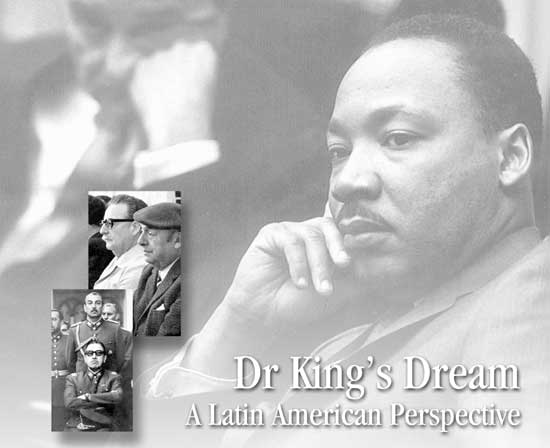 (Background) Dr. Martin Luther King (r) with President Lyndon B. Johnson. (Inset, top) President Salvador Allende, the world’s first democratically elected socialist president with poet Pablo Neruda (r) (Inset, bottom). Dr King's Dream: A Latin American Perspective - By Ariel Dorfman Forty years ago in August, Martin Luther King, Jr. gave a clarion call for civil rights. Activist and author Ariel Dorfman reflects on King’s relevance to Chile’s struggle and today’s dangerous world. Far away. I was far away from Washington, D.C. that hot day in August of 1963 when Dr. Martin Luther King, Jr. delivered his famous words from the steps of the Lincoln Memorial. I was far away in Chile, twenty-one years old at the time and entangled, like so many of my generation, in the struggle to liberate Latin America. The speech by King that was to influence my life so deeply did not even register with me. I cannot even recall having noticed its existence. What I can remember with ferocious precision, however, is the place and the date, and even the hour when, many years later, I had occasion to listen for the first time to those “I have a dream” words, heard that melodious baritone, those incantations, that emotional certainty of victory. I can remember the occasion so clearly because it happened to be the day Martin Luther King was killed, April 4, 1968, and ever since that day, his dream and his death have been grievously linked, conjoined in my mind then as they are now, forty years later, in my memory. I recall how I was sitting with my wife Angélica and our one year old child Rodrigo, in a living room, high up in the hills of Berkeley, the university town in California where we had arrived barely a week before. Our hosts, an American family who had generously offered us temporary lodgings while our apartment was being readied, had switched on the television and we all solemnly watched the nightly news, probably at seven in the evening, probably Walter Cronkite. And there it was, the murder of Martin Luther King in that Memphis hotel and then came reports of riots all over America and, finally, a long excerpt of his “I have a dream” speech. It was only then, I think, that I began to realize who Martin Luther King had been, what we had lost with his departure from this world, the legend he was already becoming in front of my very eyes. In the years to come, I would often return to that speech and would, on each occasion, hew from its mountain of meanings a different rock upon which to stand and understand the world. Beyond my amazement at King’s eloquence when I first heard him back in 1968, my immediate reaction was not so much to be inspired as to be puzzled, close to despair. After all, the slaying of this man of peace was answered, not by a pledge to persevere in his legacy, but by furious uprisings in the slums of black America, the disenfranchised of America avenging their dead leader by burning down the ghettos where they felt imprisoned and impoverished, using the fire this time to proclaim that the non-violence King had advocated was useless, that the only way to end inequity in this world was through the barrel of a gun, the only way to make the powerful pay attention was to scare the hell out of them. King’s assassination, therefore, savagely brought up yet one more time a question that had bedeviled me, as so many other activists, in the late sixties: What was the best method to achieve radical change? Could we picture a rebellion in the way that Martin Luther King had envisioned it, without drinking from the cup of bitterness and hatred, without treating our adversaries as they treated us? Or did the road into the palace of justice and the bright day of brotherhood inevitably require violence as its companion, violence as the unavoidable midwife of revolution? Questions that, back in Chile, I would soon be forced to answer not through cloudy theoretical musings, but in the day-to-day reality of hard history, when Salvador Allende was elected president in 1970 and we became the first country that tried to build socialism through peaceful means. Allende’s vision of social change, elaborated over decades of struggle and thought, was similar to King’s, even though they came from very different political and cultural origins. Allende, for instance, who was not at all religious, would have not agreed with King that physical force must be met with soul force, but rather with the force of social organizing. At a time when many in Latin America were dazzled by the armed struggle proposed by Fidel Castro and Che Guevara, it was Allende’s singular accomplishment to imagine as inextricably connected the two quests of our era, the quest for more democracy and more civil freedoms, and the parallel quest for social justice and the economic empowerment of the dispossessed of this earth. And it was to be Allende’s fate to echo the fate of Martin Luther King; it was his choice to die three years later. Yes, on September 11, 1973, almost ten years to the day after King’s “I have a dream” speech in Washington, Allende chose to die defending his own dream, promising us, in his last speech, that sooner rather than later — más temprano que tarde — a day would come when the free men and women of Chile would walk through las amplias alamedas, the great avenues full of trees, towards a better society. It was in the immediate aftermath of that terrible defeat, as we watched the powerful of Chile impose upon us the terror that we had not wanted to visit upon them, it was then, as our non-violence was met with executions and torture and disappearances, it was only then, after the military coup of 1973, that I first began to seriously commune with Martin Luther King, that his speech on the steps of the Lincoln Memorial came back to haunt and question me. As I headed into an exile that would last for many years, King’s voice and message began to filter fully, word by word, into my life. After all, if ever there was a situation where violence could be justified, it would have been against the junta in Chile. Pinochet and his generals had overthrown a constitutional government and were killing and persecuting citizens whose radical sin had been to imagine a world where you do not need to massacre your opponents in order to allow the waters of justice to flow. And yet, very wisely, almost instinctively, the Chilean resistance embraced a different route: to slowly, resolutely, dangerously, take over the surface of the country, isolate the dictatorship inside and outside our nation, and make Chile ungovernable through civil disobedience. Not entirely different from the strategy that the civil rights movement had espoused in the United States. And indeed, I never felt closer to Martin Luther King than during the seventeen years it took us to free Chile of its dictatorship. His words to the militants who thronged to Washington, D.C., in 1963, demanding that they not lose faith, resonated with me, comforted my sad heart. He was speaking prophetically to me, to us, when he said, “I am not unmindful that some of you have come here out of great trials and tribulations. Some of you have come fresh from narrow cells.” Speaking to us, Dr. King, speaking to me, when he thundered: “Some of you come from areas where your quest for freedom left you battered by the storms of persecution and staggered by the winds of police brutality. You have been the veterans of creative suffering.” He understood that more difficult than going to your first protest, was to awaken the next day and go to the next protest and then the next one, the daily grind of small acts that can lead to large and lethal consequences. The dogs and sheriffs of Alabama and Mississippi were alive and well in the streets of Santiago and Valparaiso, and so was the spirit that had encouraged defenseless men and women and children to be mowed down, beaten, bombed, harassed, and yet continue confronting their oppressors with the only weapons available to them: the suffering of their bodies and the conviction that nothing could make them turn back. And just like the blacks in the United States, so in Chile we also sang in the streets of the cities that had been stolen from us. Not spirituals, for every land has its own songs. In Chile we sang, over and over, the Ode to Joy from Beethoven’s Ninth Symphony, the hope that a day would come when all men would be brothers. Why were we singing? To give ourselves courage, of course. But not only that, not only that. In Chile, we sang and stood against the hoses and the tear gas and the truncheons, because we knew that somebody else was watching. In this, we also followed in the cunning, media-savvy footsteps of Martin Luther King: that mismatched confrontation between the police state and the people was being witnessed, photographed, transmitted to other eyes. In the case of the deep south of the United States, the audience was the majority of the American people, while in that other struggle years later, in the deeper south of Chile, the daily spectacle of peaceful men and women being repressed by the agents of terror targeted the national and international forces whose support Pinochet and his dependent third-world dictatorship needed in order to survive. The tactic worked, of course, because we understood, as Martin Luther King and Gandhi had before us, that our adversaries could be influenced and shamed by public opinion, could eventually be compelled to relinquish power. That is how segregation was defeated in the South of the United States; that is how the Chilean people beat Pinochet in a plebiscite in 1988 that led to democracy in 1990; that is the story of the downfall of tyrannies in Iran and Poland and the Philippines — although parallel struggles for liberation, against the apartheid regime in South Africa or the homicidal autocracy in Nicaragua or the murderous Khmer Rouge in Cambodia, also showed how King’s premonitory words of non-violence could not be mechanically applied to every situation. And what of today? When I return to that speech I first heard thirty-five years ago, the very day King died, is there a message for me, for us, something that we need to hear again, as if we were listening to those words for the first time? What would Martin Luther King say if he contemplated what his country has become? If he could see how the terror and death brought to bear upon New York and Washington on September 11, 2001 had turned his people into a fearful nation, ready to stop dreaming, ready to abridge their own freedoms in order to be secure? What would he say if he could observe how that fear has been manipulated in order to justify the invasion of a foreign land, the occupation of that land against the will of its own people? What alternative way would he have advised to be rid of a tyrant like Saddam Hussein? And how would he react to the Bush doctrine that states that some people on this planet, Americans to be precise, have more rights than the other citizens of the world? What would he say if he were to see his fellow countrymen proclaiming that because of their pain and their military and economic might they can do as they please, flaunt international law, withdraw from nuclear treaties, deceive and pollute the world? Would he warn them that such arrogance will not go unpunished? Would he tell those who oppose these policies inside the United States to stand up and be counted, to march ahead, never to wallow in the valley of despair? It is my belief that he would repeat some of the words he delivered on that faraway day in August of 1963 in the shadow of the statue of Abraham Lincoln. I believe he would declare again his faith in his country and remind us of how deeply his dream is rooted in the American dream, of how, despite the difficulties and frustrations of the moment, his dream is still alive and how his nation will rise up and live out the true meaning of its creed: “We hold these truths to be self-evident: that all men are created equal.” Let us hope that he is right. Let us hope and pray, for his sake and ours, that Martin Luther King’s faith in his own country was not misplaced and that forty years later his compatriots will once again listen to his fierce and gentle voice calling to them from beyond death and beyond fear, calling on all of us to stand together for freedom and justice in our time. - Argentina-born playwright, poet, novelist, cartoonist, essayist and |TOP| Report:  (Background) Indian students like these benefit from a host of UN programs in India (Doranne Jacobson/ UN photo) Indians Helping UN The Pride in India Challenge – A Siliconeer Report Indians are responding warmly to a fundraising call from the United Nations Foundation. A Siliconeer report. Indians have warmly responded to a $56,000 challenge grant issued by the Washington D.C.-based United Nations Foundation to celebrate India’s 56th Independence Day, already giving $20,000, according to a UNF press release. Gifts for the “Pride in India” challenge ranged from a $5 contribution from Tokyo to a $5,000 check from the U.S.-based Suri Sehgal Foundation, said Seema Paul, senior program officer at the UN Foundation who is now leading the organization’s focus on India. “I am really proud to find there are people around the world who want to make a positive contribution for the development of India, even if they don’t live there anymore. As an Indian myself, it gives me a lot of hope for the future of my country,” she said. The UN Foundation reached out to the 20 million-strong global Indian Diaspora, through the media, flyers and an email campaign built around India’s Independence Day. The campaign will continue through Diwali, creating a tradition of giving around India’s most celebrated festival, Paul said. The UN Foundation, created by philanthropist and entrepreneur Ted Turner, is matching every gift contributed to its United Nations projects in support of India’s advancement, dollar-for-dollar, up to $56,000. Givers have a choice to decide on one of three areas they want to impact most — environment, children’s health and women and development. Donations can be made through the UN Foundation’s India website, PrideInIndia.org, which was launched to coincide with India’s Independence Day on August 15. For more information on the UN Foundation’s grantmaking to India, visit www.PrideInIndia.org. Politics:  Fighting for Minority Rights Vote No! on Prop 54 – By Birjinder Anant and Bhavna Shamasunder South Asians should oppose an initiative that could take the state back decades in terms of civil rights, write Birjinder Anant and Bhavna Shamasunder. An initiative on the Oct. 7 is receiving little press, but has potentially tremendous consequences for the lives of all Californians. Proposition 54 advocates statewide censorship — a ban on racial and ethnic data collection throughout the state. If enacted, Proposition 54 (CRECNO—Classification by Race, Ethnicity, Color, National Origin) would censor essential data collection on public health, employment discrimination, racial profiling, education, and consumer protection. If passed, this initiative would have devastating impacts on the South Asian community, particularly in the areas of health and civil rights. CRECNO is an initiative sponsored by Ward Connerly, an anti-civil rights crusader, who spearheaded the passage of Prop 209 to end affirmative action in California in 1996. Connerly is banking on our ignorance to propel California backwards and make it virtually impossible for our communities to gather information that would improve our health, our access to jobs, and our quality of life. Originally dubbed the “Racial Privacy Initiative,” CRECNO has little to do with privacy (government data is already collected anonymously), and a lot to do with censorship and anti-democratic repression of basic information that empowers all California citizens. If enacted, CRECNO would potentially prevent South Asians from knowing and acting on facts such as:
Bad for Our Health These programs exist in every state in the country, and allow for the prevention and detection of thousands of cases of genetic disease every year. Diseases such as diabetes, heart disease, breast cancer, Tay-Sachs, cystic fibrosis and sickle cell anemia are conditions that affect different racial groups to differing degrees. Early treatment in some of these genetic conditions can prevent serious mental retardation, profound disability, and death. California would go backwards in our ability to provide good health care and forward thinking research if this initiative is enacted. Virtually every public health and medical association in California is opposed to Prop. 54. Rather than propelling California backwards, we must arm ourselves with information and work constructively to achieve equality in California. We can only do this by acknowledging and confronting racial disparities in health, employment, and education. We must continue to conduct rigorous analyses of the racial and ethnic impact data that Prop. 54 are targeted to eliminate. In public health, as in many other critical disciplines, ignorance is not bliss. Connerly claims the initiative will bring us closer to a “colorblind” society. In actuality, it would leave Californians blind, deaf and dumb to the problems all around us—disproportionate health burdens, unequal schools and unfair discriminatory practices in employment, housing, transportation and law enforcement. We would also be unable to celebrate our community successes and achievements because we would not have the information as to where we stand as a community. Instead of banning information, we should demand more knowledge about social and economic conditions. CRECNO amounts to an undemocratic gag order. The South Asian community should not allow themselves to be tricked into voting for an initiative that could take the state back some 40 years in terms of civil and human rights. CRECNO will have the greatest impact on members of ethnic minority groups. But make no mistake: it is censorship that will ban the collection of basic facts on public health, employment and education that serve to improve the lives of all Californians. Vote “NO” on Prop 54 on October 7, 2003. Interested readers can find more information about Concerned Desis Against 54 at their Web site: www.DesisAgainst54.org - Bay Area-based activists Birjinder Anant and |TOP| Technology:  Bengali Unleashed!: Free Bornosoft Download – By Ashfaque Swapan A fundraising campaign has made a Bengali word-processing software free, writes Ashfaque Swapan. We take great pleasure in announcing that Bornosoft, the best Bengali software, is now a free download. (Go to www.digitalbangla.org for the link) The International Institute of Bengal Basin launched the campaign to make this software free through the Digital Bangla Project in Dec. 16, 2002. The great thing about BornoSoft is that it anybody can start using almost immediately, because it is a phonetic software that uses a consistent, easy-to-learn transliteration system. In today’s IT age, languages will fall by the wayside if computer usage in the language is not universal. Alas, Bengali, like other South Asian languages, is in a sorry mess. Only five percent of Bangladeshi computer users can type their language in the computer. The lack of computer word-processing skills in Bengali means that IT tools like the Internet, digital archiving and searching of information is beyond the reach of Bengali speakers. Popular Bengali software is so difficult that Bengali word-processing has become the sole domain of professional typists. Yet with Bornosoft, it takes just an hour to learn to type fluently. We made a deal with Bornosoft: We raise $30,000, Bornosoft makes the $55 software a free download. We blew the deadline and raised a little over a third, but Dr Abdus Shakil, the developer, accepted what we had raised, and at considerable personal financial loss, he has made Bornosoft a free download. We thank him and our donors, who are the real heroes of this campaign. Interested readers can find more information about the Digital Bangla Project at www.digitalbangla.org. - Ashfaque Swapan is a journalist who lives in Berkeley, Calif. |TOP|
Photo Essay:
Celebrating India: Independence Day Bash – By Som Sharma Bollywood star Dharmendra headlined FIA’s Festival of India in Fremont, Calif. Photo essay: Som Sharma
Healthcare and Language:
 Accidental Interpreter Highland Hospital's Bi Le – Pacific News Service Hospital interpreter Bi Le’s experience shows that clear communication is essential for effective health care. A Pacific News Service report. Every step that led Bi Le to become an interpreter at Oakland’s Highland Hospital seems to have happened by accident. First there was her scholarship to an American college when she was a high school student in Vietnam. The scholarship had originally gone to her brother but when he got drafted into the Vietnamese army, Le’s mother put Le, then only 15 years old, on the plane in his place. Then there was her decision to enter what was then the new field of medical technology. Le recalls that the idea for her career came from a professor who was impressed by the tireless way she worked to master English. Now 50, and married with two children, Le has worked as a clinical laboratory scientist at Highland Hospital since 1977. Now 50, and married with two children, Le has worked as a clinical laboratory scientist at Highland Hospital since 1977. But it was her encounter with another Vietnamese immigrant in Highland’s emergency room that convinced Le her most important contribution to the field of medicine stems from her work as a health care interpreter. The woman — who spoke no English — was described as having jumped out of a car on the freeway. Medical staff judged her suicidal and scheduled her to be transferred to a psychiatric ward. Le was asked if she would talk to the woman and find out why she had tried to kill herself. “It turned out this patient wasn’t suicidal at all. She had seen something interesting through the window of the car, and wanted to get out,” Le recalls. “The freeway was so smooth, she had no idea the car was moving so fast. In Vietnam, especially in the country side, people are used to hopping on and off the vehicles they’re riding in: a car moves about as fast as a bicycle.” When she was hired at Highland, Le had no idea her fluency in Vietnamese, Cantonese, Mandarin and English would be so valuable. With the huge influx of Asian refugees that came to the Bay Area during the mid-1980s, demand for Le’s interpreting skills grew. At first, she simply tried to translate what a patient was saying to the doctor, and translate what the doctor was saying to the patient. Now the role of hospital interpreter has become a profession of its own, with training courses, standards of practice, formalized rules. Today, Highland has a corps of dedicated interpreters on staff, but the language needs of its patients are so great multilingual staff like Le are still needed to step in and help. “It is difficult to balance two jobs,” Le says. “Sometimes people feel like, ‘Oh, she’s going again,’ but what good is a lab result if the patient isn’t getting the correct information?” Le remembers another woman who brought in after a suspected suicide attempt. This woman, also a recent immigrant, was trying to cook noodles on a gas stove, but, unable to figure out how to light the stove, she was poisoned by gas fumes. “They were tying her down and about to send her to the psychiatric ward. Can you imagine that, not knowing why you’re being tied down? Can you imagine what would have happened to her if I wasn’t there that day? Can you imagine what her life would have been?” — Pacific News Service |TOP| Legal Issues: Go to an attorney who practices in the local bar. An attorney who practices in a local area can make a huge difference. In the course of practice, attorneys have to make appearance at local court many times. The judges know how an attorney behaves and acts. Hiring an attorney who has practiced before a local court can help a lot if the attorney is well reputed and well respected. For example, in immigration court, sometimes a client is not well-prepared or needs a continuance for serious personal reasons. If the request to continue the case comes from a well-respected attorney who the judge knows is always prepared, shows up on time, cares about the client, the continuance is more likely to be granted. Each court has its own local rules and procedures. A local attorney will know these local court rules for filing deadlines, number of copies of the legal documents to be served, settlement conferences, etc. Timely submission and following of local rules is very important for a proper outcome of the case. Hire an attorney who specializes in a particular area of law. Some attorneys are very specific about what kind of cases they take. For example, an attorney who handles only estate planning and immigration cases may not take a civil litigation matter. A good attorney always knows how to say no to a case. Experience counts. Always hire a lawyer who is particularly experienced in the kind of matter you have. If the matter is minor, a new or inexperienced attorney can handle it. An experienced and mature attorney is required if your matter is complicated and the stakes are high. Long gone are the times when “general practice” was the norm — when Attorney Jones could write a will and also represent Bob Joe for fight against the widget supplier. Now, with tremendous growth in legal field, the law has its own sub-groups or sub-specialties. The law grows and changes so quickly that it is difficult to track down all the changes in one field of law, let alone various fields of law. So hire an attorney who specializes or focuses on one area of law. I mean, if you have stomach ache, you could even go to a quack, but if you have a heart attack, you would go to a cardiologist, right? Personal and ethnic background makes a huge difference. In order to understand a legal matter, it is very important to understand the people involved in such matters. People come in all shapes and forms. If the attorney’s background, ethnic background or experience allows him or her to understand his or her clients’ background, the handling of the case is as much more convenient and easy. For example, if an attorney does not understand the sensitivities of Indian culture, he or she will not be able to appreciate certain cultural issues in an immigration or divorce case. Similarly, if an attorney has never handled an asylum case from Punjab because all his cases have been from Mexico, he may not be a good attorney for such a case, even if he is otherwise a good asylum attorney. Amount of fees can play a huge consideration in selecting the right attorney. In my opinion, the amount of fees charged might be indicative of the kind of service an attorney provides. An experienced attorney would normally charge higher fees. In my opinion, if you are serious about the outcome of your case, do not compromise the quality of work because of the amount of fees an attorney charges. Saving a few hundred or even a few thousand dollars upfront could mean a huge difference in the quality of the case and your own life afterwards. Communication with attorney, accessibility and flow of information or case status report are other important factors. The best way of finding a good lawyer is through friends, family and even other lawyers. You should always interview the lawyer before you hire a lawyer. Personal chemistry between the lawyer and you can make big difference. Do not worry about traveling an extra fifteen minutes if the lawyer is good. A good lawyer will also interview the client before accepting the case. Once the hiring decision is made, it is very difficult to change the relationship. Even if you change the lawyer, it could be draining emotionally and financially. - Raja Ahluwalia is an attorney based in San Mateo, Calif. |TOP| Community News in Brief: 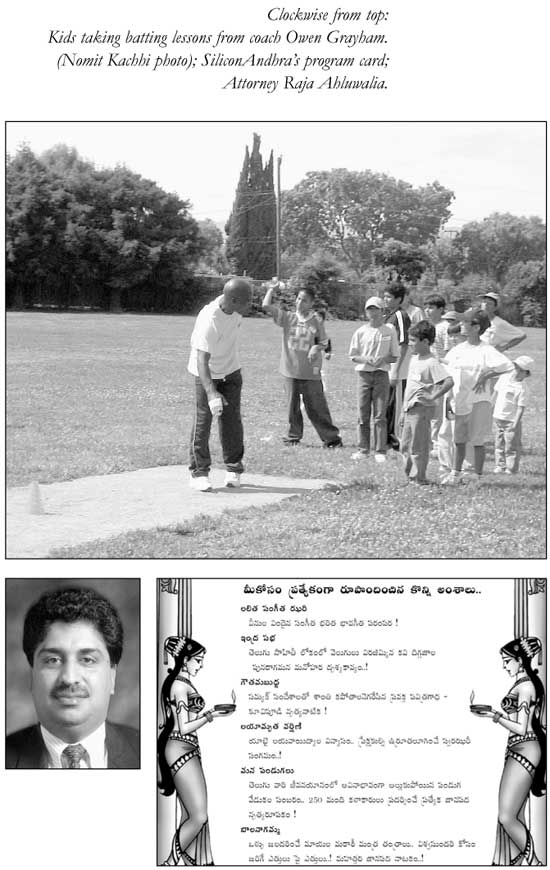 Cricket Academy Hemant and Kinjal Buch have launched the California Cricket Academy for kids launched in Cupertino, Calif. A batch of 22 kids has just completed training. During summer, the academy offers eight two-hour sessions . Starting September, the academy will offer classes in Milpitas, Calif., in addition to those at the current Cupertino location. The Northern California Cricket Association helped by offering equipment and suggesting Owen Grayham, a coach from Jamaica. The Cupertino Unified School District helped by assigning the ground and developing a pitch which can coexist with baseball. Interested readers can reach Kinjal Buch at kinjalbuch@yahoo.com. However, Artesia recently voted to extend their $5,000 per month contract with a Sacramento lobbying firm hired to oppose ACR 67. Bermúdez’ resolution recognizes the Artesia DES Portuguese Hall and the Little India business district by placing signage on the north and southbound exits on Route 91 near Pioneer Boulevard. The Telugu cultural show will have an authentic Andhra touch, including a 20-course Andhra meal. “The objective of ACF is to showcase the rich Telugu culture, in the most appealing way, to the culturally starved people of the Silicon Valley, and the people across U.S,” says SiliconAndhra president Dilip Kondiparti. “ACF2003 is not just a show, it’s going to be an experience.” ACF2003 comprises six highly charged programs: Lalitha Sangeeta Jhari, Indra Sabha play, Gautama Buddha dance ballet, Layaamrutha Varshini percussion extravaganza, Manpandugalu folk dance drama and Balanagamma legendary drama. Interested readers can get more details at www.siliconandhra.org. He was among several people among the delegation to be recognized by the state senate and assembly. An assemblyman presented Ahluwalia with a document of appreciation that recognized him as an integral part of the community and commended him for serving the community and contributing to the state economy and development. Auto Review: — Post-World War I song How you going to keep them out of the Acura MDX luxury sport utility after they’ve seen the new 2003 entry? If they (consumers) are looking to replace their current slogger, they’d do well to take a look at the MDX now in the showrooms. The engineers and designers have worked together to enhance and improve the latest iteration. Designed at Honda’s studio in Torrance, Calif., the MDX exterior has been given an uncluttered, smooth look from front to back. SUV overkill has been avoided with the lack of bulky side cladding and a pompous front-end treatment. So it’s not out of place either at Nordstrom’s valet parking or grocery shopping with the kids. But certainly too good looking to be found at the Georgetown Jamboree. Of more interest is the long list of unseen improvements that have been made. The engine has been muscled up from 240 to 260 horsepower, the 5-speed automatic transmission with Grade Logic Control is all new, and a drive-by-wire throttle system has been “stolen” from NSX high-performance sports car. For comfort and security the suspension and chassis have been tweaked and the VTM-4 all-wheel drive system has been recalibrated. An Acura spokesperson said the new MDX is the first SUV to meet the ULEV-2 emission standards. My aversion to big machinery is well known, but one can’t deny the dramatic handling and performance improvements in just the past few years. These enhancements are most prominent in the likes of luxury lines such as the top-of-the-line MDX Touring model. One of my big tests is the humongous speed bumps in my parking lot. With the chassis changes made in the MDX, the expected shudder and rebounds over these bumps at slow speeds are not there. The rigidity is there as is the flexibility to soak up the bumps. From a test point of view, we “lucked out” with a few days of rather heavy rain, which created lots of lovely mud fields to push our sophisticated MDX through. The VTM-4 4-wheel drive system worked in perfect unison with the firm but comfortable suspension. Using the quickly responding drive-by-wire and the precise steering we turned the mud flats into a circus of spins and slides. All through this the MDX stayed flat and demonstrated little body roll (thanks goodness). Our stately luxury SUV has the heart of a warrior. The powered-up 3.5-liter, SOHC, 24-valve, VTEC, all-aluminum V6 is smooth and quiet pumping out 260 horsepower and 250 lb.-ft. of torque. The broad torque range works from 3500 to 5000 rpm’s. The performance standard of the powerplant was appreciated during our mud party, responding in collaboration with the redesigned steering. Towing capability is 4500 pounds for a boat and 3500 lbs. with a trailer. But truly, the operative word is luxury, and it operates at all corners of the MDX. Leather, of course, is just about everywhere, from paneling to seating. Low-keyed use of wood appointments and chrome accents add an urbane feel to the rather large 7-passenger interior. The middle row of seats feature seven reclining positions and the rear row — mainly for children or small adults — folds flat creating a deep cargo area. Actually, the 2003 Acura MDX SUV has so many new features and held-over facilities it takes over fifty, two-sided pages to describe in the factory press book. Beneath the well-received Acura badge is the undisguised quality of Honda, a most complimentary partnership. Besides, how many carmakers offer concierge service? Al Auger, our automotive editor has been writing about cars for over 30 years. Guftugu Let me explain. Pakistani director Sabiha Sumar’s poignant tale of partition Khamosh Pani won the Golden Leopard, the best film prize, at the 56th Locarno Film Festival, and guess who won the best actress prize? Kiron Kher, no less. Kiron is no newcomer to prizes. She has not only won the National Award for Best Actress for her performance in Rituparno Ghosh’s Bariwali, the film won the audience award for the best film at the San Francisco Film Festival. Kiron shared the Silver Leopard with two actresses. She was all praise for the film. “This is a truly international film,” she said. “Sabiha Sumar, the director and all other actors were Pakistani, while the crew was a mix of French and German. One of the co-producers, who is also Sabiha’s husband, is Sri Lankan and I was the Indian. The film is a labor of love by people of different nationalities who fought against amazing odds to complete the film.” Kiron was in London shooting for Gurinder Chadha’s Bride and Prejudice, when she finally decided to hop across to Locarno to be with the crew “at almost the last moment... When we got to know that we’d won, we spent an hour screaming and shouting. “The film is very powerful, in terms of its content and emotions. But there’s no technical wizardry. It was a little tough to believe that an eminent jury, with members like David Robbins, Stefania RoccaI and Jean-Luc Bideau, chose Khamosh Pani for the honors, especially because this is Sabiha’s first feature film.” Set in 1979, when Pakistan was under Gen Zia-ul-Haq’s martial law, Khamosh Pani is a story of a widow and her son, as the young man veers towards religious extremism. Pity poor Ash. She was at the fest with Rituparno Ghosh’s Chokher Bali, but the film was likely too esoteric and Bengali to appeal to an international audience. This charge, if it stuck, could land Sallu in jail for as long as 10 years. What with the long arm of the law reaching for him on the hit and run case, shooting blackbuck in Rajasthan and God knows what else—and old flame Aishwarya Rai and Vivek Oberoi an item—this will be a welcome bit of happy news. Sallu hasn’t come out entirely unscathed, however. The court retained other charges including rash and negligent driving, but happily, even if worse comes to worse, this just means a mere two years in the slammer. Salman had rammed his car into a bakery last year killing one person and injuring four others. That’s changed with Aziz Mirza’s Chalte Chalte, which has catapulted her to dizzy heights with its stellar box office showings. Rani is having a ball, and she isn’t shy about taking some of the credit. “I deserve the good films I’m getting because I’ve always been sincere,” she says. “I’ve never compromised on work and I’m glad that people have started to acknowledge me.” It’s not just hubris, either. Rani is one busy star, currently in a film by Mani Ratnam, Sanjay Leela Bhansali’s Black and Baji Rao Mastani, and she has even slipped in a cameo in Ketan Mehta’s The Rising while she is at it. Word must have gotten around that this Bengali beauty is worthy of the confidence of Bollywood’s heavy hitters. But in the fickle world of public opinion, will Rani’s newfound fame last? She’ll find out soon enough. Coming up next week is Sudhir Mishra’s Calcutta Mail, where she plays Bulbul, a writer who lives in Kolkata. Take Sonu Nigam. The crooner is telling anybody who will listen that his debut film as hero was Love in Nepal. Come again? Psst!!! A little bird tells us that his debut film was actually Kash Aap Hamare Hote, a film produced by Raj Babbar where his daughter Juhi acted opposite Sonu. Kash …what, you may well ask, and who can blame you? The film was an eminently forgettable potboiler, and it sank like a stone in the box office. Which may explain why few film buffs remember the film. But how is one to explain why Sonu’s memory fails him? Milind’s makes his debut as a Bollywood producer with the film and he also stars in it, but says the focused main character he plays isn’t the real him. Love in complicated, he says. “Love is a most mysterious, indefinable and tragic term but on a lighter side I feel it is lots of fun too,” says 38-year-old Milind. Now he ought to know. Our Milind is a regular Lothario, who has been through relationships as often as a baby changes diapers. Ah, bechara, makes you want to weep. Call me a cynic, but our Milind seems to have been having a gala time breaking and mending his heart. Is this what people call a stout-hearted man? At least Tere Naam is a semi-hit in India. Mumbai Se Aaya Mere Dost has not been so lucky, for it has flopped badly at home as well. Poor Abhishek, he doesn’t have a dost in des or pardes. Hindi Film Review Hit Mil Gaya  KOI MIL... GAYA Produced and directed by: Rakesh Roshan Music: Rajesh Roshan Starring: Rekha, Rakesh Roshan, Hrithik Roshan, Preity Zinta, Rajat Bedi and Johny Lever Only in Bollywood. Who else would come up with the idea of combining ET and The Sound of Music? So what, masala Hindi movie fans will say. Only in Bollywood could one make such an implausible combo work, they will counter. You can almost hear the Mumbai film industry heaving a huge, collective sigh of relief after Rakesh Roshan and son Hrithik have hit the jackpot with this film, and detractors better get out of the way. When the cash registers are speaking loud and clear, few Bollywood aficionados have much patience for snooty reviewers. Well, one doesn’t like to be a party pooper, so let’s start with giving this film its due. Rakesh Roshan has spun a fetching yarn of music, melodrama and feel-good entertainment that tells a story with panache, and the crowds are packing the cinemas to show their appreciation. Of course technical values count, but Rakesh’s masterstroke is to make it a servant to his story, not the other way around, and the ace up his sleeve is Hrithik Roshan. Somehow, it is only the father who seems to be able to unlock the magic of the son’s acting skills and he does this with such remarkable success that Hindi movie buffs, the world’s most forgiving audience anyway, are willing to give him all the slack he wants. Sanjay (Rakesh Roshan) and Sonya (Rekha) are in Canada where Sanjay is a scientist whose specialty is seeking out and communicating with UFOs/ aliens. One day, when he actually makes contact through some nerdy computer wizardry, his colleagues scoff at him. An alien space ship comes to earth, Sanjay dies in a car accident and pregnant Sonya sustains an injury that causes brain damage to her unborn son who grows up to be . . . (how did you guess) Hrithik Roshan! His reel name, by the way, is Rohit. Rohit and his mother move to India. Rohit grows up mentally handicapped, a preteen mind in the body of an adult. He has a fondness for Nisha (Preity Zinta), who doesn’t reciprocate initially. When his computer teacher gives him a hard time, though, Nisha offers to teach Rohit how to operate it. Rohit starts tinkering with his father’s computer, which has been lying like a sack of potatoes for 20 years, and he strikes the same notes as his father did with the same remarkable result: He receives alien signals. A spaceship lands, and the town honchos realize that aliens had landed and that one has stayed back. The city establishment is after Jadoo, the alien. The creation of Australian graphic artists, it is slick enough, but lacks the otherworldly magnetism of ET. However, Rakesh has a compelling storyline. Jadoo has the power to raise Rohit’s intelligence to superhuman levels, but there is a catch. He will return to his old form if Jadoo leaves him. So for Rohit it’s quite a predicament: If he wants to be true to his friendship with Jadoo, he has to let him go, at terrible personal cost. It’s a good, gripping story with enough emotional punch and entertaining, funny touches told well, and carried with aplomb on the able shoulders of Hrithik Roshan, whose acting is, in a word, outstanding. Of course, the story has its faults (this is a Bollywood film, after all). The most glaring flaw is alas, a common one in Hindi films. The film fails to end with a bang. The climax is overly long, and in the hallowed tradition of Hindi cinema, quite implausible. The music is pleasant but quite forgettable. The special effects are okay if not great, but wisely, Rakesh lets the story rule everything else. So for once, this reviewer is willing to give the filmmaker some slack. Despite its flaws, Rakesh Roshan has shown Bollywood filmmakers—and they badly needed to see this—that a good story, told with superb skill, backed by solid, conscientious filmmaking production values still has the capacity to bring back the crowds who were getting increasingly fed up with poorly-made potboilers. Rating: ***1/2 (Good) |Return to Bollywood Index| |TOP| Tamil Film Review: All Sound and No Fury DIWAAN Director: Surya Prakash Cast: Sharat Kumar, Kiran, Sharmilee, J.P.R., Anandraj, Udayprakash, Vadivelu. In his latest release Diwaan, Sharat Kumar plays two characters: the powerful, aged, feudal lord Duraisingham, and of his long-lost grandson Bala Murugan alias Raghavan. In the first half of the film, orphan Raghavan woos the wealthy Gita (Kiran), and gives refuge to Aishwarya (Sharmilee), a lonely rich girl who eloped with her chauffeur and gets stranded. In the second half, Raghavan suddenly finds himself face to face with his past and learns that he is Bala Murugan, the grandson of local bigwig Duraisingham. A long-drawn-out flashback depicts the life and times of Duraisingham. Durai has an ongoing feud with wily politician Kandavelu (J.P.R.). Kandavelu goes on a bloody killing spree at Durai’s house. As Durai’s sister (Manorama) escapes with his grandson Murugan, the baby is accidentally flung across, where he falls into the hands of a blind beggar. A vengeful Durai kills Kandavelu and his gang, then surrenders and confesses to his crime. The director, in eulogizing his hero, turns the whole court-room scene into a mockery. The film returns to the present, where Murugan alias Raghavan visits the prison to see his grandpa, only to be shown a samadhi right inside the cell. The director goes overboard paying homage to the hero, and he has taken a lot of liberties while going about it. Kandavelu is supposed to be the dreaded villain, but J.P.R. (from Telugu films) cuts a comic figure with his snarls and tortuous expressions straight out of some decades-old film. There’s a constancy about Kiran in her looks, dressing, performance and roles. So there’s not much expectation or disappointment here. Sharmilee has to get out of her cute bubbly act. With his long flowing, grey, shoulder-length hair, a part of it falling over his left eye, and in a white dhoti-kurta, and those long strides, one has to concede that Sharat does cut a handsome figure as Duraisingham. Apart from this, Diwaan is all sound and no fury. — Malini Mannath |TOP| Recipe:  Savory Finger Food: Kalmi Vada – By Lalita Agarwal With a little work, even simple chana dal can be fashioned into a delicious snack, writes Lalita Agarwal. Ingredients
Method Make tikki-shaped small round patties from the mix and deep fry till golden. Cut it in the shape of fingers as shown in picture and deep fry it again till brown. Garnish with chat masala and coriander leaves. Serve with hot sauce and tomato ketchup. – Lalita Agarwal is a homemaker. |TOP| September-October Horoscope ARIES (March 21 to April 20): Life will be a lot less stressful. Career improvements are foreseen. You will visit old friends. An ongoing litigation could take a dramatically favorable turn. TAURUS (April 21 to May 20): You will readily dispose off an asset for a loss. Those of you who are in business, keep an eye on your subordinates. Someone close will take undue advantage of your generosity. You will spend on car repairs and home improvement. GEMINI (May 21 to June 20): A lot of juggling with cash is foreseen and may force you to amend earlier plans. Good communication skills will help in getting things done through a government official. You will work hard and concentrate on career. CANCER (June 21 to July 22): Some major financial deals may slip out of your hands at the last minute. Money anticipated will not come on time and you may need to answer to some legal queries also. Expenses will be extremely high. You will go on a short trip with family. LEO (July 23 to August 22): You will spend on a new wardrobe and may also purchase jewelry. Visit a specialist to treat skin rashes that you have developed lately. A property deal will materialize. VIRGO (August 23 to September 22): There will be improvements but not to your satisfaction. Intake of caffeine and other intoxicating substances will increase. People in business will face new competitors. You may have to pay a fine to a government agency. LIBRA (September 23 to October 22): It could be a slightly disturbing month. Mind will be restless and some serious differences could develop in relations or partnerships. A property deal could help your earn extra cash. Someone might try to trap you into trouble. SCORPIO (October 23 to November 22): Long awaited positive developments will take place in career. You will finally sign a major contract this month. Legal matters should be handled on priority. Avoid any arguments with spouse. SAGITTARIUS (November 23 to December 22): You will get the lucky break you’ve been waiting for. You will also find yourself drifting away from someone close. You may finalize a property deal. CAPRICORN (December 22 to January 19): You will resolve important issues related to career. An incident will prove to be a blessing in disguise. Do not trust anyone and do not underestimate your opponents. Financial decisions could go wrong, beware. AQUARIUS (January 20 to February 18): Stress will burn you out. Try light exercises and relaxing techniques, they will help you keep your sanity. You may cancel a trip. In laws will send a valuable gift. It will be difficult to deal with a new partner. It will be an expensive month. PISCES (February 19 to March 20): Someone will try to severe relations within in the family. You will end up making new commitments and increase your liabilities. New opportunities are on their way from distant places. Bay Area-based astrologer Pandit Parashar can |TOP| |
|||||
|
|
|
|
|
|
Advertise in Siliconeer | Home | Subscribe PRINT Issue | About Us (FAQs) | Contact | Locations | Staff Login | Site Map
© Copyright 2000-2013 Siliconeer • All Rights Reserved • For Comments and Questions: info (AT) siliconeer.com |
|