!-- Start Alexa Certify Javascript -->
|
|||||||||||||||||||||||||||
|
|||||||||||||||||||||||||||
|
|
|||||||||||||||||||||||||||
|
|||||||||||||||||||||||||||
|
|
|
|
|
|

AUGUST 2004 |
IN THIS ISSUE
MAIN FEATURE The Arsenic Threat : A New Solution By Dr. Rashbihari Ghosh TECHNOLOGY Stealing the Thunder : Top-speed Supercomputer A Siliconeer Report E-BUSINESS Return of the Dotcom Bubble? : Internet Frenzy in India By Siddharth Srivastava Publisher’s Note • Infotech India • HEALTH: Body Mass Index Funds for BPO Leader • India, California Ties • Happy Birthday, India Internet Cash Register • An American in Bangalore • Poetry in Motion: Abhinaya Chanchal in Bay Area • Bollywood Showcase • Britney Does Bollywood? Community News in Brief • Auto Review: 2004 Mercedes E500 Wagon Bollywood • Tamil Cinema • Recipe: Desi Veggie Chowmein • Horoscope |
||||
|
Publisher's Note
Like a huge sword of Damocles, the threat of arsenic looms large on the lives of millions of people in West Bengal and Bangladesh. While much has been written about the plight of the poor village folk who are condemned by arsenic-contaminated water, satisfactory remedial measures have been elusive. Dr. Sibdas Bandopadhyay, a researcher at Kolkata’s Central Glass and Ceramic Research Institute, has developed an exciting new technology that not only works, but it has been implemented in several pilot projects in West Bengal. The technology uses a special ceramic membrane through which arsenic contaminated water is passed, and the resulting water meets stringent World Health Organization standards in terms of arsenic and iron content. Bandopadhyay recently attended a seminar in Berkeley, Calif., hosted by the International Institute of Bengal Basin, a California-based NGO run by former Cal EPA environmental scientist Dr. Rashbihari Ghosh. Ghosh is providing assistance in getting this new technology approval from the U.S. Environmental Protection Agency. IIBB hopes to work with Bandopadhyay and implement this technology as widely as possible to bring succor to millions of people who are struggling with contaminated water. The cover story of this month’s issue presents an overview of the technology by Dr. Ghosh. MAIN FEATURE  The Arsenic Threat: The Arsenic Threat:A New Solution Dr. Rashbihari Ghosh Over 220 million people live in the greater Bengal Basin— West Bengal and Bangladesh. Arsenic contamination in groundwater beyond the permissible limit of WHO (0.01 ppm) poses a serious public health problem in 9 (out of 17) districts of West Bengal, India and 59 (out of 64) districts of Bangladesh. Dr. Sibdas Bandopadhyay and his associates at the Central Glass and Ceramic Research Institute in Kolkata have developed a technology package that achieves a purification level as per WHO recommended limits for arsenic (<0.01 ppm) and iron (<0.3 ppm) in drinking water which can not be achieved by the currently available techniques for arsenic removal, writes Dr. Rashbihari Ghosh. Over 220 million people live in the greater Bengal Basin, which is divided into two geographic areas and two political entities—West Bengal and Bangladesh. Residents in both parts of the Bengal Basin suffer the poisonous consequences of toxin-contaminated drinking water. It is reported that about 100 million people in India along the river Ganga are also exposed to arsenic poisoning and many more are also suffering from other toxic poisoning throughout the Indo Bangla subcontinent. The Bengal Basin lies in a part of India and covers a substantial portion of Bangladesh. It is endowed with unique geographical features and a challenging terrain. It has one of the world’s largest alluvial deltaic plains, allowing the flow of three big rivers - the Ganga, the Brahmaputra, and the Meghna. In 1993, studies detected the first patient suffering from arsenic-contaminated groundwater. The Bangladesh government began to face a very difficult and serious water problem. Arsenic is a known carcinogen and is highly toxic. It has gradually affected people in the Bengal Basin. Triggered by the installation of tube wells without careful scientific investigation, arsenic dissolved into the drinking water. People did not realize that arsenic was present in the drinking water since it is colorless, tasteless and odorless. Moreover, people didn’t even know what arsenic was, and could not recognize the outward manifestation of its poisoning. Now this disaster is widespread in the Bengal Basin. About one-third of the population of the Bengal Basin suffers from various diseases, such as warts, skin lesions, and cancers, a substantial part of it caused by arsenic poisoning. This serious water problem can be attributed to the combination of ineffective water resource management, industrialization and the rapid increase of population Arsenic contamination in groundwater beyond the permissible limit of WHO (0.01 ppm) has posed a serious public health problem in 9 (out of 17) districts of West Bengal, India and 59 (out of 64) districts of Bangladesh. Chemical treatment has a few constraints: the dosage of chemicals needs to be controlled, ineffective mixing and/or separation of fine particles using sand filter can give unsatisfactory results. The adsorption technique can be constrained by iron content in groundwater forming a coating of iron particles over the adsorbent and minimal contact time for adsorption during the flow of raw water. Dr. Sibdas Bandopadhyay and his associates at the Central Glass and Ceramic Research Institute in Kolkata have developed a technology package with the following basic components: A. Porous ceramic membrane elements in multi-channel tubular configuration. B. Adsorbent media in colloidal form. In the CGCRI technology, contaminated (arsenic and iron) groundwater is pumped to a tank containing the adsorbent media in colloidal form. The raw water is allowed to come in contact with the suspended media for a pre-determined time depending on the concentration of arsenic and iron in the raw water. The contaminated water along with the colloidal media is then re-circulated through tubular ceramic membrane tube under pressure for separation of the media particles in the retentate stream and production of safe drinking water as the permeate. The efficiency of removal is higher due to intimate contact of arsenic with colloidal adsorbent media followed by complete separation of fine particulates of iron and media by ceramic membrane in a cross-flow filtration mode. The process has been patented.
Pilot Projects “In practice, this experiment has succeeded beyond expectation,” a CGCRI report says. “Such an extraordinary success has been possible primarily because the quality of the purified water is far superior than that available from other sources and all the users have experienced a healing effect not only to their arsenic related ailments but also to different kinds of stomach disorder arising from iron contamination.” After field studies, four treatment plants, each with a capacity of 2,500 liters per day, have been designed, fabricated, installed and commissioned at four different locations of North 24 Parganas District of West Bengal for community use. All continue to function without fail with total community acceptance, CGCRI reports. I welcome any suggestions, questions from interested readers. Dr. Rashbihari Ghosh can be reached by email at Bengal_basin@hotmail.com. Interested readers can find out more about IIBB at its Web site at: www.nvo.com/ghosh_research/ - Dr. Rashbihari Ghosh, an environmental scientist formerly with the California Environment Protection Agency, is the founder chairman of the non-profit International Institute for Bengal Basin. |TOP|
INFOTECH INDIA  China Catching Up ... Wipro Profits Up ... Disabled Can Boost IT ... IT Dealers Strike ... Infosys, IDBI Tie-up ... Kalam Against Human Cloning ... Cyber Police Station Soon ... World Tech Award ... Nuclear Power ... Jaguar Accidents — Here is the latest on information technology from India China Catching Up China is only 3-5 years behind India in software development, steadily closing the gap on the strength of better technology and learning from its competitor’s mistakes, says a California-based IT industry expert. China has also made great progress in teaching English to its citizens — an effort that has been increasingly strengthening its challenge to India’s dominance in computer software development and IT services industry, says Dale L. Fuller, president and chief executive of California-based Borland Software, in an interview to Executive Magazine. Fuller compares India and China in terms of their inexhaustible human resources, costs, their IT and IT-enabled services industries, their telecom infrastructure, and the pace of development in these areas. China wins hands down over India in its abilities to attract state-of-the-art technology, to learn quickly from its competitors’ mistakes and to provide infrastructure and train workers for the IT and IT-enabled services. China also has lower costs than India’s, but that advantage is increasingly waning because of the two countries’ inexhaustible human resources, says Fuller. India wins over China in terms of a huge English-speaking workforce that has created a formidable Western-style IT and IT-enabled services industry, but China is catching up so fast that it is now only 3-5 years away. “China has said that every Chinese will be speaking English within 20 years; they have made big strides,” he says. The Bangalore-based Wipro had reported a net profit of Rs.206.1 crore and revenues of Rs.1,198 crore during April to June 2003. “Consistent with our performance in recent quarters, every single vertical, every single geography and key service lines witnessed robust revenue growth,” Wipro chairman Azim Premji told reporters. “While it is too early to claim return to a period of price increases, pricing pressures are clearly on the wane,” he said. Wipro also said its thrust on offering high-end work with mixed projects is helping it to realize higher prices with new customers, even as existing clients are reluctant to increase rates during renegotiation. “We are signing new customers at higher rates,” Wipro Vice Chairman Vivek Paul said after the Bangalore-based IT major posted strong first quarter results, driven by higher volumes and better price realization. The NYSE-listed Wipro, he said, had not been able to renegotiate better prices from existing clients, but had seen a surge in business in volume terms. Paul, president of Wipro Technologies, the global IT services division of Wipro, said, the firm registered a double-digit growth from 27 of the existing top 50 clients during the first quarter. “On new accounts, we have been able to realize better prices on three fronts. One, our blended offering of an end-to-end services, the second, more high-end work like chip design and package implementation and third, higher realization from our fixed price projects, through better productivity by improving our processes,” Paul said. Wipro added 35 new customers including 23 from the U.S. The list comprised 13 customers for R&D services, 19 customers in enterprise services and three for Spectramind. “As the IT spending environment stabilizes, customers are increasingly demanding integrated services backed by high quality service delivery. Our early identification of this trend and proactive investments have resulted in record revenue for us,” Wipro chairman Azim Premji said in a statement here. “We in the IT industry should be able to employ more disabled people because it does not involve physical labor as in other industries,” Rao told a consultation on “IT and Social Change” organized by Voices, an NGO in Bangalore. He said he would moot discussions with IT firms and banks to provide services tailored to disabled people, targeting them as profitable customers. Rao said banks could launch a virtual banking service targeted at the visually challenged people and if “they get one million customers, it is good for their business.” Rao, who is also chairman of Mphasis, a software and BPO firm, said his company employs about six visually challenged people who write programs and test software and intends to add more people in the future. “The IT industry can address the high attrition problem with them. There will not only be lower attrition by employing disabled people, you also have increased productivity,” he said. India, Rao said, has about six to 10 percent of its population who are disabled and “if they are employed, we will be able to add so many people into the labor pool, our wage rates would drop and the productivity of the nation can be increased by 6 to 10 percent.” The dealers under the Forum of Association for Information Technology has termed “retrograde and directionless” the budget proposal to increase the taxes to 13.8 percent from the existing 5.75 percent. “The current budget is set to reverse the trend and block the growth of IT in Karnataka,” AIT secretary R. Sridhar said in a statement in Bangalore. The ruling Congress-JD(S) coalition presented its first budget early this week with a “pro-poor and pro-farmer” focus and taxing the “well off.” “When the entire country is getting to move into the VAT regime and tax rates for IT products in the neighboring states are at four percent, this move by the government is retrograde and directionless,” he said. The association is submitting a memorandum to Chief Minister Dharam Singh and Siddaramaiah, who holds the finance portfolio to roll back the tax hikes, and threatened to hold a protest march and go on a indefinite strike if their demands are not met. “The government appears to be very myopic in its vision and is using the budget as a political tool instead of a fiscal exercise,” it said. Finacle will be deployed across 101 locations by March 2005 and will power IDBI’s transformation from a development finance institution into a commercial banking entity, a company statement said July 21. “I don’t want my country to allow cloning of humans,” he said July 23 as he interacted, via satellite, with students of Nasik, Ahmedabad, Bangalore and Belgaum after inaugurating a conference on EDUSAT, an exclusive satellite for educational services in Bangalore. But he said cloning should be allowed with regard to various systems of the body like eye and liver. The president expressed serious concern over peers and parents dissuading students from taking to pure sciences and encouraging them to opt for professional courses, citing employment prospects. He termed pressure from peers and parents in this context as “victimization of science.” Emphasizing that science needs to be grown and “is basic need for any achievement,” Kalam spoke about its role in discoveries and inventions. “Science should be given its due place,” he stressed. Addressing a meet-the-press here, Tharakan said the radar system to check road accidents caused by overspeeding would be introduced in the state shortly. A total of 57 police stations in the state would be modernized and the duty time for police personnel in them would be limited to eight hours. He said 5,000 police personnel would be imparted special training in traffic rules and management at the police training college. They would undergo three-day course in batches of 100. Tharakan said the crime rate in the state had come down by 2003 when compared to the period from 1999 to 2003. He said no lenience would be shown towards the culprits involved in the violence at the KPCC executive meeting venue two months back. Winners would be announced Oct. 8 at the World Technology Awards ceremony at San Francisco City Hall at the conclusion of the two-day world technology summit. The WTN honors individuals and corporations from 20 technology-related sectors viewed by their peers as being the most innovative and doing the work of the greatest likely long-term significance. Balagurusamy, on hearing the news, said that he is delighted to have been nominated for the education category of the 2004 world technology awards — recognition from one’s peers means so much more than other kinds of honors. Nominees for the 2004 awards were identified based on an intensive global process in which current WN members made their nominations based who they think is doing the innovative work of the greatest likely long term significance within the particular field. After a study carried out in 1999 on the long-term cost-effectiveness of nuclear energy was updated in 2004, the government had given green signal to the projects costing Rs.29,500 crore, Rajya Sabha members Vijay Mallya and Rajeev Shukla said in a written reply. The study also evaluated the cost of electricity production through nuclear power compared to thermal power. It suggested that electricity produced from nuclear power at distances of about 800 km from the coal pitheads is a long-term cost-effective option, they said. During 2003-04, the electricity generated from nuclear power was 17,861 million units which is about 3.2 percent of the electricity generated by the utilities in the country, they added. Replying to a question, Defense Minister Pranab Mukherjee ruled out increasing age or the absence of timely technical assistance and advice by the French company to the Air Force regarding its maintenance being some of the reasons behind such accidents. Jaguars were inducted into Indian Air Force after stringent flight evaluation, he said adding the aircraft has a proven track record and is in front line service with many air forces of the world.
TECHNOLOGY
 Stealing the Thunder: Top-speed Supercomputer - A Siliconeer Report California Digital, founded by C.J. Arun, has deployed Thunder, the most powerful Linux supercomputer ever built. At 19.94 teraflops of sustained performance it’s the most powerful computer in North America and worldwide, second only to the Earth Simulatorin Yokohama, Japan. A Siliconeer report. A plucky Indian American-owned company has walked into the domain of big—read big as in billions of dollars—and come up with the America’s fastest supercomputer. “Thunder,” a 4,096 Itanium(R) 2 processor-based Linux cluster, at Lawrence Livermore National Laboratory, was adjudged North America’s fastest supercomputer by the Top 500 project, which keeps tabs in the world of supercomputing. In fact, it is second only to NEC’s Earth Simulator in Japan. “We’re proud to have successfully delivered such a ground-breaking Linux cluster with world-record performance and efficiency,” reported California Digital CEO B.J. Arun. “Thunder sets important benchmarks for massively-parallel Linux computing.” What is remarkable about all this is that supercomputing has traditionally been the domain of huge scientific establishments with deep pockets, typically affluent Western nations. California Digital has changed the ball game by using “clusters,” a method of using off-the-shelf servers and hooking them up, thus making supercomputing considerably more affordable and accessible. Japan’s Earth Simulator, for instance, cost $350 million. Thunder, on the other hand, cost $20 million. Supercomputing costs have consequently come down by a factor of 10, California Digital estimates. The Thunder cluster delivers 19.94 teraflops of sustained performance. A teraflop is a trillion floating-point operations per second. Thunder has the largest Itanium 2 processor deployment, as well as the largest implementation of Quadrics’ low-latency QsNet(II) interconnect technology. These technologies allow Thunder to achieve record cluster efficiency of 86.9 percent, an important metric in measuring cluster scalability.
While NEC’s Earth Simulator in Japan is No. 1 on the prestigious Top 500 list released by the University of Mannheim, the University of Tennessee and Lawrence Berkeley National Laboratory,. Thunder was second, and Hewlett-Packard’s ASCI Q supercomputer in Los Alamos National Laboratory came in third, followed by IBM’s Blue Gene DD1 at the company’s Thomas Watson Research Center in Yorktown Heights, N.Y. The TOP500 project was started in 1993 to provide a reliable basis for tracking and detecting trends in high-performance computing. Twice a year, a list of the sites operating the 500 most powerful computer systems is assembled and released. Despite the technical sophistication of Thunder and the incorporation of new technologies, California Digital deployed Thunder in five months, speeding delivery of computing solutions to support Lawrence Livermore’s national security and science programs in fields such as materials science, structural mechanics, electromagnetics, atmospheric science, seismology, biology, and inertial confinement fusion. “Thunder represents the next generation of Linux cluster for scientific simulation,” remarked Mark Seager, Livermore’s assistant department head for advanced technology. Thunder uses a number of innovative open-source software tools developed by California Digital and Lawrence Livermore to manage the cluster effectively. The cluster paradigm—independent machines connected with a high-speed network—has been around for more than 15 years, according to Dave Turek, leader of IBM’s “Deep Computing” team. “What’s changed in recent years is that they can be assembled using Linux, Intel or AMD processors and conventional networks instead of exotic, rare or customized technology,” Turek told CNet News. The supercomputing feat has attracted admiring press reports. “Thunder, a supercomputer recently installed at Lawrence Livermore National Laboratory, is possibly the second-most powerful computing machine on the planet—and it was built by a company with about as many employees as a real estate office,” CNet News reporter Michael Kanellos wrote. California Digital was founded in 1994 and initially specialized in relatively generic Intel servers. In June 2001, it bought the hardware unit of VA Linux and refocused itself on the high-performance computing market. The Thunder project came along after Lawrence Livermore researchers were impressed with manageability tools California Digital released to the open-source community. By chance, the company had just completed an Itanium 2 project for a large corporate client — “one of the biggest corporations in the world,” according to California Digital — that required California Digital to build a cluster that could run 21 different applications, an unusually large amount. |TOP| HEALTH  Body Mass Index Body Mass IndexAsk Your Doctor – By Deborah Gould, MD. Body Mass Index may be the most important measurement you can ask your pediatrician to do, because obesity is now one of the top 10 health issues for kids, writes Deborah Gould, MD. BMI can save your child’s life. But do you know what BMI is? Do you know your child’s BMI? BMI stands for Body Mass Index, a quick measurement to determine if an individual is overweight by assessing the relationship between weight and height. It may be the most important measurement you can ask your pediatrician to do. Why? Because obesity is now recognized to be one of the top 10 health issues for children in the United States – 15 percent of all American children between the ages of 6-19 are now considered overweight or obese. Consider this: an obese teenager has almost an 80 percent chance that he/she will stay obese as a grown-up. Why does this matter? It matters because we know that being overweight is linked to diabetes, high blood pressure, fatty liver, joint problems, and sleep apnea—all chronic conditions that can seriously decrease the quality of life. Perhaps most painful of all for a youngster is the deep psychological pain and the self-esteem issues that are created by being “fat.” BMI is often a family issue. Not long ago I saw an overweight 11-year-old boy in my office whose father is very obese. Sadly, the boy said the only time he feels good is when he’s eating. I finally got the family to talk about food as their great common comfort. What they weren’t talking about was the boy’s self-esteem. What can you do?
Choosing a healthier lifestyle is a decision anyone can make. I see my patients and their families taking positive steps toward healthier lives with every visit. I encourage you to check Kaiser Permanente’s website for more information on obesity at www.kaiserpermanente.org. But to take the first step toward building a healthy life for you and your children – talk to your doctor. - Dr. Deborah Gould is Chief of Pediatrics at Kaiser Permanente |TOP| VC WORLD  Funds for BPO Leader: $6M for STI Knowledge - A Siliconeer Report Mauritius-based WestBridge Capital Partners has led a $12 million Series B round with a $6 million investment in Atlanta-based STI Knowledge, Inc., a leading provider of integrated business process outsourcing. A Siliconeer report. WestBridge Capital Partners, a Mauritius-based U.S.-India focused venture capital fund with approximately $140 million under management, announced that it has led a $12 million Series B round with a $6 million investment in STI Knowledge, Inc., a leading provider of integrated business process outsourcing and enterprise support solutions and services, an STI press release said. Satish Sanan, who founded IMRglobal in 1988, led the company’s first round of $14 million in Series A funding. WestBridge will assist the company in developing its India delivery capability and in developing its overall global business strategy. Sumir Chadha of WestBridge Capital Partners will join the other investors on the board of directors of STI. “STI Knowledge, based in Atlanta, Ga., has significant expertise in the U.S. healthcare, insurance, government, and commercial enterprises industries, along with strong technology capabilities,” the release added. “STI has been named as an industry leader and visionary in Gartner Group’s Magic Quadrant and is committed to continuing its position as a leader and visionary as it forays into new market segments and expands its capabilities within its industries of focus.” STI was founded in 1995 and employs approximately 350 professionals throughout the United States. WestBridge had identified outsourced services as a key focus area for their investments and has been actively evaluating companies in the BPO sector. “We are excited to partner with an exceptional entrepreneur like Satish Sanan in addition to the other world-class investors in STI, and the high caliber management team. STI has an innovative approach to address a large market opportunity, particularly in healthcare outsourcing,” said Sumir Chadha, senior managing director, WestBridge Capital Partners. Interested readers can find more information about WestBridge at its Web site at www.wbcp.com and about STI Knowledge at www.stiknowledge.com. |TOP| E-BUSINESS  Return of the Dotcom Bubble? Internet Frenzy in India - By Siddharth Srivastava For the first time since the worldwide dotcom bubble burst five years ago, there is excitement in the Indian e-space, writes Siddharth Srivastava. Two recent acquisitions of Indian dotcoms by global players Ebay and Monster.com has re-focused attention on the still largely untapped business space that exists in the Indian e-market. This is perhaps the first time since the dotcom bubble burst worldwide as well as in India five years ago, that there is some excitement in the Indian e-space, which is not without reason. Online auctioneer Ebay has recently acquired the country’s well-known auction vertical Baazee.com for about $50 million, which is a reflection of the way the Indian Internet space is now beginning to be viewed as a business proposition. A few weeks ago, Indian recruitment portal Jobsahead.com was acquired by Nasdaq-listed online hiring company Monster Inc. for close to $9 million. The figures, of course, pale in comparison to the deals that were struck in the heydays of the dotcom boom. India’s e-poster boy Sabeer Bhatia sold hotmail to Microsoft for $400 million; in November 1999 Indiaworld was bought by Satyam Infoway for $100 million; in the heyday of the tech boom, Bazee.com commanded a steeper valuation of $78 million while today after garnering one million confirmed registered users, profits of $2 million on a net business generation of $20 million, it has been valued almost 36 percent lower. While sanity has returned to the valuations, the interest shown by the global heavyweights in occupying the Indian e-market is an indication of better days ahead. Indeed, Internet business models are stabilizing worldwide, one real signal being the Google initial public offering. Google, pronounced the modern day God by the venerable New York Times, has announced it will go in for a $2.7-billion IPO, thereby allowing people to own a slice of God, which is expected to bring back memories of the days before the dotcom bust when everybody could benefit from the humongous Internet pie. Today, Ebay has a market capitalization of $57 billion. It had a net profit of $200 million on revenues of $766 million for the year ended March 31, 2004, though gross revenues could be close to $ 2 billion. CEO Meg Whitman is among the few women to have made it to the top of a major U.S. company. Ebay has a stunning price-earning ratio of 106. To further add to the good news, U.S. Internet ad revenue is surging at an estimated 39 percent to $2.3 billion in the first quarter from a year ago as advertisers moved more aggressively online to reach consumers, a recent study has said. According to the study by the interactive advertising bureau in association with PriceWaterhouseCoopers, the first-quarter revenue was the highest quarterly sum recorded since it began measuring online ad revenue in 1996. “Internet advertising rebounded in 2003 after a multiyear slump triggered by the dotcom bust. Internet advertising is expected to grow as much as 20 per cent this year. Blue-chip advertisers still spend only a fraction of their budgets online, but they have steadily increased those ad dollars as consumers spend more time on the Web and new technologies make it easier to track the effect of those ads,” the study says. In India too, the mood is turning upbeat. According to Whitman, the attraction for the big players is due to the fact that select Indian dotcoms have gained critical mass. Though she says that “it is early days for e-commerce in India, there is an opportunity over the long term. Ebay expects India’s current internet user base of 17 million to shoot up to almost 30 million by 2006. “For Ebay, the acquisition is a step forward in increasing its presence around the globe. The online auctioneer has a clear strategy of buying out companies, which are based on its business model, around the world,” she added. Indeed, the growth figures of major Indian web portals such as Indiatimes.com, Rediff.com, offering online shopping give a clear indication of this trend. Most of them have clocked an annual growth of 150 to 200 percent. Just as in the West, Web portals say that it is lower prices and comfort factor that lure people to shop on the Internet. Several portals offer white goods such as air-conditioners available in the market for $500 at $300. Suvir Sujan who headed Bazee.com told the media recently that the portal expects to double business in this financial year. Bidding, as it is worldwide, remains the single most popular mode of purchasing. “Auction is popular among online shoppers as it gives them the feel of buying a product for a price they themselves consider fit,” says Gautam Thakkar, chief marketing officer, Baazee.com. However, observers also warn that the popularity of online shopping remains confined mostly to the urban metros of the country as they account for majority of the transactions. While it is prudent not to get carried away like it happened in the past, there is no denying that the Internet, whether at the global or local levels, is likely to be a factor that will translate to profits. The mantra, it would seem, is going to be (low) price based or without cost. The e-customer will be e-king. - Siddharth Srivastava is a journalist. He lives in New Delhi. |TOP| REPORT:  Ravi Sanwal (l) seen here with California’s Lieutenant Governor Cruz M. Bustamante during his appointment as trade advisor. Ushering Trade: India, California Ties - A Siliconeer Report Real Estate tycoon Ravi Sanwal, appointed by Lieut. Gov. Cruz Busta-mante, will go to India to improve bilateral trade. A Siliconeer report. Ravi Sanwal, who has been appointed trade advisor for the California Economic Development Commission, is planning a trip to India in August. He says trade between California and India is negligible and can be easily increased tenfold. “Japan does almost 29 billion dollars worth of trade with California, Netherlands does $31 billion trade, but India does only a little over $300 million,” says Sanwal. “Our goal is to take this figure to at least $3 billion by 2006.” California Lt. Gov. Cruz M. Bustamante, who plans to develop a stronger trade relationship with India, appointed Sanwal to visit India and identify areas of trade, particularly in the technology, automobile, textile, tourism, entertainment and aerospace sectors. Bustamante will visit India in December along with other Economic Development Commission members and trade advisors including Sanwal. “We will open a trade center in New Delhi in the last quarter of this year, around December,” says Sanwal. “The main focus will be to build a strong trade bond between India and California.” “We have seen tremendous growth in the IT sector and I feel that there is a huge area yet to be uncovered when it comes to exploring the trade opportunities with India,” he adds. A self-made entrepreneur who started as a busboy at a Hyatt hotel, Sanwal is today president and CEO of Sanwal Construction and Property Management, a company based in Sacramento that owns over 600 apartment buildings in and around Sacramento and Stockton. He says increased trade with India will bring benefits to both California businesses and consumers: “What does this mean to a small business owner or a common consumer? Here is an example: You have an expensive car in U.S. which needs a minor repair but a major part replacement is called for by the dealer. The dealer says that in order to fix it, the whole assembly of a particular part needs to be replaced. The cost could be well in the thousands of dollars. The reason being, the automaker itself does not manufacture a small part of the assembly nor do they have ways to outsource it.” Trade with India could change that, he says. “We can help the consumer cut his car repair cost drastically while we provide an excellent trade opportunity for India’s small scale automobile parts industry. The auto part manufacturer in India can make that small missing part of the large assembly at minimal cost to the consumer in U.S. while they themselves make a decent profit in the venture. We will help that Indian manufacturer sell their products which in turn will help the consumer and the automaker as well, because now the automaker can sell to a bigger market that would not have bought the cars that were originally expensive to maintain and repair. This is a win-win situation for everyone,” explains Sanwal. Sanwal, 51, lives in El Dorado Hills, Calif., with his wife, Manita and two sons Rishi and Muni. He has hosted Indian celebrities including veteran actor Dev Anand, ghazal singer Ghulam Ali, actor Dharmendra and is looking forward to host Pandit Jasraj towards the end of this year. Community activist Lahori Ram, a commissioner in the California State’s Commission for Economic Development, introduced Sanwal to Bustamante, who is also the chief commissioner of California’s Department for Economic Development. Sanwal was actively supported by Indus Valley American Chamber of Commerce. Sanwal is scheduled to visit India in August. Interested private sector corporations can reach Sanwal on this fact-finding visit at the following e-mail: scpm1234@aol.com. EVENT ATTENTION READERS: Karisma Kapoor will not be attending this event. This news was received after the magazine's August 2004 issue had gone in print. The new chief guest as per FIA sources is Shilpa Shetty. Please verify further changes at FIA's Web site at: www.fianc.com.  Happy Birthday, India: Happy Birthday, India:India Festival 2004 - A Siliconeer Report For the first time ever in downtown San Jose, FIA Northern California is celebrating India’s Independence Day with entertainment, mela, beauty pageant headlined by Bollywood star Karisma Kapoor (now Shilpa Shetty). A Siliconeer report. The Federation of Indo-American Association of Northern California is hosting a two-day India Festival Aug. 14-15 at the Children’s Discovery Museum – Meadow Park, according to a press release. “In years past, the festival has been held on a small High School Campus at Logan High School in Union City,” the organizers said in the release. “Now, we want to bring the festival for the first time to the mainstream community. We are trying to establish ourselves there as the Mexican community has done with their Cinco De Mayo festival.” Festivities will include Indian food booths, all-day entertainment program on stage featuring ethnic dancing, singing, etc, over 70 booths selling everything from Indian clothing, accessories, handicrafts, information booths from various businesses and organizations, free health fair with check ups. Events include Sony Entertainment TV Asia’s Boogie Woogie – Chalo America warm up for finals, Open Audience Dance Competition and Karaoke Live and Miss India Global USA 2004 Beauty Pageant and FIA Banquet with special guest Bollywood star Karisma Kapoor (now, Shilpa Shetty) at the Fremont Marriott Hotel. Interested readers can visit the FIA Northern California Web site for more information at: www.fianc.com.
WEB BUSINESS:  Internet Cash Register: Convio's Funding - A Siliconeer Report Vinay Bhagat’s Austin, Texas-based Convio has been the key to Howard Dean’s successful strategy of turning the Internet into a cash register. A Siliconeer report. The race for money between the GOP and the Democrats used to be as lopsided as a horse-drawn buggy and automobile race, until the Internet and Democratic presidential hopeful Vermont Gov. Howard Dean changed the ball game with the Internet. “The Internet has turned out, for the Democrats, to be a gold mine for campaign financing,” Michael Waldman, who was director of speechwriting for former U..S. President Clinton between 1995 and 1999, told the BBC. Guess who is powering the Internet revolution? It’s an Austin, Texas based company called Convio, whose CEO is Vinay Bhagat. Convio was hired to mastermind Dr. Dean’s online campaign and bring a fresh face to political fund raising, the BBC reports. “Instead of setting one big, lofty campaign goal, the thing that the campaign did most effectively was set very short-term, interim goals, tied to political or calendar events,” said Bhagat. The amount of cash needed to compete for the top job in the White House is staggering. By mid-June this year President George Bush had raised about $216 million, and his opponent John Kerry had brought in about $145 million. Experts say this year the race for the White House might cost a whopping $1 billion, a new record. Convio calls its approach Online Constituent Relationship Management of eCRM. ”Convio helps you attract, motivate and retain the constituents who support your organization,” its Web site says. “The key is to gather information about constituents and their interests, and use that knowledge to communicate with current and prospective constituents in a targeted and cost-effective way.” Interested readers can find more information on Convio at its Web site at www.convio.com
Like a real-life Truman Show in India, 23-year old Joshua Bornstein plays Jim Carrey as a living, talking, working native-born American climbing the corporate ladder in Bangalore, writes Siddharth Srivastava.
If there is a real-life Truman Show in India, it is happening at the Infosys office in Bangalore where the 6-foot-3, 23-year old Joshua Bornstein is playing Jim Carrey as a living, talking, working native-born American who has sought employment and is now climbing the corporate ladder in India. Faced with the prospect of job cuts due to work being outsourced to low-cost economies, skilled foreign workers from the U.S. and the U.K. have been doing the next best thing—finding employment in prime destinations such as India. Bornstein appears to buy the credo—if you can’t beat them, join them What an American does when he/she does the round as a regular executive is a subject of curiosity, not to mention that most Indians don’t stand more than 5-foot-8. In a recent article The New York Times referred to him as an “anomaly:” “He quit his job at an investment bank in Los Angeles and came to this southern city on the Deccan plateau. He pays $110 a month to share a two-bedroom apartment with a Japanese roommate. He takes the company bus to work at the Infosys campus, as lush and large as Microsoft’s in Seattle. He has Indian, European, Israeli and Asian friends, and he has become a familiar figure on this city’s thriving pub scene” “Everyone talks about globalization left and right,” he said. “This is the way the world is moving.” Perhaps so, but he is the only one of his friends in the United States who even considered going to India for work after college. He has become a member of a cosmopolitan village that has formed as multinational companies flock here, and Indian companies try to become multinationals. The city is full of foreigners—10,000 to 12,000 are registered here with the government’s office of foreign registration. Over the past year, prominent headhunters here have corroborated that there has been a flight of top and middle level executives from the U.S. and U.K., exploring job opportunities in top technology firms such as Wipro, Infosys, Satyam, TCS, to name a few. This is apart from regular middle and top-level management positions in multinational companies such as IBM, GE that have set up huge operations here. “Lot of foreign nationals are looking at mid-level and senior level positions in India. Every week, we get at least one well-qualified foreigner looking for a job here,” says Kris Lakshmikanth, founder CEO and managing director of executive recruiting firm Head Hunters (India). “As several IT product firms are setting up shop in India, experienced professionals from the U.S. are also on the lookout for jobs here and the trend is being witnessed by the top-tier recruitment firms,” he said. “Earlier only call-center jobs were being outsourced to India,” says Anil Mahajan, executive director of Talent Hunt Private Ltd, “but now as companies start to ship high-end research and senior managerial jobs too to India, foreign workers see a huge opportunity for themselves here. “Till a few months back, we were getting regular job queries from expatriate Indians who wanted to move back to India. But we were also taken by surprise when overseas professionals from countries as far as the U.S., Britain and South Africa also started to call us up to inquire about job opportunities here. This has now become a trend,” said Mahajan. Estimates suggest that 200,000 to 400,000 jobs have moved from the U.S. since the outsourcing trend began in the 1990s, which is still a fraction of 138 million jobs in the U.S. The Information Technology Association of America says only around 2 percent of the 10 million computer-related jobs have been sent abroad; 12 percent of IT companies have “outsourced”’ work, compared to 3 percent of non-IT firms. The most high-end projection is by Forrester Research—a loss of 3.3 million jobs by 2015, including 1.7 million back-office jobs and 473,000 IT jobs—which will create a dent in the U.S. job market and won’t be the train wreck that everyone fears. But the story goes beyond just a replication of hands at work. Experts say that foreign manpower, apart from pressure of job-losses, are seeking out India for the opportunities on offer and as an attractive destination. This is because many leading global technology firms have started to move high profile and highly skilled jobs to India, apart from the many low-end call centers jobs that have already shifted base to this country. In the past, Indian outsourcing companies have set up offices in the United States, but they have been largely restricted to marketing, generating new clients as well as establishing a countrywide network that have created very few jobs and that, too, mostly for Indians. Several reports now indicate that Indian IT giants such as Infosys, Wipro, Tata Consultancy Service have resorted to hiring Western employees to deal with local populations abroad. An indication of the global reach of Indian IT giants can be gauged from the fact that Infosys Technologies, which has risen to become the country’s second-largest software maker mainly due to outsourced work from the West, reversed the trend by investing $20 million to create nearly 500 consulting jobs in the United States. The company has set up a subsidiary in Fremont, Calif., to provide business consulting to American corporations. The new company, Infosys Consulting, has begun “aggressive hiring in America,” Infosys chief executive officer Nandan Nilekani said in a statement. “As we are looking to expand our global footprint, we are creating local employment in the countries we operate,” he said. While the U.S. has lost thousands of jobs to low-wage countries such as India through offshore outsourcing, the investment by Infosys shows outsourcing can also generate new jobs in the United States—though on a smaller scale, Nilekani said. The company’s American employees will advise U.S. corporations on improving their efficiency by embracing outsourcing and moving work to Infosys’ offices in India. Hiring Americans would help understand the needs of the clients and industry trends better, Nilekani added. Tata Consultancy Services recently announced that it has opened a training centre in Buffalo, N.Y., as part of its program to expand its presence and bring jobs to the area. A global information technology services provider, TCS will provide advanced training in IT to new recruits and the exiting employees in North American region. The training center is named Chrysalis. Company executives explain that this reference is analogous to the emergence of bright new talent into advanced IT professionals who will lead the technology industry into the future. The firms said it has already hired 20 new recruits primarily from western New York and has plans to triple that number by the middle of the next year. Indeed, observers say that overseas professionals feel comfortable working in these firms, as over the years they have imbibed global practices that are inherent in their operations now. As Indian companies continue to expand operations worldwide, they have adapted management practices and strategies to compete in the global marketplace. Until recently, most Indian software companies employed Indians in key positions in global positions around the world. An onsite posting or assignment was a plum perk that the companies offered budding MBAs and other consultants wishing to move towards marketing or sales. During the recent past, Indian companies have begun to realize the significance of having “local hands in local markets” and have started recruiting sales and marketing people in local markets to represent them. This has not only created a familiarity among foreign workers about Indians and India, but also acted as a push to look for placements when the going is tough. Joshua can vouch for this. - Siddharth Srivastava is a journalist. He is based in New Delhi. |TOP|  Abhinaya Dance Company of San Jose presented a bharatanatyam dance performance “Poetry in Motion” on June 20, 2004 to dance connoisseurs at the Mexican Heritage Theater, San Jose. Some of India’s finest composers and poets of the century were the inspiration for Abhinaya Dance Company’s recent production titled “Poetry in Motion.” The bharatanatyam program began with a deepanjali and stuti composed by freedom fighter and Tamil poet Subramanya Bharati and Bankim Chandra Chattopadhyay, composer of the patriotic song “Vande Mataram.” The program also included items choreographed to compositions by Meerabhai, Narsinh Mehta, Purandaradasa, and Papanasam Sivan. The lyrics were set to music and sung by Asha Ramesh. The live orchestra included all the traditional bharatanatyam accompaniments, and also included sitar, tabla, and kanjira. Abhinaya director Mythili Kumar herself presented two solo items: One featured a nayika yearning for just one glimpse of the beloved Lord Venkateswara; another was choreographed to an excerpt from Rabindranath Tagore’s dance-drama Shyama. . The second act of the dance performance depicted various forms of Krishna poetry in several Indian languages. Notable among them were “Vaari Jaanure” in Gujarati, “Go Radhe” in Oriya, and “Mhaare Sirpar Saaligraam” in Hindi. EVENT: Chanchal Attracts Record Crowd in Bay Area A Siliconeer report 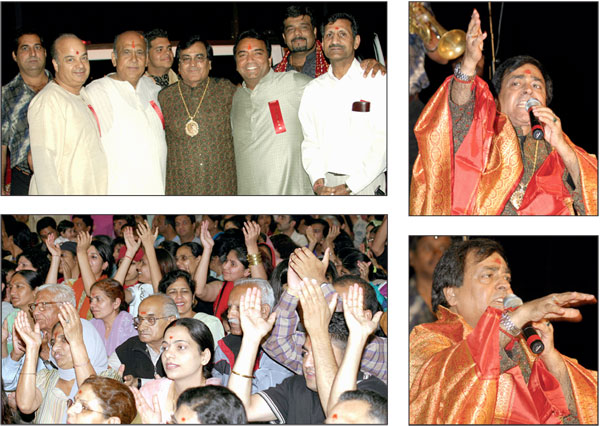 Clockwise from top left: Narinder Chanchal (c) poses with the organizers and promoter. Seen in the photo above are (l to r): Mr. Kakkar, M.P. Sethi, Naranji Patel, Chanchal (c, with glasses), Raj Bhanot, promoter Georgy Bhalla, and Bodh Raj Saini; Chanchal singing a devotional number; the audience enjoying every moment of Chanchal’s performance. (Sunnyvale Temple photos). SUNNYVALE, Calif. — Narinder Chanchal, one of India’s leading devotional singers performed “Maata ka Jagraata” at the Sunnyvale Hindu temple, July 24. Chanchal, who was performing his twentieth jaagran in U.S., said this was the most successful of them all. “Close to 9,000 people attended the night-long event,” said Raj Bhanot, one of the key organizers. “We were expecting a big crowd, but this has surpassed all expectations. This is by far the largest audience that ever attended a jaagran in U.S.,” he added. Chanchal, who has been performing for over four decades, is extremely popular in India, specially within the Punjabi community. According the Bhanot, the net proceeds from this event will be used in renovating the temple. FILM FEST:  Bollywood Showcase: Austin Film Festival Bollywood Showcase: Austin Film FestivalA Siliconeer report Bollywood comes to the heart of American in Austin, Texas as the Austin Film Fest makes room for the screening of several Bollywood films and panel discussions. A Siliconeer report. Austin Film Festival and Screenwriters Conference and New York-based CineMaya media, a leading South Asian media company in North America have announced the first special Showcase of Bollywood cinema and panel discussions at the 11th Annual Austin Film Festival, Oct. 14-21, 2004 in Austin, Texas, according to a press release from Cinemaya. “The Austin Film Festival is addressing a need to showcase more international cinema to the emerging crop of filmmakers and industry insiders who attend the festival every year,” the release said. “The initiative has been launched with a showcase of films and filmmakers from the world’s biggest film industry—Bollywood. The festival will screen three to four films and conduct panels on regional filmmaking and marketing as well as the craft and business of screenwriting and filmmaking.” AFF cofounder Barbara Morgan said: “The Austin Film Festival is excited about the addition of Bollywood films to its 2004 line-up. Today, Bollywood is on Broadway, on cable and satellite television, video-on-demand, and Blockbuster. Austin is known for its thriving culture of music, films, and art. We are delighted to have CineMaya media as our partner in bringing Bollywood to the Heart of America – Austin, Texas.” Cinemaya COO Nayan Padrai added: “Austin is the perfect venue to create a lively exchange between filmmakers from Bollywood with the mainstream. Bollywood films are no longer just song-dance, family drama. They are gritty, cutting-edge, and universal. And they are here to stay!” A special call for entries has been announced for South East Asian filmmakers and films with South East Asian themes from around the world. Filmmakers have been encouraged to submit films for competition in these categories: Narrative feature, narrative short, narrative student short, documentary feature, documentary short. Interested readers can find more about the Austin Film Festival at www.austinfilmfestival.com. REPORT: Britney Does Bollywood? Pop Diva in Masala Film - By Siddharth Srivastava  If rumors are to be believed, the sultry celebrity veteran of a 55-hour marriage, virgin-until-found-out, Justin Timberlake’s ex, the Madonna kiss is seeking to spread her already marked presence to India. Siddharth Srivastava reports. It is not often that the reigning pop icon of the world who makes as much of a splash for personal and professional reasons, bids to reach out to an Indian audience. Rumor has it that Britney Spears, she of a 55-hour marriage, virgin-until-found-out, Justin Timberlake’s ex, the Madonna kiss fame, is seeking to spread her already marked presence to India. According to reports splashed all over the media here, Spears is being considered for a role in a multi-million dollar movie based on Indian students in New York. British tabloid The Mirror says the movie is a great opportunity for the singer to make a mark in Bollywood after her flopped Hollywood venture Crossroads. The film is about four Indian students getting used to life at Columbia University, New York. “They fall in love with Western culture and make new friends, including with the character Britney Spears plays. This is going to be one of the biggest-ever budgeted Bollywood movies. The exposure for Britney in India would be massive. These films attract a giant audience,” an insider was quoted in the story. A broadcast on U.S. radio has also claimed that the film will be the most expensive Bollywood film so far and will star superstar Bollywood actresses Aishwarya Rai, Rani Mukherjee and Preity Zinta. According to the channel, “The three actresses play Indian girls studying at Columbia University and fall in love with an American who helps them tune to the western culture in New York. And this American is no man but none other than Spears herself. Another lesbian story in making with some explicit scenes.” It’s all about expanding audience reach. When a recent mainstream masala Hindi movie climbed on U.S. charts, it was marked as the cultural and social arrival of the two million-strong Indian community in the U.S. The Hindi potboiler Main Hoon Na starring number one Bollywood star Shah Rukh Khan drew Indians, Asians and more than a few Americans, sometimes in mainstream, lily-white multiplexes. Trade expert Taran Adarsh wrote in a Mumbai daily, “The U.S. guys have a top 100 chart based on average per print per theater. And on that basis MHN is number two on the top 100. The film is creating hysteria in the U.S. markets unlike what has been seen before by an Indian film. Going by the average collections per number of prints, MHN has grossed $570,000 in just three days of release, with an average per print working out to be $6,920. This places it second to Mean Girl that also had a wide release and had an average of $ 8,670. And number three is the Denzel Washington film Man on Fire which is averaging $5,020 per print.” MHN itself is a mix of everything that is standard Bollywood fare—romance, songs, violence, comedy and dollops of India-Pakistan hatred/bonhomie depending on the mood. The biggest draw in MHN is Shah Rukh, the number one Indian star, a mix of Jim Carrey when he does comedy, Hugh Grant when he does romance and Ben Affleck when he does action. Yet, the success of MHN is not due to Khan alone. It marks the beginning of Indian cinema’s slowly coming of its own to veer towards the center stage of global entertainment. Perhaps Britney, or her managers, also know. Over the last few years, Indian cinema has come some way from the 800 odd movies churned out by Bollywood that is estimated to cater to billions worldwide. Second generation Indians in Britain and the U.S. have been making movies that reflect the enmeshing of two cultures (Gurinder Chadha’s Bend it Like Beckham). They are also presenting their take on the environments they have grown up in and their country of origin (American Desi, Hyderabad Blues, Bombay Boys.) Then there have been crossover movies in an Indian setting with English scripts aimed at western, non resident Indian as well as urban English speaking Indian audience (Mira Nair’s Monsoon Wedding, Subhash Ghai’s Jogger’s Park, Sujoy Ghosh’s Jhankar Beats). These movies have been marked by tight scripts, wacky humor catering to an audience that is also exposed to the best of Hollywood fare. That’s not all. Indians such as M.N. Shyamalan (The Sixth Sense) and Shekhar Kapur (Elizabeth, starring Cate Blanchett that received eight Oscar nominations) are now making mainstream Hollywood movies. Several Indian stars have appointed agents in the U.S. to scout for work. As one of Bollywood’s all time greats Amitabh Bachchan said in a recent interview, Indian actors are looking beyond just essaying minor character roles of taxi-drivers, maharajas and saints in Hollywood movies. In a rare departure from movies, Nair is planning to bring a staged version of Monsoon Wedding to New York. After Bombay Dreams (though it has been labeled the most trashy musical on Broadway), this $10-million production will be the second Indian show to appear on Broadway. Britain-based Chadha has finished the shooting for the Bride and Prejudice, which has been described as an Indian take on Jane Austen’s classic novel. With Aishwarya Rai as the star attraction, this eagerly anticipated film from Miramax is sure to have broad appeal both in India and the West. The most successful Hollywood-Bollywood merging has been in the Indian offices of American studios like Columbia Tristar and Twentieth Century Fox. While billion-dollar Hollywood blockbusters continue to be unleashed across the country, Fox and company are also emerging as key distributors of small-budget Indian films. Columbia Tristar distributed 42 Indian movies last year simultaneously unleashing Terminator 3 and Maa Santoshi Maa primarily for the rural market. Warner Bros and Paramount Films are also reportedly on the verge of finalizing long-term plans to distribute Hindi and English movies in India. It is estimated that these studios control 10 percent of the Indian film market. The globalization of Indian cinema has seen Bollywood also change track to meet audience requirements. While the movies of the ’70s and ’80s catered to the mass rural Indian audience looking for a three-hour break from their farming schedules, the current crop of releases are aiming to hit where it matters most—cash rich urban and Non Resident Indians. The catch is that this section of the audience is sophisticated and cosmopolitan, exposed to the best cinema around the world. Bollywood has had to change with the times. Directors such as Karan Johar (Kal Ho Na Ho, Kuch Kuch Hota Hai), Farah Khan (Main Hoon Na), Ram Gopal Verma (Bhoot) make movies that they know have to meet stiff standards. They know that, with an Indian movie seeking ringing cash registers around the world, entertainment Indian style better be good. Britney in a sari, a treat to navel gazers, is just another version of the mass phenomena. To be sure, hurdles and pitfalls remain. Many crossover films have been sheer disasters, too many Bollywood films are based on thin, silly storylines, and Westerners are yet to take to Bollywood films in substantial numbers like they do, say, Hong Kong Kung Fu films or Japanese animation films. Time will tell if Bollywood proves equal to the task. - Siddharth Srivastava is a journalist. He is based in New Delhi. |TOP| COMMUNITY NEWS IN BRIEF: Anti-Immigrant Amendment Defeated ... NRI Tax Relief ... Named for Wall of Tolerance ... Training for Activists ... Toastmasters Award ... HamaraStar Launches Network Anti-Immigrant Amendment Defeated New York Democrat Joe Crowley led the charge against an ‘anti-immigrant’ amendment sponsored by Rep. Tom Tancredo, R-Colo., and, in a day of high drama June 18, managed to get the amendment defeated 259 votes to 148. Speaking in opposition Crowley, Co-Chair of the Congressional Caucus on India and Indian Americans, argued that while Tancredo’s amendment was offered ostensibly as a measure to save tax payers’ money, it was in fact “solely about racism against anyone who isn’t a native-born U.S. citizen.” The amendment put the two co-chairs of the India Caucus on opposing sides. After the defeat of the bill, an unnamed senior Congressional aide slammed Caucus co-chair Joe Wilson, R-S.C., and other Caucus members such as Ed Royce and James Greenwood for voting in favor of the amendment, India Abroad reported. “I think there are many South Asians who have been victims of discrimination who would be concerned about this,” the aide told India Abroad. “You just can’t say you are pro-Indian because you have a desi on your staff. You have to show it in floor votes.” Crowley later said he was glad the amendment had been defeated by a resounding margin. “The hard working immigrants in my district do not deserve to be singled out by police officers who are not immigration officials,” Crowley told India Abroad. “These police officers should not be threatened by the removal of funds, which would make New York vulnerable once again to the high threat of terrorism.” The Global Organization for People of Indian Origin is campaigning against income taxes imposed by the Indian government on returning Non-Resident Indians, saying it imposed double taxation on NRIs and cause undue financial suffering on many who are of limited means, according to a GOPIO press release. The Global Organization for People of Indian Origin protested at that time, calling it unfair and counter-productive. The tax policy took a major bite of their income on which they had already paid taxes in the countries they had earned it. It was also an unbearable cut in income for those who had already settled in India on limited retirement income or for those who had no alternative but to go back to India even before retirement for family obligations or other considerations. At the GOPIO Convention 2004 held in New Delhi early this year, GOPIO had passed a resolution where it urged that the global tax exemption of two years be restored back to the original nine years. GOPIO can be contacted by email at gopio-intl@sbcglobal.net or by telephone at (818) 708-3885. Dr. Austin D’Souza Prabhu has been honored by placing his name on the Wall of Tolerance, according to news reports. The Wall of Tolerance gives public recognition to people who stand for justice and practice tolerance in their daily lives, which has a purpose beyond public recognition. This wall will be a visible, powerful symbol of unity and the strength of the tolerance movement, the new crusade being launched by the National Campaign for Tolerance. Every name added to the wall will serve as a call to action for other Americans of good will to follow great campaign for tolerance and justice, campaign activists say. The Wall of Tolerance will be located in the new Civil Rights Memorial Center in Montgomery, Ala., a city that is famous in the struggle for human rights in the United States of America. It will be blocks from where Rosa Parks helped launch the Civil Rights Movement when she refused to give up her seat to a white man. It will be around the corner from the church where Dr. Martin Luther King, Jr., led the Montgomery bus boycott in 1955, and the Capitol steps where the Selma-to-Montgomery Voting Rights March ended in 1965. The Wall will be in the same complex as the Civil Rights Memorial, which honors the slain heroes of the movement. The memorial was designed by Maya Lin, architect of the Vietnam Veterans Memorial in Washington, D.C. Asian Pacific Americans for Progress, a national Asian Pacific American grassroots organization, hosted a National Training Program for Activists to coincide with the 2004 Democratic National Convention in Boston, an APAP press release said. The main NTPA program, which was coordinated with training assistance from Democratic Grassroots Action Institute & Network, ran from July 24 through July 26. “It included conferences, networking opportunities and training workshops to help prepare Asian Pacific American activists and community leaders to take back their country in this November’s election and beyond,” the release added. APAP is a grassroots, internet-empowered, national network of Asian Pacific Americans for Progressive Action. Its goals are to:
At the first-ever APIA Conference Call with Sen. John Kerry, D-Mass., June 18, coordinated by Asian Pacific Americans for Progress, Kerry gave a rousing speech to approximately 1,000 Asian Pacific Americans at a D.C. gala fundraising event that netted close to $1 million. Interested readers can find more information on APAP at www.apaforprogress.org Milpitas, Calif.-based India Community Center co-president Anil Godhwani announced June 29 that ICC’s Toastmasters Club—ArtICCulators—will receive the Toastmaster International’s President’s Distinguished Award, according to an ICC press release. “We are so proud of this club as it is one of the first in the nation to achieve the highest award a Toastmasters Club can receive,” he said. “Our club will receive the award within its first year of inception.” The ICC’s Toastmasters Club July 1 hosted their first year anniversary celebration and open house at ICC Milpitas. ICC Toastmasters Club meets every Thursday at ICC Milpitas from 7:30-9:15 p.m. Admission is free for ICC Members and $5 for Non-Members. Interested readers can visit the club’s Web site at http://www.indiacc.org/site/Offerings/Clubs_Groups/toastmasters/view for more information. HamaraStar is a network of desi event organizers with the primary objective to inform various organizations about visiting artists. This information will help artists plan events in more locations and also help event organizers who wish to invite the artists to such locations for performances. HamaraStar extends its service to visiting artists, movie stars, musicians, religious workers, journalists, authors, literary professionals, scientists, and social activists. The service is also available for artists and professionals living in the USA. Desi event organizers will be able to register in HamaraStar and get notifications of visiting artists. HamaraStar has plans to extend this service to Canada, U.K. and other countries in the coming months. Interested readers can get more details at HamaraStar’s Web site: www.hamarastar.com.
AUTO REVIEW
Classy, Comfortable Ride: 2004 Mercedes E500 Station Wagon – By Sally Miller Wyatt  With commuting these days With commuting these dayssomething of an endurance sport, the E500 Mercedes station wagon’s fine ride is a treat, writes Sally Miller Wyatt. Commuting on many American roadways is becoming something of an endurance sport these days. If your job takes you into that morass of bumper-to-bumper traffic on a daily basis, perhaps you should treat yourself to a fine ride – particularly if you’re a parent who also has to ferry children here, there and everywhere on the weekends. The Mercedes E500 station wagon loads up on the creature comforts, protects you in layers of safety, and teases your hopes of an open road with an unbelievably powerful 5.0-liter, 24-valve V8 engine. Even if you’re just idling, you’re idling in class. No matter what your driving habits or size of family, you’re probably most interested in safety features, and there are many standard ones on the E500 station wagon. They include a steel reinforced cabin with front and rear crumple zones, side air bags for front and rear passengers, electronic braking system with brake assist, electronic stability program, front air bags with multi-stage deployment, head protection curtains and a rollover sensor Also on board is the Sensotronic Brake Control braking system, which distributes brake force to each wheel, making steering on curves even safer. The standard sound system on the E500 wagon is outfitted with 10 speakers and a single CD; opt for the $950 upgrade and you receive a Harmon Kardon sound system with a CD changer. If your family automotive needs call for a station wagon, what better way to go than in a Mercedes E500?. - Sally Miller Wyatt is a freelance writer Guftugu Our pretty damsel is past all that now, thank you. Why make up fiction when facts are so much sexier? After all Mallika is just back from Shanghai shooting The Myth with Kung Fu superstar Jackie Chan, no less. And she is gushing about it. “I still feel that I am in a dream where I acted opposite Jackie Chan. I cannot believe that I stayed in Shanghai for two weeks and acted opposite Jackie Chan in the film,” she told reporters here on her return from Shanghai. The Myth has Chan in two roles—a modern day Indiana Jones type of archaeologist and a General Men Yi in Qin Dynasty of 3rd Century B.C. Mallika plays the role of an Indian princess in the film. Then one reporter asked the question that was on everybody’s mind: So how many hot scenes are there in the film? Mallika is aghast. “No way! Jackie Chan films are known for clean image,” she replied. “It is a very clean film. I am acting as a princess in the film and I do martial arts rather than doing any bold scenes.” No kidding. Which inspired the usually staid Press Trust of India to wax poetic: “The east-west cruising star of films like East is East and My Son the Fanatic, Om Puri, has been awarded the prestigious Order of the British Empire.” “I guess it’s like our own Padmashri,” Om Puri said after he heard the news. “I’m honored that it comes to me from a country to which I don’t belong. Nor do I live in England. I don’t have a British passport. Saeed Jaffrey got it. But he held a British passport.” Om is keen on going to Britain to receive the award “even if I have to bear the traveling expenses myself.” He said that there had been many more offers from the West, but he had to refuse because of a back surgery last year. “I didn’t work for four months. Fortunately, I’m on the way to recovery. In India, I can control the number of hours I put in. But abroad one has to put in grueling hours, which my back couldn’t take.” A graduate of Pune’s film institute, Om Puri made his name in essaying unforgettable performances in the art film circuit. He has been widely respected in Bollywood as well, and his foreign credits include Jewel in the Crown, Gandhi, City of Joy and recently BBC Television’s Canterbury Tales, among many others. Although a committee of British MPs recently called the awards system outdated and a symbol of imperialism, Om is unfazed. “I have no problems with the empire,” he told BBC Hindi recently. He begins his day with orange juice and a vitamin tablet and for dinner there is tandoori murg again with a roti or a naan. Mostly his son joins him for a bite. After dinner, he has black coffee. “When I go to a Chinese or Italian joint, the standing instructions are to cook something nearest to tandoori chicken,” says Shah Rukh, who also loves chicken tikka. He also loves in ice creams or chocolates, and he never has salads or fruits. “I eat in between smoking and never exercise,” he says proudly. Apparently Shah Rukh has a simple rule: If it’s healthy, he ain’t interested. But how on earth does he stay fit, you may wonder. The King Khan intones: “I stay fit by positive thinking.” If only we also were as lucky. However the Bollywood heartthrob stays away from booze. His favorite beverage is Pepsi, which he prefers to other fruit juices. His idea of a romantic meal? “A McDonald burger, a Pepsi and a good movie on DVD.” Munnabhai is a wacky comedy about an underworld don Munnabhai—played with superb aplomb by Sanjay Dutt—and his foray into the medical world with hilarious consequences. While comedy is not a genre one would associate with Vidhu Vinod Chopra, his attempt in Munnabhai MBBS was a huge success. In the film Munna (Sanjay Dutt) plays a gangster who turns his den into a fake hospital with his goon friends to fool his strict dad. The lies tie him up, and lead to more complications. Later, he decides to enroll in medical school. What non-Indian viewers will make of all this is anybody’s guess. Particularly intriguing will be translations of such tapori dialogue as this: “Bole to, apun ki whaat lag gayi hai Mamu! “ Now how would you say that in English? The studmuffin star rushed to help three youths trapped in an automobile that crashed against an electric pole in front of Galaxy apartments July 13 night and removed them before he accompanied them to Lilawati Hospital, police said. He not only rushed the injured to hospital, but also informed the Darvesh family, police sources added. He also stayed in the hospital till early morning to assure proper care of the injured. Unfortunately, one of the youths, Anzar Darvesh, 17, succumbed to injuries, while his brother Turaib Darvesh, 21, and friend Raunak, 20, were admitted at the hospital’s intensive care unit, police said. Turaib studying abroad and had come to India on a small vacation trip, police sources said. This is a very different Salman than the inebriated film star in a Toyota Land Cruiser who rammed his vehicle at night and killed one person and injuring many in front of a bakery in Bandra in September 2002. he will continue to act in films while devoting enough time to his constituency and working to maintain a “clean image” as a parliamentarian. Which is nice for his millions of filmi fans. But what are his constituents going to say about all this? Dharmendra was recently in Bikaner, dressed in black trousers and a white shirt unlike a politician’s trade mark of white kurta pyjama. He gave a patient hearing to the people who thronged the circuit house to meet their leader. Explaining the delay in his visit to the constituency, he said he was first busy with Parliament session and then in Mumbai, attending to his son Sunny Deol who was ill and later the death of his mother-in-law prevented him from coming to Bikaner. He told reporters that while he will continue to act in films he would devote enough time to his constituency, attending to its problems and its people. He said he hoped to do some concrete work for his constituency to ease the misery of the poor people in the desert land. All of which is quite touching. Besides, Dharmendra needn’t get too worried about his constituents. As a cynical voter commented drily during the elections: “All these MPs are useless to us anyway, they come to us only during election time. So we might as well elect a film star.” Grewal approached the music director duo to record a song for the Punjabi film Yaariyan, to be shot entirely in Vancouver, Canada, expecting N-S to either quote a huge fee for one song or reject the offer outright (the duo don’t believe in sharing credits with other music composers in a film). He was in for a surprise when Nadeem told him that he’d record the song absolutely free. “I was touched by this gesture… I was completely speechless for a while,” Grewal says. What prompted Nadeem to be so generous? “I did it for two reasons,” Nadeem says. “I’ve shared a long association with Deepak. Earlier, when he was with Sunny and Raj-ji [Santoshi], we’ve interacted on several occasions. The second reason being, new talent should always be encouraged. As a senior, it’s my duty to extend a helping hand to someone who is taking his first big step in life.” Now isn’t that nice? Apparently one good turn deserves another, because the visibly moved Grewal isn’t hiring N-S for just one song any more. In fact, has gone ahead and signed the music director duo to compose the entire soundtrack of his second film, in Hindi this time. Hindi Film Review Violence and Clichés  GARV Directed by: Puneet Isarr Music: Sajid-Wajid, Anu Malik and Aadesh Shrivastava Starring: Salman Khan, Shilpa Shetty, Arbaaz Khan, Amrish Puri, Anupam Kher, Shivaaji Satam, Farida Jalal, Govind Namdeo and Mukesh Rishi What’s with Bollywood? It’s as if men in uniforms have taken over the place. First there was Khakee then there was Ab Tak 56, Aan and Dev—films about cops seemed to be a dime a dozen. Which is not an entirely bad thing, when you consider Bollywood’s spate of gangster movies that reveled in violence and appeared to idolize big-time crooks whose language was as vile as their mayhem was gruesome. The jury is still out, however, if this pack mentality will work. Many of the new cop dramas have floundered in the box office, and for good reason. And the latest avatar, Garv, does little to inspire confidence in the genre. Director Puneet Issar seems to have the oddest notion on earth: if you throw in enough gratuitous violence and spice it up with a whole lot of tapori one-liners, the public won’t notice that you don’t really have an intelligent—or even plausible—storyline. Here are a few choice specimen lines: Haramkhor! Tujhe maine doodhwale se neta kisliye banaya? Or how about this: Agli baar mardon ki baarat mein hijron ki toli mat bhejna. Or this: Arjun Ranawat, tune barood pe baith kar aag lagayi hai. Ab dhamaka hoga. Dhamaka. Dhamaka my foot. The absurd story line, riddled with potholes of logical absurdity, ends up going nowhere, and you can’t fool the satellite-savvy movie-going public anymore with this kind of trash. This grisly maara-maarithon lets loose hero Salman Khan who maims, murders or mutilates at least 100 extras as he sports a designer wound and gets to cool his heels in a designer jail cell. As hundreds of guns fire and bullets rain all over the screen, brains pop out and fluorescent red blood spews out of a man’s mouth. There’s more: police encounters, RDX traps, extortion, rape, you name it. Here’s the story, such as there is: Disgraced and arrested cop Arjun Ranawat (Salman Khan) has killed eighteen assorted creeps of various hues. The list includes gangsters, politicians and their relatives, a corrupt cop, a corrupt lawyer and his cronies and relations—all are dispatched to meet their creator at one go. Now Salman is going to be hanged as a killer, and he can be save only if his ex-boss and mentor Samar Singh (Amrish Puri) discovers the real reason for his silence and death wish. Samar wears two hats—he is a police commissioner as well as a lawyer. This deserves to be in the Guinness Book of World Records, because never has anyone in this world heard of somebody who is a cop and an attorney at the same time. Hey, Puneet, didn’t anybody tell you that’s what district attorneys and public prosecutors are employed by the sarkar. If the asinine story of the film bores you to tears, here’s an idea—you could amuse yourself by spotting the film’s continuity flaws be keeping a sharp eye on Salman’s coiffure. The man’s black hair, for no earthly reason, sports a dark golden brown streak later in the film. Later still it gets longer and is a different shade of brown. To return to the so-called story, the film’s many events defy logic, even by the flexible standards of the world’s most tolerant people—i.e. the hapless Bollywood buff inured by masala movie antics. Salman’s mentor Samar manages to save him after doing all sorts of impossible things, like getting important evidence from the CBI overnight. Then there is our old Bollywood friend—coincidence. At the trial, it turns out the judge is no other than his sister’s father-in-law to be. What happened to Salman’s report to the PM about the corrupt coterie of the chief minister? And precisely what purpose is supposed to be served by Salman’s decision to allow himself to be convicted and hanged? Ah well, there are some concessions, if the viewer is so inclined. At the pretext of exposing the chief minister’s debauchery, there is a procession of cabaret girls ho expose their navels. And give Puneet his due—the fellow doesn’t have a sexist bone in his body. For the ladies, he has thoughtfully allowed Salman to expose his torso often enough. Which is just as well, because that’s about all there is worth seeing as far as Salman goes. What appears above the torso—i.e. Salman’s face—is so devoid of emotion that this appears to be histrionic understatement carried to its extreme. The music is dispensable, the background score is deafening, the technical values average, the script mediocre and the dialogues unremarkable (except for a profusion of swear words.) To add insult to injury, all of this is packaged in the most hackneyed of stories where no Bollywood cliché is left out. Rating: *1/2 (Poor) |Return to Bollywood Index| |TOP| Tamil Film Review: Director’s Heroic Misadventure NEW Director: S.J. Suryah Cast: S.J. Suryah, Simran, Devayani, Kiran, Manivannan, Karunas  Take the Hollywood blockbuster Big—the story of an eight-year-old boy caught in the body of a 28-year-old. Ignore its basic theme of exploring a child’s mind. Concentrate on building up the physical, (read erotic and titillating) part of the story. Add some steamy scenes, double entendres, suggestive dialogues and situations. Place three heroines (popular and not-so-popular) in it. Throw in a director who debuts as its hero, and Voila! You have New. A little boy, fed up with his mother’s constant nagging and his elder brother’s indifference, expresses his frustration to a research scientist, who turns him into a youth of 28. But the experiment goes haywire and the boy finds himself a boy during the day, and an adult after sunset. How he shuttles between home, school, job and playing unsuccessfully the newly-wed husband, (which includes being goaded on by his wife to perform his marital duties in bed) forms the rest of the story. The last mentioned is the focus of the director. Towards the end, the director makes a half-hearted, forced attempt to bring in some maternal sentiment, but who does he think he is kidding? There’s nothing new about the film. Unless it’s about Suryah debuting as a hero. It is a rehashed subject, has a careless screenplay and is a blatant attempt to titillate (it carries an A certificate). The saving grace of the film is A.R. Rahman’s peppy numbers including the re-mixes, their picturization with some slick photography (K.V. Guhan) and editing. Suryah is at ease in front of the camera, but it’s a lost battle as he tries in vain to fit into the role of the little boy in an adult’s body. Simran is a sight for sore eyes in the earlier part, but cuts a pathetic figure when the character tries to goad and coax her husband to perform his conjugal duties. Devayani is just plain awful, her screeching voice jarring. The whole Kiran-episode could have been edited out totally, and it wouldn’t have made any difference to the narrative. And as a plus, there would have been that much less of titillating dialogue and situations. “Scientist” Manivannan’s workshop and research products—like the two-tailed dog—look like toys and his opening scenes are straight out of a Chaplin film. It’s director Suryah’s third directorial venture after his highly successful Vali and Khushi. Wonder what made him rehash Big for his debut “heroic” misadventure! — Malini Mannath |TOP| RECIPE: Quick, Delicious Snack: Desi Veggie Chowmein - By Seema Gupta Seema Gupta provides a recipe for a perennial favorite snack that is healthy and easy to cook.  Ingredients:
Method:
– Seema Gupta is a homemaker. She lives in Elk Grove, Calif. |TOP| August Horoscope By Pandit Parashar ARIES (March 21 to April 20): You will be on the move, conducting business meetings. Anxiety and concerns will mount. A major decision taken earlier will prove to be a blessing in disguise. You will gain useful knowledge and implement it in your current lifestyle. There will be celebrations within the family. TAURUS (April 21 to May 20): It’s time to move ahead and launch your projects. Lucky planets will take you closer to your goals and help you gain ground towards financial freedom. Some of you may soon need to move to a better place. You will barely manage to escape an accident. Financially, it will be a very favorable month. GEMINI (May 21 to June 20): Venus and Saturn will bring sudden positive changes in life providing reasons to celebrate. You may hurt yourself in the arm or suffer from minor pain. You will be work hard and enjoy life as well. Your child will give you some good news. Government related issues should be handled with proper consultation. CANCER (June 21 to July 22): You will be offered an excellent opportunity to earn money fame. Watch out for people trying to play games and take advantage of your weakness in a certain area of your life. You may decide to equip yourself with latest technology and replace some items. LEO (July 23 to August 22): A favorable combination of planetary positions will provide the much needed boost in your life. Long-awaited deals will start maturing and motivate you to scale new heights. A vacation with old friends will be rejuvenating. New medication will improve your health considerably. VIRGO (August 23 to September 22): Things will be slow and cause concern. Some of you will be working hard to grab another opportunity with a reputed organization. You will take courses to upgrade your skills. Colleagues will plan an exciting evening. You will make some money through stocks. LIBRA (September 23 to October 22): There will be an increase in your assets and the value of recently acquired stocks will appreciate considerably. A business deal will finally go in your favor. You will have to modify travel plans on a short notice. You will finish your project on time and with flying colors. SCORPIO (October 23 to November 22): You will have better control over the situation and communicate well with people on the other side. Children will cause excitement in life as they do well to achieve their goals. An elderly family member will need extra attention and care. New opportunities are headed your way. A gamble you made earlier or you might be planning, will pay off. SAGITTARIUS (November 23 to December 22): Changes in career will be favorable and you may even get a major promotion. You will make friends with an interesting personality. You will be calling overseas more frequently. A big reunion will take place soon. CAPRICORN (December 22 to January 19): Weakness of planets will cause anxiety regarding career or a business. Relax, it is a temporary phase. Opposition will get stronger. You will become health conscious. Keep an eye on your valuables while on a long distance trip. A close relative will make plans to visit you. Stay focused on your goals. AQUARIUS (January 20 to February 18): You will be spending on travel and shopping as you prepare to visit family or friends. Despite serious efforts, your opponents will fail to hurt you. You will quickly overcome minor health complications. You may dispose-off some assets for a huge profit. Spouse may not trust your judgment completely. PISCES (February 19 to March 20): Income and expenditure will rise considerably. A slump in business will cause concerns for a short while. You will be meeting old acquaintances after a long gap. You will continue your quest for new sources to improve income. You will spend heavily on remodeling your home. Bay Area-based astrologer Pandit Parashar can |TOP| |
|
|
|
|
Advertise in Siliconeer | Home | Subscribe PRINT Issue | About Us (FAQs) | Contact | Locations | Staff Login | Site Map
© Copyright 2000-2013 Siliconeer • All Rights Reserved • For Comments and Questions: info (AT) siliconeer.com |
|





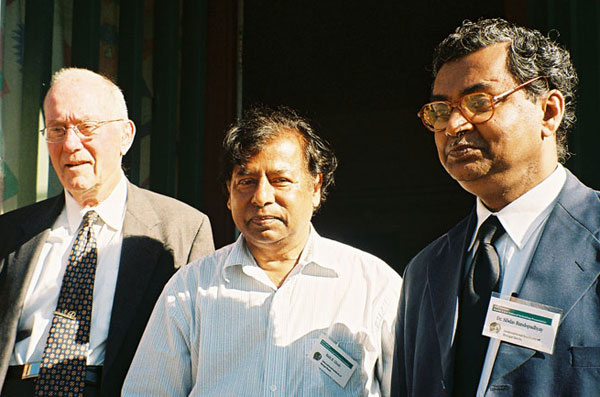

 Truman Show in India:
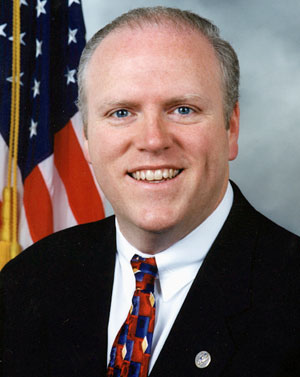 The amendment to the Homeland Security Appropriations Bill called for funds to be cut off from any state or local government entity or official that prohibits or restricts the sharing of an individual’s citizenship or immigration status with the Bureau of Immigration and Customs Enforcement.
 India has imposed income tax on Non-Resident Indians on their global income (not earned in India) after two years of their residency in India. Previously, the government had a blanket no-tax policy for nine years for returning NRIs. However, former Finance Minister Jaswant Singh changed it to two years.
  A certificate of recognition signed by anti-racism activist attorney Morris Dees and civil rights activist Rosa Parks, co-chairs of the National Campaign for Tolerance reads: “The National Campaign for Tolerance does hereby authorize that the name of Dr. Austin D’Souza Prabhu be placed on the Wall of Tolerance. Honoring those who are taking a personal, public stand against hate, injustice and intolerance, and who are leading the way toward a more just America as Founding Members of the National Campaign for Tolerance, authorized this 5th day of July, 2004.”
 NTPA topics covered included honing field organizing skills, improving voter contact and targeting, volunteer recruitment, building grassroots organizations, get-out-the-vote campaigns and effective fundraising. Participants also had the opportunity to attend other convention-related events including MTV’s Rock The Vote Concert and the Revolutionary Women Forum with Hillary Clinton, Madeleine Albright, Jennifer Granholm, Carol Moseley Braun and Nancy Pelosi. There was a one-day Asian American forum. NTPA registration was Free with membership in APAP ($50 for professionals or $25 for students and those with limited income) and includes lodging (limited to first 75 non-MA residents only), meals and materials.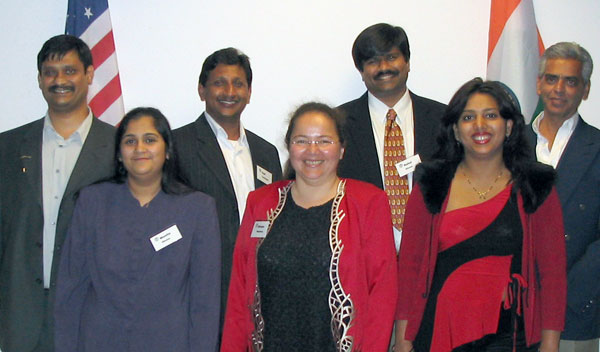


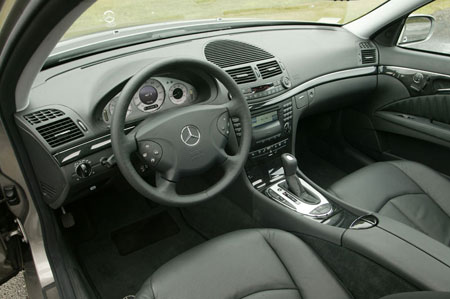 Of course, no Mercedes, let alone an E-Class model, would be complete without loads of conveniences. For the fussy family, a four-zone climate control should keep everyone happy. Front seats can be adjusted up to 10 ways and has a memory feature for three drivers. The steering wheel is equipped with multi-function controls. Both power windows in the front are equipped with express up and down feature.
 Seats are covered in fine leather and the dash is trimmed in walnut burl, which should be no surprise for a Mercedes product. There is one surprise within the E500 wagon, however: a standard third row of seats. When the third row is folded down, you have a large and easily accessible cargo area; when they are up in the “up position,” you now have two more seatbelts in the rear-facing direction.