!-- Start Alexa Certify Javascript -->
|
|||||||||||||||||||||||||||
|
|||||||||||||||||||||||||||
|
|
|||||||||||||||||||||||||||
|
|||||||||||||||||||||||||||
|
|
|
|
|
|

FEBRUARY 2004 |
IN THIS ISSUE
MAIN FEATURE The Threat to Food Security : Peril to Both Iowa, Telengana By Sripad Motiram, Vamsi Vakulabharanam and Vijay Prashad GLOBAL TRADE Made in India : Retooling a Brand By Siddharth Srivastava SOCIAL JUSTICE A Different Kind of Desi : NRIs at the World Social Forum By Tom Hayden Publisher’s Note • Infotech India U.S. Outsourcing Backlash: India Slams Senate Bill Online Wedding Bazaar: ShaadiTimes.com • The New American Century Westerners Eye India • Pravasi Bhartiya Diwas • BBC: Roadshow to Rural India NCM: Bush Immigration Proposal • Legal Issues: Traveling to South Asia Community News in Brief: Forum on Patriot Act... Star in Biomedical Engineering... Memorial Service for Uday Singh... State Controller Meets Auto Review: 2004 Volkawagen Touareg V8 • Bollywood • Tamil Cinema Recipe: Paneer with Tomato Gravy • Horoscope |
|||||||||||||||||
|
Publisher's Note
In this issue we step back aside our usual interest in information technology and look at an critical to sustainable human survival: food. Three scholar-activists make an impassioned and compelling case that poverty and hunger India is not simply due to backwardness. They argue that a rigged trading system that lopsidedly favors corporate agribusiness in the developed countries puts India, and other developing nations at a huge disadvantage. That’s not all; even in the U.S., the beneficiaries of huge government largess are not small farmers at all; notwithstanding billions of dollars of subsidies, the number of U.S. farmers is shrinking as more and more of agricultural commodities go into the hands of a handful of global giants. India may have made the world sit up and take notice with its IT capabilities, but who would have thought the “Made in India” brand is worth global respect? Our intriguing report says that Indian manufacturers have recently won the world’s most coveted quality control prize, Japan’s Deming Prize (something that has eluded China), and companies ranging from Swedish automaker Volvo to U.S. retail giant Walmart are rushing to India to explore manufacturing. The World Social Forum in Mumbai attracted about 100,000 activists from all over the world. Indian Americans went there, too. We look at what that means, and also offer an excerpt of an address by activist author Arundhati Roy at the WSF. Typically provocative and trenchant, it presents views that we may not always agree with, but Roy’s opinion is a valuable counterpoint to the increasingly one-sided intellectual monoculture in the U.S. that blindly champions globalization and the neoliberal Washington consensus. |TOP|
MAIN FEATURE
The Threat to Food Security Peril for Both Iowa, Telengana - By Sripad Motiram, Vamsi Vakulabharanam and Vijay Prashad What have farmers in Iowa and Telengana got in common? A whole lot, argue economists Sripad Motiram, Vamsi Vakulabharanam and political scientist Vijay Prashad, who blame a rigged economic system stacked in favor of global corporate agribusiness and the West that is squeezing the small farmer in Iowa and crushing the landless farmer in India. This article is excerpted from the booklet “Iowa is Not Far from Telengana" Some Arguments for Food Security in India” by the authors, published by the Working Group on Food Security. The full text and author contact information is available at the Web site of the Working Group on Food Security at: http://www.geocities.com/wgfs2004/ Far be it for us to go against this trend and argue against the tangled agricultural history of our planet: India and America will continue to trade and trade they must. The current process known as “globalization,” however, is actually corporate globalization, because it does not operate for planetary welfare, neither in the Indian region of Telengana nor in the U.S. state of Iowa. Between 1998 and 2002, over a thousand farmers in the region of Telengana committed suicide. In the United States, according to the Centers for Disease Control, the highest rates of suicide take place in the states with the largest farm populations: the Rocky Mountain states, the Dakotas, Iowa and Florida. Small farmers and farm hands are killing themselves. Why is this? Globalization in agriculture works against those who work the soil. Farmers and farm hands do not own the bulk of farm production, and certainly not the major profit-generating part of the agro-business industry. Whether in India or the U.S., those who work the soil for those who own it have been vulnerable to the fixed game of globalization. In the relationship between nations with regard to agriculture, double standards are the order of the day. The World Trade Organization and the main advanced industrial states (the G-8 or Group of Eight countries, including Canada, France, Germany, Italy, Japan, Russia, United Kingdom and the United States) pressure the Third World states to reduce government support for farmers and open their agricultural economies to the rest of the world. The G-8/WTO argue that subsidies and price controls “distort” the market and contribute to the poverty of places like rural India. Meanwhile, within the G-8, the governments provide a high level of support for agriculture and they keep their economies closed to agricultural products from the Third World. A significant fall in the incomes of the poorer farming population in India can be directly traced to the farm-subsidy and tariff structures that exist in the G-8 countries, most notably the U.S. The subsidy regime has allowed large agro-businesses to dominate the world agricultural industry, and create misery not only for those who work the soil in India, but also in the U.S. Many U.S. small farmers have lost their lands and livelihood to banks and agro-businesses who flourish on the world market, mainly because of their economies of scale, their use of industrial science on the fields and the considerable subsidies and tariff support they receive from the G-8. The WTO’s ally in the destruction of older schemes for food security is the International Monetary Fund. Since 1991, the IMF in India has pushed a structural adjustment policy that demands that the state reduce its support in the production of agricultural goods and in its consumption. As the state withdraws from the agricultural arena, agro-businesses enter and decimate the security of ordinary people. If there are now less well-paid jobs, there is also less food to eat. In the 1960s, the Indian government instituted a food procurement and distribution system known as the Public Distribution System. The PDS system stabilized food prices by the purchase of food grains at a fixed price from farmers. That food then entered the homes of farmers and workers through Fixed Price or Ration Shops. The crackdown on PDS in the last decade has produced dire results both in rural and urban India. Not only can small farmers not rely on fair prices for their products, but workers across the country cannot rely upon fair price shops for their goods. Market distortions like the U.S. subsidy regime and the privatization of credit markets directly cause the suicides of farmers around the world. In this sense, in the new global agricultural arena, Iowa is not far from Telengana. Farm Subsidies in the U.S. One result of this has been the decline of the family farm, where income is currently just above $23,000. Between 1994 and 1996, 25 percent of hog farmers, 10 percent of grain farmers and 10 percent of dairy farmers went out of business. The Bureau of Labor Statistics projects that between 1998 and 2008 the number of family farms will decrease by over 13 percent. Meanwhile, the agricultural industry continues to concentrate in the hands of a few monopoly firms. Four firms control more than half the poultry industry, four others control more than 80 percent of the beef industry. Two firms, Cargill and Continental, control two-thirds of the world’s grain. Ten firms control over 84 percent of the world’s agro-chemical market. Today, 8 percent of the farms account for 72 percent of agricultural sales. These firms, not the market, control prices. The government’s subsidies go to these firms that control the market. In 2000, 63 percent of the $27 billion subsidy went to just 10 percent of the farm owners or agro-businesses. From the 2002 Farm Bill (size: $248.6 billion), the top 10 percent of those who receive subsidies rake in two-thirds of the subsidies, while the bottom 80 percent will have to rest content with a sixth of the subsidy pot. The New York Times offered the following analysis and rebuke: “The farms that benefit most [from the subsidy-tariff regime] are industrial sized. American small farmers are victims of federal agricultural policies, just like the African cotton growers, who cannot compete against the American product. American cotton – thanks to subsidies – often sells for less than it costs to grow. The real small farmer’s opportunities are limited by high land costs. The stream of subsidy dollars flowing from the federal Treasury – about $20 billion [in 2002] – has a way of turning arable land into welfare tickets. That’s why in 2001, despite low commodity prices and an ongoing exodus from rural America, farmland values in places like Iowa were hitting all-time highs. Subsidies inflate the price of land by an estimated 25 percent” (“The Farmland Bubble,” New York Times, Dec. 26, 2003). The number of farms in the U.S. has declined from six million in the 1950s to two million today – an indication of the concentration of farmland wealth in a few hands. Plight of Indian Farmers Agricultural growth has been erratic since the liberalization of agriculture. In 2002-03, the growth rate is –3.1 percent. Rural unemployment has risen from 5.61 percent in 1993-94 to 7.21 percent in 1999-2000. Investment in agriculture, notably public investment, has become almost stagnant. Many of the crops grown by Indian farmers come to a market place where the prices for these crops are undermined by the agro-businesses and the subsidies they enjoy in their home countries. Take the case of King Cotton. Between 1999 and 2002, the U.S. agro-business share of the world cotton market grew to 40 percent from 25 percent. This was entirely because of the $12.9 billion subsidy paid by the U.S. tax-payer to the cotton industry. In the same period, India’s imports of cotton grew by almost 29 percent, while India’s production of cotton has fallen. The loss to Indian farmers from U.S. subsidies is calculated to be about $1.3 billion (in 2001). Apart from subsidies, agriculture in the Third World is additionally under pressure from trade restrictions and tariffs employed by the advanced industrial states. Tariffs on products like sugar and beef as well as on processed fruit and diary produce often exceed 100 percent. The tariff structure is “escalating,” or it increases for processed goods as opposed to raw materials. For example, a Latin American farmer who wants to export tomato sauce would have to pay a six percent higher tariff as compared to what s/he would have to pay if s/he exported raw tomatoes. The IMF policies adopted by the Indian government in 1991 have resulted in an increase in the input costs of agricultural production – power, fertilizers and other such high-value items can break the farm. The change of agricultural credit policy has squeezed the ability of the small farmer to afford these inputs, and therefore has benefited the large agro-businesses whose access to credit leaves them invulnerable. The worst hit are the marginal farmers who have less than 2.5 acres. While they account for 72 percent of rural households, their share of agricultural credit has declined from 30 percent (1990-91) to 24 percent (1996-97). High interest rates are the bane of rural India, and many of those who have committed suicide did so to relieve their families of the endless cycle of debt. Faced with the enormity of the rural crisis, the reaction from the well-heeled is often to blame local officials for their disregard, a position on which journalist P. Sainath is trenchant: “Beating up on a district collector and other more lowly officials may serve the demands of drawing room outrage. It doesn’t begin to gauge the crisis Indian agriculture and those dependent on it find themselves in. For a decade now, the launch of harsh anti-poor policies has driven that crisis. But the media cry — with fine but rare exceptions remains the same: It’s a failure in implementation. Reality: it’s the policy, stupid, not the implementation. All an officer has to do to be true in implementation now is to do nothing. That is the policy. The stopping of rural credit. The dismantling of the public distribution system. Gutting what remains of the public health system. Withdrawing the state from basic services.” To justify the attack on the welfare system, some of the well heeled make the argument that “you can’t make an omelet without breaking a few eggs.” After a decade of agricultural neoliberalism in India, one is tempted to say, “I see the broken eggs, but where is the omelet”? What is to Be Done? Reduce Subsidies and Tariffs in the advanced industrial states. One approach is to unmask the hypocritical subsidy regime within the European Union, the US and Japan that enables global agro-businesses to thrive at the expense of the small farmers and the farm workers. We need to demand an end to the subsidy regime that leads to the misery of our rural world. Similarly, we demand a reduction of tariffs in the advanced industrial states, so that Third World farmers can access these markets. Harness Agricultural Policy for People Not Profits. To argue for a symmetrical tariff-subsidy reduction around the world fails to see how the tariff-subsidy regime that used to operate in the Third World worked. While the tariff-subsidy regime in the G-8 is designed to promote the profit sector within agriculture, the tariff-subsidy regime in the Third World, in general, worked to develop the food security of regions. In light of a lack of a social security net in India coupled with the other structural problems that continue to plague the Indian economy, we feel that it is necessary to protect the operation of the Indian small farmer from the depredations of corporate agriculture. Better PDS. Food is a basic need. The signatories to the 1948 Universal Declaration of Human Rights agreed to the “right to adequate standard of living,” which in the 1966 International Covenant on Economic, Social and Cultural Rights was elaborated to mean, “an equitable distribution of world food supplies in relation to need.” In the 1974 Universal Declaration on the Eradication of Hunger and Malnutrition, the world community agreed that, “Every man, woman and child has an inalienable right to be free from hunger and malnutrition.” Land Reform. Studies show that small farms are far more productive than big farms, that if those who work the soil also control it, then they are able to earn more income and make the land more productive for the long-term. We believe that land reform is a long-term solution to the problems of hunger, under-nutrition and poverty. Apart from increasing efficiency by decreasing farm size, land reforms, by improving nutrition, and improving the farmers’ ability to work, go a long way toward addressing the problems of productivity in agriculture. South Korea, Taiwan and China witnessed high growth rates and rapid development on the foundation of land reforms. Revamp Institutional Credit. We believe that the provision of credit is crucial for the food security of the rural poor – the landless laborers, the marginal farmers and the small farmers. Before the structural adjustment of Indian agriculture, institutional credit schemes existed with many problems – high transaction costs, low recovery rates and less desirable access of the funds to the rural poor. Instead of this, we have entered the world of micro-credit. By its very nature micro-credit cannot address the major credit problems in the rural sector. In the Indian context, it is fair to say that so far micro-credit has not proved to be a viable alternative to institutional credit in such important areas as technology adoption, irrigation and long-term investments. Necessity for Rural Women’s Rights. The weight of neoliberal policies has fallen heavily on rural women in the Third World – many of whom have had to use creative strategies to feed their families at the same time as agricultural work has been taken away from them. Forced out of daily labor, many rural women farm workers are without income and as the PDS ends, they are now also without food. At an April 24, 2003 All-India Women’s Democratic Association convention on food security and employment, this large organization argued that food security, employment and political participation are interlinked, that without the one, it is infeasible to fight for the other. AIDWA member Gomti Sakhya described the atrocious living and political conditions for women in Rajasthan, notably the end to food security. Women from thirty two villages organized themselves and picketed the District Collector’s office to demand food grains. Limits of Public Action. The Nobel Laureate Amartya Sen and his long-time collaborator Jean Dreze have made a crucial intervention as critics of the current economic reforms. They advocate redistributive policies and an enhanced role for the state, especially in the key areas of health and education. Sen and Dreze have done more than anyone else to highlight the problem of food insecurity, hunger and starvation in India. They have offered a very strong rebuke of the current global inequalities and they see global solidarity as one way forward. We are in agreement with their criticisms. On the issue of asset redistribution, especially land reform, we are not as optimistic as them about the effect that public action can have on the creation of policy for a state dominated by the powerful. If a relatively more progressive state in the initial decades of independence did not carry out land reform, it is unlikely that the current right-wing state will do so. We are skeptical that a state that is fully committed to the current neoliberal economic policies will engage in redistributive policies. Therefore, we advocate the political fight for a change of government as the precondition for the creation of genuine food security in India. - Sripad Motiram is assistant professor in economics at Dalhousie University in Halifax, Canada. |TOP| INFOTECH INDIA Democratic senators Deanna Hanna and Terry Phillips said they were shocked when workers of EDS, a Texas-based company with offices in Colorado, which has a contract for computers for the state Human Services Programs, said that the firm is sending technical support jobs to India. Hanna said her measure (Bill 170) would require companies to keep workers assigned to state contracts in the United States. Phillips’ measure (Bill 169) would bar companies that relocate 100 or more jobs outside the United States from doing business with the state for seven years. The U.S. Senate had earlier passed a law barring doling out sub-contracts to India and other countries by American companies. “The three companies, leaders in their respective areas of operation, have joined hands to offer next generation e-banking solutions that are out-of-the-box and ready to be deployed,” the NASDAQ-listed, Bangalore-headquartered company said in a statement. The solution is based on Infosys’ Finacle, running on Microsoft .NET and Intel platform. This joint initiative was a result of efforts which these companies had been investing in optimizing the solution to deliver and maximize business value and return on investment to their mutual customers, Infosys said. “It has been clarified that if outsourced services are ancillary and auxiliary in nature and adequate remuneration is paid to the Indian call centre, then there shall be no tax on such foreign company as has outsourced its activity to India,” Finance Minister Jaswant Singh said while presenting the interim budget for 2004-05. This policy is on the lines of OECD norms and double-taxation avoidance agreements, he said. Singh said business process outsourcing has vast scope for employment generation. “The new IUC regime will come into effect from midnight. However, with regard to change in numbers by hitherto limited mobile operators now converted into unified service providers like Reliance and Tatas will happen gradually by March,” D.P.S. Seth, Member, TRAI, said. TRAI has specified IUC charges payable between two operators for usage of network, and it is up to the service providers to work out the tariffs based on margins. As of now, none of the operators has announced new tariffs under the IUC regime but industry sources indicated that additional burden on service providers, in terms of access deficit charge to be paid by them to incumbent Bharat Sanchar Nigam Ltd could be passed on to the subscribers. Earlier, the private telecom operators — cellular and unified — had raised concerns over BSNL’s approach of calculating inter-operator charges saying they have been using different pulse rate for making payments to other operators and separate pulse rate for taking payments on the basis of IUC. In this newly-created post, Venkatesan will have direct responsibility for Microsoft’s marketing, sales, operational and business development efforts in India, and will provide a single point of leadership for Microsoft India, in partnership with the leaders of Microsoft’s other business units, in working with policy makers, customers and partners, Microsoft said in a statement. Prior to joining Microsoft, Venkatesan served as chairman of Cummins India Ltd, it said. Microsoft operates four distinct business units in India: the sales and marketing subsidiary; Microsoft’s Indian Business Unit IT Development Centre in Hyderabad; the India Development Centre, also in Hyderabad, and the Global Support Centre in Bangalore. ”Venkatesan will provide strategic direction to all of Microsoft India and focus on the success of Microsoft’s partners and customers in India,” the statement said. (Agencies) Tatas were issued letters of intent for 12 circles last month but the company has signed a license agreement for 11, leaving out Madhya Pradesh. With this, Tatas would have a presence in 17 circles. The new licenses are for Uttar Pradesh (E), Uttar Pradesh (W), West Bengal, Kolkata, Bihar, Orissa, Rajasthan, Himachal Pradesh, Haryana, Punjab and Kerala. When contacted, Ashok Sud, chief regulatory officer of Tatas, said, “We have received licenses for 11 circles. For Madhya Pradesh, some additional documents need to be prepared and we will complete the formalities for MP also soon.” He said the company was contemplating to start services in all new circles within six to nine months from now. “We had started the planning for rolling out networks much before signing the licenses. Now we can place orders for equipment. We hope to start services within the targeted period of up to nine months,” he added. However, he declined to give investment estimates, saying final figures were yet to be determined. Launching the country’s first Campus Radio Station at Anna University here, he said “in a highly diverse country like India, where dialects and socio-cultural attributes change from place to place and from community to community, there is no better people’s medium than community radio.” Stating that nobody could deny that India had entered a new orbit of development under the leadership of Prime Minister A.B. Vajpayee, he said the entire world was noticing and acknowledging the rising stature of the country. Campus radio, Advani said, could be a very useful tool for enhancing the pedagogical capabilities of an educational institution. The country had the second biggest population of students in the world after China, he said. “We need to enrich this human resource through quality education. Today students everywhere and their parents are particular about the quality of education. Therefore, we have to harness new methods and new technologies to upgrade the standards of teaching to global levels in our colleges and universities,” he said. Recalling that the first experimental FM radio station began in 1977 when he was Information and Broadcasting minister, he said the other footnote was that “our government, which came into being riding on a strong anti-emergency wave, freed up All India Radio and Doordarshan from the shackles of political interference.” The Rs. 1.5 million radio station was built by the audio vision research centre of the university. This project will help improve customer service levels and reduce its cost of customer services operations significantly and quickly. The project, started 24 months ago, went live at the end of November 2003, a Wipro release said. The system would enable Prudential customer service agents to have a consolidated view of the customer and quickly conclude a significantly larger number of transactions. Prudential would be able to deliver on the brand promise of “One operation,” reduce costs and deliver even better customer service, Wipro said. The project was built on a Web-based, three-tiered architecture and involved integrating over 20 different technology components. The solution spanned 10 legacy applications, including those performing customer administration, workflow and contact management, the release said. Initially, this facility would be made available as a pilot project for such trains departing from Delhi area, Railway Minister Nitish Kumar announced while presenting the interim rail budget in the Lok Sabha Jan. 30. A pilot project enabling passengers traveling on select Shatabdi Express trains to get reservations booked through Internet and occupy their reserved seats on the basis of a computer generated slip was announced by Kumar as well. He said the commencement of the pilot project is proposed to cover a new horizon, namely the ticketing of the reserved segment. Kumar also announced the facility of train reservations through mobile phones. He said the Indian Railway Catering and Tourism Corporation has developed technical ability to enable cell phone operators to integrate their system with the Railways and this facility will be offered to all cell phone operators. “The expansion of communication aids and the extraordinary penetration of mobile phones in the common man’s life style cannot be ignored by the Railways,” Kumar said in his speech. The agreement gives rights to the Space Imaging to sell data from these two Indian remote-sensing satellites, an official release said in New Delhi. Under the pact, the National Remote Sensing Agency of the Department of Space, based in Hyderabad, acquires and markets the data in India, it said. RESOURCESAT-1 is the most advanced remote-sensing satellite built by the Indian Space Research Organization and was launched by India’s popular satellite launch vehicle PSLV in October last year. Antrix and Space Imaging have been working as partners to fulfill India’s vision of a global commercial Earth Observation Programmer, it said. Combined with the successful launch of RESOURCESAT-1 and Space Imaging’s worldwide user-base, its imagery is sure to gain maximum exposure across the global markets, it said. The Space Imaging has set up 19 ground stations in the past few years to access data from IRS-1C and IRS1-D. It feels that the quality of data from the RESOURCESAT-1 and the forthcoming CARTOSAT-1 will be much more superior and ensure the success of India’s Global Commercial Earth Observation Program, the release said.
GLOBAL TRADE
 Made in India: Retooling a Brand - By Siddharth Srivastava ‘Made in India’ no longer means shoddy outdated products made for a protected market as global heavyweights like Toyota, Volvo, Honeywell and Walmart look at India as a manufacturing hub, writes Siddharth Srivastava. Not too long ago the ‘Made in India’ brand epitomized all that was unreliable and shoddy — a synonym for poverty and deprivation. Now things are beginning to turn around. The `Made-in-India’ tag is making a global splash. We are not talking here of Information Technology, BPO service segments or Indian film actress Aishwarya Rai being branded the most beautiful woman of the world. We are looking at the segment of Indian industry that matters the most for any economy but was always drew global suspicion as far as India was concerned — manufacturing. IT helped India to achieve global recognition. Now, two million trained engineers in the country are infusing vibrancy in manufacturing companies — many of them growing at 40 percent. First the facts — from biscuits and veggies to automobiles and pharmaceuticals, Indian produced goods are breaking new frontiers. Export growth of cars, cigarettes, tobacco and motorcycles has topped 50 percent this fiscal year. For long, Indian manufacturing exports were largely restricted to components. There’s been a huge shift along the way: industry data reveals the export of finished consumer goods is making rapid strides. Automobiles, consumer durables, drugs, IT hardware and FMCG are all clocking double-digit revenue growth in the international market. Recently, five Indian companies bagged the globally acclaimed Deming prize, a touchstone for quality manufacturing. This prize is given to an organization for rigorous total quality management practices. China is yet to get such an honor. Eight more Indian companies are preparing for the 2004 Deming recognition. In addition, the Japanese Institute of Plant Management has rewarded 18 manufacturing plants in 10 Indian companies for excelling in Total Productive Maintenance this year. World-renowned TQM expert Prof Yasutoshi Washio predicts that Indian manufacturing quality will overtake Japan in 2013. U.S., Europe and Japan are seeking outsourcing opportunities through manufacturing supply chains from India. Toyota is establishing India as a source for transmission parts. Ford is sourcing engines from Hindustan Motors. Yamaha and Mitsubishi have announced plans to make India a global sourcing hub for 125 cc motorcycles. Volvo, Renault and Mack Truck want to develop Indian vendors for their global requirements. U.S. retail chain Walmart, through its global outsourcing office in Bangalore, will increase outsourcing from India from the current $1 billion to $10 billion in the next couple of years. It is looking at sourcing paints, automotive, sport goods, lawn and garden equipment and hardware among others. Honeywell, a $22-billion technology and manufacturing company, is finalizing its outsourcing strategy for aerospace products and services. Siemens has committed to make $500 million investments soon. Perhaps the most revealing figures have been thrown up by the automobile sector where passenger cars exports jumped 72.9 percent with volumes fast approaching 100,000 units. Scooters recorded a marginal 2 percent rise in domestic sales, but exports jumped 91.2 percent in the April-December period. Exports of motorcycles and step throughs have also spurted 52.6 percent with volumes surpassing 100,000 units in the first nine months of the fiscal. So, is India a brand new success story? Observers say this was bound to happen over time. It is a clear reflection that the Indian manufacturing sector is maturing from being just suppliers of components to final products. And as could be expected, multinationals are playing the key role in opening the global market with their established brands. In some cases products without a ready market in India are also being outsourced in large quantities for global customers. For instance, Whirlpool is sourcing coffee grinders for its buyers in North America even though it doesn’t have a ready market in India. Its export-oriented unit has become one of the main suppliers of the product for Whirlpool globally. This clearly is an indication that India is slowly catching up with the rest of the world and is being recognized as a hub for manufacturing products with the same low cost base as China. Some have compared the current phase as the same journey towards good quality that Japan embarked on after World War II. Other have described it as a tidal wave just building up. Global consultancy firm AT Kearney advises that India will have to bring down costs to improve its manufacturing competitiveness. The making of the “Made in India” brand has advanced alongside a metamorphosis of the popular global perception of India. The connotations attached to the Made in India logo are beginning to represent cool, savvy and fashionable. The idea of India as the ‘metro-spiritual’ finds favor with New Age Indians who are equally comfortable with the meditative and the material world. Hence it is no longer taboo to make your millions en route to moksha. Indeed, this success is a jump forward from the time that India was cocooned in the khadi of Nehruvianism to ‘Brand India’ inching up its way to become the flavor of the millennium. Examples abound, from the ubiquitous “hot” curry becoming the national dish of Britain (Former British Foreign Secretary Geoffrey Cook famously declared chicken tikka masala the national dish of Britain) to the nation with exchanging its begging bowl of yesteryear for a robust foreign exchange reserve of $100 billion or Kiran Karnik becoming the Forbes face of the year to the silver screen success of Bollywood, India is beginning to shine bright in the new ICE age of Information, Communication and Entertainment. But there is the other dark side. Thousands of illegal immigrants are willing to pay any amount to roost in foreign lands. These people belong to the India still untouched by the bounty that flows. They are the 26 percent of people who live in abject poverty and 42 million unemployed. The cruel paradox is that India has 18 million child workers despite 200 laws banning child labor. A prominent economist recently said that red tape has proliferated in government and each file has to make 267 stops before clearance. India has also been witness to numerous scams with politicians leading the stampede of the scamming brigade. If India has $100 billion as forex reserves, China has $400 billion. If India’s tourist industry has recorded 3 million people tourist inflow, Singapore alone accounts for 7.5 million. India, it must be said, still remains a sea of mediocrity dotted with islands of excellence. While there is no gainsaying the fact that a new beginning has been made, the real challenge is to expand these islands of excellence to encompass the entire country. Interested readers can find more information about IIBB at www.nvo.com/ghosh_research. - Siddharth Srivastava is a journalist based in New Delhi. |TOP| REPORT  U.S. Outsourcing Backlash: India Slams Senate Bill – By Siddharth Srivastava The recent U.S. Senate bill to curb outsourcing to countries like India has drawn a sharp reaction in India, writes Siddharth Srivastava. Indian industry and government have taken umbrage at the U.S. Senate’s curb on outsourcing government contracts that has barred doling out sub-contracts to India and other countries by American companies. At the same time the move is seen to be short sighted and populist with no appreciable impact on Indian current business interest. “The Senate Bill is a surprise,” Commerce and Industry Minister Arun Jaitley said, recalling his meeting with U.S. trade representative Robert Zoellick in June last year in which Zoellick had termed as “bad policy” attempts then being made some state legislatures to ban outsourcing of government contracts to countries such as India. “The actual volume of trade that we do with regard to outsourcing of U.S. government contracts is not a lot,” Jaitley said. “But it sends out a wrong signal at a time when the U.S. and India are working with others to lower trade barriers and establish fair trade rules,” he said. Echoing similar sentiments, Information Technology Minister Arun Shourie said that this was not the way Washington could advance in the backdrop of multilateral trade negotiations. “I feel this would worsen prospects of multilateral negotiations in trade,” Shourie said in a statement from Davos while advising the Indian companies to diversify their markets. Clarifying that India did not do much of the outsourcing business on U.S. government contracts, he said, “The direct effect would be little and Indian IT companies must learn some lessons from such moves.” “We must continue to move up the value chain and evolve such solutions and services which are good and cost-effective and Indian IT companies must diversify to other markets,” Shourie said. Indian industry, too, has reacted angrily to the passage of the Senate Bill and is seeing it as a case of protectionism building up in the U.S. ahead of this year’s presidential election. CII president Anand Mahindra termed the Senate action “unfortunate” and said, “Although normally such provisions are not changed, perhaps the U.S. president would reconsider this before signing the Bill.” Software industry association NASSCOM president Kiran Karnik said, “We are dismayed. Such legislation is not in keeping with the increasing globalization of trade which benefits all countries and is contrary to the spirit of free trade espoused by the U.S.” Although the full implications of the bill are not clear, it does seem that India will not be greatly affected by it. Only about 2 percent of India’s $10 billion software revenues come from U.S. government contracts, according to NASSCOM. Most outsourcing business is in the private sector domain. Most government contracts are already earmarked for American companies by existing laws. According to a report in The Times of India, what is not clear is the impact of the legislation in situations where foreign or foreign-owned companies have bid to win U.S. government contracts. For instance, part of the contract to build the U.S. government website Firstgov.com was won by a Norwegian company. Also unclear is whether the proposed law will affect foreign companies executing on-site work at U.S. government sites. Business groups in the U.S. are protesting the measure. “We want to grow the worldwide economy and create jobs. Isolating ourselves is not the way to do it,” director of communications from Business Roundtable Tita Freeman has said. Business Roundtable is an association of CEOs of the biggest firms in the U.S. and it recently urged the Bush administration not to be swayed by the public furor over the loss of American jobs overseas and not to espouse policies that would prevent American firms from getting jobs done cost-effectively, including outsourcing and subcontracting to countries like India, China or Russia. Reports also suggest that U.S. companies are expected to lobby against some of the provisions in the bill that affect their operations. Indian-American companies in the tech field, who win substantial amounts of government contracts often under special schemes for minority businesses, are not affected by the legislation, except where they might be sub-contracting the world to an Indian subsidiary. In India, at best only a few call center businesses that have state government contracts may be affected. Observers here say that U.S. lawmakers are being shortsighted and populist in bringing about such legislation and will be brought to their senses when enough qualified people are not found to do the job. According to a McKinsey estimate, for every dollar of U.S. spending in off-shoring, the benefit to U.S. could be in excess of $1.10 — and to India it could be $0.33. That is, this is a zero sum game. On the next course of action from government to counter this, Shourie said: “The real action has to come from the firms who avail our services and they must know the consequences on their competitiveness if they are not allowed to outsource.” Shourie said the move by the U.S. Senate was an “important symptom.” “It may have implications on the chances of similar bills being passed by 8 U.S. states,” he said. In a broader context, the move is being seen here as a test of U.S. commitment to the ideal of free trade. It is the politicians, and not industry spokespersons, who are attributing America’s so-called jobless recovery to outsourcing. - Siddharth Srivastava is a journalist based in New Delhi. |TOP| SOCIAL JUSTICE 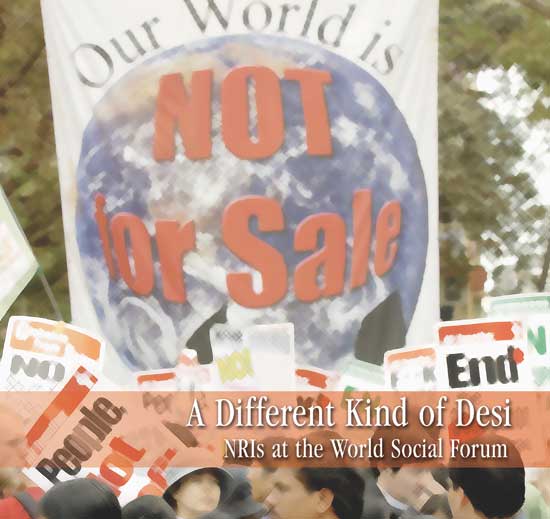 A Different Kind of Desi: NRIs at the World Social Forum – By Tom Hayden Young progressive Indian Americans at the World Social Forum mark a growing willingness of a new generation to challenge the conservative mindset of their elders, writes Tom Hayden. Indian-Americans are a prime target of opportunity for conservatives seeking political headway among people of color. The author Dinesh D’Souza, funded by conservative foundations, attacks campus liberals and affirmative action, becoming an Indian-American version of Ward Connerly, the conservative African-American who wishes to legislate color-blindness. In Louisiana this year, a 29-year-old, born-again Christian Republican, Bobby Jindal, was almost elected the first Indian-American governor of any state. But at the World Social Forum in January, young, progressive Indian-Americans have surfaced everywhere, all with stories to tell. The forum experience may be seen as a turning point in building their confidence to challenge the conservative leadership of their communities, according to one of them, Rinku Sen, 37. Sen, a Brown University graduate, directed the Oakland-based Center for Third World Organizing before becoming the publisher of ColorLines magazine. She came to the U.S. with her parents in 1972, part of the wave of Indian professionals encouraged by 1965 immigration reforms. “We grew up in white suburbia,” she recalls, “with no desis to relate to.” She was encouraged by her professors to study literary criticism, but chose to do something about social justice instead. She became involved in student movements, then was trained by longtime organizers at the Midwest Academy. Last year she published her first book, “Stir It Up” (Jossey-Bass). Sen’s consciousness initially was radicalized by African-Americans and feminists more than other South Asians. As the Indian immigrant community became larger and more diverse, an identifiable constituency began to search for definition, including where they fit on the color spectrum. While there were only 387,000 Indians in the U.S. in 1980, estimates today are as high as two million — still only six-tenths of one percent of the American population, but 16 percent of Asian Americans. D’Souza’s arguments extolling upward mobility would be favorably received by this first generation of Indian professionals, with nearly twice the median incomes and college degrees of other Americans. But the growing Indian community still experienced the color line, political isolation and, especially after September 11, hate crimes and hostility towards immigrants. They began to address their political invisibility, having only three elected official at state legislative levels when their population ratio should result in 45. For Sen, the World Social Forum has been a marker on her journey. “It’s a perfect mix of my identities. It’s about my political work. About spending time with my family and not feeling the divisions of identity. I pass as all Indian, it’s important to have that in one’s life. Otherwise we are constantly negotiating the fragments inside us.” Sen believes that the more her community has this experience of integration, “it builds the community confidence so that progressive south Asians might take on the conservatives” now trying to dominate and speak for the whole community. And Rinku Sen is not alone. There are other Indian Americans, most in their mid-20s, attending the forum:
These days there are fewer ABCDs (American-born Confused Desis) than ever before. The new generation marched among 100,000 in their Indian homeland at the World Social Forum, before returning to their lives and struggles in America. They may come to apply the radical traditions of their Indian heritage in a unique form of progressive assimilation into American political culture. - Tom Hayden is a progressive activist, author and former California elected official. |TOP| REPORT:
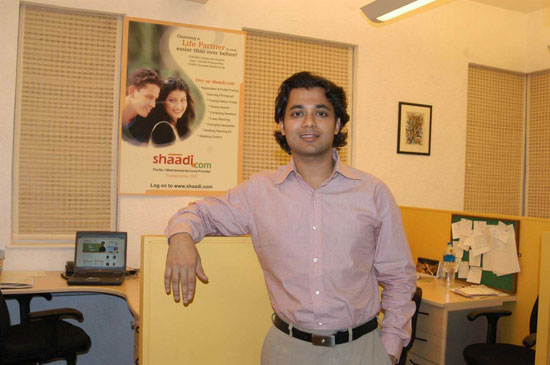
Online Wedding Bazaar ShaadiTimes.com – A Siliconeer Report Online desi matrimonial Web site Shaadi.com now has a Web site that offers advice and a virtual wedding store. A Siliconeer report. Shaadi.com, the desi matrimonial services provider which bills itself as a service with “more than 1.5 million members, 500,00 pictures and 50,000 plus success stories,” has launched a Web site, according to a press release. ShaadiTimes is a relationship and wedding Web site offering a host of services with a panel of experts offering advice in diverse areas like beauty, fashion, law, fitness, relationships and wedding planning. The panel includes Jamuna Pai (beauty), Laura Vaz (psychoanalyst), Anirudh Malpani (infertility specialist), Vivek Nigam (fitness), Sneha and Dipa (wedding planners), each well known in India in their respective fields. The panelists will contribute articles and offer free advice to people asking questions through the Web site. The site also features a comprehensive wedding store. Online visitors can send gifts and buy products and services that may be required for a wedding. In addition, the Web site covers current affairs and includes features and researched articles. Readers contributions will also be included. “A large portion of the content is generated by readers themselves,” the release adds. “One can read poems, essays, and articles based on experiences of the readers. “ “It is ironic that in a country like India where the emphasis on marriage is so high, the education system and culture do not prepare one for a healthy post marital life,” says Shaadi.com CEO Anupam Mittal. “ShaadiTimes seeks to bridge this gap.” ”Its not just about matchmaking,” says ShaadiTimes editor Jaanhavi Paal. “The idea is to ensure that anybody who wants to tie the knot is aware of all the realities and myths associated with marriage, relationships and sex. But that’s not where it ends. It is ShaadiTimes’ endeavor to make sure that two people who have decided to become partners for life stay that way…happily ever after.” CRITIQUE:
The New American Century Against the Imperium - By Arundhati Roy Arundhati Roy offers a blistering critique of what she calls the “new imperialism” of the world’s only superpower, the United States. This article is excerpted from her address at the World Social Forum in Mumbai in January. In January 2003 thousands of us from across the world gathered in Porto Alegre in Brazil and declared — reiterated — that “Another World Is Possible.” A few thousand miles north, in Washington, George W. Bush and his aides were thinking the same thing. Our project was the World Social Forum. Theirs — to further what many call the Project for the New American Century. For the first time in history, a single empire with an arsenal of weapons that could obliterate the world in an afternoon has complete, unipolar, economic and military hegemony. It uses different weapons to break open different markets. There isn’t a country on God’s earth that is not caught in the cross-hairs of the American cruise missile and the IMF checkbook. Argentina’s the model if you want to be the poster boy of neoliberal capitalism, Iraq if you’re the black sheep. Poor countries that are geopolitically of strategic value to Empire, or have a “market” of any size, or infrastructure that can be privatized, or, God forbid, natural resources of value—oil, gold, diamonds, cobalt, coal—must do as they’re told or become military targets. This brutal blueprint has been used over and over again across Latin America, in Africa and in Central and Southeast Asia. It has cost millions of lives. It goes without saying that every war Empire wages becomes a Just War. This, in large part, is due to the role of the corporate media. It’s important to understand that the corporate media don’t just support the neoliberal project. They are the neoliberal project. This is not a moral position they have chosen to take; it’s structural. It’s intrinsic to the economics of how the mass media work. Most nations have adequately hideous family secrets. So it isn’t often necessary for the media to lie. It’s all in the editing—what’s emphasized and what’s ignored. Say, for example, India was chosen as the target for a righteous war. The fact that about 80,000 people have been killed in Kashmir since 1989, most of them Muslim, most of them by Indian security forces (making the average death toll about 6,000 a year); the fact that in February and March of 2002 more than 2,000 Muslims were murdered on the streets of Gujarat, that women were gang-raped and children were burned alive and 150,000 driven from their homes while the police and administration watched and sometimes actively participated; the fact that no one has been punished for these crimes and the government that oversaw them was re-elected...all of this would make perfect headlines in international newspapers in the run-up to war. Next thing we know, our cities will be leveled by cruise missiles, our villages fenced in with razor wire, US soldiers will patrol our streets, and Narendra Modi, Pravin Togadia or any of our popular bigots will, like Saddam Hussein, be in US custody having their hair checked for lice and the fillings in their teeth examined on prime-time TV. But as long as our “markets” are open, as long as corporations like Enron, Bechtel, Halliburton and Arthur Andersen are given a free hand to take over our infrastructure and take away our jobs, our “democratically elected” leaders can fearlessly blur the lines between democracy, majoritarianism and fascism. Like Old Imperialism, New Imperialism relies for its success on a network of agents—corrupt local elites who service Empire. We all know the sordid story of Enron in India. The then-Maharashtra government signed a power purchase agreement that gave Enron profits that amounted to 60 percent of India’s entire rural development budget. A single American company was guaranteed a profit equivalent to funds for infrastructural development for about 500 million people! Unlike in the old days, the New Imperialist doesn’t need to trudge around the tropics risking malaria or diarrhea or early death. New Imperialism can be conducted on e-mail. The vulgar, hands-on racism of Old Imperialism is outdated. The cornerstone of New Imperialism is New Racism. The best allegory for New Racism is the tradition of “turkey pardoning” in the United States. Every year since 1947, the National Turkey Federation has presented the US President with a turkey for Thanksgiving. Every year, in a show of ceremonial magnanimity, the President spares that particular bird (and eats another one). After receiving the presidential pardon, the Chosen One is sent to Frying Pan Park in Virginia to live out its natural life. The rest of the 50 million turkeys raised for Thanksgiving are slaughtered and eaten on Thanksgiving Day. That’s how New Racism in the corporate era works. A few carefully bred turkeys—the local elites of various countries, a community of wealthy immigrants, investment bankers, the occasional Colin Powell or Condoleezza Rice, some singers, some writers (like myself)—are given absolution and a pass to Frying Pan Park. The remaining millions lose their jobs, are evicted from their homes, have their water and electricity connections cut, and die of AIDS. Basically they’re for the pot. As part of the project of New Racism we also have New Genocide. New Genocide in this new era of economic interdependence can be facilitated by economic sanctions. New Genocide means creating conditions that lead to mass death without actually going out and killing people. Denis Halliday, who was the UN humanitarian coordinator in Iraq between 1997 and 1998 (after which he resigned in disgust), used the term genocide to describe the sanctions in Iraq. In Iraq the sanctions outdid Saddam Hussein’s best efforts by claiming more than half a million children’s lives. In the new era, international instruments of trade and finance oversee a complex system of multilateral trade laws and financial agreements that keep the poor in their bantustans. Its whole purpose is to institutionalize inequity. Why else would it be that the US taxes a garment made by a Bangladeshi manufacturer twenty times more than a garment made in Britain? Why else would it be that countries that grow cocoa beans, like the Ivory Coast and Ghana, are taxed out of the market if they try to turn it into chocolate? Why else would it be that countries that grow 90 percent of the world’s cocoa beans produce only 5 percent of the world’s chocolate? Why else would it be that rich countries that spend over a billion dollars a day on subsidies to farmers demand that poor countries like India withdraw all agricultural subsidies, including subsidized electricity? Why else would it be that after having been plundered by colonizing regimes for more than half a century, former colonies are steeped in debt to those same regimes and repay them some $382 billion a year? For all these reasons, the derailing of trade agreements at Cancún was crucial for us. Though our governments try to take the credit, we know that it was the result of years of struggle by many millions of people in many, many countries. What Cancún taught us is that in order to inflict real damage and force radical change, it is vital for local resistance movements to make international alliances. From Cancún we learned the importance of globalizing resistance. No individual nation can stand up to the project of corporate globalization on its own. Time and again we have seen that when it comes to the neoliberal project, the heroes of our times are suddenly diminished. Extraordinary, charismatic men, giants in the opposition, when they seize power and become heads of state, are rendered powerless on the global stage. I’m thinking here of President Lula of Brazil. Lula was the hero of the World Social Forum last year. This year he’s busy implementing IMF guidelines, reducing pension benefits and purging radicals from the Workers’ Party. I’m thinking also of the former president of South Africa, Nelson Mandela. Within two years of taking office in 1994, his government genuflected with hardly a caveat to the Market God. It instituted a massive program of privatization and structural adjustment that has left millions of people homeless, jobless and without water and electricity. Why does this happen? There’s little point in beating our breasts and feeling betrayed. Lula and Mandela are, by any reckoning, magnificent men. But the moment they cross the floor from the opposition into government they become hostage to a spectrum of threats—most malevolent among them the threat of capital flight, which can destroy any government overnight. To imagine that a leader’s personal charisma and a record of struggle will dent the corporate cartel is to have no understanding of how capitalism works or, for that matter, how power works. Radical change cannot be negotiated by governments; it can only be enforced by people. At the World Social Forum some of the best minds in the world come together to exchange ideas about what is happening around us. These conversations refine our vision of the kind of world we’re fighting for. It is a vital process that must not be undermined. However, if all our energies are diverted into this process at the cost of real political action, then the WSF, which has played such a crucial role in the movement for global justice, runs the risk of becoming an asset to our enemies. What we need to discuss urgently is strategies of resistance. We need to aim at real targets, wage real battles and inflict real damage. Gandhi’s salt march was not just political theater. When, in a simple act of defiance, thousands of Indians marched to the sea and made their own salt, they broke the salt tax laws. It was a direct strike at the economic underpinning of the British Empire. It was real. While our movement has won some important victories, we must not allow nonviolent resistance to atrophy into ineffectual, feel-good, political theater. It is a very precious weapon that must be constantly honed and reimagined. It cannot be allowed to become a mere spectacle, a photo opportunity for the media. It was wonderful that on February 15 last year, in a spectacular display of public morality, 10 million people on five continents marched against the war on Iraq. It was wonderful, but it was not enough. February 15 was a weekend. Nobody had to so much as miss a day of work. Holiday protests don’t stop wars. George Bush knows that. The confidence with which he disregarded overwhelming public opinion should be a lesson to us all. Bush believes that Iraq can be occupied and colonized as Afghanistan has been, as Tibet has been, as Chechnya is being, as East Timor once was and Palestine still is. He thinks that all he has to do is hunker down and wait until a crisis-driven media, having picked this crisis to the bone, drops it and moves on. Soon the carcass will slip off the bestseller charts, and all of us outraged folks will lose interest. Or so he hopes. This movement of ours needs a major, global victory. It’s not good enough to be right. Sometimes, if only in order to test our resolve, it’s important to win something. In order to win something, we need to agree on something. That something does not need to be an overarching preordained ideology into which we force-fit our delightfully factious, argumentative selves. It does not need to be an unquestioning allegiance to one or another form of resistance to the exclusion of everything else. It could be a minimum agenda. If all of us are indeed against imperialism and against the project of neoliberalism, then let’s turn our gaze on Iraq. Iraq is the inevitable culmination of both. Plenty of antiwar activists have retreated in confusion since the capture of Saddam Hussein. Isn’t the world better off without Saddam Hussein? they ask timidly. Let’s look this thing in the eye once and for all. To applaud the US Army’s capture of Saddam Hussein, and therefore in retrospect justify its invasion and occupation of Iraq, is like deifying Jack the Ripper for disemboweling the Boston Strangler. And that after a quarter-century partnership in which the Ripping and Strangling was a joint enterprise. It’s an in-house quarrel. They’re business partners who fell out over a dirty deal. Jack’s the CEO. So if we are against imperialism, shall we agree that we are against the US occupation and that we believe the United States must withdraw from Iraq and pay reparations to the Iraqi people for the damage that the war has inflicted? How do we begin to mount our resistance? Let’s start with something really small. The issue is not about supporting the resistance in Iraq against the occupation or discussing who exactly constitutes the resistance. (Are they old killer Baathists, are they Islamic fundamentalists?) We have to become the global resistance to the occupation. The Project for the New American Century seeks to perpetuate inequity and establish American hegemony at any price, even if it’s apocalyptic. The World Social Forum demands justice and survival. For these reasons, we must consider ourselves at war. - Arundhati Roy is an author and activist based in India. |TOP|
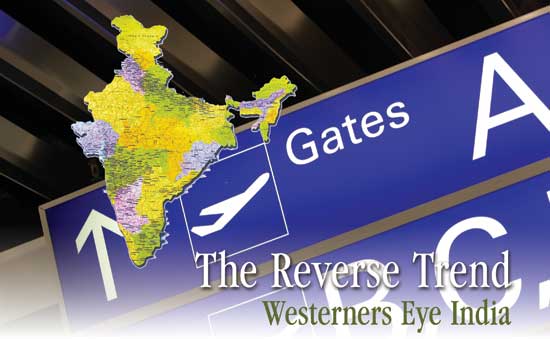
BUSINESS Prominent headhunters in India have corroborated that over the past six months several inquiries have been received from top and middle level executives from the U.S. and U.K,, exploring job opportunities in top technology firms such as Wipro, Infosys, Satyam, TCS, to name a few. This is apart from regular middle and top-level management positions in multinational companies such as IBM, GE that have set up huge operations here. “Lots of foreign nationals are looking at mid-level and senior level positions in India. Every week, we get at least one well-qualified foreigner looking for a job here,” Kris Lakshmikanth, founder CEO and managing director of executive recruiting firm Head Hunters (India), told reporters. “As several IT product firms are setting up shop in India, experienced professionals from the U.S. are also on the lookout for jobs here and the trend is being witnessed by the top-tier recruitment firms,” he said. The movement of skilled manpower from India to Western countries has been happening for decades. Doctors, engineers, software professionals, nurses, teachers have always been in demand, given the international shortage of such personnel. The last couple of years, however, have witnessed Indians in technology firms especially in the Silicon Valley, headed back home, following job losses and recession in the U.S. market. Indian firms with foreign arms have hired foreign workers in their location of operation. The Aditya Vikram Birla Group, for instance, has recruited over 72,000 employees in 20 different countries. This is the first time, however, that reports are coming in of foreign personnel willing to physically trans-locate to India in search of work. “Last year, it was Indians abroad who were shifting to places like Bangalore. Since the last six months, it is the foreigners and all the top recruitment firms are getting inquiries,” said Lakshmikanth The broader picture speaks for itself — that outsourcing is a phenomenon likely to stay, despite temporary voices of protest, linked more to an election year in the U.S. than anything else. According to a study by management consulting firm A T Kearney, financial services companies are planning to move more than 500,000 jobs overseas in order to reduce operating costs by $30 billion annually. Global technology giant IBM expects to save $168 million annually starting in 2006 by moving several thousand high-paying programming jobs abroad, according to internal company documents obtained by The Wall Street Journal. IBM has said it plans to move up to 3,000 jobs from the U.S. to developing countries this year. Estimates suggest that 200,000 to 400,000 jobs have moved from the U.S. since the outsourcing trend began in the 1990s, which is still a fraction of 138 million jobs in the U.S. The Information Technology Association of America says only around 2 percent of the 10 million computer-related jobs have been sent abroad; 12 percent of IT companies have outsourced work, compared to 3 percent of non-IT firms. The most high-end projection is by Forrester Research — a loss of 3.3 million jobs by 2015, including 1.7 million back-office jobs and 473,000 IT jobs — which will create a dent in the U.S. job market but not the trainwreck everyone fears. But that’s not the only reason foreigners are mulling a job in India. Experts say that foreign manpower, apart from pressure of job losses, are seeking out India for the opportunities on offer and as an attractive destination. This is because many leading global technology firms have started to move high profile and highly skilled jobs to India, apart from the many low-end call centers jobs that have already shifted base to this country. “Earlier only call-center jobs were being outsourced to India,” Anil Mahajan, executive director of Talent Hunt Private Ltd has been quoted by a news agency, “but now as companies start to ship high-end research and senior managerial jobs too to India, foreign workers see a huge opportunity for themselves here.” “Till a few months back, we were getting regular job queries from expatriate Indians who wanted to move back to India. But we were also taken by surprise when overseas professionals from countries as far as the U.S., Britain and South Africa also started to call us up to inquire about job opportunities here. This has now become a trend,” said Mahajan. In the last few years, most of the jobs outsourced sought to tap vast pool of English-speaking manpower in call centers as well as back-end work for multinational companies. The rapidly growing Business & Process Outsourcing industry has virtually turned India into an electronic housekeeper to the world, taking care of a host of routine activities for multinational giants. In order to cater to customers, a call center in New Delhi has employed Finnish people to answer queries for a leading travel Web site in Europe, but such instances of foreign employees have been few. However, in recent months, India has also seen the inflow of research and development and high-end technology jobs that is beginning to change the picture. Inquiries are now coming in from overseas professionals looking for these openings at middle and senior level positions. Foreigners are looking at Indian IT companies that are operating on a truly global scale. Three of Indian IT giants — TCS, Wipro and Infosys — are already racing to become billion dollar entities. With operations in dozens (if not more) of countries and offices in scores of other locales, even the next 20 or 30 largest Indian software and services companies are not too far behind. Overseas professionals feel comfortable working in these firms, as over the years the company executives have imbibed global practices that are inherent in their operations now. As Indian companies continue to expand operations worldwide, they have adapted their management practices and strategies to compete in the global marketplace. Until recently (even as recent as a couple of years ago), most Indian software companies employed Indians in key positions in global positions around the world. An onsite posting or assignment was a plum perk that the companies offered budding MBAs and other consultants wishing to move towards marketing or sales. During the recent past, Indian companies have begun to realize the significance of having “local hands in local markets” and have started recruiting sales and marketing people in local markets to represent them. This has not only created a familiarity among foreign workers about Indians and India, but also made foreign employees more willing to look for placements in India when the going is tough. - Siddharth Srivastava is a journalist |TOP|
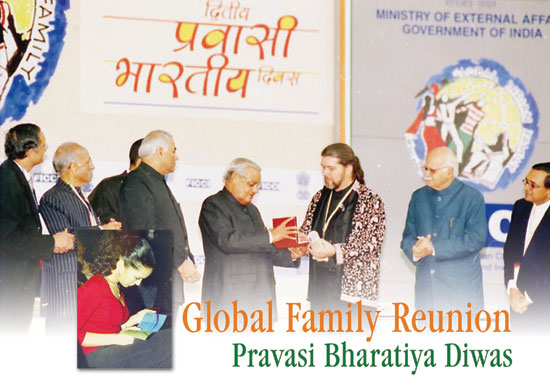
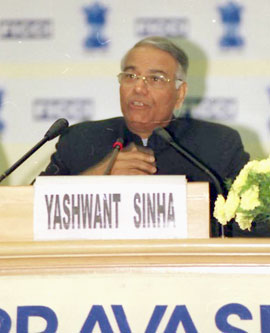
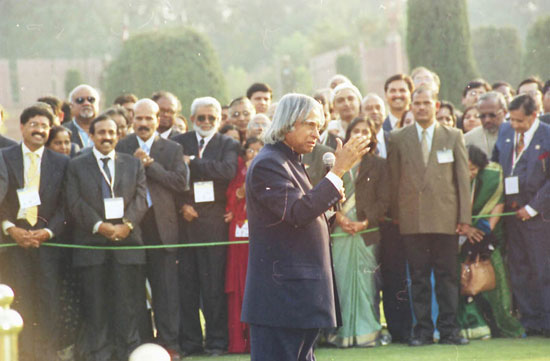
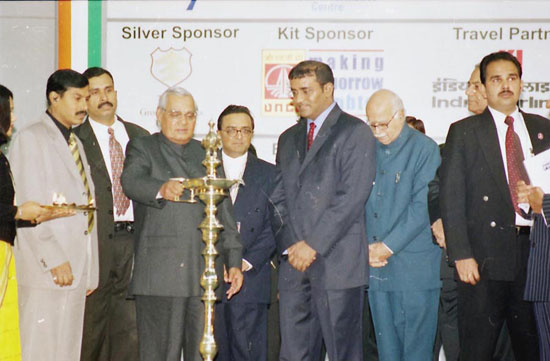
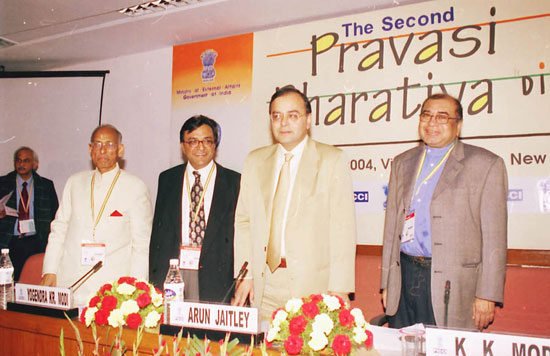
Global Family Reunion: Pravasi Bharatiya Diwas - By Siddharth Srivastava Pravasi Bharatiya Diwas brought the 20-million-strong global Indian family back to their land, writes Siddharth Srivastava. It began as a gargantuan task to bring Indians from every corner of the globe under one roof. The second three-day Pravasi Bharatiya Diwas Jan. 9-11 is an attempt to bring to fruition a process started last year of bringing the 20-million-strong great Indian family spread all across the world back to their native land, emotionally, financially and physically. To gauge the importance of the event, among those in attendance were Prime Minister Atal Behari Vajpayee, fresh from his successful visit to Pakistan and Deputy Prime Minister L.K. Advani, who has been at the forefront of granting dual citizenship to Indians abroad. Over 2,000 people of Indian origin came from across the world. Among them were Nobel Laureate Sir V.S. Naipaul, management guru C.K. Prahalad, economist Jagdish Bhagwati, Lord Bagri of U.K., business magnate L.N. Mittal from England and veteran West Indies cricketer Rohan Kanhai. Leaders of Indian industry who addressed the gathering included Mukesh Ambani, chairman of India’s largest conglomerate Reliance Industries and Sunil Mittal, chairman of Bharti Telecom. Other subjects of dialogue included issues of personal international law and the diaspora; international trade, diaspora hubs and the global market; knowledge based industries: networking for global leadership and tourism; branding strategies for India. Round table discussions on making India a competitive destination in healthcare, voluntary sector and development and finance were an added attraction. “The first PBD last year set into motion the task of bringing Indians from every corner of the globe under one roof and for the first time created awareness about the achievements of the Great Indian Family. The second will take this effort further and not only enhance the belief and power that this family possesses but also deal with the issues and concerns faced by them,’’ said J.C. Sharma, secretary, Ministry of External Affairs, a member of the organizing committee of the PBD. The Indian government was closely involved as the event was hosted by India’s Foreign Ministry in association with the leading industry body FICCI. Indeed, as the last year after the first PBD has proved, the event turned out to be much more than just an occasion of plenty of talk and airing of grievances. There has been follow-up action. Dual citizenship, a long-standing demand and main concern of the diaspora in developed countries has been brought to fruition. The draft bill was introduced in the Rajya Sabha May 9 to amend the Citizenship Act, 1955, as a follow up to the announcement made during the first PBD held Jan. 9-11, 2003. The Act now stands amended. For those who have taken foreign passports, dual citizenship will remove the obstacles in travel to and from India with no multiple visa requirements. The move will help fostering cooperation with powerful elements of the People of Indian Origin settled in advanced countries. While strengthening the emotional bonds, it should also facilitate contributions in India’s social development and buttress links with the younger generation keen to keep in touch with their roots. “The fervor and passion elicited at the first PBD was very heart-warming and marked the beginning of a new chapter,” says former diplomat L M Singhvi. On the basis of feedback during the previous PBD, the Gulf insurance scheme which had been pending for quite some time, has been formalized. In order to protect the interests of blue collar workers in the Gulf region, a compulsory insurance scheme is in place that can be extended to other countries as long as the system of recruitment is through proper channels. A welfare fund for Indian workers in the Gulf is also finalized. Taking the process of systemic changes further this year, a special forum was dedicated to air grievances and present their solutions. An attempt was made to engage the younger generation of the Indian Diaspora by offering internships. There was a session on the ethnic media, which plays an important role in keeping Indian communities connected and informed of India. A special handbook was published for Non-Resident Indians and PIOs, which will give them rules and frameworks on basic issues such as, taxation situation, rights on property matters and special schemes offered by state governments. Indeed, the PBD is now being seen as not only an event that helps dip into an investment-centric relationship with the powerful Indian community abroad, but also an attempt to leverage the great talent and abilities of the diaspora in various fields. It goes without saying the fact that Indians abroad have emerged as a powerful community, helps. The money-power speaks for itself. The U.S. Census Bureau has pegged the Indian American median family annual income at $60,000 against the national average of $38,885. Despite the recession, the dotcom bubble burst and the tech meltdown, the estimated annual buying power of Indian Americans still stands at $20 billion. However, observers insist that the event is not only about money. “Today investment is not quantifiable in money terms only. There is a realization among Indians living abroad that our destinies are inter-linked even now. If India is seen as the emerging country, or as the growing economy, people will pay much more attention to people of Indian origin in various parts of the world. On the other hand if our diaspora are seen to be doing well, it only goes to enhance India’s prestige,’’ says Sharma. The feeling is echoed by several other observers. When the Indian economy performed well in the 1990s, despite recession elsewhere, there was more attention on Indian communities. They were seen as links to reach India’s emerging markets. Another example of this change is seen in the Information Technology sector. Indians excelling at Silicon Valley have revolutionized India’s image within five years in the U.S. Indians began to be connected with software and computers rather than elephants and snake charmers. Indians now want this success to be replicated in sectors like healthcare and biotechnology through a technology and knowledge jump with the world continuing to see us as the best source for human capital. The PBD is a another way of sending this message. - Siddharth Srivastava is a journalist |TOP|
Roadshow to Rural India: BBC World Service - A Siliconeer Report The redoubtable BBC World Service is taking its Hindi radio shows to rural areas of Uttar Pradesh and BBC World Service is mounting its biggest ever meet-the-people campaign in rural India, according to a BBC press release. Its “Voice of the People” program was launched Feb. 4 in the Uttar Pradesh capital Lucknow and it will travel to 40 locations in Uttar Pradesh and Bihar, in Northern India, in February and March. The traveling radio show features presenters from BBC Hindi’s popular morning and evening programs (Aaj Ke Din and Aaj Kal) and encourages debate, much of which will be broadcast on BBC Hindi and can be heard on its popular Web site www.bbchindi.com Many of BBC Hindi’s millions of listeners live in the poorer parts of India. While the BBC is popular, many do not know where to find us on their radio. “People look on us as authoritative, truthful and reliable,” said the BBC World Service’s Alan Booth. “But we also need to present people with the faces of the BBC in India. This campaign will do just that as it features the people who make the programs, encourages the audience to take part and ensures they know how to tune in.” BBC World Service goal is to re-launch and reposition BBC Hindi as contemporary, relevant and inspiring, to connect and engage with the target audience and to increase listening. The roadshow focuses on Hindi speakers who hold aspirations either for themselves or for their children, who have limited access to news choices, who use radio for most of their news and are looking for news and information they can trust, from India and beyond. The BBC World Service broadcasts programs around the world in 43 languages and is available on radio and online. It has a global audience of 150 million listeners. REPORT Latinos demonstrated a high level of awareness that an immigration proposal was made by the Bush’s administration. Once respondents received more information, however, opinions about the proposal changed, with opposition increasing. A large majority of respondents (74 percent) said they had heard of the proposal, which proposes a temporary worker program that will match undocumented workers living in the United States and potential workers abroad with jobs. When first asked, a significant number of Latinos were aware of the plan and supported it (42 percent), while a lower proportion (20 percent) were aware and opposed it. The rest (38 percent) either were not aware of the plan or did not have an opinion. Opposition to the plan doubled once respondents were informed that “most” temporary workers would have to return to their home countries. With additional information, respondents became evenly divided between those (45 percent) who opposed the plan, and those (45 percent) still supporting it. Bush’s approval rating among Latinos and the percentage of Latinos intending to cast votes for him in 2004 did not show improvement over figures from recent national surveys completed before the immigration proposal was announced. A third (31 percent) said they would vote for Bush in the NCM poll. A higher number (48 percent) said they would choose the Democratic Party candidate. Bush won 35 percent of the Latino vote in the 2000 presidential elections. The NCM survey polled 800 Hispanic/Latino adults who could choose to be interviewed in either Spanish or English. The poll, conducted by Sergio Bendixen, has a margin of error of +/- three percentage points. LEGAL ISSUES These are re-entry permits, advance parole documents and refugee travel documents. Due to some new laws and strict implementation of the old laws, aliens (real people, not from Mars, but non-immigrant visa status holders or green card holders are called aliens under U.S. immigration laws) can be refused entry or otherwise have their status denied or revoked. Each entry into the U.S. is subject to immigration inspection to determine whether the entrant is admissible into the country. Under the Illegal Immigration Reform and Immigrant Responsibility Act of 1996, aliens who depart the United States after being unlawfully present in the United States for certain periods may be barred from admission, even if they have obtained Advance Parole. Those aliens unlawfully present in the United States for more than 180 days but less than one year and depart voluntarily before the start of removal proceedings are inadmissible for three years; those who are unlawfully present for one year or more are inadmissible for ten years. Green card holders use re-entry permits to re-enter the U.S. after travel of one year or more. Re-entry permits are generally valid for two years from the date of issuance of the re-entry permit. A re-entry permit is very useful for green card holders who have to stay out of the U. S. for extended period of time either for personal or business reasons. For example, sometimes a young child has to return to the home country to finish the school or a couple has to return to the home country to dispose of a piece of property and they do not want to rush into the decision or be time-bound. Typically, older folks wish to hold on to green card holder status but want to spend time with the other children in the home country. So they can benefit from re-entry permits. Re-entry permit should be applied for before leaving the U. S., though but the applicant does not have to wait after applying. It can be either mailed to the applicant by someone local (a friend or a relative) or even to the U.S. consulate in the country of visit or stay. Re-entry permits allow the person to return and resume permanent residency status but a stay of more than one year breaks the continuous residence requirement for later naturalization purposes. Travel for over six months may or may not break the continuous residence requirement depending upon “the totality of circumstances” (total period of absences, reasons for stay out of country, etc.). For people who have their green card applications pending before the Immigration Service (now known as U. S. Citizenship and Immigration Services) must apply for Advance Parole to re-enter the U.S. after traveling abroad. The application for advance parole on the basis of a pending application for adjustment of status must be approved prior to leaving the United States in order to avoid the termination of the pending application for adjustment. However, if the applicant maintains the non-immigrant visa status such as H-1B (specialty worker) or L-1 (intra-company transferee) status or V nonimmigrant visa, etc. can travel and return without Advance Parole. However the ways to maintain such nonimmigrant visa status are complicated and one must consult with an experienced attorney before making the decision. Aliens in the United States are not eligible for Advance Parole if they are either illegal in the United States or are an exchange alien subject to the foreign residence requirement. A refugee travel document is a valid travel document issued to people who are or once were asylees or refugees and enables them to return to the U.S. after travel abroad. Again, the refugee or asylee should apply for this benefit before leaving the U.S. In some cases, immigration officials may issue travel documents to refugees or asylees who are physically outside of the U.S. However such issuance is rare and entirely discretionary. The Secretary of Homeland Security may allow any alien applying for admission to the United States temporary parole into the U.S. for urgent humanitarian reasons or significant public benefit. This benefit is granted rarely, on a case-by-case basis. The processing time of various such applications varies. Under the immigration laws, there are provisions for immediate issuance of such travel document if there is an emergency situation such as death or serious sickness in the family. However, in the absence of a serious problem, proper and timely planning should be done with the counseling of an attorney. - Raja Ahluwalia is an attorney. He is based in San Mateo, Calif. |TOP| COMMUNITY NEWS IN BRIEF About fifty residents of the community joined constitutional law scholars Lawrence Lessig and Vik Amar for a discussion about the Patriot Act. Lessig is a professor of constitutional law at Stanford, while Amar teaches at Hastings College of Law. Incumbent Congressman Tom Lantos voted for the Patriot Act and recently voted to expand some of its provisions. Khanna explained that Lantos’ support for the Patriot Act was one of the motivating factors behind his decision to run for Congress. “When I found out that my congressman was supporting these policies, I decided that someone had to challenge him,” Khanna said. Earlier, prominent Indian-Americans from around Silicon Valley came together Jan. 18 night to host a fundraiser for Democratic congressional candidate Ro Khanna, who would be the first Indian-American in Congress in over 40 years. The fundraiser was held at the New Amber restaurant in San Jose, Calif. The four co-hosts of the fundraiser were Bipin Shah, a partner in INC3 Ventures; Kanwal Rekhi, President and CEO of Ensim, Inc.; Dr. Ramesh Karipenini, M.D.; and Stanford Professor Rafiq Dossani. Shah, who is also serving as the finance chair for Khanna’s campaign, noted that he “presents an excellent opportunity for Indo-Americans to have their own representative in Congress for the first time since Dalip Singh Saund in 1962.” Saund was also elected from California. Rekhi noted that it was time for Indian-Americans, who have made “a tremendous contribution to the growth and dynamism” of Silicon Valley, to also “participate in the political process.” He voiced his confidence that Khanna would “represent not only the Indo-American community but everyone else as well.” Prof. Dossani noted that Khanna’s approach to a cooperative foreign policy is needed at this time. “The wise exercise of power requires engagement, communication and accommodation to the social and economic aspirations of the world around. Ro Khanna, whose world-view is global, is the kind of person we need to further the process of globalization in both the economic and social spheres.” Dr. Karipenini also expressed his support for Khanna’s candidacy, noting that he was “impressed by the optimism and the thoroughness with which he advanced his campaign.” Khanna is challenging 12-term incumbent Congressman Tom Lantos in the Democratic primary in California’s 12th District, which includes parts of San Mateo County and San Francisco. The primary election will be held March 2, 2004.
The 19 finalists for the Woman of the Year award were:
|Back to Community News Index| |TOP| Uday’s parents flew in from India to attend his last ceremonies in Washington, D.C. and then in Chicago. In Washington, D.C. the rites took place at the Arlington National Cemetery. on January 8, 2004. A large number of socio-cultural and charitable organizations from the Indian community worked around the clock to organize this service. H.S. Chawla, the president of the Palatine Gurudwara Sahib appealed that “more and more numbers of organizations and members of the Chicago community must come and pay glorious tribute to the son of the Sikh community who fought valiantly and sacrificed his life for the United States.” He says that organizations and individuals can also place banners and memorial placards at the designated place to pay homage to Uday Singh. Born and brought up in India, Uday Singh migrated to the U.S. in 90s. He enlisted in the U.S. Army in August 2000. The actions of Uday Singh and his platoon during “Operation Iraqi Freedom” led to the capture of enemy combatants and a large weapons cache. He lived with his uncle and aunt, Prem and Harpreet (Happy) Datt, in Lake Forest, Illinois.
California State Controller Steve Westly addressed a gather of Silicon Valley entrepreneurs in a meeting organized by Silicon Valley entrepreneur Vishal Verma and Sanjeev Kaushal an executive at Tokyo Electron Limited. Those in attendance included Ronnie Lott, the Hall of Fame football player of San Francisco 49ers, Hsing Kung, founder of SDL, Eli Sternheim, founder of InterHDL, Jay Sethuram, founder of Cerent, Deepak Bhagat an executive at Sun, and Mukesh Advani, CEO of Legal Remedies. As the state controller, Westly serves as the chief financial officer of the fifth largest economy in the world. He has power of audit over every state agency. Before running for office as controller,. Westly was a senior vice-president of marketing, business development, mergers and acquisitions and international operations for online auction company, E-Bay. In his address, Westly was very optimistic of his outlook for California. He stated that California was on a rebound, a great place to be and its problems are only temporary. He spoke about breaking rank with the Democratic Party in working with Gov. Arnold Schwarzenegger Propositions 57 and 58 on March ballot. He is traveling up and down the state with Gov. Schwarzenegger. He said that the passage of these bond measures was the best hope for California. It would consolidate California debt which would be paid back over a period of ten years. Proposition 57, the bond, would allow California to pay off existing debt. The second measure, Proposition 58, would require the Legislature to pass a balanced budget and create a rainy-day reserve. Both measures must pass for either to take effect. He said that if these measures failed, there would have to be tax increases. In terms of tax increases, he thought that sales tax may be raised by ¼% and better job may need to be done in collecting revenues. He did not have much hope of receiving substantial amount of money from settlement with power companies, as many such settlements are on appeal and some of the companies have filed for bankruptcy protection. In response to a question, he said that he was not overly concerned about representatives from other states visiting California to lure away businesses from California. He said that those states are desperate for these businesses and have a very high unemployment rate. However, they do not have the trained and educated manpower as California does. He said that there were 3 million students in various California community schools alone. With respect to running for the position of governor in the next election, he stated that it was a distinct possibility.  Ultimate Hi-tech Wizardry: 2004 Volkswagen Touareg V8 – By Sally Miller Wyatt The 2004 Volkswagen Touareg is such a luxurious sport utility vehicle, it's the super latte grande to your regular cup of coffee, the Big Slurp version of a cup of soda, the banana split compared to an ice cream cone, writes Sally Miller Wyatt.  You know how there always seems to be something or someone that aims to offer “more”? It’s the super latte grande to your regular cup of coffee, the Big Slurp version of a cup of soda, the banana split compared to an ice cream cone. In the world of sport utility vehicles, that could be the 2004 Volkswagen Touareg. This sport utility reaches for the extremes, not only in the way it is designed, but in the features it offers and the places it is prepared to go. For example, this is one sport utility vehicle that will not only go off road, but up 45-degree inclines. Need to forge a stream on your way to wilderness adventure? No problem. The Touareg can withstand depths up to 22 inches without watery incursions. It has power seats, but not your boring, every-day six-way adjustable seats here. No, these seats adjust 12 different ways. Heated seats are a luxury only a driver or front seat passenger may enjoy in some high-end cars, but the Touareg offers an optional heated seat package that warms the backsides of not only four passengers, but the steering wheel and the side seat cushions as well. Braking, traction control and stabilization devices are de rigueur on vehicles that will be heading off road, but the Touareg offers a virtual alphabet soup of these state-of-the-art features: ABS, ASR, EDL, EBC, EBD, ESP, HDA, HCA, DSP. Translation? Here goes: Antilock Brake System, Antislip regulation, Electronic Differential Lock, Engine Braking Control, Electronic Brake Force Distribution, Electronic Stabilization Program with brake assist, Hill Descent Assist, Hill Climb Assist, and a six-speed transmission, with Tiptronic, a Dynamic Shift Program. That’s a boat-load of braking technology, and we felt it all, too. It took me a while to get used to the sensitive brakes and I found myself apologizing for jerking my passengers a bit too much. But, those sensitive brakes won’t matter to those who regularly face uncertain and unfavorable road conditions. Interior design includes leather seating and real teak wood and chrome accents. The standard sound system is complete with 10 speakers, but if you want an upgrade, an 11-speaker audio system is available. A sampling of other extra features includes a parking aid that signals if you are too close to objects, and a multi-function steering wheel with buttons to tune the radio or adjust the climate control. Speaking of that climate control, it can be customized to suit the peculiarities of four – not the usual two – passengers. As for power, there’s no puny V6 here. The Touareg pulls out all the stops with its 4.2-liter, 310 horsepower, 40-valve V8. You can’t help but notice this workhorse the moment you turn the key and the engine roars to life. If you didn’t know better, you’d swear you were behind the wheel of one of those monster trucks. There is a fair amount of cargo space in here, with just over 31 cubic feet available without rear seats folded down; 70.9 cubic feet when they are. The test car came with a hefty $7,300 premium package that included a navigation system, the 11-speaker audio system with CD changer, bi-xenon headlights with washers and leather seating. Volkswagen has almost gone over the top in its efforts to pack a lot of sophisticated technology and design style into this Touareg package. But, happily for Volkswagen, there are plenty of people who seek this kind of vehicle for their over-the-top activities. For those pleasure seekers for whom just any sport utility vehicle will not do, the Touareg will probably be the best bet with its unbeatable ability to go the extra mile — it’s a bit like extreme sports sort of an extreme SUV.
- Sally Miller Wyatt is a freelance writer Guftugu What we mean is the good old Auntie Beeb has taken a fancy on her. I kid you not. Check out the Web site of the British Broadcasting Corporation, and go to its South Asia section, and sure enough, you will find a column written by the Bollywood star everybody loves. Preity is taking it all in stride. “For me, this column is an opportunity to address any issue, from the prospects of mainstream cinema to why Delhi is no longer safe for women. I can write about Indian culture and... life! But it all depends on how I manage the time for it,” she said recently. “It’s about 700-800 words per column, and that’s quite a bit. And I’m not a professional writer. I could punch it out on my laptop. But I prefer to put down my thoughts with a pen on paper. I feel it would be a good opportunity for me to have my say.” Well, I always thought dimples smile or no dimpled smile, when it comes to our Preity, a very sensible head rests on those Preity shoulders. So who won? Given the lopsided box office reports, Khakee is the hands down winner. Of course, Khakee’s initial draw was powered by the combined pulling power of Amitabh, Akshay Kumar and Ajay Devgan, apart from the synergy of their combination, the reputation of Rajkumar Santoshi and whatever clout Aishwarya Rai commanded. Add to that the fact that the film is really well made and no prizes for guessing which film became the runaway winner. Of course, you could ask why did the producers do such a dumb thing like releasing both Amitabh films together. Well, the producers weren’t dumb, it happened because Aetbaar producer Tata Infomedia had an annual general meeting in late January and had to release the film. I suppose the only one who came out a winner was the Big B. Either way, he wins. Talk about a win-win situation. Detractors, snooty artsy types, get this: Britain’s Hello! Magazine has voted our Aish the topmost beauty in the world. She now towers over the likes of Nicole Kidman, Keira Knightley, Kate Winslet and Catherine Zeta-Jones, all of whom had to eat humble pie in the contest. Impressive, huh? Well no one will be surprised. After all, from Swami Vivekananda to Amartya Sen, somehow we need a phoren seal of approval before we really respect somebody. Heck, Tagore had to wait for the Nobel Prize, and Satyajit Ray had to get foreign awards before being taken seriously, so why should Aish be any different? The nice thing though, is how calmly the gorgeous star herself has reacted to the magazine poll. “What can I say? It is the love and support of my fans and my well-wishers which has made this possible,” she says oh-so-modestly. “And I am thankful and grateful to them all. I hope they continue supporting me in the same vein.” Okay, now get your minds off the gutter, because it ain’t what you folks are thinking what it is. Trishala is Sanjay’s daughter who lives in the U.S. Sanjay recently took her to Salman Khan’s birthday party and Trishala danced till the wee hours. Trishal resembles her father but she also has her mother’s grace and charm. Sanjay wants her to become a doctor. Apparently distance, if anything, has made them fonder of each other. Chi Chi has completed an entire film in—get this—27 days. Of course, this being Bollywood, snide remarks are as abundant as raindrops in monsoon. Some are saying sure, no surprise here. After all the film is being produced by Chi Chi, so that means no unexpected disappearances from the sets, no cancellation of shooting dates. Besides, others add, joyfully twisting in the knife a little bit further, his co-stars have all the time in the world anyway: Producers aren’t exactly making a beeline to get dates from the likes of Chunkey Pandey, Aarti Chhabria or Preeti Jhangiani. At least the film is well titled. It’s called Sukh, an apt enough title for a hero whose comic antics have enlivened the hearts of many a Bollywood buff. Pritish Nandy Communications’ Chameli opened to houseful shows in Mumbai at its main theatres, the 1100-seater Maratha Mandir, the 1100-seater New Excelsior, the 800-seater Galaxy and 250-seater Gemini. The film also drew house full audiences at multiplexes like Fame Adlabs and Fun Republic. Over 30 halls released the film in Mumbai. Delhi showed the same trend, with audiences braving the chilling winter to throng to the theatres. Calcutta’s Inox theatre showed an 85 percent collection during the weekend. Bangalore sealed the fate of the film with 88 percent collection in Multiplex, 77 percent at Rex and 79 percent in Kailash. The rest of the figures are still coming in from distributors all over India but the trend clearly shows that Chameli is a hit. The music is topping charts in India as well as overseas. The film opened simultaneously over the weekend in London, New York, Houston, Toronto, New Jersey, Mauritius, Kenya, Singapore. Star TV has acquired its worldwide satellite rights. Pritish Nandy, chairman, Pritish Nandy Communications, said: “We have won the hearts of the audiences — and the critics. We are now waiting to win the hearts of the award juries. Kareena Kapoor, Sudhir Mishra and Rahul Bose must get the recognition they so richly deserve.” Hindi Film Review Superb, Action Packed Thriller 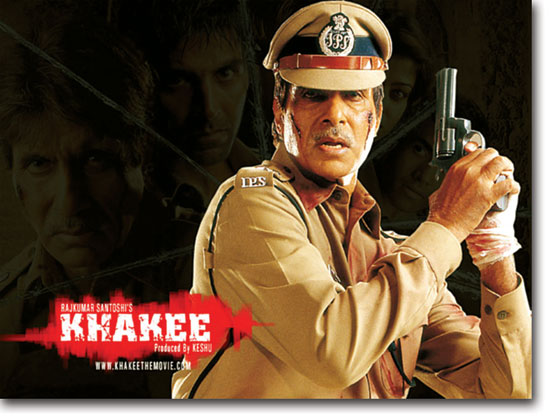 KHAKEE Directed by: Rajkumar Santoshi Music: Ram Sampath Starring: Amitabh Bachchan, Akshay Kumar, Ajay Devgan, Aishwarya Rai, Tusshar and Lara Dutta Regular readers of this review column may now have wearied of the curmudgeonly critiques that have been issued here with regularity against the feckless lack of professionalism of too many Bollywood films. Too often producers who don’t have a clue have roped in directors who have no business picking up a bullhorn leading an assorted crew of performers and technicians of limited ability and dubious commitment. The result has often been overlong monstrosities which have been dumped on the lap of the Bollywood buff’s lap. Now there is no more tolerant and forgiving species like the Bollywood film buff, but even he or she has tired of the dreadful stuff that has been coming out lately and thrown the insipid stuff right back at the filmmaker. The result has been a terrible time for Bollywood. Recent times have seen the Bollywood strewn with so many rotting carcasses of films that deserved a quick death at the box office that it reminded one of the battlefield of the Somme in World War I. Yet there is light at the end of the tunnel, thank god. It’s not only Koi Mil Gaya or the offbeat Dil Chahta Hai or the more recent Paap or Jogger’s Park. It’s great to see a good old fashioned masala film like Khakee also make a serious effort to entertain the Bollywood buff—which means precisely that. Filmmaker Rajkumar Santoshi got serious. Much thought, intelligence and care was lavished in making the film—tight script, crisp dialogue, super cinematography—and the result shows. The film, obviously still is very much within the Bollywood idiom, but it goes on to show that with a bit of hard work and application Bollywood has all the talent and ability it needs to acquit itself quite creditably. Khakee is a thriller and a cop film which is—something that is rarer than hen’s teeth in Bollywood and isn’t always evident in Hollywood, for that mater—an intelligent whodunit whose appeal lies in the deliciously unexpected twists in the story. Here’s how the story goes: A bunch of cops have the difficult task of shifting ISI terrorist Iqbal Ansari (Atul Kulkarni) from Chandangarh to Mumbai. It’s not an easy task, because Ansari’s cohorts are freely moving all over the place and what’s more, are vicious and ruthless. The omens are not good. A group of police escorts have been blown to bits, and it was only the quick thinking and valor of a single police officer that Ansari remained in custody at all. The job of this sensitive assignment falls on the weary shoulders of DCP Anant (Amitabh Bachchan). Anant is past his prime, a sad failure in the eyes of the police establishment and also himself. This could be his chance to prove himself. He is joined in the effort by Sr Inspector Shekhar (Akshay Kumar) and Sub inspector Ashwin (Tusshar Kapoor), a rookie cop. With sensitivity and depth all these characters are fleshed out and it pays off. None of the cops are cardboard cutouts, they are characters that the audience comes to care about. Anant is a demoralized but committed cop keen to redeem himself. Shekhar, on the other hand, is quite a contrast. A cynical, corrupt police officer for whom the line between right and wrong, black and white, had been blurred long ago into a gray moral nether zone, the audience watches him reluctantly dragged into a dangerous, critical mission. Poor Ashwin has to learn from the school of hard knocks one of life’s valuable lessons: Most of the stuff in real life they don’t teach you at the police academy. Two constables join the team. As they get ready to shift the prisoner, word comes in from local school social worker Mahalakshmi (Aishwarya Rai) that terrorists are holed up in a house near the school. The action in the film begins from the get-go and it’s non stop. The journey from Chandangarh to Mumbai is complicated by the fact that they are being hounded by the mysterious Inspector (Ajay Devgan). No more of the story can be told without giving away some of the most absorbing and diabolical twists ever in a Bollywood story, so let’s move on to the technical values. First, the acting, which is mostly exemplary. The Big B’s Anant is a towering presence, and he proves he is worth his weight in gold even today. Tusshar brings an endearing earnestness into his performance as a rookie, but the film surely belongs to Askhay Kumar, who gives one of his finest film performances to essay a street-smart cynical cop whose values are changed in front of the eyes of the audience as he sobers up and matures and develops a conscience. What a far cry from the times when Akshay was better known as a beefcake stud whose pectorals showed more muscular movement than his face. Nitin Desai’s evocative sets provide the compelling backdrop for Santoshi and Shridhar Raghavan gripping script and K.V. Anand’s cinematography to cast its spell, and what a joyous spell it is. Shridhar Raghavan is quite a coup as scriptwriter, and no surprise here. He is the screenplay writer for two of the most absorbing television serials, CID and Aahat. All credit, ultimately, must go to the filmmaker. Like Harry Truman said, “The buck stops here.” This column has been unflinching in dishing out the harshest criticism against the drivel that many a director has been churning out; this is one occasion where it is a pleasure to say that Rajkumar Santoshi deserves all the praise: wonderful, nuanced performances from his stars, absolutely first-rate technical values. For all the hype about Bollywood going global, it is the NRI crowd and non-Western audiences in some regions (Central Asia or the Middle East) who still constitute Bollywood’s overseas audience. It’s not easy to break into the Western mindset which is used to a very different film esthetic: Bollywood’s melodrama, high action and songs seem a bit over the top. But Santoshi proves that even within the Bollywood idiom, a well-made film is a well-made film, and a truly international audience will not be far behind if this trend continues. Don’t take my word for it. Here’s what Peter Bradshaw wrote in the London Guardian: “Sergio Leone comes to India for this madly over-the-top Bollywood melodrama directed by Rajkumar Santoshi. An elite squad of tough anti-terrorist cops is assembled by the haggard but incorruptible old police chief Anant Shrivastav (Amitabh Bachchan) - who, despite his advanced years and tendency to asthmatic attacks, can kick some ass with the best of them. “It’s all wildly gung-ho Boy’s Own stuff, with bits of 007 and Asian martial arts chucked in for good measure, featuring endless shoot-outs with the balloons of Kensington Gore exploding under many a military shirt. The result is entertaining and watchable for most of its three-hours-plus running time.” Watch out world, here comes Bollywood! Rating: ***1/2 (Good) |Return to Bollywood Index| |TOP| Tamil Film Review: Insipid Script, Lackluster Narration Pudukottayilirunthu Saravanan Director: S.S. Stanley At first it’s the dingy bunker he has to share with quite a few unsavory characters for company. Then it’s the unruly Chinese immigrants he has some unpleasant encounters with, who destroy his passport and assault him. In the tussle, one of them (Peter Heyn) gets killed, and Saravanan, chased by the cops, has to hot-foot it out of the place. Also on the run is Shalini, a wealthy girl trying to ward off unwanted male attention. Saravanan is promised a hefty sum if he can get Shalini back safe to her family in India. The adventures of the duo as they shuttle across different countries, by road and water, forms the rest of the tale. Inevitably, love blossoms, to no one’s surprise. The script is insipid and the narration lackluster. It’s like the lead pair were asked to hop, jump and run all over the place without properly planned or convincing incidents for back-up. To make matters worse, we do not even get to see any exotic locations or interesting spots, as the director fails t take advantage of his foreign trip. Dhanush carries over his innocent-vulnerable look into this film, doing whatever was expected of him, and that’s not much, even when crooning a song. The actor comes out best in the fight scenes. Debutant Aparna may not be a conventional beauty, but she more than makes up for it by her supreme confidence before the camera, her spontaneous expressions and her uninhibited dress sense. It’s a jarring comedy from Karunas in a dual role, the take-off on Vaali falling flat. With three hits to his credit, Dhanush’s fourth film had naturally raised a lot of expectations. In fact, it was the most expensive of his films, and the first time a Dhanush film was shot abroad. The promos aired on television channels promised more exciting things to come. But the film is a huge disappointment, proving yet again that it’s a good script that ultimately works. Here, the excitement is confined only to its slick promos. — Malini Mannath |TOP| RECIPE:  Delicious Veggie Dish: Paneer with Tomato Gravy – By Seema Gupta Here’s a vegetarian dish that’s simple, easy and delicious, and goes well with rotis or rice. Seema Gupta shows you how to make it.
Method: Add ½ cup of water. Stir for 5-10 minutes. Sieve to collect thick puree. Put butter in a heated pan. Add chopped onions, chilli, puree, chilli powder and boil for 5-7 minutes. Add paneer pieces and boiled peas. Stir for 5 minutes. Garnish with chopped cilantro and serve hot. – Seema Gupta is a homemaker |TOP| February-March Horoscope By Pandit Parashar Bay Area-based astrologer Pandit Parashar can |TOP| |
||||||||||||||||||
|
|
|
|
|
|
Advertise in Siliconeer | Home | Subscribe PRINT Issue | About Us (FAQs) | Contact | Locations | Staff Login | Site Map
© Copyright 2000-2013 Siliconeer • All Rights Reserved • For Comments and Questions: info (AT) siliconeer.com |
|