!-- Start Alexa Certify Javascript -->
|
|||||||||||||||||||||||||||
|
|||||||||||||||||||||||||||
|
|
|||||||||||||||||||||||||||
|
|||||||||||||||||||||||||||
|
|
|
|
|
|

JANUARY 2004 |
IN THIS ISSUE
MAIN FEATURE The Wrong Accent? Discontent over Call Centers By Siddharth Srivastava ENVIRONMENT Saving the Bengal Basin : IIBB's Two-city Symposia By Rashbihari Ghosh CULTURE A Contrarian's Gita : Naatak's Tathaa Kuru By Sujit Saraf Publisher’s Note • Infotech India ICC's India Heritage Day Celebrations Kamala Harris' Historic Election Win Celebrating Telugu Culture: Andhra Pradesh Month Indian Made Cars: Ready for the World? Finance: The New Tax Law • The Wedding Deluge: India's Busy Season Yoga: Sadhguru's U.S. Tour • Clasic: State-of-the-art Housing Community News: Pepsi's Nooyi Honored... Home of Hope Fundraiser... ICC Activities... MKCA Nathal Fest Auto Review: 2004 Chevy Colorado LS Crew Cab • Bollywood Tamil Cinema • Recipe: Vegetable Gratin • 2004 Yearly Horoscope |
|||||||||||||
|
Publisher's Note
Riding on the tail of India’s information technology boom has been a flurry of other kinds of jobs which have been made possible by India’s astonishing strides in IT. Indian analysts call them ITES—information technology enabled services—and they are being touted as the next big thing. It is true that the growth of call centers—which provide customer service to consumers—has been spectacular in India. However, murmurs of discontent are already being heard in developed countries. Some corporations are moving services back because of deficiencies in English communication. Meanwhile, other developing countries with even lower infrastructural costs are eyeing a slice of the global ITES pie. Our cover story looks at the challenges that India will have to weather if it wishes to replicate its sustained success in IT in ITES. For Cal EPA scientist Rashbihari Ghosh is a remarkable man. For many years, he has been tirelessly working with world-class scientists all over the world to explore ways to address the formidable environmental challenges faced by the Bengal Basin, the geographical area comprising India and Bangladesh. This year, his NGO, the International Institute of Bengal Basin, is hosting its sixth symposia in Dhaka and Kolkata where scientists, scholars and public officials will search for answers to this challenge. Siliconeer is pleased to invite Rashbihari Ghosh to offer readers his perspective on his symposia, his NGO and his mission. Bay Area-based high-tech professional Sujit Saraf is better known for the institution he has helped found: the theatre group Naatak which now has a formidable following for the superb dramatic performances it has been presenting. Saraf has written a provocative play on the Bhagavad Gita which he will direct in February. In this issue he muses on the issues that drove him to write the play. |TOP| MAIN FEATURE  The Wrong Accent? Discontent over Call Centers - By Siddharth Srivastava In the mushrooming call centers in India, rumblings of discontent over the quality of spoken English are already being heard, and India needs to get its act together, writes Siddharth Srivastava. The accent now is on accents. India’s much touted, English-speaking, back office soldiers who man the 24-hour call centers of multinationals round the world have been getting some flak lately — the problem is that the Indians do not speak their English the way the Americans or the British pronounce their words. This can be more than just an irritant as vouchsafed by Dell Inc, the world’s largest computer seller that decided to shift its customer support service for corporate clients back to the U.S.. Earlier, Lehman Brothers also decided to take back its internal computer help desk, outsourced to Indian IT major Wipro, due to the dissatisfaction with the skills offered in India. One of the dissatisfied customers widely quoted in news reports is Ronald Kronk, a Presbyterian minister from Pennsylvania, who said that he spent the last four months trying to solve a problem that resulted in his being billed for two computers. Kronk has been quoted as saying: “They’re extremely polite, but I call it sponge listening — they just soak it and say — I can understand why you’re angry — but nothing happens. I even said to them once that I’d like to speak to someone in the U.S. They gave me a number but it’s a recording and I can’t speak to a human being.” There are even reports of racial customer screams — “You bloody Indians, you don’t get it, do you?” These problems, at one level, seem inevitable. In spite of TV and e-mail, people living thousands of miles away and without local knowledge cannot always answer inquiries authoritatively. According to reports, England is full of jokes about operators in India who master Scots or Midland accents but falter over small physical details. Kate, a doctor based in England, recently on a visit to India, told this correspondent that grappling with rail inquiries in the U.K. can be quite onerous as often the information is incorrect, as the person at the other end just does not seem to understand the queries. The fear here, as exemplified by the Dell and Lehman Brothers example, is the doubts that have been creeping in about the quality of the Indian Business and Process Outsourcing — BPO — industry. Indeed, the threat to the BPO industry is generally seen as one of resistance in the developed world to jobs shifting to countries like India. But, there seems to be an increasing consensus in India now that the economic benefits in terms of lower costs are so substantial that firms cannot be prevented from tapping this potential. And, the foreign companies should be able to withstand the political backlash at home, which is a matter of time. A recent instance being quoted is the Indiana Senate panel’s refusal to support a sweeping bill to limit foreign workers (read Indians) out of American state contract jobs. Union Commerce and Industries Minister Arun Jaitley said in Parliament that the Indian government has been assured by the U.S. government as well as industry that they would not approve opposition to business outsourcing to countries like India, brought in through legislation in New Jersey and some other states. The problem lies elsewhere. The Indian BPO industry has been growing at a mind boggling 60-70 percent annually with revenues growing from $565 million in ’99-00 to almost $2,400 million in ’02-03. The future projections look brighter — employment to over a million people by 2006, up from the current 200,000. Revenues are estimated to increase to $2,400 million by 2006. It is said that while the Indian IT industry took 15-20 years to start making its presence felt, the Indian BPO industry has done it in less than 10 years. According to the Economic Times Intelligence Group study ET Knowledge Series, call centers account for almost 65-70 percent of the Indian BPO industry in terms of revenues and numbers. And, herein lies the problem, as most of the growth has been at the lower-end of the skill pyramid. Indeed, according to observers here, dissatisfaction with the quality of manpower here which is employed in relatively less-skilled services could result in an immediate flight of jobs, should even a slight price differential happen. Examples quoted are the trail of Nike shoe manufacturing that moved from South Korea to Malaysia to Indonesia. Another instance is the competition that a country such as Bangladesh provides to Indian export of lower-end of the garment industry due to lower infrastructure and labor costs. The writing is for all to see — that no resting place is permanent. Each is determined by cost effectiveness. India must guard its lead, which is the essence of globalization. The warning has been sounded by Singapore’s Prime Minister Goh Chok Tong who recently said that the next round of the globalization of jobs might see China, Malaysia and the Philippines competing with India in what Tong called the world’s “information technology and back office.” HSBC, Citibank and Standard Chartered already have service centers in Shanghai and Guangzhou in China, and Cyberjaya and Penang in Malaysia. The prescription is two-fold — re-training call center employees adequately to retain the current business as well as moving up the value-chain in terms of the quality of jobs outsourced. According to Sabira Merchant, speech-voice consultant, “Indians have excellent control over written English, yet when it comes to pronunciation, we do not always sound right. The problem is while Americans think in English, we think in our mother tongue and translate it while speaking. As a nation we do speak good English. That is why most Indians score easily over people of other nationalities. But, it will still take time for Indians to speak with a polished accent and fluency.” Yet, call center executives are confident that business is not going to move in a hurry to other Asian countries. As Prashant Bhardwaj, a manager with a leading call center says, “By the time the other countries produce the required English speaking manpower, the world will be used to the Indian-way of speaking and business wont shift unless there is a substantial cost differential. A Chinese speaking English will take a whole lot more time to get used when Indians are already being spoken to on such a large scale.” However, experts warn that the Indian BPO strategy that concentrates only on the less-skilled jobs is fraught with risks. At the lower end, competition tends to be entirely in terms of price. And it is quite possible that in the near future countries with much lower labor standards could become price competitive leading to large-scale cuts in wage and infrastructure costs. The long-term solution to sustaining the ongoing BPO boom will have to provide for opportunities of career growth within the industry and working conditions will have to be kept at levels that keep attrition rates to a minimum, in the face of price competition. In the more traditional IT industry, even if local firms offered lower end jobs, individuals always had the option of moving to greener pastures abroad. But, the value of the BPO lies in location. Hence, the long term-sustainability of the BPO, will thus depend upon the quality of outsourcing, industry specific training and a constant endeavor to move up the value chain, instead of being counted just by numbers and cost. And inculcating the right diction. - Siddharth Srivastava is a freelance |TOP| INFOTECH INDIA The development follows on the heels of the recent signing in New Delhi of an accord between the Israel Space Agency and the Indian Space Research Organization. ISA has allocated $4 million to finance the project’s new interface programs. These will adapt the TAUVEX’s (Tel Aviv University Ultra Violet Experiment) three, 20-cm wide field identical co-aligned Ritchley-Chretien UV telescopes to India’s 6.5 telescope. GSLV will hurl GSAT-4 into space from the Antariksh Bhavan space satellite station. Israeli and Indian science and industry teams will fly between New Delhi and Tel Aviv in efforts to complete the technical adaptations by June 2005 when the 32 kg telescope is scheduled to arrive in India for final tests prior to the launch. To date Israel has invested $14 million in developing its UV telescope to probe the secrets of the universe. Its Israeli manufacturers, Electro Optics Ltd, claim it is superior to previous generation X-ray telescopes developed also by Israel, Denmark, Italy, the U.S. and France. The move will involve transferring about half the bank’s call centre activities. The most likely destination for the outsourced Barclays call centre is India although South Africa may also be considered as an option. “Barclays is moving part of its call centre operations offshore and as many as 5,000 jobs could be involved,” the London Evening Standard quoted a source. However, a Barclays spokeswoman denied this. “We have no precise plans at this moment in time,” she said, although she refused to rule it out for the future. “Off-shoring is something everyone is looking into at the moment. It is a very complex issue,” she said. Reports say British companies have been slower than their American counterparts to take advantage of the lower costs that call centers in the developing world can give. Less than 15 percent of top British companies have taken the plunge so far, against 35 percent of leading U.S. firms. As many as 50,000 British jobs have been transferred to Indian centers in the past two years. The industry, which still employs nearly 600,000 people in Britain, is expected to shed 100,000 more jobs in the next five years. British Trade and Industry Secretary Patricia Hewitt has ordered an independent study of the phenomenon. The study starts in January and is expected to last three months. Dell’s second Indian venture would be for undertaking specialized services of high technology computer systems, storage devices, computer consultancy and solutions. Significantly, Dell plans to shift all the domestic sales and marketing activities of its existing subsidiary to the new venture. It is, however, not clear what Dell’s existing subsidiary will do once these functions are transferred to the second venture. Though the details of Dell’s investment plans for its second venture in India are not available, sources said the second subsidiary will be set with minimum capital, which would be increased depending on the business requirements from time to time. Sources said Dell has already obtained a no-objection certificate from the existing subsidiary in India for setting up a second venture. Dell has also got conditional government clearance. The solution was specially designed to meet the needs of the corporate customers, Touchtel, the country’s first private fixed line service providers, said in a press release in Chennai. “Corporates using the IndiaOnline MeetXpress solution are set to save substantially both in terms of time and also in their travel costs. In addition, the audio conferencing solution also offers other intangible benefits like ensuring uniformity in communication and transparency in business operations,” company CEO K. Krishnan said. The Rs .50,000 award will be given from next year and the Department of Science and Technology and the Indian Science Congress will select the candidates, Science and Technology Minister Murli Manohar Joshi said in his address at the 91st Science Congress. Joshi said the first winner of the Indian Science Award, instituted last year, would be announced later this year. The Rs. 2.5 million award is the highest and most prestigious national recognition in science in the country, he said. The minister also released a logo for “The Year of Scientific Awareness” being observed this year and a “roadmap for plant genome research.” Joshi gave away awards for excellence in science and technology to 10 scientists, including noted space scientist and Rajya Sabha member Dr. K. Kasturirangan. “I am going to Islamabad to take part in the SAARC Summit. I shall discuss with my counterparts how we can expand regional cooperation in diverse areas of science and technology for mutual benefit,” Vajpayee said in his message to the 91st Science Congress, which opened in Chandigarh Jan. 3. Reading out the prime minister’s message in his absence, Science and Technology Minister Murli Manohar Joshi said Vajpayee could not inaugurate the Congress this year due to “unavoidable reasons.” Vajpayee said, “We will have to strengthen the alliance of moving on the four wheels of science, technology, business and government for further toughening the competitive muscle of the Indian economy.” He said the country was actively helping other developing countries in biotechnology and Indian companies in this frontier area of science were “poised to ride the bio-industrial revolution now on the anvil.” “I very recently inaugurated with the president of Syria a national biotechnology centre in Damascus,” he said. The division is engaged in software development projects and ERP implementation. “Through this assessment, Accel ICIM has shown its commitment to deliver high quality products and services to their clients which will be on par with international quality standards,” R.S. Prasad Rao, director of the company, said in the release. The assessment was carried out by Dr. S. Ravichandran, the Software Engineering Institute’s authorized lead assessor. BPO units offering incidental services do not generate income separately and that it was difficult to determine the profits generated by the Indian BPOs to the foreign company, which had outsourced the services, the Central Board of Direct Taxes said in New Delhi, explaining the tax exemption. Moreover, the services rendered by such BPOs resulted in an “insignificant” profit to the principal company abroad, the CBDT noted. The government, however, has put up a pre-condition that charges paid by foreign companies to Indian call centers should be at arm’s length/fair market price. The decision to exempt tax, which would help many call centers catering to IT, banking and insurance sectors, comes in the wake of apprehensions over a certain section of the Income-Tax Act which laid out that profits of the foreign companies attributable to business activities in India become taxable. However, in the case of BPO entities undertaking core activities as software development and maintenance, debt collection service, investment consultancy and travel agent services for the principal foreign companies, such firms will have to pay income-tax, CBDT said.
ENVIRONMENT
 Saving the Bengal Basin: IIBB's Two-city Symposia - By Rashbihari Ghosh A Berkeley-based NGO, which explores ways to address the environmental challenge faced by the Bengal Basin region comprising West Bengal and Bangladesh, is hosting its sixth symposia in Dhaka and Kolkata, writes Rashbihari Ghosh. Inset picture above: IIBB founder Rashbihari Ghosh with Nobel laureate physicist Charles Townes (r), an IIBB advisor. Ancient India was the first country in the world to research drinking water. In spite of this, water quality on the Indian subcontinent is probably the worst in the world today. A growing population of 210 million in the Bengal Basin (Bangladesh and West Bengal) puts a huge demand on the need for potable water. The Berkeley, Calif.-based non-governmental environmental organization International Institute of Bengal Basin has been exploring this issue since its inception in 1998. It is hosting its 6th International Symposium on Water Quality in Dhaka and Kolkata in February. Eminent international scientists and researchers from premier institutions and organizations are expected to discuss their theses on the two topics of discussion at the 6th International Symposium in India and Bangladesh: Water and Public Health: Crisis and Strategies (India) and Water Quality and Public health: Reducing the Impact of Toxic Contamination on the Bengal Basin Ecology, Public Health, and Environment (Bangladesh). The symposium in Kolkata will be hosted Feb. 7-8 at the K.P. Basu Memorial Hall at Jadavpur University and the symposium in Dhaka will be held Feb. 10-11 at the Department of Public Health and Engineering Auditorium in DPHE Bhavan in Dhaka. A field trip to the Sundarbans, the world’s largest mangrove forest, may be arranged if enough participants indicate interest. Thus far, nine international symposia and workshops focused on reducing the impact of toxins such as arsenic on the Bengal Basin drinking water supply have been organized in Bangladesh, India and the United States. This year’s symposia will provide a forum for technical discussion on various water issues. Strategies for water management include raising the level of social concern and initiating practical solutions to reduce the impact of toxic contamination on Bengal Basin’s ecology and environment. Just four hundred years ago Bengal was a rich region, but now it is one of the poorest nations in the world. The Bengal Basin is facing one of the largest environmental disasters in human history. Over 70 million people are showing symptoms of toxic poisoning due to contamination of their drinking water. Another 100 million people are also showing symptom of toxic poisoning along the river Ganges towards upper valley of the Ganges in India (apart from West Bengal) Local organizations, as well as national and international authorities, are struggling to provide safe drinking water for citizens of the region, but the problem is immense and the world needs to help. Over 210 million people live in the greater Bengal Basin, (an approximately 100 sq. mile area) which is divided into two geographic areas and two political entities. The eastern part of the Bengal Basin is the independent nation of Bangladesh, which has a population of 130 million people. The western part of the Bengal Basin is the state West Bengal of India, which has a population of 80 million people. Residents in both parts of the Bengal Basin suffer the poisonous consequences of toxin-contaminated drinking water. The level of toxins in the environment throughout the Basin is by far the highest in the world, and the scope of the problem is immense. If even one-tenth of this toxic poisoning were to occur in a Western nation such as the United States, there would be a public outcry and an official national emergency. The environmental and public health problems found in the Bengal Basin are extremely challenging. In the present and future global economy, activities in one part of the world will impact lives in other parts of the world. We are part of a global ecology. Environmental isolationism is no more tenable in the long term than economic isolationism. Threats to public health know no boundaries, and problems do not go away when we ignore them. The problems in the Bengal Basin impact all of us. Some have considered the groundwater and surface water pollution of the Bengal Basin as the most serious and the worst anywhere in the world. Due to the climate and the watershed, the pollutants are not confined but continually being drained into the Bay of Bengal. If fundamental and major changes in how pollution issues are addressed are not made now, the rest of the world will also be impacted by pollution and public health problems from this region. Scholars from all over the world have visited the Bengal Basin and have collected enormous amounts of human data for epidemiological study, but none of this activity has yet been translated into a single glass of potable water for the victims of toxic contamination. Environmentally and geographically, the problems and challenges in the region need to be approached in a holistic manner, with a combined effort that transcends political boundaries. Politically, of course, West Bengal is part of India, and Bangladesh is an independent nation. But the environment does not recognize these boundaries, so we have to muster the foresight and wisdom to recognize this and be able to deal with the challenges we face. Dhaka and Kolkata groundwater is exhausted and has exceeded the danger zone. However, Dhaka groundwater is situation is slightly better than Kolkata. In the region, severe annual flooding and uncontrolled industrial activities degrade the environment and ecosystem necessary for sustaining all life. The surface water fingerprint in the vicinity of the basin and the Bay of Bengal is 7 ppb of Arsenic (parts per billion); higher than any region in the world. There are significant differences between rural and urban water-related environmental health hazards. In rural areas, toxic contaminated fresh water, inadequate sewage treatment, and pesticide laden agricultural run-off are among the main environmental health hazards. In urban areas, the rapid pace of population migration from rural areas to urban centers along with uncontrolled industrialization stress water supplies and degrade their quality. In the last few decades, Bangladesh and India have shown remarkable theoretical sophistication in terms of water management. The actual situation is marred by a lack of equitable water distribution, contamination, wasteful and excessive flow, inadequate systems maintenance, improper equipment operation, poor monitoring and inadequate testing, and a dismal lack of enforcement with regard to environmental laws. At the local level, community-based organizations and user associations can play a major role in planning and managing sanitation facilities, irrigation works, monitoring performance, testing water quality and managing land use in local watersheds. For long-term sustainability, participation must be committed and ongoing. Those who use the water must play decisive roles in what is to be done and who pays for it. Water is a finite resource, but humans fail to regard it as such. Unless human conduct towards water changes drastically, technology solutions will be of no use. Public awareness, education, identification and dissemination of best practices and incentives for action could conserve water resources, promote upkeep of public sanitation systems, assess and remediate water problems, and assure equitable distribution. One purpose of IIBB is to sensitize leaders and functionaries to the urgent problems regarding the diminishing supply of potable water in the Bengal Basin and its impact on Public and environmental Health. IIBB accomplishes this through international symposia, workshops, seminars and networking. An equally important objective is to generate knowledge and resources to facilitate programs and activities that enable continuing research and implementation of research findings. Meaningful exchanges among scientists, scholars and community members will improve understanding of the issues. This information can then be used to address the Basin’s problems. IIBB hopes to develop a practical working model for emerging economies. About IIBB. The forerunner of IIBB — Ghosh Research and Associates — was set up in 1984 to provide affordable environmental consulting services to organizations and governments working on the environmental problems in Bengal Basin. In June 1998, GRAI became the International Institute of Bengal Basin, an act mirroring the changes taking place within the organization. The organizational change expands the strategies and activities of IIBB. While it will continue to provide environmental consulting services, IIBB will likewise be involved in the following areas: human development, knowledge generation and resource development. Since its formation, IIBB had the privilege of receiving encouragement and support from two Nobel Laureates and distinguished environmental scholars and activists. The late Nobel Laureate Glenn T. Seaborg (adviser to ten U.S. presidents) was a founder advisor of IIBB. Nobel Laureate Charles Townes is currently IIBB’s adviser. It receives support from environmental scholars, scientists, community leaders and activists who share IIBB’s mission. The International Institute of Bengal Basin is a non-profit environmental services organization dedicated to realizing the promise of safe drinking water in Bangladesh and West Bengal, India. The institute has attracted a wide range of experts who are proposing solutions to the various drinking water problems that exist throughout the Bengal Basin. The IIBB would like to increase environmental awareness and public health awareness. We want to help with the mitigation of environmental problems such as air, surface and groundwater pollution, and we want to help protect and preserve groundwater and watersheds throughout the Basin and address related public health issues. We do not have the funds to do all this ourselves, but we have excellent human resources and the best available experts in the field who would be delighted to help develop the watershed and provide guidance on how to protect the groundwater of deep production aquifers. These experts may be available at little or no cost if we can organize these projects, so it is incumbent upon us to build momentum for the important projects that need to be undertaken. If successful, we can dramatically improve the water quality in the Bengal Basin, and in the process we can help create economic prosperity as well. The region might then be able to export some water to needy neighbors in the Middle East and Africa, where IIBB could also provide much needed services and expertise. We hope to build our programs into working models for emerging economies around the world. We know that the environmental challenges that we face in the Bengal Basin are the same challenges that other countries face. There are broad issues involved in our effort. Environmental safekeeping is not just about science. Science may be the starting point, but taking care of the environment involves a complex web of factors. These factors include public awareness, political will, sound scientific knowledge, and—most important of all—a suitable coalition of experts, academics, policy makers, administrators, and community leaders. Interested readers can find more information about IIBB at www.nvo.com/ghosh_research. - Former Cal EPA scientist Rashbihari Ghosh is chairman and founder of the International Institute of Bengal Basin and its forerunner Ghosh Research Associates, a Berkeley, Calif.-based NGO that provides low-cost, affordable consulting services to organizations and governments working on environmental issues in the Bengal Basin. |TOP| EVENT  ICC's India Heritage Day: Indian American Fest – By Radhika Mathur The India Community Center will celebrate India’s diversity and culture with an annual event, writes Radhika Mathur. The Milpitas, Calif.-based India Community Center will salute India and the diversity of her vibrant culture in the first of an annual event — India Heritage Day 2004. This event Feb.21 and 22 also marks ICC’s first anniversary. The first day of this program will feature dynamic panel discussions on balancing life in dual cultures, how far Indians in America have come and vision for the future. Kamala Harris, San Francisco’s district attorney, will be the keynote speaker. Art and photo exhibits will also be on display, including works by award-winning photographer Rick Rocamora. A cultural evening will follow the next day, showcasing an Indian classical symphony, dances by Naach Company and ICC artists and a sitar recital by Pandit Habib Khan accompanied by Pandit Swapan Chaudhari on tabla. Given today’s globalized economy and prominent role of Indians in the IT industry and other fields, ICC will acknowledge Indian Americans who have made outstanding contributions to American industry. The book which will be distributed to over 10,000 members, Indian businesses and organizations and featured on ICC’s Web site. Interested readers can find more information about the event and sponsorship opportunities by sending an email to info@indiacc.org. All proceeds from India Heritage Day 2004 go to support ICC, a registered non-profit organization. The India Community Center. The San Francisco Bay Area is home to over 100,000 Indians from diverse backgrounds, many of them immigrants from the IT boom. As the population of the Indian community has grown, so has the need for community infrastructure. ICC aspires to bring the Indian community together and promote Indian culture through social, educational, cultural and recreational activities. ICC’s diverse programs also provide a way for future generations to stay connected to their rich heritage. - Radhika Mathur is currently working on her first book about second generation, South Asian women, culture and relationships. She lives in Pleasanton, Calif. |TOP| CULTURE 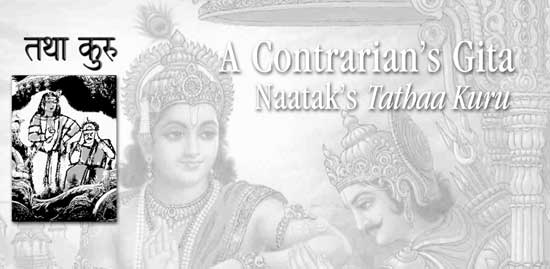 A Contrarian's Gita: Naatak's Tathaa Kuru – By Sujit Saraf His new play finds its way back to the Gita after attempting to move away from it, and it provides a reason for the atheist to believe in the Gita, without having to first believe in God, writes author and director Sujit Saraf. On February 7 and 8, the Bay Area theater group Naatak will stage the first “religious” play in its eight-year history, Tathaa Kuru: The Bhagavad Gita as it Should Be. I have put the word “religious” in quotes because, although the subject of the play is the Bhagavad Gita, the play is an atheistic re-interpretation of that book. This perhaps raises the question: can the Bhagavad Gita make any sense to the atheist? The Bhagavad Gita is described as a distillation of the substance of Hindu philosophy. To the religious mind it is grand, beautiful and awe inspiring, because the religious mind accepts without hesitation the divine status of Krishna. There is no question of contradiction or repetition, because every syllable of the Gita was uttered by Krishna himself. The atheist knows that the Gita was meant to be a religious book, not a work of philosophy. As a book of religion it is subtle and original; as a philosophical treatise it is repetitive, verbose, arrogant and self-contradictory, and therefore unconvincing. Repetition and verbosity are not problems in themselves. They can be put down to the aesthetic preference of the age in which the Gita was composed. Arrogance afflicts most world views, which regard themselves as self-evident until proven to be ridiculous by opposing ideas. The problem of self-contradiction, however, cannot be explained away, if the Gita is to claim itself as a philosophical work in the Western sense. At different times, Krishna argues from different angles, providing more than a dozen reasons for Arjun to fight the battle. Taken together, these reasons do not make sense. If Arjun is merely an instrument of Krishna’s will (nimitt maatra), why does it matter that he can earn fame through battle, or that he can prevent varna sankar? Krishna’s most powerful argument -karmanyevaadhikaaraste maa phaleshhu kadaachan ... - can easily be construed as a direction to not fight the battle. A dispassionate atheistic listener of the Gita can be convinced of almost anything by paying particular attention to one of its many ideas. This is not a new revelation. The Gita has been used by different people to justify different (and opposing) points of view. Gandhi used it to condemn violence, politicians use it to justify incompetence, businessmen use it to expect dutiful (and uncarping) hard work from their employees, and I have heard a professor in IIT use it to condemn the Mandal Commission. Yet, in the last chapter of the Gita, Arjun avers that his doubts have been dispelled and he is fully convinced he must fight, which is what he does. Arjun is a devotee of Krishna. He does not sift finely through the arguments put forth by his Supreme Master. He was eager to be convinced even before he voiced his doubts. Krishna’s only substantial argument is never presented explicitly in the Gita - I am God, so do as I say. A fine vision for the religious mind, a circular argument for the atheist. Tathaa Kuru his begins with a simple premise: Arjun does not accept Krishna’s divinity and concludes that the Gita is not convincing enough. There remains no reason to fight, so he leaves the battlefield. He is finally brought back into battle after a violent confrontation with Krishna, and the appearance of a man named Tiraskari. Tiraskari is an “anti-Krishna”. He sees through Krishna’s arrogance and self-contradiction and offers his own nihilistic world-view. These arguments ultimately lead him to join the battle himself. Tiraskari’s final reasons for fighting the Mahabharat are not very different from the ones Krishna gave to Arjun, but he is much more consistent and concise. He is the atheist’s Krishna. He does not require a divine status to be believed. Almost unintentionally, the play finds its way back to the Gita after attempting to move away from it. It provides a reason for the atheist to believe in the Gita, without having to first believe in God. The title of the play, Tathaa Kuru, derives from Krishna’s last instruction in the Gita. I have revealed the most secret of secrets to you, says Krishna to Arjun, and now, after having deliberated completely on this, do as you want (yathechchhasi tathaa kuru). I have often heard this line used by apologists for Hinduism, who take refuge in its seeming liberalism when accused of intolerance. Hinduism is a broad-minded, tolerant way of life, they say. Why, even Krishna advised Arjun to do as he wanted! Which code of ethics, which system of morality in the whole wide world offers you such a liberal, accommodating set of choices? What the apologists do not say, or do not know, is that Krishna follows up his liberal advice with threats of what will happen to Arjun if he does not do as he has been told. Such threats are brandished throughout the book, leaving no doubt that the enlightened man has but one supreme goal: to be an instrument of Krishna’s will. And Krishna’s will is expressed a few dozen times with maddeningly repetitive certainty – he wants Arjun to fight. This is the perfect non-choice, in the manner of “choose any color so long as it is red”, and it allows the Gita to appear broad-minded while being strict and narrow. Tathaa Kuru does not attach much weight to the divinity of Krishna, so it is hobbled by no constraints that allow one to find clarity in nonsense. It takes the lines in the Gita literally and seriously without contorting them to suit a comprehensive world-view. It de-mystifies the Pandavs, Kauravs and Krishna by presenting them as worldly, ambitious, lustful, manipulative, greedy and conniving human beings. It places them in awkward and funny situations from which they extricate themselves in the manner of more terrestrial beings, and it brings to the fore the obvious contradictions that are littered all over the Gita but are always glossed over by sympathetic readers and interpreters. The entire play rhymes. It moves at the pace of a poem, a very humorous and violent poem, a poem that writes a second Gita while pulling apart the first one. Naatak’s seventeenth production, Tathaa Kuru, will be presented Feb. 7 and 8 at West Valley College, Saratoga. Interested readers can find more information at www.naatak.com. - Sujit Saraf, an IT professional, playwright, filmmaker and theatre activist, helped found the Bay Area-based theatre group Naatak. He lives in San Jose, Calif. |TOP| REPORT:  The Victory of Kamala Harris: Historic Election Win – By Toby Chaudhuri Kamala Harris created history by becoming the first district attorney of a major U.S. city of Indian descent, and the Indian American Leadership Initiative helped rally support, writes Toby Chaudhuri. Kamala Harris became the first Indian American district attorney in U.S. history and the first female district attorney in San Francisco’s history by unseating two-term incumbent Terence Hallinan. Harris won 56 percent of the vote in the runoff election to Hallinan’s 44 percent. The final hours of the race found Harris pounding the pavement and pressing the flesh to get out the vote in a contest that was far closer than expected. The Indian American Leadership Initiative was the first group to organize the Indian American community’s political efforts behind Harris. IALI West Coast directors Amit Sevak and Vivek Malhotra actively campaigned for Harris and hosted a major fundraiser in the final weeks in her support citing her positive agenda for Bay area Indian Americans and Hallinan’s failed record. “Kamala won because she has a proven record of results,” said Sevak. “Kamala overcame tremendous odds and won. Her message resonated strong with San Francisco voters. The Bay area already feels safer now that Kamala is our new district attorney.” “District Attorney Kamala Harris will be a strong advocate on issues important to the Indian American community,” said Malhotra. “She has been a champion of domestic violence victims’ rights and is a longstanding civil rights leader in San Francisco.” IALI president Varun Nikore said that there is a public service spirit emerging in our community, noting that Harris, like Indian American Iowa state Rep. Swati Dandekar, is an example of increasing numbers of Indian American women in American politics. Harris surprised everyone by knocking out former city prosecutor Bill Fazio, who narrowly lost the race two previous times, when she advanced to the runoff election. Harris, 39, is a former prosecutor in both Alameda County and San Francisco, where she worked for Hallinan. Harris received the backing of many of San Francisco’s top legal and social opinion leaders. She positioned herself as a progressive candidate who is tough on crime and capable of building coalitions to prevent young people and minorities from getting trapped in the criminal justice system. She came into the race with the least name recognition and published polling numbers never showed her above 19 percent in the general election. Yet she triumphed in a nasty, hard-fought race. - Toby Chaudhuri is a political activist. He was deputy press secretary for Al Gore’s 2000 presidential campaign. |TOP| COMMUNITY:  Celebrating Telugu Culture: Andhra Pradesh Month Silicon Andhra and the India Community Center is Andhra Pradesh Month in January to showcase Telugu culture, writes Dilip Kondiparti. Silicon Andhra, in association with Milpitas, Calif.-based India Community Center is hosting “Andhra Pradesh Month” from Jan. 1-31. ICC started the tradition of highlighting one state of India each month as a part of its effort in bringing the Indian community together. ICC senior director Vishnu Sharma says, “India is a true symbol of unity in diversity. Each state of India offers a rich heritage in every aspect of life. At ICC, we plan to bring that richness and share it with all the Indians living in the Silicon Valley. In the past, people enjoyed very much when we presented Orissa month. Now we want to present January 2004 as Andhra Pradesh Month.” The event’s main objective is to showcase the state of Andhra Pradesh, its rich culture, art and literature. The exhibits and programs are designed to reflect the vibrancy of Andhra Pradesh in a very informative yet entertaining fashion. I am confident these exhibits and programs are the best way to experience Andhra Pradesh without leaving Silicon Valley, especially for the younger generation of Indians who has never visited India. Scores of SiliconAndhra volunteers are working day and night to make this month long event a grand success. Siddharth Nookala, the project director of SiliconAndhra says, “We are working with the Government of Andhra Pradesh in procuring a lot of material to enhance the exhibit material that is already collected locally. This month long event will promote Andhra Pradesh with the help of posters, exhibits, handicrafts, short films and documentaries. One of the attractions of the event will be a 3-D Model of Andhra Pradesh depicting the places of agricultural, historic, industrial and religious importance. This is being designed by the SiliconAndhra resident architect Srinivasa Murthy Manapragada.” SiliconAndhra is a pre-eminent Telugu organization in the United States with the goals to maintain, preserve, and perpetuate the spirit of Telugu culture. Interested readers can reach Vishnu Sharma at (408) 934-1130 or Dilip Kondiparti at (408) 888-0464 for more information. Information is also available at the ICC Web site at www.indiacc.org and the Silicon Andhra Web site at www.siliconandhra.org. - Dilip Kondiparti is president of SiliconAndhra. He lives in Sunnyvale, Calif. |TOP|
BUSINESS Though the numbers are still in the thousands, compared to the millions of cars sold across the world, a beginning has been made and exporting cars is very much on the agenda of automobile players in this country, whether they are homegrown or subsidiaries of international manufacturers. A look at the statistics first: The increased acceptance of Indian made cars abroad is quite apparent. In the seven month period from April 2003-October 2003, 53,870 units have been sold compared to 30,866 units last year, which is a growth of nearly 75 percent. This is a far cry from a decade ago when only Maruti cars used to be sold in minuscule numbers to Hungary. This year Maruti has been able to export 20,048 units till October, a whopping jump of 101 percent from the same period last year when it sold 10,951 units. Maruti is not the exception. Its arch rival Hyundai Motor India, a wholly owned subsidiary of the South Korean automobile major has also been successfully pushing the overseas sales of cars manufactured in India. The company has exported 16,089 units till October this year compared to 3,321 units sold in the same period last year. Indigenous carmaker Tata Motors has not lagged behind either in the race to tap the global markets. The company has tied up with U.K.-based Rover to sell its cars in Europe and is confident of selling 100,000 units in the next five years. The upgraded Euro-1V Tata Indica will be sold across the U.K. and Europe under the brand City Rover. Further, Tata Motors is close to acquiring South Korea’s Daewoo Commercial Vehicle for around Rs. 5.3 billion, a move that, apart from helping the company make inroads into the Korean market, will provide a convenient platform to break into China. Then there’s Mahindra & Mahindra, which has identified seven overseas markets for its utility vehicle Scorpio. Even Hindustan Motors is setting up an assembly unit in Sri Lanka to manufacture its flagship product, the 50-year-old Ambassador.
The story does not end with just automobiles. Two-wheeler makers such as Kinetic, TVS Motor, LML, and Bajaj are in various stages of going global. More than 25,000 units of scooters and scooterettes were exported between April and October this year, more than double from 12,022 sold in the same period last year. Motorcycles have grown by 62 percent with 88,960 units being sold in the seven months of the current fiscal, according to the latest data released by the Society of Indian Automobile Manufacturers. Three-wheeler sales overseas has also witnessed a remarkable growth. The success of the Indian auto industry was not in everyone’s script a while ago. As a matter of fact, in the face of global competition many expected India’s indigenous auto industry to wilt. The signs were all there — falling market shares, bleeding financial statements, even griping CEOs complaining that their companies were not given enough time to get used to the rules of the open market. Then, surprisingly, the industry pulled itself up with the sector going through one of the most intense business restructuring and cost-cutting exercises seen in corporate India. Soon people were getting used to the unheard-of notion of the British driving Rovers made in India, the Italians driving Indian-made Suzuki Alto, the Spanish loving their Tata Safaris, the Brazilians going ga ga after Bajaj Pulsar while Americans can’t get enough of Mahindra tractors. Analysts say that it was the imposition of stringent Euro norms three years ago that put immense pressure on the Indian automobile industry to upgrade engines quickly and start major development centers that are now cornerstones of growth plans. And, of course, the unmatched Indian wizardry in computing skills helped, as cars today are actually a slew of computers on four wheels. A case in point is the BMW’s highly acclaimed iDrive system that was developed by an Indian software company. But, as in the Business and Processing Outsourcing sector and call centers that are being outsourced to India, one of the major factors is the cost advantage. Indian-owned companies as well as subsidiaries are looking to break into the developed markets in U.S., U.K., Italy, Sweden, Germany, Spain, Australia, New Zealand based on the low-cost base that allows for low sales prices. Automotive designs in India cost $60 per hour as opposed to $800 per hour charged by European design houses. The Indian developed Reva costs less than half of the next cheapest electric car sold anywhere in the world. This also means that India is set to emerge as the preferred research and development center. There are more factors responsible for the turnaround. The current car and two-wheeler export boom has been helped in no small measure by the booming auto-components segment that has actually witnessed greater growth than automobiles. Exports have touched $850 million and predicted to cross $2 billion by 2006. Firms such as Bharat Forge, Sundaram Fasteners and Sona Koyo have been exporting auto components designed and manufactured in India. Delphi, the world’s largest automobile component company has also been active in the Indian market for long. German-U.S. auto giant Daimler-Chrysler AG aims to buy auto parts worth over Rs. 5 billion from India over the next two years. Aggressive cost-cutting measures coupled with world-class quality of local components are the major reasons for the increase in outsourcing from Indian companies. The auto-component sector has infused an element of familiarity about India’s auto industry. Observers also make the point that the world is ready for made-in-India products that increasingly bear the stamp of quality whether in the form of human capital such as engineers, doctors, teachers, nurses or software products. Further, the Made in India brand is increasingly being noticed with India Inc beginning to assert itself with a series of international acquisitions — Reliance bagging Flag Telecom, Tata Motors becoming the preferred bidder for Daewoo’s commercial vehicle unit or Kumar Birla acquiring copper mines in Australia. Motown India seems to have finally come of age, though it will still take some time before Indian products gains universal acceptability — after all Maruti is still exported under the Suzuki brand and Tata Motors under the Rover one. The journey will of course come to fruition when the dream of Ratan Tata, chairman of Tata Motors culminates in the building of a global Indian car. - Siddharth Srivastava is a freelance journalist |TOP| FINANCE EGTRRA is the new tax bill Congress passed and President Bush signed into law last summer. It revised current tax laws to strengthen and expand our nation’s private retirement system as well as provide tax relief to individuals. How can taxes affect you? Taxes can make or break a retirement plan. The best way to protect your money from taxes is to invest in tax-deferred vehicles such as your 401(k) plan. With tax-deferred investments, you’ll pay less in taxes now (because your contributions are subtracted from your taxable income) while also allowing your investments to grow for years untouched by the taxman. For example, if you contributed $2,000 a year for 10 years to a tax-deferred account and received an eight percent annual return (assuming a 28 percent marginal tax bracket), you would wind up with $31,291 — instead of the $27,568 you would have if the money had been taxed all along. That’s a difference of $3,723. This is a hypothetical example and does not represent the past or future performance of any specific investment product or class. Rates of return will vary over time. What changed with EGTRRA? EGTRRA made saving for retirement even easier by:
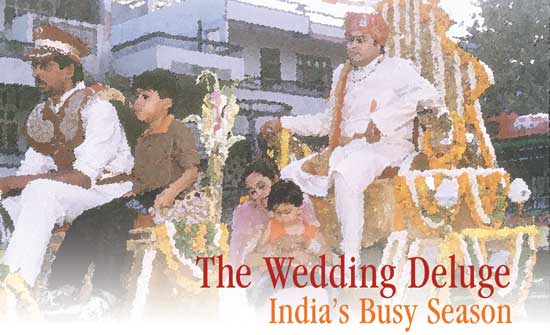
Bottom line, start saving as much as you can to your retirement plan. You’ll reduce your taxes and save even more for retirement. - Ashok Gupta is a financial advisor based in San Jose, Calif. |TOP| REPORT: To get a sense of the extent, consider this: In Delhi alone over 12,000 weddings were held in a single day Nov. 27 last year and in the city of Ahmedabad in Gujarat 20,000 weddings were planned before Dec. 15. The budget of each wedding can range from Rs. 200,000 ($4,000) to Rs. 20 million ($4000,000). It is estimated that over Rs. 50 billion is spent in just under a month. The confluence of marriages on the same day is due to auspicious dates and time, which given the nature of predominantly Hindu weddings, fall on the same day. The marriage deluge is particularly high this year as the months of September and October had been declared by pandits and astrologers as devoid of mahurats (auspicious days) while the months of November and December had been slotted as months most divine to tie the knot. To clog it more, the months of January and February again did not find favor with the gods and planetary configurations. To narrow it down further, more specifically Nov. 17 to Dec. 15 is the brief interlude of good days in a six-month period. According to well-known astro-numerologist Aarti Chakraborty, there were eight propitious days in November — 17, 20, 21, 25, 26, 27 28 and 29 — with families trying to make the best of them. While one is not sure how far this number play affects the prospect of a marriage lasting longer, people dare not infringe upon such assertions of faith. The most immediate impact has been on the price of gold as by tradition jewelry forms an essential and big part of any bridal ensemble. Gold is quoting at the highest in seven years. Gold, which usually sells at Rs. 4,000-Rs. 4,500 per 10 grams is currently priced at over Rs. 6,100 per 10 grams. The last time it touched this price was in March 1996. Yet jewelers are not complaining as the demand remains quite high. “The high rise in gold prices is affecting sales only to a certain extent, but the market is not that bad. Since this is the wedding season people have to buy gold. They don’t have an option,” says a spokesperson of a prominent jeweler in Delhi. Adding their mite to the huge marriage expense are Non-Resident Indians from all over the world who have converged to their respective native areas to combine family re-unions with marriage celebrations. Many more are simply on a shopping binge for the bride or groom, as the case may be, to provide the right ethnic touch to wedding trousseaus. The bulk spenders are the cash and dollar-rich NRIs from the U.S. who have been flocking to the country with the biggest marriage budgets. The state of Gujarat with the economically powerful community of Gujaratis across the world leads by far in the NRI deluge. One report suggests that as much as Rs. 200 million of marriage related purchases comprising saris and jewelry take place every day in the city of Ahmedabad alone. Prema Patel, wife of a physician in Memphis, Tenn., is on a special shopping mission. Patel has already bought bridal finery worth Rs. 1.5 million for her daughter and is still scouting stores across Ahmedabad to buy wedding saris and lehngas (special dress worn by women) for a number of relatives back in the U.S. “I have this big shopping list complete with measurements. The wedding is in California but it would be incomplete without shopping in Ahmedabad,” says Prema, “I have come early to buy my sherwani and marriage suit,” she adds. Across the country, five-star hotels, banquet halls, party lawns, caterers have been booked and any father who has arranged his daughter’s marriage in a hurry has a lot to huff about. Among the people most in demand are pujaris (who conduct the actual marriage ceremony) as well as the colorfully attired bands who belt out popular Hindi tunes and are essential to any baraat (troupe of relatives and friends who accompany the groom in a procession resulting in horrible traffic jams that are the order of the day). Hair stylists, wedding planners, caterers, generators on lease have never been more in demand. In Delhi, horses, the preferred mode for the groom to travel in the baraat, have been shipped from other states to meet the shortfall. Predictably, costs have sky-rocketed. Florists are making a killing and a rose that costs Rs. 7-10 does not come for less than Rs. 20 even after long haggling. The really affluent rein in popular film stars such as Shah Rukh Khan and Kareena Kapoor (costing up to Rs. 1 million an evening) for special song and dance performances, with top designers such as Rohit Bal and Ritu Kumar designing the clothes. Others pull out their best to entertain the guests, hiring event management companies such as Bridal Affairs that have sprouted to tap the business of marriage as well as organize all the paraphernalia that go with the celebrations. “Marriage is big business here,” says Hitesh Kumar, bead of Bridal Affairs in Delhi. “Of the Rs. 5,000 crore spent in nuptial ceremonies across the country every year, nearly Rs. 500 crore is pumped into the ceremonies in Delhi. Marriage is one of the best businesses to be in as they happen round the year and is a booming sector with budgets only going up.” The responsibilities for Bridal Affairs include organizing live DJs and dance floors, elaborate sangeet (singing songs) arrangements by inviting professional singers, parties for close friends and relatives at exotic locations such as Goa, Mauritius, Udaipur and destinations in south-east Asia. Then there are theme weddings that could be Egyptian, Moroccan or Goan. Indeed, the economics of modern Indian marriages have spiraled in the last few years with the event being treated as an out-and-out entertainment bonanza. It may be said marriages are made in heaven, but in India they certainly can cost the earth. - Siddharth Srivastava is a freelance journalist .|TOP| LIVING Sadhguru Jaggi Vasudev belongs to no particular tradition, but has developed a form of yoga, Isha Yoga, which “offers yoga as the absolute potential to participate in the elusive mystery of existence,” according to a press release from the organizers of the tour. He will be offering workshops of varying durations in Oxford, Ohio; Novi, Mich.; Ann Arbor, Mich.; Flint, Mich.; Detroit; Scottsdale, Ariz., and Atlanta, Ga. Several other venues are yet to be announced. Born and raised in Mysore’s Karnataka, Sadhguru was not religious. He practiced yoga for his physical well-being rather than as a spiritual practice. As a teenager, Sadhguru grew up with blue jeans and Beatles’ music, and spent most of his time outdoors in the wilderness. He has a bachelor’s degree in English. At the age of 25, Sadhguru, then running a construction company, sat on his favorite rock in the Chamundi Hills located in the outskirts of Mysore. Though he was sitting with his eyes open, he had a very powerful spiritual experience – which lasted for what seemed liked five to ten minutes but actually ran into several hours. This experience soon changed everything in his life. From then on he has made an endless effort to make this possibility happen in other people’s lives. As he says, “This life for me is an endeavor to help people manifest their divinity within themselves.” Sadhguru developed Isha Yoga through “a set of scientifically structured yoga programs which are conducted worldwide leading to physical, mental and inner well-being, and for those who seek – the complete liberation of the self or mukthi,” to the press release. His prison outreach programs, “Inner Freedom for the Imprisoned,” have been successful in all the central prisons of Tamil Nadu and also in several U.S. prisons. Officials have requested this program for all the correctional facilities in Pennsylvania, the press release adds. Isha Foundation, the international public service organization founded by Sadhguru, offers yoga in over 100 centers throughout the world. The Isha Yoga Center, a spiritual refuge created by Sadhguru at the foothills of the Velliangiri Foothills, is a learning center where all aspects of yoga – bhakti, gnana, karma and kriya – are taught under one roof reestablishing the guru shishya paramparya. Located on the same premises is the Dhyanalinga multi-religious temple, created solely for the purpose of meditation, devoid of any rituals or worship. “Sadhguru believes in empowering the common man to transform himself into a peaceful, joyous and loving human being with simple but powerful yogic methods and practices,” says the press release. “Individual transformation,” he has said, “is the key to global transformation. “ Sadhguru was a delegate to the United Nations Millennium Peace Summit and a member of the World Council of Religious Leaders. He has initiated various social and ecological projects including ‘Action for Rural Rejuvenation’, a very comprehensive program aimed at addressing the basic needs of the rural people. Thousands of volunteers and about 150 mobile clinics are to cater to the basic health needs of these people and also offer them sacred tools for self-transformation. The Vanashree Eco Center, also started by Sadhguru to support these efforts, is aimed at protecting and conserving nature and creating awareness amongst the public. The Velliangiri Hills conservation Campaign is one such massive effort. A powerful orator and communicator, Sadhguru’s recent engagements include a cancer survivors program held at St. Mary’s hospital in Detroit, Michigan, which served to empower and transform the attendees and talks and programs at the Church of Today, Riverside Church, Omega Institute, Princeton University, and the major auto companies of Ford, Chrysler and General Motors. Interested readers can get more information by visiting the Web site of Isha Foundation at www.ishafoundation.org. |TOP|
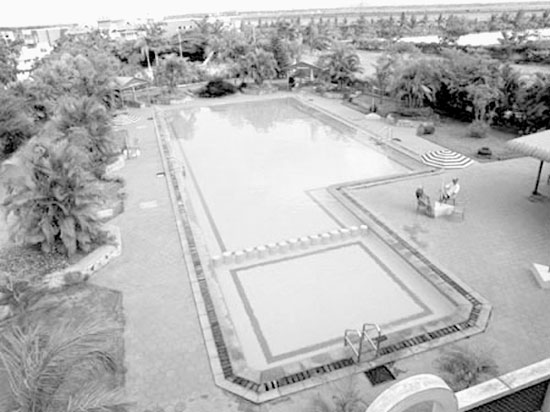
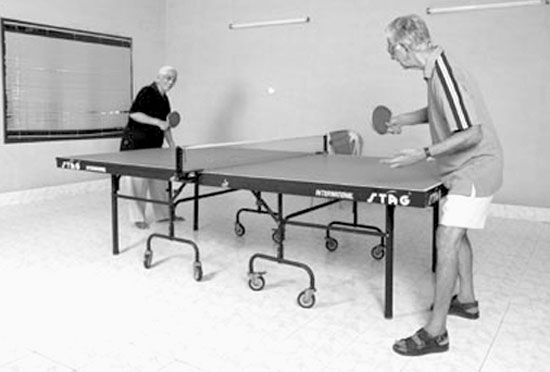
The real estate company Clasic Group had focused on Sholinganallur in 1992 based on vaastu specifications, namely hills in the south-west and water (Bay of Bengal) in the north-east directions. With growing population and the increasing need for residential houses, the firm felt that the necessary roads and communication infrastructure will enhance the value for money by investors. Clasic Group started developing wide roads, which were adequately planted with over 25,000 trees which provide greenery all around. Along with the roads, the other facilities like water, electricity, telephone, cable lines, security were also provided. To provide perennial water supply to the public, a fresh water lake is being desilted, deepened and renovated with creation of bunds. Once the work is completed, this lake will facilitate storage of around 500 million liters of water which will enhance the underground water table in the entire Sholinganallur village. Survey has been concluded for providing underground water and sewerage connection which is likely to be completed within a year. The Clasic Club was developed with modern facilities like ozonized swimming pool, Hi-tech gymnasium, beauty parlor, barber’s shop, reading room, a multi-cuisine restaurant, a host of indoor games including. This club now has over 700 members, including many corporate executives.
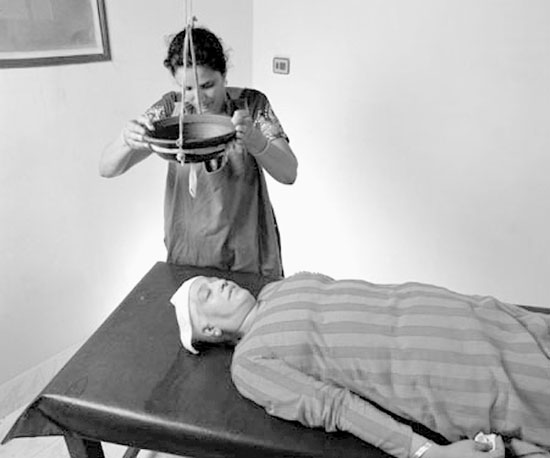
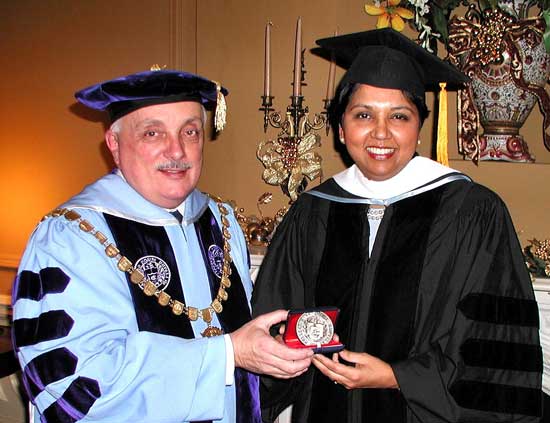
For those who want to own a plot of land to build their dream home the group offers residential plots in the only gated community in Chennai, the Clasic Retreat. The area has over 400 plots which has been developed over the last 7 years with fully developed roads planted with avenue trees. The well planned layout has water, electricity, telephone, cable connections, street lights and 24/7 security. Already a number of independent houses have been constructed. For those desiring exclusive bungalows, the group has Clasic Gardens, a satellite township comprising 100 independent houses to be built on an area covering almost 10 acres. This picturesque community will have 24 hours security, neatly laid roads, private water supply network, electricity, telephone connection, high-speed Internet access. During the first phase, 18 houses will be built—city approval has already been acquired. These houses have been designed by expert architects. The proposed Clasic Gardens Satellite Township will stand as a model to many of the developing urban areas. Clasic Kudumbam, a retirement community with world-class facilities has just been launched, also with the Chennai city administration’s approval by CMDA. Clasic Kudumbam provides excellent accommodation for retired persons and many NRI parents have given applications for accommodation. This is the only one of its kind in the nation which has been duly recognized by the Senior Hospitality Institute, U. S. Many retired officials from U.N., UNESCO, World Bank and the American Embassy residing outside Chennai have also shown interest in living here. All residents of the above projects have access to the Clasic Club. Rajakalyani Trust, an NGO of the group, has planted trees and provided greenery to the local surroundings. The trust runs social programs like rain water harvesting, waste management, medical campaigns and adult education, supported by Rotary International. The various future projects of the group include setting up of a Veda Patashala, meditation centre, primary school, ayurvedic hospital, cremation ground, retirement village with shopping faculties. Interested readers can visit their Web site at: www.clasic.com |TOP| COMMUNITY NEWS IN BRIEF In her role as CFO over the past decade, Nooyi has been ranked by Fortune magazine as “one of the most powerful women in American business.” “In less than a decade she has played an instrumental role in transforming PepsiCo for the 21st century,” according to a college press release. At the convocation, CNR conferred an honorary Doctor of Humane Letters degree on Nooyi “for embodying an ideal integration of a successful liberal arts education and career, for her devotion to lifelong learning, her commitment to the value and dignity of all persons, her modeling of the importance of faith and family to a successful career life, and her creative and responsible corporate leadership.” A dinner buffet was followed by entertainment featuring jazz/tap dance performance by Namita Kapoor, live music by Vikas Singh, Anil and Tanya Gupta, and deejay music. The evening benefited “many, many kids,” said Nilima Sabharwal, president of Home of Hope, “igniting the dwindling flame of hope in that less fortunate child to become a shining star.” “In a span of 4 years we now have 10 projects all over India and are touching the lives of close to 1,200 children,” she added. The 10 HOH booths had handicrafts and project reports, displaying the transforming nature of the money being sent to India by Home of Hope. Holding up one such display toy,. Sabharwal said, “With your help, Home of Hope has produced many talented kids, who are ready to released into the outside world. You have helped this little hand to be creative, show artistic and academic skills…have a chance in life, live a life of dignity to become a self sustaining citizen of tomorrow.” Interested readers can get more information at the Home of Hope Web site at www.hohinc.org In addition to ICC’s involvement in the Second Harvest Food Bank Food Drive, ICC members and staff collected an entire box of new toys for the Ecumenical Hunger Program’s Mentoring Program. Located in East Palo Alto, California, the Ecumenical Hunger Program is a non-profit organization that relies on donations from the community to help those in need. ICC is offering over twenty classes in Milpitas and its newly acquired Mountain View facility. A new center in Sunnyvale is scheduled to open in early 2004. In addition to the program offerings on-site, ICC has introduced new online language classes for those wanting to improve their knowledge of a particular language at their own pace.
MKCA Nathal Fest
The Mangalorean Konkan Christian Association celebrated “Nathal Fest 2003” (Christmas celebrations) Dec. 20 at the Crown Jewel Banquet Hall in Des Plaines, Illinois, according to a press release. Rev. Dr. George Madathiparampil celebrated Holy Mass and gave a befitting homily. MKCA choir group under the leadership of Francis Lobo and Solomon David sang traditional Konkani hymns. Mangaloreans from Chicago and its surrounding suburbs, Canada, Texas, Wisconsin, Indiana and Iowa attended and filled the banquet hall. After mass, and social hour Chicago’s Consul General of India, Arun Kumar, presided over the program and Mohammed H. Mirza, president of Samir Financial Services was the guest of honor. MKCA president Dr. Austin D’Souza Prabhu welcomed the audience giving a brief history about Konkans coming all the way from Saraswati River.  Versatile, Functional Pickup: 2004 Chevy Colorado LS Crew Cab – By Sally Miller Wyatt Chevy’s Crew Cab is the perfect marriage of versatility and functionality, writes Sally Miller Wyatt.  If people like pickups for their versatility and functionality, then we’re looking at true love when it comes to trucks with crew cabs. Crew cabs allow you to haul plenty of people as well as cargo, and that kind of versatility can be very appealing. Chevy introduces an all-new truck for 2004 that not only offers a crew cab configuration, but lots of features to improve on that functionality. The best part: all this is packed into a mid-sized platform. That is especially appealing to those who don’t need higher payloads or heftier towing capacities, and yet still want to be able to park with relative ease. The all-new 2004 Colorado was designed to offer buyers lots of choices to best suit a variety of needs. There are six models in the line-up: a 2WD crew cab, a 2WD extended cab, a 2WD regular cab, and a 4WD crew cab, extended cab and regular cab. There are also two choices available when it comes to engine sizes and transmissions. Buyers can select from a Vortec 2800 2.8-liter or a Vortec 3500 3.5-liter, from a five-speed manual or a four-speed automatic. We test-drove the 4WD Crew Cab with Vortec 3500 and automatic transmission. There was seating for five on board, and this seating configuration was not cramped. In fact, we — two adults and three teens — enjoyed plenty of head, leg and hip room. Even that dreaded rear middle seat was comfortable. Seats are accessed by four doors, which make getting into and out of the back seat very easy. These rear seats also fold in a 60/40 configuration. Built on a body-on-frame design, the Colorado chassis offers a stiff, durable ride, which should please those who seek the true “truck” driving experience. The Colorado also offers a shift-on-the-fly 4WD system and four-wheel anti-lock brakes — designed for heavy-duty work — which are standard. Rack-and-pinion steering is also standard. Other standard features include dual stage air bags, keyless remote and daytime running lights with automatic headlamps. Standard conveniences include air conditioning, cruise control, tilting steering wheel, front bucket seats equipped with arm rests and reclining features, and a driver information center. Options on board included an AM/FM radio with CD changer for an additional $395, and the OnStar communication system for an additional $695. OnStar is a terrific safety feature, in my opinion, and is well worth the additional $695. The Colorado was also equipped with XM Satellite Radio, which offers more than 100 coast-to-coast channels. For those of us who put in a lot of time behind the wheel, shuttling children here and there, this is a terrific entertainment system. You’ll find a radio station — from salsa music to music of any decade, to comedy or financial reports — to suit any mood. On the road, we found the Colorado was “right-sized” in many ways: it was large enough for the whole family, but not so large as to be difficult to muscle around in parking lots. Visibility was very good in all directions and the car handled well whether driving on city streets or on the freeway. Although the Colorado’s gas mileage was rated at 17/city and 22/highway, it seemed that we went far longer than that on a tank of gas. The Colorado — with its versatility in seating and cargo-carrying ability — may prove to be a great fit for an adventure-seeking family. With growing kids, the outdoors is a tempting destination, but many outdoor activities require gear that seldom fits in a regular car. The Colorado brings together the best of both worlds — it has the space of a truck and the comfort of a regular 4-door sedan.
- Sally Miller Wyatt is a freelance writer Guftugu Hi-tech hijinks of the West will now meet the swashbuckling dialogues of Bollywood made famous by the likes of Salim-Javed, masala movie buffs must be hoping. If the film’s name is any guide, they could be right on the money, too. Bond’s Hindi avatar is the brainchild of Om Films, which has tied up with MGM and U.S.-based film producer Ashok Amritraj. And it isn’t just Hindi. Soon he will be excoriating evil men and romancing sexy nymphets in Tamil and Telugu. Rajnikant and Kamal Haasan, eat your hearts out. At least that’s what Mumbai-based non-governmental animal rights organization People for Animals believes, and it is taking Feroz to court. PFA has filed a case in the Bombay High Court asking for a ban on the screening of Janasheen. PFA says Feroz Khan has made animals to perform in his film without legal permission from the Animal Welfare Board of India. A producer is required to seek permission from AWBI before using animals in his film. Janasheen has a tiger, an elephant and a monkey. That’s a load of you-know-what, says Khan’s lawyer. He says that the filmmaker had used the animals under the supervision of circus authorities and had obtained all necessary permits from the zoo authorities. Which prompted a wag to say: “Why go after the animals, baba? The humans in the films acted worse than the animals, how about the human rights of the poor audience?” What has happened is this: Both have decided to give each other a break professionally and go about their own ways. The last film the love-birds worked on together was Ek Hasina Thi. And why not? Ramu is at the top of his filmmaking career, working as either director or producer with the likes of talented stars like Antara Mali , Suchitra Krishnamoorty, Sushmita Sen and Nandana Sen in different projects. Meanwhile Urmila is going from strength to strength, fortifying her reputation as a serious actress in films like Pinjar and Bhoot. Those days are long gone when film critics snidely remarked that folks went to see an Urmila film more to watch her derriere than her acting. This woman can act, she has proved it, and now she is ready to go places. So see you at bedtime, Ramu baby! Our upcoming Bollywood actor Dino Morea is to play the lead in veteran filmmaker Shakti Samanta’s new Indo-Chinese production. So how do you say sexy in Chinese? The film will be directed b Shakti’s son Ashim, and a lucky Chinese actress will have a chance to get up close and personal with Bollywood’s hottest hunk. “It’s a different kind of a love story,” Dino said. “A man falling in love with a Chinese woman.” Come again? With Dino, we thought it would be the other way around! “I’ll be delivering my lines in Hindi, the lady will be conversing in Chinese,” he says. Well, with his looks, who needs to communicate verbally? “It’s an international project in its true sense,” he gushes. “We’re trying to go beyond the borders of our country, reaching out to the world audience.” No, Dino, we think you got that exactly backwards. Somehow we get the feeling that it’s the world audience—the fairer sex, at any rate—that will be reaching out to you. Then, for those who still don’t get it, or those with a reading disability, the poster adds a helping hand: there’s a woman in black lingerie and lots of cleavage making the message clear. You see, it’s a poignant story that the good Mr Jha has filmed for the edification of the broader public. You know how it is: innocent small town gal comes to big bad city to make it as an actress, and she ends up in prostitution. “It is about this lady who encounters betrayal, deceit and physical exploitation by all until she meets a painter who falls in love with her,” he explains. Stop, please, Mr. Jha, you are breaking our hearts. Now wait a minute, here. Hello, hello, hello. Who is that roly-poly man in the poster? Not Anupam Kher? Well, well, if it isn’t our new censor chief, the paragon of virtue who has been lately fulminating over the lascivious music videos! Fancy meeting Anupam Kher here! As they say, what’s a nice guy like him doing in a place like this? “Anupamji plays the painter and acts as her mentor,” Jha explains. He is also confident that the censor board will go easy on the scissors while looking at his film. “There are no objectionable scenes in it. It will be easily cleared by them,” Jha adds with a straight face. Amol Palekar’s superbly crafted Marathi historical film Anaahat has opened her eyes. In the movie, she plays a queen whose monarch husband badly needs Viagra. However, these were ancient times, so the wise folks had figured out a more fun way out of the impasse, namely the custom of niyog, whereby the queen gets to sleep with another man to conceive an heir. Well, the queen wasn’t initially thrilled about the idea, according to the film’s story, but once she does do her duty, her sexuality blossoms, and she decides she kinda likes this niyog thing. Now the old geezers at the king’s senate aren’t thrilled. Anyway, Sonali’s performance in the film has drawn rave reviews, and she is keen to do substantive roles, not just eye-candy stuff which has been this poor aspiring actress’ lot lately. A substantive role in a Bollywood film? That does sound a bit like Bappi Lahiri going on an Atkins diet. Here’s wishing lots of luck to this talented actress. God knows she will need it. Then he gets the news that his film’s script will be part of the Oscar academy’s library. I kid you not: A copy of the movie’s screenplay will share space at the Oscar Academy Margaret Herrick Library with the works of Charlie Chaplin, Alfred Hitchcock and D.W. Griffith, to be used for research by students, writers and filmmakers. This is just the icing on the cake for the film, starring Shah Rukh Khan, Saif Ali Khan and Preity Zinta, which has raked in over Rs. 30 million in India and abroad in just the first three weeks of its opening. The evergreen hero received a standing ovation at the 50th National Film Awards ceremony where a bevy of film stars cheered as the octogenarian filmmaker and hero was honored by the president. Amid thunderous applause, Anand walked up to the podium in his characteristic slanting style and his trade mark Jewel Thief cap to receive the award. Bollywood star Ajay Devgan got the best actor award for the lead role in the Legend of Bhagat Singh while Konkona Sen Sharma received the best actress award for her role of a Tamil Brahmin woman in Mr and Mrs Iyer directed by Aparna Sen. Aparna Sen herself got the awards for best director, best screenplay and the Nargis Dutt award for best film on national integration for Mr and Mrs Iyer. Yet Chief Judicial Magistrate Mohammad Salim Malik granted Sallu permission to visit Mauritius and Dubai Jan. 4 to Feb. 6 on an application filed by his counsel Hastimal Saraswat. Salman had asked for the court’s permission to visit Mauritius to take part in the shooting of the film Mujhse Shaadi Karogi from Jan. 4 to Feb. 3 and an entertainment stage show in Dubai from Feb. 4 to 6. The actor is facing trial in three cases of killing black buck and chinkaras and another of illegal possession of arms. The cases were registered in 1998 while he was shooting Suraj Barjatya’s Hum Saath Saath Hain. Of course, the Maharashtra government has been less kind, and has been trying to come down on Salman on the drunk driving case, but he has managed to charm the Supreme Court, leaving the state’s prosecutors fuming. This seems to be not to the liking of some people. At an urgently called press conference, Akbar Khan announced that video pirates have flooded the market with VCDs of Robin Khosla’s flop film Taj Mahal — A Monument of Love packaged in “duplicate inlay covers” of Akbar Khan’s magnum opus. “They are misusing my name to sell Robin Khosla’s film. I would like to warn the pirates that they are headed for trouble. I will be going to the roots of this issue and will make sure that the culprits are put behind bars,” Khan thundered. Khan said the police, with the assistance of anti-piracy cell people, have already conducted raids in Surat, Ahmedabad and Bangalore, and seized more than 5,000 duplicate inlay covers. Some 35 producers will be able to sell movies using Kazaa, a file-sharing program owned by Australia’s Sharman Networks. “In a distribution deal struck between Sharman’s partner Altnet, Inc...and IndiaFM.com, one of the most popular Bollywood entertainment sites, Kazaa’s estimated 60 million global users will gain access to previously unavailable content,” the statement said. The industry started its first download last month when Kazaa’s users were offered Supari (A Contract for Killing), a slick thriller, for $2.99. The file was programmed to self destruct after being viewed and could not be copied. “It was a thrill for me to become the first to do it, in an industry which had ignored the Internet, or did not pay enough attention,” said Meenu Kumar, the film’s executive producer. Only about 10 million of India’s one billion people are Internet users. But with another 20 million Indians overseas, the Internet could become a worldwide box office for Bollywood. IndiaFM’s customers include Mukta Arts, controlled by director Subhash Ghai, and Tata Infomedia Ltd. “The deal means that Bollywood producers can now distribute movies, music and other large, rich media files online that would be too large and expensive to host on a traditional Web site,” the statement said. Directed by Sudhir Mishra, starring Kay Kay Menon and introducing Chiney Ahuja, the film captures the spirit of the turbulent ’70s, a release said in Mumbai. The music of the film, recently released by Virgin Records, has been scored by Shantanu Moitra. The film was earlier screened at the India International Film Festival in Mumbai and the River to River Film Festival in Florence, Italy. Hindi Film Review Overkill, But Superb Effort 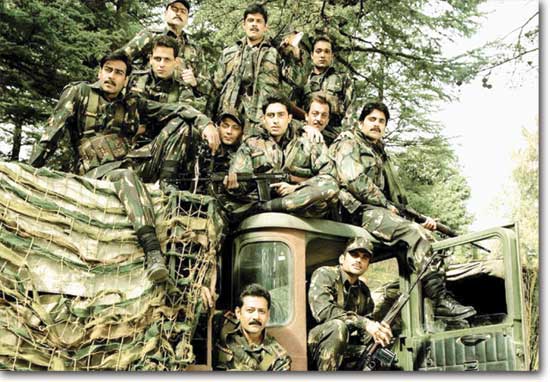 LOC Kargil Written, produced, edited and directed by: J.P. Dutta And I am going to be critical, but I will also say that this is an absolutely must-see film. Doesn’t make sense? Read on, gentle reader, and all will be made clear. Month after month, this space has skewered Bollywood producers and filmmakers for insulting the audience’s intelligence with sloppy storytelling and dumping on the Bollywood buff films with the thinnest excuse of a plot which has been more an excuse for mindless song-and-dance routines, gratuitous mayhem and cloying, maudlin melodrama. A ringing cry has often been dispatched from this space to anybody who would listen: Films are a serious business, and should have a taut, well-told story with thoroughly fleshed out characters and have excellent technical values. Well, to his credit, J.P. Dutta’s epic has all of these, but the film falls short of becoming a towering success for one, vital reason: Somewhere along the line, during his absolutely stupendous research and painstaking attention to detail, Dutta forgot the first rule of good filmmaking: You have to tell a ripping good yarn to connect to the audience. A four-hour-long film with umpteen characters and their distracting personal and romantic stories fail to fuse into a seamless whole, and so the sum, sadly, is less than its parts. So we have a curious situation which one thought would never happen in a Bollywood film: The film fails to soar to truly lofty heights not because the filmmaker wasn’t serious enough, but because perhaps he was too serious. And along the way, he forgot that film, like theatre, nautanki or even traditional forms like Ram Lila and Kathakali, is essentially about katha (the Sanskrit word for story). If you don’t know how to tell a story, then all the realism in the world won’t bail you out. Our everyday reality isn’t a katha because it’s not meant to be. The trick of a really good story is to borrow from the elements of reality and craft together a narrative that is both affecting yet has enough of the accoutrements of reality to gull us into taking it seriously. It is, in a word, the oldest of shell games. Dutta is too honest for his own good. So the result is a film that fails to reach its full potential, and I harp on this point because this film could have been one of India’s greatest all-time classics. The film gets buried under its own seriousness, and too many characters, with too many stories, get in the way in a film too long (four hours, which is long even by Bollywood standards) to pack the kind of wallop a film of this quality could. And yet. Whatever its minor flaws, LOC—Kargil is one of the most stupendous achievements of Indian cinema. Word has it that Dutta had accumulated 200 handwritten notebooks following his interviews with the families of Kargil veterans. That utter commitment to realism is written all over the film. Karim Khatri’s exquisite cinematography and Bhiku Verma’s utterly real action sequences meet the crisp dialogue by O.P. Dutta to create a picture of war in all its varied awe-inspiring power—the ugliness, the gruesome violence, the heartbreaking pathos, the terrible loss and the heroism and valor. The result is a recreation so compelling that it not only beats the best of Bollywood, but can easily hold its own with the best of Hollywood as well. Of course, with a crowded cast of characters not all actors can shine, but Saif Ali Khan, Abhishek, Sanjay Dutt and Ajay Devgan deserve special mention. The women have far less scope, but even then Kareena makes an impression. The star cast includes a variety of Bollywood actors—some at their peak, some past their best. Here, all look and act like real soldiers. Some really astute casting also played a role: Dutta followed veteran filmmaker Satyajit Ray’s priceless advice: “Get the right guy to play the right role, and your job is 90 percent done.” Dutta took special care to choose Bollywood stars to play characters that resembled them, so that sometimes the characters seem extensions of the persona of the film stars. At the end, the film remains an admittedly imperfect, but all the same a marvelous tribute to the heroes who died in Kargil to defend India. Imperfect or not—Go see it, and see what Bollywood is capable of when it sets its mind to it. Rating: ***1/2 (Good) |Return to Bollywood Index| |TOP| Tamil Film Review: Thoughtful, Different Fare SOORI Director: Selvan Cast: Vignesh, Uma, Partibhan, Vijaylakshmi, Senthil, Chinny Jayant. What attracts Soorya to Rishabha the moment he sets eyes on her is her unique qualities: She is different from the rest, sober and socially-conscious. He is drawn to her, expresses his love, and she reciprocates. He even consents to her condition when she proposes that they part and meet a year later at a designated place. If theirs is indeed true love, it will stand the test of time, she says. A year passes, he turns up at the proposed place, but she’s not there. His inquiries reveal that she got married and left the place. Hurt and furious at her betrayal, he vows upon revenge, and goes on a search for her. But when the moment of reckoning comes, he’s in for a shock. The ending is a little different, daring, thoughtfully planned and deserves praise. There are some unnecessary distractions, like the hero shaving his head, his odd mannerism of twitching his neck, and his feral howls, considering that the character was not mentally imbalanced but only yearning for revenge. But the rest of the script is well thought out and sensitively handled, the debutant director (who apprenticed with Shanker) revealing a firm grip on the medium and showing a lot of promise. For Vignesh, who’s been struggling to get a foothold in films, his performance here should make filmmakers take him more seriously. Whether it’s the fights or the romance or the emotional scenes, Vignesh performs with conviction. Parthibhan, surprisingly, fits well into the role of the local dada with the golden heart. It’s to the credit of both the artists and the director that the Partibhan-Vijaylakshmi romantic interludes have been projected very sensuously, but without any vulgarity. For the petite and talented Uma, neglected by the film industry, this should be a turning point in her career. The actress has played her role with understanding, particularly in the closing scenes. About three years in the making, and after crossing various hurdles, Soori has just hit the theatres. Fortunately, the time-gap has not affected the look of the film or its smooth narrative flow. — Malini Mannath |TOP| RECIPE:  Delicious, Hot Entrée: Vegetable Gratin – By Seema Gupta Seema Gupta offers a simple hot entrée of vegetables and cheese that is perfect for a cold or rainy day. Ingredients
Method: Add all chopped boiled vegetables and potato in white sauce and mix well. Pour the mixture in a greased bowl. Add grated cheese on the top. Add 2 tsp butter for garnishing. Preheat oven to 450 degrees. Put the bowl in the oven and bake for 25 minutes, or until cheese becomes light brown. Serve while hot. – Seema Gupta is a homemaker |TOP| 2004 Yearly Horoscope By Pandit Parashar Bay Area-based astrologer Pandit Parashar can |TOP| |
||||||||||||||
|
|
|
|
|
|
Advertise in Siliconeer | Home | Subscribe PRINT Issue | About Us (FAQs) | Contact | Locations | Staff Login | Site Map
© Copyright 2000-2013 Siliconeer • All Rights Reserved • For Comments and Questions: info (AT) siliconeer.com |
|