!-- Start Alexa Certify Javascript -->
|
|||||||||||||||||||||||||||
|
|||||||||||||||||||||||||||
|
|
|||||||||||||||||||||||||||
|
|||||||||||||||||||||||||||
|
|
|
|
|
|

MARCH 2004 |
IN THIS ISSUE
MAIN FEATURE Growing Silicon Nanowires : Raj Solanki’s Breakthrough By Deepak Goyal IT BUSINESS Outsourcing Outrage : U.K., U.S. and India By Siddharth Srivastava CONTROVERSY Back to Burning and Lynching? A Playwright Responds By Sujit Saraf Publisher’s Note • Infotech India The Qadeer Quandary: India, Pak and Nukes • Health: Dealing with Anemia Bangla IT Center • Finance: Small Business and Heirs Photo Essay: Holi in Sunnyvale • Film Fest: Traveling Film South Asia 2004 Muslim Film Festival • First ICC Annual Fest • Abhinaya Dance Performance Community News in Brief: The Global Entrepreneur... Fundraiser for Judge... Remembering Athavale... Boeing Engineers Honored... New Short Film Auto Review: 2004 Nissan Quest 3.5 S • Bollywood Tamil Cinema • Recipe: Shahi Cheese Carrot • Horoscope |
|||||||||||||||
|
Publisher's Note
Nanotechnology is the cutting edge of computer science. However, the hype surrounding it often fails to note the very real, daunting challenges posed by this fascinating field of computing at almost the atomic level. Oregon electronics Prof. Raj Solanki may have come up with a breakthrough that could continue the breathtaking pace of miniaturization in computer chip manufacturing that could make all kinds of science-fiction-like gadgets a reality. While Solanki is the first person to admit that there is a lot of work that remains to be done, the scientific community is already hailing his discovery as a historic breakthrough. Solanki’s work is the cover story for this month’s issue. MAIN FEATURE
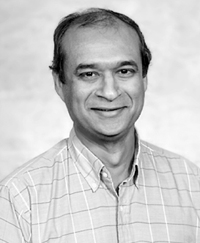
Growing Silicon Nanowires Raj Solanki's Breakthrough - By Deepak Goyal Oregon Professor Raj Solanki has devised a technique which could extend the limits of Moore's Law, an informal industry truism which maintained that the number of transistors on a chip would double about every 18 months. Solanki has discovered a new way to accurately grow silicon nanowires — super-small needles — on an electrode for use in fabricating transistors. This could be the breakthrough that opens up the cutting edge world of nanotechnology — the science of extremely miniaturized computing. Deepak Goyal reports. Nanotechnology may be the hottest thing in computer science, but its promises are not going to come true tomorrow, thanks to the tough scientific challenges that remain. All the same, nano is all the rage in the scientific world. The word is derived from nanometer — one-billionth of a meter. Nanotechnology is defined as anything working at the scale of less than 100 nanometers. Just to get a sense of what kind of small we are talking about, a human hair is about 50,000 nanometers thick.
The scientific possibilities are endless, but the hurdles are equally daunting. Now Raj Solanki, a professor at the Oregon Health & Science University’s OGI School of Science and Engineering, has devised a technique which could provide an early breakthrough. In techie language, Solanki and his fellow researchers have discovered a new way to accurately grow silicon nanowires on an electrode for use in fabricating transistors. The discovery may one day help engineers build faster computer chips. What it means is Solanki and his team have found a way to use a microscopic silicon stubble that used to be a nuisance when building chips. A semiconductor chip is built with an exacting recipe, with chemicals to lay down layers of metal and semiconducting and insulating films on a silicon wafer the size of a medium pizza. The metal layers are precisely patterned and interconnected with aluminum or copper wires to route electrical signals. The pizza-size wafer is then cut into postage stamp-size squares, which become the chips powering home computers, cell phones and other everyday products. For years, chip miniaturization has been a fact of life guided by Moore’s Law. Intel co-founder Gordon Moore had predicted way back in 1965 that the number of transistors on a chip would double about every 18 months But as device dimensions rapidly approach the nanometer (one billionth of a meter) scale, traditional electrical engineering methods and materials are being pushed to their physical limits, and experts now believe Moore’s Law cannot continue beyond the 2010 to 2015 time frame. It’s almost like Hollywood star Zsa Zsa Gabor’s plaintive cry: “It’s dreadful the way miniskirts are getting smaller and smaller. My legs don’t go all the way up.” “A completely new approach needs to be developed to go beyond the current limit,” says Solanki. “One possible solution is to develop electronic devices that incorporate silicon nanowires or carbon nanotubes as active components operating under physics laws of quantum mechanics.” As chips shrink to fit ever smaller computerized products, the layers of the silicon sandwich — now thin enough to be measured in individual atoms — often were polluted by a silicon-based stubble. “This kind of effect was a nuisance for a long time,” Solanki told The Oregonian recently. “We used to call it whisker growth.” “Today, however, those whiskers have a new and fashionable name: nanowires,” The Oregonian reported. “As it turns out, they might be the key to a new generation of computer chips, flat panel displays and biological sensors. “They also might be an important early development in Oregon’s quest to become a national player in the embryonic but burgeoning field of nanotechnology. “Researchers say technologies under development in Oregon could one day show up in a variety of everyday applications, including lightweight power sources capable of running laptops for days, instead of hours; more fuel-efficient cars; better methods of delivering drugs; small in-room heat pumps that eliminate the need for duct work in homes; and microreactors capable of cleaning up toxic waste.” Solanki’s team demonstrated it is possible to grow silicon nanowires exactly where you want them on an electrode using electrical fields. Solanki’s team also can grow silicon-based nanowires in the exact direction necessary to fabricate electronic devices. The researchers now are exploring electrical properties of the silicon nanowires. “Now that we know we can grow silicon nanowires in a precise location and in a specific direction, we want to know what happens to the nanowire when it contacts the metal on the electrode,” says Solanki. “We also are studying how any kind of coating or contamination on the nanowire surface affects the passage of charges through it. “These kinds of factors determine the performance of nanoelectronic devices, so we need to thoroughly understand and perfect this technological advancement before any devices with silicon and silicon-based nanowires can be mass produced,” he said. “In addition, a better understanding of the effect of contamination on the nanowire can lead to development of very sensitive sensors for a wide range of applications, such as environmental pollution to bio-toxins.” Silicon nanowires are typically between 5 and 20 nanometers in diameter (about 1,000 times smaller than a human hair) and can be up to several micrometers (one micrometer equals one thousandth of a millimeter or one millionth of a meter) long. On photos taken via electron microscope, the silicon nanowires resemble skinny needles. Unlike semiconductor silicon nanowires, carbon nanotubes—another possible tool for creating super-small chips — can be either semiconductor or metallic, and are difficult to dope — the process of deliberately introducing impurities to change electrical behavior. For those reasons, Solanki’s team is focusing on silicon nanowires, which also would make it easier for the microelectronic industry to adopt this technology. Research at other institutions involves growing nanowires or nanotubes in a chamber separate from the silicon integrated circuits, then forming a liquid suspension and flowing it over silicon wafers that have prefabricated electrodes. Some of the nanowires or nanotubes grown in this way will settle between desired electrodes, which are then fabricated into devices such as transistors. This method uses only a small fraction of the nanowires or nanotubes and is time-consuming and expensive for mass production, Solanki observed. “Growing silicon nanowires in a specific location in whatever direction you desire, which we have done, is much more practical for gigascale integration — putting a billion transistors on a chip — in the long term,” said Solanki. Solanki grows his silicon nanowires in a quartz reactor using a technique developed decades ago by Bell Labs called vapor-liquid-solid deposition. “The addition of the electrical fields is what’s new,” said Solanki. “We have also grown nickel silicide conducting nanowires, which will be useful for contacting the silicon semiconductor nanowires.” A lot of work remains. “This is still alchemy; it’s not well understood,” Solanki said. “Right now there is a lot of promise, but to actually make it work will take a lot of work — and a lot of funding.” As chips get smaller, the physical limits get closer. Solanki says current technology will hold out for six more years, at which point nanowires might start showing up in mass-produced computer chips. “That’s my guess,” he said. “This is still research. We have to make sure we can grow this well on a 12-inch wafer. At this point, we’ve just demonstrated the feasibility of the technique.” - Deepak Goyal is a frelance writer. He lives in Kolkata. |TOP| INFOTECH INDIA The TRAI would seek the appeal on the basis that it was yet to formulate detailed guidelines for CAS, implementation of which has been kept in abeyance for the time being, Baijal said, adding any view taken on the subject should await the framing of the rules. “What the Madras High Court has given is an ex parte stay. We will present our case before the court. We will also seek a clarification on whether the stay is only meant for Chennai or is it applicable to the entire country,” he said. “Implementing CAS without regulation means consumers will be exploited. Besides, the Tamil Nadu government had itself said CAS implementation should be deferred,” Baijal said, adding all these points will be put across to the court. He also pointed out that the consumer organizations have said set-top boxes for CAS are not interoperable and that consumers have been cheated. The Madras High Court, on March 4, stayed the center’s February 27 notification indefinitely suspending implementation of CAS. The TRAI, in its interim report, had suggested suspension of implementation of CAS in Chennai and South Delhi for three months, until certain obstacles in the way of implementation of CAS were removed. The new partnership effectively offers VSNL’s domestic corporate customers a cost-effective bandwidth solution to Trans-Pacific routes over Asia Netcom’s EAC cable system, or all the way to U.S. and Europe. “The combination of the new Tata-Indicom India-Singapore Cable and Asia Netcom’s region-wide network offers one of the most powerful solutions for Indian businesses to connect to the rest of the world and for multinationals looking to link up offices and locations inside one of the world’s fastest growing economies.” said Bill Barney, president and chief operating officer, Asia Netcom. “The eventual network architecture will not only offer unmatched network quality and performance by linking VSNL’s new subsea cable with EAC, but also eliminate expensive local loop connections that is typically necessary to link up two cable systems.” The new 3175 km Tata Indicom Submarine Cable system will run between Chennai and Singapore. The state-of-the-art cable system will have an initial capacity of 320 Gbps with the ability to scale up to its design capacity of 5.12 Tbps. With an estimated operating lifespan of 25 years, the new cable will connect Chennai to Singapore, from where onward extension to the U.S. and other significant geographies is readily available at competitive prices. After running a successful small pilot scheme in two government schools in Haryana and West Bengal in 2003, Think.com has now been introduced in 25 Kendriya Vidyalayas nominated by the Kendriya Vidyalaya Sangathan, their apex management body. Fifteen schools in Delhi and 10 in Bangalore have joined the pilot project. A group of 25 teacher-administrators — one from each of the participating schools — has successfully been trained on integrating Think.com into the teaching and learning activities. Think.com is an Oracle-hosted, global, Web-based educational environment and is designed for students aged between seven and 14. It enables students and teachers to create, communicate and collaborate, providing them with personal Web pages, along with powerful communication and collaboration tools at no cost. Think.com is a part of Oracle’s Education Initiatives, aimed at catalyzing learning at all levels of education by leveraging the company’s core competencies in information management and Internet technologies. By investing in the education of today’s students and partnering with governments and academic bodies, Oracle is helping students meet the challenges of the information age. “This is a very powerful collaboration tool for students enabling them to collaborate across schools and countries and undertake joint projects. I see students communicate effectively, read, reason and write more powerfully,” said S.C. Jain, former Joint Commissioner (Academics), Kendriya Vidyalaya Sangathan. Jain, who retired end of February 2004, was closely associated with the project and helped in getting it off the ground. “By mid-2004, we plan to include another 40 schools in the program and thereafter involve all our 930 schools over a period of time,” Jain added. “We are happy to be partnering with KVS in this initiative. Think.com is provided by Oracle to primary and secondary schools as a technology-driven collaborative learning environment that familiarizes students with the effective usage of IT tools from an early age and enhances their learning process,” said S. Dasgupta, managing director, Oracle India. Under the agreement, Thai Exim Bank will deploy Finacle across retail and corporate banking trade finance and treasury operations of the bank, an Infosys release said. “Our Telecom Ministry is talking to Home Ministry on this. We will try,” Shourie told a press conference here. He said the Cellular Operators Association of India and individual operators like Hutch and Bharti had mooted the proposal to allow mobile roaming during the Indo-Pakistan cricket series. “I have not promised anything. We will definitely talk to the Home Ministry on this issue,” Shourie said. “I give a lot of importance to views of the Home Ministry and the decision of deputy prime minister will prevail.” “We will only give views of telecom,” Shourie said. Welcome to the wire-free world of Pune University. The campus is becoming Wi-Fi (wireless fidelity). This university is the first university in Asia that is becoming wire free and in the next few days, the entire campus will become wire free. Only few universities in the world such as Carnegie Melon University, Stanford University and few others can boast of being wire free where one can log on to the computer the moment they enter the campus, university vice chancellor Ashok Kolaskar told reporters. This is being done through Centre for Network and Information Security at a total cost of around Rs. 7 million. It comprises computers, modem, and access points installed at vantage points at around 90 different places in the sprawling 412 acre of the university campus. For Rockwell Scientific Co., hiring the best talent is a matter of corporate survival but its chief executive Derek Cheung says he simply can’t find enough professionals in the United States with the highly specialized skills to produce the sophisticated sensors and other high-technology products the California company makes, media reports said here. Changes to a foreign worker visa program, he says, threaten the ability of Rockwell Scientific and other U.S. technology firms, schools and hospitals to bring in employees from abroad — just when they are needed most. The H-1B visa program, designed to allow U.S. companies to hire foreign professionals on a temporary basis, was scaled back last year because of the sluggish U.S. technology job market and a political backlash in Washington D.C. about the importation of foreign labor. Now, with the economy healing, companies are scrambling to get foreign hires approved. H1-B-holders are allowed to renew their visas if they get jobs, without coming under the quota. As per the order, Accel ICIM, a Sun iForce partner in India, will provide systems integration services support at United India Insurance Company’s 24 regional offices across the country and offer software upgrades and updates for four years, a UIIC press release said in Chennai March 2. “We selected Sun’s Star Office software because it matches our technical specifications and it is very competitively priced,” S.M. John Victor, assistant general manager, UIIC, was quoted as saying in the release. Under the tie-up, Servion would provide a customer-friendly, multi-lingual interactive voice response system for Bharti’s network of services, according to a Servion press release in Chennai March 1. Plans are on to deploy a full-fledged computer telephony-integration solution for Bharti, the release said. Mony, director of the Indo French Centre for the Promotion of Advanced Research, supported by both the governments, is the first Indian to get this French honor in the category of science. The centre is a joint organization with equal participation between the two countries that takes up research projects involving the two sides in various areas of science. “The creation of such a centre to support collaborative research in science and technology was without precedence in the history of bilateral cooperation in science and technology between any countries of the world,” French Ambassador Dominique Girard said, honoring Mony. The organization has funded more than 230 research projects with 68 ongoing projects, he said. Mony said for the past three years, the body had also started projects with industrial partners. Mony graduated from the University of Kerala and did his M. Tech from the Indian Institute of Technology, Chennai. He worked as an engineer in the field of atomic energy for 31 years. He was also involved in setting up of country’s Tarapur nuclear plant. Noted filmmaker Satyajit Ray had got this honor in the category of fine arts. “Clandestine transfer of technology by the neighboring country was everyone’s concern in the region and we have to protect our interest and everything around us,” he said. “Our installations are very secure. Measures are in place and periodical reviews are being undertaken by the department and is a matter of routine,” Kakodkar told reporters after inaugurating the 15th Foundation Day celebrations of Board of Radiation and Isotope Technology here. “Because of our strength in security measures, even the International Atomic Energy Commission had requested for a training program for its few member states by the DAE and one course of training has already been completed. “The next training program for IAEC member states is again scheduled for anytime this year,” Kakodkar said. “The logic of it is irrefutable,” Singh said March 5 during an interview to USA Today, one of the largest circulated newspapers published from several cities in the United States. “I’m convinced the logic of outsourcing is such that eventually it will reassert itself,” he added. Singh stressed that outsourcing has now become a two-way traffic — with some jobs coming from the U.S. to India and some flowing in the reverse direction from India to the U.S. Proudly noting the economy’s eight percent growth rate in India, he called India “the land of tomorrow.” “I think the economy is on a roll....India is the land of tomorrow,” said Singh. Rebuffing U.S. critics, the paper reported, Singh said that high-tech jobs would continue to move from the U.S. to India because the savings make it unavoidable. Amid a so-called jobless recovery in the U.S., the paper notes, Democratic presidential contender Senator John Kerry of Massachusetts has slammed corporations transferring jobs to India and China as “Benedict Arnold” companies (named after the traitor to the American Revolution against the British) and called for efforts to discourage additional shifts. In recent weeks, as the debate flared, some U.S. companies involved in moving work abroad, or “offshoring,” grew skittish about being publicly linked to the practice. India, where operating call centers or writing software costs a fraction of what they do in the U.S., said the paper, has become a magnet for high-tech jobs. Companies under pressure to cut costs have shifted thousands of information technology jobs to the well-developed technology industry, centered around Bangalore. Supporters of offshoring say it benefits the U.S. economy because companies invest the sizable savings in other job-creating activities, far outweighing the number of jobs lost. The number of positions affected is only a sliver of the labor force of 138 million, in the U.S., they argue. Amid the furor over job relocation, the Indian economy is growing at a robust 8 percent annual rate. Singh said that while many low-end technology jobs were moving to India, at the “upper end,” many were moving from India to the U.S. “India, too, is outsourcing. So many things are being outsourced in high technology, certain aspects of research,” he said. “It is now a two-way traffic. It is not a one-way traffic.” India, the paper points out, is preparing for national elections next month. Singh refused to comment on statements by Kerry, now the apparent Democratic nominee, supporting tax code changes that would discourage companies from relocating jobs to other countries. But the minister, clearly hoping that tempers will cool after the November U.S. presidential election, suggested that any protectionist moves are doomed. “If we are moving into a globalized world, we won’t be able to keep these doors shut for too long,” he said.
IT BUSINESS
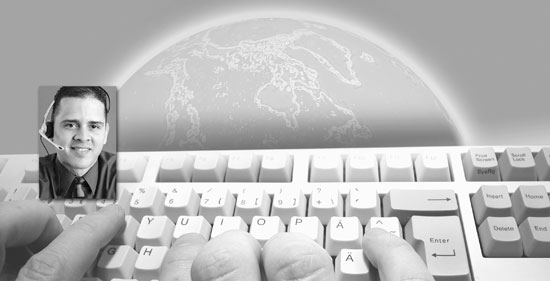 Outsourcing Outrage U.K., U.S. and India - By Siddharth Srivastava Already Britain is realizing that ranting against outsourcing is futile, but things are different in U.S., with tempers frayed in an election year. India, meanwhile, is fuming at rising protectionist trends in the country that teaches the rest of the world the gospel of free trade, writes Siddharth Srivastava. Usually Britain and the United States are in sync on most major issues, including the invasion of Iraq (at the governmental level, at any rate). However, when it comes to outsourcing, the difference could not be starker between the transatlantic cousins. The United States and Britain find themselves at the two ends of the spectrum on the issue. While an anti-outsourcing movement rages across the U.S., in the UK, apart from the trade unions and people affected, everybody (politicians included) wants to join the party — cutting costs to almost a quarter. Outsourcing is turning out to be a major issue in the build-up to the U.S. elections. U.S.-based top executives of Indian IT and BPO firms are boycotting the fund-raising dinner parties for John Kerry, who has been dubbed the “BPO party spoiler.” President George W. Bush had to turn defensive after a backlash over an aide’s contention that free flow of jobs, including the migration of services to India, benefited the U.S. economy in the long run. Although White House economic adviser Greg Mankiw was merely echoing what was stated in Bush’s economic report to Congress, Washington’s political class lashed out at him. The case of the U.K. is different. It will be “wholly wrong” to adopt a protectionist attitude regarding outsourcing by British companies to India, a 10-member all women Labor MP delegation said after a visit to India. “The whole group felt that it will be wholly wrong to be protectionist on the issue of outsourcing which not only helps India but also the British companies,” Dari Taylor, leader of the delegation, said. Similar sentiments were echoed by Stephen Timms, the U.K. minister for e-commerce, department of trade and industry, earlier in the month. “We don’t want to interfere in the decision-making process of investing companies. We will leave it to the market forces to make decisions. I believe protection is not the way for progress,” he said. The list of companies based in U.K, outsourcing to India have grown exponentially over the past couple of years. They include all the big names — Abbey, ABN AMRO, American Express, Aviva, Axa Insurance, Barclays, Citibank, Deutsche Network Services, Goldman Sachs, HSBC, Morgan Stanley, Prudential, Standard Chartered Bank, JP Morgan Chase, Capital One, Lloyds TSB, Accenture, AOL Online, British Airways, British Telecom (with plans to mover more than 7,000 jobs,) Dell, GE (over 11,000 employees), Ideal Shopping Channel, National Rail Enquiries (plans to move 600 call center jobs to India), Tesco, Vertex. Among the US biggies assigning work to Asia are Oracle, Hewlett-Packard and AIG Life Insurance. The difference in approach in the U.K. and U.S. is due to economics scoring over politics or vice versa. While political compulsions score high in the U.S. in an election year, in the U.K. the movement of jobs is related to good business sense. Indeed, as far as business is concerned there appears to be a near unanimity that outsourcing is good for individuals as well as economies. There will be the initial hardship of a job loss compensated by re-training and creation of other jobs. A Bloomberg report said that Atlanta-based Delta Air Lines created 1,000 call-center jobs last year in India. The Indian operations saved $25 million in 2003, enabling the No 3 US air carrier to add 1,200 positions for reservations and sales agents at home. But no Delta employee lost his or her job as a result of outsourcing. General Electric has created 20,000 jobs in India since 1997. Peter Stack, a GE spokesman, said: “When we sell effectively to international markets, it grows our business, and that benefits our workers here (USA).” Economists including Stephen S. Roach of Morgan Stanley have all come out in support of outsourcing, saying it will benefit the U.S. on a long-term basis. US Federal Reserve chairman Alan Greenspan has strongly defended free trade in goods and services. McKinsey has estimated that every dollar of U.S. labor cost assigned overseas will generate $1.12 to $1.14 in additional value for the American economy by making goods and services cheaper and companies more competitive. Hewlett-Packard chief executive Carly Fiorina has urged tax reductions and better schools to improve the competitiveness of U.S. industry. Business groups in the U.S. are protesting growing attempts to curb outsourcing. “We want to grow the worldwide economy and create jobs. Isolating ourselves is not the way to do it,” director of communications from Business Roundtable Tita Freeman has said. The Business Roundtable is an association of CEOs of the biggest firms in the U.S. and it recently urged the Bush administration not to be swayed by the public furor over the loss of American jobs overseas and not to espouse policies that would prevent American firms from getting jobs done cost-effectively, including outsourcing and subcontracting to countries like India, China or Russia. Opponents of moving work offshore, such as Paul Craig Roberts, former assistant secretary of the Treasury during the Reagan administration, say that times have changed and that today’s migration of service-industry positions isn’t likely to provide the benefits that some economists say it will. “It is not your father’s traditional foreign trade,” Roberts said in an essay published by NewsMax.com. “Goods are not being traded. Offshore production is not a case of the U.S. making good X and trading it to China for good Y. It is a case of the U.S. ceasing to make good X in the U.S. and making it in China instead.” Here in India, the reactions have been of unqualified umbrage. “The laws are a surprise,” Commerce and Industry Minister Arun Jaitley said, recalling his meeting with US trade representative Robert Zoellick in June last year in which Zoellick had termed as “bad policy” attempts then being made some state legislatures to ban outsourcing of government contracts to countries such as India. Zoellick who was in New Delhi recently met Jaitley to discuss a range of trade-related issues. Speaking to reporters after the meeting Jaitley said that any further progress in the WTO linked to opening up of Indian agriculture will be pegged to the U.S. approach to outsourcing. “It is strange that on the one hand, people are talking about opening of markets, and on the other hand, banning business process outsourcing. Our agriculture is fragile as it is not subsidized, like in the U.S.,” Jaitley said. Echoing similar sentiments, information technology minister Arun Shourie has said that this was not the way Washington could advance in the backdrop of multilateral trade negotiations. “I feel this would worsen prospects of multilateral negotiations in trade,” Shourie has said. “We must continue to move up the value chain and evolve such solutions and services which are good and cost-effective and Indian IT companies must diversify to other markets,” Shourie said. Indian industry too has reacted angrily to “protectionism” building up in the U.S. ahead of this year’s presidential election. Software industry association Nasscom president Kiran Karnik said, “We are dismayed. Such legislations are not in keeping with the increasing globalization of trade which benefits all countries and is contrary to the spirit of free trade espoused by the U.S.” Observers in India say that U.S. lawmakers are being shortsighted and populist and will be brought to their senses when enough qualified people are not found to do the job. On the next course of action, the advice is to bide one’s time taking a leaf out of the response to outsourcing in U.K. The belief is that matters will die down. Some prominent American think tanks (Economic Strategy Institute, East West Center), have already advised India to keep calm for the moment, as the outsourcing backlash is likely to die out once the elections are over in the U.S. Shourie has said: “The real action has to come from the firms who avail our services and they must know the consequences on their competitiveness if they are not allowed to outsource.” In a broader context, the moves are being seen in India as a test of U.S. commitment to the ideal of free trade. To votaries of free trade, any attempt to erect barriers in services is as reprehensible as maintaining barriers in the movement of manufactured goods. NASSCOM, the leading software forum, has advocated that India keep it counsel and observe a low profile strategy, as the anti-outsourcing bills are likely to be ineffective. They will end up costing more U.S. jobs than they save. The bills will be shelved the moment a new government —Democratic or Republican — is in place. - Siddharth Srivastava is a journalist based in New Delhi. |TOP| REPORT 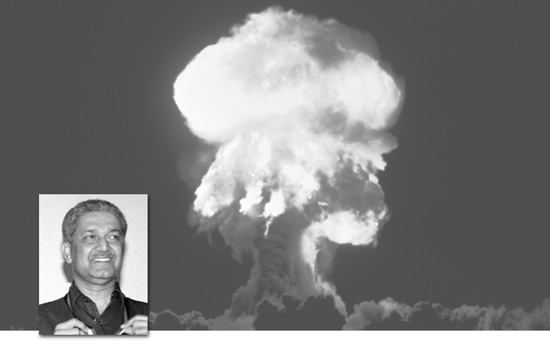 The Qadeer Quandary India, Pak and Nukes – By Siddharth Srivastava Pakistan’s N-bomb guru A.Q. Khan’s dramatic mea culpa marks an essential difference between how governments in India and Pakistan function, writes Siddharth Srivastava. This subject has caught attention here — how would have Pakistan’s tainted nuclear scientist Abdul Qadeer Khan (inset, above) been treated had he been in India and leaked as well as shopped nuclear arsenal around the world? Reflection on the issue offers a fundamental answer of how Indian society has developed so much differently from Pakistan since partition created the two countries in 1947. It also provides an insight into the way corruption is viewed in both the countries as well as systemic checks and balances in place. But first, a brief survey of what happened. This is how events have unfolded in the past couple of weeks — the initial reaction of President Pervez Musharraf, in what has become apparent was evidence of nuclear peddling supplied by the U.S., was to crack down on the scientists involved. But, Musharraf had to demur. Taking on Khan was not going to be easy as the scientist presented just the tip of the iceberg that involved the military rulers of the country, the ISI intelligence establishment as well as several leaders past and present. Musharraf’s military advisors warned him against any overt action against Khan. Khan, himself threatened to spill the beans through a video safely tucked away with his daughter who moved out of Pakistan. What further clinched it for Khan were the widespread protests against the treatment meted out to him, as well as the growing perception that Musharraf was acting at the behest of the U.S. Khan’s role in leaking nuclear technology to countries such as North Korea, Libya and Iran in exchange of enormous sums of money could be forgiven. After all, it was Khan as father of Pakistan’s nuclear program, who made Pakistan see eye-to-eye with enemy number one — India. In the end, Musharraf had no choice but to arrange a deal with Khan. A presidential pardon followed Khan’s admission of guilt on national television. The U.S. has so far restrained itself from presenting any fait accompli to Musharraf. In its estimate Musharraf still remains the best bet for a moderate Pakistan away from the Islamists who continually threaten to Talibanize the country. India, too, has been remiss in its response to the events. With the peace process in place and it does not want to indulge in any verbal sparring with its neighbor. The Indian government has all along kept a studied silence on the issue, except for a mild statement criticizing Pakistan issued by Foreign Minister Yashwant Sinha during the visit of his British counterpart Jack Straw. Even as election-related speeches gain tempo in India, nobody from the Indian establishment has overtly attacked Pakistan. The Khan episode has drawn comparison to a recent court judgment on the late Indian Prime Minister Rajiv Gandhi, though the issue is not of the same magnitude as Khan’s misdemeanors. After 17 years of hearings, Gandhi was exonerated from any pecuniary gain in the Bofors gun deal that bedeviled his career in the latter half of the eighties. The Swedish Bofors guns were among the best in the world and extensively used during the Kargil war, a low-intensity conflict between India and Pakistan in 1999. Gandhi enjoyed an unblemished image of “Mr. Clean” when he began his tenure as prime minister in 1984. Seeds of the Information Technology revolution and economic liberalization were laid in this country, courtesy his vision. Yet, when it came to unsubstantiated reports of him or his family having benefited from the Bofors gun deal, the Indian electorate did not forgive him. He lost subsequent elections and eventually was assassinated by LTTE terrorists from Sri Lanka. The experience of Khan and the late Indian Prime Minister Rajiv Gandhi are not related in any way. But, in their stories lies a critical difference in the way corruption or moral standards in public life are viewed in the two nations. It is not as if corruption is not endemic in India — it is, as evidenced by a slew of recent scams involving tinkering with the stock market, spurious stamp paper, ministers being caught on camera accepting bribes. Petty government officials make it a habit to harass the public for well, petty, benefits. A recent analysis titled “Why Indian N-tech wont leak” in The Times of India, reads: “In the past, other countries like Iraq and Iran have expressed interest in Indian nuclear and missile technology, but have been politely shown the ‘not for sale’ sign. How do Indian scientists resist the lure to flog WMD technology around the world? According to a former nuclear scientist, there are several reasons for this — foremost being the strong culture of bureaucratic control by the Prime Minister’s Office and Cabinet. In contrast to Pakistan, Indian nuclear and missile scientists, while celebrated, have not been needlessly lionized and made to feel they are above the law. Second, Indian efforts have been largely indigenous and did not require an extensive network of illegal back-channels where the “hook or by crook” and “money is no object” culture prevailed. Third, Indian WMD capabilities have evolved with a strong system of formal and informal governmental controls. According to a former atomic energy department head, India has had “formal and informal” export controls since the 1950s’ Atomic Energy Act. The strict guidelines are not just about missiles and nuclear weapons, but have even been applied, in one case in the 1980s, to jeeps being sought by Iran, for fear they may land up in its Iraq war front. Since the 1990s, even these have been tightened by written guidelines being disseminated to all public sector units, the departments of space, defense research and atomic energy, on what can be exported and to whom. Indeed, it is the informal controls in the form of norms of behavior that defines the way how the corrupt or others who are perceived to be corrupt are treated in this country. The five-year-old Bharatiya Janata Party-led government under Prime Minister Atal Behari Vajpayee has witnessed several sting operations by television journalists. The president of the BJP and a union minister reporting to Vajpayee have been caught on camera accepting bribes. Similar allegations have been leveled against Defense Minister George Fernandes. However, none of these charges have had any impact on the stature of Vajpayee, whose reputation remains unblemished in the eyes of the Indian public. The former BJP president and the minister were disgraced. Fernandes has continued as he enjoys the confidence of Vajpayee. Such has not been the case with Pakistan, wherein the means are being justified to meet any ends. The military, including Musharraf, are part and parcel of the same system that propagates, indeed, supports such ends. All is fair as long as it meets with the agenda of putting Pakistan on an even keel militarily with India. - Siddharth Srivastava is a journalist based in New Delhi. |TOP| CONTROVERSY  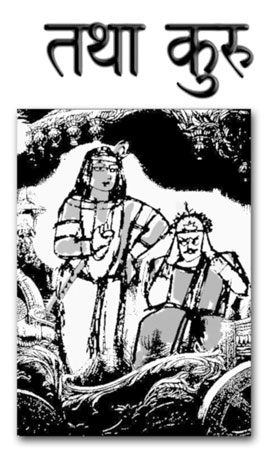 Back to Burning and Lynching? A Playwright Responds – By Sujit Saraf Bay area-based theater activist and playwright Sujit Saraf’s provocative play ‘Tatha Kuru’ rewrote the Gita as a book fit for an atheist. The performances drew a flurry of ugly emails. Sujit Saraf responds. On February 7, 8 and 21, the theater group Naatak staged its seventeenth production, my Hindi play Tathaa Kuru: The Bhagavad Gita As It Should Be. The words tathaa kuru translate into “do that,” from the last instruction that Krishna gives to Arjun in the Bhagavad Gita: “Reflect fully on the truth revealed to you by Me,” says Krishna, “and then, whatever you desire, do that.” The play, our advertisements said, “re-writes the Bhagavad Gita as a book fit for an atheist.” This made clear, I hoped, that the play was not a reverent recitation of platitudes about the wisdom of the Gita, its infinite depth and its eternal truth. Instead, I hoped to indicate that I had read the Gita (not books about the Gita), found ideas in it that did not satisfy my intellectual curiosity, and had my own ideas about how it could be re-written to make sense, at least to me. We staged two very successful shows of Tathaa Kuru. After the shows, we received a flood of emails. Some praised the play for its originality and boldness, some criticized it for its impudence, and some were outraged that we had dared to speak about the Bhagavad Gita without their permission. We were flattered that our play generated such attention, but we were shocked to discover that, hidden in the moderate climate of the Bay Area, there are people with extreme views who cannot tolerate the slightest dissent. Instead of expressing intellectual disagreement with the play — which is their privilege — these “critics” took great offence at the play, treating it as a personal attack on themselves. They let loose a torrent of abusive emails, accusing Naatak members of being “bastards,” “commies” and “Hindu haters.” They took up the cause of Hinduism as they understood it, which was to warn us not to stage our third show. We staged the third show. There were protesters outside the theater, holding signs that accused the play of “insulting Krishna.” There were protesters in the parking lot, handing out flyers and encouraging people to turn back. The protests were peaceful, except for frayed tempers when we decided to take down the protesters’ names, in case they had planned disruptions inside the theater (they had not). The audience did not seem to care about the protests, and the show was successful. The protesters enjoy the same rights as we do. It is their privilege to criticize our play, as it is our right to stage it. This, perhaps, is American civil society at its best, except for one wrinkle. The protesters were peaceful, but not by choice. They felt constrained by the American Constitution, as made clear by the emails they circulated on mass mailing lists, in which they wished that Americans would give them the same rabble-rousing freedom they are accustomed to in India. I feel no compunction in reproducing these emails, because they have already been sent to large groups of people. Consider the following charge: “Naatak group in San Francisco Bay Area has been formed by renegade Hindus, atheists, and commies … Some of these misguided people were educated in church-run schools, and they raise funds to send to India through probably church-related organizations.” Or this nugget, obviously typed in a moment of passion: “These idiots and bastards are not ashamed of demeaning their ancestors’ civilization and Hindu Dharma.” Some emails expressed a yearning for the days of burning and lynching, and a sigh of resignation at the unfair restraints imposed by American society: “Dear Mr. Saraf Thank god you are in America! Do you have nerves to stage your play in India ? .... I bet you don’t.” Others bemoaned the tolerance of Hindus: “If you think you are that creative, why don’t you try something related to Islam? That will give you fast publicity and fame. Or maybe a ‘Fatwa.’” Yet another abused the art of analogy: “This is no way to abuse the first amendment freedom of speech. Remember Hillary Clinton apologized for making a comment about Gandhi having a gas station.” I do not want to quote out of context. One of these emails, selected because it was the longest of the many we received, can be found (unedited, with the name removed) on our website, www.naatak.com. We were impressed by the sender’s enthusiasm even as we were amused by his charges. Most of the protesters did not watch the play, although I answered all their abusive emails with invitations to the show. They had been told, by the one or two who did see the play, that it was a threat to Hinduism itself. As far as I could tell, their interest lay neither in the Bhagavad Gita (which they may or may not have read) nor in the art of drama, merely in venting anger at a perceived slight to their vanity. They seemed to forget that the Bhagavad Gita is a world book — it belongs to me as much as it belongs to them, and that a book which has survived for two thousand years need hardly worry about threats to its existence. If they had actually read the book they were hoarsely defending, they would have appreciated Tathaa Kuru as an honest attempt to find clarity in the arguments of the Gita. I feel grateful to American society that these protests were peaceful. My protesters, no doubt, wish they were somewhere else, so they could have protested in the manner made evident by their emails. I can only hope their anger remains electronic, bound by the society they have chosen to live in, not by the society they have left. - Sujit Saraf has a Ph.D. in computer science. He helped found the Bay Area |TOP| HEALTH:  Dealing with Anemia A Physician Explains – By Monu Mukherjee, MD Anemia is a common condition, but some forms, like thalassemia, can be very serious, physician Monu Mukherjee writes in her explanatory essay. Anemia is a common condition which often goes undiagnosed because of initially mild symptoms such as pale skin and tiredness. Severe anemia, however, can cause palpitations and heart failure. In most people it is diagnosed by a routine blood test. In the What is anemia? A person is anemic when he or she has too few red blood cells and too little iron in the blood. As a result, the hemoglobin and hematocrit values are low. Normal hemoglobin for a man is between 14.0 and 17.4 g/dL. For a woman it is between 12.3 and 15.3g/dL. The normal range for hematocrit is between 41.5 percent and 50.4 percent for men. For women it is between 36 percent and 45 percent. What are hemoglobin and hematocrit? Hemoglobin (Hb) is the protein in red blood cells which contains heme. It transports oxygen from the lungs to other body tissues and also transports carbon dioxide in the reverse direction. About 98 percent of the protein in red blood cells is hemoglobin. In normal adults, 97 percent of the total hemoglobin is HbA which has two α subunits or globin chains and two β subunits (α2β2).Other possible globin subunits are γ and δ. In the fetus, the Hb is α2γ2. During the last three months of pregnancy, γ-chain synthesis switches to β-chain synthesis. In certain congenital anemias, the production of γ chains persists. The hematocrit (Hct) is a measure of what percentage of the blood is composed of red blood cells. Usually a low level of iron in the body causes too few red cells to be formed and this causes a low hematocrit. There are other causes of a low Hct (and Hb) in which there is enough iron in the body but it is not being utilized correctly to form normal red blood cells. So what causes anemia? Iron deficiency is the most common cause of anemia, either due to low intake of iron or abnormal losses of iron such as from a bleeding ulcer or heavy menstrual periods. Pregnant women are prone to iron deficiency because of the iron requirements of the fetus. Iron deficiency anemia is usually treated by taking iron pills but blood transfusion may be needed in severe cases. The cause of the low iron has to be identified and treated. In some cases, iron intake actually may be normal but the iron may not be absorbed normally from the gut. Vitamin deficiencies can cause anemia. For instance, pernicious anemia is caused by a deficiency of vitamin B12. The body stores of iron can be checked with blood tests such as the ferritin level. If the hemoglobin and hematocrit are low but iron stores are normal, the cause of the anemia is usually seated in the bone marrow, where most red blood cells are made. The problem then is improper utilization of iron or abnormal maturation of red blood cells. Chronic kidney disease is an example, where the kidneys cannot make enough of the hormone erythropoietin — essential for making red blood cells — and this causes an anemia that can only be corrected by shots of synthetic erythropoietin. Chronic inflammatory diseases such as rheumatoid arthritis also cause anemia, as well as infections such as tuberculosis and HIV/AIDS. Many cancers cause anemia. In leukemia, there are too many white blood cells and too few red cells. The bone marrow becomes full of abnormal white cell precursors and there are very few red cell precursors. An important cause of anemia among South Asians, as well as in people from
Thalassemias—it’s all in the genes. Normal people inherit two α-chain genes and one β-chain gene from each parent. The thalassemias are caused if any of these genes are missing or abnormal. In α-thalassemia, if one of the four α genes is missing, there is normal red blood cell production. If two genes are missing, the red cells are small but Hb level is normal(α -thalassemia trait). Deletion of three α-chain genes causes an anemia in which abnormal red cells tend to break up (hemolytic anemia) but new cells keep forming, so there are no serious problems. If all four genes are missing, the condition is incompatible with life—the affected baby usually dies before or soon after delivery. In β-thalassemia, if both parents have β-thalassemia trait, then statistically one quarter of the children will have the serious β-thalassemia major, half will have β-thal trait which only causes a mild anemia, and one quarter will be normal. It is therefore very important for would-be parents to be checked for thalassemia trait if either parent is anemic or has small red blood cells on the CBC blood test, especially if the parent is South-east Asian, Middle Eastern, African or of Mediterranean origin. The test used to check for thalassemia is hemoglobin electrophoresis. Genetic counseling. There are clinics that specialize in diagnosing genetic traits or diseases in prospective parents and in advising them as to the risk of having a baby with the disease. There are also ways to check the unborn fetus for defects, such as amniocentesis and chorionic villus sampling. Since β-thal major is a serious disease needing repeated blood transfusion — which causes complications and is expensive —and usually leads to early death, many parents may want to end the pregnancy. The choice is up to the parents but the important thing is to have the necessary tests done and to be fully informed.
- Monu Mukherjee got her medical degree in England and did her residency in San Francisco. |TOP| REPORT:  Joining the IT Wave Bangla IT Center - A Siliconeer Report IT firms from The Bangladesh ICT Business Center, based in Silicon Valley, Santa Clara, California, hosted its 2nd annual Technology Open House March 7. “For the past year in business, BIBC’s goal was to open up opportunities and niche markets for Bangladeshi ICT products, and to facilitate partnerships with U.S. companies in relevant fields,” BIBC said in a press release. “BIBC has served as a one-stop international office for these companies, providing administrative support and other office amenities at a prime location in Silicon Valley, California. With the assistance of the Bangladesh Ministry of Commerce, BIBC has emerged as a power tool for promoting and channeling IT business to Bangladesh.” The BIBC’s annual Open House event showcased the products and services of eight of the numerous Bangladeshi companies it represents, each providing distinctive expertise in all sectors of the ICT business, ranging from software development to services. “This event is a great opportunity for Silicon Valley companies to know and explore new, emerging technologies in Bangladesh,” the release added. The following companies showcased their products:
Interested readers can get more information at the BIBC homepage: http://www.bibc.biz
FINANCE Prakash and his wife, Gayatri, pooled their savings to get the business off the ground and have spent their lives nurturing it. It is by far their largest asset. Their oldest daughter is very active in the company, but their other two children are too young. Will any of their three children run Krishna Printing some day? Or perhaps one of their key people? That depends. According to a study conducted by the U.S. Small Business Administration in 2000, only 30 percent of family businesses pass successfully to the second generation. Business continuation planning can be difficult for your clients, especially with all the day-to-day problems that need immediate attention. But, lack of planning can be devastating. Most likely the 30 percent of businesses that do make it, make it because their owner planned for the orderly transfer of the enterprise. Prakash and Gayatri’s situation is common. A family business is often the owner’s major asset. The death or disability of a business owner — who is usually the key to the success of a business — can seriously damage the business’ value. Good planning can substantially minimize these risks. Let’s take a look at why some owners plan for business continuation while others do not, the methods and tools to transfer business interests, and how to begin developing a plan. “Business continuation” planning simply means planning for the transfer of business ownership and management from the current owner to someone else. There are a number of good reasons why owners should plan for the transfer of their businesses, such as avoiding the business passing to under-qualified owners, protecting key employees or raising cash. However, most of the time the planning is done simply to “keep the dream alive” — to make sure the business extends beyond the owner’s lifetime, as in Prakash’s case. Few business owners work for a lifetime only to consciously decide to let their business dissolve when they’re no longer able to manage it. Every business owner should consider having a buy-sell agreement to assure the continuation of the business and to protect the owner and his or her family. However, owners frequently don’t know what they want to do, nor do they understand the various options open to them. Buy-sell agreements work no matter what form a business takes: sole proprietorship, partnership, LLC, ‘C’ Corporation or ‘S’ Corporation. Beyond taking that all-important first step and getting the agreement set up, having the dollars available to make the transfer happen is also key. Generally, the most convenient and least expensive method of funding the buy-sell agreement is through life insurance. Buy-sell agreements funded with life insurance offer these benefits:
Clearly, a buy-sell agreement best protects owners and families if arrangements are made prior to death or disability. And, funding the buy-sell agreement so the dollars are there when needed is essential. There are a myriad of disability and life insurance solutions for this problem. It’s never too early to plan for the continuation of your business. To get started, ask yourself some general questions:
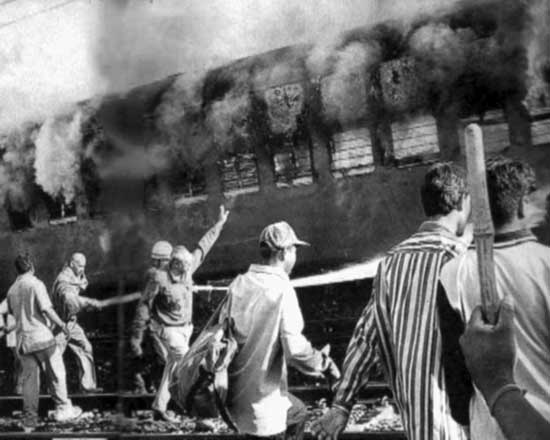
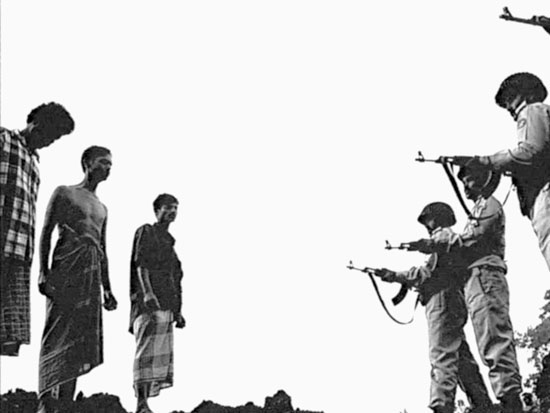
First and foremost, assess your business continuation situation carefully so your plan accomplishes your goals. A buy-sell agreement funded with life insurance may offer some answers to keep the dream alive. - Ashok Gupta is a financial adviser based in San Jose, Calif. |TOP| PHOTO ESSAY: HOLI IN SUNNYVALE REPORT  Documentary Film Fest: Traveling Film South Asia 2004 - A Siliconeer Report Pravasi Bharatiya Diwas brought the 20-million-strong global Indian family back to their land, writes Siddharth Srivastava. Over three weekends in San Francisco and Milpitas, Calif., the Bay Area will host some of the most exciting documentary work currently being done in South Asia. All told, 19 films will be screened from March 12-21 in San Francisco and from March 26-28 in Milpitas. “Showcasing the groundbreaking work and emerging talent of non-fiction filmmakers from South Asia, Traveling Film South Asia 2004 debuts March 12 as the only festival of its kind in California,” say organizers Ekta and Friends of South Asia, who are hosting the festival in collaboration with Himal Association. The festival will screen 19 compelling documentaries that “chart the shared history and complex lives of the people of the sub-continent,” according to Ekta. “Covering a wide range of important political, social, and economic issues and giving voice to many of the region’s people—women, religious minorities, and indigenous communities—the films focus the lens on life in contemporary South Asia, while celebrating its rich cultural diversity.” The diverse array of films include work from Bangladesh, India, Nepal, and Pakistan. The offerings include award-winning and thought-provoking films, including a selection of films from the 2003 Film South Asia festival in Nepal, six films that screened at the recently concluded World Social Forum in India, and two films by the internationally acclaimed Pakistani filmmaker, Sabiha Sumar. As the only such event solely dedicated to supporting contemporary South Asian non-fiction films, TFSA 2004 provides a platform for filmmakers to exhibit new works that examine critical and often provocative issues. Since its beginnings in 1997, Film South Asia has traveled to more than 45 international venues. TFSA 2004 will be held over three weekends in March at two Bay Area venues: at the Mission Cultural Center, San Francisco, during March 12-14 and March 19-21, and at the India Community Center, Milpitas, during March 26-28. The March 12 program opens at the Mission Cultural Center at 7 p.m. with a screening of Amar Kanwar’s, A Night of Prophecy (India, 2002). One of the films censored at the recent Mumbai International Film Festival but shown at the World Social Forum, this poetic documentary travels through different parts of India to reveal how poetry and music can unify a nation’s people even in the face of severe conflict and oppression. The program continues with the groundbreaking Resilient Rhythms (India, 2002), a dynamic and truthful portrayal of India’s caste system and the Dalit response to their marginalization. Gopal Menon, known for his compelling and acclaimed documentary, Hey Ram: Genocide in the Land of Gandhi, directed the film. Reflecting the current political situation in India, religious fundamentalism and the need for tolerance was a powerful and recurrent theme explored by many of the films. In Godhra Tak: The Terror Trail (India, 2003), director Shubradeep Chakravorty investigates the Godhra train burning and subsequent rioting that killed 2000 Muslims in Gujarat, India in February 2002. Chakravorty retraces in chilling detail the route of the first batch of kar sevaks from Gujarat to Ayodhya and back and carefully reconstructs the terror they unleashed en route leading to the Godhra fire and the riots that followed. In a climate of increasing religious divides, directors Jayasankar and Monteiro provide a glimmer of hope in their film, Naata – The Bond (India, 2003). The film is a moving tale of two friends who work on promoting communal harmony in Bombay’s largest slum. Naata was one of the films removed from the Mumbai International Film Festival, but shown at the World Social Forum in Mumbai in January 2004. Swara – A Bridge Over Troubled Water (Pakistan, 2003), by Samar Minallah, is a hard-hitting commentary on the Pakhtun practice of giving minor girls in marriage to an “enemy family” in reparation for serious crimes committed by male members of the girl’s family. Also from Pakistan, Sabiha Sumar’s film, Don’t Ask Why (1999) offers glimpses into the life of Anousheh and provides a moving account of the dreams and fears of a 17-year-old girl growing up in a conservative and patriarchal society. Most of Sumar’s films are banned in her native country. Two films from Bangladesh reveal that the nation’s freedom struggle of the 1970s continues to be an important theme for its filmmakers. In Words of Freedom (Muktir Kotha) (1999), directors Tareque Masud and Catherine Masud tell the story of musicians traveling through refugee camps and war zones during the Liberation War in 1971. The film blends documentary and fictional genres in a musical structure to follow the birth of a nation and the ideals of secularism and tolerance on which it was founded. In Tale of The Darkest Night (Shei Rater Kotha Bolte Eshechi) (2001), director Kawsar Chowdhury recreates the horror of the massacre by the Pakistani army in Dhaka University. The film won the Second Best Film Award at Film South Asia 2003. Interested readers can find more information at the Ekta Web site at www.ektaonline.org. REPORT: “The world has become increasingly interested in understanding the diverse Muslim culture and society,” the press release said. “The MFF seeks to help portray Muslim artists and their view, providing Muslims with a venue to share their work about themselves and their diverse traditions.” According to MFF director Juveria Aleem: “This is a significant milestone in the history of Muslim media arts. We will be featuring great films which capture a mosaic of Muslim issues and perspectives.” Festival offerings include On Common Grounds, ‘T’ for Terrorist, Haters, Born in the USA and international entries such as a music video from Denmark featuring the group Outlandish and Oil Children, a feature film from Iran. “The festival will highlight the talent of Muslim filmmakers from around the world, showcasing the creativity and richness of Muslim culture,” the release added. Interested readers can call Irfan Rydhan at (408) 509-7965 or visit the festival’s Web site at www.MuslimFilmFestival.org for more information.
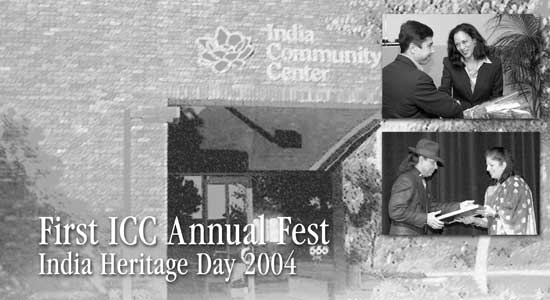
First ICC Annual Fest: India Heritage Day 2004 - A Siliconeer Report Over 1,000 people attended the two-day India Heritage Day celebrations hosted by Milpitas, Calif.-based India Community Center. A Siliconeer report. Over 1,000 people attended the Milpitas, Calif.-based India Community Center’s India Heritage Day 2004 celebration Feb. 21 and 22, organizer said. “We had some of the most stimulating panel discussions on the position of Indian-Americans and the aspirations of the younger generation,” ICC co-president Anil Godhwani said. “The standing-room only attendance of the youth panel was particularly impressive.” Guests at the event included San Francisco Consul General of India H.H.S. Viswanathan, Milpitas Mayor Jose S. Esteves, and San Francisco District Attorney Kamala Harris, who spoke about the influence of her Indian heritage on her career and character. The program also consisted of an Images of India art contest that drew over 115 participants from 3-12 years, and a vivid art and photography exhibit showcasing India’s diverse culture and people. The cultural program was held at Foothill College in Los Altos Hills, Calif., Feb. 22. It was attended by over 800 people and featured a performance by sitarist Habib Khan’s world music orchestra. Naach Company and ICC dancers performed pieces choreographed specially for the event by Mona Sampath. Talat Hasan, ICC’s chairperson of trustees, presented Bikram Choudhury, founder of Bikram Yoga, with ICC’s Distinguished Achievement Award. She also recognized Harikrishna Majumundar for his book, “Mapping the Maze,” a guide for immigrant seniors. “With the maturity of our community in the Bay Area, we have strongly felt the need for celebrating the rich culture and heritage of India. The anniversary of India Community Center has been an opportune way to do it,” said Hasan. ICC is the largest facility in the nation dedicated to promoting Indian culture and values through cultural, recreational, educational and community programs. Readers can find more information about the center at its Web site at: www.indiacc.org. CULTURE In 1986, Mythili Kumar, artistic director of Abhinaya Dance Company, presented Abhinaya’s first dance production “Shiva - The Cosmic Dancer.” The critically acclaimed performance is remembered as a presentation that set new standards for classical dance performances in the Bay area. Abhinaya will restage this theme which highlights the varied manifestations of the Hindu god Shiva. Shiva exemplifies the concept of the one Supreme Being who resolves within himself all the conflicts on this earth. He is at once the creator, the preserver, and the destroyer of the universe. He is Nataraja, the cosmic dancer, whose dance animates the universe from within. He is also the supreme ascetic. In the first part of the performance, through the music and verse of legendary composers such as Gopalakrishna Bharati, Neelakanta Sivan, and Papanasam Sivan, the Lord’s dance will be extolled. The post-intermission segment will portray the varied paths that devotees pursue to attain Shiva’s grace. Interested readers can call Abhinaya Dance Company at (408) 983-0491 for more information. COMMUNITY NEWS IN BRIEF
Speakers include:
Interested readers can visit the following Web site for more information www.entforum.caltech.edu. At the fundraiser, Guerrero-Daley spoke about the equal rights and fair judgment for all communities and emphasized the need for minority representation in the legal system. She campaigned on the basis of her experience as a trial attorney, and her long record of service, including serving as judge pro term for the Santa Clara County Superior Court, inspecting police misconduct in investigations to determine if the outcome was supported by the evidence; service as an arbitrator deciding consumer vs. auto manufacturer cases. She is a certified mediator in conflict resolution and a professor at Lincoln Law School. Supporters who attended the fundraiser included Dr. Dharam Salwan, Mohinder Mann, Ashwani Bhakhri, James Canfield, Raju Bhargava, Dr. Deepak Sachdev and Deepak Mehta. Athavale, who died Oct. 25 last year, won worldwide recognition for his spiritual leadership. The U.S.-based Templeton Foundation gave him the Templeton Award for Progress in Religion in 1997. He has also won the Magsaysay Award of Phillipines and Padma Vibhushan of India. Athavale started Swadhyay movement in 1942 with just a handful of people. Today Swadhyay has become a household name across all continents in many countries. Swadhyay has successfully attracted a wide cross sections of people ranging from farmers, harijans and fishermen of Indian villages to doctors, engineers, professors in the Western world. His message of selfless love and universal brotherhood under the fatherhood of God struck a chord with many people around the world. Dr. Majid Rehnuma, a U.N. educator, called Swadhyay a “silent but singing revolution of India.” Talwalkar is a scholar who has spoken at many universities in the West. She has spoken at the Vatican in Rome for world peace in the aftermath of 9/11 bombing. The movement has thrived under her leadership. In the annual Bhagwad Geeta elocution hosted by Swadhyay Parivar in December last year, 366,000 Hindu, Muslim and Christian youths participated worldwide. During the last four months, she has visited many places in India, the Middle East and the U.K. with Athavale’s ashes “so that millions of Swadhyayis have been able to respect and salute the Universal Life and message of Pujya Dada,” the release added. “Now on March 13, similarly, Didi is planning to visit Bay Area so that thousands of Swadhyayi and Swadhyay loving families can for ever cherish the love, life and work of this universal man, Dadaji.”
“The leadership, technical expertise and diverse skills these engineers bring to our Boeing team are admirable,” says Joan Robinson-Berry, Boeing deputy vice president of technical relations. “This recognition from an external source validates our company’s competitiveness and innovation, and it salutes the value these engineers bring to our customers.” Established in 2002, the awards program provides a venue for recognizing the technical contributions of Asian-American professionals in the public and private sectors. Hank Queen, vice president of engineering and manufacturing for Boeing commercial airplanes, was the keynote speaker. Founded in 1917, the Chinese Institute of Engineers advances the science and profession of engineering and promotes the development of engineering projects. The Boeing Company has been a major sponsor of these awards for two years. Agrawal is a nationally recognized expert in high-speed aerodynamics for Boeing Integrated Defense Systems in Huntington Beach, Calif. In this role, he oversees development of technology and tools, and promotes common processes and best practices among Air Force Space Systems programs at the site. Agrawal began his career at Boeing in 1986. Since then, he has become an expert in high-fidelity Computational Fluid Dynamics methods for supersonic commercial transport, hypersonic missiles, space launch vehicles and military aircraft programs. A patent was granted in 1999 for his work in High-Speed Aerodynamic optimization technologies. Agrawal has written more than 100 reports and 11 archival journal articles. He also received a number of awards from Boeing, NASA, and the American Institute of Aeronautics & Astronautics for his dedicated service. He earned his doctorate in Aerospace Engineering from the University of Michigan, a master’s in Aerospace Engineering from the University of Maryland, and a bachelor’s degree from the Indian Institute of Technology, Kharagpur Menon’s other films include Odes from Far Lands, All That Glitters and Punarjani.  Form and Functionality: 2004 Nissan Quest 3.5 S – By Sally Miller Wyatt The designer folks at Nissan have tried to break out of the box to create the Nissan Quest, and Sally Miller Wyatt likes what they have come up with.  Parents with growing children may face a bit of a dilemma when it comes to selecting the family car. Minivans may be the most logical transportation choice, but older children (and even some adults) may not want the stigma that comes with them. Nissan attempted to address that dilemma with its 2004 Quest. Designers tried to “break out of the box,” to borrow a dot-com era buzzword, by revamping the Quest’s exterior and interior look. They addressed concerns consumers have about seating arrangements and ease of moving seats about and even out. They also focused on a driver’s desire for a responsive vehicle. They were looking to put some fun in the functionality of a minivan. The Quest’s exterior, with its swept-back lines and arched roof, is definitely a step away from the boxy look of many minivans. The Quest’s interior — especially the dashboard — puts a whole new spin on how to deal with cup holders and storage space. While you know that this is still a minivan, it has been taken to a different level. Perhaps the most striking aspect of the Quest is its interior. Not only do the dual sliding doors have wider openings than most minivans, when they are open they reveal copious amounts of interior space. No matter where you sit in this vehicle you’ll have plenty of leg, head, elbow and hip room. The taller roof line and captain’s seats in the second row make it easy to move around from front to back row of seats. Even with all this space, there is still room for a good-sized cargo area behind the third row of seats. This van should easily accommodate the family with children who have outgrown their infant seats and are stretching toward adolescence. The test car came with cloth-covered seats, although leather is available. The color scheme was light gray, which may not hide stains very well. Standard features include dual sliding doors, which are a true convenience for families. Steering wheel-mounted controls, climate control zones for both the front and the rear, eight-way adjustable seats for the driver, a bottle holder in each sliding door, keyless remote entry and a tilted steering wheel are also standard. The test car came with an optional seating package that included second row folding captain’s chairs and third row seats that fold flat for $350. That’s a must-have and an affordable option for most families. As for standard safety features, the Quest is equipped with dual stage front air bags, three-row head curtain side air bags, a tire pressure monitoring system, three-point seat belts in all positions, an energy-absorbing steering column, front and rear crumple zones and height-adjustable head rests. On the road, the Quest is powered by a very responsive 3.5-liter V6 engine. There is no hesitation at acceleration and road noise is nearly non-existent both on city streets and on the freeway. The Quest features four-wheel independent suspension and power rack-and-pinion steering is standard, all of which certainly helps the vehicle handle the road so well. The 2004 Nissan Quest has a novel new look and offers families lots and lots of room. That’s a bonus for those who really need all the space but not the stigma.
- Sally Miller Wyatt is a freelance writer Guftugu However, once he turns up there, it turns out that Karim Morani, one of the organizers, thinks Big B isn’t that big, so he sits Amitabh in the 15th row, with the predictable result that fans mobbed him. Here is where reality began to mimic a B grade Bollywood film. Amar Singh gets angry, and gives Morani a piece of his mind. Morani tells Singh to go jump in the lake. Zee boss Subhash Chandra joins the fracas, reportedly slapping Morani. Shah Rukh joins in the fun, defending Morani. He even calls Amar Singh a goonda. Amar Singh, to nobody’s surprise, takes it as a compliment, saying to defend Amitji’s honor, he was happy to be a goonda. When such fun is going on off stage, who the heck cares who won the Zee awards? But wait, there’s more. Later, as the yellow press delighted in torrid trivia, all the principal actors, in classic Bollywood style, kissed and made up. Amar Singh, oozing magnanimity, told incredulous reporters. “Shah Rukh Khan rang me up and told me that he had called me a goonda with affection.” Yeah, right. He even quoted a Big B line from the superflop Khuda Gawah: “Tu mujhe kabool mein tujhe kabool, is baat ka khuda gawah. (I am acceptable to you, you are acceptable to me, and the God is the witness).” Pity the poor Almighty. The stuff he has to be witness do isn’t funny at all. “Suraiya, Bano to me, was a bundle of unforgettable qualities. A sublime voice, the ring in the voice, the perfect diction, the effortless rendering,” he said recently to a reporter. “She brought joy to millions but what about her? She never talked about it but I knew intuitively what was going on in that pretty little head of hers. “I had a peep into her heart and mind the day I saw her rendering the song ‘Tum mujh ko bhool jaao, ab hum na mil sakenge’ for Bari Behan. The cry was loud and clear — the cry of a lonely heart. And lonely it remained till the end. Dutta made a movie with Suraiya, and the film, Pyar Ki Jeet was a big hit. Suraiya insisted she was no great shakes as an actress, but she must have been the only one who said it after her superb performance in Bari Bahen. “Success made Suraiya smile that unforgettable smile that could send a thousand hearts aflutter,” Dutta said wistfully. Ah, they don’t make them anymore like they used to. Sometimes the two will hang out at a nightclub and dance into the wee hours. Which is all nice and good, but our night owl recently spotted Bipasha going into a maha sulk when a woman fan walked up to John and told him how much she appreciated his dare-bare antics in Paap. Well Bipasha for one didn’t appreciate the compliment at all. As for how John felt about it, the night owl is mum, bit if the man has any sense, he will soon realize the some compliments are just not worth the trouble. Bipasha, it is clear, doesn’t like to share her stuff. Recently a group of 60 Russian tourists were in Mumbai and guess what was at the top of their agenda? Seeing the matinee idol, no less. And what’s more, they refused to take no for an answer. Well give the Bollywood star credit. Not only did he agree to a special meeting with the fans, he also posed for photographs with his Russian fans. The fans were on cloud nine, and you know what? We are pretty pleased, too. It’s not often that you see such disarming warmth and humility in Bollywood, and if Hrithik’s fan following is getting globalized, all we can say is it couldn’t happen to a nicer man. Love is in the air, it appears, and we don’t mean Bollywood ishq, either. The nuclear neighbors which have been at loggerheads for years appear to be both smitten with the idea of proffering the hand of kinship and camaraderie, and God knows it hasn’t come a moment too soon. Nor is it the first time that Dev Anand has expressed affection for the nation next door. He had accompanied Indian Prime Minister Atal Behari Vajpayee during his historic bus journey to Lahore, and today, as all signs indicate the two neighbors are poised for a historic rapprochement, who better to be the poster child of that moment but Dev Anand, Bollywood’s eternal lover? Little Esha is dating Dino’s younger brother Santino, and we understand drop-dead good looks run in the Morea family. Of course, officially Esha and Santino are “just good friends,” but that’s one of the oldest lines in Bollywood, and it has less credibility than a two-dollar bill. Times have certainly changed. Gone are the days when the standard was set by the ’50s Bollywood heroine who cried oceans of tears because her lover had left. Welcome to the new age of the miniskirt and cell phone, where you look at a broken relationship the same way you look at a car that’s turn out to be a lemon: You just get past it and move on. Of course, folks, we are not supposed to use the dreaded “L” word, because the two are just good friends. Wink, wink. Nudge, nudge. Aishwarya and Vivek are all set to release their first film together Kyun Ho Gaya Na Pyar, which is probably going to release in June. The fact that the two are seeing each other is already adding spice to the curiosity around films where they will star. Bollywood buffs can be a pretty voyeuristic bunch: They are dying to see if they can give Aish and Vivek their undivided scrutiny on screen to see if they can detect any real sizzle in the love scenes. If everybody else is going to have a bit of fun, daddy Suresh figures he might as well rake the moolah in. Then there is the other advantage: In a film starring Vivek, getting dates from Aish should be a breeze. But give the woman credit for just hanging in there. And at last things are looking up. She is giddy with happiness after her recent marriage, and her career seems to be taking off as well. “Everybody should get married! I am feeling eternal bliss,” she gushes. However, work cut her honeymoon short, sweet as it was. “After I marriage I had to rush to Kolkata for an endorsement. Then I had to dub for Feroz Nadiadwala’s Aan. He wants to release the film in April and cannot wait any longer. I may be doing the sequel to Hera Pheri.” The crème de la crème, however is the reprise of Sahib, Biwi Aur Ghulam. “This is the first time that I’m doing a television serial,” she says. “It is something that I’m looking forward to. I will give my own interpretation to Meena Kumari’s role.” Magistrate S.R. Bhadgale sentenced Sunita and ordered her to pay a Rs. 5,000 fine under the provisions of Bombay Municipal Corporation Act 1988. Sunita was arrested and immediately released on bail for a sum of Rs.5,000. She has been given two months to file an appeal. The BMC had ordered demolition of a structure built atop the Kapoor garage next to her bungalow after neighbors complained. Instead of demolishing the structure on her own, Kapoor applied to the BMC to regularize it. Her request was turned down but she did not demolish the structure. The BMC sued her, and now she has really landed herself in hot water. Hindi Film Review Unfocused Cops and Robbers Film  AB TAK CHHAPPAN Directed by: Shimit Amin Music: Salim-Suleiman Starring: Nana Patekar, Revathy, Nakul Vaid, Kunal Vijayakar, Yashpal Sharma, Prasad Purandare, Mohan Agashe, Pravin Patil, Jeeva and Hrishitta (in a special appearance) This review page has earlier issued scathing critiques of films which have lacked basic standards and production values, and in admittedly lamentably rare occasions, lauded when the odd director and producer did manage to get their act together. All of this has been based on a simple enough premise: if filmmakers have the requisite skills and seriousness and put together superior production values, they will end up with a decent film. Trust Bollywood to come up with something that defies logic. Ab Tak Chhappan is directed by Shimit Amin who dazzled us with Bhoot, so his skills are not in question. His directorial expertise shines more than fleetingly here as well, but we are faced with a result that’s puzzling. The end result, if not a dud, is a film brought down to its knees by its flaws. First, the story in a nutshell. Sadhu Agashe (Nana Patekar), is a hard-boiled cop who leads a crack team who ruthlessly hunt wanted criminals. The film’s title ab tak chhappan (till now 56) means exactly what you hope it didn’t mean — Inspecter Agashe not only cold-bloodedly knocks off assorted lowlifes and thugs, but he keeps score. Welcome to the brave new world of fake encounters, where legal niceties are for sissies because the hard-core thugs the cops are chasing are too clever to be nailed the old-fashioned way. “Aaj tere haath pe mehndi lag gayi,” is how Inspector Sadhu Agashe welcomes new recruit Jatin (Nakul Vaid) after Jatin’s first “encounter” victim. Now you have to concede that this has the ring of truth. In Punjab during the Khalistan insurgency, or in Mumbai during the turf wars of the underworld dons, many terrorists and crooks, real or suspected, had a suspicious habit of turning up dead following what were euphemistically called “encounters.” Human rights groups cried foul but many no-nonsense crime fighters said this was the only way. So the issue of fake encounters with its close connection to reality, moral ambiguity and its bloody trail was ripe for a hard-hitting film that takes an unflinching look at it. However, that is not what we get here at all. What the Hindi masala buff gets instead is a film about cops and robbers that is filled to the brim with violence and mayhem and is swimming in a torrid sea of obscenities and foul language. If you thought the underworld was Agashe’s only problem, think again. His working atmosphere is viciously poisoned, with co-worker Imtiaz (Yashpal Sharma) salivating for his job. Then, as mentor Pradhan (Mohan Agashe) makes way for new police commissioner Suchak (Jeeva), the pitch is further queered as Suchak leans towards Imtiaz. Agashe’s tough balancing act between underworld dons Raj Sekhar and Zameer (Prasad Purandare) no longer protects him as things get worse. His wife is murdered, and as Sadhu quits his job, the very team that he once lead is sent after him with orders to nail him in—you guessed it—an encounter. As Sadhu scrambles to rekindle an old alliance with an overseas underworld don, he realizes the supreme irony of his life: the very people he had trained are out to get him; and he is now depending on the very people whom he had sworn to eliminate earlier. The film sometimes captures the gritty, realistic mood of Ardh Satya, but too often sinks into the dreadful new Bollywood gangland idiom which is a morally vacuous nether world where violence trumps values all the time. The climax is a real letdown — utterly implausible, contrasting and mocking the film’s earlier pretensions of gritty realism. The films focus on the murkier aspects of the police hierarchy, its nexus with the mafia and netas is true enough, but after gazillion Hindi gangland movies, all we can say is we’ve been there, done that. Although the technical values are competent and director Shimit Amin shows flashes of brilliance, he simply loses his way as he tries to do a film from a cop’s perspective. The bottom line is that this stuff is getting really old. Bollywood has pumped the gangland genre for all it’s worth — after the wanton festival of violence, profanity in the name of realism led by a sordid parade of films like Dayavan, Satya, Company, Maqbool and Chhal, it’s time to turn the spigot off to stop the sewer. Rating: **1/2 (Mediocre) |Return to Bollywood Index| |TOP| Tamil Film Review: Unrealistic Campus Life CAMPUS Director: Md Sharvi Cast: Rajesh, Nitesh, Divya Dwivedi, Sheethal Shah, Sukanya, Durga Shetty, Rajan P. Dev, Kottayam Nazeer, Devan, Saju Kodiyan. It’s a college campus — the girls are in spaghetti tops and mini skirts, the guys are in designer wear; the lecturers depicted to be a bunch of jokers like in most Tamil films; the attendant, the supposed source of comedy, always looms large, hogging equal or even more importance than the heroes. You get the idea — it is just the sort of college campus that exists only in the febrile imagination of the Tamil filmmaker. The gang wars, an unscrupulous politician, and an avaricious college-founder — in a word, a seething hotbed of South Indian filmi clichés.. There are innumerable dances and fights with hockey sticks and cricket bats. So what’s new? This is how the director imagines campus life, and obviously, he cannot expect anyone who has actually been to college to take his film seriously. Having said that, the plus point of the film is its glamorous, colorful ambience. The director brings in attractive fresh faces Divya and Sheethal, and their hour-glass figures are shown to advantage. Handsome debutants Rajesh and Nitesh appear in their designer wear. However, the main leads hardly get noticed individually, getting lost somewhere in the overcrowded scenario. Also lost in the glamorous ambience are the issues the director tries to raise. In his attempt to glamorize and airbrush college life to have it resemble some never-never-land, the director fails to focus on a host of issues he seems to be interested in, like the responsibility of the students, student power, the impending sale of college land by the avaricious founder, the attempt by a college lecturer (Sukanya in a comeback role) to beat some sense into the students. It’s Sharvi’s debut film in Tamil. He has directed several Malayalam films before. It’s hardly a stellar debut; he would have done better to concentrate on his script, focusing on what exactly he wanted to convey. — Malini Mannath |TOP| RECIPE:  Delicious Entrée: Shahi Cheese Carrot – By Seema Gupta Tired of the same old subzi? Here’s something novel to try with your rotis. Seema Gupta presents the recipe.
Method: – Seema Gupta is a homemaker |TOP| March-April Horoscope By Pandit Parashar Bay Area-based astrologer Pandit Parashar can |TOP| |
||||||||||||||||
|
|
|
|
|
|
Advertise in Siliconeer | Home | Subscribe PRINT Issue | About Us (FAQs) | Contact | Locations | Staff Login | Site Map
© Copyright 2000-2013 Siliconeer • All Rights Reserved • For Comments and Questions: info (AT) siliconeer.com |
|