!-- Start Alexa Certify Javascript -->
|
|||||||||||||||||||||||||||
|
|||||||||||||||||||||||||||
|
|
|||||||||||||||||||||||||||
|
|||||||||||||||||||||||||||
|
|
|
|
|
|
SEPTEMBER 2004 |
IN THIS ISSUE |
|||||||||||||||||||||||||||||||||
|
Publisher's Note
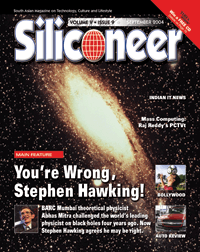
Stephen Hawking is a celebrated titan in theoretical physics and one of the few scientists whose popularity extends beyond the esoteric field of astronomy and quantum physics. In 1975, he gave broad shape to the theory of “black holes,” those mysterious bodies in space that result from the gravitational collapse of massive stars and, according to his theory, destroy everything that falls into them, preventing even light or information to escape. That was the theory. But even brilliant scientists can make mistakes, and Mumbai-based theoretical physicist Abhas Mitra took on the international celebrity, questioning the existence of black holes in a paper four years ago. The result was brutal: his colleagues deserted him, and his employing institution transferred him. But Mitra persevered, and recently Hawking himself has admitted a flaw in his theory of black holes. Our cover story offers details on this fascinating story about cutting-edge theoretical physics. MAIN FEATURE  You're Wrong, Stephen Hawking! You're Wrong, Stephen Hawking!The Triumph of Abhas Mitra Deepak Goyal World-famous Cambridge University astrophysicist Stephen Hawking is used to having the last word in his field. For over 30 years Hawking and his followers promoted the theory that black holes — resulting from gravitational collapse of massive stars — destroy everything that falls into them preventing even light or information to escape. Four years ago, BARC physicist Abhas Mitra dared to question Hawking in a paper, and became a pariah. Now Hawking says his theory was flawed, and Mitra is vindicated. Deepak Goyal reports. Stephen Hawking, the world-famous Cambridge University astrophysicist who wrote the bestselling “A Brief History of Time,” is used to having the last word in his field. For over 30 years, Hawking, regarded by many as the modern-day Einstein, has promoted the theory, backed by his countless followers, that black holes—resulting from gravitational collapse of massive stars—destroy everything that falls into them preventing even light or information to escape. Now Hawking is revising his 1975 ideas that are regarded as the most astonishing breakthrough in black hole studies. At a packed lecture hall at the 17th International Conference on General Relativity and Gravitation in Dublin recently, he presented his new views in a presentation entitled “The Information Paradox for Black Holes.”
He now believes that black holes may allow information to get out. His new research could even help solve the “black hole information paradox,” a crucial puzzle for modern physics. The intriguing thing about all this is that an Indian scientist said his theory was flawed four years ago, but nobody listened. Abhas Mitra, a physicist with the Bhabha Atomic Research Centre in Mumbai, could well be the only scientist who had the guts to openly challenge Hawking on this. Four years ago, in a paper in the journal Foundations of Physics Letters, Mitra showed that Hawking’s theory was flawed. He proved black holes couldn’t exist because their formation and existence flouted Einstein’s general theory of relativity. Pretty much the overwhelming majority of mainstream scientists dismissed Mitra’s conclusions. Mitra invited several notable black hole theorists including Hawking and Jayant Narlikar of India to criticize his work but no one replied. The only Indian who praised Mitra’s work was relativist Pankaj Joshi of the Tata Institute of Fundamental Research in Mumbai. Too “embarrassed” to be associated with a man who challenged Hawking, even Mitra’s close colleagues avoided him. BARC authorities removed Mitra from the theoretical physics division on a flimsy pretext. This is not the first time an Indian scientist has been pooh-poohed, only to be proved right years later. In the 1930s when Subramanian Chandrasekhar’s work on the upper mass limit of white dwarfs was considered incorrect by celebrated astrophysicists like Sir Arthur Eddington even though no one could precisely point out any error in Chandra’s work. “The ironic element in this whole exercise,” Mitra told PTI, “is that the person who actually dared to show that there cannot be any black holes was completely ignored both by the academicians and the media.” Yet Hawking’s own admission two weeks ago in Dublin is that there isn’t a black hole “in the absolute sense.” In essence, Hawking’s “new” black holes never quite become the kind that gobble up everything. Instead, they keep emitting radiation for a long time—exactly what Mitra showed in his paper. A black hole is characterized by an imaginary boundary called the “event horizon” that shuts everything within. But in 1976 Hawking introduced quantum mechanics into the problem and claimed that black holes do radiate energy—although at a low rate—and ultimately vanish into nothingness. The vanishing act, however, destroys all the trapped information as well—directly conflicting with the laws of quantum physics that say that information can never be completely wiped out. This is the “information loss paradox” associated with black holes that, in a way, was created by Hawking’s own work. One logical resolution of this paradox would have been to realize that black holes did not exist. But Mitra says that such sweeping, yet logical thinking “was never undertaken by either party involved in this prolonged debate and they kept on debating effectively to make the paradox more popular and perpetuating.” It was then that Mitra published his seminal paper showing that gravitational collapse of massive star can at best produce an “eternally collapsing object” but not an “event horizon” or a black hole in the strict sense. “Since no event horizon is formed, there is no paradox at all in the first place,” Mitra argued. Mitra’s work inspired American physicists Stanley Robertson and Darryl Leiter who confirmed in 2002 that Black Hole Candidates suggested earlier by Mitra have intense magnetic fields as predicted by Mitra and therefore are not real black holes, which cannot have magnetic fields. His own colleagues sidelined Mitra after his first paper, but several physicists around the world supported him. Italian relativist Salvatore Antocia, a noted relativist, wrote: “Let me express to you my great joy in seeing your much-disputed paper eventually accepted for publication by Foundations of Physics Letters. Convincing the community of relativists about the mythical nature of black holes will remain a tremendous task, but it is a little less desperate, thanks to your success.” British physicist Peder Norberg and U.S. relativist Stanley Robertson backed him as well. Robertson wrote: “On first becoming acquainted with your work, I was dubious, thinking it unlikely that something as profound as belief in the existence of black holes could become erroneously established in the literature. In the meanwhile, I have found no errors in your work. It is fascinating.” - Deepak Goyal is a freelance writer. He lives in Kolkata, India. |TOP|
INFOTECH INDIA  Not My Job! ... 2,000th iWay Cyber Café ... Fairfax County Beckons ... TCS Shares Are Hot ... Supercomputer Kalpana ... AIDS Drugs Withdrawn ... Teletracking at Bus Terminal ... Optical Solutions for Huawei ... New IT destinations ... Menlo Eyes India ... Flexitronics Acquires Future Software — Here is the latest on information technology from India Not My Job! While 85 percent of U.S. workers believe offshoring has a negative impact on the American economy, less than 10 percent of workers are strongly concerned that their own jobs are in danger of being sent overseas, according to a new survey. Workers in non-supervisory professional and technical roles are more likely than those in either management or hourly and clerical positions to feel strongly that their jobs may be at risk, according to the survey by Watson Wyatt, a leading human capital consulting firm. “Although American workers, in general, are very concerned about the impact of offshoring on the economy, they apparently have little concern offshoring will affect them personally,” said Bruce Pfau, national practice director for organization effectiveness at Watson Wyatt. “Nevertheless, the degree of this confidence seems to vary somewhat by employee job role.” The recent WorkUSA Pulse survey, the second in an ongoing series, reveals that only eight percent of all respondents are strongly concerned that their own job is at risk, while 22 percent are concerned to some or a small extent and 69 percent are not at all concerned. The 2,000th iWay cyber cafe was inaugurated on the 60th birth anniversary of the late Prime Minister Rajiv Gandhi, by union Minister for Information and Broadcasting Jaipal Reddy at the capital city, a company release said. While Sify owns 34 iWays out of the total 2,000, the remaining 1,966 are owned and managed by franchisees. The 2,000 iWays are spread in 64 locations across the country. Sify iWays provide a variety of services that include broadband Internet access, net telephony to over 150 countries and video conferencing, the release said. The county, situated in the Greater Washington area, has similar offices in Tel Aviv, London, Tokyo and Frankfurt. Nine Indian companies are already operating in Fairfax, says the county’s Economic Development Authority. The companies include Guru Infotech, HCL Technologies America, Indotronix, Indus and Megasoft. “More and more Indian firms are expressing interest in opening a U.S. office, and we want to be in place to assist in their location decisions,” said Gerald L. Gordon, president of the authority. Fairfax promotes its proximity to Washington and Dulles International Airport and its booming high-tech industries. Of the 4,400 information technology companies in the United States, 245 are foreign-owned, the county says. The scrip of the country’s largest IT company generally traded Aug. 25 at prices in excess of Rs. 1,000 per share. The first trade on BSE was struck at Rs. 1,076 for 50 shares while on the NSE TCS stock opened at Rs. 1,198.70, which was also the day’s highest, according to data available with the exchanges. The total number of shares traded on BSE stood at 6.536 million for a turnover value of Rs. 6.56 billion while on NSE the volume of traded shares was more than double at 17.1 million shares valued at Rs. 17.26 billion. The scrip touched a high of Rs. 1,080 on the BSE while it hit a low of Rs. 979. In the case of NSE, it peaked to Rs. 1,198.70 and fell to a low of Rs. 979. Analysts said the difference of Rs. 200 between the listing and the issue price on NSE was one of the largest ever in recent times. Tata Group chairman Ratan Tata and managing director S. Ramadorai were present at NSE when the scrip made its debut at the electronic exchange. Incidentally, the software at NSE has been developed and implemented by TCS. DSP Merrill Lynch chairman Hemendra Kothari said the listing propels TCS to become the third largest company by market cap in the country. Naming the new supercomputer “Kalpana” follows a long tradition at NASA’s Ames Research Centre of calling its new supercomputers after pioneers in the supercomputer industry or individuals who have significantly contributed to research at the aircraft research laboratory. “It is indeed an honor to name NASA’s new SGI Altix 3000 supercomputer after Kalpana Chawla,” said Ames Centre director G. Scott Hubbard. “She was not only a member of the NASA family, but also a special member of our own Ames family. We all miss her and her many contributions to the agency.” At Ames, Chawla had the challenging task of computing the airflow surrounding a jet-supported, delta-wing aircraft during landing. During an interview in 1995, Chawla predicted that her exposure to a wide variety of computer systems at Ames would be especially useful to her as an astronaut. Of the dozens of experiments successfully conducted by the Columbia crew, Chawla’s favorite was the Israeli Mediterranean dust experiment, which involved pointing a camera at earth to study the effects of dust on weather and the environment. This follows a similar action by WHO last May on two AIDS drugs manufactured by Cipla. A WHO press release issued in Geneva said that the three antiretrovirals will be removed from the list until such time as Ranbaxy can submit data of new studies providing unequivocal evidence of the products bioequivalence with the originator medicines. WHO said it “is committed to ensuring that the medicines it prequalifies for procurement in developing countries are of the highest standard.” The antiretrovirals in question are the triple fixed-dose combination pill containing lamivudine, stavudine and nevirapine in two different strengths and a lamivudine plus zidovudine tablet. While the three Ranbaxy products meet quality specifications, proof of bioequivalence is missing in view of non-compliance with good clinical and laboratory practices as well as data handling requirements found in the contracted laboratory, WHO said. This effectively means that the medicines may or may not offer the same therapeutic benefits as the originals on which they are based. Ranbaxy has undertaken to resubmit the products in question to a different laboratory for proof of bioequivalence. The project is funded by the union Ministry of Heavy Industries and will be implemented in a year’s time, P. Srinivasa Raghavan of Harita Infoserve told reporters here. He said an investment of Rs. 30 million has been estimated for the project. “The project, once implemented, will help in tracking the buses coming in and out of the terminal,” Raghavan said. There are about 100 buses plying from the Koyambedu bus terminal to various parts of the state. “The teletracking facility will indicate to passengers in advance the arrival of vehicles to the terminal. This will also help in scheduling the buses at the bus terminal,” he said. IBM, which had taken a lead in setting up a similar project in Korea, is expected to assist Harita Infoserve in its Chennai initiative. The Bangalore R&D centre, employing 700 high end software professionals, has built the core platform for the intelligent network and the next generation telecom switches for the Chinese firm’s global customers. “Our Indian professionals are working on the next generation products in 3G mobile and optical network and their software becomes the core platform,” Huawei Technologies India chief operating officer James Yuan told PTI here. Huawei, which has invested $80 million since setting up its India R&D centre in 1999 here, home to telecom professionals, last year said it would spend an additional $100 million by 2006. The firm is finalizing plans to build a new campus over 40 acres of land to house 2,000 professionals, he said. “We have become aggressive on campus hiring and are looking at freshers who can be trained in the telecom domain,” James said, adding, the firm intends to ramp up its workforce to 2,000 by 2006. “We are planning to showcase the secondary cities in the state as IT destinations,” Karnataka IT, Biotechnology and Science and Technology secretary M.K. Shankaralinge Gowda told PTI in Bangalore. The state’s capital Bangalore is already a major IT hub and widely regarded as India’s Silicon Valley. Hubli and Belgaum are other cities that would be promoted, he said, adding, the state would also seek increased investment by foreign companies in IT firms in these localities. At present, Karnataka employs around 2,10000 staff in various segment including BPO, IT and ITeS segments, while Infosys Technologies Ltd alone had earlier announced a recruitment of over 5,000 this year. The company has identified India as one of the key markets along with China, Mexico and England, and will grow its human resource base from the current 200 to meet demands from the fast expanding business, Menlo (UK, West South Asia) managing director Stuart Richardson told reporters in Mumbai Aug. 26. The company will open four new offices in the Indian cities, Jaipur, Agra, Pune and Chandigarh, taking its sales and operations offices to 13, he said. The firm, which operates in India through its wholly-owned subsidiary Menlo Worldwide Forwarding India Pvt Ltd, will pump additional capital in new projects, he added. On using India as an outsourcing base for the company’s global operations, he said Menlo is in the process of moving a part of its accounting section from U.K. to India by next month. “We would like to leverage cost-competitive and high quality talent in India. However, any expansion in back office operations will be done after giving due considerations to the labor market conditions in England,” he added. According to the deal, Flexitronics will buy the entire shares of Future Software and make the latter its fully-owned subsidiary, K.V. Ramani, chairman and managing director of Future Software, told reporters. “The management and all the 600 employees of Future Software will now be part of Flexitronics,” Ramani said. Flexitronics, he said, would buy the 55 percent stake held by Ramani. The stakes held by Intel (13 percent), IL&FS (13 percent) and the employees (12 percent) will also be bought by Flexitronics. The remaining stake held by former employees would also be bought by Flexitronics. He, however, refused to divulge the size of the deal. “The amount involved will be announced only after Flexitronics get the final approval from the Foreign Investment Promotion Board and the RBI,” Ramani said. He said the acquisition was part of Flexitronics’ larger plan to make India its base for embedded software space. Future Software, which has offices in Chennai, the U.S. and Europe, had revenues of $25 million in the year ended March 2004. Recently, Flexitronics bought 55 percent stake in telecom software firm Hughes Software Systems. It also made $10 million investment in Silica, a semiconductor design firm based in Bangalore.
SOCIETY
 The Trouble with English: India's Love-hate Ties - By Siddharth Srivastava English is still a political hot potato in India, despite the fact that the language has changed India, and Indians are now changing the language, writes Siddharth Srivastava. Although a sizeable population speaks English in India , the language is not just a medium of communication. Its peculiar socio-political context makes it a potent political tool and few demagogues or politicians are averse to exploiting the language issue. The language itself is claiming millions of adherents because savvy folks have taken note of the fact that the success of Indian information technology, business process and outsourcing industry is pegged to knowledge of English. This is hardly a uniquely Indian phenomenon — around the world, the Chinese and even the Germans are starting off their kids with an English curriculum. However, the fact is the language is a divide between India’s haves and have-nots, as there is a connection between economic progress and English speaking. So English is a useful political tool to curry favor with the vast masses who, ironically, do not even have access to basic education in the local language. Take the case of K.S. Sudershan, the chief of the Rashtriya Swayamsewak Sangh, the right-wing ideological arm of the sangh parivar that also comprises the opposition Bharatiya Janata Party. He recently said that English education exposes children to — I kid you not — lesbianism and free sex. Sudershan’s rant against the “alien tongue” included assertions that English simply cannot rival the rich vocabulary and emotional texture of India’s regional languages that should be used to the research level. To those more clued into the Indian political scene, Sudershan’s attack was aimed more against the Christian missionaries who work with the poor and impart the English language, as the sangh parivar is wedded to Hindutva, a philosophy that promotes majority Hindu rule. Socialists, who include prominent regional political chieftains such as Mulayam Singh Yadav (Uttar Pradesh) and Lalu Prasad Yadav (Bihar), publicly espouse an anti-English stance to appeal to parochial and regional sentiments. Hindi-medium schools are encouraged in the two states, while the children of both the leaders have studied in expensive English private schools and abroad. The likes of Lalu, Mulayam and Sudarshan realize that given the state of mass poverty with little or no hope of social mobility, it is appeals based on religion, caste and language that coalesce a vote base. Lalu once famously said that computers are anti-poor, (one of his sons-in-law works for Infosys, India’s software giant). The professed love for the vernacular of the elite sometimes can draw an unexpected backlash. Commentator Dileep Padgaonkar wrote in a recent article: “At a public meeting a famous Marathi poet held forth on the scant interest that Maharashtrian youth took in their language. He cited the example of his granddaughter. She lived and studied in America. Over the years she had forgotten her Marathi. Cut off from her roots, the poet said, she was an Indian only in name. “Echoing Martin Luther King, the poet then turned lyrical: ‘I have a dream. I’m walking through the forest adjoining my native village. Suddenly I hear a haunting melody. I approach a clearing where I find a young girl tending half a dozen goats. It was her voice that I had heard. And she was singing one of my very own poems. At that instant I knew that if Marathi survives at all it will be thanks to people like that shepherdess. “The audience was moved to tears. Just then a man seated at the far end of the hall asked for the floor. This is what he had to say to the poet: ‘I belong to the shepherd community. I would want my daughter to live in a comfortable house in America and study to become a doctor. I would not mind if she forgets her Marathi. Let your grand-daughter live in a hut in my village, tend goats all day and sing your poems to her heart’s content. Is that a deal?’ The audience sat dumbfounded while the poet wore a sheepish look.” Meanwhile, Indianisms go beyond politics as the language undergoes more and more inclusive twists and turns due to the large number of Indian English-speaking users. Indians have added their share of Indianisms that further enrich today’s global lingua franca. The newest edition of the 93-year-old Concise Oxford Dictionary — considered the world’s favorite word repository — has turned eclectic, incorporating several Indianisms like adda (local joint), langar (community eatery) and dicky (car storage space) which are now part of the Queen’s English, however clueless Her Majesty may be about the newest entrants to her language. Catherine Soanes, co-editor of the dictionary, says that the dictionary is simply doing its job in telling people the meanings of words they hear every day on the streets of cities anywhere in the world. “Language change is happening very fast, and we are very selective, I can assure you,” said Soanes, “But the Indianisms were a simple need. The 50 more new Indian entries in this 11th edition of the COD merely reflect the wider influence and growing prominence of Indian English in the world. Like Australian English, with its easy, sundowner spirit of ‘barbies’ (or barbecues) and other TV soap opera staples, Indian English is literally infecting the way the world speaks.” As the COD carefully explains, it’s all about giving free rein to the living language so long as it is correctly spelt. It is on the Internet that one finds the true free-spirited expressions. India’s Silicon Valley, Bangalore, has become the second modern city in the world to be turned into a verb after “Shanghaied” — “Bangalored” broadly means being moved forcibly, thanks to outsourcing, as in: “I am a software developer who is about to be Bangalored. Fine. I am not going to pout about it.” This is what a participant in the online forum Technewsworld has written. Although there have been other geographical places that have been turned into words (called toponyms for example, Frankfurter, Balkanization, Finlandized), few cities have taken a verb form. Meanwhile Americans, as is their wont, can turn every controversy into a few extra bucks. An online anti-outsourcing Web site is marketing a T-shirt sporting “Don’t Get Bangalored,” suggesting the loss of one’s job to outsourcing. The T-shirts, available in two designs, are priced at $15.99. A Web site of American infotech professionals sells an even pricier T-shirt ($19.99) that reads, “My Job Went To India And All I Got Was A Stupid T-Shirt.” - Siddharth Srivastava is a journalist. He lives in New Delhi. |TOP| HEALTH  Web Surfer Beware: Web Surfer Beware:Gauging Health Advice By Kate Christensen, MD. The Internet is a marvelous tool for information on health, but blind faith is risky, writes Kate Christensen, M.D. As a physician, I’m pleased when patients become active participants in their own health matters, but I’m increasingly concerned about the abundance of questionable health information online. When consulting the Internet, all health information seekers need to be skeptical and carefully scrutinize health-related Web sites. While many sites appear and “feel” legitimate, this is clearly a case of “Web surfers beware.” Only about one-quarter of “health seekers” thoroughly check the source and timeliness of health information they find on the Web. Half of all health seekers check health Web sites’ credibility “only sometimes,” “hardly ever,” or “never.” Here are a few suggestions: Consider the source. Who is providing the information? Who is the author of the Web site health information? Does the author have medical training? Is this a credible source that provides information you can rely on? Health information providers who take their role seriously should furnish you with this information. Look for the URAC seal — this independent association only accredits health Web sites that meet its rigorous standards, including the criteria just mentioned. Consider the purpose. What is the Web site trying to do? Who developed the Web site and why? Who sponsors the Web site? Is the organization in question trying to sell you something? Or is their purpose to inform and educate? Is the health information surrounded by ads? What motive would they have for providing access to this particular information? Consider the date. Is the information current? Current information is especially important when addressing health topics. Web sites offering medical advice and information should provide you with publication dates of all health information and any relevant medical and/or pharmaceutical studies. If the information is more than a few years old, it may be out of date. In some cases, just a few months can make a big difference. Get a second, third or fourth opinion. Give yourself a chance to compare notes by visiting several Web sites offering related information. Use the same selection criteria mentioned above to make sure you’re comparing information between credible health information providers. Mix it up — look at informational Web sites, your medical provider’s site (if available) and Web sites from relevant associations, non-profit organizations like the American Heart Association and national health agencies, like healthfinder.gov.
Wise health consumers should see the Internet for what it is: a great source of information that can help people become more knowledgeable participants in managing their health. It is a resource, not the resource. - Dr. Kate Christensen, M.D., is medical director of |TOP| INNOVATION 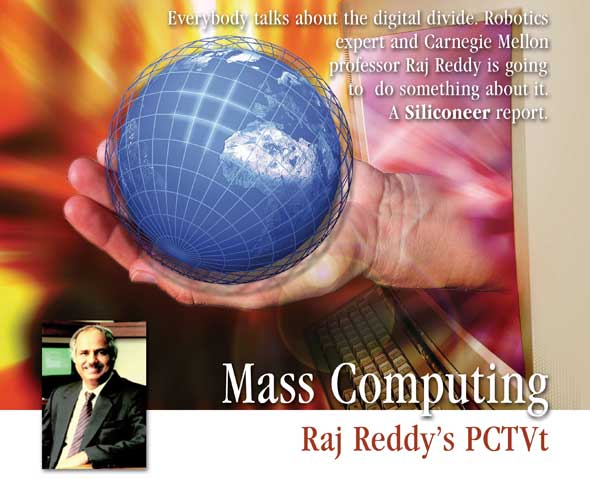 Mass Computing: Mass Computing:Raj Reddy's PCTVt A Siliconeer Report Everybody talks about the digital divide. Robotics expert and Carnegie Mellon professor Raj Reddy is going to do something about it. A Siliconeer report. The digital divide is something we talk about, but what actually is being done about it? The actual accomplishments of trying to bring the fruits of information technology to the masses is quite negligible compared to the pious protestations and hot air the debate has generated. Some interesting pioneering work has indeed been done: farmers emailing in Tamil Nadu or distance education elsewhere in India are fledgling, noble efforts, but this hardly begins to scratch the surface of the problem. The fact is that the problem is really, really daunting. The millions of impoverished masses in developing countries (and substantial number of poor in inner cities of Western developed countries, if truth be told) remain culturally, economically far removed from the affluent world of hi-tech gadgetry: They simply do not have the basic skills necessary to be comfortable with IT technology. Yet there is absolutely no hope of even the ghost of an equitable society in the future unless this divide is bridged in some way. Enter an internationally acclaimed pioneering researcher in artificial intelligence with a $250 gizmo that does a whole bunch of things: It’s a computer, it’s a TV, it’s a DVD player, it’s a videophone—it’s a PCTVt. ‘‘I kept asking myself, ‘What would the device have to do for someone on the other side of the digital divide, to be desirable?’ ’’ wondered Raj Reddy, a professor at Carnegie Mellon University. The answer, he decided, was a simple device that would offer entertainment. This November, Reddy hopes to begin installing the first 100 prototypes of the PCTVt in India and possibly several other countries. Reddy is hoping his project — with backing from Microsoft and TriGem, the Korean computer maker, and in partnership with the Indian Institute of Science, the Indian Institute of Information Technology and researchers at the University of California, Berkeley — can prove that it is possible to bring IT to impoverished communities without depending on philanthropy. Because his low-cost computer doubles as a TV and a DVD player, Reddy believes that he will be able to use it as a vehicle to take computing to populations that until now have been excluded. N. Balakrishnan, a professor with the Supercomputer Education and Research Center, IISc, says, “In India, entertainment is a key driver. Because of this, the number of TVs is more than the number of phones. For progress to happen on the connectivity front, the number of Internet connections should equal the number of TVs and telephones. One cannot expect the number of users to go up unless the cost of PCs come down.” ‘‘We needed three decades,’’ Reddy said, for those technologies to help developing nations. Reddy’s team is also working with social scientists to determine the effect that access to this technology has on communities. ETHNIC ISSUES  Mr. Wong's Dilemma Healthcare and Language - By Dr. Alice Chen For some immigrants a visit to the hospital can be complicated by poor language skills. Ask for an interpreter, advises Dr. Alice Chen. Mr. Wong went to the Emergency Room because he had been throwing up for about three hours. By the time he got to the hospital, he was exhausted and had lost his voice. The doctors gave him some medication to stop the nausea, as well as fluids through an IV. They also did lab tests and X-rays, which showed that he was a little dehydrated, but found nothing serious. By the end of his evaluation, he felt fine. But that wasn’t the end of his ordeal. Somehow the doctors had gotten the impression he had been throwing up for five days. Because he speaks very little English, and they didn’t speak Chinese, they didn’t feel safe sending him home, and admitted him to the hospital. By the time I saw Mr. Wong almost eight hours later, he had napped, eaten, and was bored. He wanted to go home. Since it was already late in the evening, I told him he should stay overnight and if everything was still fine he could go home in the morning. The next morning, Mr. Wong went home, with a hospital bill of more than $2,000. If the doctors in the Emergency Room had been able to communicate with Mr. Wong, they would have been able to take a more accurate history. They would have discovered that he was feeling back to normal and that he had a regular doctor who he could see for follow-up the next day instead of spending the night in the hospital. All in all, Mr. Wong was lucky. When doctors and patients can’t communicate, particularly in the Emergency Department, patients can experience unnecessary pain, suffering, misdiagnoses and disability. Two years ago, the Bay Area group Mujeres Unidas interviewed more than 100 Latino immigrants who used Alameda County Medical Center’s clinics and hospitals. They found that almost 50 percent of people had to wait more than two hours for an interpreter, with some waiting more than eight hours. They also found that a professional interpreter was used less than 50 percent of the time, although some of the bilingual staff were able to provide good quality interpreting. One of the Spanish-speaking patients Mujeres Unidas interviewed described her experience in the emergency department when she broke her leg: “They did some tests on me, but the main problem was that there were no interpreters available. I hadn’t eaten since the night before and I told them I was hungry, but they just said ‘No Spanish. Wait a minute please.’ They gave me just one pill all day long for the pain in my leg. I finally left at 9:30 [15 hours after her arrival at the hospital] with my leg swollen and in a lot of physical pain.” As bad as that sounds, Alameda County Medical Center is known for having one of the best hospital interpreter services in the state. It turns out that most hospitals don’t have any professional interpreters at all. Patients who speak limited English are often between a rock and a hard place, having to decide between going to a hospital where they have a chance of getting a professional interpreter after a long wait, or going to a hospital where it’s likely they won’t be able to communicate with the doctor at all.
Next time you go to the hospital, if you need an interpreter, ask for one. If you don’t get one on that visit, don’t give up. Make a suggestion, fill out a satisfaction survey, file a complaint, or, like Mujeres Unidas, work with other members of your community to make sure your voice is heard. After all, it’s your health. - Dr. Alice Chen is Soros advocacy physician fellow with the |TOP| REPORT:
Sizzling Political Mix A Siliconeer Report The Indian American and Chinese American communities are getting together in California’s Central Valley to project a unified voice in politics. A Siliconeer report. Add Desi masala to Chinese noodles and what do you have? Desi Chinese. A hot delectable combo that most South Asians would find hard to resist. Maybe Desi Chinese could add the same zing to American politics? Folks in California’s Central Valley certainly think so. The Chinese American and Indian American community is joining hands to host a free public event in Sacramento Oct. 3 to educate Asian and Pacific Islander voters. The event is the Third Annual API Voters and Candidate Education Forum. (Details at the end of article.) Central Valley entrepreneur C.C. Yin, founder of the Asian Pacific Islander American Public Affairs Association, told Siliconeer that for the first time in U.S. history, Asian immigrants from different countries such as China and India will speak in a united voice when they choose their representatives to protect the interest of the minorities at the U.S. Senate.
Yin says Asians as a minority have the fastest growth and will eventually play a decisive role when it comes to leadership. They will become a strong force that no political candidate can ignore, he said. “There was a time when we were ignorant,” he added. “We would look at politicians for our personal interests. The community leaders did fundraisers for political candidates who were either Democrats or Republicans, irrespective of whether these candidates would really do any good to serve the general interest of the immigrant community as a whole. They would merely do so for personal gain or to build ties with potential leaders.” That is about to change. Now Asian Americans want a candidate who understands the community’s concerns and will help provide solutions to. “We want to educate our community so they can make a well-informed decision when it comes to choosing their leader,” he said. APAPA and IVACC have joined hands to educate their respective communities about their rights as immigrants, minorities and U.S. citizens who can make a big difference and set a precedent for the upcoming generations who are mostly U.S. citizens and potential future voters. “We cannot have a big say just as Chinese or Indian, but as a united Asian voice, we cannot be ignored,” says Yin. “There are key issues that need to be addressed. For example, after September 11, the hate crime issues pose a serious threat to most immigrants from the South Asian region. Innocent people have been targeted based on their appearance, skin color and accent. Immigrants are facing uncertainty and the economy is not helping us achieve the growth that we look for when we moved to this land of opportunities. We want to educate our people so they select the right leaders who will look into our concerns as they would for any other minority group or the mainstream.” APAPA serves as a resource pool and support network for Asian Pacific Islander Americans, individuals and groups in the greater Sacramento region. Sanwal and Sukhchain Singh say that Indian Americans have the same concerns and need a similar forum to voice their opinions. “We strongly believe in APAPA’s mission and have decided to provide our support to APAPA’s cause,” Sukhchain adds. “Immigrants have a lot in common, whether Chinese or Indian, our concerns are the same. We want leaders who can address to issues such as hate crime, civil rights, immigration, education, healthcare and economy. It calls for a concerted effort to make a big impact and that can be achieved only if we unite as Asians, and voice our concerns in a concerted fashion.” APAPA and IVACC will host a voter awareness event on Oct. 3 in Sacramento’s California State University. The event will feature candidates as speakers from federal, state and local levels, who will address API voters. Community leaders, business leaders and elected officials will attend the event as well. According to Vipul Vaid of IVACC, organizers are developing a novel way of educating present and future voters to make well-informed decisions. A ballot is being designed with topics such as homeland security, hate crime, civil rights, immigration laws, education, healthcare, economy, social status, etc. The visitors will be handed these ballots and will be asked to check those issues that affect them most. These ballots will then be entered into a database that will sort it to provide valuable statistics for voters as well as candidates.
The candidates in turn will learn about the major issues that the emerging immigrant community wants them to deal with. “These ballots will be in English but considering the language factor, we will have interpreters, should anyone require counseling,” Vaid said. “IVACC and APAPA welcome any organization that feels the same way as we do. We request them to attend our Oct. 3 event and see what we are doing. If they like what we are doing, we urge them to join us in our efforts,” says Sanwal. “While this is a daunting task, it is not impossible. Join us today so we can have a better tomorrow for the upcoming generation.” BIOTECH  Ocimum's Offer: Free Bioinformatics - A Siliconeer Report Indianapolis-based Ocimum Biosolutions has announced free Bioinformatics services focused towards biomedical research in the field of genomics. The offer is limited and good for one month. A Siliconeer report. Life sciences contract R&D company Ocimum Biosolutions is offering free bioinformatics services for a month to help researchers conduct microarray analysis and gene optimization. “In an increasingly competitive biotech industry, the time taken for R&D is minimized by concentrating on core activities of the lab. With burgeoning of data, almost every lab has to rely on bioinformatics that includes the science of storing, retrieving and analyzing large amounts of biological information,” Ocimum CEO Anuradha Acharya said in a company press release. “Most of the labs either do not have resources, expertise or sophisticated tools to do the requisite research. To address these issues we decided to provide bioinformatics services to researchers.” The service will be available free for a month and limited to 10 samples for microarray analysis and two sequences for gene optimization that can be submitted online from the company’s Web site. Microarray experiments generate a large amount of data which is difficult for a standalone computer to handle. Also, the intricacies in data analysis leave the user undecided on how to find a correct solution. Ocimum’s well trained professionals use high-end servers to work with large microarray data in a fast and efficient manner. Ocimum provides standard analysis as well as customized analysis of clients’ microarray data. Standard analysis include data normalization, data filtration, handling missing values, handling replicates, clustering and generating comprehensive reports. Ocimum Biosolutions is an ISO 9001:2000 certified life sciences contract R&D company that provides cost-effective customized contract research services and next generation bioinformatics tools and services in the area of genomics, proteomics and laboratory information management. Interested readers can find more information on Ocimum Biosolutions at www.ocimumbio.com
IT TRAINING: 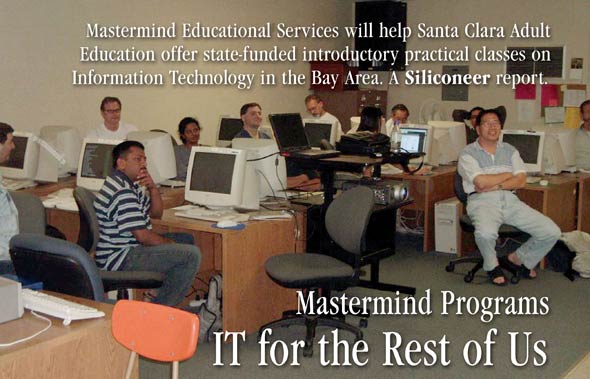 Mastermind Programs IT for the Rest of Us - A Siliconeer Report Mastermind Educational Services will help Santa Clara Adult Education offer state-funded introductory practical classes on Information Technology in the Bay Area. A Siliconeer report. These days, even a five-year-old can send an email, but what about those of us who got left out in the digital age? Computer skills have become such an ubiquitous feature of today’s age that mastering the basic skills of a computer have become almost a survival skill, and in the job market, fairly sophisticated computer skills are a virtual necessity. Deepak Vyas’s Mastermind Educational Services has stepped in to help out those who missed the digital bus. A leading training services provider of Unix and Network Security trainings, the company announced that it has been awarded a renewal contract from Santa Clara Adult Education, for its ongoing trainings for the popular state-funded “Introduction to Practical Information Technology program.” “Jobs available in various fields do require an important IT element to them, even if job profile is that of an office assistant, or a sales person,” said Mastermind CEO Deepak Vyas. “The importance of being comfortable and self-reliant with the computer, operating system and applications, is essential in the job market today, and this program is a great start for many novice users out there who own or use a computer, but do not have the requisite skills to understand and maintain it.” The wide assortment of practical topics like spyware and virus protection, downloading software drivers, transferring pictures from your digital camera to your computer, burning CD’s, opening PDF files, networking basics, setting up a wireless DSL connection etc, addresses many topics that most users would like to learn. “With the above content, Mastermind and SCAE feel that this knowledge would help many unemployed obtain jobs by enhancing their IT skills, and have been advertising this program at the Campbell One-Stop EDD,” said a press release from Mastermind. “We started 3 classes in summer at a short notice, and expected a turnout of about 60 candidates, but got a turnout of a staggering 100+ registrations and we expect a strong word-of-mouth this Fall,” adds Sean Weinstock, program manager at Mastermind. Fuelled by this response, SCAE and Mastermind have planned another free Advanced IT Program, which will help the candidates who attended the introductory program; pursue their IT careers if they have flair for the IT field. SCAE and Mastermind have also planned a Bi-Lingual Introduction to IT program in Spanish and English. Deepak Vyas adds: “The Hispanic Community has great potential, but does not have any good formal education in IT, and this program will encourage them to pursue their IT skills by communicating the course in Spanish and English.” Future bilingual courses in Chinese, Hindi, Russian, and other native languages are also in the pipeline for our immigrants from various countries. Interested readers can find more information on course contents by visiting either of these two Web sites: www.scae.org or www.mastermind.bz/training.htm
In the waning days of summer, here are a few tips to make smart savings on your energy bill. A Siliconeer report.
On hot summer days, keeping cool is at top of the “To Do” list but you can waste a lot of energy and money trying. Small retail stores and offices typically spend $800 to $1,000 a month on electricity, and cooling and heating costs can be 16 to 45 percent of your electricity use. So before you turn up the air conditioner, try these tips for staying cool:
Do you have a favorite way of staying cool? Send your ideas to Flex Your Power at cbrown@fypower.org or 2183 Union Street, San Francisco, CA 94123. |TOP| This Sept. 10, on behalf of our Bangla magazine Porshi, it is my pleasure to invite you all to an evening of Bangla music. The event will be at Ohlone College in Fremont, Calif. (Details at our Web site at www.porshi.com) We shall be presenting Bangladeshi singer Baby Nazneen, who has a formidable following back in Bangladesh and beyond. Baby Nazneen began her musical career as an exponent of one of the riches genres of Bangla music, its folk songs. Her talent caught the eye of erstwhile President Ziaur Rahman, and his patronage gave her the confidence to move to Bangladesh’s capital Dhaka and pursue her singing career with determination. Her striking voice and her particularly lively stage delivery has since made her one of Bangladesh’s most popular performers for live cultural events. We at Porshi—the word means “neighbor” in Bangla—have been bringing out a monthly Bangla publication for several years now. Most of us have day jobs—generally as Silicon Valley professionals. Porshi is more a labor of love than a business venture, though our goal is to make it self-sustaining as well as a vehicle for cultural and literary communication. Our target readership is the Bangla speaking population around the world with initial focus in North America. Both the content and format follow the style of a magazine. The objective of Porshi is to create a bridge amongst the Bangla speaking communities spread around the world utilizing the common bond of Bangla language and culture. By publishing articles from writers in North America, Bangladesh and the rest of the world on issues touching the socio-cultural lives of Bangla speaking population, we hope to bring people spread all over the world closer. Do take a moment to visit our Web site at www.porshi.com. Even better, if you love Bangla, why not become a subscriber? Interested readers can find more information about the event at the Porshi Web site at www.porshi.com or call Sabir at (510) 673-5606 - Sabir Majumder, a Silicon Valley professional, is one of the founding editors |TOP| CONCERT: 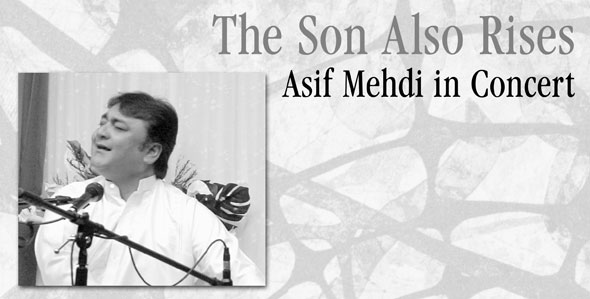 The Son Also Rises: The Son Also Rises:Asif Mehdi in Concert By Ras H. Siddiqui If Pakistan’s Mehdi Hasan is the shahenshah of ghazal, his talented son Asif Mehdi is definitely a shahzada, writes Ras. H. Siddiqui. The Aug. 7 event was billed as a “Pakistan Night” at the Chandni Restaurant in Newark, Calif. But it also turned out to be very South Asian when 300 Pakistani and Indian aficionados of Urdu, the art form called the ghazal and its ailing shahenshah Mehdi Hasan, gathered together for dinner and an opportunity to take a trip down memory lane, courtesy his son Asif Mehdi. And an enchanting evening it certainly turned out to be. Accompanying Asif’s vocals were his younger brother Imran Hasan on tabla and local musician Sanjay Sen. This show was sponsored by Nazir Khan of San Francisco’s Darbar Restaurant, so our best to him for making this effort in promoting Asif Mehdi’s career. He was assisted by Raana Faiz of the San Francisco based Hamrahi radio program and Chandni Restaurant. Asif Mehdi Hasan may look a bit like his father, but it is his similarity with the maestro singer’s voice that is more striking. One could certainly feel the pain or ranjish in his father’s signature song which opened the performance here, one that would have made its author, poet Ahmad Faraz, proud. Ranjish hi Sahi took almost half an hour for Asif Mehdi to sing. Asif continued his singing with the thought that we all love someone in our lives. So Zindagi mein to sabhi pyaar kiya kartay hain was appreciated somewhat more than his newer Yeh mashghala hai kisi ka which was good in its own right.
Faiz Ahmad Faiz, the revolutionary, was not ignored either as the classic Gulon main rang bharay was sung very well along with Mere junoon ka nateeja and Main khayal hoon kisi aur ka on special request. It was well past 2 a.m. when this reporter felt that it was time to leave. Asif Mehdi still looked energetic and it appeared to us that he could easily sing for another hour (he had started singing a bit late, around 10:30 p.m.). - Ras H. Siddiqui is a writer and a peace activist. |TOP| PHOTO ESSAY: Celebrating India: Independence Day Bash Bollywood star Shilpa Shetty headlined FIA’s Festival of India, Aug. 14-15 in San Jose, Calif. Photo Essay by Som Sharma and Subhash Bagga.  Clockwise from top left: Shilpa Shetty was this year's chief guest for the event; Shilpa lights the traditional lamp to mark the official opening of the mela; The little wonders: kids at a fancy dress competition; Republican party's voter registration drive (Som Sharma photos). Shilpa joins the performers in a dance sequence (Subhash Bagga photo) |TOP| EVENT:  Remembering Gandhi: SAALT's Tribute Remembering Gandhi: SAALT's TributeOver 10,000 volunteers nationwide, involving 200 organizations, will do more than 50,000 hours of community service to mark National Gandhi Day of Service. A Siliconeer report. South Asian American Leaders of Tomorrow will mark its 6th annual celebration of Mahatma Gandhi’s life and times, it announced in a press release and added that its celebration is leading to “the conclusion of the most successful National Gandhi Day of Service to date.” NGDOS is an annual event sponsored by SAALT to inspire and empower people around the world to participate in community service. Volunteers and team leaders are united in their common values of community involvement and service, regardless of ethnicity, racial, or religious background. “We could not be happier about this year’s effort. We enlisted more than 10,000 volunteers nationwide, involving 200 organizations to do more than 50,000 hours of community service,” said Ankur Agarwal, national co-chair of NGDOS. “NGDOS is our way of giving back to the country that has provided us with so many opportunities. Furthermore, it symbolizes the diversity of our communities, our commitment to the future of this country and the role we envision playing for years to come,” added Rajani Tendulkar, national co-chair of NGDOS. “Gandhi’s role in our nation’s history cannot be underestimated,” the release added. “Great U.S. civil rights leaders of the 1960’s like Dr. Martin Luther King, Jr. and James Lawson and other leaders around the world, such as Nelson Mandela of South Africa and Corazon Aquino of the Philippines used Gandhi’s message of non-violent civil disobedience to create social change that empowered millions for generations to come. Long after his sudden passing on Jan. 30, 1948, Gandhi’s legacy still remains a constant remainder of the work that still needs to be done.” South Asian American Leaders of Tomorrow is a national nonprofit collaboration between first generation and second generation professionals and students who care deeply about the legacy South Asians will create in America. Interested readers/ organizations who wish to volunteer can find more information at www.gandhiday.org. |TOP| TRADITION: 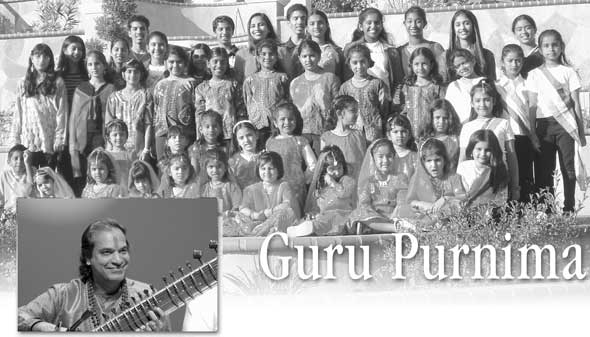 (Inset): Sitarist Habib Khan. (Background): Vinita Kumar’s Aavartan group students, who also won seven prizes in this year’s dance competiton at the Festival of India in San Jose, Calif., Aug. 15. Guru Purnima: Homage to Mentors - A Siliconeer Report Even in Silicon Valley, Guru Purnima, the ancient ritual of honoring one’s mentor, was in full bloom at a South Bay residence. A Siliconeer report. Vinita and Rakesh Kumar’s house was redolent with the aroma of agarbati. Flower decorations were present everywhere; men wore intricate kurtas of silk, women wore beautiful saris of myriad colors and designs. The dulcet tunes of the tanpura, the resonant sound of the sitar, the sweet sound of vocal music, and the cadenced beat of the tabla wafted and mingled in the air. Amidst all this Habib Khan was meditating. His presence appeared to transform the house, welcoming everyone who desired to enjoy and cherish Indian classical music. Habib Khan, a reputed sitar player in the Bay Area, has also introduced Indian classical music to Western audiences. The occasion was guru purnima, an event that pays homage to a guru, or teacher. In ancient India, in the gurukul system of education and learning, children at a very young age would be sent to live in ashrams to learn about the philosophy of life, scriptures, arts, and sciences. The gurus and their shishyas, or disciples, who eventually became gurus, formed a continuous linkage for transmission of wisdom known as the guru shishya parampara. Every year, shishyas remember and convey their appreciation to the tradition of the guru, or guru parampara, in an event called guru purnima. In today’s age, children aren’t sent to ashrams, but a solid sense of gurukul lives on in the Bay Area Indian community, as evidenced in the Kumar residence, where students paid homage to Vinita P. Kumar and Habib Khan. Vinita P. Kumar is the founder and artistic director of a dance group, Aavartan (Cycle of Beats). A scientist during weekdays, she transforms into a dance director over the weekend. Vinita’s dance students revere her and they express their respect in different, unique ways. A young dance student will blithely draw something for Vinita for no given reason or occasion. During the week, a young student will practice her dance several times so she can proudly show her guru how well she is being taught. The deep bond between Vinita and her dance students is especially evident when they dance on stage with exuberance and delight. The guru-student relationship is more traditional when it comes to Habib Khan and his students. Before formally beginning the class, the students touch his feet in deference, and in turn, Khan places his hand on the student’s head as a blessing. Khan’s progressive music institution in the South Bay is called the Habib Khan Saraswati Temple and Gurukul. The gurukul, practically a second home to many of his students, is also a place of worship for Saraswati, the goddess of learning and arts. Habib Khan teaches vocal music, sitar and tabla. Habib Khan hails from a family with a rich musical lineage. His father was his guru and instilled in him a lifelong devotion to music. Habib Khan firmly believes in God in all forms and considers music the voice of prayer. His teachings not only help students understand music better but instill in them a way of being — a way to live where music permeates one’s life. FESTIVAL: 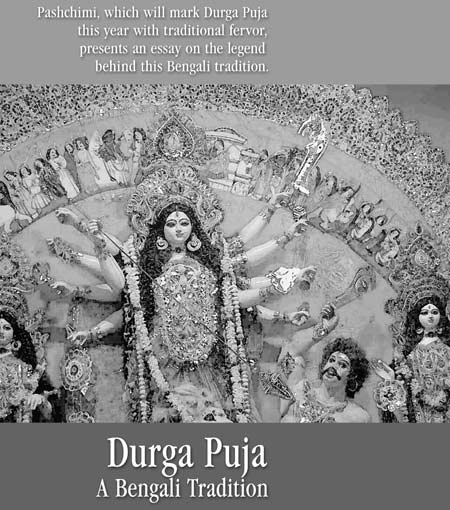 Durga Puja: Durga Puja:A Bengali Tradition Pashchimi, which will mark Durga Puja this year with traditional fervor, presents an essay on the legend behind this Bengali tradition. Durga Puja is celebrated all over India with different festivities and rituals, in the autumn month of September/October. It is the greatest festival in the eastern part of India, especially Bengal. The legend behind this festival is an all-powerful battle where good defeats evil. According to legend, the powerful demon Mahishasura, the king of Asuras, through years of austerities, was once granted by Brahma a boon that no man would be able to kill him — he could only be defeated in battle by a woman. He became all powerful and wreaked havoc on all three worlds (heaven, earth and hell) with his horde of Asuras, plundering and ruthlessly killing anyone who lay in their path. Chaos and anarchy reigned. Gods were driven from heaven and Mahishasura usurped the throne. The gods could not defeat him and he became a threat to the existence of the universe. They begged Shiva, Brahma and Vishnu for their assistance. The three gods combined their divine energy and summoned up a feminine form so brilliantly dazzling that it illuminated the heavens. From this glow emerged a magnificent and fierce goddess riding a lion. She was the Devi Durga, the invincible one. The gods armed her with all their weapons — Shiva’s trident; Varuna’s conch shell; Agni’s flaming dart; Vayu’s bow; Surya’s quiver and arrow; Yama’s iron rod; Indra’s thunderbolt; Kubera’s club and a garland of snakes from Shesha. Thus armed, Durga rode to the top of a mountain on her vahana — the lion. A bloody battle ensued between the Durga and Mahishasura. Finally when in the guise of a buffalo, Mahishasura charged against Durga, the devi beheaded the buffalo and from it emerged Mahishasura in his original form. Durga pierced his chest with her trident and relieved the world from the evil power, thus and establishing peace and prosperity on earth. What makes Durga Puja particularly extraordinary is the tension between calm spirituality and ecstatic sensuality, the twin poles of Hindu religious worship. This festival is celebrated at a time when the weather remains at its best, giving the atmosphere a festive mood. It arouses one from bed at dawn, with the sound of high-pitched ululations, the fervent blowing of conch shells and bell metal cymbals. This simple ceremony marks the arrival of the Mother Goddess Durga, for the festival of Durga Puja. Durga Puja is a festival with a long series of rituals followed on every day of the puja. Starting from the day of the Mahalaya, the days of Maha-Sashthi, Maha-Saptami, Maha-Ashtami, Maha-Navami and Maha-Dashami or Bijoya Dashami; every day has its own unique rituals to follow. Not only does the festival have rituals associated with it, the making of Durga idols is governed by a series of rituals as well. These rituals are closely related with the holy river Ganga. The elemental ritual, which is most commonly followed, is that the ingredients that are used to make the idol of goddess Durga come from the holy river. The activity of immersing the idol in the Ganga at the end of the festival this way points to a theme of cyclical regeneration too. Generally, the idol of Durga is flanked by the idols of Lakshmi, Saraswati, Kartik and Ganesh, all of whom are believed to be her children. The goddess sits atop a lion, which is her vahana. The favorite tableau is one that depicts her stabbing the demon as it arises out of its buffalo form. It is symbolic of the victory that she achieved for the gods over the demons. These days of the puja are outlined in the Bengali calendar — days are counted based on sunrise and sunset while tithi depends on the rising and setting of the moon. The traditional six-day countdown to Mahasaptami starts from Mahalaya. Goddess Durga visits the earth for only four days but seven days prior to the Pujas, starts the Mahalaya. Maa Durga arrives at her maternal home astride a lion along with her four children Laxami, Saraswati, Karthik, Ganesh and then leaves for her abode in the snowy peaks of Kailash in the Himalayas on Maha-Dashami. Durga Puja 2004 will be the debut event organized by Pashchimi at the Sunnyvale temple. “Pashchimi” (a Bengali word implying people from the West) was established to promote and nurture Indian culture, ethnicity and social interaction, as well as to work with other similar organizations to improve the socio-economic condition of the underprivileged in India. Durga Puja is the festival that brings together people from different strata of society to worship in harmony. Pashchimi hopes that their giant maiden effort ‘Durga Puja” – will establish a platform to promote social and cultural interaction among Indians living in Bay area. Our motivation in organizing this event is to bring the festivities and joyous celebrations of Durga Puja to the Bay Area in the closest authentic way that it is celebrated in Bengal. The deities have been specially designed and shipped from the famous Kumar Tuli in West Bengal for this event. The Pujas will be held on the days and times outlined in the Bengali calendar. Puja-prasad will be distributed as well as the traditional bhog. The festivities will be accompanied by the wonderful, nostalgic sounds of dhak-dholok. Thus we will strive to capture the true spirit of Durga puja celebration here in the heart of the Bay Area — our ‘home away from home’. Pashchimi in association with the Hindu Temple at Sunnyvale will host Durga Puja according to the books Oct. 20-24. All ethnic communities are welcome. Pashchimi’s Web site address is: www.pashchimi.org. SPORTS:  Online ODI Fest: Cricket on Broadband - A Siliconeer Report As cricketmania strikes desis in North America, Echostar will offer on pay TV and online, live coverage of the tri-nation Holland Cup, and the Champions Trophy with all Test-playing nations as well as the U.S. A Siliconeer report. EchoStar Communications Corporation and its DISH Network, the nation’s leading TV provider of major cricket matches, have exclusive rights to broadcast the Holland Cup and the International Cricket Council 2004 Champions Trophy via broadband connection. The Holland Cup and the ICC Champions Trophy are available via broadband through DISH Network’s Web site as a bundled package for $249.95. The Holland Cup only package is available for $99.95. Cricket fans can place their order, read the latest headlines in cricket and watch free highlight clips through DISH Network’s Web site, www.DISHNetwork.com/cricket. The Holland Cup and ICC 2004 Champions Trophy is available to anyone with a broadband connection and will air Aug. 21-September with replays in October. The ICC Champions Trophy will be broadcast Sept. 10-25. DISH Network has exclusive rights to broadcast The Holland Cup via broadband worldwide. The Holland Cup, also known as the Videocon Cup or the Dutch Tri-Series, is expected to be an action-packed triangular including India, Pakistan and Australia with four one-day internationals. It will be the first multi-nation series to take place in the Netherlands and only the second time in 25 years these three countries have faced off in a triangular tournament. During the Carlton & United Series of 1999-2000, the three nations faced off and Australia won nine straight matches. The ICC Champions Trophy is the only cricket event besides the World Cup listed on the cricket calendar that brings all 10 test-playing nations together to compete in one event. The ICC Champions Trophy will include the national teams of Australia, Sri Lanka, Pakistan, India, West Indies, New Zealand, South Africa, Zimbabwe, Bangladesh, Kenya, host country England and, for the first time, the national team from the United States. The Holland Cup and the ICC Champions Trophy are also available on DISH On Demand Pay-Per-View. Interested readers can call 1-800-333-DISH (3474) for subscription information. COMMUNITY NEWS IN BRIEF: Hospital Board Hopeful ... Indo-Pak Meeting ... IVACC Meet Mulls Immigrant Issues ... Hasya Kavi Sammelan ... Calif. Kids to Play in U.S. Cricket Team ... Chinese-American Meet ... ICO Plans Gadari Mela Hospital Board Hopeful Pediatrician Dr. Jacob Eapen is running for a two-year term on the board of directors of the Washington Hospital Healthcare System, a community healthcare facility in Fremont, Calif. In the November election, he will run against Susanna Wong, a Chinese American restaurateur appointed to the board in March 2003.
Washington Hospital serves about 320,000 residents in Fremont, Newark, Union City, south Hayward and Sunol. A graduate of Trivandrum Medical College in Thiruvananthapuram, Eapen also has a master’s degree in public health from the University of California at Berkeley. He has been a commissioner of public health in Alameda County for over four years. He received the first Physician Recognition Award from the Medical Board of California this year. Eapen said he was approached by several physicians in the community to run for the board of directors. “I want to serve the grassroots community,” he said. “I want to be their voice.” This delegation’s included Col. Rick Machamer, U.S. State Dept., Indian journalists Avnish Jain (Dainik Bhaskar), Pranab Dhai Samanta (The Indian Express) and Swaraj Thapa (The Economic Times) and three Pakistani journalists Nasir Iqbal (Dawn), Naveed Ahmad (The News) and Syed Wajahat Ali (Daily Times). Delegation members discussed both past efforts and the current talks for peace between India and Pakistan.
Ras H. Siddiqui, a Sacramento, Calif.-based Pakisani reporter and peace activist, hosted the event. Bay Area entrepreneur Syed Rifat Mahmood ably moderated the discussion. Equating the India-Pakistan relationship to that of a walk or even a run on a treadmill requiring both energy and effort, Siddiqui said that one is often reminded that we are getting nowhere. Yet it is imperative that we not lose hope, he added.. Swaraj Thapa shared his optimism because the two countries were still actually talking to each other and Pranab Dhai Samanta said he supported a shared vision of development and continual people to people contacts. Syed Wajahat Ali said both sides realize that they need peace for economic development, and Nasir Iqbal called for more transparency in the dialogue and that the people of both countries should be informed of what is going on.
Montanez talked about difficulties faced by immigrants and H-1B workers and how key issues related to immigrant communities were at times overlooked by mainstream America. Urging all immigrants to file for citizenship whenever they would be eligible, she said that would make their voice stronger. On a different note, Montanez also talked about Siliconeer’s August 2004 cover feature. Arsenic contamination in water is a serious problem. After reading about the arsenic problem in Bangladesh and West Bengal, in Siliconeer, she said that California’s central valley also had similar arsenic contamination. But they have a system to deal with the problem which can be an option that people in India and Bangladesh may want to explore.
Sunnyvale, Calif. – Noted Hindi humor poets Neeraj Puri, SurendraSharma and Arun Gemini sent the audience sprawling with laughter at the Hasya Kavi Sammelan held at the Hindu Temple and Community Center here, Aug. 22. The event organized by the Indo-American Society of Bay Area, turned out to be a sold out show.
California Cricket Academy for youth announced that four of their players Akash, Arsh, Adhiraj and Pranay, will play for U.S. All Star Under 13 team against Canada this Labor day weekend. These players include three kids from Cupertino, Calif.
Linda Ng, president of OCA’s Greater Sacramento chapter, summed up the theme of the event during her speech as “OCA does make a difference. The reception is a reflection of the importance of diversity in California and the ability to work together for a better future for all in the state.” The highlights of the evening included honoring C.C. Yin with OCA’s Corporate Sponsor of the Year award for his support, and remarks made by the impressive gathering of state legislators. Speakers included Mr. Uppal, Mr. Munir, Dr. Shyam Goyal, Bhagwan Maharaj, Madan Sharma, Janak Raj Sidhra, Upen Shukla and Dr. Romesh Japra. The meeting was aimed at uniting the diverse Indian American community and pave the way to a legacy of historical moments for the upcoming generation of Indian Americans, reminding them of their culture, heritage and sacrifices that our freedom fighters made for a free India. Some of the ideas that were explored included promoting local talents and organizing a rich cultural showcase, both for the younger generation and mainstream Americans as well. A library to preserve historical findings related to freedom fighters was also proposed. The purpose of such a library would be to archive historical facts and documents pertaining to Indian freedom movement, that would help the new generation of U.S.-born Indian Americans relate to their roots back home. The new breed of Indian Americans are not very familiar with India’s history and culture. The library will help them understand the whole essence of their Indian connection in a concise manner. The meeting was attended by about 150 members of the Greater Sacramento Indian community.
AUTO REVIEW
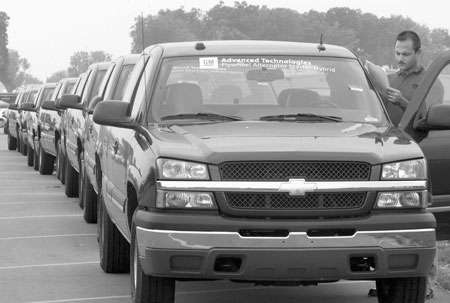
Big Truck for Big Families 2004 Chevrolet Silverado Extended Cab Hybrid – By Sally Miller Wyatt  For those who have large families and lots of things to haul, the Chevrolet Silverado is a great option. For the environmentally (and pocketbook) conscious the hybrid version is even better, writes Sally Miller Wyatt. For those who have large families and lots of things to haul, the Chevrolet Silverado is a great option. For the environmentally (and pocketbook) conscious the hybrid version is even better, writes Sally Miller Wyatt.When it comes to choosing a truck, you have as many selections as you do when stepping up to a Baskin Robbins counter. At that popular ice cream chain, as most people know, there are many variations on even your basic chocolate flavor. With Chevrolet, it gets just as varied, where consumers choose truck bed lengths, passenger cabin configurations and now, even whether to take a hybrid engine option. We recently test drove the Chevrolet Silverado LS 1500 4WD Extended Cab. The Chevy Silverado’s sister truck is the GMC Sierra. Both come in 1500 and 2500 versions, 2WD or 4WD, and with a regular truck bed or the Extended bed. Most notable, however, is the fact that both are also available with a brand-new-for-2004 hybrid option. The hybrid is available on the two- and four-wheel drive Chevy Silverado or GMC Sierra Extended cab models cost an additional $2,500. It is a limited option, available only to customers in California, Washington and Oregon. Having such fuel efficiency available on a large truck, during these times of inflated fuel prices, is an attractive option. Not to mention the satisfaction you may feel knowing that your choice to go hybrid also means you’re helping the environment. The hybrid’s fuel efficiency comes from its ability to automatically stop and restart the engine under different operating situations. Instead of a conventional starter motor and alternator, hybrids use several components, including a compact 14-kilowatt electric starter generator, all designed to provide fast, quiet starting power. The system also allows the engine to stop or restart at appropriate times to conserve fuel. Its job is to also generate electrical current to charge the batteries and run auxiliary power outlets, and to smooth out driveline surges, although you will still feel them. The system also employs a “coast-down regenerative braking,” which is also a fuel-efficiency feature. Driving a hybrid means getting used to a very quiet starter, which isn’t something you would expect on a truck with a V8 engine. It also means getting used to the little jolts and surges that occur when the power switches back and forth. When stuck in bumper-to-bumper commute traffic, it is heartening to see the alternator indicate when the engine is switching off. You know the truck is doing its part to conserve fuel.
Safety features on the 2004 Silverado include a dual-level air bag system that automatically de-activates the passenger side air bag under certain situations, to help protect small occupants. Daytime running lights and a theft-deterrent feature are also listed as safety perks. The Silverado also came with the XM Satellite Radio option, which means you can choose from more than 100 radio stations, as well as a new feature: detailed traffic alerts for many larger American cities. For those who have large families and lots of things to haul, the Chevrolet Silverado offers many choices. For those who are concerned about the environment, there is just one more choice: The Silverado hybrid.
- Sally Miller Wyatt is a freelance writer Guftugu Only a handful of cities have cinemas that screen the masala films that is our guilty pleasure, and you don’t have the 24/7 access to Bollywood films on satellite TV that you do in India. Well, that’s about to change: Indian Americans will now have access to popular Bollywood movies on cable television, following a joint venture by entertainment companies 212 Media and Schramm Sports & Entertainment. The two entertainment companies have tied up with Comcast Corp. and Time-Warner Cable to add Bollywood movies to their video-on-demand channels. The venture enables over six million digital cable subscribers of Comcast and Time-Warner direct access to “Bollywood-On-Demand/Video-on-Demand.” So far, Time-Warner has rolled out 10 Bollywood films which include Hum Dil De Chuke Sanam and Rangeela through the tie-up. The movies have been priced at $3.95 a movie, available for 48 hours. Just imagine. For a nominal fee, you can flick the TV switch and Presto! Scenes of a Bollywood hunk getting fresh with a suitably undressed Bollywood babe in exotic distant locale flash on your screen, accompanied by the sounds of a juicy masala song. Can life get any better? After signing sizzling Cindy Crawford and Pamela Anderson, the international pizza chain Pizza Hut is hiring Zayed Khan as its brand ambassador to reach out to the youth. “We have hired a brand ambassador for the first time in India. Our idea is to cater to the younger generation of the young country,” Pankaj Batra of Pizza Hut told PTI. So how much is Zayed making for being a brand ambassador. Neither Pizza Hut nor Zayed is telling. It’s safe to assume that the moolah will be good. Pizza Hut, the world’s biggest pizza chain, will soon increase the number of its food joints to 100 restaurants in 26 cities from 73 outlets in 19 cities now. With the fast food industry in India touching about Rs. 980 billion, the company views India as a critical market. To those who may tease Zayed for hawking pizza, he can always retort: “I am in distinguished company. So has former Soviet chief Mikhail Gorbachev.” That’s just the beginning. Oscar-nominated director Roland Joffe is directing Rai in Singularity, a romantic drama, according to a report in the Sunday Times magazine in London. British writer and producer Meera Syal says Rai couldn’t have picked a better time to launch her Hollywood career, with the thirst for all things Bollywood having grown in recent years. “She is staggeringly beautiful, for a start,” Syal said. “How she’s cast may be another matter.” But Syal believed Rai’s choices for her first Hollywood outings — she has avoided blockbusters with two-dimensional roles — prove she’s one step ahead. She has also hired the powerful Creative Artists Agency to represent her and Simone Sheffield, who has handled big names such as Stevie Wonder and Lana Turner, as her international manager. Her co-star in Gurinder Chadha’s Bride and Prejudice, Martin Henderson, compares her to Elizabeth Taylor. “She is one of those women who look beautiful from every angle. The camera adores her,” he said. And you thought that only Bollywood fans went bananas over pretty women. Remember the time he pissed of everybody in India with his uninformed, arrogant remark in The New Yorker that the best Indian literature after independence has been written in English? Then Rushdie and his girlfriend model Padma Lakshmi had a public spat in which each told the other what they thought of each other. Rushdie called her a “birdbrain,” while Padma returned the compliment, calling him “boring.” Now Rushdie says pornography is vital for freedom! In an essay deliciously titled “The East is Blue,” he declares: “Pornography exists everywhere, of course, but when it comes into societies in which it’s difficult for young men and women to get together and do what young men and women often like doing, it satisfies a more general need. . . While doing so, it sometimes becomes a kind of standard-bearer for freedom, even civilization.” So maybe we should put Larry Flynt right beside Voltaire, huh? What’s so civilized about looking at women or men as raw meat? Perhaps the man will do anything to be in the news. His last novel Fury had mixed reviews amid suggestions that it drew on his love life with Padma Lakshmi, who is 26 years his junior. Heck, it failed even to win the Literary Review’s Bad Sex Award though it was nominated. Shanghai or no Shanghai, the Indian Motion Pictures Producers Association is not impressed. IMPPA has warned of imposing a ban on her from acting in Hindi films for failing to comply with an earlier agreement with a producer and complete his film. One of the producers, Ramesh Sharma, had approached us a couple of months ago that actress Mallika Sherawat had agreed to work in his film Kab, Kyun aur Kahan. She had called herself Reema Puri at that time,” IMPPA president Saawan Kumar Tak told PTI July 24. However, after shooting for 15 days and completing the picturization of two songs, the actress had suddenly dropped out and had been difficult to trace. Sharma later realized that she had changed her name to Mallika Sherawat, he said. “The producer approached her again to complete his film. He also approached IMPPA stating that he had dates with actor Sanjay Dutt and needed Mallika’s dates to match with it. Sharma also agreed to adjust the other dates later as per the convenience of the actress,” Tak said. We do not yet know what Mallika has to say about all this, but if the past is any guide, we are expecting some complicating, self-serving story whose veracity may not be entirely guaranteed. Somebody needs to shake that babe by the shoulder and give her a bit of good advice: “Look here, Jackie Chan is fine for a one-time film assignment, but Bollywood is your bread and butter, sweetie. So you better get your act together and play ball!” “It is strange, really, the way they censor the scenes,” she said recently. “They will do crazy things. They may allow scenes of domestic violence, leave out scenes like a guy smoking. There should be sensible censoring of films,” she said. Ah, our Preity was never just a pretty face, there’s a sensible head on those comely shoulders. As all our readers know, Sanju Baba is still fighting a case against him in the TADA court in Mumbai. The actor, who had spent 18 months in jail for allegedly possessing an automatic weapon, said he and his family have been hurt and upset by the reports. He was in Calgary for the shooting of Dus, and he had to take the TADA court’s permission before coming to Canada. “I never will come back to Canada ever in my life,” Dutt was quoted as saying by the CBC television. He said he and his family have been fighting the allegations for years. Members of the Indian community in Toronto came out in support of Dutt but he told them he had enough, it said. He said he was surprised at how he is being portrayed in the media. “I have not been proven a terrorist,” he said, adding he thought Canada was a free country, where people were innocent until proven guilty. Sounds just like a juicy scene from some masala movie, doesn’t it? The film, Zee Network’s first theatrical release, saw off competition from various Hollywood films including Warner Brothers’ New York Minute. The most astonishing fact is that the Mujhse Shaadi Karogi (Will You Marry Me) was shown on just 32 screens throughout the U.K. and still managed to reach No. 8 in the chart. The film grossed 183,473 pounds in its very first weekend and has since seen a steady increase, Zee TV said in a release. Mujshe Shaadi Karogi is a sweet and pleasant romantic film about two hunks falling in love with the same girl. “We are delighted with the response for our first theatrical release. Mujhse Shaadi Karogi is the first of the many releases we have lined up and we are happy that it has fared well at the box office,” said Pranab Kapadia, head of programming, Zee Network (UK). Hindi Film Review Love Story That Gets Lost  Sahara Manoranjan and Narsimha Enterprises’ Kyun..Ho Gaya Naa Directed by: Samir Karnik Item songs are a Bollywood innovation whereby a panic-stricken filmmaker, realizing what a complete dud he is about to inflict on the hapless movie-going masses, tries a last-ditch effort to shore up the monstrosity with a snazzy dance and song number—preferably with a lot of skin, in the desperate hope that folks will flock to the box office for this latest condiment, if nothing else. (It goes without saying that this final addition, or its characters, has no discernible connection with the story of the film—but the long-suffering Bollywood buff is eternally forgiving, so no worries on that count.) Now Mr. Karnik has taken that a step further. Instead of an item song, we have an item race. And it’s quite an exciting car race, littered with plugs for sponsors, but its connection with the actual body of the film is virtually nonexistent. Which begs the question: Are we to draw the conclusion that this filmmaker also tacked in the racing sequence as a last-moment desperate measure? Take a quick look at the film’s premise and you decide. Arjun (Vivek Oberoi) is your typical cocky Bollywood hero who declares: “Pyaar aur haar Arjun ke dictionary mein nahin hai.” What he actually means is this: he is a firm believer in arranged marriages. Soon he finds himself with Diya (Aishwarya Rai), who is visiting from Coorg, who, on the other hand, is a firm believer in falling in love. Unbeknownst to Dia, Arjun is the person whom her father has chosen for her, but she refuses to look at any photo of a possible arranged match. Arjun, on the other hand, is a cynic who is not in love … but wait a minute, he is in love with Dia, he just doesn’t have the guts to tell her. And so the story progresses, amid banter and joking, and honestly, handled with the right amount of wit and panache, the story had the possibilities of a fairly enjoyable light-hearted romantic comedy. Trust a bunch of Bollywood scriptwriters to really mess things up. I mean, it’s hard to believe that you need so many writers to concoct such a dopey story line (studmuffin hero Vivek Oberoi, no less, also lends a hand, with very little salutary effect). The script loses its way when the scriptwriters allow Arjun and Dia’s repartee to reach a dead end, so they spring all sorts of odd and irrelevant characters on the duo to move the story along. Enter Uncle Raj Chauhan (Amitabh Bachchan), Dia’s favorite adult who runs and orphanage with really delinquent kids. Pity poor Big B, who is saddled with this rather outlandish role, and is obliged to play Cupid for Arjun and Dia while chanting, for some odd reason, “Come on, Charlie,” to his often insufferable wards. As if uncle isn’t enough, out of the blue appears Ishaan (Suniel Shetty) to add another redundant angle to the floundering love story. Where it all ends up, I shall leave unsaid, let’s just the say the way the film reaches its end is so predictable that it robs the film of any possible excitement that could revive its dud story line. Despite some spectacular photography and great sets, the limp story proves to be the undoing of the film, and not even Vivek Oberoi’s wild sense of fun cannot revive it. His real-life big squeeze Aishwarya is of little help: her stylized spaced-out stares and contrived dialogue delivery make this film a disaster for her. Which goes for Karnik too, despite his Hithcockian affectation when he plays a cameo as a flustered director. The reality, my dear Karnik, is closer than you would like. And no item car chase can bail you out, buddy. Rating: ** (Mediocre) |Return to Bollywood Index| |TOP| Tamil Film Review: Breath of Fresh Air Azhagiya Theeye Director: Radhamohan Cast: Prasanna, Navya Nair, Jaivarma, Bala, Kumaravel, M.S. Bhasker, Prakashraj  Four friends, who nurse dreams of making it big in films in various capacities, rough it out, trying to make both ends meet. Into their life enters Nandini, a wealthy girl, wanting to opt out of an unwanted marriage. Chandran, one of the four and an aspiring director, decides to help her out. He meets Arvind, her intended groom, and tells him to back out because Nandini and he are lovers. The move backfires when Arvind, sympathetic to the “lovers,” decides to do his bit for them. Before they realize the full implications of it, Chandran and Nandini find themselves bound in marriage. Arvind even gives them his bungalow to live in. Blaming each other for the situation they find themselves in, how the duo and the rest of the group tackle the situation forms the rest of the story. The film has a touching and fitting climax. Debutant director Radhamohan is focused, knows what he wants and has a firm grip on his script and narration. He has coordinated the performances well, and crafts a film sans sex and violence. His attention to minute details in particular deserves praise. The dialogues (Viji) are sparkling and crisp, meaningful and humorous, taking light-hearted pot shots at the film industry. What one can’t understand is why such a well-planned film has such an irrelevant, incongruous title! Ramesh Vinayakam moves away from the usual noisy tunes one gets to hear in films nowadays and composes some pleasant numbers. Prasanna, as Chandran, gets a lot of scope to emote. He is more impressive here than in his earlier films, and reveals his flair for comedy. Bringing in a wholesome appeal to the character and reestablishing her credentials as a talented actress is Navya Nair, popular actress of Malayalam films. From Koothupattarai come two talented actors, Bala and Kumaravel (as Balu and “Chithappa”). As aspiring story writers, their story-telling sessions add pep to the scenes. Jaivarma, as Murthy, leaves his mark. Prakashraj plays the flamboyant, easy-going character of Arvind with élan. Finally, it’s to Prakashraj’s credit that despite being the producer he’s not tried to hog the limelight this time round too, and like his earlier production, Ayithe, has given a clean, wholesome entertainer, unmindful of commercial considerations. Azhagiya Theeye is like a breath of fresh air. — Malini Mannath |TOP| RECIPE: Bengali Dessert: Mishti Doi - By Chandreyee Das Chandreyee Das shows you how to prepare a quinessential Bengali dessert.  Ingredients:
Method: Pour into an oven-proof bowl and bake at 300 degree F. for about 45 minutes.
Let cool to room temperature Scoop into desired dessert bowls. Set in the refrigerator. Serve Chilled. – Chandreyee Das works with Farmers Insurance Group. |TOP| September Horoscope By Pandit Parashar ARIES (March 21 to April 20): Maintain a tough stand on key issues and you wish will prevail. Children will make you feel proud. You may invite an old friend. Popularity levels will rise and you may be invited to a fundraiser. TAURUS (April 21 to May 20): Relocating plans will fall in place. You will buy hi-tech gadgets for yourself. Business owners are advised to keep an eye on new employees. You plan a short vacation with family. A government agency will require clarification on some issues. GEMINI (May 21 to June 20): You will devote more time to career and the results will be positive. You may hear encouraging news on an ongoing legal procedure. Financial juggling will bring things under control. You will spend time with family. CANCER (June 21 to July 22): You will be relaxed and develop patience and sense of humor. You will study philosophical materials and implement it in your life. You will control your desire and put off a big purchase. Be careful when signing any contracts or you might incur huge losses. LEO (July 23 to August 22): A major deal is in the air. You will do well financially. Sudden plans to move may take final shape and you may have to prepare for it in a rush. Expenses will be high but legitimate. There will be some changes in a partnership setup. VIRGO (August 23 to September 22): You might receive disturbing news but you will take it well and in a rational manner. A senior person will provide very good advice and help in developing a strategy for your future. You will study and look for a business as well. Financially, things will be easy. LIBRA (September 23 to October 22): Help will come from an unexpected source. You will get several chances to make money and quick thinking will fetch money from stocks as well. Colleagues may arrange a family outing. You will need to change few electric gadgets at home. You will become more religious. SCORPIO (October 23 to November 22): You will do well at work and your seniors will appreciate your help. You will spend time with some prominent personalities. Spouse will support your plans. You will prepare to receive a new member in the family. SAGITTARIUS (November 23 to December 22): There will be an addition in the family soon. Plans will be well received but final word could take some time. People, who borrowed money long ago, will offer part payment. Spouse will buy some decorative items for home. You will make frequent overseas calls. CAPRICORN (December 22 to January 19): Major breakthrough just around the corner and your feeling will reflect that as well. There will be changes in your religious beliefs and you may attend a discourse. You will get exciting news in the mail. A distant relative will invite you to a celebration. AQUARIUS (January 20 to February 18): Do not underestimate the competition. Some one at work will try to play games behind your back. You will attend a political dinner and meet influential people. Recovery of money will take some time. Negotiations will be under way for a job offer with a large corporation. PISCES (February 19 to March 20): You will need to twist the facts in order to get your work done. Business will improve and work environment will be comfortable. You will be making payments on several bills this week. Spouse will finally pay attention to health. You will a lot of parties. Bay Area-based astrologer Pandit Parashar can |TOP| |
|
|
|
|
Advertise in Siliconeer | Home | Subscribe PRINT Issue | About Us (FAQs) | Contact | Locations | Staff Login | Site Map
© Copyright 2000-2013 Siliconeer • All Rights Reserved • For Comments and Questions: info (AT) siliconeer.com |
|







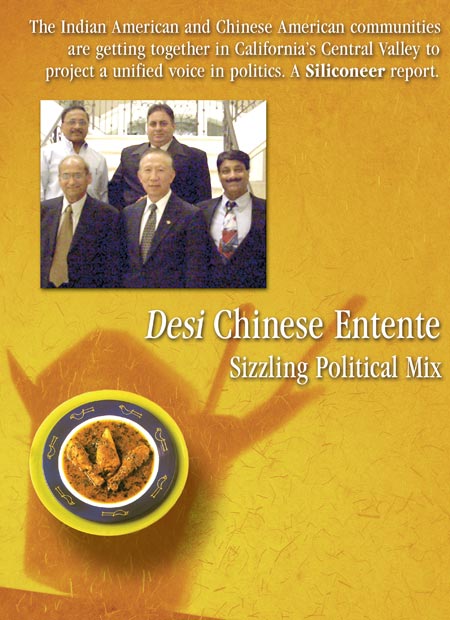
 Keeping Your Cool:
 Bangla Music Nite

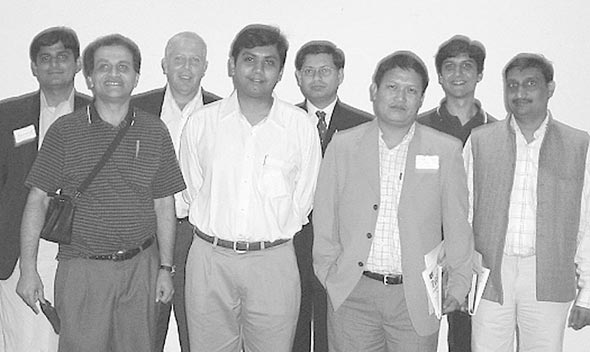

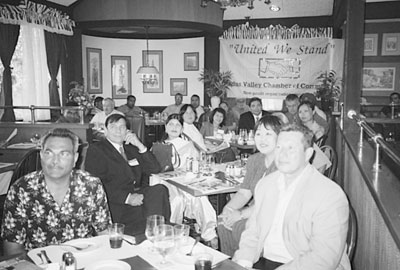
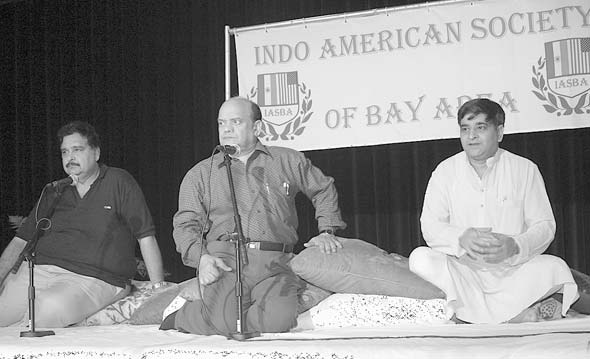
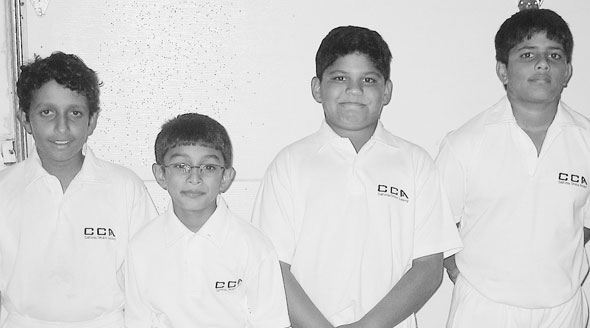
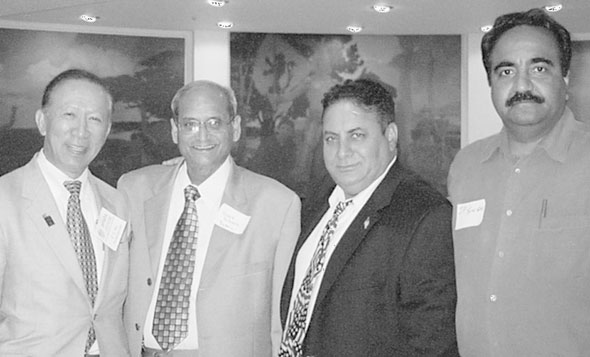
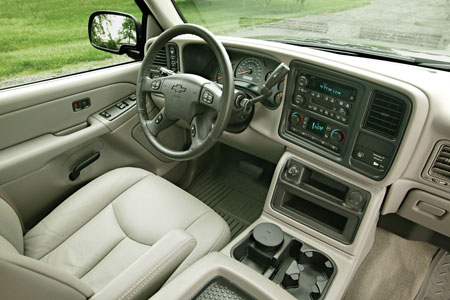 These special hybrid models promise a 13 percent improvement in fuel efficiency, while also delivering all the performance from its Vortec 5300 V-8 engine that you would expect from a truck — and engine — of this size.