 !-- Start Alexa Certify Javascript -->
|
|||||||||||||||||||||||||||
|
|||||||||||||||||||||||||||
|
|
|||||||||||||||||||||||||||
|
|||||||||||||||||||||||||||
|
|
|
|
|
|

APRIL 2005 |
MAIN FEATURE |
|||||||||||
|
PUBLISHER'S NOTE:
 From time to time, this magazine has taken a break from celebrating India’s remarkable leap into the global arena with its knowledge prowess in information technology. Two issues interest us most—one is whether any of this technology is being molded to serve the vast millions who are left out of the globalization party. The other is to take a close, hard look at whether there are any downsides to the IT revolution that is getting lost in the euphoria and hype. This month’s issue takes on the second issue—and revisits a trend we looked at in April last year: The growing problem of e-waste, and what is being done about it. While last year we looked at the national picture, with attempts by the West to dump their electronic junk, this month’s issue looks at Bangalore’s e-waste problem. It’s pretty grim, and the bizarre thing is that its IT-savvy population seems blissfully unaware. However, there is a silver lining to this story. Germany and India have joined hands to deal with the problem, and with German know how, a properly built facility will be constructed as landfill for electronic junk. However, local residents are not thrilled at the prospect of having a hazardous waste landfill in their midst, so government agencies are scrambling to woo them and assuage their fears. Their model was Shanghai, the city whose blistering growth is a symbol of the amazing dynamism of resurgent China. However, it’s one thing to plan, quite another to execute it in a complex democracy like India. Political compulsions have thrown a spanner in the initial plans, and now it’s unclear when Mumbai will actually get the radical makeover its proponents dreamed of. We present a detailed story in this issue.
MAIN FEATURE: Taking on E-Waste: Bangalore Battle A Siliconeer Report If you think Bangalore's IT revolution is about to take India into the next age, hold your applause. There is another side to the IT revolution that few talk about. A huge pile of electronic junk is creating a long-term hazard. Now HAWA (Hazardous Waste Management Project), an Indo-German joint collaboration, is taking on the challenge by building a facility at Dobbospet, 45 km from the city. A Siliconeer report. 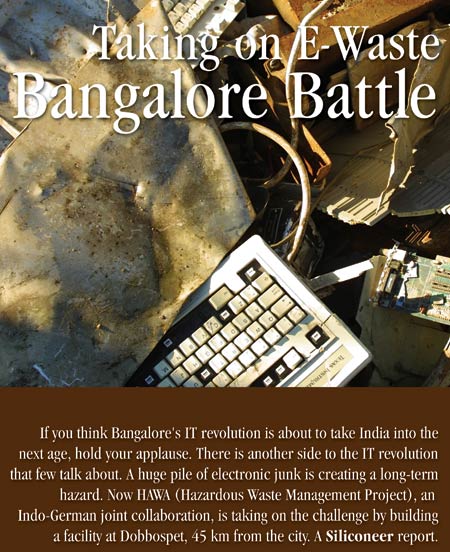 A time bomb is ticking in Bangalore, India’s hi-tech capital, but most of its six million inhabitants are largely unaware of the threat,” the BBC reported in a recent article on its Web site. “Home to more than 1,200 foreign and domestic technology firms, Bangalore figures prominently in the danger list of cities faced with e-waste hazard.” As many as 1,000 tons of plastics, 300 tons of lead, 0.23 tons of mercury, 43 tons of nickel and 350 tons of copper are annually generated in Bangalore. More than 300 small industrial units operate in metal extraction waste from dumped computers. The German government has stepped in with an innovative program to take on the challenge. Advisory Services in Environmental Management — ASEM — is a joint program of the Indian Ministry of Environment and Forests and the German Agency for Technical Cooperation — GTZ. (See box) ”The increasing settlement of manufacturing industries and the rapid development of the economy in Karnataka are leading to state courts and the Supreme Court taking actions concerning the consequences of uncontrolled disposal of industrial waste,” ASEM says in its Web site. While the volume of hazardous waste generated is relatively slight by comparison with other states, ASEM says that in view of the uncontrolled disposal it represents a high hazard potential for human health and the environment. Contamination via water, soil and the atmosphere leads to destruction of the ecological balance. “Moreover, it is above all the poor population groups who live in the vicinity of hazardous waste producing industries or along sewer lines, or who enter into contact with hazardous wastes as a result of illegal waste disposal sites, which are most severely affected,” says ASEM. “In addition, pollution of water resources leads to diseases, particularly among the poorer population groups who are unable to afford hygienically safe drinking water. Such diseases can also be triggered by accumulation of pollutants in the food chain.” Alarmed by the electronic pile up, Bangalore resident Shetty Sreenath has set up Asia’s first e-waste crematorium, the Indian Computer Crematorium, in India’s technology hub. “Here we neither bury nor burn electronic waste. It is done through a mechanical dry recycling process,” he told the BBC. Meanwhile, HAWA is facing hurdles setting up its facility in Dobbespet. Its proposed facility in Shidlaghatta is locked up in litigation. In Dobbespet the local community is up in arms because they aren’t thrilled with the idea of having a hazardous waste disposal facility in their neighborhood, unsure of its effect on their soil and groundwater. Facility builders have responded with a six-month training program for the local population in a 5-km radius of the site to educate them on the scientific features and safety aspects incorporated in a modern landfill and more such programs are in the offing. Religious leaders, the local elected body and NGOs are also involved in these programs. The Dobbespet project in terms of the technology of the landfill and transportation provisions of hazardous waste will meet European environmental regulations, which standard-wise are superior to Indian regulations. The life-span of the project involves a 20-year operational period and 30-year post operational period. One company will be authorized for the collection of hazardous waste from all their generating industries. German project advisor Jurgen Porst is urging patience and he estimates the project is likely to become operational by mid-2006.
INFOTECH INDIA  Gayoom Visits Technopark ... Nokia Plant in Chennai ... 30 Firms on Forbes List ... Tibco to Hire ... Accenture’s New Facility ... Weather Warning in Coastal Villages ... Satyam Voted Third Best ... Chennai Makeover ... Maritime Varsity — Here is the latest on information technology from India Gayoom Visits Technopark Maldives President Maumoon Abdul Gayoom visited Technopark, Kerala’s premier information technology park in Thiruvananthapuram April 1 morning. Gayoom, who reached the park at 10 a.m., went around the units of Infosys and U.S. Software. He was given a presentation on the activities of Technopark at the administrative office. The president, accompanied by his wife Nasreena M.A. Gayoom and his official entourage, spent some 45 minutes at the park. Earlier, he was received by IT Secretary and Technopark chairman P.H. Kurien and its CEO-in-charge V.J. Jayakumar. She told the State Assembly that the manufacturing unit would be located at Sriperumbudur SIPCOT Industrial Estate in Tiruvallur district. Nokia is expected to invest $150 million in the first stage and an equal investment is in order to set up ancillary units, providing direct employment to 1,200 persons and indirect employment to 6,000 more persons. The unit will manufacture 24 million mobile phones per annum initially and the handsets will be for sale in the domestic and the export markets, she said. The site where the ancillary unit would be set up will be declared as Special Economic Zone. Nokia, after inspecting several places in the country, zeroed in on Sriperumbudur, she added. Meanwhile, Lauri Vesalainen, vice-president, operations and logistics, APAC, Nokia, declined to comment on the chief minister’s statement that 24 million mobile phones would be manufactured here initially. He also declined to comment on whether the site would be declared as a Special Economic Zone. Mobile penetration in Asia Pacific is expected to be a major contributor to the global mobile subscriber base surpassing the two billion mark in 2006. Therefore, India, which is set at the heart of the region where mobile communications is growing rapidly, was a natural location of choice for the new production facility. In India, Nokia is the market leader in mobile devices. Nokia maintains sales, marketing, customer care, and research and development sites in the country. Nokia was recently recognised as the Brand of the Year by the Confederation of Indian Industry as well as the most respected consumer durables company by the BusinessWorld magazine. The Indian companies in oil and gas and banking sectors dominate the list, which includes corporations ranging from manufacturing and software to utilities and telecommunications sectors. ONGC occupies the 265th position, closely followed by the State Bank of India group listed at the 269th and Indian Oil at 273rd positions. The rankings are based on four criteria: sales, profits, assets and market value. Citigroup tops the world list, followed by General Electric, American Intl Group, Bank of America and HSBC group. Other Indian companies on the list include Reliance (309), National Thermal Power (486), ICCI Bank (757), Steel Authority of India (831), Bharat Petroleum (914) and Hindustan Petroleum (1,011). Following them are Tata Consultancy (1,167), Punjab National Bank (1,186), Gail (India) (1,250), Infosys Technologies (1,250), Canara Bank (1,260), Tata Iron and Steel (1,302), ITC (1,336) and Wipro (1,362). Further down the scale are HDFC (1,364), Bank of Baroda (1,370), Bank of India (1,371), Tata Motors (1,519), Union Bank of India (1,618), Bharat Televentures (1,648), Oriental Bank of Commerce (1,811) and Mahanagar Telephone Nigam (1,835). At the bottom of the listing for Indian corporations are Bharat Electricals (1,907), Ranbaxy Laboratories (1,936), Indian Overseas Bank (1,959)and Hindalco Industries (1,982). Larsen and Toubro just made the list at the 1,996th position. The company is ramping up product development work at its Pune centre and is building up a marketing team for the domestic market. “The Pune development centre would be key to Tibco’s expansion plans and the developing of future products,” Ram Menon, senior vice president, worldwide marketing, Tibco, said. The company, with 1,500 employees worldwide, had revenues of $387.2 million with an operating margin of 22 percent in the financial year ended November 2004. “We expect to add about 10 Indian clients in 2005 and we will be opening our marketing office in Delhi shortly,” Anup Varma, country manager, India, said. The company has HDFC Bank, BSE, Tata Teleservices, Reliance Telecom and UTI Technology Services as some of its Indian clients. In India the company is targeting the banking and financial services sector, telecom and government organizations and departments. “Tibco’s software helps companies distributing market and trade data through their front, middle and back office. Banks use the software to achieve a better view of their customers and automate activities and insurance companies use the software to accelerate claim processing,” Menon said giving examples of applications. The new facility will be bigger than the existing one and the company, therefore, is likely to increase its headcount in Hyderabad by a significant number. Addressing a press conference, Chet Kamat, partner, Accenture, and head of the company’s delivery centers in India, said, “We started our operations in Hyderabad in 2003 and have been working from an incubation facility. We will be shifting to a permanent facility at Mindspace IT Park by June this year.” “This apart, we will also be indulging in entry-level hiring from engineering colleges across the country. So we will be visiting campuses in this regard soon,” he added. Accenture, so far, has been recruiting only experienced professionals for its IT services and the company has strategically decided to now start employing entry-level people from engineering background. Globally, it has a workforce of 1,06,000 people in 48 countries. “Though the project is in pre-mature stage, these centers are expected to offer weather services like early warning and extreme weather information dissemination mechanisms, location specific forecasting,” associate director of MSSRF, S. Senthilkumaran, told reporters. Currently, RKCs provide information on agriculture, health, education, government entitlements, micro-enterprise training, among others. The RKCs, set up based on a VSAT network, located near the coastal areas, played a major role immediately following the first tsunami attack Dec. 26 and in post-tsunami relief, he said. “We set up a temporary centre at a fisherman’s house at Akkaraipettai village in Nagapattinam. It was very helpful in informing the people about the possibilities of a tsunami attack in the Indian Ocean,” he added. Expressing happiness, Srinivas Vadlamani, chief finance officer, Satyam Computer Services Limited, said in a press release, “We are happy to receive this recognition. Corporate governance assumes a great deal of importance at Satyam. The driving forces of corporate governance at Satyam are its core values, belief in people, entrepreneurship, customer orientation and the pursuit of excellence.” According to the press release, the survey covering more than 110 global institutions investing in the Asian equity markets asked the investors to nominate up to six companies demonstrating exceptional corporate governance. The multi-level car park facility, for which 67 acres of land have been acquired, would have a capacity to park 80,000 cars, Baalu told a news conference. This was aimed at the many car manufacturers in Chennai, including Ford and Hyundai, who use the port for exporting cars. The second container terminal would be established on build-operate-and-transfer basis and would enable the port to handle the increasing cargo traffic in future. The proposed desalination plant, which was expected to cost Rs. 48.50 crore, would have a capacity of one million litres per day. The Central American country of Panama will provide the necessary assistance for setting up the university, Baalu told a news conference here. The vice-president of Panama would visit the country next month for signing the accord, Baalu said, adding that the setting up of the university would be subject to the approval of the union cabinet. Baalu said the proposal for the Maritime University was discussed with the officials of Panama during his visit to the Latin American country about two months back. “They have now come forward to sign the MoU,” the minister said.
POPULAR SCIENCE
Sports with Robots: Contest with Difference - By Neil Gupta 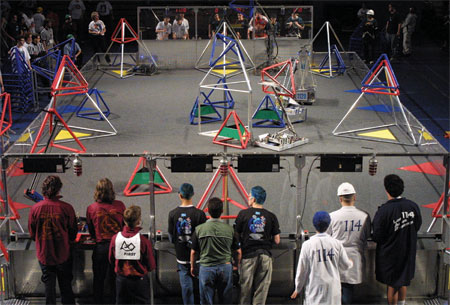 Two teams are facing off in a quarter final match. (Matthew Jojola/California Aggie Photo) From across North America, 37 high-school teams joined a contest of robots, writes Neil Gupta. Seven seconds remaining. Five goals are capped by the red team, while the blue team owns the other four goals. Two of the six players have dropped out of the round from being knocked over. Three… Two… One… The bell rings and the stadium erupts with cheers and rapid discussion. Sound like any ordinary sports game? Well, you might be surprised to hear that this description comes from one of this year’s many robotics competitions that are being held across the nation. Hailing from across the U.S. and Canada, 37 teams gathered on March 5-6 at the Pavilion at the ARC for the Sacramento Regional For Inspiration and Recognition of Science and Technology — FIRST — robotics competition. The Sacramento regional is only one of the many regional competitions that are open to teams that wish to advance to the nationals, which will be held in Atlanta later this year. Contrary to popular belief, these competitions are not unlike any other sports game. Team members could be seen with dyed hair and colorful costumes, cheering their teammates on and displaying their team spirit.
Every year, FIRST plans and designs new games that qualified engineers can compete in by controlling a robot built within a six-week period. Rules and basic kit parts were shipped to every team in January for teams to begin working. To add another interesting twist, only high school students can participate in the event. Teams consist of a group of students and a teacher to supervise in case of emergencies. Designed and built entirely by students, the robots competed in this year’s challenge with great enthusiasm and success. This year, the competition placed the high schools in a rotating alliance system, called “Triple Play.” Each round, three teams were randomly matched up to create an alliance that battled against another alliance to win the round. Winning teams increased their rank in the pool of teams and the top eight teams were selected to move on to the elimination rounds. After a series of rounds that lasted two days, the top eight teams were given the privilege to choose two other teams as their partners for their alliance in the elimination rounds. All remaining teams that were not selected were removed from the game. The rounds consisted of 2-minute, 15-second games, where the three robots on each alliance had to pick up tetrahedron-shaped game pieces, called tetras, and place them either above or below nine pyramid-shaped goals that were located on the field in a grid format. The tetras could be stacked on top of the goals and the upper-most color owned the goal. Points were awarded to every tetra above or below the goal, as well as extra points for owning a goal. Also, additional points were given if a team owned an entire row of goals, similar to a game of Tic-Tac-Toe. In the elimination rounds, teams were eliminated on a “best of three” basis.
The founders of FIRST have placed a great hope in the participants of the annual competitions, stressing that if students could build such advanced robots in six weeks, imagine what could be done in six years. Due to this motivation, they continue to develop new challenges for the students and encourage participation. The stadium was filled with music and cheering as several teams danced to the songs in between rounds and displayed their spirited costumes. Even the judges were seen dancing to songs, such as “Macarena.” Deafening cheers rang through the halls as teams encouraged their human players and celebrated their victory. “The energy of the event was incredible,” said a member of the Adambots team as the team members celebrated their victory. “It’s all about having fun.”-Inder Singh is president of the Global Organization of People of Indian Origin Outsourcing Digest: Siliconeer presents of the latest news from the world of outsourcing.  BPO Workers Happier ... IT Friendly Bush ... Lehman to Open Hub in Mumbai ... Lawmaker to Cut Outsourcing ... Outsourcing Risky: Gartner Battle to Keep Staff ... Design Outsourcing ... BPO Unit in Mangalore .... BPO Workers Happier Staggering growth is often a recipe for employee dissatisfaction, as the IT industry has seen in 2003-04. But the $4 billion business processing services industry in India has managed to defy this equation. Despite over 45 percent growth in the number of employees in India’s BPO industry in 2003-04, overall employee satisfaction actually improved in 2004. The satisfaction score rose 9 percent over last year, in the annual Dataquest-IDC BPO E-Sat (Employee Satisfaction) Survey, 2004. Daksh services emerged as the top employer in the survey this year, as opposed to its fifth position last year. There is often a disconnect between salary and satisfaction with salary. Daksh emerges at the top of the pile in terms of employees’ cost to company and yet, ranks quite low on employee satisfaction with salaries. And despite this, the employees show a very high overall satisfaction level. And size really does matter. “BPO saw a further flight to scale this year,” said Dataquest Group president, Prasanto K. Roy. “The larger companies have shown not just higher growth rates but have also managed to keep employees happier.” The five largest companies in the survey averaged a satisfaction score of 85, versus the industry average of 81, while the smaller companies stayed in the 70s. Roy added that unlike in the IT industry, money is a huge motivator in BPO. “Salaries replacing higher education as the top reason for leaving a company serves as a reminder of the trend.” The BPO Employee Satisfaction Survey 2004 covered the spectrum of the Indian BPO industry. The information in the survey was captured through face-to-face interviews with employees of participating companies. IT Friendly Bush Speaking about the impact of U.S. elections on the burgeoning IT industry in India, Nasscom president Kiran Karnik said that the Indian IT industry welcomes the re-election of George W. Bush as the president of the largest democracy in the world. The U.S. is the powerhouse of the global economy and the Indian IT industry is delighted in being a partner of U.S. corporations, helping to make them more competitive. “Software exports to the U.S. from India account for 68 percent of our total software exports and have been growing at around 30 percent a year. We are confident that with George Bush getting re-elected, the growth momentum will continue,” he added. India is now expecting that policy makers within President Bush’s administration will take cognizance of ‘business economics,’ as they have done earlier. Research reports by various think tanks and academic institutions in U.S. have already shown that the U.S. economy gains by offshoring work and job loss, if any, due to outsourcing from the U.S. is very small. Lehman to Open Hub in Mumbai “The centre will be an enterprise-wide operation handling both BPO and software development work. As far as BPO work is concerned, it is a sort of returning to India by Lehman as it had earlier ended its voice business engagement with Wipro Spectramind.” At that time Charlie Cortese, MD for information technology, Lehman Brothers Holdings, had said the company was not ending or pulling back on outsourcing and asserted that “overall numbers involved in outsourcing will go up next year.” Lawmaker to Cut Outsourcing Outsourcing Risky: Gartner “Companies are not looking at processes from a customer point of view and this is risky,” said Gartner research director Alexa Bona. Companies that outsource internal functions such as human resources and finance, don’t have the same level of exposure because problems are dealt with by their own staff, Bona said. Gartner predicted that through 2008, some 60 percent of companies that outsource customer-facing functions, will face client defections and hidden costs that outweigh any potential cost savings. It, however, predicted that the customer service outsourcing market would continue to grow, from $8.4 billion in 2004 to $12.2 billion in 2007. Battle to Keep Staff Some firms say they need to replace up to half their people every year. Call centres, which snap up English-speaking youngsters with the gift of the gab, are the worst hit, and they account for nearly 40 percent of back-office jobs in the country. “It is a major problem,” said Jerry Rao, chairman of back-office and IT services firm MphasiS BFL Ltd. Staff tend to account for half of a back-office operation’s costs, according to research firm Evalueserve, and the battle for talent has led to a 10-15 percent rise in employee salaries. Recruitment and training makes up 3 percent of the overall per employee cost of about $13,000 per year, including administration and telecoms costs, according to Evalueserve. But the really damaging cost is the lost business for companies who cannot fill key jobs quickly enough. Many face a shortage of mid-level manpower to manage their rapid growth as they lure clients with promises of 40 to 50 percent cost savings. As the industry clocks up 50 percent-plus growth, demand for quality personnel is outstripping supply. Employees often hop to new jobs for slightly more money, and many do not view back-office work as a career. Design Outsourcing According to Express India: “U.S. companies, which have development centres in India, are increasingly outsourcing industrial and engineering tasks to India.” “The last few years have definitely seen increased activity in the Indian CAD/CAM/CAE space with MNC product vendors realising the importance of India as a cost-effective destination for outsourcing CAD/CAM/CAE work,” said an industry observer. India has the expertise in 3D modeling and plant engineering in sectors like aerospace, automotive and industrial machinery. In the automotive sector, according to industry sources, 15 global car makers, including GM, Ford, Daimler Chrysler, Mercedes-Benz, Audi, Isuzu and Nissan, have set up outsourcing offices in the country, with a combined budget of approximately $1.5 billion. With the offshoring of general IT services becoming an ever more mature market in places like India, a number of outsourcing companies are trying to take the next step in service providing, Vertical IT Outsourcing. BPO Unit in Mangalore Addressing reporters here, the Chairman and Chief Executive Officer of MphasiS, Jerry Rao, said that nearly 3,000 people would be employed in the Mangalore unit over a period of time. Bhaskar Menon, president of MphasiS BPO Services, said that around Rs. 75 crore would be invested in the Mangalore unit. Stating that establishment of a BPO unit will create huge employment opportunity in the region, he said the company wants to hire around 3,000 people in 18 months time from March. In all, it wants to employ around 12,000 people in its BPO units. Rao said that the company chose Mangalore for its third BPO unit because of the region’s outstanding human capital. Literacy rate in Dakshina Kannada is very high. Apart from numerous first grade colleges, the district also has quite a few good technical education institutions. Most of the youth here are well acquainted with English and various technology platforms. Before selecting Mangalore for the BPO unit, Hewitt had conducted a survey on behalf of the company, he said. Establishment of BPO units will also lead to secondary and tertiary employment generation. Rao also thanked the Karnataka Government for waiving entry tax on export industry. GLOBALIZATION: Mumbai into Shanghai: The Stalled Makeover By Siddharth Srivastava  Democratic compulsions have put the brakes on an ambitious plan for a makeover of Mumbai along the lines of Shanghai, writes Siddharth Srivastava. Democratic compulsions have put the brakes on an ambitious plan for a makeover of Mumbai along the lines of Shanghai, writes Siddharth Srivastava.One big difference the way China and India is developing is the encumbrance of politics that becomes inevitable in a vibrant democracy like India. The most recent casualty: the Mumbai-Shanghai plan. This is an ambitious bid to convert India’s commercial capital into an approximation of Shanghai as India scrambles to catch up with its giant Asian neighbor’s torrid economic progress. However, what’s a piece of cake in China is anything but that in India. The plan has stuttered even before it has begun — exigencies of power and vote bank politics have thrown a spanner in the works. In any case, Mumbai is anything but an approximation of today’s Shanghai. Pollution, encroachments, traffic congestion, unplanned urbanization have taken its toll, made worse by the sea of slum dwellers who have been coddled by political parties of every hue because they are a rich source of votes. The rows and rows of slums that adjoin Mumbai airport are not a palatable first glimpse of the city that greets the international traveler as the plane lands. On the other hand, Pu Dong airport in Shanghai is state-of-the-art: the Maglev — magnetic levitation — train is the fastest rail system in the world, whisking passengers in Shanghai within minutes across what would be a two-hour ride for similar distances in Mumbai. If you are lucky, that is. If you aren’t (which is often), then you will get caught in a traffic jam, and even Ganpati cannot tell when you will get to your destination. The Shanghai-Mumbai bugle was first sounded by Prime Minister Manmohan Singh in October last year. “When we talk of a resurgent Asia, people think of the great changes that have come about in Shanghai. I share the aspiration to transform Mumbai in the next five years in such a manner that people would forget about Shanghai and Mumbai will become a talking point,” the prime minister said. After a Congress-led government came to power, the Maharashtra government unveiled a $6.5 billion plan to rebuild Mumbai into an international city like Shanghai. Delhi offered $2 billion over the next five years for turning the city around. Transformation plans included the Mumbai-metro rail link, the trans-harbor project, the ring railway plan and Wadala truck terminus project, removal of encroachments, beautification of the international airport at Mumbai, the Mumbai-urban infrastructural development and the upgradation of King Edward Memorial Hospital. Maharashtra Chief Minister Vilasrao Deshmukh spearheaded the Mumbai-into-Shanghai plan, seeking even more New Delhi largesse. Slum demolitions have followed, leaving over 200,000 people displaced as the government tried to free up prime real estate for development. According to reports, over 50,000 shanties have been demolished in a few weeks as the administration bulldozed 200 acres of illegally occupied government land, and that was just for starters. Slums built after 1995, located in prime locations, were to be demolished with the inhabitants transferred to government provided housing outside the city area. This step was also in agreement with a government statute in 2002 that made slum construction post-1995 a cognizable offense. A much-subdued Deshmukh said his government would focus on the human side of development while carrying out all-round development of the city to improve the quality of life; he said the action program would include rehabilitation of residents in slums which have come up before 2000. That’s not all. In the budget unveiled for the next financial year, the much-hyped national urban renewal mission, aimed at changing the look of seven mega-cities and 28 cities, will be getting all of $1.1 billion, a far cry from the $30 billion earlier touted. The three Mumbai projects mentioned by Finance Minister P. Chidambaram in his budget speech — metro rail, the trans-harbor link and western freeway sea link — each requires more than the entire allocation for completion. While it is true that any development should incorporate a human face, hard decisions sometimes need to be taken. It is perhaps a pitfall as well as a blessing of democracy that the voice of the common man has to be incorporated before hard economic decisions based on data and statistics are taken. According to The Hindustan Times: “Clearing a city (Mumbai) of slums is about economics. Shantytowns are choking Mumbai’s infrastructure development. But it is also about politics. People lose homes and they have votes. The way to take care of the politics is to offer, as it were, a concrete proof of the government’s commitment to those affected by demolition…Mr Deshmukh was brave to start the drive. He will be braver if he can start off, again, differently.’’ Perhaps the prime minister’s dream to turn Mumbai into Shanghai will happen, but not at Shanghai’s blistering pace. Democracy often means taking the staircase to economic success, not the elevator, as in China. Hopefully, the sacrifice is worth it. It’s almost certainly is more humane. - Siddharth Srivastava is India correspondent for Siliconeer. |TOP| REPORT: A NASA Fantasy: Boy Wonder Who Wasn't - By Siddharth Srivastava The Indian media went to town with a village kid's dubious claim. The sordid saga has a sobering lesson, writes Siddharth Srivastava. 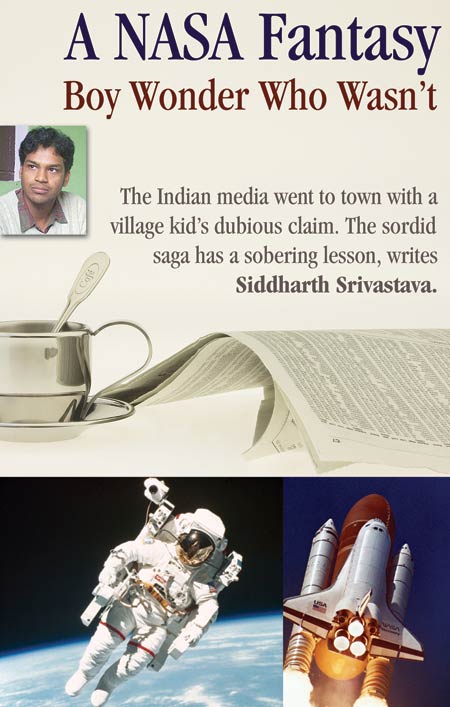 Fifteen-year old Saurav Singh (inset) was the toast of India just a few weeks back. The face of the kid from a remote, backward village of Uttar Pradesh’s Ballia district was splashed on television screens and the front pages of national newspapers. Gushing reports said that Singh had topped an exam conducted by the U.S. National Aeronautics and Space Administration, the so-called prestigious International Scientist Discovery exam. Fifteen-year old Saurav Singh (inset) was the toast of India just a few weeks back. The face of the kid from a remote, backward village of Uttar Pradesh’s Ballia district was splashed on television screens and the front pages of national newspapers. Gushing reports said that Singh had topped an exam conducted by the U.S. National Aeronautics and Space Administration, the so-called prestigious International Scientist Discovery exam. In a matter of days Saurav got a congratulatory note from President A.P.J. Abdul Kalam. Uttar Pradesh state lawmakers pledged one day’s salary. Saurav’s was a heartwarming story — of a young boy from a poor family in an Indian village fighting against social and economic odds, and triumphing. A coaching institute in Rajasthan claimed that Saurav had been their student and said that the boy got a rank higher than the late Indian astronaut Kalpana Chawla (21st), and Kalam (7th), the only two other Indians to have cleared the said exam. Saurav, in the meantime also became a hero of the non-resident Indian community very active on the Internet, who hailed his success and pledged funds for his trip to the U.S. There was just one hitch. All of this seemed to be news to the folks at NASA. The U.S. agency denied it ever conducted an exam called ISD and knew nothing about Saurav. A nonplussed Saurav said that it was not the NASA exam that he had cleared but Oxford University. However, there is no mention of the International Scientist Discovery in the Web sites of Oxford, or the British daily Guardian. The only mention of this “international” exam on the BBC Web site was in a story datelined Ballia about Saurav. Currently, Saurav is being interrogated by the police, while the people of his village have taken to the streets claiming that all of this is a conspiracy by larger forces including NASA to malign their boy. The bigger question, of course is: How did Saurav’s story create the media frenzy for as long as it did, given the false claims? Fingers are being pointed at the media which has been accused of sensationalizing news without cross-checking facts. Accusations are flying about that the Indian media as well as the community has a habit of exaggeration. Writing in The Times of India, Washington correspondent Chidanand Rajghatta says: “Hopefully, the Saurav Singh episode will have a salutary effect on the new brand of ‘gotcha’ journalism coursing through the Indian media. What the incident demonstrated is the media’s hunger for creating instant heroes and the value of the foreign cachet in doing this. If it’s NASA, it must be a phenomenal achievement, is the unchallenged reasoning, forgetting that it’s probably harder to qualify for some of India’s engineering schools.” Rajghatta presents other myths that have been promoted by the Indian media in the past, one of which is that 35 percent of Microsoft’s work force and 32 percent of NASA personnel were of Indian origin, though the figure stands between 5-10 percent — still a very high proportion, given the total number of Indians in the USA. India’s recent prominence, particularly in information technology, is no mean achievement, but it must not obscure the fact that in the broader context India remains a poor underdeveloped country with massive swaths of backward areas and millions of poor. The latest Forbes list puts things in perspective, highlighting the fact that India is a land of contrasts and inequalities. In the list of the world’s billionaires put out by Forbes India ranks 8th in terms of the number of billionaires and 9th in terms of the total wealth of the super rich, ahead of several “rich” countries. But, in contrast to other nations, the average Indian billionaire’s wealth is equivalent to almost 9 million times the country’s per capita GDP. The average Norwegian billionaire’s wealth is only about 42,000 times his country’s per capita GDP and for most of western Europe, the figure is either in tens of thousands or hundreds of thousands. Perhaps the sobering, salubrious lesson in this sordid saga will be a greater reluctance to hype any and all achievements, particularly those with a phoren whiff about it. First of all, it is imperative to avoid the egregious error of hyping phony achievements — in fact, in this age of the Internet it is astounding how long the Indian media allowed itself to be bamboozled when a few clicks in Google are enough to raise red flags — a search showed that every online reference to the phantom International Scientist Discovery was related to Saurav Singh. Even more important, while Indian excellence — and its recognition abroad — needs to be duly acknowledged and even celebrated, Indians and their media avoid the broader picture at their peril. No country in the world has developed, no matter how brilliant its scientists and engineers, while a substantial chunk of its population live in abject poverty without basic education and healthcare. Indians, including the media, need to realize that along with its laudable scientific progress there are daunting socio-economic challenges that it needs to take on. - Siddharth Srivastava is the India correspondent for Siliconeer. |TOP|
EVENT: Celebrating Bangla Arts: Kala Music Awards - A Siliconeer Report Kala Music & Play hosts two events to celebrate the Bangla films in Bangladesh and India. A Siliconeer report.  Bay Area-based event produc-tion company Kala, Music & Play will host the 2nd International Indo-Bangladesh Kala Music Award in Los Angeles and Hayward. Bay Area-based event produc-tion company Kala, Music & Play will host the 2nd International Indo-Bangladesh Kala Music Award in Los Angeles and Hayward.“As a gesture to recognize the Bangla film industry and to popularize Bangla commercial films across the globe KMP is organizing this annual award for the second consecutive year,” KMP said in a statement. The final award ceremony in Hollywood, Los Angeles at the Scottish Rite Auditorium April 23, 2005 promises to be an exclusive cultural evening with performance by renowned choreographer Sukalyan Bhattacharya. The Award Ceremony for Television & Music will be held April 24, 2005 at the Chabot Center for Performing Arts, Hayward. Both the evenings will also witness live performance by many renowned celebrities from Kolkata and Dhaka. KMP says its objective through this award presentation at Hollywood in April will be to highlight the very essence of Bangla commercial cinema, both in Tollygunge (Kolkata) and Dhaka (Bangladesh). “Bangla commercial cinema is going through a transition,” says KMP CEO Debu Ghosh. “The slump it faced till a few years back has been well overcome.” Separate jury panels for both Kolkata and Dhaka have done the selection for the awards through nominations. The Kolkata jury panel includes Chiranjeet Chakrabarti, Ranjit Mallick, Mamata Shankar, Indrani Sen, and Gautam Bhattacharya. The Dhaka jury panel has Mohiuddin Ahmed Alamgir, Runa Laila, Ashraf Uddin Ahmed Uzzal, Abdul Latif Bachchu, Gazi Mazharul Anwar and Matiur Rahman Chowdhury. More information is available at the KMP Web site at: www.kalamusic.com
HEALTH CARE: A DOCTOR'S WORD
Oh, That Sneezing! : Allergy and You - By Guillermo Mendoza, MD  Here are a few tips to avoid or alleviate allergy symptoms from Guillermo Mendoza, MD. Here are a few tips to avoid or alleviate allergy symptoms from Guillermo Mendoza, MD.In the late 1800s, a newspaper editor in New York named Horace Greeley coined a famous quote when he advised a friend: “Go west, young man, go west,” he said. Many believe this phrase to mean follow your dreams. When I was in medical school in Iowa, I learned that in truth Greeley was advising a friend with allergies to move to the country where the air quality was better. In the early 1900s, people with respiratory problems on the east coast with its coal-run factories often moved west to places like Arizona in search of clean air. Since Greeley’s time, we have become a mobile global society — and many Californians move here from elsewhere. People plan on lots of things when they move, like work, school, where to live and commute times, but people rarely consider allergies. Allergies have only been a known problem for 200-300 years. Allergies can manifest as hay fever with itchy eyes and nose, as asthma with coughing and shortness of breath, or a combination of all symptoms. Though symptoms may be different for each person, it’s really the same problem because the nose is the front end of the lungs. In California, we have two main allergy regions: the coast and the valley. For people living on the coast, coastal dominated winds create a more gradual change between seasons, which makes the allergy season less predominant. For people who live in the valleys where winds cross over pastures and fields, there is a clear season when grass and other plants are pollinating and people’s eyes start itching. The best way to avoid experiencing allergy symptoms is to stay away from polluted air with high levels of pollen — but who wants to stay indoors when flowers are blooming? You can try to minimize outdoor exposure depending on whether pollen or ozone emissions affect you most. Grass pollinates in the morning, so people allergic to grass pollen should avoid being outdoors in the early part of the day. For people sensitive to ozone emissions, air quality is generally worse in the late afternoon, so take your jog in the morning. Most doctors recommend allergy medications as the best way to control symptoms. Talk to your doctor about what medications might work for you. Allergy medications are often effective and relatively free of adverse effects, and many can be bought over the counter at a pharmacy. Plan ahead. Allergy shots suppress symptoms if received several months before allergy season begins. The key is to prepare for allergy season before it comes. Just like the lines of people filing their taxes on the last day, medical appointments fill up during allergy season, so set up an appointment in advance. If you take medications to alleviate allergy symptoms, medicate early before you feel the symptoms. Allergies are primarily a problem of industrialized countries. In developing countries, people’s immune systems are busy fighting bacterial and infectious diseases, and people rarely experience allergies. In industrialized countries where people have greater access to health care, the immune system has nothing to do, so to speak. Also, people who move from low-smog areas to high-smog areas may suddenly develop asthma, though they haven’t had it before. When moving, talk to your doctor about what environmental factors you should be aware of in your new city. - Dr. Guillermo Mendoza is chief of allergy at Kaiser Permanente’s Napa/Solano offices |TOP| REPORT:  Raas Garba Fest: Raas Garba Fest:CCF Contest A Siliconeer Report Charitable Care Foundation’s annual dance contest has become the premier cultural event for Northern California desis. A Siliconeer report. Roars of applause greeted the winning teams at the Charitable Care Foundation’s mammoth raas/ garba/ film dance fest March 5 at Chabot College in Hayward. here after almost a day-long competition. Teams dressed in exquisitely colorful folk costumes, filmi outfits vied with against each other in what is probably one of the largest community cultural events for Indian Americans in North America. The logistics alone are mind-boggling. Over 550 performers, 45 teams, 10 judges all performed at the 13th Annual Raas-Garba Folk and Film Dance Competition with clockwork precision of a crack army platoon, wrapping up the entire presentation in a day. The 1,000-strong attendance went on to show what a big deal it has become with the community. The event was expected to raise $40,000, and over the years CCF has donated millions of dollars to philanthropic causes. LEGAL ISSUES: Securing Your Future: Defined Benefit Plan - By Mahesh Bajoria  Mahesh Bajoria outlines a plan to protect assets while building a nest egg. In today’s world, everyone with means should be worried about protecting their assets against a creditors’ judgment. If you have done nothing to protect yourself after having worked hard to amass your assets, you may be at risk of losing it all due to a negative judgment. Careful, strategic planning can protect your assets from creditors in case of an adverse judgment against you. Asset protection planning keeps your assets safely secure from your greedy creditors — be it debt acquired by a cheating business partner or monies owed to an accident victim with a judgment against you. Asset protection is achieved through a customized and individually tailored plan. One size does not fit all. Plans for a 45-year old married physician with an annual income of $500,000 and a net worth of $5 million will be vastly different than a plan for a 30-year old single engineer with the same income and net worth. One common method to protect assets is through business retirement plans. Contributions made to tax-qualified retirement plans are tax-deductible to the contributing employer and not taxable to the employee upon contribution. Growth within the plan is tax deferred and withdrawals are taxed as ordinary income if made at time of the employee’s retirement. Plans may be “defined contribution plans” or “defined benefit plans.” As the name states, in defined contribution plans, a fixed or specified contribution is made to the plan over a period of time. Here, the employee’s benefit depends upon the amount invested, income earned through the investment and the duration of the plan payments. Conversely, the defined benefit plan sets a specific dollar amount to be paid monthly as retirement benefits and prescribes contributions accordingly, e.g. a retirement plan that pays $10,000 per month beginning at age 65. A particular strain of these defined benefit retirement plans are known as 412(i) plans, after the section in the Internal Revenue Code which defines their funding requirements. If a plan meets the requirements of this subsection, it is exempt from the other complex funding rules applicable to all other defined benefit plans. Though superficially it may seem like a retirement plan, 412(i) plans can minimize taxes while protecting assets. A “fully insured” 412(i) plan provides an attractive tax and asset protection solution which offers simplicity, maximizes current tax-deductible contributions, and guarantees retirement benefits. Contributions to defined benefit plans are tax deductible for the employer and not taxable for the employee. 412(i) plans are unique as they do not impose any limits on contributions. This allows arbitrarily large tax deductible contributions to be made depending upon the total amount needed to fund the defined benefit. If a defined benefit of $10,000/month requires total plan payments of $1 million, then $1 million is the allowed contribution and is the resulting tax deductible amount. Benefits under this plan are guaranteed since investments are made in plans that are unaffected by market fluctuations. Funding the plan through annuities and life insurance makes the insurance company bear the risk. Most importantly, the assets in the plan are protected from creditors because of Employment Retirement Income and Security Act rules. Thus, if a $10,000/month guaranteed benefit plan has been fully funded through $1 million in payments, the entire $1 million is protected from creditors. This strategy provides the following benefits: Firstly, the plan allowed for a $1 million tax deduction; and secondly, these funds are protected from creditors. In addition, it creates a nest egg which will guarantee you a comfortable retirement. Finally, the plan may be funded in a very short period of time – a boon for individuals who need immediate protection. However, you should also be cautious of some possible pitfalls. Be aware of the fact that the plan is fixed for a specified amount of time with a required contribution schedule. You may not take any loans from the plan and returns are relatively conservative since they are guaranteed. Furthermore, the investment options are not in control of the plan owner and the current maximum guaranteed retirement benefit is $160,000 per year. Nonetheless, the benefits of this plan outweigh its drawbacks because of the dual advantage of tax breaks and asset protection. However, plans of this nature should be carefully drafted as abusive 412(i) plans are subject to IRS scrutiny.
Here, 412(i) plans can be a very effective strategy to gradually utilize the IRS code to legally protect hard earned assets. It the following characteristics describe you, then you should seriously consider a 412(i) plan, which will minimize your tax liability while protecting your assets:
Other individuals may also benefit from 412(i) plans. Always consult your financial planner or tax attorney before implementing any retirement plans. REPORT: The Fatal Kiss: Much Ado About Meera - By Siddharth Srivastava  (Inset) Pakistani actresss Meera (Inset) Pakistani actresss MeeraThe recent brouhaha over a Pakistani film star kissing an Indian in a Bollywood film shows both the continuing ability of religious extremists to create trouble, but theirs might not be the last word, writes Siddharth Srivastava. What’s a kiss between friends? A heck of a lot, when you have the kind of baggage that arch rivals India and Pakistan have. Given the recent warmth in India-Pakistan ties, you would have thought the ruckus around news that Pakistani film star Meera kissed an Indian star in Mahesh Bhatt’s Nazar would raise the hackles of a few touchy mullahs in Pakistan and then die a quick, natural death. Perish the thought. The saga continues, a reminder of the fraught political-cultural context of the two countries, with fringe, fundamentalist elements ready to create trouble. A couple of weeks back reports emerged that the Pakistani government had imposed a heavy fine on Meera after the fateful kiss. The Lahore-based film star complained that she received threatening phone calls from people claiming to represent religious groups in Pakistan. “Meera’s actions were against Islamic ethics and moral values,” a spokesman for Pakistan’s Ministry of Information was quoted as saying. However, realizing that the issue had been blown out of proportion, Pakistan officially dismissed as malicious propaganda reports that it had slapped a fine on Meera. “No way. There is no action. This is all propaganda tactics,” Pakistan Information Minister Sheikh Rashid Ahmed said. However, self-appointed vigilantes have been coming out of the woodwork and have threatened the actress as well as her family, so much so that Meera is now contemplating not going back to her country (she is shooting in India at the moment). Just as in India prudish right-wing radicals rail against young people for celebrating Valentine’s Day or even holding hands in public, in Pakistan, which is way more conservative, fundamentalist Islamic groups think they can call the shots in cultural matters. In an interview with The Times of India Meera says: “They will lose me if I don’t go back to Pakistan. Everyone knows I’m the best actress there. If they don’t want me back, it’s their choice. Why should I run away? I love India, I’m an artist, my work is my worship. I’m not doing anything sleazy or dirty. I’m just acting, it’s my rozi-roti. I’ve written to the Pakistani PM, requesting protection when I visit my country. My parents are getting threats. There are people who don’t want actresses from Pakistan to work here. They belong to the conservative school of thought. “Imagine, a kiss can make me lose contact with my country. Sad! It’s now a big political issue. The kiss is an excuse, it was just a peck. And the film hasn’t even been released. So, why is there a controversy? Has anyone seen ‘the kiss’ yet?” A furor resulted when popular author Khushwant Singh (then in his late eighties, but known for his liking for the company of women and whisky) planted a peck on the daughter of former Pakistani High Commissioner Ashraf Jehangir Qazi, at a party. Indo-Pak relations, always fragile, took a further tumble. Qazi scurried off to Islamabad to kiss the feet of then-Prime Minister Nawaz Sharif, who threatened to fire him. Protest marches in Pakistan called for Qazi’s head. Qazi apologized that that the whole of Pakistan needn’t be outraged, as all that happened was a fleeting peck on his daughter’s cheek by an avuncular author who meant well. Luckily for Qazi, he escaped censure. To Pakistan’s credit the current issue has not snowballed into a major diplomatic fracas. In a paradoxical sense, the Meera incident shows that much has changed between the two countries with the both solidly on the path of engaging positively, including playing cricket and easier travel norms. Just a few years back an Indian kissing a Pakistani was treated as an affront and an attack; this time round it has been dealt with (officially, at least) as an insignificant issue that does not assault nation’s pride or dignity. It’s worth pondering whether class disparities are in play here as well. In both countries, society exists at two levels. In India, in urban pockets of affluence the traditional stereotype of the stay-at-home Indian woman is being continually shaken; in the other India one hears of a Hindu boy being burnt for loving a Muslim girl or the dreaded culture police of fringe Hindu fundamentalists harassing and assaulting couples in a park. The same can be safely said of Pakistan. Sayed Munawar Hasan, secretary of Pakistan’s Jamaat-e-Islami, spearheading the movement against Meera in Karachi, has been quoted as saying: “Yeh mudda kiss ka nahin hai(this is not an issue about the kiss) Everything is a political issue. Why is Meera in Bollywood? Why is she not fighting like us for the Kashmiris’ freedom and human rights? Doesn’t Meera know and understand the tehzeeb (niceties) of her culture? India and Pakistan are two different countries, two cultures. We have different definitions of shame, respect; different boundaries for our women; different ideologies. According to us, Meera should not be in Bollywood. The kiss is not the issue here. Kashmir, cricket or a kiss... there is a political angle to everything.” The fact that Pakistan—and its popular opinion—seems not to have allowed this to be the last word augurs well for Pakistan and Indo-Pakistan ties, but the challenge is by no means over. - Siddharth Srivastava is India correspondent for Siliconeer. |TOP| ENTERTAINMENT: Movie Lover's Delight: San Francisco Film Fest - A Siliconeer Preview  Fest includes films by Anurag Kashyap, Rituparno Ghosh and a Malaysian Tamil film. Siliconeer presents a preview. The 48th San Francisco International Film Festival April 21-May 5 will screen 185 films from 49 countries, including 14 world premieres and 22 North American premieres. Anurag Kashyap’s Black Friday (India, 2004) is a controversial reconstruction of the infamous bomb blasts of March 1993. With 270 characters and a complicated story to tell, this is a riveting, fast-paced epic bound to become a classic. Kashyap starts first with the bombings, then follows the police investigation. Rituparno Ghosh’s Chokher Bali, India 2003 is based on a novel of Asia’s first Nobel laureate, the Bengali poet philosopher Rabindranath Tagore. According to film notes: “The turn of the century brings both raging political turmoil over the proposed partition of Bengal by the British, as well as a new social order of liberation and rejection of old customs. Against this turbulent backdrop, the life of a young widow is explored and paralleled with a country’s struggle for independence and freedom.” “(This) quietly assured debut is based on his mother’s teenage experiences of growing up on a rubber plantation in the 1960s and becomes a rubric of personal struggle against tradition and, on a wider plane, for the assertion of (Tamil) identity,” according to film notes. Interested readers can visit www.sffs.org or call (415) 561-5000 for more information. COMMUNITY NEWS IN BRIEF: Anti Tobacco Drive ... Dance, Music Group ... BAPS Career Fair ... IVACC Racket Ball Championship Winners ... Indian Americans Celebrate Holi in Sacramento ... Real Estate Fund ... Nissan Gives $27,500 Anti Tobacco Drive  The Medical Students/Resi-dents/Fellows section of the American Association of Physicians of Indian Origin has launched its 2004-2005 National Service Project: Anti-Tobacco Awareness Among South Asians. Through this initiative, AAPI-MSRF will coordinate anti-tobacco health workshops, community health fairs, and lectures/seminars across the United States. AAPI’s project is made possible by a grant from the CHEST Foundation, the Philanthropic Arm of the American College of Chest Physicians The Medical Students/Resi-dents/Fellows section of the American Association of Physicians of Indian Origin has launched its 2004-2005 National Service Project: Anti-Tobacco Awareness Among South Asians. Through this initiative, AAPI-MSRF will coordinate anti-tobacco health workshops, community health fairs, and lectures/seminars across the United States. AAPI’s project is made possible by a grant from the CHEST Foundation, the Philanthropic Arm of the American College of Chest Physicians“The aim of this nationwide blitz via simultaneous events is to raise public awareness surrounding this important cause and to encourage healthier lifestyles as well as tobacco prevention/cessation,” said an AAPI press release. “Thus, AAPI members and other volunteers from around the nation are coming together to actively show their support for this cause.” AAPI’s medical students/residents/fellows section has thirty-five active chapters throughout the United States. Classes expose the children to a variety of Indian dance forms including folk (original), classical and Bollywood style (folk based). The mission of the school is to offer the students a chance to enjoy different kinds of music and begin dancing in a group setting.
At the recently organized Youth Utsav Fest Dance Contest’05 by SRI Communications, the group entered 5 different dances and won four trophies in various categories. The dances performed covered a wide range of folk dances from different parts of India like a harvest and pongal celebration song from Tamil Nadu, a folk dance from Rajasthan, and a giddha number from Punjab. The dances in the film category included Bhumbro and Rang De. Most of the costumes were done locally, courtesy the Ananta Boutique in Sunnyvale. Xpressions director Eashwar credits her group’s victory to her hard working students who never get tired of dancing. Interested readers can get more information at the group’s Web site at www.xpressiondancemusic.com High school students and parents attended this event held at the Swaminarayan mandir. The event was also useful for parents looking to ease the burden of financing their son or daughters college education. Topics covered on financial aid included federal grants and scholarships. There was also a forum to interact with successful professionals and get their advice. Born to Sri Lankan parents in Kuala Lumpur, Malaysia and growing up in Australia, Alles moved to the United States when she was nineteen. After completing her education, she began investing money in stocks, real estate and commodities. Alles started Stree, a non-profit organization to help battered women and young girls all over the world. She is a close friend of the Clintons and is actively involved with the Democratic Party. In addition to providing a grant to APIASF, Nissan North America vice president Joy Murakami Crose was selected to serve on the APIASF National Board of Directors on March 1. Crose becomes the first Japanese American to join the national board.
AUTO REVIEW
Safe but Powerful: 2005 Volvo S40 – By Sally Miller Wyatt Volvo’s reputation for safety can be quite appealing for families, and its 2005 Volvo S40 has a look and powerful engine that will appeal to younger, more adventurous buyers as well, writes auto critic Sally Miller Wyatt.  For 2005, Volvo completely redoes its entry-level S40 version, a model which was first launched in 1995. Although the S40 is all-new, it is still, without a doubt, a Volvo. The distinctive Volvo look is here, all the top-drawer safety features are here. It’s just been even further safety-enhanced, if that is possible. For 2005, Volvo completely redoes its entry-level S40 version, a model which was first launched in 1995. Although the S40 is all-new, it is still, without a doubt, a Volvo. The distinctive Volvo look is here, all the top-drawer safety features are here. It’s just been even further safety-enhanced, if that is possible.When revamping the 2005 S40, Volvo’s designers wanted to add those safety features, while also creating a look that would be appealing to younger buyers. Younger buyers will probably focus on the S40’s powerful engine, particularly on the T5 models. This model offers a 218-horsepower, high-pressure turbocharged engine that can be mated with a six-speed close-ratio manual gearbox and electronically controlled all-wheel drive. We had this version for our test car, and having all those horses packed into a smaller sedan really appealed to the race car driver that exists within us all. For those not needing all that performance, there is also a five-cylinder, “normally aspirated” engine that produces 168-horsepower. Designers also continue to reach new heights on safety features, building them in even at the structural stage. High-tensile steel is used to reinforce front structure, and rigid cross members at the “A” and “B” pillars are added for improved side impact protection. To these structural strengths are added such other safety features as stability traction control, an inflatable curtain side impact head protection system, driver and front passenger side air bags, weight-sensing front passenger multi-stage air bags, padded head rests and whiplash protection in the seats for driver and front passenger, daytime running lights and anti-theft engine immobilizer features. For an entry level car, the S40 offers some pretty nice features, including cruise control; front and rear arm rests; electronic climate control; personal settings for locking, audio and climate controls; power windows with auto up and down in all positions; heated power outside mirrors; keyless remote entry with alarm; and a tilt and telescoping steering wheel, to name a few. Volvo is offering something new for 2005, as far as optional features are concerned. They’ve bundled several popular options into a Select Package, and for an additional $1,850, you’ll get such add-ons as a power glass moon roof, a premium sound system with six-CD player, and 17-inch alloy wheels. For young parents or empty nesters, the Volvo S40 may be the right-sized vehicle. It offers all the safety and peace-of-mind factors that parents would want, especially if they are ferrying around children in infant seats. Empty nesters (or grandparents) may find the S40 attractive for the same reasons. But, for those families with growing children, it may be wise to look further down the Volvo line for a larger model to accommodate the gangly limbs of adolescence. Behind the wheel, you’ll find that the seats are firm and supportive. You have an immediate sense of safety and security when you get behind the wheel. Visibility is good to front and sides. Your front seat passenger will find leg room accommodating, while rear seat passengers with longer legs may feel a little pressed for space. On the road, the Volvo S40 handles very well, is very responsive and that turbocharged engine reached freeway cruising speed without skipping a beat. It’s hard to beat Volvo’s reputation for safety, and that can be quite appealing for families, no matter where you are in the parenting pipeline. The S40 version may be an excellent place to start.
- Sally Miller Wyatt is a freelance writer Guftugu Little did he know that all hell would break loose. Entire Bollywood was up in arms. The basic response was: “How dare he?” Shakti made a convoluted apology, and then like an improbable twist in a Bollywood potboiler, the attitude changed dramatically. Now Bollywood decided to back Shakti (and Aman Varma, who has also been caught on tape making similar tactless comments), raising a hue and cry over intruding an artist’s privacy. The fact of the matter is nobody comes out looking good in this sordid affair. While India TV behaved like sleazoid paparazzi, what does Bollywood look like when it defends Shakti’s dreadful behavior? Bollywood’s thin excuse is even more pathetic: Everybody does it. The response of K.D. Shorey, general secretary, Film Makers Combine, is typical.: “I would be a liar if I were to say that the casting couch is not prevalent in the industry but I would be a bigger liar to say that it exists in every section of the industry.” Oh, really? Are we supposed to express relief that sex-for-a-break is not yet the universal currency in Bollywood? But what does it all add up to? Not a whole lot, if you take a closer look. Her Bride and Prejudice opened to terrible reviews and the film has sunk quicker than a stone in cinemas in the West. Her giggly, sophomoric performance on The Late Show with David Letterman made many viewers cringe with embarrassment. And now comes some awful, awful, news. Remember when recently Aishwarya had let it be known that the Oscar committee had invited her to be one of the presenters at the Academy Awards, but she simply couldn’t make it. Turns out that story is about as real as your regular masala Bollywood movie. In fact, the Oscar committee has clarified that the list of presenters is ready at least two months before the show. The committee has also said that it doesn’t resort to last-minute changes. Finally, they have added that they never invited Aishwarya Rai for the ceremony at all. Ouch! What’s going on here? With Mistress of Spices being shot here in Oakland, Calif., Aish might still have a shot of global fame. Why tarnish all that with some stupid lie? One has to wonder what’s going on in that (outwardly) pretty head of hers. So when he invited a whole bunch of people over for a screening of his upcoming film The Rising, there was understandably a lot of enthusiasm. A whole bunch of them trooped to hard-to-reach Film City which is miles and miles away from Mumbai in the hope of getting to see the Khan and his film. Guess what? When they turn up, there’s no Aamir, no screening, just a note from him saying it’s an April Fool joke. He had left the decidedly risky job of showing this note to disgruntled guests to his business manager, while he was nowhere to be seen. Well, if it was a joke, it seems that Aamir was the only one who is laughing, because nobody else found it funny. In fact, a woman production manager gave him an earful, and a filmmaker friend of Aamir fumed: “If Aamir had a sense of humor about his friends surely he should also have included himself in the laugh. They didn’t mind the joke that much. But the fact that he was not there at Film City to receive his guests really hit them hard. Really, the joke hasn’t been appreciated at all.” What say you, Mr. Khan? Still laughing? A little bird tells us that at the Taj Land’s End recently, our Preity, busy giving interviews, caught the eye of a besotted non-resident Indian. Now he thought our Preity was too precious for just one measly bouquet. So off he goes, whips out his platinum credit card, and buys ten bouquets. Then he gets a hotel bell boy to bring it to Preity. He must have thought that will make her sit up and take notice. Sit up she did, but, Mr. admirer, I have bad news for you. Preity did take notice, but it was more bewilderment than joy. A perplexed Preity asked, “Who is this person? And why has he sent me 10 bouquets? Couldn’t he have sent just one?” If you were a fan who wanted more than just the thought to count, your idea worked, but alas, not in the way you had hoped. And give Sallu credit, no matter how much hungama he creates, he does have this kind streak that a lot of his friends attest to. So when Thakur planned to open a yoga school in Dubai, guess who turned up at the official opening of the Bharat Artistic Yoga Center? It’s our Sallu, and it was not just about showing up, either. Salman did a little demonstration for the guests. To which a female friend of mine moaned: “Was he wearing a shirt, or did he take it off.” Jeez, I thought men were bad. Lately she met designer Vikram Phadnis on the sets of Suneel Darshan’s Dosti and ironed out their differences to restore the real life dosti. Kareena isn’t talking, but Phadnis says all it took was a gesture on his part. Here’s what he has to say: “There was no intermediary or peacemaker. Prior to our problem, she and I were on excellent terms. Unfortunately, during the making of the film, we had to part ways. But over a period of time, whenever we bumped into each other, we would be polite and cordial. ”Bebo and I are both mature individuals and knowing that she will never turn down a peace offering, I decided to meet and talk to her. I dropped in on the sets of Dosti and talked to her. That’s all it took. Now everything is back to normal.” Got for both of them. Hindi Film Review: Fresh Angle on War  TANGO CHARLIE Written & directed by: Mani Shankar Music: Anu Malik, Anand Raaj Anand Starring: Ajay Devgan, Sanjay Dutt, Suniel Shetty, Bobby Deol, Nandana Sen, Tanishaa, Kelly Dorjy There was a time when war movies were the rage in Bollywood, but the tepid response to LOC Kargil and Lakshya appears to have dampen that. No matter. Mani Shankar thought he could bring a fresh angle to war in this film, and although there are some flaws, he does succeed, so he definitely deserves qualified praise.  The film goes against the traditional tendency to view wars from the top. Since antiquity, the tendency of storytellers is to look at battles from the vantage point of emperors and generals and extol their bravery or genius for strategy, but they aren’t the people who get caught in the bloody nitty gritty. It’s the lowly grunt who does the fighting — and dying — but how many times is his story told? Mani Shankar’s angle is fresh in this respect. His film looks at war from the eyes of a Border Security Force jawan. The film opens with Indian Air Force helicopter pilots Squadron Leader Vikram Rathore (Sanjay Dutt) and Flight Lieutenant Shezad Khan (Suniel Shetty) hovering over the arid white-clad wilderness in northern Kashmir. Suddenly, a number of strewn bodies strewn come in view, and then they see a hand reaching out. However, headquarters order them to return because of bad weather. They ignore the warning and rescue Tarun Chauhan alias Tango Charlie (Bobby Deol), an injured, young BSF jawan. The administer first-aid, and discover a diary. The two IAF pilots battle foul weather in a race against time to reach base to save Chauhan’s life. The story now unfolds as they read the diary. We learn about several different episodes of Chauhan’s life. The setting is all over India — Bodo-infested Assam, Naxalite militant-affected Andhra Pradesh, riots in Gujarat, local hoodlums in West Bengal and finally Kargil. Chauhan learned the rudiments of fighting in a battle in BSF Battalion 101 under the tutelage of Hawaldar Mohammed Ali (Ajay Devgan). A Chinese agent provocateur (Kelly Dorjee) is inciting local Bodos in guerilla warfare against the government. Ali teaches Chauhan how to take on the enemy. It’s not easy, because Chauhan doesn’t like fighting or killing, but he does what needs to be done to save his fellow combatants. Though far from a perfect film, one has to commend the director for freshness of approach. He has clearly jettisoned the hackneyed masala formula of gyrating pelvises and over-the-top villains, and has attempted to tell a story with fairly impressive production values (Surendra Reddy’s cinematography, for instance, is first rate). However, while the approach of flashback to various episodes in his life is an innovative narrative approach, it robs the film of a seamless continuity. Particularly with a number of subplots — including love interests of Chauhan and Ali — intruding, the film’s overall structure has a disjointed feel ruins its narrative thrust. Ajay Devgan is quite impressive as the cynical, battle-weary Ali — his dour, glum persona seems tailor-made for a role like this — and Bobby Deol isn’t half bad as the evolving rookie who has to grow up in a hurry. Others don’t have a lot of scope, but Nandana is good in her cameo appearance. Anu Malik and Anand Raj Anand’s music is largely a distraction; this is a macho war movie, essentially, and doesn’t have room for frivolous music. The fighting scenes are filmed well, though the violence and gore is a bit extreme at times. Tango Charlie is not a masterpiece. But given the slew of absolutely mindless potboilers that still seem to come out of Bollywood with alarming regularity, it has to be said that the film shows a degree of skill and good taste. Rating: *** (Good) |Return to Bollywood Index| |TOP| TAMIL FILM REVIEW: Silly Comedy Caper  LONDON LONDONDirector: Sunder C. Cast: Prashanth, Ankita, Vadivelu, Delhi Ganesh, Manivannan, Mayilsamy The story centers on a youth who leaves for London (how easy they make it look!), to get a job to tide his family over the financial crunch it is going through. His various adventures include taking part in a robbery, posing as the grandson of a wealthy, blind couple and other mix-ups when his friend joins in the act, and the supposed humor that’s meant to be generated by these situations is supposed to flesh out the story. It’s meant to be a total comic entertainer, part slapstick, part situational, and a part of humor in the lines. Don’t be a stickler for logic, and more importantly, don’t ask embarrassing questions to the director which he’ll find difficult to answer — like how they manage to get away with so much ruckus they create in London, particularly at the hospital. It’s a tall order to fulfill, but if you can, you probably will find it tolerable in parts. Delhi Ganesh, as the loyal servant vainly trying to tell his master that he was being conned, is a delight to watch. Mayilsamy and Vadivelu pep up the proceedings with their humor now and then. Vijay essays his role of the blind grandpa with dignity. London is a remake of the Malayalam film Kaakka Kuyil, only the ambience has been shifted from Mumbai to London, a couple of songs added and a fight scene too. If there’s nothing worthwhile to do, go for it! — Malini Mannath |TOP| Recipé: Punjabi Chholé - By Seema Gupta  Preparation time: 30 minutes Serves: Six people Ingredients:
Method Heat oil in a pan. Add chopped oni - Seema Gupta is a homemaker. She lives in Elk Grove, Calif.
|TOP|
HOROSCOPE: April 2005 Horoscope By Pandit Parashar ARIES (March 21 to April 20): You will hear encouraging news. You will manage to clear all hurdles that block your way. A business trip will be extremely fruitful. Those in the communications industry will benefit most due to favorable position of planets. You will pamper yourself with high ticket items. TAURUS (April 21 to May 20): You will achieve tremendous success effortlessly. You may sell an old vehicle to replace it with spanking new luxury model. You may invest in a property. Spouse will have a different outlook but will eventually agree. A family vacation is on the cards. GEMINI (May 21 to June 20): Hard work and patience will work wonders. You will have one of the finest opportunities to make big money. You will be in touch with a government office for some clarification. Addition of a new member in the family will bring in a lot of excitement. You will be looking seriously for the right property. CANCER (June 21 to July 22): You will become diplomatic as you overhaul your approach towards issues. A refund is on its way in mail. Speculation and lottery will be beneficial. Decision in legal matters will be favorable. A big family reunion is set to happen. LEO (July 23 to August 22): Concentration of planets in your sign will provide a sudden boost that will shoot up your energy levels. People creating hurdles will refrain from doing so. Some of you may start a new project in with highly qualified people. It’s time to replace that old car with a new one. VIRGO (August 23 to September 22): Patience and diplomacy seems to be the only way out of a messy situation. It will be better to settle issues amicably rather than getting into litigation. You may try to cut down on caffeine or nicotine. You could have some super natural experience or dreams. You will be spending more time with children. LIBRA (September 23 to October 22): You will be separated from some one close temporarily. Things will start picking up as far as money matters are concerned. Investing in property is a good idea at this point. You will attend an interesting party and meet important people. Children will make great plans. SCORPIO (October 23 to November 22): A career boost seems to be on its way. You will be able to relax and those who are self employed will get into a new business. You may sell some stocks for a decent profit. An error in calculation is possible. You will attend some important parties. SAGITTARIUS (November 23 to December 22): Planets support a big move in career. It is the right time to make a switch. A trip will start an interesting relationship. A long awaited response from a government agency will finally arrive and will be in your favor. You will be looking for a property. Speculation will yield desired results. CAPRICORN (December 22 to January 19): Try to be diplomatic and trust no one. Career related issues will cause endless stress with no relief in sight. Stay focused, do not alter your goals as this is just a temporary phase. You will spend more time communicating. An old friend will call to invite you to a party. AQUARIUS (January 20 to February 18): You will overcome several hurdles as you make your way through a highly competitive situation. An important contract will be finalized and mailed back. Try and sell profit making stocks for the time being and wait. Spouse will be full of brilliant ideas and support you every step of the way. PISCES (February 19 to March 20): Keep working on your plans as success is just around the corner. People in business will do well as sales figures will shoot up suddenly. Try altering your diet and you could shed a few pounds. You will purchase expensive items for your home. Bay Area-based astrologer Pandit Parashar can |TOP| |
|
|
|
|
Advertise in Siliconeer | Home | Subscribe PRINT Issue | About Us (FAQs) | Contact | Locations | Staff Login | Site Map
© Copyright 2000-2013 Siliconeer • All Rights Reserved • For Comments and Questions: info (AT) siliconeer.com |
|






 Domestic e-waste including computers, refrigerators, televisions and mobiles contain around 1,000 different toxic materials. Beryllium, found in computer motherboards, and cadmium in semiconductors are poisonous carcinogens. Chromium in floppy disks, lead in batteries and computer monitors and mercury in alkaline batteries and fluorescent lamps also pose severe health risks.
  The Tamil Nadu government and mobile giant Nokia April 6 signed a Memorandum of Understanding for setting up its first mobile handset manufacturing unit in the country, Chief Minister J. Jayalalithaa said in Chennai.
 The Oil and Natural Gas Corporation leads 30 Indian companies which have found a spot on the Forbes magazine’s list of the top 2,000 corporate titans across the world.
  Tibco, a U.S.-based software integration company which set shop in India two years ago, plans to hire over 125 employees by this November.
  Accenture, a global management consulting, technology services and outsourcing company that has a technology delivery centre in Hyderabad, will be moving to a new facility by June this year.
  Satyam Computer Services Limited has been voted as the third best company in corporate governance in India in a survey conducted by Asset Benchmark Research.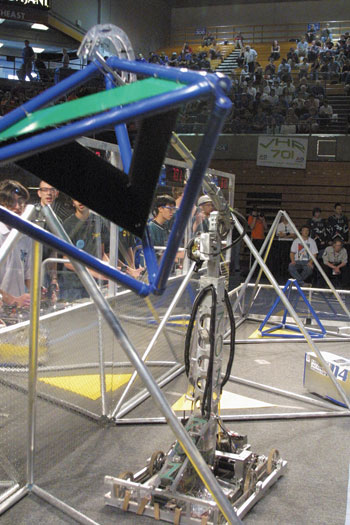

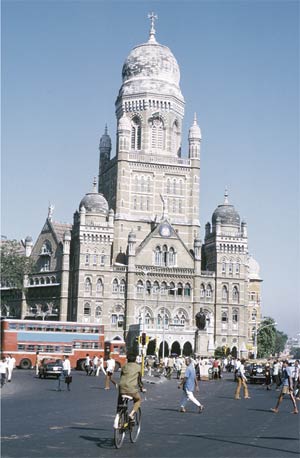
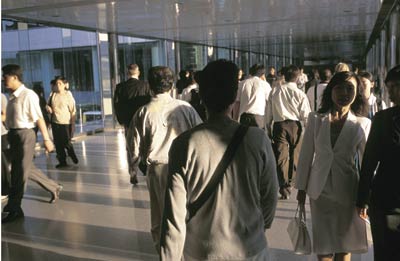 That’s when the big arm of politics — read exigencies of retaining vote banks — caught up with Deshmukh. In a clear reminder that development and governance can often be at loggerheads with politics, Congress party president Sonia Gandhi summoned Deshmukh to Delhi for a dressing down. The final word was that slum demolitions were contrary to the Congress party’s pro-poor image. Now the cut-off date for slum demolition has been revised to 2000, which pretty much retains the status quo in the overpopulated and congested metropolis.
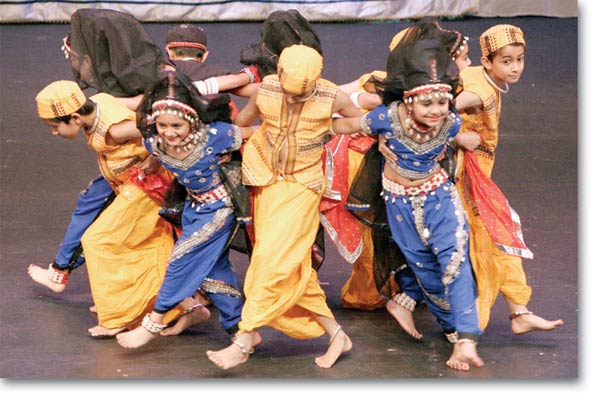




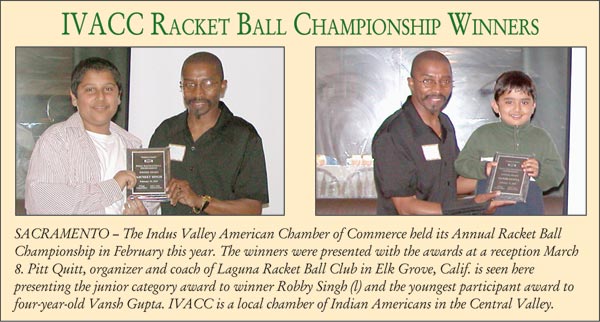



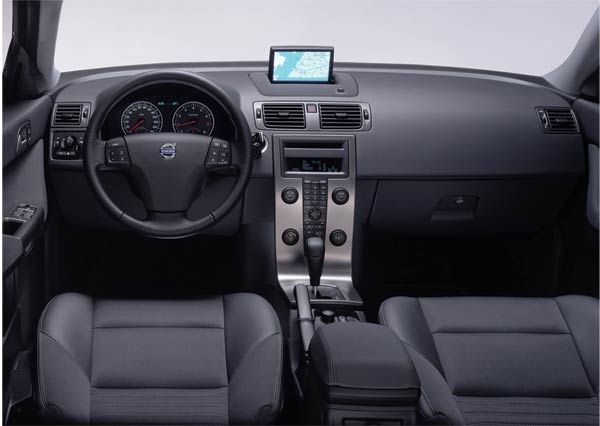



 ons, stir for 10 min. till brown. Add tomato paste to onions in pan. Stir for 10 min. Add tea. Stir for two minutes. Add garbanzo beans, salt, pepper, garam masala, chilli powder, chana masala, cilantro. Stir for 8-10 minutes. Finally, add lemon juice. Chholé is ready to serve.