 !-- Start Alexa Certify Javascript -->
|
|||||||||||||||||||||||||||
|
|||||||||||||||||||||||||||
|
|
|||||||||||||||||||||||||||
|
|||||||||||||||||||||||||||
|
|
|
|
|
|

DECEMBER 2005 |
|
||||||||||||||||||||||||||||||
|
EDITORIAL:
RAISING BILLIONS FOR POVERTY
It’s no activist pipe dream. The tax he has calculated is so minimal — 0.005 percent — that even currency traders are saying it will not affect trading. Enforcement of an across-the-board currency transaction tax is extremely complicated, so he has suggested that the U.K. levy the tax on all sterling transactions. If it does, and it works, other countries can follow. He recently went head-to-head in London with Jim O’Neill, head of global economic research for Goldman Sachs — debating the case for a currency transaction tax to help finance development, and won. About 100 people heard him argue for a CTT, with the case against made by O’Neill, one of the City’s biggest stars. The debate ended with an audience vote: the CTT a clear winner with two-thirds in favor of the proposition, and one-third against. Our cover story carries a detailed explanation of the plan. Now he is casting his eye on the U.S. He has introduced a new line of pickles, and is considering opening an upscale restaurant. He visited several Bay Area stores to promote his line of pickles. We carry an in-depth interview with him. COVER STORY: A Sterling Solution: A Currency Transaction Tax can Battle Global Poverty - By Sony Kapoor Not only can a currency transaction tax help fund the UN Millennium Development Goals to halve world poverty by 2015, but of even greater value is its ability to help grow the size of the global economic cake, with benefits to millions in poor, middle-income and rich countries, writes Sony Kapoor.  The currency market is the largest market in the world, with a turnover of $300 trillion every year. It is loosely regulated and, despite its size, is highly concentrated. Most of the trading is carried out by about 30 large banks trading mostly G7 currencies in eight major locations. The currency market is the largest market in the world, with a turnover of $300 trillion every year. It is loosely regulated and, despite its size, is highly concentrated. Most of the trading is carried out by about 30 large banks trading mostly G7 currencies in eight major locations.The price at which one currency can be exchanged for another is not constant but varies in response to changes in inflation, interest rates, unemployment and other economic factors. It is also influenced by other factors, such as speculation and market psychology, which affect the supply and demand for a currency. Surveys of currency traders show that economic fundamentals are relatively unimportant in trading decisions up to a six-month horizon. Since more than 90 percent of market transactions have a time horizon shorter than six months, it follows that most currency trading decisions do not reflect the true underlying economic value. As a consequence, exchange rates do not reflect the true relative strengths of economies and can lead to bad investment decisions. More than 75 percent of currency traders believe that speculation is the single most important reason why currency values do not reflect economic fundamentals. Though major economic variables change relatively infrequently, it is common for exchange rates to change up to 100,000 times in a single day. While most of these changes are small, they can sometimes add up to as much as 20 percent or more over the span of weeks or even days. Currency volatility is a measure of this change in the price of a currency. The larger and the more frequent the fluctuations in the exchange rate, the higher the currency volatility. When this volatility is very high, involving several large changes in prices, it causes instability in the financial system. Financial instability is one of the most serious problems currently confronting the world. High volatility in financial markets, even when it does not lead to spectacular crashes of the kind seen in South East Asia in 1997 — carries high social and economic costs. It acts as a tax on trade, investment, social welfare and growth and can undo in days what has taken years of development effort to achieve. Currency instability is by far the most pernicious form of financial volatility because of the severity of its impact. While excessive volatility in the stock or the bond markets is harmful, damage is limited to certain sectors of an economy and the people associated with those sectors. Instability in the currency markets, on the other hand, affects all aspects of the economy and can have disastrous effects on millions of people. Currency instability does not arise because of the actions of “evil speculators” but is a natural outcome of the incentive structure built into the market. The actions of a limited number of currency traders just doing their jobs can inflict damage to whole economies and have ruinous consequences for their populations. When the actions of a few can affect the welfare of many, there is a strong justification for public policy intervention. However, there are many who believe that “markets know best.” There is a way of striking a compromise between the two beliefs, using a market-based solution. The currency transaction tax changes the incentive structure in the market and works by discouraging instability-causing behavior amongst currency traders. While there have been various proposals for a tax in the past, they have either been impractical or incomplete. Both by building on the work done by others and using our own original research, we have proposed a comprehensive, pragmatic and feasible version of a currency transaction tax that would stabilize the currency markets. It would also reduce the occurrence of the kind of currency crashes that were seen in South East Asia, Mexico, Russia and Brazil. This is a mainstream proposal that combines two distinct instruments — security transaction taxes and circuit breakers — both of which are widely used in financial markets the world over. Security transaction taxes are currently in operation in many countries such as the United Kingdom, the United States, France and Belgium. Circuit breakers of various kinds such as trading halts or price limits are in existence in most major stock exchanges in the world, including the New York Stock Exchange. Our proposal is unique in the sense that it not only successfully addresses the criticisms leveled against previous CTT proposals, but also takes on board concerns expressed by both the financial and the political community. It is for this reason that we advocate a very low tax rate that the financial markets can easily afford to bear. Our version of the CTT is expected to mobilize net revenue of $15 billion without disrupting the current structure of the market. This revenue can be used for urgently needed international development programs. All UN countries have signed up to the Millennium Development Goals to halve world poverty by 2015 — however, it is widely acknowledged, by the British treasury amongst others, that there are presently insufficient funds to pay for them. This report shows that our proposition for a CTT would deliver a realistic, sustainable and powerful income stream. The CTT would also reduce both the volatility in currency markets as well as the likelihood of the occurrence of currency crashes. This reduction in volatility would be extremely beneficial for the global economy, with both international trade flows and foreign direct investment — FDI — expected to increase significantly. In addition, a reduction in the occurrence of financial shocks such as currency crashes would also help the global economy pursue a path of higher growth. Developing countries, in particular, stand to benefit from higher trade and FDI flows. How it would work. The CTT can be implemented unilaterally by any country and will apply to all foreign exchange transactions that involve its currency. This is possible, as a currency has no meaning outside the jurisdiction of the central bank that issues that currency. Even offshore U.S. dollar deposits, for example, are eventually held as “nostro” accounts by U.S. banks in the United States. So if a country signs up to a CTT, the central bank of the country is in a position to effectively oversee compliance with the tax regime. We suggest that all currency transactions be subject to the CTT — since trade and investment flows account for only a very small proportion of the total currency trading, they would not bear most of the cost of the tax. The incidence of the tax would fall mainly on large banks, where currency trading profits account for 5 percent — 10 percent of the total profits. Evasion would be expensive and carry the risk of loss of reputation. With the tax rate as small as 0.005 percent, the low cost of compliance would not justify the risks and costs associated with evasion. The CTT can be collected at the point of settlement, either through the Continuous Linked Settlement system or through a country’s gross payment settlement system that is overseen by the central bank or the finance ministry. While it is possible that derivatives instruments may be used to try and evade the tax, this is not feasible on a large scale, as the derivative market can not effectively operate in isolation. Transactions in the derivatives market would show up in the settlement system in one form or another. Benefits of introducing a CTT. The CTT creates a directly quantifiable benefit in the form of a powerful income stream. This has been widely discussed in previous literature on the Tobin Tax as funds to be designated to international development. The UN Millennium Development Goals — MDGs — are recent globally agreed targets to focus resources to urgent human need. Our contention is that revenue generated from a CTT by the Organization for Economic Co-operation and Development countries ought, by agreement with finance ministries, to be channeled towards international development objectives set out in these goals. The indirect benefits of the CTT are perhaps more challenging to quantify but potentially of far greater financial value than the tax revenue itself. These accrue through enhanced economic stability, a serious decrease in financial shocks caused by speculative attacks on currencies and a consequent reduction in the levels of foreign exchange reserves being held in order to guard against these attacks. Developing countries, especially after the South East Asian crisis of 1997–8, have accumulated $1,500 billion of foreign currency reserves, primarily to prevent the recurrence of another currency crisis. These reserves are invested mostly in short term OECD government bonds that pay an interest of only 1 percent–2 percent every year. The introduction of the CTT would, by reducing the likelihood of the occurrence of another currency crash, free up potentially 50 percent of these reserves — that is $750 billion — for more productive uses that generate returns as high as 20 percent every year. Businesses, especially multinational corporations, stand to gain from the implementation of a CTT due to the higher levels of trade, investment and growth this will bring. The CTT would directly reduce the risk of investing abroad. It would make a currency crash, where the value of overseas investments of MNCs would plummet, less likely. The cost of hedging foreign currency income streams and expenses would also diminish with the reduction in currency volatility that a CTT would bring. The mergers and acquisitions and overseas lending operations of large banks suffer when currency volatility is high, even as the currency trading operations make money. A lower volatility would make both M&A and overseas lending more safe and attractive. In the past 40 years there have been more than 300 chronicled speculative attacks on currencies. Of these, 105 have been successful and have resulted in a significant and sudden change in the value of a currency. The South East Asian crisis was an extreme example where the countries involved suffered serious economic and social consequences. However, even if such an attack is unsuccessful, the country suffers from serious economic costs as a result of the high interest rates that are needed to defend itself. By making the occurrence of a crisis less likely and by making the defense of a currency more effective, the CTT can help countries have lower interest rates which stimulate growth in an economy.
Not only can the CTT help fund the UN Millennium Development Goals to halve world poverty by 2015, but of even greater value is its ability to help grow the size of the global economic cake, with benefits to millions in poor, middle-income and rich countries. The passing of the CTT legislation in Belgium is a testament to the fact that the modern CTT proposition is technically possible and politically acceptable. Excerpted from a draft of “The Currency Transaction Tax: Enhancing Financial Stability and Financing Development,” a groundbreaking research report prepared by Sony Kapoor with support from the London-based Cooperative Bank. Readers can download the entire document at this Web link: http://www.waronwant.org/?lid=9100
WRITING: A History of The Universe: Science Writer Simon Singh - By Johnnye Jones Gibson Science writer Simon Singh weaves a magical, accessible tale of how scientists figured out the history of the cosmos, writes Johnnye Jones Gibson.  I decided to write a book about the Big Bang theory of the universe because it is one of the pinnacles of human achievement,” science writer and television producer Simon Singh says in his Web site. “I wanted people to understand the theory and to appreciate why cosmologists are confident that it is an accurate description of the origin and history of the universe.” The story begins with the theoretical foundations laid by Einstein and his General Theory of Relativity, but it was Georges Lemaître, a Catholic priest from Belgium, who proposed the idea of a universe born at a single instant in the past — “a day without a yesterday” — and expanding outwards from that moment. “Like any good tale, the discovery and proof of the Big Bang theory has more than its fair share of curious incidents and peculiar characters,” he adds. The theory was controversial. The scientific establishment believed in an eternal universe, and many cosmologists were reluctant to accept a theory that smacked of divine creation. An epic battle began. With both sides desperately in search of evidence to crush the opposition, the ensuing bitter disputes resulted in one of the greatest political, religious and human adventures ever told.
A scientist, mathematician, physicist and cosmologist, Singh vividly brings this sometimes geeky, techno world to life, making the theories accessible to a curious layman. In person, he had an instinctive ability to captivate an audience during a reading he gave in Berkeley, Calif. as part of his book-promotional tour. This book follows two others written by Singh: “The Code Book,” about the secret history of codes and code creaking, and “Fermat’s Last Theorem,” which became the first book about mathematics to make the best-seller list. In “The Big Bang” Singh weaves an entertaining story that captivates even those who have no scientific learning. He has a remarkable ability to impart scientific facts and theories in a way that is not only understandable to very young minds, but is fun, exciting and entertaining. “Ever since I learned about the Big Bang theory as a teenager, I have been explaining it to friends, relatives and strangers,” Singh said, when asked why he wrote the book. “Being trapped with me on a transatlantic flight means that you would probably get the full six-hour Big Bang tutorial. “I would argue that the Big Bang model of the universe is the most important and beautiful theory in science, and once you know what it is, how it works and why scientists believe it, then the temptation to share it with others is irresistible,” he said. Singh said his readers could be split into three categories. “First, there are those with some kind of science background; second, there are the high school students who are developing an interest in science; third, there are all those people who are just curious about the world. “I try to make the book accessible so that anybody can read it,” Singh said. “I mixed science with stories, explanations with narrative.” Singh wonderfully brings to life the elements of scientific history, the players, the theorists, the movers and shakers, with concepts that have been, up to now, out of reach for non-experts. He creates the “story” through the real-life historical characters who search and analyze and find theories and provable answers to many universal mysteries and questions. He uses examples from popular culture masterfully. Common everyday experiences of music, film, literature and even cartoons illustrate his points and concepts about these theories and sciences. For example: To involve the audience and simplify a point he later makes, he plays Led Zeppelin backwards and invites the audience to “hear” the satanic words (that aren’t really there). Amazingly, most of us hear those words. He explains how our minds continually search for patterns, and how we are so excellent at it that we find patterns even when none may exist — or, hear words that aren’t there. That should bring out a red flag to make us aware that a scientific theory based on a small amount of obscure evidence is more likely to be wrong. Because when we do this brain pattern search, we tend to “see” an aspect of what we are looking for. It is only when there are multiple evidences of substance that a theory has more of a chance of being accurate Singh was born in Wellington, in England’s Somerset, and his mother emphasized education, though his ancestry goes back to generations of farmers in Punjab. He found Somerset a fertile ground for budding scientists. Growing up in an era where he could watch Carl Sagan and others entice young minds, by age nine he declared he wanted to be a nuclear physicist. “Like many immigrants, my parents encouraged me to work hard at school and benefit from the sort of education they never received,” Singh said. Like most children during this time, he grew up loving TV. But he also knew what he wanted, and that meant concentrating on his studies: mathematics, chemistry and ultimately physics. Growing up in an area of Somerset where theirs was the only Indian family, Singh never felt discriminated against. According to Singh, “Everyone knew who we were, and everybody knew that we were not going to steal their children, or eat their pets. In Britain, problems seem to occur in those bigger cities where ghettos emerge. Where I live now, in West London, the communities are fairly mixed and everybody gets along reasonably well.” At college, while pursuing a scientific career in academia, his interest in journalism grew from writing articles for campus publications. Between leaving Imperial College and starting his PhD, Singh had a brief teaching stint at Doon School in Dehra Dun where he began to learn how to explain scientific concepts in a vivid and clear way. He always enjoyed talking about and explaining science, and eventually decided on a career in journalism focusing on science communication, as he always loved television and felt it was an influential medium. Singh is passionate about science education, which is, in part, why he wrote “The Big Bang.” “So people will understand what the theory is, who came up with it, and why we believe it is true,” said Singh. “In Britain, fewer people are studying science and mathematics, which is rotten because these subjects are wonderful and because we need scientists and mathematicians to innovate and invent and fire up the economy,” Singh said. “I suspect that it is the same in America.” Singh believes the only way to solve the crisis is to have more qualified and engaging teachers, but he finds that many good teachers leave the profession or many potential teachers do not enter it. According to Singh, “Somebody needs to acknowledge the problem, understand the problem and fix it.” He believes teaching is an incredibly difficult and potentially rewarding career, and we need to understand why there is such a shortage of teachers in subjects like mathematics and science. “In India, in contrast, there is a huge enthusiasm for these subjects,” said Singh. “Young people (there) realize that they can help themselves, their families and nation by studying science, but in the west We have lost the appetite for science.” In an age when children are less and less inspired, Singh is the master magician enticing them to return to reality. Specifically in the “Big Bang,” he introduces all readers of his book to the world of the theory of relativity and he expects them to be to be excited, educated, intrigued and inspired. Involved in many areas of education, he also put on a theatre show in London with a psychologist called Richard Wiseman, who has a background in magic. “He taught me a huge amount about performance,” says Singh. “Together we try to explain science and entertain, and the shows have had sell-out runs in London and Edinburgh. We are hoping to bring Theatre of Science to America.”
However, his programs on BBC Radio 4 are accessible online — “The Serendipity of Science,” “Five Numbers,” “Another Five Numbers,” “A Further Give Numbers.” Readers can check out these available works through the BBC’s Web site. Singh’s U.S. book/lecture tour began in California on Nov. 4. He heads for India in December in a trip sponsored by the British Council, an organization that tries to promote Britain around the world. Singh will be partly talking about his book, and also discussing how to engage the public in science and how to involve scientists in a dialogue with non-scientists. NEWS DIARY: November Roundup  Economy Summit | Four South Asians Win Rhodes Scholarships | Sikh Delegation Visits Pakistan | Bomb Blasts Kill Eight in Bangladesh | San Jose Doc Missing | Amrita Pritam, Doyenne of Punjabi Literature, Dies | Lanka Offers Peace Talks | Telephone Ladies | Altitude Record | LOC Opens | Pneumonia Hits Quake Zone | Attempted Gandhi Murderer Dies Economy Summit | Four South Asians Win Rhodes Scholarships | Sikh Delegation Visits Pakistan | Bomb Blasts Kill Eight in Bangladesh | San Jose Doc Missing | Amrita Pritam, Doyenne of Punjabi Literature, Dies | Lanka Offers Peace Talks | Telephone Ladies | Altitude Record | LOC Opens | Pneumonia Hits Quake Zone | Attempted Gandhi Murderer DiesEconomy Summit
“Our economy has been growing at an unprecedented rate ... and we are likely to grow by about 7.5 percent this year,” Singh told the business conference. But India faced an infrastructure deficit and the government would spend $37 billion over the next seven years into developing the road network which in many areas is unpaved and riddled with potholes, he added. Another key area targeted for reform by the communist-backed coalition government led by Singh’s Congress Party is labor laws. Employers and economists say increased flexibility in hiring and firing is vital, but Singh’s communist allies are resisting changes they say will hurt workers. India needs to create at least 10 million jobs a year to provide work for its young and increasingly educated workforce. Singh said India’s foreign direct investment regime was one of the world’s most liberal and ministers were working on cutting red tape, which he admitted slowed down business.
Samsher S. Gill graduated from the University of Chicago in 2005 where he majored in political science, and where he won the top undergraduate honor. He is now working as a researcher in media criticism at Media Matters, a Washington, D.C. watchdog group. Gill plans to do an M.Phil. in political theory at Oxford. Noorain F. Khan is a senior at Rice University where she is writing her thesis on issues relating to the veiling of Muslim women. An active campus leader, she has interned at the Middle East Institute and Amnesty International. At Oxford, she plans to do an M.Phil. in migration studies. Lakshmi Krishnan is a senior at Wake Forest University. She is president of her campus Amnesty International chapter, and recently interned in the Health Action AIDS Campaign at Physicians for Human Rights. At Oxford, Lakshmi will read for the M.St. in English. Rahul Satija is a Duke senior majoring in biology and music with a minor in math. He has been carrying out research in bioinformatics. He is also concertmaster for the Duke Symphony Orchestra and first violinist of a student string quartet, and holds Duke’s only music performance scholarship. He also teaches violin to inner city youth in Durham. Rahul plans to do the D.Phil. in bioinformatics at Oxford.
Elahi said the friendship process initiated by him and Capt. Amarinder Singh would continue. He said the Amritsar-Nankana bus service would begin soon. He said the Pakistan government was working on development projects to facilitate Sikh visitors at Nankana Sahib, including a modern hospital in the city and Wagah-Nankana dual carriageway. Capt. Amarinder Singh said the peace process initiated by the chief ministers of Indian and Pakistani Punjab had led to improvement of economic and trade ties. He said the people of Indian Punjab were grieved by the earthquake in northern Pakistan and they wanted more openings along the Line of Control.
No one claimed responsibility, but police investigators pointed to outlawed Islamic militant group Jumatul Mujahideen Bangladesh, blamed for similar attacks this year. The attacks prompted widespread condemnation and protests, including a call by lawyers for a day-long general strike. Prime Minister Khaleda Zia called the bombers “enemies of the nation, Islam and democracy” and vowed to punish them. Other political parties, including the main opposition Awami League and an Islamic party allied to Zia’s four-party alliance, also condemned the bombings in separate statements. The explosions in the port city of Chittagong and in Gazipur town, just outside the capital, Dhaka, happened just before 9 a.m. local time and appeared to target courthouses, police said. A handwritten note found on one of the suspected bombers warned police, judges and lawyers “to stop upholding man-made laws which go against Islam,” Chittagong police official Mohammad Majedul Huq said. The blasts triggered panic and protests at courthouses across Bangladesh. In Dhaka, hundreds of lawyers boycotted courts and took to the streets, urging authorities to act against those responsible. “Catch the bombers and put them on trial,” shouted dozens of lawyers at the Dhaka Judge Court. Her husband Tasadduq, 60, had asked her many times to give up her pediatric medicine practice in a tough section of Oakland, but she always refused. The Attaris came to the United States in 1976. He worked as an engineer while she built her medical practice. Together, they raised two daughters, 20-year-old Huma Attari and 27-year-old Ruby Ali. Now Tasadduq Attari, a seemingly stoic man, stays busy making posters and fliers with his wife’s image. Oakland police are investigating the disappearance, which has been classified as a missing person case. The three full-time officers assigned to the case, with help from the FBI and U.S. Marshal’s Office, have retraced Zehra Attari’s route, scanned the region with aircraft and dredged waterways, but have come up with no firm clues. “She enshrined the concept of punjabiat, the deep consciousness of being a Punjabi — a child of the land of the five rivers — irrespective of religious or caste affiliation.” In 1986 she was nominated to the Rajya Sabha, and what moved her particularly was when later Punjabi poets in Pakistan’s Punjabi Academy sent her chaddars, green silk covers edged with gold, from the tombs of Waris Shah and fellow Sufi mystic poets Bulle Shah and Sultan Bahu. Touched, the dying poet proudly had herself photographed with the chaddars. Winner of India’s Jnanpith Award, the Sahitya Akademi Award, and Padma Shri — she was the first woman to win the last two awards — Pritam penned 24 novels, 15 collections of short stories and 23 volumes of poems. In 1960, Pritam left an unhappy marriage and her husband for Imroz, an artist and writer. For more than four decades, they were inseparable and supremely happy, and he designed most of her book jackets. He survives her, as do a daughter and a son from her marriage. He said he was ready for talks immediately to review the two sides’ 2002 ceasefire. Tiger leader Velupillai Prabhakaran had said the rebels would intensify their struggle if there was no settlement within the next year. The Tigers have been campaigning for more than two decades for self-government in the north and east, which they consider the Tamil homeland. The 2002 truce brokered by Norway ended more than 20 years of civil war which has killed more than 60,000 people, but has become increasingly fragile. The president has said the solution to the ethnic conflict lies with a unitary state, but the rebels’ official position is that they want to share power along federal lines. Tamil Tigers leader Prabhakaran said Rajapakse should put forward a “reasonable political framework that will satisfy the political aspirations of the Tamil people” soon.
One pioneering scheme in Bangladesh has become famous for its “telephone ladies,” reports the BBC. In Kalimajani, a typical Bangladeshi village surrounded by paddy fields where the only way to get here is by walking along pathways, the mobile phone has changed communications dramatically. After village resident Roshinara Begum got her mobile phone with the help of Grameen bank, she began selling calls. She’s become one of Bangladesh’s telephone ladies. “Before I got the phone nobody respected me,” she told the BBC as she sat in the tin hut she uses as her office, clutching the phone that has changed her life. Roshinara Begum makes a good living selling calls, earning $60 to $70 a month. It has helped other villagers too. Mohammed Abul Kashem, who runs a fish farm of 10 man-made ponds, uses the phone service to order food and other supplies from the capital. “If the phone wasn’t here then I’d have to travel to Dhaka,” he said. Grameen has given loans to 180,000 telephone ladies so far, and 10,000 more are being signed up each month. The key to the success of the scheme is that it is not charity - every month Grameen gets $10 million in revenue.
“The exact height reached was 21,290.89 meters (69,852 feet). This is subject to certification,” said Colin Prescott, one of two British designers of the 44-ton balloon. The previous world record was 19,811 meters (64,997 feet), set by Sweden’s Per Lindstrand in Plano, Texas, in June 1988. ”This goes to show to the world that we are not bullock cart drivers, but we can compete against the best of the world,” said Singhania, chairman emeritus of the Raymond Group, one of India’s leading textile companies. Jubilant villagers crowded around the balloon to congratulate Singhania. He prayed at a nearby shrine of a Hindu religious leader, Sai Baba, before driving to Mumbai where he popped bottles of champagne with his friends and supporters.
India, Pakistan had Oct. 29 agreed to open five points along the LoC in Jammu and Kashmir. For most of the people who crossed over, it was a dream come true. “I wanted to see all of Kashmir and all the places in India but now I don’t know whether I will be allowed to do that,” said Mahmood Aslam, resident of Kotli, Pakistan-ruled Kashmir. People were also happy as didn’t have to take the Srinagar- Muzaffarabad bus and travel hundreds of kilometers afterwards to meet their loved ones in Mendhar. “Most people who had come to watch the crossover taking place said that many such crossing points should be opened in the future for free movement of people across the LoC. “Cases of pneumonia are coming in. They’re in the hundreds, affectees are mostly children,” said Sardar Mehmood Ahmed, district health officer in Muzaffarabad, the devastated capital of Pakistani Kashmir. The quake left more than three million people homeless in Pakistani Kashmir and adjoining North West Frontier Province, which bore the brunt of the biggest disaster in Pakistan’s 57-year history. Aid agencies are racing to ensure that homeless survivors get adequate shelter and enough food to see them through the winter. Failing this, disease could sweep through cold, poorly nourished survivors, causing a second wave of deaths, aid officials say. Gopal Godse was 86. He never repented of his role in Gandhi’s death — a crime for which he served 16 years in jail. Mahatma Gandhi’s peaceful campaign is widely credited with bringing about the end of British rule in India in 1947. As a result of his pacifist philosophy, he went on to become one of the most revered men in modern history. Gandhi was a frail man of 78 when he was killed Jan. 30, 1948. He was on his way to the prayer grounds at his home in Delhi when a man stepped in front of him and shot him. The man was Gopal Godse’s brother, Nathuram. They and several others masterminded the assassination, which at the time sent waves of revulsion through India. Nathuram and another man were hanged for Gandhi’s murder. Gopal was spared. Even though he had tried to kill Gandhi, he froze and was unable to pull the trigger. He said he had done what he had done in the interests of the nation. He said Gandhi had to die because he betrayed Hindus by backing the creation of Pakistan. CUISINE: Chef’s Passage: TV Cook Sanjeev Kapoor in U.S. When you are cooking, cook with passion, cook with a smile and it will work, guaranteed, advises celebrity TV chef Sanjeev Kapoor in an exclusive interview.  From Left: Sanjeev Kapoor standing next to his Khazana brand of pickles display at Namaste Plaza in Sunnyvale, Calif. Sanjeev Kapoor talks to a shopper at India Cash & Carry in Sunnyvale, Calif. about his pickles as owners Neelakshi (r) and Dinesh Sharma (3rd from r) of India Cash & Carry and U.S. distributor of Khazana Pickles Kuntal (2nd from r) look on. Sanjeev Kapoor, one of India’s leading chefs and presenter of the wildly popular Khana Khazana show on Zee TV, was in the San Francisco Bay Area for the launch of his Khazana brand of pickles. A road show of his launch in various South Asian outlets was organized by Deep Foods, distributors of his products in this region. Excerpts for an exclusive interview with Sanjeev Kapoor follow. Tell us briefly about how you got into cooking. Actually, it was an unintended move. Main galti se is field mein aagaya tha. What I meant was that I had never considered taking up cooking as a profession. I sort of bumped into it. But I have a problem. Whatever I do, I like to do it with passion and I do not venture into anything half-heartedly. So when I took up cooking professionally 20 years ago, I worked at various hotels and I simultaneously started teaching people how to cook. Whether at the hotels where I worked or through the television, I kept teaching people how to cook and the benefit of all of this was that I got the viewpoint of people regarding food, what they want, what they don’t want. Because of time constraints, the teaching that I do is through mass medium like television, because to do teaching through small batches is just not possible because the demand and pressure on me is so much. However, I am also teaching through the Internet, through my Web site which is www.sanjeevkapoor.com. and I am also looking at a distance learning course that we are developing. Definitely the way I would like to position myself and Indian food for this market would be to talk about Indian food from a position of strength and also look at taking this cuisine to greater heights. There is growing interest in this food and the right thing to do would be to take it to a different level and take it to a premier positioning. The only way it can be done is through different products such as pickles, spices, etc or through direct food experiences such as restaurants as well. I am considering opening a really upscale restaurant in U.S. at a premier location in New York. I want people to look at Indian food from a different perspective. When I say different, it’s not cheap Asian food, it is something which is a premier thing to have. It can be done fairly easily if we do the right thing and not cut corners and not deliver average quality or poor quality stuff. Just for the international market I want to look at Indian food with great respect and reverence because what I have seen is that they currently look at Indian food as hot curries and cheap curries. I want people to change that perception. I think it’s a great confusion. The way I look at is that you can make changes, you can make a food grow, but you should not just mix, marry and match just for the heck of it, just to be different. I think if we look at anything which is good, anything which is of any real meaning and value then it would be nice and authentic. When I say authentic, it need not be old and traditional, authentic would mean using all elements which are relevant, not marrying and mixing and matching just for the heck of it which most of the time is done by people who get into fusion food. Currently we are launching pickles for this market. The next step will be to look at spices and in spices we would look at blended spices, whole spices and then we would look at ready-to-eat products also, that would be the next step. Definitely. In the past less than twelve months, this is my third trip to this country and before that for ten years I have not been here. This means that my commitment to this market is definitely there. I will make sure that I keep on interacting with people of this market more often and for the readers of your magazine I would like to say that when you are cooking, cook with passion, cook with a smile and it will work, guaranteed. Through my Web site: www.sanjeevkapoor.com readers of your magazine can reach out to me where we have a section where they can write to me. SOCIAL WORK: Quake Aid: Imran Khan Fundraiser - by Ras Siiddiqui In response to Pakistani cricket legend Imran Khan’s appeal, a single fundraising dinner raised nearly $300,000 for earthquake victims, creating a heartwarming example of South Asian solidarity and compassion, writes Ras Siddiqui. 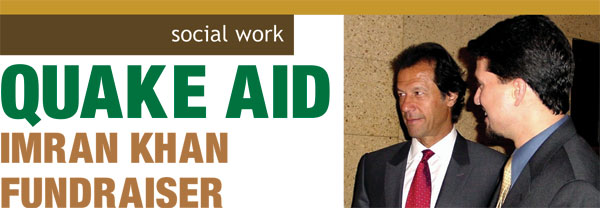 Pakistani cricket legend Imran Khan with Omar Khan of Jaiza. The Pakistani-American, Muslim and broader South Asian community in Northern California has held numerous fundraising events for earthquake relief since Oct. 8 when the massive 7.6 Richter scale quake hit mainly Kashmir and Pakistan. Cricket legend Imran Khan came to San Jose, Calif., Nov. 18 to a fundraiser sponsored by the Silicon Valley chapters of the Organization of Pakistani Entrepreneurs of North America, The Human Development Foundation, The Citizen’s Foundation and last but not least The Indus Entrepreneurs. At the time of this writing the final amount raised was just under $300,000. Despite the event taking place at the tail end of the current fundraising season for earthquake victims, it was still the largest amount raised at a single event in Northern California.
Imran Khan makes Pakistanis proud no matter where they may be. And here he was once again, in person, at his 3rd appearance in the San Francisco Bay area this year, for a cause that is close to many hearts. Describing the delayed response to the magnitude of this earthquake tragedy, Imran said that he was taken aback when he visited some of the affected areas on the third day after October 8th. “It is beyond description,” he said. “It is too tragic to describe. This is beyond the Government of Pakistan,” he added CINEMA: South Asian Film Festival: Celebrating Desi Cinema - A Siliconeer report From cutting-edge documentaries to Bollywood extravaganzas, the South Asian international film festival presents a comprehensive package of some of the most interesting work coming out of the region and its diaspora. Siliconeer presents reviews of some of the films shown this year.  Clockwise, from top: San Francisco’s Castro Theater, venue of the South Asian Film Festival; stills from “No More Tears, Sister,” Khamosh Pani” and “Meghe Dhaka Tara.” In just its third year, 3rd I’s annual San Francisco International South Asian Film Festival has become a must-see event for desi film aficionados in the San Francisco Bay Area. For good reason, too. To the enormous credit of its organizers, the festival cuts an astonishingly wide swath, reaching all over the world and putting together a wondrously rich, diverse offering that befits this many-splendored culturally vibrant region. Like previous years, this year’s festival had it all — a quirky Rajasthani folk tale-based film from Bollywood featuring Shah Rukh Khan and a number of documentary gems from the U.K. and Canada as well as short films. Shonali Bose and her much-expected AMU were both no-shows, but Junoon band Sufi rock star Salman Ahmad was present in person at the screening with his deeply affecting BBC documentary reflecting on the harrowing experience of being a Muslim in post 9/11 United States. Another film that deserves mention as was a poignant documentary on a slain Sri Lankan Tamil activist. Following are reviews of some of the films shown in this year’s festival. This moving BBC documentary follows Junoon singer Salman Ahmed all over the U.S. as Khan meets a diverse group of Muslims (read Pakistani immigrants) to figure out how they are coping. What emerges is a complex story of a diverse community that simply cannot be described in a sweeping brushstroke based on religious identity. From New York cabbies to a mother whose loss of her son in the 9/11 attacks made her a civil rights activist, from a hilarious Muslim comedy troupe called “Allah Made Me Funny” to a super rich Pakistani family who are committed supporters of President George W. Bush, the film shows a varied group of people who have, in their own way, taken up the challenge of coping with the rising tide of suspicion and xenophobia in the wake of the terror attacks of September 11. “Following the attack,” Salman says, “there were human rights abuses against Muslims, using immigration violations as a weapon. Thousands have been detained and others deported.” One month after the attacks on New York and Washington, Congress rushed the Patriot Act into law to help track down terrorists. “The Act gave the FBI the right to spy on American citizens, to look into our lives, our email, and even our library records,” he says. While some Muslims have joined civil rights activists to fight the draconian law, former lawyer Azhar Usman has a different strategy. He believes the answer lies in comedy. Touring the U.S. with the show “Allah Made Me Funny,” Azhar is convinced that many Americans want to hear from moderate voices. “The more mainstream America hears the moderate voices, the less suspicious they’ll be,” he says. Usman also thinks the onus is on American Muslims to regain their rightful place in the United States. “We as American Muslims must stand up, be proud of who we are, and be people who say unequivocally and enthusiastically, that we’re American Muslim.” Here, Muslims have fallen short, he argues. He adds: “Our problem as a community is that we’re very isolationist. We don’t want to get out there and make bridges with people, connect with people.” A visit to the Colorado mansion of his aunt, Seeme Hasan, is a surreal experience. Seeme and her husband Dr Hasan are staunch supporters of President Bush. They get personal birthday wishes from the president, they are regular guests at his ranch in Crawford, Texas. This couple is so completely removed from the struggles and frustrations of the less privileged Muslims that they could well live in another world. Salman has a deadpan style of commentary that doesn’t have the slightest whiff of criticism, yet the values and perceptions of the Hasans, juxtaposed with the contrasting experience of other Muslims, makes for quite amusing viewing, even if the humor may be unintended. Overall, Salman steers clear of sitting in judgement. Sufism-inspired artist that he is, he exudes a gentle, healing humanity that acts as a soothing salve in a portrayal of a very disturbing and challenging time for the community. In 1914, Gurdit Singh, a Sikh entrepreneur based in Singapore, chartered a Japanese ship, the Komagata Maru, to carry Indian immigrants to Canada. On May 23, 1914, the ship arrived in Vancouver Harbor with 376 passengers aboard: 340 Sikhs; 24 Muslims and 12 Hindus. Many of the men on-board were veterans of the British Indian Army and believed that it was their right as British subjects to settle anywhere in the Empire they had fought to defend and expand. They were wrong. When the ship reached Vancouver Harbor the most popular ballad of the day was “White Canada Forever,” and a newspaper headline screamed: “Hindu Invasion Now Imminent.” Canada had a policy of excluding of South Asians by a little known immigration rule called the Continuous Journey Regulation of 1908. Unlike the Chinese and the Japanese, people from British India were excluded by this regulation that appeared fair, but in reality, was an effective way of keeping people from India out of Canada until 1948. There were about 6,000 South Asians in Canada by 1908, and white politicians passed a law requiring immigrants to come by “continuous journey” from their country of nationality. That is, no stopovers. To emphasize the point, Immigration Canada, the country’s immigration bureau, forced the Canadian Pacific Company to shut down all ship service to and from India, continuous or not. Only a half-mile from Canadian shores, the Komagata Maru was surrounded by immigration boats and the passengers became virtual prisoners on the ship. During their two-month detention in the harbor, Canadian authorities drove the passengers to the brink of thirst and starvation. The stand-off was broken with the intervention of Prime Minister Robert Borden who also called in a Canadian battleship to underline his stance. On 21 July, over 200 fully armed local militia lined the shore, while The Rainbow prepared for confrontation on the sea. All of Vancouver was out for the spectacle. Major confrontation was averted through eleventh-hour negotiations, and in the end, provisions for the Komagata Maru’s return journey were provided. The misery of the Indians did not end there. Upon its return to India, the Komagata Maru encountered hostile British authorities who fired on the passengers, suspecting them to be seditious. Over forty people went missing or were killed. Some of the passengers escaped, including Gurdit Singh, who lived to tell the “true story” of the Komagata Maru. Kazimi s puts this relatively little-known event in a contemporary context as he reflects on his own feelings as a person of color who has immigrated to Canada. The film is not without is flaws — digital manipulation of photos and voice-overs of people reading period texts sometimes feel like overkill. This shameful chapter of history is inherently full of drama, colorful personalities and superb documentation, and perhaps Kazimi would have been wiser if he had taken a more minimalist approach. That said, it’s an affecting poignant tale that brings into the limelight an ignored but important slice of history of the early South Asian diaspora in North America. Ali’s films have been screened in festivals around the world, broadcast nationally in Canada and abroad on Channel 4 in Britain and PBS in the United States. A major river in northern India and Bangladesh, it originates as the Bhagirathi from the Gangotri glacier in the Uttaranchal Himalaya and joins the Alaknanda near Deoprayag to form the Ganga. Then on, the Ganga flows across the large plains of North India and empties into the Bay of Bengal after dividing up into many branches. One of them is the Hoogli River near Kolkata, another being the Padma river that enters Bangladesh and merges with Jamuna river, a branch of the Brahmaputra River. One of the densest human population belts on earth is built around the 1,560 mile-long river. The Ganges basin is incredibly fertile and, at present, about one in every 12 people in the world live in its catchment area. However, due to this incredible concentration of population, pollution and destruction of habitats is increasing at an alarming rate in the region. With a title like “Ganges: River to Heaven,” the expectation is that the long, diverse path it courses through the heart of North India will be captured in some measure; yet there is little of this in the film at all — which is a disappointing surprise. The film’s focus is entirely Varanasi, the ancient Hindu holy city by the banks of the Ganga. Director Gayle Ferraro follows four families who bring loved ones, all at their deathbed, to a hospice. Family members, hospice workers, nearby shopkeepers who sell cloths and pyres for cremation, provide an intimate view of how deeply attached Hindus are to this river. Dying by the river brings moksha to the human spirit, liberating the soul from the endless cycle of life and death, devout Hindus believe. Along with the touching faith of ordinary people, Ferraro also shows the real ecological challenge the river faces with untreated waste being dumped in the river by the ton. A local mahant, Veer Bhadra Mishra, who is also a scientist, has spearheaded a heartening public campaign to clean up the river, the film shows. Ferraro’s inquiring eye presents a vivid picture of Varanasi, with its teeming crowds, innumerable bathing devotees, people involved in the cremating business, and it is at the end of the day an affecting film — but you will learn a lot more about Varanasi than the river. It’s actually a pretty good film, it’s just that the name is very confusing and gives little inkling of what is going to follow. BUSINESS: Bibliophile’s Web site: Abebooks Acquires BookFinder - by Anirvan Chatterjee Although it has been acquired by Canadian online giant Abebooks, bibliophiles’ favorite online haunt Bookfinder.com will continue to remain independent, writes CEO Anirvan Chatterjee.  BookFinder.com has been acquired by Abebooks, and will continue to be an independent and unbiased resource. But let’s start at the beginning: I first started working on BookFinder.com nine years ago, as the final project for a class at the University of California Berkeley. I put it online in 1997, and relaunched it in 1999 with my best friend Charlie. Over the years, we’ve received tremendous support from online book shoppers, collectors, sellers, and listings services, who have helped us develop what we believe to be the best book search service online — whether you’re looking for new, used, rare, out of print, or international titles. We work very hard to get the details right. BookFinder.com is a small operation, with only two full-timers (and the support of a few friends). We work to do more with less, but have sometimes had to make compromises because of our size, leading us to scale back or shelve some of our more interesting projects. We’ve been in touch with the folks over at Abebooks (based in Victoria, Canada) since 1998, and in that time, we’ve come to respect the business and the people behind it. We face many of the same challenges: managing massive inventories, serving diverse groups of users, and balancing the needs of booksellers and shoppers. We check in with Abebooks regularly, and it recently became clear that many of our ideas and goals are related. One thing led to another, and now, I’m delighted to announce that BookFinder.com has been acquired by Abebooks. We will remain an independently operated and managed entity based out of Berkeley, but we’ll now also be able to draw upon our Canadian friends’ technology resources and industry expertise to help us develop our ideas, and make this an even more useful service for book buyers and sellers.
Charlie and I have been friends since junior high school, when we’d spend many of our free periods in the school library, tinkering with computers and reading sci-fi. We’ve worked on a lot of projects together over the years (e.g. publishing zines, photographing subway stations), but we’ve always gravitated back to books and technology. We’ve been working with our users to build the perfect book search system for the past nine years; we think assistance from Abebooks can help us get there a little bit faster. TECHNOLOGY: Biotech Bazaar: EPPIC Meet - A Siliconeer report Experts from U.S. and Indian biotech firms met to discuss affordable innovation, opportunities for clinical research in India and follow-on biologics. A Siliconeer report. 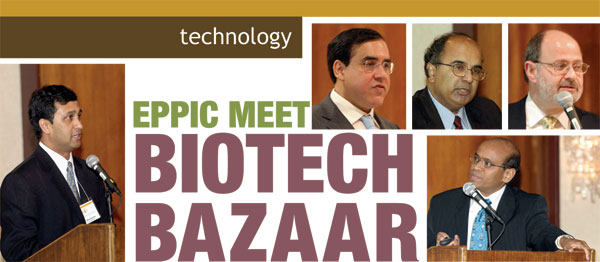 Top, from left: Quintiles India CEO Ferzaan Engineer, Consul General B.S. Prakash and Barr Labs, U.S., director Alan Liss. Bottom, left: EPPIC president Ram Mandalam. Bottom, right: Global Industry Analysts CEO Ram Reddy. Just what are the major challenges in today’s biotech industry? What advantages does India have? Professionals from about 80 biotech, pharmaceutical and allied organizations from across the U.S. and India came together at a symposium at the Clarion Hotel in Millbrae, Calif., recently to focus on affordable innovation, opportunities for clinical research in India and follow-on biologics, according to organizers EPPIC. EPPIC — Enterprising Pharmaceutical Professionals from the Indian Sub-Continent — was founded in 1998. A not-for-profit organization headquartered in San Francisco with a chapter in Chennai, it is run by a team of volunteers comprising scientists, executives, entrepreneurs and attorneys and fosters networking and entrepreneurship among biotech and pharmaceutical professionals. EPPIC president Dr Ram Mandalam said in his welcome note that the symposium is being organized at a time when pharmaceutical and biotechnological industries are undergoing a paradigm shift in ways to develop cost-effective products while focusing on global markets for commercialization. San Francisco Consul General for India B.S. Prakash said the biopharmaceutical industry in the U.S. and India were at the “peak of exploring great opportunities.” He emphasized that the “synergy between the world’s largest democracies is great and it was due in part to shared values and interests.” Advinus Therapeutics CEO Dr. Rashmi Bharbhaiya said the growth in U.S.-India collaboration will be necessitated by emerging trends in the U.S. life sciences industry including rapidly aging population, skyrocketing cost and slowing pace of new drug development, increasingly personalized medicine, political and social pressure to reduce excessive waste in healthcare delivery, and stretched-thin industry R&D budgets. Advinus Therapeutics is a leading Indian contract research organization focusing on drug discovery and early-stage development. U.S.-based ReaMetrix CEO Dr. Bala Manian, a successful serial entrepreneur, said that the cost of innovation in the developed world is too high and out-of-box thinking is needed to overcome the current crisis in R&D productivity. Manian, who spends most of his time in ReaMetrix’s Bangalore facility, said a new tendency was emerging in biopharma R&D that exploits affordability and scientific skills of India to accelerate product development output of the U.S. industry. A panel on “Affordable Innovation in Life Sciences” moderated by Dr. Dinesh Patel, CEO of Miikana Therapeutics, presented experts from clinical development, vaccines, diagnostics, and drug discovery backgrounds. Dr. Anish Bhatnagar, vice president of clinical development at Titan Pharmaceuticals, estimated that net costs savings afforded by going to India to be around 40-50 percent and found the data quality from India to be “good and acceptable by the U.S. FDA.” More information on EPPIC is available on the Web at www.eppicglobal.org TELEVISION: Cricketmania! England Tours on TV - A Siliconeer report Dish Network Brings the glad tidings for cricket buffs that it will bring all matches of the India, Pakistan and West Indies tour of England from 2006 to 2009. A Siliconeer report.  India’s Sachin Tendulkar (above) and West Indies’ Brian Lara (below). India’s Sachin Tendulkar (above) and West Indies’ Brian Lara (below).Bottom: The Lords cricket ground in London. Cricket buffs in North America are in for a treat. They can now watch cricket matches played in Lords cricket ground in London, the Mecca of cricket, live from 2006 through 2009. DISH Network has acquired exclusive rights to the England cricket home tours for 2006 through 2009 from the England and Wales Cricket Board. This comes on the heels of a previous announcement that it acquired the rights to Pakistan national cricket for 2005 through 2008.
Televised tours include: Sri Lanka (three test matches, five ODIs and one Twenty/20) and Pakistan (four test matches, five ODIs and one Twenty/20) in 2006; West Indies (four test matches, three ODIs and two Twenty/20s) and India (three test matches and seven ODIs) in 2007; South Africa (five test matches, five ODIs and one Twenty/20) and New Zealand (three test matches, five ODIs and one Twenty/20) in 2008; and Australia (five test matches, seven ODIs and two Twenty/20s) and Zimbabwe (two test matches and three ODIs) in 2009. DISH Network offers hundreds of channels, Interactive TV, HDTV, sports and international programming, together with professional installation and 24-hour customer service. TELEVISION: Lock Kiya Jaye? KBC Returns - A Siliconeer report Big B returns for a second run of the game show Kaun Banega Crorepati, which revolutionized both Indian TV and his sagging career. A Siliconeer report. 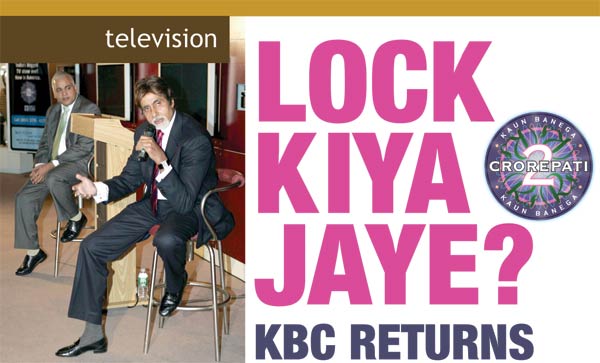 Amitabh Bachchan seen here with DirecTV’s senior manager (international programming) Anu Babber (l) at a press conference to launch ‘Kaun Banega Crorepati 2’ in the U.S. in New York, Nov. 17. India’s biggest game show Kaun Banega Crorepati 2 is launching on STAR PLUS in the U.S. on DIRECTV channel 2001. To commemorate the event, Bollywood icon and show host Amitabh Bachchan, was on hand in New York at a ceremony at News Corp. headquarters in Manhattan, according to a press release. KBC, India’s version of Who Wants to Be a Millionaire, was the show that changed the face of Indian television. It has been the No. 1 show in cable and satellite homes in India with consistent TV ratings of over 40 percent share. STAR PLUS will bring the show to DIRECTV subscribers for the first time Dec. 2, every Friday to Sunday 7:00 p.m. Pacific Time (10:00 p.m. Eastern) Bachchan returns for the second run of KBC. At the event he shared his experience of working on the hit show, and spoke about the runaway success of KBC across Asia and the U.K. Aside from the Big B, viewers can also expect plenty of glamour-packed celebrity specials featuring top Bollywood personalities such as John Abraham, Saif Ali Khan, Ajay Devgan, Kajol, Priety Zinta and Lara Dutta. A record total of 21.5 million viewers tuned in to KBC 2’s August season premiere in India. When registration phone lines opened for people wanting to participate in KBC 2, STAR PLUS was flooded with 15 million calls in only 10 days and that number has gone up to 100 million calls as of this week. Another crowd puller is the fact that the winner now walks away with Rs. 20 million ($500,000) instead of Rs. 10 million. TELEVISION: Kareena Kareena: ZEE TV Star Kulraj Kaur Randhawa - A Siliconeer report Television serial Kareena Kareena star Kulraj Kaur Randhawa was in the U.S. to perform in a Raas Garba fest. A Siliconeer report.  Kulraj Kaur Randhawa at a reception in Elk Grove, Calif. Television serial Kareena Kareena star Kulraj Kaur Randhawa recently stopped by for a vacation break in the Sacramento suburb of Elk Grove, Calif. at a relative’s place. About 40 people turned up to meet the television star at the residence of Gurjatinder and Pinky Randhawa. Personable and vivacious, Randhawa chatted with others with enthusiasm and grace. The curious thing about her is that she never planned to be an actress initially. “I never thought of acting being my career since I thought it had a risk factor involved,” she has said in an interview. “But soon I realized that I was born to become an actress.” After getting a bachelor’s degree in business management from Bangalore University, Randhawa took a course in acting under Kishore Namit Kapoor. “He requested me to come over to Mumbai and take acting seriously,” she says. “So I came to Mumbai, completed the acting course and then started looking for work.” Offers poured in, but she was choosy. “I wanted to choose something that I was convinced of,” she said. “Kareena Kareena was really very nice and I liked it very much. It’s not a Kkusum or Jassi type of role which is quite plastic, linear and straitjacketed, I felt, and signed on right away as it was the script, which attracted me to accept the role. It has a climax and then an anti-climax angle too. As a newcomer I knew this was one serial where I could carve a niche for myself.” Randhawa says what the show has going for it is “the chirpy feel, its freshness and humor.” “The situations in the serial are very simple and can happen to any person,” she says. “Even in the serial it is not played up at all, and rather it’s given a very straightforward approach rather than a serialized setting. It’s something that could happen to any girl of my age. It’s a very natural, situational comedy.” Randhawa says she identifies with the character, because although Kareena goes through a lot of struggles in her day-to-day life, she still manages to stay cool and calm. That doesn’t mean the story has anything in common with Randhawa’s personal life. “The script was written way back before I could even see it and there was nothing connected at all,” she says. “It’s all about a girl who comes to Mumbai. Randhawa is now contemplating a future in Bollywood and life after Kareena Kareena which has ended. She is willing to work in Bollywood but she has no wish to expose her body. “I wouldn’t do roles which one can’t see with one’s family,” she announces firmly. “I don’t need to show my skin to prove that I can act.” THEATER: Indian Theatre in Berkeley: Harvest - A Siliconeer report Cal Berkeley theatre professor and director Sudipto Chatterjee used a spirited student cast to stage Manjula Padmanabhan’s award-winning futuristic play “Harvest.” A Siliconeer report. 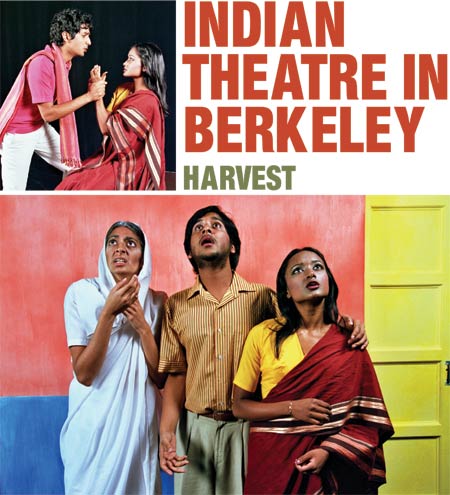 Top: Anand Sarwate and Rasika-Sharon Marletto in Manjula Padmanabhan’s “Harvest.” Top: Anand Sarwate and Rasika-Sharon Marletto in Manjula Padmanabhan’s “Harvest.”Bottom: Meer Kumbhani (l) Tanmay Dhanania (c) and Rasika-Sharon Marletto in “Harvest.” Manjula Padmanabhan’s Harvest is a remarkably prescient play. Selected from over 1,400 entries from 76 countries for the $250,000 Onassis Prize in 1997, the play takes disturbing dark, sci fi, futuristic look at Third World exploitation by the First World predates current controversy over transnational corporations from developed countries making a controversial grab for resources in Third World countries. The story centers on Om, an impoverished young man in overcrowded, desperate Mumbai. The dark presence in the play is Interplanta, an octopus-like multinational firm that “harvests” organs from Third World countries like India to ensure eternal youth for affluent First World folks. Om lives in a dysfunctional joint family that includes his wife Jaya, his brother Jitu, who is in the flesh trade, and mother. Though Om’s agreement with Interplanta provides him financial respite, soon his family finds that their lives are completely taken over by Interplanta. New wealth and gloss changes their dingy apartment, but it is also accompanied by disquiet as the organ recipients and Interplanta get increasingly insistent in controlling the lives of Om and his family. Soon their mother becomes a virtual zombie as she becomes addicted to television provided by Interplanta, and it is Jaya who begins to question and rebel against the insidious but increasing control that the shadowy, all powerful multinational exercises and seems poised to destroy all of their lives. Directed by Sudipto Chatterjee, the play was performed date by a group of feisty students who performed with great energy and skill to several sold-out performances. The play has previously been performed in India and broadcast in the BBC World Service radio. This is only the second time that the play is being staged in the U.S., although there have been several readings. The play has also been adapted into a film, Deham, by Govind Nihalini, which opened to mixed reviews. After reading a copy of the play sent to him by a colleague in Australia a few years ago, Chatterjee said he was “totally stunned.” The play won the Onassis Award in Athens when it was first performed in the late ‘90s and was an instant success in academic circles. “The play is set in the future, at a time when multinational companies have gone to the Third World not for software, minerals or fabric, but to harvest organs for their rich customers in America,” Chatterjee said. “It’s about India and the gritty Third World reality.” William Worthen, chair of UC Berkeley’s Department of Theater, Dance & Performance, said he included it in “The Wadsworth Anthology of Drama,” one of the most widely used books of its kind in the United States. “I thought that it would make a good addition for undergraduate teaching in the sphere of world drama in English, especially given its postcolonial thematics,” said Worthen. The play may be set in the future, but it reflects contemporary conditions as well, Chatterjee said. India, one-third the size of the United States, has three times the population and almost 30 percent of its employable labor force out of work, he said, and the country’s biggest problems are overpopulation and inadequate education. Padmanabhan, who was specially brought in to attend the staging of the play, is an artist, illustrator, cartoonist, playwright and novelist. She was born in Delhi, grew up in Sweden, Pakistan and Thailand, and now lives in Delhi. Alienation and marginalization play a large role in her work. Her short stories are marked by a wry sense of humor. Some of her graphic work was on display at the Center for South Asia Studies. She has illustrated 21 children’s books, and has had a long running cartoon strip, Suki, in the Sunday Observer and later the Pioneer. The exploitation of Indians by foreign organ traffickers has been well documented by authorities, including UC Berkeley anthropologists Nancy Scheper-Hughes and Lawrence Cohen, through the UC Berkeley-based Organs Watch center. In addition to its performance in UC Berkeley’s Durham Studio Theater Nov. 12-18, Harvest will be performed by some of Chatterjee’s former colleagues in Philadelphia in mid-September and by the East Coast Artists in New York City in January.
SOCIETY:
The Sexist Backlash: The Assault on Kushboo, Sania - By Siddharth Srivastava Recent prudish attacks on film star Kushboo and tennis star Sania Mirza are a sad commentary on the fact that reactionary, extremist elements in India can hold people to ransom whenever they wish, writes Siddharth Srivastava.  Film star and TV game show host Kushboo (top) and tennis sensation Sania Mirza (bottom) have both been target of attacks by self-appointed reactionary moral vigilantes. Film star and TV game show host Kushboo (top) and tennis sensation Sania Mirza (bottom) have both been target of attacks by self-appointed reactionary moral vigilantes.There are people in India who do not want to hear about a few things — one of them happens to be the subject of pre-marital sex. From time to time, the issue has resulted in mass protests, violence and court cases in the recent past. At one level such intolerance to free expression is a reflection of the way India is — a multi-layered cultural cauldron of classes, castes and religion, liberal and conservative opinions. It is also a sad commentary that reactionary and extremist elements can hold people to ransom whenever they wish, a wasted vengeance that is often buttressed by politicians eager to fulfill their own narrow gains. Actress and television game show hostess Kushboo triggered off the current debate on sex — premarital sex, to be precise — in Tamil Nadu. For those uninitiated to the South Indian film industry, it is bigger than Bollywood with its own share of scandals, stars, gossip and diehard fans who are known to commit suicide if anything befalls their favorites. Present Chief Minister Jayalalitha is a former film star and lover of the late M.G. Ramachandran, another matinee idol who ruled the state for many years. The late N.T. Rama Rao, also an actor, was at the helm in Andhra Pradesh for a long time. Kushboo is rated among the top actresses with temples dedicated to her to enable fans to worship her. Recently, in an interview to India Today, she said that pre-marital sex is okay provided it is safe, consensual and between adults over the age of 18 and no educated man should make virginity such a big issue. A pretty common-sense, pedestrian comment, you would think. Well, think again. A huge brouhaha followed — statewide protests, rallies, burning and beating of her effigies with chappals (slippers) and court cases. Local politicians keen to play the caste card due to upcoming elections in the state fanned the fire. A local court issued a non-bailable warrant against the beleaguered actress who has been at pains to explain that her views have been blown out of proportion. Some of the intellectuals in the state tried to support Kushboo only to be met with a similar backlash. Just as one thought that the debate would die out, India’s tennis icon Sania Mirza, who turned 19 Nov. 15, said she supported Kushboo’s views. That has given fresh ammunition to mullahs who have been happy to join the bandwagon. Mullahs had been complaining bitterly about Sania’s mini skirts, earlier. “Not everyone is perfect and just because I wear a miniskirt or just because I’m wearing pants or whatever it is doesn’t make me a bad Muslim,” Sania has responded. “As long as I believe in God and I have my faith, I think that’s good.” Speaking at a seminar, Sania said: “What I do at home, what I wear, is no one else’s business. As long as I am winning, how does it matter whether my skirt is six feet long or six inches?” Since Sania echoed Kushboo’s views the Muslim clerics have gone to town saying she had defied Muslim principles. One cleric has said that her views justify the earlier fatwas issued against her about the clothes she wears, following which an elaborate security detail follows the tennis star. Protests, similar to the ones against Kushboo, have followed in Tamil Nadu, Andhra Pradesh and her hometown Hyderabad. Taken aback by the ferocity of the protests, Sania has since retracted her statements. In a statement specially for the media she said: “I would like to clearly say on record that I could not possibly justify pre-marital sex as it is a very big sin in Islam and one which I believe will not be forgiven by Allah.’’ He father has urged that the “kid should be left alone.” Political parties are averse to taking on mullahs as somehow a view has gained ground that siding with the religious heads conveys an image of being pro-Muslim. By voting en masse Muslims offer a powerful vote bank. Such a strategy is a long shabby tradition followed by national parties like the Congress Party. In the Shah Bano case before, the ruling Congress Party had overturned a ruling by the Supreme Court to provide alimony to a divorcee. Moral vigilantes exist amongst fundamentalist Hindus, too, backed by regional parties such as the Shiv Sena that allies with the Bharatiya Janata Party. The extremists attack movie halls that screen controversial films, the express their ire at couples holding hands, women wearing jeans and celebrations linked to Western influences such as Valentine’s Day, in the name of cleansing society for higher social good. Recently, an Israeli couple who kissed after marrying according to Hindu rites at the famous religious destination in Pushkar, Rajasthan, were in for shock and harassment after priests filed a complaint with the police that they defied Hindu religious norms by doing so. There are reports of other foreign couples being victimized by priests at Pushkar. A hotel was forced to shut down in Chennai, the capital of Tamil Nadu following photographs that appeared in the media of a couple kissing at a party in the premises. This kind of public conduct does not sit well, to put it mildly, with the image of the IT-driven, knowledge-based forward-looking nation that India’s leaders and captains of industry try to project. It’s also way more serious than just a public relations disaster. For India to truly be included in the global comity of developed nations, its reactionary, intolerant tendencies need to be kept on a very tight leash. - Siddharth Srivastava is India correspondent for Siliconeer. He lives in New Delhi. |TOP| LIFESTYLE: Fashion Fusion: Manish Malhotra in New York - A Siliconeer report After creating a buzz in Bollywood costume design, Manish Malhotra branched out into mainstream India fashion a few years ago. He displayed his line in New York recently. A Siliconeer report.  Models showcase outfits by Manish Malhotra (c) at a fashion show hosted by the Nargis Dutt Memorial Foundation for Cancer Research in New York Nov. 13. Models showcase outfits by Manish Malhotra (c) at a fashion show hosted by the Nargis Dutt Memorial Foundation for Cancer Research in New York Nov. 13.The Nargis Dutt Memorial Foundation for Cancer Research hosted a fashion show Nov. 13 at the Marriott Long Island in New York presenting outfits designed by internationally reputed fashion designer Manish Malhotra, according to a press release from event organizer Mediasphere, Inc. The event showcased the prêt-a-porter collections of the celebrity fashion designer presented by a host of dazzling New York models. In the presence of nearly 600 elite attendees including Nargis Dutt’s granddaughter Trishala and noted actress and TV anchor Kirron Kher, the models brought about an attractive fusion of East and West as they sported the Indian designer’s costumes, which got an added fillip from the impressive jewelry collection of D. K. Surana. Malhotra was delighted. “Fashion is my art, my religion,” he said. “The greatest thrill for me is to receive appreciation from Indians around the world — especially here in New York, as this is considered to be the birthplace of creative fashion. I am truly excited about the fact that my clothing line will soon be available here in New York, and I had a blast in working with a highly professional crew and management team.” The silent auction was a great success with brisk sales and bids reaching $2,000. All proceeds went to cancer research, inspired by the tragic death of Bollywood screen legend Nargis Dutt. After making a splash in costume design in Indian films, Malhotra branched out into mainstream fashion a few years ago. He has received many awards including the first and last Filmfare Awards for costume design. His work has adorned international celebrities like Michael Jackson, Naomi Campbell, Reese Witherspoon (in the Mira Nair film Vanity Fair) and almost all Bollywood stars. Today, Manish’s label is available in Chicago, Singapore and Dubai outside India. PERFORMANCE: Defiant Frankness: Yoni ki Baat Show Bay Area-based South Asian Sisters presented a performance where desi women took on issues of sexuality with guts, candor and compassion, writes Anjali Verma.  Bottom Left and top two photos: Various performers on stage at Yoni Ki Baat. Bottom Left and top two photos: Various performers on stage at Yoni Ki Baat. Right, bottom: Performers come on stage at the end of the show to acknowledge audience appreciation. Women talked frankly about their sexuality at the recent Yoni Ki Baat show, loosely modeled around Eve Ensler’s celebrated play “Vagina Monologues.” Hosted by nonprofit South Asian Sisters, the show championed openness and candor to end silence and shed shame and aimed at initiating a dialogue with friends, family and loved ones to expose thoughts otherwise deliberately tucked away. Started three years ago at the University of California at Berkeley, the annual event shifted to Stanford University last year, and this year moved to the Canvas Gallery in San Francisco. The Canvas was a delightfully funky, laidback venue — part art gallery, café, restaurant, bar, and performance arena.
Part of the show’s proceeds this year went to the Asian Women’s Shelter (www.sfaws.org), a program in San Francisco that provides safety, food and advocacy to assist women in rebuilding violence-free lives for themselves, and their children. More information on South Asian Sisters is available on the Web at: www.sasisters.org FESTIVAL: Festival of lights: Diwali in Sunnyvale - A Siliconeer photo essay Photos by Sunnyvale Temple and Som Sharma/Digital IVision Thousands attended Diwali Mela at Sunnyvale Temple that included children’s performances and big time performers. A Siliconeer photo essay.  Clockwise from top left: Annu Kapoor hosts Antakshari competition; Sunnyvale Temple officials and devotees during the Rath Yatra; a classical dance performance; Punjabi singer Hans Raj Hans presented an electrifying performance; children dance on stage with pop singer Suneeta Rao, Temple officials Naranji Patel (l) and Raj Bhanot (2nd from l) present a plaque to Santa Clara county official Karyn Sinunu as Anita Gunsagar (r) look on; participants and winners of the Antakshari. |TOP| FESTIVAL: Festival of Lights: Diwali at Stanford - By Bhavna Hariharan Bollywood, bharatnatyam and music enlivened the cultural event hosted by Stanford students to host Diwali, writes Bhavna Hariharan. 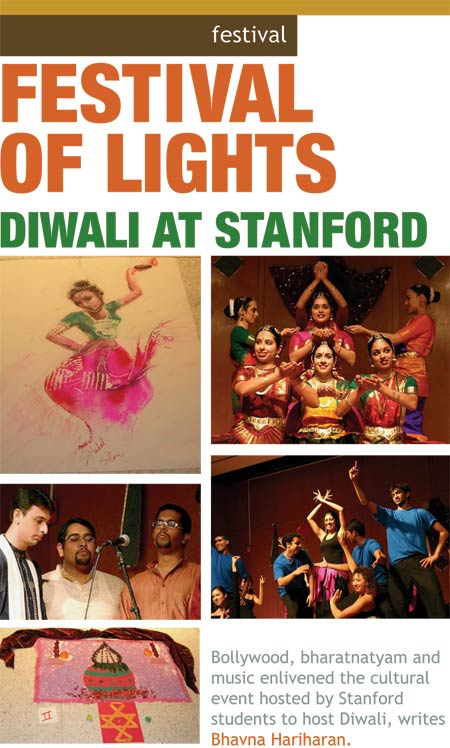 Clockwise from top left: Rangoli Display (1st Prize), Noopur, Rangoli Display (2nd Prize), Grand finale, Dhwani, Rangoli display Clockwise from top left: Rangoli Display (1st Prize), Noopur, Rangoli Display (2nd Prize), Grand finale, Dhwani, Rangoli displayThe Indian community at Stanford celebrated Diwali Nov. 13 with music, dance, colors and lights. A cultural evening was organized jointly by Sanskriti and Stanford India Association, the undergraduate and the graduate Indian student groups at Stanford University respectively. The cultural show began with an invocation to the divine, performed by Noopur, Stanford’s Bharatnatyam Association. Dhwani, a graduate music group, presented the song “Ishwara Allah” from the movie 1947 Earth with their very own creative improvisations. Twenty-five voices blended in harmony to implore God to help mankind overcome differences and live in unity and peace. Enthusiastic undergraduates, on the other hand, danced to Bollywood hits. A powerful vocal performance blended elements of Sufi and western music. The graduate dance group maSTANae presented a ballet based on the Ramayana, depicting the reason for celebrating Diwali.
Carnatic classical music was presented with the performance of Vatapi Ganapatim in raga Hamsadvani. A series of dance performances followed, including a Bharatnatayam recital to the Hindi bhajan “Jag main sundar hain do naam.” A freshman skit which poked fun at Bollywood celebrities and Indian TV shows. The evening was rounded off with a vibrant dance set to a medley of Indi-pop and Bollywood songs. The dance itself was a mix of belly dancing, hip-hop and Bollywood dance styles. PAGEANT: Honoring NRI Women: Miss & Mrs NRI Global 2005 Twenty-six women competed for the first Miss & Mrs. NRI Global 2005 crown at the international pageant for Non-Resident Indian women. A Siliconeer report. 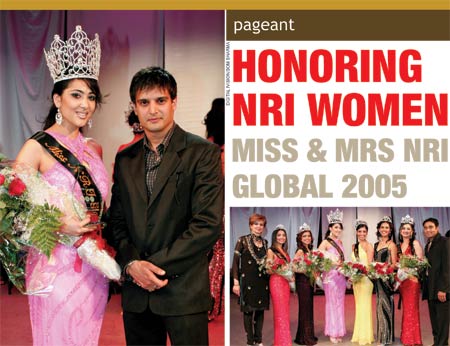 Left: Miss NRI Global 2005 Mehru Khan, (Pakistan) with special pageant guest Bollywood star Jimmy Sheirgill. Right (l-r): Pageant organizer Rennu Dhillon, Miss NRI Global 2nd runner up Rimi Gill (U.S.), Miss NRI Global 1st runner up Kanchana Nanda (Malaysia), Miss NRI Global winner Mehru Khan (Pakistan), Mrs. NRI Global winner Mikki Singhal (Botswana), Mrs. NRI Global 2nd runner up Nikhat Afza (U.S.), Mrs. NRI Global 1st runner up Vidushi Babbe-Tyagi (West Indies) and organizer Jay Patel. Mehru Khan of Pakistan and Mikki Singhal of Botswana were crowned the Miss & Mrs. NRI Global 2005 winners at an international pageant for Non-Resident Indian women all over the world, according to a press release from the organizers. The event was produced and directed by California-based nonprofit I-NRI Organization. Kanchana Nanda (Malaysia) and Rimi Gill (USA) were 1st and 2nd runner up in the Miss NRI Global competition while Vidushi Babbe-Tyagi (West Indies) and Nikhat Afza (United States) were first runner up in the Mrs. NRI Global competition. The star-studded event featured among its guests Bollywood star Jimmy Sheirgill, New York-based R&B singer Sumeet and Lisette Diaz, the newly crowned Miss U.S. World The pageant was a five-day affair commencing Oct. 13 as women from around the world arrived at San Francisco airport. Contestants were not charged any fee for entry, and all their accommodations, meals, training and most of their outfits and attire were funded by sponsorships arranged by the organizers. A talent showcase Oct. 14 presented performances by 16 of the 26 delegates. Kanchana Nanda Kumar of Malaysia won the winner’s $500 scholarship. The final pageant Oct. 16 at the Santa Clara Convention Center featured over 80 dancers who entertained the audience. Genius Kids, a group of 4-5 year-old kids, presented a skit. Contestants competed in a personality interview; a fitness segment (bathing suit); self expression and elegant wear. The top contestants proceeded on to the final question-and-answer round. More information available on the Web at www.nriglobal.org. COMMUNITY: Celebrating Culture: Machhi Samaj Fest - A Siliconeer Report An organization of Indians who have emigrated from the coastal area of Gujarat, the Machhi Samaj hosted its annual cultural show in Sacramento. A ` report.
The organization was established in 1997 and the majority of its members are from the San Francisco Bay Area and Sacramento, California. “The Samaj’s goal is to unite families that immigrated from their coastal villages and cites of the western state of Gujarat,” the press release added. “Machhi Samaj of USA provides an environment where the members and their children can engage in cultural and religious activities so that the knowledge and cultural values of Hinduism can be promoted and transferred to the future generations.” COMMUNITY: News in Brief  Theater Promoter Dies | Swaminarayan Mandirs Celebrate Diwali, New Year | Little Miss Beautiful Eyes | Young Professional of the Year | Kareena Kareena Star Meets IVACC Members | Scientist Honored | Deepavali at Badarikashrama | Marathon for Quake Victims | Running for Congress | Tough Tobacco Law | Education Award Created Theater Promoter Dies | Swaminarayan Mandirs Celebrate Diwali, New Year | Little Miss Beautiful Eyes | Young Professional of the Year | Kareena Kareena Star Meets IVACC Members | Scientist Honored | Deepavali at Badarikashrama | Marathon for Quake Victims | Running for Congress | Tough Tobacco Law | Education Award CreatedTheater Promoter Dies 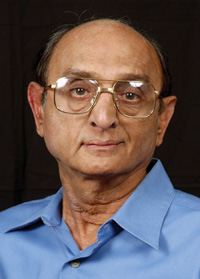 Anupam Yagnik, who acted in, produced, directed or promoted almost two dozen plays in Northern California in the last 22 years, died Nov. 16 in Mumbai, following a sudden cardiac arrest. The Surat-born cultural event promoter joined the Indian National Theatre in his youth as publicity director with Pravin Joshi, a well-known figure in Gujarati theatre. Anupam Yagnik, who acted in, produced, directed or promoted almost two dozen plays in Northern California in the last 22 years, died Nov. 16 in Mumbai, following a sudden cardiac arrest. The Surat-born cultural event promoter joined the Indian National Theatre in his youth as publicity director with Pravin Joshi, a well-known figure in Gujarati theatre. Yagnik moved to the U.S. in 1983 and settled in San Jose, Calif. Soon after he came here, he produced a one-act Gujarati play, Chhama Tujmein Teen Guun. Encouraged by the enthusiastic response, he started producing and sponsoring plays, music shows and comedy nights. Yagnik is survived by his wife Minaxi, son Sameer and his wife Abhirupa, daughter Gayatri and her husband Sameer Dave, and grandson Rishi Dave. In addition to popular traditions, BAPS mandirs have added a new dimension with unique events organized in various centers that include children’s Diwali celebrations, home decoration and rangoli competitions, lakshmi poojan and chopada poojan, devotional assemblies to welcome the New Year, grand annakut and prasad distributions to the members of the community. Devotees prepared different varieties of traditional food items and preparations. Colorful rangoli artwork, candles, and flowers added to the picturesque Annakut. Artis were performed every hour throughout the day. The children’s Diwali celebrations with rides, games, gifts, magic show and food was a fun-filled event for young and old alike. Each mandir also had exhibits conveying lofty messages from the Indian scriptures. The Little Miss & Mr. Hawaiian Tropic International Pageant is a children’s model search in which Hawaiian Tropic’s models are selected for their Just For Kids and Baby Faces suntan products national print ad campaign. Hawaiian Tropic gives importance to educating children and their families on sun protection since most skin damage occurs before the age of eighteen. Interested readers can find more information at the following Web site: www.htkids.info. In nominating Chattha for the award, his colleague Robert Anton Patterson wrote: “At 28, Vijay is worthy of the award because he has led our firm to over 110 percent annual revenue growth and demonstrated the power of strategic publicity in emerging markets.” With the nomination, Chattha becomes one of the first South Asian-Americans to be proposed for the award. VSC has developed a strong base of South Asian-American clients that operate in North America and abroad. After 9/11, Chattha was strongly affected by hate crimes targeting Sikh and Muslim Americans and stated, “public relations was a resource that our community desperately needed.” Chattha used that craft to establish awareness and visibility for the Sikh Heritage Gallery at the Smithsonian Institution and for hate-crime victims through fundraisers organized by Project Ahimsa. The award, given by the Indian American Heritage Foundation, was presented by the organization president Inder Singh (r) to Dr. Bhaumik for his outstanding contribution to science and humanity and in celebration of his bestselling book, “Code Name God.” Bhaumik is the co-inventor of the laser technology that made Lasik surgery possible. Born in Bengal, Bhaumik earned a Ph.D. in physics from India’s IIT and a Sloan Foundation Fellowship for postdoctoral work at UCLA. His contributions to laser technology led to his election as a fellow of the American Physical Society and the Institute of Electrical and Electronics Engineers. The program continued with a Carnatic concert by the students of Padmaja Kishore, daughter and disciple of Sangeetha Kalanidhi Shri T.K. Govinda Rao. Kishore presented several solo pieces. A classical Indian dance performance in the Odissi style was presented by Sima Chakraborty and her students. A role model for young women in Pakistan and in the Muslim world, Ali works for an established financial firm as a professional banker and runs marathons regularly. The New York City Marathon is the world’s largest and most internationally recognized marathon. In its 36th year, over 30 nationalities and 35,000 runners participated in the race. “The message today is that I am bringing forward a new brand of conservatism,” said Bhakta, 29, a Republican who likened himself to Teddy Roosevelt and touted a platform based on educational, health care and environmental reform. Due to this ordinance, 22 stores which sell tobacco have been shut down for 30 days. Stores which sell only cigarettes are totally closed for 30 days. This action was taken without warning and stores are closing on the first strike, and this enforcement is more severe than state law, store owners complained. Enforcement of this law has resulted in substantial business losses and misery for small businesses in the Sacramento valley, local small business owners said. If the trend continues, then within 6 months 25 percent of the stores will be closed, some added. Sacramento resident Anwar Rashid’s store was closed for 30 days for selling a single cigarette from a pack without his knowledge of the violation of law. In spite of training, one of store owner Amrik Singh’s employees made a mistake and the owner had to suffer with a 30-day ban on cigarette sale in the store. “As a founding board member of our Asian Pacific Fund, Dr. Tien provided leadership in many arenas that are important to the Asian American community,” said Yeh. “The purpose of our award is to establish a living testament to Dr. Tien’s record of accomplishments in higher education.” Tien was chancellor of the University of California, Berkeley, from 1990-1997. He was the first Asian American to head a major research university in the United States and was an outspoken supporter of equal opportunity in higher education. The main goal of the award is to recognize highly accomplished Asian Americans in higher education in the Bay Area, by supporting their development and advancement as institutional leaders. More information about the Asian Pacific Fund, its programs, and services can be found on the Web at www.asianpacificfund.org INFOTECH INDIA: ROUNDUP  Poor Response | Nokia Bags $141 Million BSNL Contract | Poor Response | Nokia Bags $141 Million BSNL Contract |BT Indian affiliate Buys U.S. Firm | Assembling Cell Phones | Doubling Staff | Design Center | Global MAKE Award | Stem Cell Center | China to Be Top Five Poor Response  Oracle Corp.’s offer to buy up to 20 percent of Indian banking software company i-flex solutions ltd. from public shareholders has received a poor response because the bid was lower than the market price. Oracle Corp.’s offer to buy up to 20 percent of Indian banking software company i-flex solutions ltd. from public shareholders has received a poor response because the bid was lower than the market price. Oracle Global (Mauritius) acquired 517,375 shares or 0.68 percent of i-flex at the offer price of 882.62 rupees a share, the Indian firm said in a notice to the stock exchange after the offer closed. On Nov. 24, i-flex’s shares were trading at 959 rupees, down 1.5 percent, in a firm Mumbai market. The U.S. firm had made the open offer under Indian takeover rules after it bought 42.41 percent of i-flex from Citigroup. i-flex’s shares were trading at 896 rupees when the announcement was made in August. Oracle’s stake in the company has risen to 43.09 percent, i-flex said. BSNL hopes to add capacity for two million new connections in Jammu & Kashmir, Haryana, Uttaranchal, Uttar Pradesh (east and west circles), Himachal Pradesh, and Rajasthan, on completion of the project. “This is an important network expansion for BSNL as we strive to offer the best network coverage and capacity to our subscribers,” said G.S. Grover, the BSNL director, commercial & marketing, soon after signing the agreement. Speaking on the occasion, Ashish Chowdhary, country head Nokia India, said that the company valued the contract and was “delighted to strengthen its successful co-operation with BSNL.” “This expansion will provide BSNL the ability to enhance its network coverage and capacity, apart from displaying Nokia’s expertise in the range of services offered,” Chowdhary said. BSNL has the third-largest mobile subscriber base in India after Reliance Infocomm and Bharti. In the GSM segment it comes in at No.2 after Bharti. According to Chowdhary, services play an important role in the contract, including complete network planning and optimization, infrastructure design, supply and implementation, and commissioning as well as systems integration and Nokia’s over-the-air device management solution. This expansion was an extension of a $284 million GSM/Edge and GPRS contract signed by Nokia and BSNL in 2004, Chowdhary added. Axes, founded by India-born Paul Pandian, has software units in India and the United States and customers such as Motorola, while French telecom company Alcatel is a client for both Mahindra-British Telecom Ltd. and Axes. Mahindra-BT, ranked eighth in India’s $17.2-billion software and business service export industry, is 43-percent-owned by BT that is also a client. Indian tractor and utility vehicle maker Mahindra & Mahindra Ltd. holds the remaining 57 percent. The Indian firm, which is expected to close the year to March 2006 with a consolidated revenue of $280 million, aims to launch an initial public offer of shares. “That we will go for an IPO is definite. What is undefined is when,” Mahindra-BT’s chief executive, Vineet Nayyar, said. Mahindra-BT has about 7,500 workers and Axes 850. The total staff strength is expected to reach 10,000 in the near future, company officials said. Axes President Pandian will join the management of the Indian firm. “We shall start shipping made in India handsets in India by December,” Allen Burnes, vice president for mobile devices at Motorola, told reporters. India’s red hot wireless services sector, the world’s fastest growing major mobile market, is adding some 2.9 million new users each month, thanks to the cheapest local call rates anywhere. Schaumberg, Illinois-based Motorola lags far behind Finnish giant Nokia, the world’s top handset maker, in the cut-throat Indian mobile phone market. Doubling Staff “By the end of next year or early 2007 we should be maxed out at 675,” Sam Srinivas, chief technologist at Juniper’s Bangalore centre, told Reuters after the company inaugurated an $8.5 million facility. It currently employs 300 engineers, who constitute about 10 percent of Juniper’s global engineering work-force. Last month, Juniper’s main rival, Cisco Systems broke ground for a new $50 million Bangalore technical facility with a capacity to take 3,000 employees. Cisco, which like Juniper is also targeting customers in India’s exploding telecommunications sector, currently has 1,400 engineers in India. Design Center India’s booming $17.2 billion software services industry has become a quality hub for global firms such as International Business Machines Corp. which are benefiting from the vast pool of low-cost, English speaking engineering talent. The design centre, to be based in Chennai, will initially be staffed by 25 engineers and the number will increase over the next two to three years, M.N. Divakar, head of HCL Technologies’ semiconductor practice, told Reuters. “The market place is huge,” said Divakar, speaking on the phone from California. “IBM is trying to proliferate the use of this architecture in industries like medical imaging, aerospace and consumer electronics where high computing power is needed.” “We are trying to integrate our embedded architecture to deliver new chip designs and end-products for these (sectors).” Under the agreement, New Delhi-based HCL Technologies has acquired the right to use and sublicense IBM’s PowerPC 405 and PowerPC 440 microprocessor cores and some other peripheral cores, a company statement said. Shares of HCL Technologies were down 1.6 percent at 488.35 rupees in a flat market. The stock had run up 5.9 percent on Wednesday, ahead of the announcement. The award is the result of the MAKE study that was conducted by Teleos, an independent knowledge management and intellectual capital research company, in association with The KNOW Network, a Web-based global community of organizations dedicated to networking, benchmarking and sharing best knowledge practices leading to superior organizational performance. This year, Wipro has won the MAKE 2005 awards at every level — the India and the Asia level and now has made it to the global list of MAKE awardees, a company statement said. Dr George Chandy, director of CMC, said in Chennai that the research centre at CMC, the first of its kind in India, would be built in collaboration with the department of biotechnology of the Ministry of Science and Technology, Government of India. The CMC, Vellore, has been selected to undertake transitional research (translation and basic research into practical applications during treatment) recognizing the potential of stem cells and in combating diseases. This centre will focus on the use of bone marrow and cord blood derived form adult stem cells for treatment of various conditions. Attempts will be made to genetically modify these cells for possible use in people with genetic diseases. George Chandy said that experiments were on in the CMC lab for nearly two years but things had not reached the trial stage yet. China to Be Top Five Chris Dobson, general manager of digital marketing sales at MSN International, said the software giant intended to ride that growth while taking a larger share of the country’s nascent but booming $500 million online advertising market. The world’s second-largest Internet market — 100 million Web users and counting — does not even rank among MSN’s 10 biggest markets now, executives said. “We’re starting from very modest beginnings in the Chinese market, but if we look five years out and if we haven’t graduated China to be in the top five of the world’s market, then we would have failed,” Dobson said in an interview in Shanghai, where he was attending an advertising forum. In May, the software giant launched MSN China, a Chinese-language portal with content provided by local partners. The portal is run by Shanghai MSN Network Communications Ltd., a joint venture Microsoft established with Shanghai Alliance Investment Ltd.
AUTO REVIEW
Stand-out SUV Gets Better: 2006 Toyota Highlander Hybrid - By Sally Miller Wyatt Toyota Highlander definitely stood out when it was introduced back in 2001. Now its 2006 and Toyota has gone and outdone itself, writes Sally Miller Wyatt.  After driving literally hundreds and hundreds of test cars, some definitely stand out. The Toyota Highlander is one of those vehicles for me. We had an opportunity to test drive this mid-sized SUV back in 2001 when it was first introduced, and I still remember being very impressed with it. Now, here comes 2006 and Toyota has gone and outdone itself. First of all, from a parent’s perspective, this SUV is terrific because it is not huge and unwieldy, and yet it is big enough to realistically accommodate a third row of seats. When not in use, the third row folds down flat into the cargo floor. That’s a great advantage for those times when you’ve — surprise! — been appointed as the designated driver for the soccer team. Two more seat belts are certainly a welcome addition. While having extra seat belts is a bonus for parents, the Highlander’s Hybrid technology is a bonus for commuters and everyone else who is on the road a lot. Wait, that would include parents again, wouldn’t it? The Highlander Hybrid is powered by Toyota’s Hybrid Synergy Drive powertrain, the same powertrain found on Toyota’s Prius. The difference is that the Highlander Hybrid is a version that has been developed to meet the load and performance demands expected of a SUV. It is available with either in two-wheel drive or electric four-wheel drive with intelligence (4WD-i). This all-new high-speed electric motor operates at twice the speed and delivers twice the power than the motor that powers the Prius. It is capable of rapid and powerful acceleration, in addition to providing a towing capacity of up to 3,500 pounds. According to Toyota, the Highlander Hybrid is defined as a “high-power, high-voltage full hybrid,” which means it is capable of “operating in electric-only or gas-only mode, as well as a mode that combines the power of the gas engine and the electric motor.” By contrast, Toyota points out, other hybrid technologies are not capable of running only on electrical power, but instead need constant gas engine operation. The Toyota Highlander was a standout SUV when it was first introduced, and now it is just all that much more impressive, with the availability of Hybrid technology and that third row of fold-down seats. - Sally Miller Wyatt is a freelance writer who writes family-oriented auto reviews for newspapers, magazines and the Web. |TOP| BOLLYWOOD: Guftugu  Crooks Rule | GANGSTER: Moll Get Caught, Bollywood Relieved | The Patil Twins in Harry Potter | The Farmer Who Rules Bollywood | Rumble of Discontent | Sorry, Ash | Pizza Boy | Mid Day Madness | Return of Sanity? | Crooks Rule | GANGSTER: Moll Get Caught, Bollywood Relieved | The Patil Twins in Harry Potter | The Farmer Who Rules Bollywood | Rumble of Discontent | Sorry, Ash | Pizza Boy | Mid Day Madness | Return of Sanity? | Crooks Rule 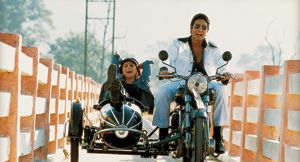 Remember the time when heroes were purer than the driven snow, and heroines were a notch more virginal than Mary? Well, times have certainly changed in Bollywood. Remember the time when heroes were purer than the driven snow, and heroines were a notch more virginal than Mary? Well, times have certainly changed in Bollywood. Have you noticed lately how crooks and conmen are ruling the roost in the box office? Yashraj Films’ Dhoom and then Bunty Aur Babli seems to have started the recent trend. In Dhoom John Abraham with his gang looted money and zoomed on their motorbikes all the way to the bank, with the cat-and-mouse game between cop Abhishek Bachchan and thief John spicing up the proceedings. In Bunty Aur Babli, conning couple Abhishek and Rani set cash registers ringing with their hilarious antics as Amitabh Bachchan raced to nab them. This is not to say that heroes were always squeaky clean. One can go back all the way to Vijay Anand’s Jewel Thief and Johnny Mera Naam, Amitabh Bachchan’s The Great Gambler in the 70s, to find celluloid con men who got top billing. The new trend continues. Dhoom 2, a sequel to Dhoom, is in the works. Matinee idol Hrithik Roshan, no less, steps into the shoes of John Abraham and plays a con man, while Aishwarya Rai will feature as his ladylove in the film. So what gives? Is Bollywood merely aping the values of the real world, where all that counts is the pot of gold, not how you get it? GANGSTER: Moll Get Caught, Bollywood Relieved Originally from Azamgarh, U.P., this thug made his first connection with Bollywood when he was asked by Anees Ibrahim, brother of Dubai-based gangster Dawood, to take an AK 56 gun to Sanjay Dutt. Since then there has been a slew of killings and rumors of murder threats and extortion. In July, 1997, filmmaker Rajiv Rai was shot at because he balked at Salem’s extortion attempts. Rai eventually fled to London. In August, 1997 Salem’s men murdered music baron Gulshan Kumar in broad daylight in Andheri. Filmmaker Rakesh Roshan nearly died when Salem’s men shot him a few days after his blockbuster Kaho... Na Pyaar Hain was released in January, 2000. “I was disturbed for a month,” Rakesh Roshan told the news Web site Rediff.com, “But I thought I have to move on.” Manisha Koirala’s secretary Ajit Dewan was less lucky. He was killed, allegedly at Salem’s bidding. Presumably at Salem’s behest, girlfriend Monica Bedi signed films like Jodi No 1 and Pyaar Ishq Aur Mohabbat. Gangster and moll were finally arrested by Interpol in Lisbon, Portugal, in 2002. “Our industry can sleep at ease now after his arrest,” says filmmaker Mahesh Bhatt. “Almost half the industry people I know had received death threats from Abu Salem. Now is the time for him to face the law.” The Patil Twins in Harry Potter
Seventeen-year-old Shefali is doing A-levels in sociology and religious studies while 16-year-old Afshan is an A-level student learning chemistry, biology, English and media language. It all happened when the casting agents started going round some schools in Bradford. Not finding anyone satisfactory, they checked out the two Bangladeshis in different parts of London. “I went to the first audition and I thought OK there’s a lot of girls here, I don’t know if I’ve got a chance, but there’s nothing to lose, so I just went for it,” recalls Shefali. Afshan added: “Me and a friend had read the book, and we thought we’re never going to get in but we’re not going to lose anything. So we sent in after school and saw all the girls lining up and they were all looking after themselves, all combing their hair, putting make-up on. I literally thought I didn’t have a chance, so I just went in as myself, you know, smiled a bit and out of my group of five I was the only one that got through to the next round.” Before the final audition there were about 12 more girls. “Me and Shefali got put back a lot because they were trying to find twins — it was quite weird because there were twins there but (director) Mike (Newell) was saying that we would rather have two people that could act than twins who couldn’t act,” said Afshan. The final audition was nerve-wracking. “I was very nervous, I didn’t eat anything for a day,” said Shefali. Both were overjoyed to get the roles. Afshan remembers the moment when she got the news: “We were crying and screaming and my mum was running down the stairs saying: ‘Who’s died? Who’s died?’ And I said: ‘No I just got into Harry Potter.’ And then I rang my brother at work and he was screaming to his friends, you know it was just really surreal, as Shefali says, it still hasn’t sunk in yet.” The Farmer Who Rules Bollywood Big B? A farmer? You are not the only one scratching your head, so are the folks with the Pune district authorities. Here’s what happened. Big B bought a 20-acre plot near Pavana Dam in Maval in 2000. The catch is that under the 1963 Tenancy and Agricultural Land Act only farmers can buy agricultural land in the state. So Big B had the land registered in his name on the basis of documents proclaiming him to be a farmer at Jaunpur near New Delhi. Come again? Pune officials are skeptical. They have issued a notice asking him to authenticate his claim of being a farmer. ”We began an enquiry following a report in a news magazine about the purchase of agricultural land by Bachchan,” a senior official said, adding the notice had been issued a fortnight ago. “We have asked for original documents to be presented. At present, the registration of the land purchase in 2000 has been done on the basis of xerox copies,” the official added. It seems fair to say that Bollywood fans are just as keen to see documents that prove that Amitabh Bachchan is “a farmer at Jaunpur.” Rumble of Discontent A student group in Bikaner, Rajasthan, is now threatening to ban screening of films by Garam Dharam or his sons. The Sanyukta Chhatra Sangarsh Samiti charges that the Bharatiya Janata Party MP did not keep his promise to get the Bikaner university a grant of Rs.25 million. “We will not allow any of his or his sons’ films to be screened in Bikaner,” says local college student Rajesh Singh. “Dharmendra is willing to jump to death for Basanti (in one of his hit films Sholay). But when it comes to the students and people of Bikaner, he turns deaf, despite the fact that we are the people who voted him to Parliament,” fumed Kailash Sharma, another student. “We want our MP to visit us regularly. We don’t want him to sit in Mumbai and do nothing for us,” weighed in local resident D.R. Chaudhary. Ouch. Sorry, Ash It’s old news that Rajkumar Santoshi and Dr Chandraprakash Dwivedi were making films on the Prithviraj Chauhan-Samyukta love-story. Both filmmakers had claimed that their respective films would have Aishwarya Rai. So Santoshi’s volte face comes as a bit of a surprise. “The fact of the matter is that Aishwarya is already doing period dramas like Akbar-Jodha, Umrao Jaan and Rani Laxmibai. By the time she gets down to doing my film, I think she will be bored with the idea of doing another period love story,” he said. Age is also an issue, he added. “While scripting the film, I realized that the love story has a swayamvar scene, which is a very crucial point,” he said. “In those days, swayamvars (occasions when a woman chose her husband) used to take place when the girl was hardly 15 or 16 years old, and Aishwarya definitely does not fit the bracket. I am now thinking of casting a completely new girl in the film and the hunt is on for the same.” So Aishwarya is no longer going to be in the Rs. 600 million film. Poor Ash. She may be the most gorgeous woman on earth, but there’s no way you can make her look 15. Pizza Boy The entire cast of Home Delivery is now going to deliver pizzas, and even stars like Vivek Oberoi, Mahima Chaudhary and Ayesha Takia will actually deliver pizzas to the doorsteps of a few lucky customers! The idea is to promote the film through interaction between the stars and the people. So the cast will even have tea with these customers and spend some time with them. The entire proceedings will be shot and presented as a reality show on Star News. Mid Day Madness Preity has slapped a defamation lawsuit on the Mumbai eveninger Mid-Day for printing a “transcript” of a conversation between Salman Khan and Aishwarya Rai where Sallu referred to a relationship with Preity. Well guess what, it turns out that police forensic examination has determined that the tape was a fake and the voices of the persons on the tape matched neither Salman nor Aishwarya. Lajwanti D’Souza of Mid-Day offers a rather lame excuse: “It is something on record (the tapes); we just reproduced it. We feel bad about it, but that is what it was.” Well, maybe feeling bad isn’t enough. If the courts make the errant newspaper cough up some moolah, it will likely act more responsibly in future. Return of Sanity? Her only supporter, Suhasini Maniratnam, had also been taken to court and protesters had a field day creating a ruckus and lambasting her for allegedly impugning the honor of Indian women. The cause for all the ire was her frank and honest remark to India Today that premarital sex is okay and it is unrealistic for men to expect their wives to be virgins. Now, thank goodness, there is (at last!) growing impatience with the intolerance witnessed in the last few weeks. ”Can you tolerate the intolerant? These are intolerant people. You misuse the criminal administration system and behave thuggishly. Does the public tolerate it?” said N. Ram, editor-in-chief of The Hindu. The Dalit Panthers of India, who had been bitter critics of Kushboo less for her comments than political grievances, has toned down its rhetoric and promised to call off the protests. Bollywood star Aamir Khan has said Tamil star Kushboo should not back down from her liberal views on Indian women. Khan told NDTV that she must fight for what they believe in. HINDI CINEMA: Not Quite an Epic: Taj Mahal - An Eternal Love Story 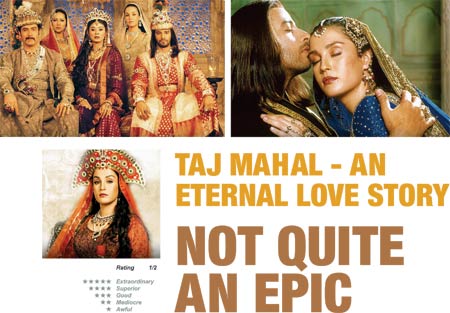 Mashreq Communications’ Mashreq Communications’Taj Mahal – An Eternal Love Story Produced and directed by: Akbar Khan Music: Naushad Starring: Kabir Bedi, Manisha Koirala, Arbaaz Khan, Pooja Batra, Arbaaz Ali, Kim Sharma, Zulfikar Syed, Vaquar Shaikh and introducing Sonya Jehan The story of the Taj Mahal is one of the most celebrated historical love stories in India, and Akbar Khan is to be commended simply for having the chutzpah to take on such a challenging subject. For a challenging task it is, indeed, to bring this grand tale of love, pain, and royal intrigue in the Mughal court and put it on film, particularly with public memory of classic work of titans like Sohrab Modi and K. Asif still fresh, to which inevitably his work will be compared. Money has clearly been no object in making the film — at a whopping Rs. 700 million and a four-year time frame, in terms of time and effort it is clearly a milestone in Bollywood. Akbar Khan’s intentions are majestic enough, it’s his execution and casting that leave a lot to be desired. Yet let us be very clear, this is by no means the mindless disaster another historical extravaganza has been. I am talking about Mangal Pandey. Taj Mahal – An Eternal Love Story definitely has some very strong points, and of these, the towering presence of Kabir Bedi will surely come at the top of any critic’s list. His splendid performance adds just the sort of gravitas a historical epic like this needs—too bad the rest of the cast do not quite match his level. The film opens with an ageing Shahjahan (Kabir Bedi) being held captive by his son Aurangzeb (Arbaaz Khan). After killing his brother Dara Shikoh (Vaquar Sheikh) and his other brother, Aurangzeb not only keeps his father in captivity, but also puts his elder sister Jahan Ara (Manisha Koirala) under house arrest. Bitter, disillusioned, in the sunset of his life, Shahjahan begins to narrate his tale to daughter Jahan Ara—and before you can say aaj se bees saal pehle, off we go on a flashback. The two youths Prince Khurram/Shahjahan (Zulfi Syed) and Arjumand/Mumtaz Mahal (Sonya Jehan) meet each other in a jungle, and fall in love at sight. But Shahjahan’s step-mother Noor Jehan (Pooja Batra) has her own plans: She wants Shahjahan to marry her daughter from her earlier marriage, Ladli Begum (Kim Sharma). Shahjahan and Mumtaz Mahal’s romance does lead to marriage, but they have to cross their share of hurdles. On her deathbed, Mumtaz Mahal extracts a promise from her beloved Shah Jahan to build an edifice in memory of their love. And thus begins work on a monument that continues to attract millions of people even today. The director deserves credit for touching upon some unknown historical facts, for example the intrigues of Jahangir’s wife Noor Jehan, her illicit affair with Jahangir aide Mohabbat Khan, and the passionate side of emperor Shah Jahan. Arbaaz Khan’s Dara is portrayed as a very intriguing blend of black and grey. Such subtle characterizations are a pleasant surprise in a film that is made in historical blockbuster mode. However, for one of the most expensive Bollywood films, the costumes and overall décor can be surprisingly down-market at times. Royal pillars look like you could haul them away, the jewelry looks downright tacky, and Pooja Batra’s costumes look too contemporary to be plausible. When the ruthless Aurangzeb beheads his father’s favorite son Dara and sends his head to Shah Jahan in a platter, what could have been a harrowing, horrific moment in the film becomes comical instead because the severed head looks so patently and ludicrously phoney. You have to wonder where did Rs. 700 million go? Even Sanjay Leela Bhansali’s Devdas had a more gorgeous look. The real problem with Taj Mahal is that while Akbar Khan did his homework and the film crew was conscientious in its research, the film fails to recreate the magic of the Mughal era. Akbar got the details right, the sets are often opulent, but that magic spark which made a classic like Mughal-e-Azam soar is quite clearly lacking. Maybe film critic Subhash K. Jha has a point when he observes unkindly: “It’s easy to write off a film that comes with the burden of a rather cumbersome history of its own — a non-happening star cast, a director who doesn’t have anything to show for himself, a music composer who retired decades ago.” While Jha himself goes overboard in praising the film, there is no question that a really first-rate cast would have gone a long way in giving the film some much-needed heft. Zulfikar Syed’s Shah Jehan is a sincere enough lover, but he is clearly not emperor material; Sonya Jehan’s Mumtaz Mahal is undoubtedly beautiful, even her acting isn’t that bad, but she fails to draw the audience’s sympathy in a way Madhubala did in Mughal-E-Azam. As for Pooja Batra’s Noorjehan and Kim Sharma’s Ladli Begum, they could just as easily be stock characters of conspiring, intriguing women so common in run-of-the-mill melodramas and soaps, and Arbaaz Ali’s wimpy Jahangir is a disaster. And that’s not all, the piece de resistance in god-awful casting surely must be Nigar Khan, whose talents are as skimpy as her clothes, who has been cast as an Indian queen. So what is one to make of this attempt. Again, it is not a disaster like some other doomed attempts, nor is it a soaring success. Taj Mahal—An Eternal Love Story belongs to that netherworld in between, where a film is serviceable rather than extraordinary. Akbar Khan gets an A for effort, but his film, alas, fails to make the cut as a classic that will endure outside its modest run in the cinemas. There are lessons to be learned here, and if Akbar learns them, maybe his future ventures will be more successful. TAMIL CINEMA: Eternal Love Triangle: Bambhara Kannaale Director: Parthi Bhasker Cast: Srikanth, Arti Agarwal, Namita, Vikram Aditya, Vadivelu  The eternal love triangle is given a slightly different twist by debutant director Parthi Bhasker (nephew of Ilayaraja, and son-in-law of Deva). The accent here is on getting maximum fun moments from the situation as two men vie with each other for the hand of the same girl. The director can be commended for revealing a new side of Srikanth, and it’s fun watching Srikanth going totally wacky and funny, with some of the situations evoking considerable laughter. But then the acts get repeated. And all too soon, we suddenly get this feeling that the story is hardly moving forward, and a growing apprehension that it may never end. Srikanth plays Arumugham whose charm is so overpowering that every single woman he meets falls for him, or rather is overwhelmed with desire. The scenes are overdone here. Arumugham, however, smitten by Pooja (Arti), worms his way to close proximity of her and soon becomes her friend and adviser. When Pooja approaches him to break her marriage with Gautam, the man with all the faults, Arumugham sees this as an opportunity to earn her gratitude, trust and love and get his rival out of the way. The rest of the story is how he manipulates situations to present Gautam in an unfavorable light; how a furious Gautam hits back and makes Arumugham seem the villain of the piece, and how Pooja, shuttling between the one and the other, realizes the truth. There are plenty of risqué double entendres which the director should have avoided. Arti Agarwal, after holding the No 1 slot in Telugu films in the recent past, makes her entry into Tamil cinema. She may have got the hero in the end, but she’s no match for the feisty and vivacious personality of Namita who makes even monotonous scenes come alive. This despite being given the role of Meena, the hero’s friend with her one-sided love, a character that is sidelined to make way for the hero’s tryst with Pooja. To give Namita due credit, she’s slimmed down a little, but it must also be said that she still has ways to go. For Vadivelu, being in almost all the recently released films, it’s like an overdose of comedy Vadivelu-style, but it misses its target often. Vikram Aditya as Gautam is better doing his villainy than he was as playing the hero of Whistle. As for the relevance of the title to the story, try to figure that one out! RECIPE: Delicious Dessert: Texas Lemon Cake - By Norma T. Gruman How about something different and phoren? Our American reader Norma T. Gruman offers a recipe for a delicious cake.  Ingredients Ingredients
- Norma T. Gruman lives in Sunnyvale, Calif.
|TOP|
HOROSCOPE: December 2005 Horoscope By Pandit Parashar ARIES (March 21 to April 20): You will achieve success with ease. You may replace your old car with a luxurious one. You could be investing in a property. There will some difference of opinion but your spouse will eventually agree with your decision. You will be taking a short family vacation. TAURUS (April 21 to May 20): You will hear encouraging news and may strike gold. Obstacles will fall out of your way. A business trip will go well exceeding expectations. Those in the communications industry will benefit from favorable planets. You will spend on buying luxury goods. GEMINI (May 21 to June 20): Expect some major changes in career and for good. Things will become more relaxing and those who are self-employed will get into a new business. You may sell some stocks for a decent profit. You may make a mathematical error and send check in the wrong amount. You will attend a few parties. CANCER (June 21 to July 22): Planets support a big move in career. Now is the time to switch. A trip will mark the beginning of an interesting relationship. A long-awaited response from a government agency will come in your favor. You may be in the market for a real estate investment. Speculations will be profitable. LEO (July 23 to August 22): Be diplomatic and trust no one. Career related issues will cause stress with no visible solution. Stay focused, you’re almost there. You will spend time communicating. An old friend will invite you to a party. VIRGO (August 23 to September 22): You will overcome all hurdles winning a highly competitive situation. An important contract will be finalized. Dispose-off profit bearing stocks for now and refrain from buying. Spouse will have brilliant ideas and all the support for you. LIBRA (September 23 to October 22): Keep working on your plans, success is around the corner. Businessmen will do better as sales will suddenly shoot up. A small change in dietary habits could help you shed those extra pounds. You will buy some expensive items for your home and will dine out more frequently. SCORPIO (October 23 to November 22): Hard work and patience is all you need. You will come across excellent opportunities to make some serious cash. You will call on a government office seeking some clarifications. An addition to the family will cause excitement. You will be seriously looking for real estate. SAGITTARIUS (November 23 to December 22): Your approach will undergo a major overhaul as you become more diplomatic. A refund may come in mail. Speculating and trying your luck at lottery could be beneficial. Legal affairs will bear a favorable verdict. A huge family reunion is in the works. CAPRICORN (December 22 to January 19): Concentration of planets in your sign will provide a sudden boost. Your energy levels will hit an all time high. Hurdles will disappear. You may start a project with highly competent associates. You may be in the market for a new car. AQUARIUS (January 20 to February 18): Patience and diplomacy are your only weapons as you come across an awkward situation. It will be better to settle issues rather than taking the legal course. You may try to cut down on caffeine or nicotine. You may experience super natural dreams. You will spend more time with kids. PISCES (February 19 to March 20): You will be separated from someone close on temporarily. Financially, things will start picking up. Investing in property will be a great idea. You will attend an interesting party and meet important people. Children will make some great plans. Bay Area-based astrologer Pandit Parashar can |TOP| |
|
|
|
|
Advertise in Siliconeer | Home | Subscribe PRINT Issue | About Us (FAQs) | Contact | Locations | Staff Login | Site Map
© Copyright 2000-2013 Siliconeer • All Rights Reserved • For Comments and Questions: info (AT) siliconeer.com |
|






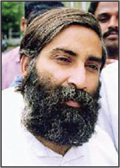 We are delighted to welcome aboard Sandeep Pandey on our editorial staff at Siliconeer. Sandeep Pandey, the youngest Indian to win the Magsaysay Award, got a Ph.D. in engineering from the University of California at Berkeley before returning to India. After a stint at IIT Kanpur, he became a full-time activist, runs an ashram in Uttar Pradesh and is involved in a host of issues including Indo-Pakistan peace, agitation against Coca-Cola’s unlimited access to potable water, and communal harmony.
 Our proposal for a CTT — currency transaction tax — is a market-based mechanism which, by changing the incentive structure in the market, helps discourage excessive speculation and encourages traders to give greater importance to economic fundamentals. It comprises a very small (0.005 percent) tax that will be levied on all exchange transactions in a particular currency and a higher variable tax that will apply only in highly volatile markets and act as a circuit breaker to stabilize markets.
 Sony Kapoor, a U.K.-based expert on international finance and development, is currently the head of policy and advocacy for Stamp out Poverty, a U.K.-based network of over 50 International NGOs, trade unions and faith groups that. He also leads the international policy and advocacy work for the International Tax Justice Network. He lives in London.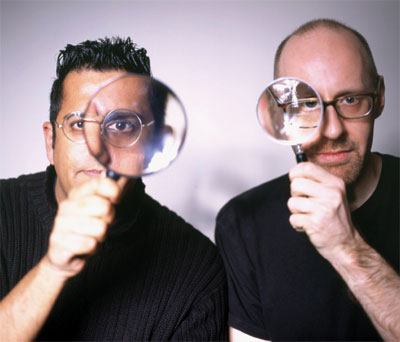
 Johnnye Jones Gibson is a freelance writer who lives in El Cerrito, Calif.
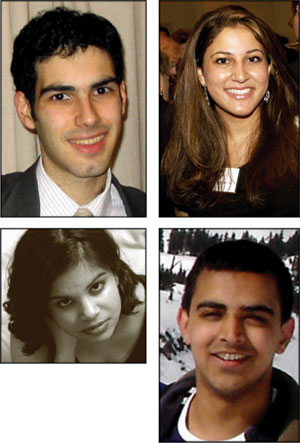
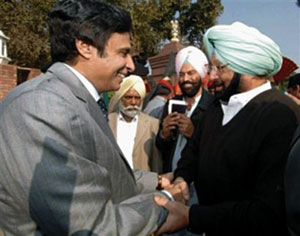

 A physician who lives in San Jose, Calif., has been missing for over three weeks since she left work on the afternoon of Nov. 7. Zehra Attari, 55, left her Oakland medical office at 5 p.m. Nov. 7. Office workers watched as she got into a gray 2001 Honda Accord and drove off. The 5-foot, 4-inch doctor was wearing a blue turtle neck sweater, navy-blue pants and black glasses.
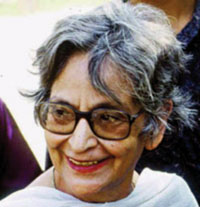 Celebrated writer and poet Amrita Pritam, a doyenne of Punjabi literature famous for her poignant stories dealing with India’s Partition and her feminist ideas, died in her sleep in New Delhi last month. The death of the 86-year-old writer “is being mourned on both sides of the India-Pakistan border, for it was she who chronicled so movingly and passionately the pain of partition in 1947,” wrote the London Guardian in an obituary. “Regarded as the leading 20th-century poet of the Punjabi language, she wrote verses that are sung and recited in cities and villages by many who are illiterate — such is the hypnotic appeal of her poetry. She was, in many ways, the voice of the Punjabi people, for her poems gave utterance to their anguish.
  Sri Lanka’s newly-elected President Mahinda Rajapakse has invited the Tamil Tigers to resume peace talks after the rebels issued an ultimatum for a political settlement.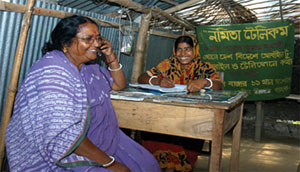
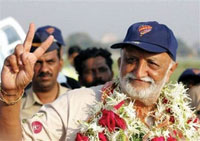

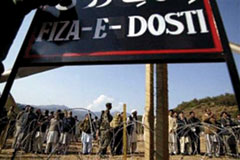
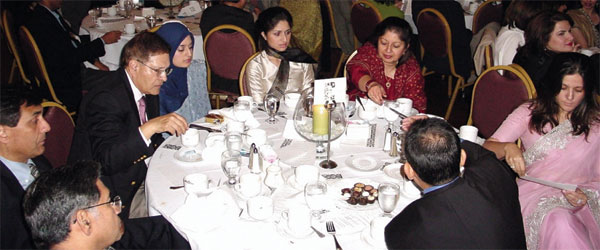

 Anirvan Chatterjee is the co-founder and CEO of BookFinder.com, a Web site that allows buyers to search through over 100 million new used books from thousands of booksellers. He lives in Berkeley, Calif.
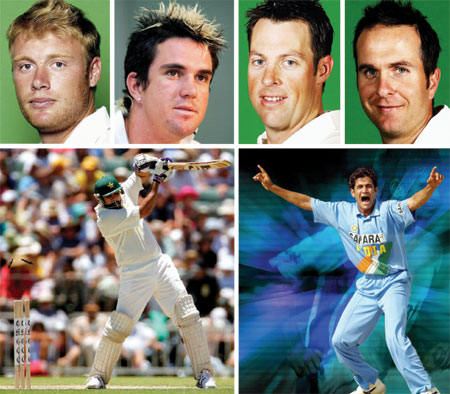
 Anjali Verma is a member of South Asian Sisters. She lives in San Francisco.
 Bhavna Hariharan is a graduate student at Stanford University. She is affiliated with the School of Engineering
 Clockwise from top left: Azadeh (front) and Roshni Sarang; (L-r) Purvi Tandel, Megha Tandel, Aayushi Tandel, Amber Tandel, Hemit (Monty) Tandel and Amar Tandel; (L-r) Sapna Tandel, Nehal Tandel, Megha Tandel, Jyoti Tandel, Karen Tandel; Sixth grader Hemit (Monty) Tandel receiving an award for outstanding student from president Pravinbhai Tandel.
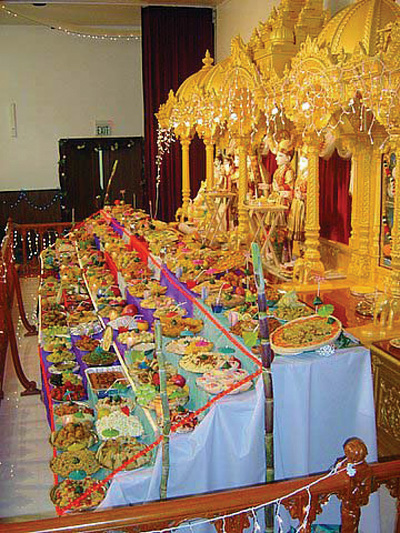 From New York to Los Angeles and from Houston to Chicago, devotees gathered at Bochasanwasi Akshar Purushottam Swaminarayan mandirs to celebrate Diwali and New Year.
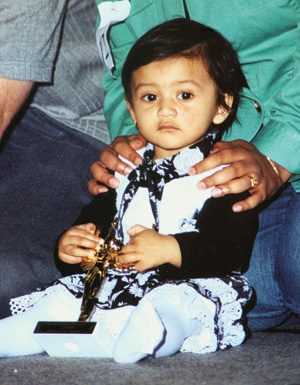 Ten-month-old Sonal Agarwal won the title of “Miss Beautiful Eyes” in the Hawaiian Tropic pageant for kids held in October at Hayward, Calif. Sonal is the daughter of Amit and Sadhana Agarwal, who live in Fremont, Calif.
 Vijay S. Chattha, San Francisco-based VSC Consulting’s “Chief Talker,” has been nominated for PR Week’s 2005 Young Professional of the Year Award, which honors the individual who represents the best in public relations each year.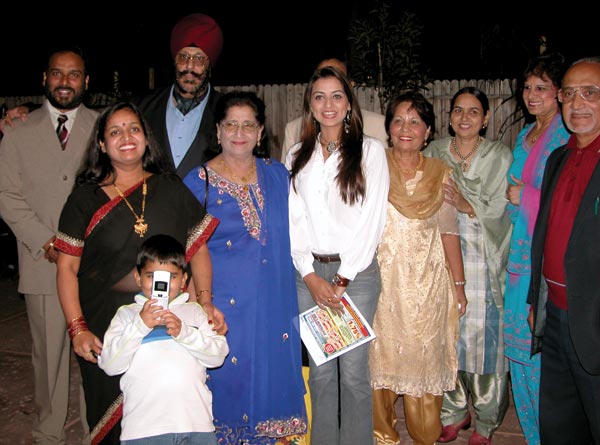
 Oscar-winning British actor Sir Ben Kingsley (c) presented the Mahatma Gandhi Humanitarian Award Nov. 15 to Dr. Mani Bhaumik (l) at the Regent Beverly Wilshire Hotel in Beverly Hills. Calif.
 A two-day Deepavali celebration was held at Badarikashrama in San Leandro, Calif., Nov. 1 and Nov. 5. The celebration on Nov. 1 was marked by Mahalakshmi Puja and Sri Ganesha Puja. The celebration on Nov. 5 began with the Sri Mahalakshmi Homa officiated by Swami Omkarananda.
  Sher-Bano Ali, a Pakistani Muslim woman who lives New York City, competed in the ING New York City Marathon Nov. 6 in an effort to raise her personal goal of $100,000 for devastated earthquake victims in her native country. She had been preparing rigorously for the race under the direction of trainer Lisa Smith-Batchen, North America’s top endurance athlete.
  Raj Peter Bhakta, known for his appearance on the NBC television reality show The Apprentice, has formed an exploratory committee to begin raising money for a possible challenge to Rep. Allyson Schwartz, D-Pa., in 2006.
 prehensive GSM/Edge and GPRS network expansion project in North India to Nokia.
  An Indian affiliate of BT Group Plc said on Wednesday it would buy U.S.-Indian software services firm Axes Technologies Inc. for $54 million in cash to strengthen its presence in a $50 billion global market for telecoms-related services.
  Motorola Inc., the world’s No. 2 mobile phone maker, said it will start assembling handsets in India by December in a bid to increase its market share in the booming sector.
  Juniper Networks Inc., which makes gear to speed up or protect Internet data traffic, said it planned to more than double staff at its engineering centre in Bangalore.
  HCL Technologies Ltd., India’s No. 5 software services firm, said it will set up a unit using embedded architecture from IBM Corp. to design products for sectors that have high computing needs.
  Wipro has announced it has won the Global Make (Most Admired Knowledge Enterprise) 2005 award, a global recognition in the area of knowledge enterprise.
 The 3.3-liter V6 engine, also found on the conventional Highlander, receives significant revisions designed to integrate it with the hybrid system. Several components — including the power steering pump, water pump and AC compressor — are not driven by belts. They are instead electrically powered. It also employs electronic air conditioning and power steering, electronically controlled brakes and continuously variable transmission.
  Seating for driver and front seat passenger is comfortable and leg and head room is generous. Second-row passengers can use any one of six cupholders — two in each door handle and two in the center fold-down arm rest. Leg room here is also very good. The third row of seats are on the small side, particularly in hip room, but when they are folded away, the rear cargo area is quite generous.
  Sure it sounds like a Bollywood B movie, but its reality. Abu Salem, a notorious underworld extortionist who has haunted Bollywood for decades, is in the safe arms of the law after years of wrangling between Portugal, where he was fighting extradition, and India.

 Just when you thought you had heard it all comes the news that a chunk of prime farming land has been bought by an illustrious resident in Mumbai who has introduced himself as a farmer, but who is known to the rest of the world as Amitabh Bachchan.
 Real life is seldom as easy to fix as reel life, poor Dharmendra (seen here with Mallika Sherawat in "Kis Kis Ki Kismat") has been discovering. The evergreen macho hero of Bollywood is finding out the hard way that his sexy smile no longer cuts much ice when there are real problems which irate constituents feel he is not addressing.
 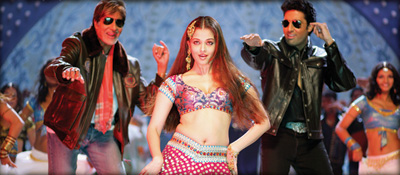 You can’t win them all. Bollywood princess Aishwarya Rai (seen here with Big B and Abhishek in "Bunty Aur Babli") found that out when she learned that Rajkumar Santoshi has decided not to cast her in his historical epic based on the medieval Rajput royal love story of Prithviraj Chauhan and Princess Samyukta.
 You have to hand it to Bollywood publicists. Their fertile imagination never fails to come up with new outlandish gimmicks.
  Give credit to gutsy star Preity Zinta (seen here with Saif in "Salaam Namaste"). She is one star who isn’t going to take nonsense from a newspaper that will print any salacious morsel of gossip as long as it will sell a few copies.
 Pour lemon juice on cake while hot after poking holes through cake with toothpick. Sprinkle 1 cup powdered sugar.