!-- Start Alexa Certify Javascript -->
|
|||||||||||||||||||||||||||
|
|||||||||||||||||||||||||||
|
|
|||||||||||||||||||||||||||
|
|||||||||||||||||||||||||||
|
|
|
|
|
|

JUNE 2005 |
MAIN FEATURE |
|||||||||||||||
|
PUBLISHER'S NOTE:
 While the Western media was hyping Andhra Pradesh’s “wonderful” Chief Minister N. Chandrababu Naidu and his dreams of bringing IT to that state, a terrible man-made disaster struck the state’s villages. Harsh doctrinaire policies of neoliberal ayatollahs put Andhra farmers in such an economic fix that they committed suicide in unprecedented numbers. Siliconeer had previously written a cover story on the disgraceful episode (“The Threat to Food Security: Peril to Both Iowa, Telengana,” by Sripad Motiram, Vamsi Vakulabharanam and Vijay Prashad, February 2004), but for two reasons, we decided to revisit the issue. First, we have learned from a report of the British charity Christian Aid that it wasn’t just Indians. Tony Blair’s Labor government pumped in British taxpayer dollars to finance the murderous policy. Second, the Christian Aid report gives a heartbreaking human face to the tragedy. We present some vignettes from the report as we focus on the fallout of blinkered ideology. The Indus Entrepreneur’s annual conference is billed as “the world’s largest conference for entrepreneurs.” Every year, TiE manages to rope in a who’s who of the hi-tech entrepreneur world, and this year was no exception. IT honchos rubbed shoulders as Pulitzer Prize-winning New York Times columnist Thomas Friedman regaled the audience with the argument he has been making in his latest book: the U.S. better get its act together in the contemporary globalized world, otherwise countries like India or China are going to eat America for lunch. We carry a report in this month’s issue. Outsourcing is one hot topic now. American industry says the U.S. needs continuous access to foreign skilled manpower as well as the flexibility of outsourcing to compete in a globalized world, but irate IT employees are crying foul. They say this is an attempt by U.S. corporations to use cheap labor at the expense of American employees. Now a bunch of entrepreneurs have come up with an idea which neatly dances around the argument. They are planning to commission a ship off U.S. shores in international waters and house both U.S. and Indian IT employees, thus giving new meaning to the word “offshoring.” Our India correspondent Siddharth Srivastava reflects on this issue. |TOP| MAIN FEATURE: Fields of Despair: The Death of Lachi Reddy - A Christian Aid Report
On the morning of Feb. 2 this year, 32-year-old Lachi Reddy seem no more depressed than usual. He had been worried for months about the mounting debts on his three acres of potatoes and, his wife Bujjamma believed, today was no exception. The harvest was due and Lachi knew he was in the wrong crop. Seed potatoes were expensive and as they grew, they were thirsty for the water and fertilizer needed to force the dry, red earth round the village to yield a viable crop. Ever since he had begun farming a decade ago, these extras had cost more and more. So Lachi had borrowed. First from the banks and when they refused, he went to private lenders. Lenders rarely said no, but their yes cost dearly—36 percent on the repayments. Even with all the latest pesticides and chemicals to throw at the land, making a living had been a huge struggle for Lachi. Over the years, sales hadn’t come even close to covering costs. Then, two years ago, the situation deteriorated rapidly. The last of the surface water evaporated in the storage tanks around the village in the Madak area, as it fell victim to the severe drought covering most of the Deccan plain in Andhra Pradesh. Without water there was no hope, so Lachi did what all his neighbors had done, and borrowed even more money—Rs,80,000—to dig a bore well. It was a gamble. There might not be any water where he dug, and the men from the agriculture ministry who could tell him where to dig hadn’t been seen for years. But unless Lachi spent the money, he would never find out. The alternative—doing nothing, invited certain failure. Besides he might strike it lucky. He did. There was water where he dug. Only his troubles lay elsewhere. The price of potatoes at market had fallen too low even to repay the interest on the loan for the ell, let alone all his other debts which now amounted to some Rs. 170,000. So two years ago, Lachi had decided he would have to change to another crop. Sugar cane was the answer, he thought. It seemed a more reliable cash crop than potatoes. And he couldn’t go back to traditional farming. Given his debts, just growing the crops he needed for his family was no longer an option. The trouble was that now he didn’t have enough money to buy the cane or the labor to plant it. The banks continued to refuse anymore loans, and even the private lenders were saying no. The only option left open to this proud man was to go round to his friends and neighbors pleading with them to lend him some money. It is hard to imagine what it took Lachi to ask this. For the sake of his wife and two young sons, he had to try. He must have known that everyone in his home village of Raipally was in the same position. He must have realized, therefore, that he would be rebuffed. Perhaps he knew even then that the alternative was far worse. So on that February morning as Lachi looked out at his potatoes waiting to be harvested, he must have realized that his troubles were far more than simply being in the wrong crop. But we can only surmise what he really thought, because at 10:30 a.m., Lachi told his wife that he wanted top get something from the bullock care. Without anyone seeing him, he went back to his empty hut and swallowed a bottle of Endo Sulfan pesticide. With this inside him, he returned to Bujjamma. He told her once more about the potatoes and the debt and the sugar cane and the water, and how he believed that he could not care for his family. While taking, he collapsed. He never regained consciousness and died later that day in the local hospital. In 2004, 2,115 of the state’s farmers took their own lives. That’s over 40 people a week—nearly six a day. Since, 1998, 4378 farmers have committed suicide in Andhra Pradesh. The causes of suicide are always complex. Many areas of India have been afflicted by terrible droughts which have exacerbated existing problems. It is also true that farmers from all around the world have always taken their lives for a variety or reasons. But in Andhra Pradesh the number of such deaths rose sharply from the mid-1990s, caused by an agricultural crisis in the state which has provoked a crisis of personal debt and misery. The agrarian crisis was caused by a zealous program of liberalization and privatization brought about by the World Bank, the International Monetary Fund, with the active support of the British government. In 2005, the Commission on Farmers’ Welfare, set up by the Andhra Pradesh government, concluded that the state was in “an advanced stage of crisis.,” the most extreme manifestation of which was the rise in suicides among farmers. Chaired by Professor Jayati Ghosh of Jawaharlal Nehru University, the commission concluded that the causes of the problems related directly to public policy and economic strategy at both local and national levels. Heavy burden of personal debt among farmers is the “most acute proximate cause of agrarian distress,” the commission said. “There may be various reasons for the farmers’ suicides, but the most important one seems to be the very high level of indebtedness,” says JNU economics Prof. Utsa Patnaik. “The question is: Why should there have been this phenomenon leading to high indebtedness?” Simply, there are solid institutional reasons: (i) A steep rise in the cost of inputs; (ii) Volatility and often a fall in the price of produce (iii) Lack of proper agricultural advice and (iv) lack of access to formal lines of credit. Farmers like Lachi Reddy have been forced to pay more for their seeds, fertilizers, pesticides, water and power. At the same time, the price they’ve received for their crops at market has swung wildly and even fallen. Round this off with an inability to get bank loans and a sudden absence of proper advice from the state government on what crops to grow where, and farmers are on the fast track to ruin. “While this is a generalized rural crisis, the burden has fallen disproportionately on small and marginal farmers, tenant farmers and rural laborers, particularly those in drier tracts. The most extreme manifestation of the crisis is in the suicides of farmers.” Farmers were encouraged to shift from growing a mixed bag of traditional subsistence crops to concentrating on single cash crops. This was fine while it lasted, but dangerous in the longer term as farmers found themselves competing in a volatile market. Non-food cash crops increased hugely the amount of water, pesticides and fertilizer required to grow them, having a significant effect on farmers’ debt. Andhra Pradesh’s love affair with liberalization received a major fillip when Naidu signed the first-ever state-level agreement with the World Bank—The Andhra Pradesh Economic Restructuring Program.The World Bank gave Andhra $830 million in return for a set of structural reforms. Naidu enlisted international consultants McKinsey, which envisaged a new form of corporate agriculture which saw small firms giving way to larger ones. Markets were to be opened, agriculture was to become agribusiness. “The state of Andhra Pradesh had become a laboratory for every extreme form of neoliberal experiment,” said Jayati Ghosh and C.P. Chandrasekhar. A DFID grant of $3.1 million was used to help set up a body called the Implementation Secretariat. DFID awarded the contract of running the secretariat to the right-wing, free market fundamentalists from the Britain-based Adam Smith Institute. Till Naidu was thrown out, the IS was immersed in a whirlwind of privatizing activity. At the project’s heart was Adam Smith. As Adam Smith’s influence grew, so did the number of state-run enterprises to get the chop. In phase one, 19 went down. By the end of it 43 state-run enterprises had bitten the dust. Former Andhra Pradesh principal secretary V.K. Srinivasan said: “This is privatization of governmental decision-making with staff neither being responsible for the results nor being accountable to the government or the legislature.” The Implementation Secretariat’s savaging of the public sector seriously damaged some aspects of the agricultural sector. The immediate causes of the terrible suicides deaths in Andhra Pradesh is debt. This debt was brought on by a number of factors, all of which, except for the weather, can be ascribed to liberalization. “There is a general attitude towards (privatization) and specific interventions that have contributed substantially to removing public protection from farmers,” said Jayati Ghosh. “And without public protection no farmers anywhere in the world can survive, and that’s what’s happened here.”
INFOTECH INDIA  Award for Chemist... Infosys Profit Up 50 Percent... Wipro: Alliance with Wind River... I-flex Castek Alliance... Satyam in Malaysia... Singtel Pumps $252M in Bharti... Capgemini Opens New Center... Scandent Net Up 22.5% — Here is the latest on information technology from India Award for Chemist 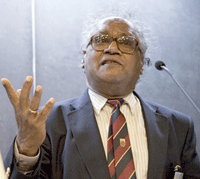 Renowned Indian chemist Professor C.N.R. Rao has won the one million USD Dan David Prize here for his lifetime contribution to material sciences. Renowned Indian chemist Professor C.N.R. Rao has won the one million USD Dan David Prize here for his lifetime contribution to material sciences.“This is a high point in my career. I have received several awards but this is like the Nobel Prize. The standards are very high here and such a major award is being bestowed on an Indian after a long gap since C.V. Raman got the Nobel Prize in 1930,” Rao said before the award ceremony. He also expressed hope that the award will inspire young Indian scientists to believe that pioneering research can be carried out in their own country. “I always wanted to stay and work in India. I never wanted to move out even though I could and I am glad that my work is being recognized,” Rao told PTI. The Dan David Prize is a joint international enterprise endowed by the Dan David Foundation and headquartered at Tel Aviv University. The award is annually given in three fields — archaeology, performing arts and material science — in the three dimensional time framework of past, present and future. Reminiscing his long trail of scientific research, the 71-year-old Linus Pauling research professor at the Jawaharlal Nehru Centre for Advanced Scientific Research in Bangalore said that people initially ridiculed when he delved into solid state research some 40 years ago. Infosys Profit Up 50% Nasdaq-listed Infosys said its April-June net profit rose to 1.9 billion rupees or 28.59 rupees per share, from 1.27 billion rupees or 18.93 rupees a share in the same period a year ago. Total income rose 68.9 percent to 6.26 billion rupees. That exceeded the consensus net profit estimate of 1.84 billion rupees in a Reuters poll of 12 brokerages. Net profit rose 4.4 percent from the previous January-March quarter, compared to expectations of a mere 1.45 percent increase. “Infosys has surpassed expectations both on profit and total income,” said Chetan Shah, a technology analyst at DBS Securities in Bombay. “The client additions are encouraging considering the current environment. In the light of the company guidance, we plan to revise our whole-year profit estimate upwards.” The technology bellwether added 26 clients in April-June, against 37 in January-March, the highest quarterly figure ever. Bangalore-based Infosys, the first Indian software company to report results for the past quarter, had forecast in April total income of 5.8 billion to 5.9 billion rupees. Infosys announced the results before the start of trading. Infosys’ shares were up 1.7 percent at 3,580 rupees in mid-morning trading. The Bombay Stock Exchange benchmark index was up 0.65 percent at that time. Alliance with Wind River I-flex Castek Alliance As part of the alliance, the company has established an equity financing arrangement with Castek that allows it to become the largest shareholder in Castek, I-flex informed the Bombay Stock Exchange. R. Ravisankar, CEO of international operations and business development of I-flex, has joined Castek’s Board of Directors, it said. “Our investment in Castek creates a winning combination of I-flex’s project and quality management skills built over a decade coupled with Castek’s advanced product intellectual property and domain expertise. We are committed to the insurance industry and this initiative is in line with our mission of enabling financial institutions worldwide to excel through the use of technology,” he said. The firm is currently holding talks with potential clients including banks, the financial sector and government bodies, Satyam’s senior vice president Zain Hussain was quoted by the New Strait Times daily as saying. He said the pressure and demand from customers globally would drive business to solutions of this kind to be more competitive. The VDS, which has been tested by Satyam, will help coordinate inter-departmental functions via shared information. The company has decided to use Malaysia as a development center to market its products and services to other international markets, the daily said. It added that Satyam had transferred the bulk of its outsourcing operations in India to Malaysia. SingTel’s stake has gone up by buying shares worth $252 million in the unlisted Bharti Telecom which is the parent company of Bharti Tele-Ventures. Meanwhile, the company has decided not to proceed with the proposed secondary overseas issue. SingTel’s stake in BTVL has been increased through its subsidiary Pastel Limited which has increased the stake in Bharti Telecom to 32.81 percent from 26.96 percent.
CONFERENCE
Entrepreneurs’ Bash: TiECon 2005 - A Siliconeer Report Headlined by the likes of Pulitzer Prize-winning New York Times columnist Thomas Friedman, this year’s TiE conference was abuzz with ideas and eager, energized participants. A Siliconeer report. 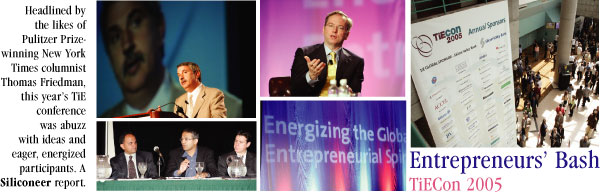 CLOCKWISE FROM TOP, LEFT: NEW YORK TIMES COLUMNIST THOMAS FRIEDMAN, GOOGLE CHIEF ERIC SCHMIDT ; VIEW OF THE CONFERENCE HALLWAY; SLOGAN FOR THE MEET (BOTTOM, CENTER) AND PANEL PARTICIPANTS (L-R) ADOBE COO SHANTANU NARAYEN, MICROSOFT VP SATYA NADELLA AND ORACLE VP FRANK PRESTIPINO. (ALL PHOTOS BY SOM SHARMA / DIGITAL IVISION) Two-time Pulitzer Prize-winning New York Times columnist Thomas Friedman headlined an A-list of Silicon Valley entrepreneurs at the TiECon 2005 May 13-14 at the Santa Clara Convention Center hosted by The Indus Entrepreneurs. With Silicon Valley showing renewed signs of life after a prolonged hangover following the dot-com debacle, many of the 3,000 attendees had a spring in their step. Friedman quoted Infosys chief executive officer Nandan Nilekani, who told Friedman in India that “the global playing field is being leveled, and you (Americans) are not ready.” It is hard to think of a more receptive audience. The articulate foreign affairs writer, who seems to be everywhere these days as he promotes his book “The World is Flat,” is telling anybody who will listen that in the present “plug and play” world, Americans are dangerously unaware of the impending challenge that is going to be posed by formidable brain power coming out of countries like India and China. As he rattled off key events that led to his flat-plain theory — the fall of the Berlin Wall, Netscape going public, the growth of middleware connecting applications, the open standard movement, outsourcing, offshoring, supply chain efficiency and the convergence of all these elements, the audience lapped it up, not always without a trace of self-satisfied smugness. TiE likes to call its annual conference “the world’s largest conference for entrepreneurs.” In its Web site, it said the conference offered “two days of learning, discussion and networking among thought leaders, corporate executives, and successful veteran entrepreneurs.” The conference detailed “the framework of today’s business environment and discuss(ed) the big issues facing industry and entrepreneurs. Plenary sessions and panel discussions focused on business ecosystems in networking, semiconductors, software, storage, consumer Internet, wireless and new emerging technologies.” In opening remarks at the conference, TiE Silicon Valley president Raj Jaswa celebrated the diversity within TiE. In a joint presentation, TiE Inc. chairman Apurv Bagri and TiE Inc. president Sridar Iyengar spoke about the progress of the organization. TiE now has 42 chapters in nine countries, 1,300 chapter members and over 7,000 members worldwide. Bagri added, “More than 70,000 people every year attend (one of TiE’s) 500 events.” Iyengar said TiE is looking for TiE members to help launch new chapters in Dhaka, Mauritius, Colombo and South Africa. Google chief executive officer Eric Schmidt was on hand. In his remarks to the audience, he dismissed any notion that cost-cutting was his company’s priority when he open research facilities in India. Google was in Bangalore and Hyderabad, he said, because it was attracted to the brainpower of India’s top computer scientists.
Schmidt was cautious about detailing specific projects, but he indicated that high-end research that meets Google’s scalable requirements is one area of focus. Google’s corporate culture apportions about 70 percent of employees’ time to core issues, 20 percent to “adjacent” areas and 10 percent to “blue-sky,” or visionary, ideas. He said Google was lucky enough to have so many satisfied workers so excited about their work that few workers gravitate to blue-sky projects, he said. On day two attendees had to choose between a mind-boggling 17 panel discussions led by founders of software, semiconductors, services, security, healthcare, Internet, networking and wireless digital media companies. “TiECon caters to a global audience, with representatives from top technology companies, leading VC firms, key service providers and consumer electronics firms. Attendees span the spectrum from CEOs of mature companies, to first-time entrepreneurs creating new companies, financial market experts, and government policy makers and well regarded personalities from academics and media,” the TiE Web site says.. In one panel, Yahoo! COO Daniel Rosensweig spoke on the future of Web services. He said the old model of network television, where consumers worked out their schedules to fit the broadcast schedule had been turned upside down in the case of the Internet where the winner would be the nimbler service providers who could attend to the individual consumer’s needs most effectively. He said Yahoo!’s phenomenal growth with revenue of $3.6 billion was made possible because the company has two revenue streams: advertising and paid services. The day’s events included a rebroadcast of Microsoft CEO Steve Ballmer’s May 12 talk at a TiE reception; a keynote speech by Bruce Chizen, CEO of Adobe Systems, Inc.; and a discussion on “Democracy and Sustained Economic Growth.” |TOP| Outsourcing Digest: Siliconeer presents of the latest news from the world of outsourcing.  World Outsourcing Forum in Dubai Nortel Expanding in India Offshoring to Continue SCI Companies Expands Symphony Eyes China Colorado Outsourcing IT Work Report Warns about BPO New Tax Threatens BPO Firm, UMD Battles Outsourcing MindTree Acquires Linc Software World Outsourcing Forum in Dubai The first global forum for the outsourcing industry will take place this year, bringing together for the first time leading outsourcing companies, suppliers, consultants and experts from around the world to discuss future business requirements and opportunities in global outsourcing. The World Outsourcing Forum is a conference and networking based event designed for senior decision makers and industry influencers within global businesses. The forum will take place in Dubai during GITEX international technology week in late September, and will be hosted by Dubai Outsource Zone, the world’s first “free zone” dedicated to outsourcing which launched in June 2004. James Freeman, director of the World Outsourcing Forum said: “Outsourcing has become a defining global strategy for many high-profile multinational businesses, but until now the industry has lacked a focal point to support these companies and the vendor companies that make up this industry. What the World Outsourcing Forum will do is for the first time, enable leading outsourcers and outsourcing suppliers to share case studies and opinion on macro-level outsourcing issues ranging from global sourcing to international standards and corporate social responsibility within a collaborative, open environment.” India’s Minister for Communication and Information Technology Dayanidhi Maran told news agencies in New Delhi that several foreign companies including Nokia, Nortel and Alcatel were lining up to set up plants in India. Other reports quoting Nortel CEO Bill Owens said the company plans to invest and expand in India through equity partnerships and joint ventures. Nortel spokeswoman Ann Fuller wouldn’t comment on the reports, but said Nortel is “aggressively” pursuing growth in India, one of the world’s fastest-growing economies. “Essentially, if it becomes a law that you require locally manufactured products (for Indian government telecom contracts), Nortel will absolutely look at it and work with suppliers to figure out how to address that,” Fuller said. Nortel has previously outsourced much of its manufacturing to other companies and plans to outsource the rest by early next year in order to concentrate on developing new products in higher-margin parts of its business. “Nortel’s pulling out of manufacturing in general, and I don’t think they’d be establishing facilities in India just to address that market,” said Scotia Capital analyst Gus Papageorgiou. However, Nortel bought a $10 million U.S. stake in Indian telecom outsourcer Sasken Communication Technologies in April, saying the two companies would work together to develop new software and deploy Nortel’s networking technology. “There could be some more hiccups, but the long-term factors that favor outsourcing are still in place,” said Gartner analyst Frances Karamouzis. U.S. businessmen have little choice but to continue to outsource IT work because they simply do not have the internal resources to meet their needs, she said. “Some big companies are still operating with green-screen applications because they don’t have the IT people or the skills to move off legacy systems,” Karamouzis pointed out, adding that much of the work that is outsourced will also be placed offshore because of price considerations. Alarms were raised in some quarters about outsourcing to India when it came to light that money was siphoned from Citibank accounts, but most analysts do not see an end to the offshore-outsourcing boom. Karamouzis noted that the perpetrators in the case were quickly arrested and jailed by police. “It shows that India has modern, capable law enforcement,” she said. Adam Frisch, a UBS Securities analyst, also does not believe that the outsourcing market is about to lose steam. “We do not think the fundamentals of a growing and nascent industry will change in a three-month period,” Frisch said in a report. The SCI India operations will be handling data entry of paperwork, which will allow its U.S.-based client service team to focus on providing higher level of quality customer service to its clients. SCI has placed stringent security measures, such as a state-of-the-art firewall and 128-bit encryption, to ensure data integrity between its U.S. offices and its India operation. Over the past months, SCI has identified and implemented key processes to maintain its reputable quality of standards across the board. At the same time, SCI has moved its Atlanta operation center into larger premises. One of the highlights of the 25,000-square-foot office in Lawrenceville is a best-in-class payroll center to accommodate the growing number of clients. The Atlanta operation center handles payroll distribution, benefits administration, and other HR services for SCI clients located primarily in the Southeastern region. “We will start to shift work out to China early next year, employing 100 people to begin with,” Symphony CEO Gordon Brooks said. Seeking skills not easily available in the country, Symphony bought over the services of about 100 people from an existing Mumbai-based company, kickstarting its operations there. That business line also had some employees based in Europe, thus Symphony could strengthen its European offerings too. Symphony operates some 10 different areas, and is expecting to either take over the operations of, or handle the expansion of at least another 20 areas during this year. This will add some 400-500 people on the rolls, said Brooks. Symphony has been advocating third-party outsourcing to companies who want to set up areas and in several cases, managed to take over the entire existing unit when the local set-up could not meet the expectations of the U.S. or European parent. The contract is for developing a computer system called “RISE,” a program to help the department in its mission of preparing disabled Coloradans for the job market. It’s the kind of contract that Sen. Deanna Hanna (D-Lakewood) was trying to forbid state agencies from entering into when she introduced a bill in the last legislative session that targeted outsourcing. “Our taxes should be paying salaries of people who live in our country,” Hanna says. “My citizens are going without jobs.” Hanna’s bill failed to pass, but she hasn’t ruled out re-introducing it. However, a spokesperson for the Department of Human Services, which oversees the Division of Vocational Rehabilitation, says they are bound by state procurement rules that direct them to give the contract to the lowest qualified bidder. “Yes we’re very concerned about outsourcing,” says Liz McDonough, spokesperson for the Department of Human Services. “But the reality is, we also have to balance against the best interest of the taxpayer, and we have to ensure that we get the best value for the federal or state dollars that we spend.” Contradicting this, Sabyasachi Satpathy, director-research, neoIT — an offshore advisory and management firm — said that outsourcing is going to stay, but companies (vendors) need to have strong program governance. “Some of the findings of the report are true, though we cannot say that outsourcing will lose its importance in the near future,” he said. According to Satpathy, companies are now not looking at outsourcing large deals. “Each deal is splitting into two to three vendors. This will provide extra cost benefit to customers. Also, this will lead to lesser dependence on a single vendor,” he said. The Deloitte report says that in the long run, organizations that continue to outsource will experience a loss of bargaining power to vendors as the supply side consolidates. Further, the report claims that weaknesses in operational management will result in more deal failures, prompting organizations to bring more operations back in-house. “Some of the hosting-data centre kind of outsourced work is going back. If vendors try to take beyond what he can offer, there will be some issues,” says Satpathy. According to him, over 60-70 deals in 2005 are due for renewal. “There will be some price negotiations with these projects,” he says. However, he says that outsourcing will continue to offer savings for companies. The US-India Business Council, which represents over a 100 big companies doing business in India, has written to Finance Minister P. Chidambaram saying that the proposed tax will have “significant ramifications on businesses operating from India.” Companies that outsource a huge amount of work to take advantage of the cost benefits that India offers will now have to rethink their strategy as the levying of FBT makes India an expensive place now. The USIBC letter said that the “tax will reduce cost competitiveness and add to litigation at a time when companies operating from India are seeking to build a competitive position in the export sector, and global business interest in India is rising The letter added that FBT will, over time, lead to a misalignment between benefits enjoyed by employees and taxes borne by them, as employers seek to pass on the FBT costs equivalently among employees. Saturn Systems Inc., a 15-year-old software engineering firm, unveiled its “Outsource to America” initiative with UMD’s electrical and computer engineering department. The hope is to increase the number of student interns Saturn uses as part of its plan to offer low-cost services to medium-sized businesses. It’s being offered as an alternative to companies that outsource work to countries such as China and India — a phenomenon that has badly hurt information technology, manufacturing and other American industries. “We’re not going to surrender and say China and India have won,” said Saturn Systems Chairman and CEO Jim Gustafson. Some businesses have found that the savings they expected when outsourcing overseas are disappointing. One study — prepared in 2004 by Howard Rubin, a computer science professor emeritus at City University of New York — said that the average cost savings for New York City companies was 44 percent. He also found that “the true savings can sometimes be less than half of that. Using the skills of UMD undergraduate and graduate interns will help keep Saturn’s fees 30 percent to 50 percent lower than competitors based in larger cities, said Bart Knopik, director of sales and marketing. That’s $40 to $250 per hour, depending on the type of work. Other contributing factors include Saturn’s location in a small city, with its lower cost of living, and the region’s outstanding work ethic. The same concept could be used in other fields, too, said Stan Burns, head of UMD’s department of electrical and computer engineering, which will graduate a record 38 undergraduates and two graduate students this month. The arrangement will give students “skills that you can’t get in the classroom,” he said. Avendus was the exclusive financial advisor to MindTree in this transaction. Avendus vice president Shyam Shenthar said that “the strong competence of Linc in the IBM mid-range system space would enable MindTree to offer its clients a wider range of services thus aiding its plans to grow significantly ahead of the market.” Founded in 1988, Linc Software focuses on the areas of application development and maintenance, ERP product support and Web development. The Bangalore headquartered company has over 220 employees and offices in the U.S.A., U.K., Singapore, Switzerland and Australia. Linc specializes in offering software services to manufacturing and, banking and insurance sectors. The company has Fortune 500 customers such as Conagra Foods, Unilever, Atlas Copco, Emerson Group, Novartis and Viacom. “There is a large installed base of IBM iSeries (formerly AS/400) systems and a strong demand for application development and maintenance on these platforms, the world over. As an important component of our growth strategy, the acquisition of Linc Software will enable MindTree to strengthen its capabilities in this space,” said MindTree CEO of IT Services Krishnakumar Natarajan. OUTSOURCING: Offshoring for Real: IT Workers on Ship - By Siddharth Srivastava  If you can’t get them in, ship them close enough. Savvy U.S. entrepreneurs are now planning to house software developers in ships close to the U.S. coast, giving new meaning to the word “offshoring,” writes Siddharth Srivastava. A front page report in The Times of India talks about three American entrepreneurs who plan to house an international crew of software developers on a ship just off the California coast. This way, say promoters of the company called Sea Code, U.S. jobs will stay close home, foreign workers will be saved immigration hassles, and U.S. firms will get competitive rates for projects. Sea Code will be registered in the Bahamas, not subject to U.S. labor laws. The trio has already identified a $10 million ship called the Carousel for their experiment. The promoters, San Diego techies David Cook and Roger Green backed by investor Barry Shillito, a former assistant secretary of defense, say they will hire around 600 programmers from all over the world — including the U.S. and India. “With hybrid-sourcing Sea Code brings already-off shored jobs back to the U.S. and assures that 90 cents of every dollar from our clients stays in the U.S. instead of flowing to foreign locations,” a company press release said. Cook, a former sailor-turned-techie, said he expects the venture to sail smoothly, adding: “We’re not a slave ship.” His partner Green says it will be more “like the International Space Ram Station.” Well, it remains to be seen whether the trio pull it off, but their attempt surely is a reflection (even if slightly bizarre) of the U.S. industry feeling the pinch of federal government policies to keep a check on the number of foreign skilled workers. Microsoft chairman Bill Gates echoed similar sentiments when he directly slammed the U.S. administration’s strict limits on temporary visas for technology workers (the bulk of whom are Indians), saying that if he had his way, the system would be scrapped entirely. “The whole idea of the H1-B visa thing is, don’t let too many smart people come into the country,’’ the world’s richest executive has said. “The thing basically doesn’t make sense.” Gates was reacting to the current annual cap of 65,000 with an additional 20,000 exempt visas (for foreign graduates out of U.S. universities), taking the total to 85,000 consequent to the outsourcing backlash as well as Americans losing jobs to skilled workers from Asia. Prior to 2000, the H1-B program had a visa ceiling of 65,000 but was increased to 115,000 in 2000 and subsequently to 195,000 for a period of three years, during the tech boom. But, after the three-year period ended, H1-B cap was brought back to the original 65,000 per year, due to protests by American workers in an election year. Last year the quota was exhausted on the very first day the new allocations opened, the first such occurrence. H1-B is the specialty-occupation visa status under which a large number of Indian information technology firms send their employees to the United States for on-site project-development work, popularly known as body-shopping. The United States is the prime export destination for the Indian software industry. Echoing Gates words, Ravi Venkatesan, chairman, Microsoft India, has said: “There exists a demographic challenge in the U.S. with an aging population whereas India has dynamic and highly educated youth. It is in the natural interest of both the economies to allow this integration of resources and talent. In this day of globalization, dropping of artificial barriers such as this is essential to allow free flow of trade and talent to benefit both countries while fostering economic development at the same time.” U.S. industry has been pushing for a removal of the cap which has been opposed by labor unions. Complete America — a coalition of over 200 corporations, universities, research institutions and trade associations — has been advocating for a raise in the annual cap. The allowance of the extra 20,000 visas to foreign nationals graduating from U.S. universities was as a result of their efforts. As things stand, the Bush administration does not seem to be in any mood to comply. The H1-B visa program has been criticized by unemployed U.S. professionals for “taking away” their jobs. The administration is of the view that unemployment among U.S. computer engineers regularly exceeds the figures in other industries. Indian information industry czars are predictably happy at Gates’ clarion call which highlights the mismatch between the availability of skills and demand for tech workers in the U.S., despite the U.S. administration claims. The Indian IT industry is concerned that the limit will affect Indian software firms, which have a large number of clients in the U.S., though it would bring more offshore work to India from the U.S. The restriction will curtail the flexibility to reinforce onsite teams at various stages in the software development lifecycle (system requirement study, testing and implementation phases) if adequate and proactive planning is not in place. Big companies like Wipro, Infosys, HCL and Tata Consultancy Services have already built robust H1-B visa banks, with a shelf life of 6 years, in anticipation of a shortage; it is the smaller IT firms that will really have to struggle. However, it is believed that if the cap remains for a longer while, it will definitely impact the Indian IT industry as a whole. In a statement, India’s software giant Infosys has said: “Bill Gates is an icon of American industry. His voice creates a positive cluster of opinion and is a clear signal to policy makers what U.S., Inc. wants. Such voices will be more vocal now as you will see the rhetoric fading out.” In any case, there are other areas, apart from the tech-sector which may feel the pinch of the H1-B cap. Reports in India highlight the acute shortage of nurses and teachers which can adversely affect U.S. while at the same time open up opportunities for Indians. According to Stephen S. Nuell, president of Nurses for International Exchange, the demand for nurses has escalated so much that the U.S. Congress is set to bring in legislation to make visas to nurses easily available. Estimates put the demand for Indian nurses in the U.S. to the tune of 250,000. Estimates of shortage of teachers in U.S. range up to 700,000. This is a huge human resource problem. So What is to be done? Could floating hospitals be an answer? Or schools? - Siddharth Srivastava is India correspondent for Siliconeer. |TOP| REPORT: South Asian Voters: Insight into Trends - A Siliconeer Report New York’s SAALT have a striking analysis from a multilingual exit poll in November. A Siliconeer report.  SAALT — South Asian American Leaders of Tomorrow — have May 2 presented an analysis of findings gathered from a multilingual exit poll conducted by the Asian American Legal Defense and Education Fund during the November 2004 elections. The poll, which surveyed 2,636 South Asian voters in New York, New Jersey, Michigan, Illinois, and Virginia, reveals valuable information about voting trends and patterns. SAALT — South Asian American Leaders of Tomorrow — have May 2 presented an analysis of findings gathered from a multilingual exit poll conducted by the Asian American Legal Defense and Education Fund during the November 2004 elections. The poll, which surveyed 2,636 South Asian voters in New York, New Jersey, Michigan, Illinois, and Virginia, reveals valuable information about voting trends and patterns.“Striking conclusions can be drawn from the data,” said Deepa Iyer, executive director of SAALT. “For 42 percent of the South Asians polled, this was the first election in which they had voted. Additionally, 88 percent of the South Asians who voted are foreign-born. This emphasizes the need for voter education and registration campaigns to include strategies such as naturalization drives and outreach tailored to South Asians who have arrived more recently.” The data also revealed that South Asians chose civil liberties as the civil/immigrant rights issue most important in their lives. “The South Asian community has endured increased incidents of bias and immigration enforcement since September 11th,” according to SAALT Board Member, Jayesh Rathod. “Our own work through dialogues with community leaders also echoes the importance of civil liberties as a prominent issue in the lives of South Asians, one that needs to be addressed in various contexts by policymakers, candidates, and advocates.” SAALT has produced a backgrounder that interprets the data from the multilingual exit poll and makes recommendations to improve South Asian political participation in the future. The recommendations reflect specific action steps for local boards of elections, community leaders, elected officials, policymakers, political party leaders and candidates. SAALT Recommendations:
|TOP|
HEALTH CARE: A DOCTOR'S WORD
Pregnancy 101: What Every Woman Should Know - Gonzalo Garretòn, MD  It’s the most natural of conditions, yet it’s a cause for great apprehension. Gonzalo Garretòn, MD offers some basic tips on pregnancy. It’s the most natural of conditions, yet it’s a cause for great apprehension. Gonzalo Garretòn, MD offers some basic tips on pregnancy.Everyone has a story about a friend’s difficult labor or horrible morning sickness. When you’re listening to other people’s experiences and advice, it’s essential that you remember that pregnancy is a natural process. Ninety-eight percent of pregnancies result in a healthy baby and a healthy mother. The best way to dissipate your fears about having a baby is to talk to your doctor, midwife or nurse practitioner. Here are some of the many questions expectant mothers ask me everyday — and remember: the key to feeling relaxed about your pregnancy is getting your questions answered. What can I do if I think I’m pregnant? Set up an appointment with your doctor right away. Not only is it important for the health of you and your baby, but talking with your doctor can also help you emotionally by teaching you what steps to take. It’s important to refrain from drinking, smoking or taking other drugs even before you know for sure if you are pregnant. What are my options if I am pregnant? Every woman has a different reaction to discovering she is pregnant. One patient of mine decided it was a sign that she should get healthy and signed up to train for a marathon! Although it’s not the right time to put your body through the stress of a marathon, her impulse to get healthy was right. If you decide to continue with the pregnancy, the first step is to take a look at your health. For those who are not seeking to continue with the pregnancy, in the state of California you have the right to terminate the pregnancy, no questions asked. Planned Parenthood is often the most accessible but most clinics, both public and private, can provide these services. Adoption is also an option to consider. Prenatal care is essential to having a healthy pregnancy. If you don’t have health insurance, there are many public clinics and charity non-profits that have free prenatal care. If you are not a legal resident of the United States, don’t worry: Physicians are not required by law to report any patient’s legal status, and doctors have long resisted any pressure to report undocumented persons. You may not be eligible for state-run programs, but there are many community groups — through churches, community centers, etc. — that have programs to help you get the care you need.
Will one beer or one cigarette really affect the baby? There is no safe amount of smoking or drinking during pregnancy. Smoking and alcohol have the same basic effect on the fetus — they inhibit your baby’s development. Alcohol causes physical, mental and behavioral problems for the newborn. Smoking decreases blood supply to the baby. I’ve heard horror stories about morning sickness. Will I be sick for nine months? If you’re nauseated, don’t drink fluids. Try to eat something dry in small amounts, like dry cereal, toast or a hard-boiled egg. When the nausea quiets down, drink fluids only by the teaspoon. Try dividing meals into smaller meals, from three to six servings a day.
CONFERENCE: 3AF Conference: Marketing to Indian Americans - A Siliconeer Report 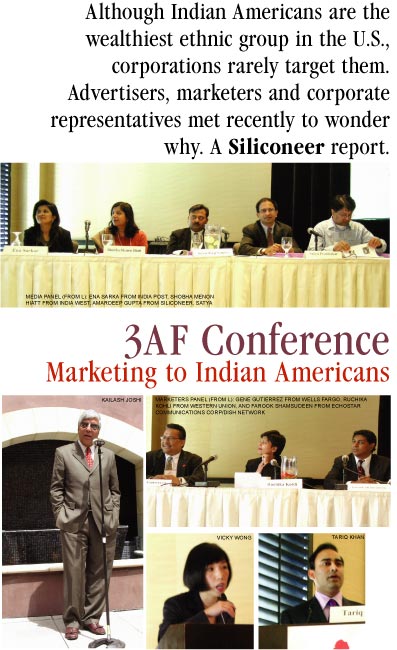 Although Indian Americans are the wealthiest ethnic group in the U.S., corporations rarely target them. Advertisers, marketers and corporate representatives met recently to wonder why. A Siliconeer report. Although Indian Americans are the wealthiest ethnic group in the U.S., corporations rarely target them. Advertisers, marketers and corporate representatives met recently to wonder why. A Siliconeer report.Clockwise from top: Media Panel (from L): Ena Sarka from India Post, Shobha Menon Hiatt from India West, Amardeep Gupta from Siliconeer, Satya Prabhakar from Sulekha.com and Mahesh Pakkala from TV Asia; Marketers Panel (from L): Gene Gutierrez from Wells Fargo, Ruchika Kohli from Western Union, and Farook Shamsudeen from EchoStar Communications Corp/Dish Network; Tariq Khan; Vicky Wong; Kailash Joshi. According to the 2000 census, the population of Indian Americans in United States is 1.67 million, with an average household income of about $71,000, $20,000 more than American families as a whole. Indian Americans are also ahead of every other Asian group in education, professional job status and English language ability. You would think this would be an attractive target for corporate America to market its goods and services, but somehow that hasn’t happened. The Asian American Advertising Federation hosted a meeting April 22 entitled “The Growing Power of Asian-Indian America” that brought together corporate representatives, academics and South Asian ethnic media representatives to give their perspective on the issue. After an overview of the U.S. Indian American market, a host of panels discussed issues from the perspective of academics, the ethnic media, community organizations, advertising agencies and marketers. The lack of targeted marketing is due in part to the Indo-American community’s fluency in English, said Vicky Wong, president of San Francisco-based Dae Advertising, which works with corporations wanting to do business with to various Asian groups. Corporations understand that they can’t sell to Korean-, Chinese- and Vietnamese-Americans if they don’t target them in native tongue, Wong said. Census figures show that those groups are less comfortable in English. Corporations also believe that Indo-Americans can be reached by mainstream advertising, she said. CULTURE: Natya Mela 2005: Bangla Theatre Fest - A Siliconeer Report Theatre troupes from as far as Sacramento and Los Angeles came together to celebrate Bangla theatre in a day-long festival. A Siliconeer report. 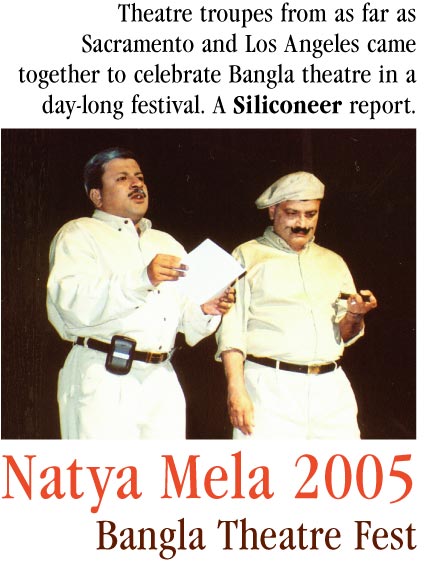 A scene from Utsav’s “Public Servant”. A scene from Utsav’s “Public Servant”.San Francisco Bay Area-based Bengali cultural group Sanskriti hosted a theatre festival with four participating groups May 21 in Pleasanton, Calif. The performances were not always flawless or of professional caliber, but what the groups lacked in professional expertise, they made up in commitment and passion. The four groups that participated were Utsav from Sacramento, Bina and Enad from the Bay Area and Shruti Natak from Los Angeles. Of these, Shruti Natak presented—as its name implies—not full-fledged theatre, but a sort of reading of two short plays. The festival opened with a lecture by Sudipto Chatterjee, a professor of theatre at the University of California of Berkeley who urged both the theatre groups and the audience to expand their cultural and artistic horizons The festival began with Utsav’s production Public Servant, a play by Gautam Roy it had performed in Davis in its Durga Puja festivities back in 2002. A light-hearted comedy focusing on a pompous but cowardly police officer who fails to be with his domineering wife on his first marriage anniversary, the play also reflects on the ills that bedevil contemporary West Bengal, particularly the power of goons with political connections whom the police are powerless to rein in. “A group of Bengalees had been performing drama in and around Davis, Sacramento since 1997,” the Sanskriti Web site says about Utsav. “Later, the group reorganized itself under the name of Utsav serving mainly the Bengali community scattered around Sacramento.” Enad presented Badal Sircar’s Shonibar, a light-hearted, comic reflection on a Bengali mid-level office worker whose disappointing, mundane life is contrasted with dream sequences where all sorts of wonderful things happen. Interesting stage effects added to its performance value. “Enad, a San Francisco Bay area theater group, already known in the local theater connoisseurs as a disciplined and dedicated group, has been entertaining local audience with its remarkable productions since its formation in 1999,” the Sanskriti Web site informs. “The group staged their first production in 2000. More than anything else, this group is particularly recognized as producing and practicing contemporary, thought-provoking and relevant plays.”
Bangladeshi theatre group Bina’s production Amader Katha deserves special mention because it is written by the group’s founder Abu Hena Mustafa Kamal. The play casts a broad canvas to reflect on the challenges of contemporary life in Bangladesh. University professor Sinha fights an uphill battle as he tries to live a principled life in a society where political manipulation and corruption have made it an almost impossible challenge. The play had an elaborate cast which highlighted a variety of social issues in contemporary Bangladesh. While Shruti Natak’s presentation wasn’t exactly theater, Biplab and Rumi Bhawal’s reading of two short plays, Balaka and Bougainvillea, was nevertheless quite entertaining. In addition to their well-nuanced reading, credit should specially go to Rumi Bhawal, who wrote both plays. LIFESTYLE: Medieval Mantra: Fashion Show in New York - A Siliconeer Report  CLOCKWISE FROM TOP LEFT: COSTUMES DESIGNED BY PRIYA & CHINTAN EXCEPT (BOTTOM, R) BY PAYAL SINGHAL. (PHOTOS COURTESY SHEHNAAI, NEW YORK) Five Indian fashion designers will present costumes based on medieval themes like Mughal, Sultan and Rajputana at a fashion show in July hosted by New York’s Shehnaai boutique. Over 600 people are expected to attend the show accompanied by DJ music. A Siliconeer report. Shehnaai, New York’s primary Indian designer boutique, will celebrate its first anniversary with a gala fashion show July 14, according to a press release. Called “Medieval Mantra,” the show will present collections from some of the top fashion designers from India who will theme their work on a medieval Indian era/ region. Five fashion designers will participate: Ritu Kumar, Satya Paul, Payal Singhal, Priya & Chintan and Nisha Sagar. Payal Singhal, Priya & Chintan and Nisha Sagar will be in attendance at the event. The show is being presented at Earth in Manhattan. Each of these designers will depict a certain Indian medieval era such as Mughal, Sultan, Rajputana with their fashion collection. “We anticipate a turnout of over 600 people,” organizers said in the release. Here are brief profiles of the designers. Ritu Kumar. Having started in the 1960s with hand block printers and two tables in a small village near Kolkata, Ritu Kumar’s team of dedicated workers have produced some of India’s most exquisite garments and accessories in cotton, silk and leather. Ritu has been designing wardrobes comprising swimwear, evening wear, traditional Indian wear, casual wear and formal evening gowns of the winning three Miss India’s during their participation in the international fashion pageants. Kumar has exclusive outlets in Mumbai, Delhi, Kolkata, Chennai, Amritsar, Bangalore, Chandigarh and Ludhiana. Satya Paul. The Satya Paul label incorporates various brands. Having launched in 1985, Satya Paul was the first designer to sell across 12 cities in India by 1986. By 1989, the label had expanded to launch four lines: Signature Series, Renaissance, Avant Garde and Museum Piece Collection and was selling all through the U.S., Europe and Japan. Payal Singhal. Payal’s tryst with fashion began more than a decade ago when she won her first design award at the age of 15. She grew up surrounded by Indian art and fashion pioneers such as grandfather J.P. Singhal and father Dinesh Singhal. Payal received training at SNDT, Mumbai and Parsons School of Design, N.Y. At 22, following a stint as stylist of MTV, Payal launched her own signature label. Today her signature label retails through various stores in Mumbai, Delhi, Calcutta, Hyderabad, Hong Kong, Dubai, Miami and New York. Priya & Chintan. Priya & Chintan aim to combine heritage and innovation to enhance Indian handicraft and endeavor to blend tradition and youth. After training at SNDT in Mumbai and the Parsons School of Design in N.Y., they worked with Calvin Klein and Randy Rahm. The duo launched their own label amongst 30,000 people at a Society Show in Mumbai. Nisha Sagar. Nisha Sagar, a Mumbai-based designer, has been dressing leading ladies of Bollywood for many years. Her clients include Hema Malini, Jaya Bachchan and Juhi Chawla. Her designs emphasize glamour and tradition. Her forte is in sarees, to which she adds a touch of creativity and glamour to take them to Bollywood. HONOR: Immigrant Accolade: Ellis Island Medal This year, three Indian Americans won the Ellis Island Medal of Honor. A Siliconeer report. 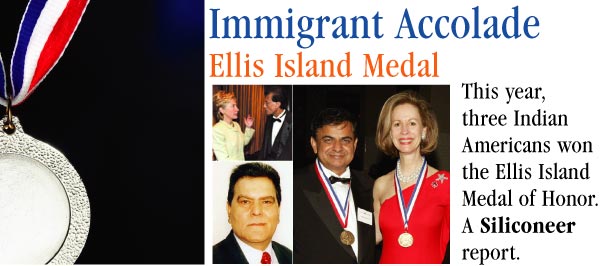 Clockwise from top left: Ellis Island medal winners H.R. Shah with Sen. Hillary Clinton, D-N.Y.; Sudhir Parikh with Ellis Island medal winner American Red Cross Chairman Bonnie McElveen-Hunter; and Parveen Chopra Three Indian Americans have been awarded the Ellis Island Medal of Honor by the National Ethnic Coalition of Organizations, the largest organization of its kind in the United States which serves as an umbrella group for over 250 organizations that span the spectrum of ethnic heritages, cultures and religions Dr. Parveen Chopra, author, professor, and chairperson of the Commission of Human Rights of Nassau County, New York; nationally-recognized allergy, asthma and immunology expert and community activist Sudhir Parikh, M.D.; and entrepreneur and philanthropist H.R. Shah, chairman and CEO of TV Asia and Krauszer’s, are among this year’s recipients of the Ellis Island Medal of Honor, NECO has announced. “The Ellis Island Medal of Honor was created in 1986 to honor the many ancestral groups who through struggle, sacrifice and success, helped build this great nation,” according to NECO. “Six Presidents, several senators and congressman and Nobel Prize winners are among the remarkable group of individuals to receive the Ellis Island Medals of Honor for their outstanding contributions to America. This year, the prestigious Medals has again been presented to outstanding Americans who have distinguished themselves as citizens of the United States.” FINANCE: New Financial Center: Technology Credit Union  One of the nation’s largest credit unions, Technology Credit Union, will open a new financial center in South San Jose. A Siliconeer report. Technology Credit Union, among the top one percent of the nation’s largest credit unions, has announced the opening of its new Santa Teresa Financial Center in South San Jose. The new branch office opens its doors to the public June 1, a company press release said. To celebrate the expansion, Tech CU has invited the community to its opening celebration June 18 with prizes, food, music and entertainment. “We also invite neighboring residents to stop by our new location before June 17 to get acquainted with our friendly staff and to enter our ‘Driven to Excellence’ Sweepstakes with a grand prize of a one-of-a-kind, fabulous 2006 Pontiac Solstice roadster,” the release added. “The Sweepstakes drawing for this ‘welcome wagon’ and other great prizes will be held on the day of the Grand Opening Celebration on June 18.” Tech CU offers leading edge financial solutions — everything from checking and high yield certificate accounts, to home loans and Home Equity Lines of Credit. For each new account opened at the Santa Teresa Financial Center, Tech CU will donate $10 to HOPE Services, a non-profit charitable organization that has served the Bay Area for over 50 years. Gaining a community charter in 2004 enabled Tech CU to widen its focus, so that it may provide its services not only to the employees of technology companies and their families, but also to the professionals living and working in Santa Clara, Alameda and San Mateo counties. Technology Credit Union is a member-owned, full-service financial provider that offers services to technology professionals and their families, as well as individuals who work, live, go to school or regularly worship in Santa Clara, Alameda, and San Mateo counties. With more than $1 billion in assets, and six full-service branches in the Silicon Valley, Tech CU is a leader in the credit union industry. For more information, interested readers can visit www.techcu.com. PHOTO ESSAY: Kucch Dil Se: Adnan Sami Concert Singer Adnan Sami May 7 mesmerized a huge crowd in Oakland, Calif., with superb performance and excellent musical accompaniment. A photo essay by Som Sharma.  |TOP| TRIBUTE: Farewell, Sunil-saab: A Siliconeer Tribute He was a talented actor, a humane politician, but most important of all, a genuine gentleman. Siliconeer bids a fond farewell to Sunil Dutt. 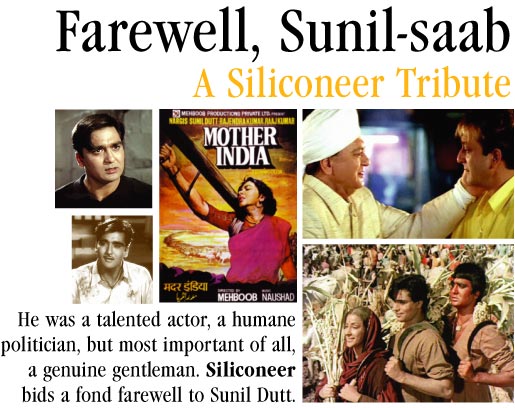 Clockwise from top left: Sunil Dutt in “Waqt” (1965); Nargis seen in a poster of the film “Mother India”; Sunil Dutt with son Sanjay in “Munnabhai M.B.B.S.”; Nargis, Rajendra Kumar and Sunil Dutt in “Mother India” (1957); Sunil Dutt in “Payal” (1957). Clockwise from top left: Sunil Dutt in “Waqt” (1965); Nargis seen in a poster of the film “Mother India”; Sunil Dutt with son Sanjay in “Munnabhai M.B.B.S.”; Nargis, Rajendra Kumar and Sunil Dutt in “Mother India” (1957); Sunil Dutt in “Payal” (1957). Of course he was a memorable actor. He was also a veteran politician, a popular Member of Parliament and a social activist. But the most important thing about him, at the end of the day, was the consummate grace of this thoroughly decent man. Sunil Dutt, actor, politician and peace activist, died of a heart attack at his Bandra residence in Mumbai May 25 morning, following a brief illness. He was 75. He is survived by his son Sanjay Dutt and two daughters. “From impoverished Partition refugee to popular film star to Member of Parliament to a Minister in the Union Cabinet — the story of Sunil Dutt’s life reads like a film script,” wrote Chennai daily The Hindu. His filmography was long and varied but the film for which he is best remembered is Mother India (1957), where he played the role of Birju opposite the legendary Nargis. They married a year later. Between Mehboob Khan’s Mother India and Humraaz in 1967, Dutt was at the peak of his acting career. In 1981, he lost his wife, Nargis, after a long and painful struggle against cancer. This was a deciding moment for Sunil Dutt. It was then that he turned his attention to social work, beginning with working for those afflicted by the disease that killed his wife. Deeply committed to peace, he walked 2,000 km from Mumbai to Amritsar in 1987 and prayed at the Golden Temple for peace at a turbulent political time in Punjab. In 1988, he went from Nagasaki to Hiroshima in Japan to protest against nuclear weapons. A committed secularist, he quit Parliament in 1993 after the communal conflagration in Mumbai following the demolition of the Babri Masjid, His numerous awards include the Padmashree in 1968. In addition, he had the love, affection and respect of many millions who admired his acting skills, his social commitment and his compassion. NEW PRODUCT: Hair Loss Breakthrough: Regen Herbal Vitalizer Just one 250 ml bottle is all that is needed to make you a permanent fan of their hair vitalizer, says producer Raylon Industries. A Siliconeer report.  Balding, thinning hair or a receding hairline is a serious concern for those coping with hair loss. More people are losing their hair in today’s high-stress society. Now there’s good news for all those suffering from thinning hair, receding hair line and bald patches, according to a press release from Raylon Industries, who say that after decades of research, testing and study, the company has made the long-awaited breakthrough and found a solution with Regen Hair Vitalizer. Balding, thinning hair or a receding hairline is a serious concern for those coping with hair loss. More people are losing their hair in today’s high-stress society. Now there’s good news for all those suffering from thinning hair, receding hair line and bald patches, according to a press release from Raylon Industries, who say that after decades of research, testing and study, the company has made the long-awaited breakthrough and found a solution with Regen Hair Vitalizer.“A refreshingly unique blend of rare herbs from the Himalayan mountain ranges of India, Regen Hair Vitalizer comes as a blessing for people across the country,” the release says. “100 percent herbal and gentle enough for everyday use even on children and babies, Regen is made with the highest quality botanical ingredients and hence has no side effects.” “This natural, simple-to-use, non greasy liquid/magic potion, not only arrests excessive hair fall within a week but also regenerates hair growth within two months,” says the company. “It dramatically revitalizes dull hair giving it shine, volume and bounce. The results of Regen are real and lasting.” The product has undergone extensive scientific research and clinical tests, “yielding astonishing results,” says the release. “Clinical trials show a 98 percent success rate for people in the beginning to intermediate stages of hair-loss.” Raylon Industries has won the National Award For Outstanding Achievement in India and several other such prestigious awards. Interested readers can get more information at the following Web site www.exclusivelines.co.uk. COMMUNITY NEWS IN BRIEF: Pharmacists’ Meet ... Community Award ... Online Voting for NASABA Awards ... Asian Heritage Event ... IIFA Awards Contest ... Grant for College Students ...
Pharmacists’ Meet “AIPhA has made significant gains in the political arena, having earned newfound respect and co-operation with a plethora of state representatives,” the release added. “Through its efforts, AIPhA has brought government officials to the table and has opened dialogues never before possible. Even now, AIPhA is preparing itself to work with the state on many issues including measures to: increase access to pharmaceutical care to every citizen of Illinois; enact legislation that will properly monitor and control Pharmacy Benefits Managers’ irregular and incoherent policies that have financially crippled the state and pharmacies alike.”
Jairam procured t-shirts with the India Literacy Project logo printed in local screen printing companies, and sold the t-shirts at the Indian Independence Day fair. He is the first youth volunteer for the India Literacy Project. “NASABA looks to serve its community, so the community should play a role in deciding who our award winners will be,” said NASABA president Vijay Bondada. The 2005 NASABA Conference, to be held at the Hyatt Regency Washington on Capitol Hill, June 17-18, will showcase achievements of South Asian-Americans and feature panel discussions and breakout sessions covering a range of topics from immigration law and religious freedom to homeland security. Nominees for the NASABA Dalip Singh Saund Attorney of the Year include: Vanita Gupta, Neal Katyal and Suhag Shuklam. NASABA Public Interest Organization of the Year nominees include: Sakhi - a non-profit, community-based anti-domestic violence organization that concentrates on South Asian women. SAALT - South Asian American Leaders of Tomorrow, a national non-profit organization dedicated to ensuring the full participation of South Asians in American civic and political life. Apna Ghar - Its pioneering work as a domestic violence shelter primarily helps Asian women and children. It was the first Asian shelter of its kind in the Midwestern United States, with over 3,800 domestic violence clients. This year’s guest speakers for NASABA’s annual convention include: Raj De, counsel, 9/11 Commission; Timothy Edgar, legislative counsel, ACLU; Sri Srinivasan, assistant to the solicitor general, U.S. Justice Department; Olati Johnson, professor, Columbia Law School; and Prakash Khatri, immigration and citizenship services ombudsman, Department of Homeland Security. For more information, to purchase tickets, or to vote for the 2005 NASABA Dalip Singh Saund South Asian Attorney of the Year and 2005 NASABA Public Interest Organization of the Year, interested readers can visit: www.na-saba.org The fair featured a variety of food and entertainment, including Asian cooking demonstrations, electronic games, a car show, arts and crafts, and multi-lingual booths hosted by Bay Area community groups and businesses. Local Asian American musicians including the BAMMIE winning beat/reggae band Native Elements, jazz artist Francis Wong, the alternative rock band the Skyflakes, deejay Mike Nice, and singer/songwriter Goh Nakamura provided live entertainment. “We would like to thank our sponsors for recognizing the significance of Asian Pacific American Heritage Month,” said Ted Fang of the AsianWeek Foundation. “We would particularly like to acknowledge co-presenters Kaiser Permanente, Albertsons, and Celebration Sponsor Budweiser for their strong commitment and contributions to the Asian American community in the Bay Area.”
The contest began May 16 and winners will be announced June. meraTicket.com is the only South Asian internet portal exclusively geared towards online ticket sales for Bollywood events organized in the United States. Established in 2003, the company says it has become the leader in online ticket sales for South Asian events. Interested readers can visit www.meraTicket.com for more information. The contribution will be devoted to supporting students who would otherwise be unable to attend a post-secondary institution without financial assistance. In recognition of the fact that most scholarship recipients require support throughout their tenure as college students, Sodexho will devote its funding support to each of its APIASF scholars, based on their academic performance, for a minimum of three years. According to the U.S. Census, more than 12 percent of Asian Americans and nearly 18 percent of Pacific Islander Americans live in poverty. In several communities, including Native Hawaiians, Samoans, Cambodians, Hmong and Vietnamese, as many as 50 percent of the population have not completed high school. “Sodexho is truly proud of its commitment and support to students in need of financial assistance to help them pursue their goals of higher education,” said Rohini Anand, senior vice president and chief diversity officer at Sodexho USA. APIASF (www.apiasf.org) is the first national organization devoted solely to the scholarship needs of college-bound students of Asian and Pacific Islander American heritage. In May, APIASF awarded its first scholarships, totaling more than $300,000. APIASF’s mission is to ensure that every Asian and Pacific Islander American student is enabled to attend a post-secondary college, university or vocational institution regardless of their cultural background, ethnicity or financial means. Recently, Sodexho was named one of Asian Enterprise magazine’s Top Ten Companies for Asian Americans in 2005 for offering substantial resources and opportunities for Asian Pacific American business owners and employees. “When APIASF was contacted by Sodexho, I was extremely impressed with their understanding of the needs of APIAs in this country,” said Tim Leong, president and executive director of APIASF. “They also recognized immediately that many students and their families in our community live below the official poverty line, and don’t have the means to pay for the enormous costs associated with a college education. ADVERTORIAL: Real Estate and You: How to Make Money in Real Estate Investing - By Raja Ahluwalia Want to be a successful investor in Real Estate? Raja Ahluwalia offers some tips on how to do it right.  Lower Your Taxes Tax incentives for real estate investors can often make the difference in your tax rates. Deductions for rental property can often be used to offset wage income. Tax breaks can often enable investors to turn a loss into a profit. For which items can investors get tax breaks? You could claim deductions for actual costs you incur for financing, managing and operating the rental property. This includes mortgage interest payments, real estate taxes, insurance, maintenance, repairs, property management fees, travel, advertising, and utilities (assuming the tenant doesn’t pay them). These expenses can be subtracted from your adjusted gross income when determining your personal income taxes. Of course, these deductions cannot exceed the amount of real estate income you receive. In addition to deductions for operating costs, you can also receive breaks for depreciation. Buildings naturally deteriorate over time, and these “losses” can be deducted regardless of the actual market value of the property. Because depreciation is a non-cash expense — you are not actually spending any money — the tax code can get a bit tricky. For more information about depreciation and various tax alternatives, ask your tax advisor about Section 1031 of the U.S. Tax Code. Regardless of what kind of real estate you choose to invest in, timely collections from your tenants is absolutely necessary. A positive cash flow — whether it is pre-tax or after-tax — requires rental income. Be sure to find quality tenants; a thorough credit and employment check is probably a good idea.
While investing in real estate is relatively complex, it is often worth the extra work. When compared to other financial investments, like bonds or CD’s, the return on investment for real estate purchases can often be greater. The key to real estate investing is equity. Determine an amount of equity that you want to achieve. When you reach your goal, it’s time to sell or refinance. Determining the proper amount of equity may require the assistance of a real estate professional.
AUTO REVIEW
Well-mannered Road Presence: Lexus GS 430 - By Sally Miller Wyatt Overall, the well-mannered road presence with plenty of room for passengers makes the Lexus GS 430 a delight to drive, writes Sally Miller Wyatt.  There used to be a time when auto manufacturers and dealers made a big deal out of introducing the new model year. Most of the hoopla and hype occurred as football season was getting under way. So, here it is June, and I’m driving around in a 2006 model. What happened to all the fall fanfare? When did this new model year officially roll in? They put up Christmas decorations after Labor Day now, so why should I be surprised? There used to be a time when auto manufacturers and dealers made a big deal out of introducing the new model year. Most of the hoopla and hype occurred as football season was getting under way. So, here it is June, and I’m driving around in a 2006 model. What happened to all the fall fanfare? When did this new model year officially roll in? They put up Christmas decorations after Labor Day now, so why should I be surprised?My first taste of 2006 came in the form of an all-new, next-generation Lexus GS 430. This version has been designed, according to Lexus’ press materials, to offer all the latest in technology and design, taking safety, performance and luxury to even higher levels. The 2006 Lexus GS 430 has a softer-edged look, with an aerodynamic undertone. The outward appearance only hints at the power and performance lurking under the hood. Our test model came with a brawny 4.3-liter, 32-valve V8 engine. To put it bluntly, it offered breathless care-free acceleration. When ferrying children about, having this kind of quick acceleration at your disposal is a comfort factor. Worried about the mileage ratings on a V8, when gas prices are spiking? This Lexus GS 430 had an EPA of 18 for city driving and 25 for highway, which isn’t bad. However, there is an all-new 3.0-liter, 24-horsepower V6 available, which has a new fuel injection system that balances the fuel mixture better to enhance power and fuel economy. So you have some choices. The 2006 Lexus also has an all-new suspension system that uses the latest in technological advances. The effect essentially smoothes out the ride to the point where you can actually lose a sense of tires rolling along the road. Hint: Keep an eye on the speedometer, because when the ride is this smooth and quiet, you could easily exceed posted limits. The new GS 430 also offers Lexus Vehicle Dynamics Integrated Management System. It’s a long name for a monitoring system that integrates all the latest safety technology, such as a new Electronically Controlled Brake system, Variable Gear Ratio Steering, Electronic Power Steering, Vehicle Stability Control, ABS, Brake Assist, Electronic Brake force Distribution and engine torque. Using a system of sensors, VDIM monitors all these technological advances. If it anticipates the potential for an impending skid or slide, VDIM helps correct the situation by using a combination of throttle control, braking and steering in a way that is designed to be transparent to the driver. It’s so cutting edge, it just makes you wonder where we will be when they roll out 2016 models. Of course, with this being a Lexus, you can expect the best when it comes to luxurious details, and for 2006 you will not be disappointed. To maximize passenger comfort, ventilated front seats are available as an option, as is a power rear sunshade. Used in conjunction with the standard dual-zone climate control, you’ll find an interior cabin that can be comfortably customized to suit all passengers. The Lexus GS 430 also has “Smart Access” keyless entry, and a new push-start ignition system. I found it a little hard to get used to this keyless ignition, because I was constantly checking to make sure I had the key in my pocket or purse. The trunk is deep, but access to the opening is limited by low-slung rear window glass. We thought it might be difficult to load long and bulky items, such as golf clubs or trombones. There are many other nice touches on board the Lexus GS 430, including a hidden panel to the left side of the steering wheel, which tucked away all the buttons and switches – such as a fuel door release – not often needed. By hiding these, the dashboard cuts down on visual clutter. Overall, we found the Lexus GS 430 was a delight to drive. It offers a well-mannered road presence and plenty of room for passengers of all sizes. - Sally Miller Wyatt is a freelance writer Guftugu The film, directed by Rajkumar Hirani and produced by Vidhu Vinod Chopra, will now be cast in a Hollywood format, according to Sam Fernandez, CEO, Vidhu Vinod Chopra Films. “We received a call from the company stating that they were interested in remaking Munnabhai MBBS in English. It took around five to six months after the call to translate the thought into an agreement,” Fernandez told PTI. The mind boggles at how the raffish goon played by Sanjay Dutt will be translated into a Western idiom, but Fox apparently smells moolah. “The film will not be dubbed but be a remake in the Hollywood format. Vidhu will be part of the production team and may also be part of the distribution network in India, though the latter is still to be finalized,” Fernandez said. “The cast of the film will be finalized by 20th Century Fox. They will be deciding on the cast; there will be no intervention from our side,” he said. The runaway hit Munnabhai MBBS portrays a local goon, played by Sanjay Dutt, who enters the medical world to fulfill the dreams of his father — an upright moral man of the village, played by actor-turned politician and Sanjay’s real-life father, Sunil Dutt, who returned to the screen after a 17-year-gap, and has recently died. Too bad Sunil-saab won’t be around to see the result. At a gathering held May 15 at Akal Takht premises, activists of Shiromani Akali Dal (A), Dal Khalsa, Shiromani Khalsa Panchayat, Khalra Mission Committee and Sikh Students Federation announced their action program and resolved to stop the screening of the controversial film in case the Punjab government did not do so by May 19. Later, within hours of the Shiromani Gurudwara Prabhandak Committee demanding a ban on controversial film, distributors May 19 withdrew the movie from theatres across Punjab, Haryana and Chandigarh. Other cities like Lucknow have joined in the banning frenzy. The film, however, continues to be screened in at least 20 theatres in the city amidst tight security measures in the wake of twin blasts in cinema halls in Delhi. What’s getting missed in the shuffle is the fact that the film has flopped in India, anyway. Overseas, it’s a different story. In terms of screen average, this Sunny Deol starrer overtook the No. 1 hit abroad, Waqt. Go figure. Rumors are making the rounds that in this age of curvaceous females all to ready to show as much as they can, Tanvi is ready to do them one better. She’s going to show everybody how to kiss. Not that she’s got a body to be ashamed of, she was once Miss Madhya Pradesh, after all. In an upcoming film by T.L.V. Prasad, she reportedly puts all of Bollywood’s kissing queens to shame. Tanvi has a long, passionate and raunchy kissing scene in the movie with Zoom TV’s sex talk show Dangerous host Samir Kochhar who is the male lead of the film. Now that should come as no surprise. Her yet-to-be-released first film is, after all, called Bold. Her film with the sizzling kissing scene is named, suggestively, Ek Se Mera Kya Hoga. We kid you not. So what’s a 46-year-old wannabe mom to do? Heck, why not try ayurveda? That’s exactly what the pop diva is doing. According to the London tabloid Sunday Mirror, she is popping ayurvedic pills brought in from India. Her film-director husband Guy Ritchie, 36, has joined in the bandwagon. “Tablets were sent over from India. They are supposed to increase potency,” the tabloid said, quoting a source. Hmm, ayurvedic Viagra, anyone? As for the hazards of such a late-age pregnancy, Madonna is keeping an eye on that angle as well. The tabloid says Madonna is visiting a private obstetrician, Dr. Gowri Motha, at her exclusive clinic in North London. Motha integrates alternative therapies with conventional Western medicine to help women have pain-free natural births. The singer has made at least two visits to Viveka clinic in St John’s Wood, North London, and is also being visited at home. Madonna — mother of Lourdes, 8, and Rocco, 4 — is desperate to be a mum again, the tabloid said. Los Angeles-based filmmaker Jag Mundhra is making Provoked, a story of a London-based Indian housewife who brought about a change in English law after she was convicted of the murder of her husband. The film, to be shot non-stop in London in the coming weeks, also has Nandita Das playing an important role and will be ready for release June 15. “Provoked brings together an international cast from India, Los Angeles and Britain. Both Aishwarya and Nandita Das, who are at Cannes film festival now, are very excited about the project,” he told PTI “The story is an adaptation based on a book titled ‘The Circle of Light,’ which traces the life of Kiranjit Ahluwalia who snapped after suffering ten years of abuse and set her husband on fire while he was asleep. “Her landmark case formed the basis for a redefinition of the word ‘provoked’ in British law and she was set free after her first-degree murder charge was reduced to manslaughter,” Mundhra said. Kiranjit’s real-to-reel life story enacted by Aish will underline the courage that took a Punjabi woman and a small group of British Asian feminists into English legal history. It is also expected to spark renewed interest in Kiranjit, who became a household name here in 1992 after winning freedom from fear and prison by forcing British law to recognize the trauma of a battered wife. Then there is Farhan Akhtar’s Don, where she has been signed to play the lead. Here again, it will be quite something, living up to Zeenat Aman’s memorable role with Amitabh Bachchan in the older, original version quite fondly remembered by many middle aged film buffs. Satyajit Ray’s Apu Trilogy, which helped redefine Indian cinema in the 1950s, Guru Dutt’s classic Pyaasa (Thirsty), portraying the disillusionment of a poet with the material world, and Mani Ratnam’s Nayakan (The Hero), based on the life of a Mumbai gangster, are among a list of 100 all time great films compiled by Time magazine. Now let’s not get carried away. Five films for a billion-strong nation is less than overwhelming showing, but having said that, this is no mean achievement given decades of utter apathy to Indian cinema except in the more rarefied festival circuits. Put together by Time magazine critics Richard Schickel and Richard Corliss, the unranked list of the 100 greatest films includes Lawrence of Arabia, Casablanca, Lord of the Rings trilogy and Pulp Fiction. The list names the best film from each decade since Time began and here there are no Indian films: Metropolis (1927), Dodsworth (1936), Citizen Kane (1941), Ikiru (1952), Persona (1966), Chinatown (1974), Decalogue (1988), Pulp Fiction (1994) and Talk to Her (2002). We mean it literally. South as in south India, more specifically Karnataka. Amitabh Bachchan is going to make a special appearance in the Kannada film Amrutha Dhare, directed by Nagathihalli Chandrasekhar. A leading daily reports that for the film, Amitabh has already shot for four days in Mumbai. In a career spanning over three decades, Amitabh Bachchan has acted in films directed and produced by South Indian filmmakers but it is for the first time that the superstar will appear in a South Indian film. Although details are not being divulged about his role, sources say that he plays the role of a person who rescues the lead hero. The buzz is that it took director Nagathihalli four months to convince Amitabh to act in this film. Hindi Film Review: Noble Plot Squandered Baweja Movies’ MAIN AISA HI HOON Directed by: Harry Baweja Music: Himesh Reshammiya Starring: Ajay Devgan, Sushmita Sen, Esha Deol, Anupam Kher and Rucha Vaidyan  The idea of a Bollywood film having a socially relevant message is about as convincing as a loan shark with a conscience. For this reason alone, producer Pammi Baweja and director Harry Baweja deserve credit. By focusing on the right of a mentally retarded man to his child, Harry has eschewed the conventional mindless formula of song-and-dance routine soaked in melodrama and action. Alas, if he deserves A for effort, the same cannot be said of his execution. People don’t go to see a film for edification. At least not a Hindi film. So at the end of the day, if a film doesn’t have the basic entertainment value that comes from a taut, well-thought out script, with half-way decent production values, nobody is going to watch it. Film isn’t like castor oil. You don’t just accept it because it’s good for you. First, the story. Indraneel Thakur (Ajay Devgan) is mentally retarded with the mind of a seven-year-old. However, when Maya Trivedi (Esha Deol), raised abroad by an apathetic father, meets him, she falls in love with him, because Indraneel gives her the love and respect that her father never did. She gets pregnant, has a child, but leaves him. Indraneel raises the child Gungun (Rucha Vaidya). By the time Gungun is seven, she refuses to study further. She doesn’t want to be smarter than her father, and she dislikes school, where her classmates ridicule her retarded but beloved father. It’s quite a touching story, and with a bit of care, had all the potential to be a heartwarming tale. It also could have had a gripping climax, because the film ends in a courtroom battle. Maya’s father, Dayanath Trivedi (Anupam Kher), on learning that he has a granddaughter, sues for custody. Indraneel approaches hotshot legal eagle Neeti Khanna (Sushmita Sen). Neeti herself is a workaholic divorcee who hasn’t enough time for her own son. She agrees to take the case and fight for Indraneel in court. The film has a compelling message: Children, more than affluence and comfort, need emotional sustenance, which translates into time, attention and love that their parents must commit so that they can grow up into complete and confident human beings. The director fails to capitalize on the potential, however. The rot begins with the leaden script, which meanders aimlessly and fails to catch fire. The courtroom scenes could have been an emotionally charged climax, but here also the script fails. It is not that Harry fails completely; his direction is otherwise competent, actors do a decent job — Rucha and Sushmita Sen are in fact extraordinary. Ajay Devgan deserves special mention for his inability to show the versatility needed to essay such a character. You have to wonder about this man who is stuck in his monotonous groove in terms of performance. One of Harry’s biggest failures in the film is to build the relationship between Indraneel and Gungun, and Ajay bears a heavy responsibility for the failure, because he simply fails to match the wonderful performance by Rucha with a nuanced performance himself. In fact, the film is also a harsh reminder of the limitations of Ajay as an actor. In the end then, a good theme is totally squandered due to a director’s failure of vision. An A for effort is small consolation when the film finally gets a big ‘F.’ Rating: ** (Mediocre) |Return to Bollywood Index| |TOP| TAMIL FILM REVIEW: Thin Story Lurid Scenes KARKA KASADARA Director: A.R.V. Udayakumar Cast: Vikranth, Diya, Lakshmi Rai, Manorama,Vadivel, Zic Zac German, Charuhasan, Rajeev, Sita  He’s directed engaging entertainers like Kizhakku Vasal and Chinna Gounder and given hits with the likes of Rajinikant, Kamal Hassan and Vijayakanth. He has depicted the rural ambience with insight and sensibility. Now director Udayakumar returns after a long hiatus. One can understand the director’s apprehension that village life has evolved and developed since he last made a film on it. But surely it hasn’t changed so drastically as he’s depicted it here! With a very loosely written script, lackluster narration and weakly defined characters, it looks like the director has totally lost his touch and exhausted all his ideas. Or is it the burden of handling too many departments like story, screenplay, lyrics, direction and production, that has cost him dearly? The film is set in a village where Kasi Ayyanar holds sway, with his henchmen doing the dirty work for him. Ayyanar is overly possessive of his sister Anjali (Lakshmi Rai) but doesn’t seem to mind her cavorting around the place the whole time in the barest minimum of clothes. It’s only when she falls in love with Rahul, who’s come to visit his grandparents, that Ayyanar puts his foot down. With Anjali erratically shifting loyalties from Rahul to Ayyanar, eloping and then returning umpteen times, it’s the director’s confusion that is more evident here. Incidentally, Avyanar’s body language and pompous dialogue delivery would have more suited a mantravadi in a Vittalacharya film! Rahul (Vikranth), meanwhile, doesn’t seem much bothered about the erotic and erratic excesses of the scenes, focuses as he is on his dances and fights. One can’t blame him, for as a debutant wasn’t he supposed to prove his expertise in these matters, rather than what the story has to say, or whether it says anything at all? Vikranth “Rahul” does it all with ease. The guy has a strong resemblance to Vijay (he’s Vijay’s cousin) and all the while it’s like watching a Vijay clone in action. But hand it to him, he’s a lot better than Vijay was in his first film. There’s Paro (Diya), a dance teacher with her one-sided love for Rahul. The role is a “homely” one, but you wouldn’t believe it if you saw Paro cavorting around in her glamorous designer wear. Poor Diya desperately tries to fit into the rustic mould, but her come-hither eyes and expression and obvious oomph put a stop to any such intention. Karka Kasadara — can one ask for a more chaste Tamil title than this? But such “chaste” thoughts seem to have been far away from the director’s mind while he was penning his screenplay. If only he had shown half the enthusiasm in ensuring a coherent script and smooth narration that he had lavished on how best to exploit the anatomy of his heroines, the film wouldn’t have turned out so bad. Recipé: Cool Confection: Chocolate Freezer Cake - By Seema Gupta  It’s cool, it’s sweet, it’s chocolate. Seema Gupta shows you how to make this delicious dessert. It’s cool, it’s sweet, it’s chocolate. Seema Gupta shows you how to make this delicious dessert.Ingredients: 24 Marie biscuits (available in Indian groceries) 4 tbsp icing sugar 4 tbsp drinking chocolate 1½ tsp gelatin 1 ½ cup unsalted butter 2 cups milk 1 tbsp vanilla essence 2 lb bag of ice Method Mix icing sugar and drinking chocolate. Take a bowl and put ice cubes on it. Then put another, smaller metal bowl and press it against the ice. Wait for five min till the metal bowl is very cold. (This is important. Without cold temperature, the recipe won’t work.) Add butter to this smaller bowl. Beat butter thoroughly with spoon and allow water to separate. Remove water from butter. Add sugar, chocolate mixture slowly as you beat the butter to mix thoroughly with the chocolate and sugar. Heat three tbsp of water in microwave for 1 min. Add gelatin and mix thoroughly to get have an even, thin mixture. Add to butter-chocolate mixture. Add vanilla essence. With a spoon, cover the softened biscuits with the butter chocolate mixture until a half-inch thick layer covers all the biscuits. Repeat procedure with second cup of milk-water mixture, heating and bringing it to a boil. Lay softened biscuits side by side on top of the layer of chocolate butter mixture like the previous batch of biscuits. Cover with another ½ inch layer of chocolate butter. Refrigerate for six hours in summer. - Seema Gupta is a homemaker. She lives in Elk Grove, Calif.
|TOP|
HOROSCOPE: June 2005 Horoscope By Pandit Parashar ARIES (March 21 to April 20): Do not mess with the law. Park your vehicle in designated area. Those trying to hurt will end up giving you a good lead. You will find a good person to help you in your venture. You will be heavily inclined towards purchasing a new property. A piece of your advice could change somebody’s life. TAURUS (April 21 to May 20): You will be spending most of your earnings on family and other noble reasons. You may buy some valuable gifts and attend a social event. You will make improvements at home and buy some expensive decoration items. Career will continue to be your main focus. Meetings will go well. GEMINI (May 21 to June 20): You may sell some assets for a large financial gain. Some one close will ask for your help. Stay away from a colleague who is trying to flirt with you. You will have meetings with top level executives in your organization. You may make big changes in your diet. CANCER (June 21 to July 22): Surgery may be the only way to deal with a health issue. You will be offered a lucrative business deal but it will involve some risk. There will be changes at work and you will be assigned additional work without any financial benefits. A new relationship will form a strong bond. LEO (July 23 to August 22): You will start a slow and gradual journey towards financial freedom once again. There could be changes in a partnership setup and you will deal with a new face in business. Long due money may eventually come now. VIRGO (August 23 to September 22): You will achieve one of your cherished goals. Business will improve and financial pressures will reduce. You will be shopping for a luxury car. You will be involved in negotiations with a well reputed corporation. People may not like your changing attitude. LIBRA (September 23 to October 22): Planets, now positioned well, lift all restrictions and allow several opportunities to knock at your door. Response on legal matters will be immediate and positive. You will travel long distance to attend a party. House will need minor repairs and change of electrical gadgets in the kitchen. A child will bring good news. SCORPIO (October 23 to November 22): Planets indicate a financial windfall. You will be offered a huge sum of money for your business or an idea you had been working on. You might make a deposit for a house. Celebrations will call for mailing invitations. Life will be exciting. SAGITTARIUS (November 23 to December 22): Beware, you could end up in the midst of a well planned conspiracy. You will be writing a check to the government and also settle several large bills. You may have to apply for a loan. You will abstain from attending a religious ceremony. CAPRICORN (December 22 to January 19): Well positioned planets will guide you towards progress in life. Your popularity will rise. This could be the appropriate time to enter politics. Recent project will start generating revenue. Critics will turn into friends. AQUARIUS (January 20 to February 18): You will be unusually busy. There will be slow and gradual improvement in career or a new business. Lack of support from spouse will worsen things. You may miss a family member who has recently relocated. Expenses will quadruple. PISCES (February 19 to March 20): Spouse may attend meetings in your absence. A sought-after job will require relocation. Competition will mount and keep you on your toes. Do not have blind faith on anyone and watch out for those who may try to you’re your image. A change in medication will improve health. Bay Area-based astrologer Pandit Parashar can |TOP| |
|
|
|
|
Advertise in Siliconeer | Home | Subscribe PRINT Issue | About Us (FAQs) | Contact | Locations | Staff Login | Site Map
© Copyright 2000-2013 Siliconeer • All Rights Reserved • For Comments and Questions: info (AT) siliconeer.com |
|






 Infosys Technologies, India’s second-largest software exporter, has reported that its net profit rose 50 percent in April-June from a year earlier, beating expectations, but said it was keeping its full-year revenue estimate unchanged.
  India’s third-largest software firm Wipro Ltd. and U.S.-based Wind River Systems, which develops technologies to run software in devices efficiently, has announced that they have formed a strategic alliance. Damian Artt, vice-president of professional services at Wind River, said in a statement that the alliance would increase the potential of both companies in device design outsourcing. Joint customers of the two firms will have access to a larger team of development engineers trained in Wind River products, the statement said. No financial details were disclosed on the alliance, which deepens a relationship that began in 1998. Prior to the announcement, New York-listed Wipro’s stock closed with little change at 667.85 rupees on a slightly stronger Bombay Stock Exchange.
  India’s Satyam Computer Services plans to introduce the company’s Virtual Delivery System solutions, which facilitates information flow in an enterprise, in Malaysia.
  Singapore Telecom has increased its stake in Indian telecom major Bharti Tele-Ventures, offering mobile services under AirTel brand, to 30.84 percent by infusing $252 million dollars.
 Europe’s largest computer consulting company, Capgemini, has announced its fourth center in India and will step up hiring people to serve global customers.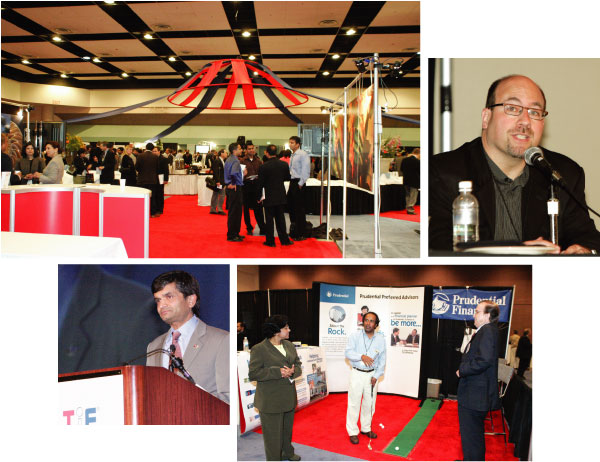

 Keep an eye out for the next “A Doctor’s Word” by Dr. Garretòn that will answer more questions about pregnancy, including common myths and postpartum depression.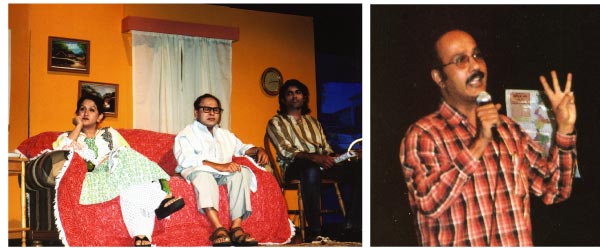
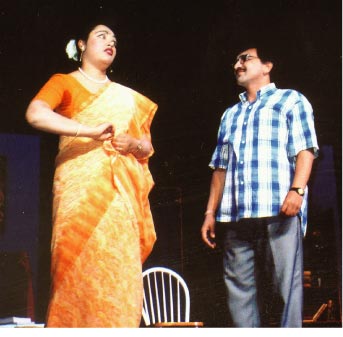

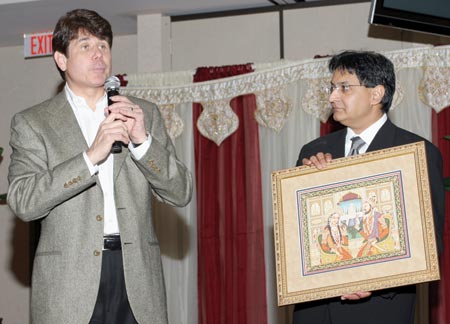
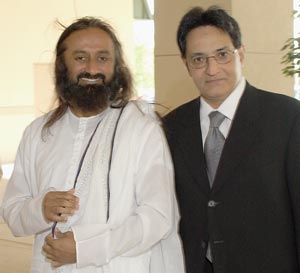 ABOVE: Ohio Governor Rod Blagojevich (l) with Harish Bhatt at the AIPhA’s 14th annual banquet.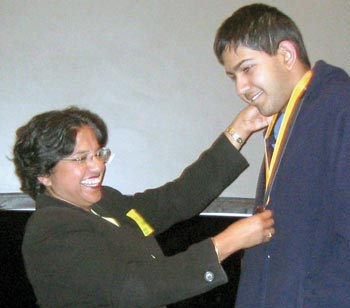

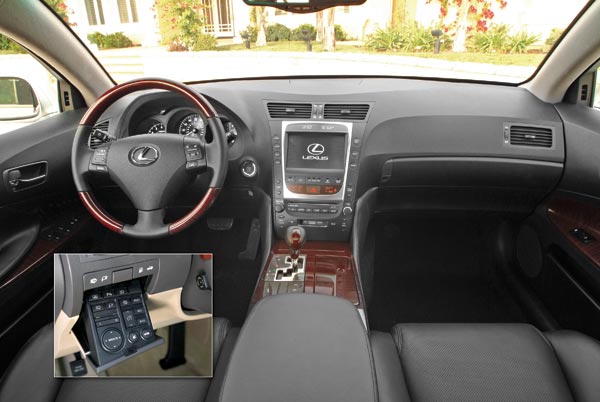
 And as for your passengers, they will have plenty of leg, hip and shoulder room, as this Lexus has a wheelbase that has been extended by two inches. The interior has been appointed with premium wood, polished metal and leather accents.
 It needs to be said that the film is not entirely original. It is based on the Hollywood film I am Sam starring Sean Penn. But that’s okay. If he had been able to make a successful adaptation, Bollywood buffs, the world’s most tolerant bunch of people, wouldn’t have grudged Harry his “inspiration.”