!-- Start Alexa Certify Javascript -->
|
|||||||||||||||||||||||||||
|
|||||||||||||||||||||||||||
|
|
|||||||||||||||||||||||||||
|
|||||||||||||||||||||||||||
|
|
|
|
|
|
MARCH 2005 |
MAIN FEATURE |
||||||||
|
PUBLISHER'S NOTE:
 We begin with a happy announcement. From this month, Siliconeer goes all color. Our graphics department has worked overtime to take full advantage of this to bring to you a magazine that’s a joy to look at. We take this moment to thank our readers, patrons and advertisers. We cannot thank you enough for your continuing and growing support. Thanks to your support, Siliconeer continues to grow and develop as a magazine. This month’s cover story takes a closer look at India’s progress in science. We are deeply indebted to the popular magazine New Scientist, which has sent a veritable army of reporters to do a comprehensive survey about the extraordinary developments in science in India. In the past decade, India has rapidly emerged as a scientific powerhouse, and the future appears to hold even greater promise. Which is not to say that it doesn’t have daunting socio-economic problems. That it certainly does, but having said that, the past few years have been a remarkable story of the nation’s emergence from a byword for poverty, red tape and backwardness, to an IT heavyweight and now a versatile scientific and technological powerhouse. For readers who are interested, the entire contents of the Feb. 19 issue of New Scientist is available on the Web at their Web site at this link: http://www.newscientist.com/special/india Dalip Singh Saund is a much-loved Indian American hero. His inspiring story of overcoming the prejudice of his time and ultimately becoming the first Asian American Congressman is one that the community justly celebrates. This year, the House of Representatives has unanimously decided to pass an act to name a post office building in California after him. On this occasion, we present a life sketch of Saund by Inder Singh, a long-time California activist who has been unceasing in his efforts to bring recognition to Saund. Now to a more global issue. The recent tsunami has provided heartening evidence that we indeed live in a global village. The surge of support for the victims in the wake of the natural disaster has been remarkable. But the tsunami disaster, we feel, is a good time to reflect on the structural flaws of the global economic and political system that continues to give the underprivileged a raw deal. |TOP| MAIN FEATURE: The Next Knowledge Superpower: Where Indian Science is Headed A Siliconeer Report “India is not yet a knowledge superpower. But it stands on the threshold.” That was the verdict of the popular science magazine New Scientist in its Feb. 19 issue. The remarkable issue has a wealth of thoroughly researched articles which provides an in depth look at Indian science and its future. A Siliconeer report.  A profound change is happening in India, and now the world is beginning to sit up and take notice. Some of the attention is not pleasant. In the West, particularly the U.S., there is growing concern about job flight; the dreaded word “Bangalored” is now part of the English language.  There is no question that information technology brought India to the limelight. The economic liberalization of erstwhile Prime Minister Narasimha Rao provided a much needed fillip, and firms like Infosys and Wipro seized the moment with alacrity. Before you knew it, IT had taken off. IT had several advantages. It was particularly free of the baggage that of years of protectionism that had crippled manufacturing industry, so entrepreneurs began with a clean slate, and the raw material was simple brain power, rather than the huge infrastructural backing required by industry. While auto manufacturers were still bringing out outmoded Morris clones of the 1950s, IT companies began to bring in work from abroad and U.S. companies began to take an interested look. U.S. chip giant Texas Instruments came in 20 years ago, and in the beginning it was grunt work. It’s no longer the case. In the last five years, over 100 companies are in India and many are doing cutting-edge research. “Some of the biggest names in IT are heading towards Bangalore once more, and this time round it’s not cheap labor they are looking for,” reports the New Scientist in its Feb. 19 special issue on India . ( For readers who are interested, the entire contents of the Feb. 19 issue of New Scientist is available on the Web at their Web site at this link www.newscientist.com/special/india.) “They are hunting down the brightest, most inventive minds in India to populate a swathe of cutting-edge research facilities.” General Electric’s 2,300-employee $80 million multidisciplinary centre, its first and largest R&D lab outside the U.S., uses numerical analysis and computational fluid dynamics to improve the efficiency of the company’s wind turbines and its engine for Boeing’s planned 7E7 airliner. Its materials science division invented a resin co-polymer that has made possible self-destructing CDs and DVDs. California-based search engine company Google is looking for top PhD graduates from Indian universities to add to its researchers working in Google’s Bangalore office, Cisco, Intel, Motorola and Sun Microsystems have opened research labs. After India’s nuclear blast in 1974, the West clamped down on space technology. The Indian Space Research Organization had to reinvent technologies it could no longer buy. Today its space program is already largely self-sufficient and aims to soon be completely independent of foreign support. However remarkable India’s scientific progress is, this happens in an oasis that is surrounded an ocean of backwardness and poverty. One out of four people in the world living in poverty call India their home. Free market ayatollahs have been quick to laud the jettisoning of the license raj of the Nehru era, but India’s scientific talent has been nurtured and developed by the Nehruvian commitment to publicly supported high-class education as manifested in the creation of the IITs and government support. Likewise, what the f “India is not yet a knowledge superpower,” the New Scientist reports. “But it stands on the threshold.”
INFOTECH INDIA  Solar Police Stations ... Ringing Honor ... Notice to VSNL ... Digital Theater ... CBI Probe into Reliance ... Cognizant to Invest $76 m in India ... GSI Tsunami Survey ... ISRO Mulls Linking Plan ... Science Boost — Here is the latest on information technology from India Solar Police Stations Solar power systems have been commissioned in 300 police stations located in various rural areas of Karnataka by the Electronics Division of engineering major Bharat Heavy Electricals Limited. The solar modules installed atop the police stations will directly convert sunlight into electricity and store it in a battery bank through which lighting, computer and wireless systems were operated, a BHEL statement said Feb. 25. “The successful commissioning of solar power systems will go a long way in improving the working conditions of police stations in rural areas of the state,” it said. NYSE-listed Wipro, with over $1.7 billion in revenues, is one of India’s leading IT services companies and the fourth largest worldwide, based on market capitalization. Wipro’s major lines of business include product development, IT services, consulting and business process outsourcing, which together for the core of its integrated portfolio of services that it provides to Fortune 1000 clients. Its 39,000 employees are located in 35 countries. TRAI has sought explanation from Tatas-owned VSNL on various issues, including technical details on routing of calls with diagrams and inter-carrier billing for such calls, Caller Line Identification as received by called party, numbering plan and issues relating to ADC settlement. When contacted, VSNL officials declined to comment, saying the company would furnish the details before the closing hours of the date set by the TRAI soon. Mani Ratnam said it is a win-win situation for the entire film industry as it provides not merely benefits to the filmmaker and filmgoer but also to the producers, distributors and exhibitors. The digital format can greatly reduce the cost of prints and thus the cost of production and distribution but more than anything else can enhance the quality of films, he added. He recalled how as a boy he watched films in “touring talkies” where often there would be a gap of several minutes when reels were changed. Also, the quality of prints would be bad. Today, the digital format assures a viewer the same quality even on the last day of screening. Ramanathan, owner of Abirami group of theatres, said the complex took pride in bringing several new concepts, right from DTS sound. Although an investment of Rs .6 million has been made though no digital films are available now, he said he was sure that digital films would soon be made in India. Also, digital films would also come into the country from abroad if such theatres were available. The probe by the CBI comes amid a major crackdown by the Department of Telecom and its PSUs, which have imposed stiff penalties that have been challenged by Reliance Infocomm. The CBI, which has initiated the probe suo motu, has asked concerned authorities to furnish relevant details of international telecom traffic which is alleged to have been rerouted as local calls to avoid payment to levy to telecom PSUs, officials said. The investigating agency stumbled upon the case during its investigations in the illegal telephone exchanges busted in Tamil Nadu, Kerala and Andhra Pradesh recently during the agency’s special drive Feb. 2. CBI officials said during its investigations into the functioning of illegal exchanges in the southern states, it had found involvement of certain private telecom companies and some officials of the Department of Telecommunications. The company will also build new centers in Hyderabad, Pune, Chennai and Kolkata that would totally house over 9,000 professionals, Cognizant president and CEO Lakshmi Narayanan told reporters here. The U.S.-headquartered Cognizant has nearly 90 percent of its 15,300 employees in India and plans to hire 7,200 people in 2005, of which 60 percent will be from college campuses. It aims to touch a total strength of 22,500 by December 2005, he said. Salaries for programmers in India were rising at double digit percentage while in its Europe and U.S. centers, it was less than five percent, Narayanan said, adding that there was a demand for people with four to five years experience, who commanded a higher premium. Cognizant’s revenue in 2004 was $586.7 million and it expected to increase to $845 million in 2005. He said the firm was eyeing acquisitions of firms in the open source, high-end BPO, banking and finance and insurance areas. The survey comprises of deep study, which would be recorded for future use, Dr. M.M. Nair, deputy director general, GSI, Chennai, told reporters here. The survey would be completed well before the onset of the monsoon, as further delay would lead to losing of vital information, Nair said. The delicate traces of deposits and sediments of very fine nature could reveal newer scientific truths. The entire machinery and human resources of GSI offices at Chennai would be deployed for the project, he said. The GSI had adequate manpower and skills, and there was no need for involving other agencies in the project. Detailed action plans had been already chalked out and GSI team would be divided into three teams. Stating that the GSI was in the process of preparing geo-chemical mapping, he said in one year each regional directorate would cover 750 square km using sophisticated equipment with the help of remote sensing and satellite readings. Every single square meter area would be studied physically on the parameters of 63 specified elements. Sample analysis of the specified 63 elements would be undertaken before plotting the area-wise maps. The university has approached and discussed the possibility of linking nearly 200 colleges in the state and the issue was under consideration, Nair said in an informal chat with reporters. Under a pilot project, 100 engineering colleges in Karnataka were linked under Edusat, he said, adding that out of this 50 colleges had the provision of interacting through video and the remaining linked through audio. A pilot project, linking all medical colleges in Kerala, would become operational in June, by which normal education and continuing medical education would be beamed, Nair said. ISRO will review the progress of three village resource centers — Rameswaram, Dindigul and Thiruvaiyaru — connected through remote sensing satellite in three months, and depending on the success, extend the facility to other selected villages in Tamil Nadu, he said. Another major announcement this year was a government decision to develop the Bangalore-based Indian Institute of Science into a world-class university and allocating Rs 100 crore for it. The budget for the Department of Ocean Development has increased by 64 percent over last year’s Rs. 230 crore to about Rs. 377 crore. About Rs. 20 crore has been kept for tsunami and storm surges warning system while another Rs. 25 crore will be given to ocean data buoy program, an important part of ocean monitoring. Overall, the budget for various science activities has gone up to Rs. 16,361 crore over the pervious year’s Rs. 13,147 crore.
HERITAGE
Congressional Honor: Dalip Singh Saund 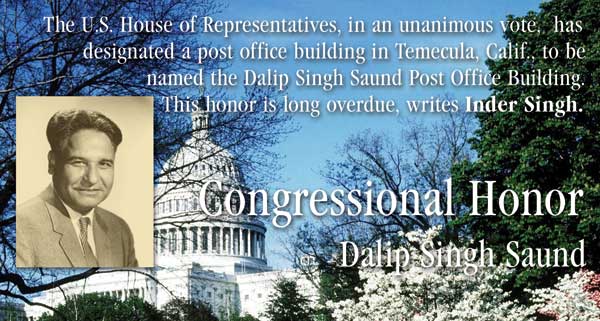 Inset: Dalip Singh Saund The U.S. House of Representatives, in an unanimous vote, has designated a post office building in Temecula, Calif., to be named the Dalip Singh Saund Post Office Building. This honor is long overdue, writes Inder Singh. In order to bring about awareness about the first Asian/Indian in the U.S. Congress, I organized a whole day seminar and banquet in 2002, to commemorate the 45th anniversary of the first victory of late Dalip S. Saund in the election to the U.S. Congress. In 2003, I also sent a request to the U.S. Stamp Advisory Committee to issue a commemorative stamp at the 50th anniversary of the first victory of an Asian/Indian to the U.S. Congress. The Dalip Singh Saund Post Office Building Designation Act is an honor that is long overdue. Congressman Dalip Singh Saund was the first Indian American and also the first among Asian Americans to be elected to the U.S. Congress. He was first elected in 1956 from 29th congressional district comprising of Riverside and Imperial Counties of California. He was re-elected twice, in 1958 and 1960. While contesting election for his fourth term in 1962, he suffered a debilitating stroke and became incapacitated. Although he did not win his fourth term, he did set a precedent for many Asians to follow him in the U.S. Congress. Saund was born Sept. 20, 1899 in village Chhajalwadi, Amritsar, Punjab. He graduated with a bachelor’s degree in mathematics from Punjab University in 1919. In the U.S., he enrolled at the University of California at Berkeley in 1920 to study food preservation. Later, he switched to the mathematics department and received a master’s degree in 1922 and Ph.D. in 1924. By the time Saund finished his education at Berkeley, he decided to make America his home. Saund started his first job as a foreman of a cotton-picking gang, a job that hardly required any schooling. His job required him to weigh sacks of cotton that the pickers had picked by hand and make up their payroll at the end of the week. In between weighing, he would read books, borrowed from the library. In 1928, Saund married Marian Kosa, who was born of immigrant Czech parents. They had three children, a son and two daughters. Since his university days in India, Saund had been taking a keen interest in the political system of the country. He formed the India Association of America in 1942, of which he was elected its first president. The main objective of the new organization was to mobilize the Indian community and get citizenship rights. He mobilized the Indian community, mailed out thousands of letters, mostly in Punjabi, raised funds, and furnished financial assistance to Indian groups in New York to lobby at Capitol Hill. They were able to convince Congresswoman Clare Booth Luce from Connecticut and Congressman Emanuel Cellar from New York who jointly introduced a bill in Congress. In 1946, after four years of continuous struggle, the Luce-Cellar bill was finally passed by both houses of Congress and signed by President Harry S. Truman on July 3, 1946. Saund became a naturalized citizen on December 16, 1949, and was ready to take more active part in the political process of his adopted homeland. Saund was persuaded to become a candidate for judge in the general election in November, 1950. He was elected judge solely due to his exemplary grassroots campaign. No other foreigner had by then been elected to any high office in Imperial County. But the judgeship was denied to him, as he had not been a citizen for one full year by Election Day. In 1952 he ran again and won the election and served as judge for four years until his election to the U.S. Congress in 1956. In October, 1955, he decided to be a candidate from the 29th Congressional district. Saund won the primary with a tremendous majority. In the general election, Saund faced Jacqueline Odlum, recipient of many prizes in the field of aviation, leader of women fliers during World War II and wife of a multimillionaire financier. Judge Saund faced formidable handicaps but his friends and neighbors with the help of Democratic groups in Riverside County, began to sponsor a series of free barbecues. His wife and daughter organized and carried out an intensive campaign of registration of voters and “passed out 11,000 Saund circulars” before the election. His hard work did bring him enough votes so that in the general election, in November 1956, “the first native of Asia” was elected to the United States Congress with a 3 percent vote margin. There were very few Indian Americans registered to vote in the 29th congressional district. He did not adopt a new religion in his new country nor did he Americanize his name to sound less ethnic. His opponents repeatedly tried to exploit his being an Indian. But he had completely assimilated with mainstream America while maintaining his heritage. -Inder Singh is president of the Global Organization of People of Indian Origin |TOP| OUTSOURCING DIGEST:  Outsourcing Digest: Siliconeer presents of the latest news from the world of outsourcing. Xansa Eyes 10,000 ... Pfizer BPO Deal ... Tesco Opens Center ... Orange to Outsource ... Gulf Air Outsources Xansa Eyes 10,000 U.K.-based IT services company Xansa recently inaugurated a Rs. 60 crore facility here that can accommodate 1,000 people. The company already has two facilities in Noida, which have close to 1,600 workers, apart from a campus in Chennai and a center in Pune. “We currently have little less than 3,000 people and in next three to four years our headcount is expected to grow to 10,000,” executive chairman of Xansa India Saurabh Srivastava said. Xansa is also expanding its 28 acre Chennai campus in phases. “The first phase of campus is already functional with 800 people,” he said. It has the land to ramp up capacity to 10,000. The company’s Pune facility has over 200 employees. The company’s latest 90,000 sq ft facility in Noida was inaugurated by senior Samajwadi Party leader and chairman of U.P. Development Council Amar Singh. For PGRD, this relationship with Cognizant is part of an overall plan to strengthen relationships with contract research organizations through its affiliate in India. The move allows Pfizer to leverage a rich talent pool while capturing the unique cost productivity advantage India offers. The work for Pfizer will be done out of a new Cognizant facility in Mumbai (sixth location for Cognizant in India). Initially, it will be done out of Pfizer premises and subsequently (in about six months’ time) moved to the vendor’s place. The relationship has an initial commitment of 90 people, a bulk of them with bachelors and masters in pharmacy, statistics and analytics. “Cognizant has extensive experience in life sciences including clinical trial study setup and validation and data management that are compliant with international standards of good clinical practices as defined by FDA,” said Hocine Sidi Said, country manager, Pfizer India. HSC CEO Meena Ganesh said, “We are already attracting some of the best talent in the industry and plan to increase our headcount to 770 by the end of 2005.” Tesco has long been a major investor in India. Its nonfood sourcing office, now based at HSC, buys more than $70 million worth of products from the Indian sub-continent each year. Tesco sells around one million pairs of shorts bought from Bangalore itself, and over four million vests and t-shirts sold in Tesco stores across the world come from Tirupur.” “A final figure on the numbers we intend to outsource will not be decided until these trials are complete. The steps we are taking will not lead to site closures and redundancies,” said an Orange spokesman. “This outsourcing is intended to help Orange customer services cope with high demand and ensure the company continues to offer customers the high level of service they have come to expect over the last 10 years.” Call center staff make up half of Orange U.K.’s 12,000-strong workforce, with the lion’s share working in the North-East in Darlington, Peterlee and North Tyneside. The group is also making 200 staff redundant from the technical department at its Bristol headquarters, where it has offered some information technology staff one-year salary deals. According to the Communication Worker’s Union including Barclays, British Airways, LloydsTSB, Prudential and Reuters have collectively outsourced 52,000 jobs serving British customers. The Confederation of British Industry recently warned there would be no jobs for unskilled workers in Britain in 10 years because of outsourcing, while Amicus has predicted that 200,000 jobs could be lost to offshore outsourcing by 2010. According to the company, using its exhaustive audit tools, Kale MPS will provide Gulf Air with end-to-end revenue recovery services — from identifying revenue leakages arising out of errors in ticketing and incorrect application of fares and rules to generation of debit notes on the agents. Kale president Ashish Malhotra commented, “We are happy to partner with Gulf Air and look forward to a mutually rewarding relationship. Kale MPS will help Gulf Air to not only recover lost revenue and ensure accurate revenues from sales but will also offer outsourced revenue recovery and protection services.” GLOBAL OUTLOOK: The Tsunami's Wake: Lessons of the Brandt Report By Mohammed Mesbahi and Angela Paine  Willy Brandt (inset) once warned that emphasis on profit at all costs would lead to worsening poverty in the Third World. After the December tsunami, it’s a good time to revisit the Brandt report, write Mohammed Mesbahi and Angela Paine. The response of the world public to the tsunami disaster on Dec. 26 last year was (and continues to be) one of heartfelt empathy and an instinctive desire to help fellow human beings in trouble. Never before have so many people, from so many countries given so much to the victims of a disaster. World governments have been shamed into promising far greater sums of aid than they originally wanted to offer by the sheer magnitude of the public’s generosity. The U.S. initially pledged $15 million but in the end promised $350 million while the U.K. government felt obliged to raise their pledge to $96 million, still a tiny fraction of the money these governments have so far spent ($148 billion — the U.S. and $11.5 billion - the U.K.) on the war in Iraq. How many people realize, however, that many of the deaths caused by the tsunami could have been prevented? The area affected has been hit by tsunamis in the past, with far fewer deaths resulting, because the coastlines of South East Asia were protected by a natural defense system composed of coral reefs and mangrove forests. Many of the previous tsunamis were tamed by the coral reefs before hitting the coast, where they were absorbed by a dense layer of red mangrove trees. These flexible trees, with long branches growing right down into the sand below the surface of the sea, absorb the shock of tsunamis. Behind the red mangrove trees there is a second layer of black mangrove trees, which are taller and slow down the waves. Thousands of miles of coastline in South East Asia were densely covered in mangrove forests, protecting the coastline from erosion, absorbing carbon dioxide and providing a breeding ground for crustaceans and fish, on which the local population depended for their livelihood. This was a fragile environment, which ecologists have long recommended should enjoy special protection. In India a Coastal Regulation Zone was created to protect a 500-meter buffer zone along the coast. While the belt of mangrove forest still existed, the people of the area lived inland, behind it. In 1960 a tsunami hit the coast of Bangladesh in an area where the mangroves were intact. No one died. These mangroves were subsequently cut down by the shrimp (prawn) farming industry and in 1991 thousands of people were killed when a tsunami of the same magnitude hit the same region. On Dec 26th 2004, Pichavaram and Muthupet, in South India, which still have their mangrove forests, suffered fewer casualties than the surrounding mangrove-less areas of coast. Mangroves also acted as a barrier, helping people to survive on Nias Island, Indonesia, close to the epicenter of the Dec. 26 tsunami. Since the 1960s, the mangrove forests of South East Asia have been systematically destroyed to make way for commercial shrimp farming and a massive increase in the tourism industry. The aquaculture and tourism industries succeeded in diluting any protective regulations that were in place, until they were able to take over most of the buffer zone. Almost 70 percent of the region’s mangrove forests have now disappeared. Since three quarters of South East Asian commercial fish species spend part of their life cycle in the mangrove swamps the loss of these swamps has resulted in declining fish harvests. To compound this situation, the commercial feeds, pesticides, antibiotics and non-organic fertilizers used in intensive shrimp farms have generated huge amounts of pollution, destroying the remaining fish and harming the coral reefs. According to University of California professor Susan Stonich, international corporations, based in the first world but operating in the Third World, produce 99 percent of farmed shrimp. Almost all of it is eaten in the U.S., Western Europe and Japan, where consumption has increased by 300 percent in the last ten years. Today world shrimp production, in an industry worth $9 billion, is almost 800,000 metric tons and 72 percent of farmed shrimp comes from Asia. Hundreds of nongovernmental organizations have sprung up at local, national and international levels to oppose this destructive aquaculture industry. In 1997 the Industrial Shrimp Action Network was formed, a global alliance opposed to unsustainable shrimp farming. Aquaculture corporations responded by forming the Global Aquaculture Alliance to counter the claims of the ISA Network. Commercial shrimp farming has displaced local communities, exacerbated conflicts, decreased the quality and quantity of drinking water and decimated the natural fish species on which the local population rely. The reason why the aquaculture and tourism corporations have been allowed to destroy the coastal environment of South East Asia is because the current neoliberal trade system favors corporations over and above all concerns for the environment and the people living in it. Trade liberalization, through the World Trade Organization, has enabled corporations to challenge the legislation of the countries they wanted to operate in, legislation that was designed to protect the local environment. Ecological and human disasters such as the 2004 tsunami will continue to occur as long as the current Global Economic system is allowed to exist in its present form. Way back in the 1980s one-time German chancellor and Nobel Peace Prize-winner Willy Brandt warned that the current global economic system, with its emphasis on profit at all costs, would lead to environmental degradation and worsening poverty in the Third World. He said: “Important harm to the environment and depletion of scarce resources is occurring in every region of the world, damaging soil, sea and air. The biosphere is our common heritage and must be preserved by cooperation – otherwise life itself could be threatened.” How prophetic these words sound today. He set up the Independent Commission on International Development Issues to make an in-depth study of the global economy. His team of advisers included many experts in the field of international policy and economics. Their detailed report came to the conclusion that the developed nations dominated international trade and that this was unbalanced and biased in favor of large corporations based in the West. The Brandt Commission was the first major independent global panel to examine connections between the environment, international trade, international economics and the third world. The United Nations Conference on Environment and Development took Brandt’s proposals regarding the environment seriously enough to hold international conferences in Rio in 1992 and in Kyoto in 1997. However, America refused to sign the Kyoto Protocol and corporate power prevented any of the Brandt Report recommendations being put into practice. The Brandt Reports called for a complete restructuring of the global economy, in order to protect the environment and meet the needs of the world population. Willy Brandt said: “We see a world in which poverty and hunger still prevail in many huge regions; in which resources are squandered without consideration of their renewal; in which more armaments are made and sold than ever before; and where a destructive capacity has been accumulated to blow up our planet several times over.” He proposed a Summit of World Leaders, with the backing of a global citizens’ movement, to discuss how to meet the needs of the majority of the world’s people. This would, he recognized, mean reforming the international economy. Brandt also recognized that poverty contributes to high birth rates and that overpopulation puts pressure on the environment. This has indeed happened all over the world, including South East Asia. Two decades later, world leaders had not responded to any of Brandt’s proposals. They continued to allow an ever increasing export of arms to some of the most repressive regimes, and public apathy towards the plight of the world’s hungry billions continued. In the 1980s Brandt was calling for preventive action and his proposals were falling on deaf ears. Only now is preventive action beginning to be taken seriously. The World Bank estimates that losses caused by disasters in the 1990s could have been cut by $280 billion if $40 billion had been spent on preventive measures. Only one organization has the staff and the close relationships with governments to make coordinated disaster aid work, the UN’s Office of Coordination of Humanitarian Affairs. Yet immediately after the tsunami world leaders were in disagreement over coordination of the relief operation. Bush refused to cooperate with the UN because of his long-running differences with the UN leadership. World opinion eventually forced him to recognize the need for cooperation with the OCHA for the smooth running of the disaster relief. He recommended that instead of fighting wars, armies and navies from the developed world could be deployed to bring in the food, resources and technology needed to help poor nations reverse hunger and poverty. This has indeed been happening since the tsunami. Since the tsunami world opinion has shifted. People have been so moved by the plight of the people in the devastated areas that they have begun to talk about poverty and injustice in other parts of the world, such as Africa. Some of the poorest people in the world are concentrated in Sub-Saharan Africa, where “we have the resources to save millions of lives and raise the basic infrastructure” (Harvard-trained economist Jeffrey Sachs, Kofi Annan’s special adviser). Over the past few decades official development assistance to Third World countries has been declining. Sachs would like to see donor countries increase their aid budget. But in the end it will be popular opinion which pushes governments into rethinking their aid policies. Brandt and his team of experts spent years researching world poverty and the best way to alleviate it. Brandt’s far-reaching vision predicted many of the human and ecological disasters that have (and continue to) occurred since the 1980s, as a result of neoliberal economic policies. His reports laid out an alternative system of global governance, based on the principle of sharing: sharing the world’s resources and sharing responsibility for the environment. He proposed that every member of the human race had a right to food, water, shelter, clothing, education and healthcare. Only when every human being’s basic needs have been fulfilled will the world’s population stabilize. Perhaps world leaders could be persuaded to re-examine both the original reports and their updated version and to come together to discuss how to implement some of the recommendations. World opinion is calling for a more equitable and just world in which everyone has the right to food, water, shelter, clothing, education and healthcare; where the power of corporations is curbed in favor of human rights and the environment; where governments are shamed into putting a stop to arms exports and where the money currently squandered in wars is spent on raising the standard of living of the world’s poor. Without sharing the world’s resources there can be no justice and without justice there can be no peace. The Brandt Reports have been updated by James Quilligan. Readers can find more about them at this Web site: www.brandt21forum.info - Mohammed Mesbahi is chair and founder of the London-based nonprofit |TOP| REPORT: Honored Scientists: AAAS Fellows - A Siliconeer Report Ten South Asian scientists were recognized by the American Association for the Advancement of Science held in February in Washington, D.C. A Siliconeer report.  One of America’s most respected scientific organizations honored 10 South Asian scientists at its Fellows’ Forum Feb. 19. The 10 scientists were among 308 members in 23 disciplines who were elected AAAS fellows. The new Fellows received a certificate and a blue and gold rosette pin as a symbol of their distinguished accomplishments. The South Asian scientists came from a variety of fields. The discipline where South Asians shone most, unsurprisingly engineering: four were elected fellows; next was the field of biological sciences, with two elected fellows. Amit Goyal, Oak Ridge National Laboratories; Ravi K. Jain, University of the Pacific; Pradeep K. Khosla, Carnegie Mellon University and Noor Mohammad of Howard University were the four engineers who were elected fellows. Sankar L. Adhya, National Cancer Institute and Altaf A. Wani, Ohio State University, were recognized as fellows in the biological sciences. In addition, Ajay K. Bose of Stevens Institute of Technology was recognized for his contribution in chemistry. Asish R. Basu of the University of Rochester was recognized for his contribution to geology and geography. Ravi V. Iyengar of the Mount Sinai School of Medicine, New York City, was recognized for his contribution to medical sciences. Ravindra N. Bhatt of Princeton University was recognized for his contribution to physics. The American Association for the Advancement of Science, is an international non-profit organization dedicated to advancing science around the world by serving as an educator, leader, spokesperson and professional association. In addition to organizing membership activities, AAAS publishes the journal Science, as well as many scientific newsletters, books and reports, and spearheads programs that raise the bar of understanding for science worldwide. Founded in 1848, AAAS serves some 262 affiliated societies and academies of science, serving 10 million individuals. Science has the largest paid circulation of any peer-reviewed general science journal in the world, with an estimated total readership of one million. The non-profit AAAS is open to all and fulfills its mission to “advance science and serve society” through initiatives in science policy; international programs; science education; and much else. AAAS seeks to “advance science and innovation throughout the world for the benefit of all people.” To fulfill this mission, the AAAS Board has set the following broad goals:
|TOP|
REPORT: Catch IT if You Can: Berkeley Asia Meet - A Siliconeer Report The Berkeley MBA Asia Business Conference is an annual one-day event hosted by the Asian Business Conference Club in collaboration with the University of California at Berkeley’s Haas School of Business. A Siliconeer report.  Industry and regional experts shared their knowledge in panels covering biotech, wireless technologies, electronic gaming opportunities, venture capital investing and corporate social responsibility at the day-long Asia Business Conference Feb. 26. The conference brought together business leaders, entrepreneurs, alumni, graduate students and international advocates to examine the growing role of Asia in the global economy. Keynote speakers included Wu-Fu Chen, chairman, Acorn Campus and renowned serial entrepreneur in Silicon Valley, and Allan Kwan, regional vice president and managing director Yahoo! North Asia. Panel speakers included Ram Shriram, managing partner, Sherpalo Venture. Hosted at the Haas Business School at the University of California at Berkeley, it also included special panels which focused on the impact of the tsunami and rebuilding efforts and on the Lenovo-IBM acquisition. The conference was hosted by the Berkeley MBA students of the Asia Business Conference Club.
HEALTH CARE:
All About Balance: Living with Diabetes - By Dr. Tat S. Lam, MD   When it comes to diabetes, prevention and early treatment are your best strategies, writes When it comes to diabetes, prevention and early treatment are your best strategies, writesTat S. Lam, MD. An ounce of prevention is worth a pound of cure, or so the saying goes — but it is true that prevention and early treatment are your best strategies for staying healthy. This is especially true when you have diabetes. People with diabetes don’t have, or their bodies can’t effectively use, insulin, a hormone that turns the sugars in your blood into energy. When insulin is not available or used properly by the body, the sugars in your bloodstream rise above a safe level. Over time, untreated diabetes can lead to health problems like blindness, kidney failure, heart disease, and other serious conditions. These factors make it important to take steps to keep your blood sugar levels balanced each day. There are two basic types of diabetes — called type 1 and type 2. People are born with type 1 diabetes and type 2 usually develops in adulthood and can be caused by factors like a high sugar diet, smoking and low exercise. Family history, age and ethnicity also contribute to your chance of getting diabetes. If diabetes runs in your family, be aware that you have a greater chance of developing the disease. Type 2 diabetes is prevalent among African American, Hispanic, Asian American and Pacific Islander people. But these factors are out of your control. What is in your control is nutrition, exercise and quality health care. Here are a few issues you may want to focus on. Exercise. Regular and appropriate exercise can help muscles absorb more blood sugar, help lower both blood pressure and cholesterol and keep you fit. Try activities like walking, jogging or swimming. Everybody has different abilities and interests, so you should talk to your doctor about the right kinds and amount of exercise for you. For patients receiving insulin injections, intense exercise can lower their blood sugar levels too much, so it is better to gradually increase the duration and intensity of exercise rather than push your body too hard. Nutrition. Nutrition is important because diet directly impacts the amount of sugar in your bloodstream. Many foods that aren’t sweet contain lots of sugar, such as rice, noodles and bread. That is why sometimes your blood sugar level is normal before a meal and gets much higher after eating. Patients often ask me why their blood sugar is still high in the morning after being asleep and not having food for 10 hours. That is because your metabolism slows down while you sleep and speeds up again when you wake up. Medical Care. If you have diabetes, medications prescribed to you by your doctor are key to maintaining your health. Depending on what kind of diabetes you have, prescription drugs and/or insulin shots help your body keep blood sugar at healthy levels. Insulin injections help your body absorb sugar. If you visit your doctor regularly to monitor your health, you will be more likely to prevent diabetes or get the treatment you need and advice on how to make healthy choices every day. With recent scientific advancements and a more sophisticated understanding of diabetes, people are being diagnosed and treated earlier — making it possible for many people with diabetes to live a healthy life. - Dr. Tat Lam is a family physician at the Bilingual Chinese Service/Montebello MOB, |TOP| REPORT: Ghazals for Tsunami: Pankaj Udhas Performs - A Siliconeer Report Pankaj Udhas performed at a sold-out tsunami benefit hosted by the India Community Center. A Siliconeer report.  Pankaj Udhas was recently in the San Francisco Bay Area. He performed to a sold-out audience at Chabot College in Hayward, Calif. His performance was part of a benefit for tsunami victims. He spoke to the press before the performance. Excerpts:  I have completed 25 years as a singer, my first album was in 1980. For any singer to have survived for 25 years with the same love and affection from his fans, it is a great feeling. This is also my 20th year of performance in U.S. I came here for the first time in 1986, performing at the Madison Square Garden. I still remember singing “Chitthi aayi hai” for the first time and I received an amazing standing ovation in New York. I also performed in San Francisco at that time. At the end of this tour, I will have visited 25 cities here in U.S. and Canada. It will give me great opportunity to personally meet people and thank them for the support. I have completed 25 years as a singer, my first album was in 1980. For any singer to have survived for 25 years with the same love and affection from his fans, it is a great feeling. This is also my 20th year of performance in U.S. I came here for the first time in 1986, performing at the Madison Square Garden. I still remember singing “Chitthi aayi hai” for the first time and I received an amazing standing ovation in New York. I also performed in San Francisco at that time. At the end of this tour, I will have visited 25 cities here in U.S. and Canada. It will give me great opportunity to personally meet people and thank them for the support.
During this tour, I will be visiting many countries US, Canada, Kenya, Uganda, Tanzania, South Africa, Gulf countries, Australia, New Zealand, Fiji Islands, my hands therefore are full and I hope to have a great year ahead of me. This year I plan to do 25 concerts in India. In those concerts I plan to select 25 different cities and what ever we collect from these concerts I will donate to “Bachpan Bachao” and cancer patients and thalassemic patients program. Once I return to India, I will be releasing an album of geets that I have just completed, and it will be followed by an album that I will be completing shortly on the life of Daag Dehlvi, an outstanding poet after Mir and Ghalib. I am also working on an album on fusion music by maestro Anand Shankar. So I have three albums coming in the next few months. I have also started writing my memoir where I will talk about all my life, work and an honest account of all that I have been through, good or bad. I want to make an honest confession through that book. I intend to complete it early next year. Ghazal has been an integral part of our culture and has been around for over 4-5 hundred years. In the last five years the interest in this kind of music has revived as I am doing more work now than what I did five years ago. The media is to blame for the downfall of ghazals over the past years, particularly the television media. They kept saying ghazal is finished, ghazal is over. I had to literally fight with MTV because they refused to air the video of a ghazal. Ultimately I succeeded and today MTV shows ghazals. There is no problem, ghazal is where is was, but it all depends on the media and interest in promoting ghazals.
|TOP| COMMUNICATION: Global Cell Phone: International Calling Unleashed - A Siliconeer Report  A new plan by Primus Telecommunications allows international cell phone calls at prices comparable to the prices of international calls made from regular home or office phones. A Siliconeer report. If you have ever tried to call the old country with a cell phone, you know what a pain it can be. Of course, most of you avoid it like the plague, given the extortionate rates. When you do use it, you probably use a phone card. Which means call a toll-free number, dial the pin code, and call the number which in full splendor is a string of digits, thanks to the international, country and city codes. And if you don’t get through the first time, you have to go through the whole darn process again. Well, that’s about to change, thanks to a new plan from McLean, Va.-based Primus Telecommunications. Primus has entered the U.S. wireless calling market with a product targeted at customers who make international calls. “Primus Wireless fills an unmet need by making it much simpler for U.S. consumers to place direct international calls on their cell phones at prices averaging 50 percent less than rates charged by any major U.S. wireless provider,” a company press release said. “With Primus Wireless, international cell phone calls are at prices comparable to the prices of international calls made from regular home or office phones.” For example, cell phone calls to the United Kingdom from the U.S. can run as high as 65 cents a minute, while Primus Wireless’s basic plan will offer direct dial rates as low as 4.9 cents per minute to the United Kingdom. And no waiting period, prepayment, or charge extra monthly fees. “At a time when the U.S. wireless market is experiencing explosive growth, our market research suggests that only 5 percent of international calls made from the U.S. are dialed directly from a wireless phone, primarily because of high per minute charges,” said Primus Wireless president Jay Rosenblatt. “In creating Primus Wireless, we sought to provide a unique service that responds to the needs of an increasingly mobile and international population.” Primus Telecommunications, Inc. is the principal U.S. subsidiary of Primus Telecommunications Group, Incorporated a Fortune 1000 global telecommunications company with $1.3 billion in annual revenue. Headquartered in McLean, VA, and founded in 1994, Primus Telecommunications Group, Incorporated is among the largest international telecommunications concerns. The company offers voice, wireless, Internet, voice-over-Internet protocol, digital subscriber line, and other data services to corporate customers, small and medium-sized businesses, residential customers, and other communications carriers located throughout the United States, Canada, Europe, Asia, and Australia. Interested readers can find more information about the plan at the following Web site: www.PrimusWireless.com REPORT: Valley of the Dolls: Mrs. World in India - A Siliconeer Report  (Left) Newly Crowned Mrs. World 2005 Sima Bakahr of Israel with first runner up Ivana Brnic Boce of Croatia (r) and second runner up Sherin Peace of New Zealand (l) after the finals held at Amby Valley, Sahara Lake City. (Shaielesh Mule/ Fotocorp) (Left) Newly Crowned Mrs. World 2005 Sima Bakahr of Israel with first runner up Ivana Brnic Boce of Croatia (r) and second runner up Sherin Peace of New Zealand (l) after the finals held at Amby Valley, Sahara Lake City. (Shaielesh Mule/ Fotocorp) Sima Bakahr of Israel bested 40 of the world’s most beautiful married women to win the Mrs. World crown in Amby Valley. A Siliconeer report. In the final judgment, it was her disarming candor that triumphed. Beating 40 other beauty queens, Mrs. Israel Sima Bakahr won the Mrs. World 2005 crown at Amby Valley Sahara Lake City Feb. 26 in a glitzy ceremony. “As a judge at the contest, it had become increasingly difficult when it reached the last stage. It was difficult to pick the winner from the last three,” former international tennis star and Hollywood filmmaker Vijay Amritraj said. “Mrs. Israel won because of her simplicity, which you associate with married women. In the judge’s question round, she said it was tough for her to stay away from her daughter. That touched all our hearts.” Mrs. Croatia Ivana Brnic Boce and Mrs. New Zealand Sherin Peace were declared the first and second runners-up respectively. India’s Jeevika Shah could only make it as one of the six semi-finalists. Last year’s winner Suzana Pavadee Vicherut McNokroot of Thailand crowned Bakahr, 28, with a diamond and ruby studded crown worth $18,000. A five-member panel of judges including Amritraj, Oscar-nominated filmmaker Ashutosh Gowarikar, Swapna Roy, Mrs. America 2004 Heida Dianan and Mrs. World 1985 Rosy Senanayake picked the top three winners. This was the first time that India played host to the contest, initiated in 1977. David Z. Marmal, president of Mrs. America Inc and Mrs. World, Inc., said: “The event began with the intention of recognizing the contribution of a woman to her community, country and modern contemporary life. It now showcases the modern married women who have imbibed style, grace, beauty and intelligence.” Added Seemanto Roy, head of Sahara infrastructure and housing: “All the participants from around the world are living testimony to the continuously evolving empowered women who strive and achieve unprecedented balance in their multifaceted lives, contributing significantly both to the family and society as a whole.” Marmel reorganized the pageant in 1977 featuring a more contemporary and glamorous approach. While beauty is the key element, contestants are urged to voice their opinions about marriage and current events. All married women, young wives, mothers and even grandmothers are eligible to participate. “Bringing Mrs. World to India was a huge task for us,” said Sahara executive Seemanto Roy. “But it was a way to showcase our culture to the world and I am glad that it has come out well. The present Mrs. World is fond of Indian culture and she has a camaraderie spirit, which makes for a winner.” Said Mrs. World president Marmel: “Amby Valley, is an ideal location for Mrs. World. This magnificent city in the hills offers plethora of choices when it comes to picturesque locales to shoot the interviews of the contestants.” ENTERTAINMENT: Cinema Utsav: NAATA Film Fest - A Siliconeer Report  The international Asian American festival in San Francisco offers a 16 feature length and short works by South Asian filmmakers from both the old country and the diaspora. A Siliconeer report. The international Asian American festival in San Francisco offers a 16 feature length and short works by South Asian filmmakers from both the old country and the diaspora. A Siliconeer report.The 23rd San Francisco International Asian American Film Festival presented by the National Asian American Telecommunications Association, is a movie buff’s dream with more than 130 feature-length and short films and videos from 23 countries. Scheduled March 10-20 in San Francisco, Berkeley and San Jose, “the SFIAAFF spans the globe to offer the largest and most prestigious showcase of movies by and about Asians and Asian Americans,” its organizers say. The festival has a particularly rich South Asian content this year. Included are Bollywood hit Swades, directed by Oscar-nominated filmmaker Ashutosh Gowarikar; United States premiere of two feature length films from Canada, Continuous Journey and Pink Ludoos; two features from the United Kingdom exploring the Pakistani British experience, Scottish filmmaker Ken Loach’s A Fond Kiss and Kenny Glenaan’s Yasmin. The “3rd I South Asian International Shorts 2005” presents an array of new South Asian films from India, Canada, the United Kingdom and the United States, including The Bypass by Amit Kumar; Richie Mehta’s Amal; G.D. Jayalakshmi’s Arranged Marriage; Keshni Kashyap’s Waxed Poetic and Good Thing; Nilesh Patel’s The Waiter; Dishad Husain’s Holly-Bolly; and Amyn Kaderali’s Call Center. The 23rd San Francisco International Asian American Film Festival, presented by NAATA and Asia Street on International Channel is supported in part by the Asian Art Museum, Canadian Consulate Trade Office, Comcast, Grants for the Arts, Koret Foundation, National Endowment for the Arts, Noon, Oscar Printing, Procter & Gamble, Radisson Miyako Hotel, San Francisco Tobacco Free Project, Wallace Alexander Gerbode Foundation, and Wells Fargo. NAATA is supported with major funding from the Corporation for Public Broadcasting. Interested readers can get more information on the festival at its Web site at www.naatanet.org/festival. Ticket information is available on phone at (415) 865-1588. |TOP| ENTERTAINMENT: Film Buff's Delight: Cinequest Film Fest - A Siliconeer Report  Films of 30 countries, with 78 world/U.S. premieres make the 15th Annual Cinequest Film Festival, already billed one of the top ten film festivals of the world by “The Ultimate Film Festival Survival Guide,” an attractive bet for film buffs. A Siliconeer report. In its 15th edition March 2-13, the 12-day-long Cinequest (www.cinequest.org) film festival in San Jose, Calif., will present 245 screenings at four venues, continuing to consolidate its reputation as a regional festival focusing on maverick filmmakers. The film festival has attracted formidable star power. In previous years, Alec Baldwin, Ian McKellen, Spike Lee, Jackie Chan and Kevin Spacey have been in town; this year’s honoree is Indian-British star Ben Kingsley. “Cinequest has stepped up as a leader in discovering the best films and artists while presenting the technologies that empower creativity through engaging questions and answers forums,” Cinequest co-founder and executive director Halfdan Hussey said in an announcement. “With over 30 countries represented, 300 film artists expected to attend, and 78 World and U.S. premieres, Cinequest is taking the movie going experience to new heights.” This is no joke: The film festival has thrived since 1990 where several other similar projects failed. This year, Cinequest debuts 26 world, four North American and 14 United States premiere feature films out of a program containing 78 features. Interested readers can get more information on the festival by visiting the festival Web site www.cinequest.org. Ticket information is available by phone at (408) 295-FEST (3378) REPORT: Bollywood Unveiled: Aishwarya in America  India’s most beautiful woman unveiled to America as Aishwarya Rai was interviewed by U.S. late night television king David Letterman, writes Siddharth Srivastava. India’s most beautiful woman unveiled to America as Aishwarya Rai was interviewed by U.S. late night television king David Letterman, writes Siddharth Srivastava.She is leading the march of Bollywood, India’s humongous film industry that churns out more than 800 movies in a year, into Hollywood. In her latest attempt to ride the imagination of Americans, India’s top actress Aishwarya Rai has appeared on the prestigious Emmy award-winning Late Show with David Letterman. This is the first time that an Indian actor from mainstream Bollywood has tried to make such a splash in America, though her success or failure to impress audiences remains to be seen. Letterman introduced her as “often called one of the most beautiful women in the world and most famous actress. She is known by billions of people but is still unknown in America.” Aishwarya chatted easily with Letterman about her first English-language movie, Bride and Prejudice which opened in theatres in the U.S. “The irony is, she is barely known here,” Letterman said, “This resets our perspective on the world. It is going to change the way we look at the world.” Rai was unveiled on the Letterman show ready to bedazzle America, dressed in a short black dress that reached above her knees, a fact that some of the very excited desi community has commented on (they would have preferred a sari). There are hundreds and hundreds of takes cluttering Indian electronic mailboxes ever since the interview appeared. One comment by an Aishwarya-struck viewer reads: “She appeared nervous, giggling, but also fairly confident. And there were some moments of brilliant sparks in her. Aishwarya’s attempts to impress the U.S. is getting a helping hand by agent and publicists William Morris and Canyon Entertainment who are also scouting for her work and. Compliments are nothing new for Aishwarya Rai, though recently she has been upstaged by the highly talented Rani Mukherjee who has put up an extraordinary performance in her latest release Black. Abroad, she has made waves as well. Last year, Rolling Stones magazine named the actress in its “international hot-list” and called her “the hottest Indian import since chicken tikka.” There have been reports that Aishwarya could be the next Bond girl, her wax replica adorns Madame Tussaud’s in London; she has been selected jury member for the Cannes film festival. Aishwarya has featured on the cover of Time magazine, an achievement made only by one more Indian actress, the voluptuous Parveen Babi, who died recently. Aishwarya has also been snapped up by veteran Hollywood superstar Michael Douglas for his next movie Racing the Monsoon. The movie will be in the genre of his earlier two highly successful films Romancing the Stone and Jewel of the Nile and will be shot with India in the backdrop. Douglas, who was in India recently admitted that he did not follow Bollywood films, but had watched Rai’s recent outputs Bride & Prejudice and Raincoat, and was quite impressed. When asked for further details, Douglas did not say much except, “It involves diamonds and one of India’s most beautiful actresses Aishwarya.’’ Indeed, the signing of Aishwarya by Douglas is another turn in the journey of the Indians trying to make creative inroads into the global entertainment scene. Second-generation Indians in Britain and the U.S. have been making movies that reflect the enmeshing of two cultures (Gurinder Chadha’s Bend it Like Beckham, Bride and Prejudice) as well as present their take on the environments they have grown up in and their country of origin (American Desi, Hyderabad Blues, Bombay Boys, One Dollar Curry.) Then there have been the cross-over movies made by directors in an Indian setting with English scripts aimed at Indians abroad as well as resident Indians (Mira Nair’s Monsoon Wedding, Subhash Ghai’s Jogger’s Park, Sujoy Ghosh’s Jhankar Beats). Indian American M.N. Shyamalan (The Sixth Sense) and Shekhar Kapur (Elizabeth, starring Cate Blanchett that received eight Oscar nominations) are making mainstream Hollywood movies. Nair, whose recent film Vanity Fair had a worldwide release, was also offered to do the latest Harry Potter sequel. Bollywood now has global ambitions, too. Of course, it’s always had global appeal, going way back when Raj Kapoor’s Awara swept audiences off their feet as far as China, Russia and Central Asia. Even to day, the ubiquitous Indian diaspora provides a global market for Indian movies, as well as wide swaths of audiences in the Middle East, Africa, and Asia. But that’s not what Bollywood movers and shakers mean when they talk about going global. What they are talking about is getting a piece of the action in the West. And here, it has to be said, there is a long way to go still. Buried under all the hype of Bollywood going global are some sobering facts. Consider: Bride and Prejudice has been panned in the West (including Aishwarya’s performance), and to this day not a single mainstream Indian film has managed to draw Western audiences. Bollywood audiences in the West still remain stubbornly ethnic, mostly desis. Lagaan and Asoka were marketed to mainstream audiences in the U.S., and neither performed well, though Lagaan drew some admiring reviews. Unlike Japanese anime, or Hong Kong Kung Fu films, Bollywood films have failed to this day to create even a cult niche audience for the genre. So unless either Bollywood films or Western viewers change drastically, Bollywood’s dream of having a Western mainstream following is apt to remain as unlikely as any plot of your typical masala potboiler. - Siddharth Srivastava is India correspondent for Siliconeer. He is based in New Delhi. |TOP| COMMUNITY NEWS IN BRIEF: New Consul General ... Yale Prize ... Appointed to State Commission ... Pageant Queen ... Women Leaders Meet ... Language Rights New Consul General 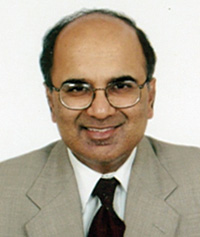 B.S. Prakash has just joined as the Consul General of India in B.S. Prakash has just joined as the Consul General of India in
He joined the Indian Foreign Service in 1975. He has also written extensively on various issues in international relations. He has several publications in academic journals on issues relating to international terrorism, UN reforms and UN Security Council restructuring, peace keeping and international humanitarian law. Prakash is a frequent writer in the media on literature, arts and lifestyle. He speaks Hindi, Kannada and German. His interest includes philosophy, literature, classical music and golf. He is married to Ratna, until recently also an Indian government official, and has two daughters who are both in college. He has served in Indian embassies in |Return to Community News Index| |TOP| Yale Prize Yale history Assistant Professor Mridu Rai has been awarded inaugural YCIAS International Book Prizes from the  Rai received her prize in the best first book category for “Hindu Rulers, Muslim Subjects: Islam, Rights, and the History of Kashmir.” Rai received her prize in the best first book category for “Hindu Rulers, Muslim Subjects: Islam, Rights, and the History of Kashmir.”“Professor Rai, in this exceptionally well-researched book, examines how the attempt to establish legitimate authority in According to Harvard history professor Sugata Bose, “‘Hindu Rulers, Muslim Subjects’ is a brilliant work of historical scholarship that will become indispensable reading for all those interested in the modern history and politics of the subcontinent. It a pioneering historical study of rights, religion, and regional identity in "YCIAS established the book prizes to stimulate scholarship in the international field by honoring outstanding accomplishments,” said Ian Shapiro, YCIAS director. “Professor Rai's work is a testament to the value that rigorous archival work, undertaken with a careful eye to historical and local particularity, can contribute both to our understanding of contemporary international affairs and to questions of broader interest." |Return to Community News Index| |TOP| Appointed to State Commission Arizona Gov. Janet Napolitano has appointed Sandeep Gopalan, a law professor at the Arizona State University College of Law, to the Arizona Aerospace and Defense Commission. Gopalan is an expert on the legal aspects of the financing of satellites and aircraft. He is a member of the American Bar Association’s Air and Space Law Forum. He has authored one book, entitled Transnational Commercial Law, and several scholarly articles in prestigious publications. Gopalan has conducted extensive research on a new Convention that is expected to infuse huge amounts of financing into the space and aviation sectors. The entry of private enterprises into the space sector will be facilitated by this international law. Many companies are planning to enter the area and the first big sign was the formation of Virgin Galactica by Sir Richard Branson, with the idea of sending tourists to space. Gopalan is an alumnus of the National Law School of India, The Arizona Aerospace and Defense Commission was formed by statute primarily to develop, use and maintain an aerospace and defense strategic plan that builds synergy between government, industry and education and to advise state agencies in order to maximize Arizona's response to market opportunities and to build on the State's unique aerospace and defense assets. It is also expected to provide technical support to the Department of Commerce, local and regional industrial development organizations, local agencies and other groups concerning infrastructure improvements and any other projects designated by the Governor; adopt rules it deems necessary or desirable to further the objectives and programs of the Commission. |Return to Community News Index| |TOP| Pageant Queen  Sarmi Karati of Sarmi Karati of
Karati was born in Murshidabad,
Karati is now headed for the Mrs. Worldwide Pageant at the end of this year representing
Karati started modeling in 2003. To date, her photograph has been selected for exhibition of framed photographs with famous actors and actresses in the foyer area at De La Salle Theatre,
AUTO REVIEW
Family Car with Muscle: 2005 Dodge Magnum RT – By Sally Miller Wyatt Dodge’s all-new Magnum’s chiseled looks brings back some fond memories of the Barracudas and Chargers of her youth, writes Sally Miller Wyatt.  When I first saw Dodge’s all-new Magnum, I couldn’t wait for a chance to test drive it. This current generation’s muscle car brings back some fond memories of the Barracudas and Chargers of my youth. When I first saw Dodge’s all-new Magnum, I couldn’t wait for a chance to test drive it. This current generation’s muscle car brings back some fond memories of the Barracudas and Chargers of my youth. I bet the Magnum’s chiseled looks also appeal to us Moms and Dads who drove those powerful cars of the ’60s and ’70s. Now that we’re in our adulthood, who among us wouldn’t wish we could drive something that supercharged, even with our graying hair? The Dodge Magnum may offer an opportunity to fulfill that desire, while also still providing a way to safely ferry the children around. The Magnum has an intriguing design. Would it be harsh to say it is a bit thuggish looking? You sure don’t want to dare call it a station wagon – out loud, at least – but its length definitely leaves that suggestion. Designers, according to Dodge’s press materials, raised the belt line on the body of the car, while pulling the roof line down around the windows. The effect leaves a hot-rod-like impression. The front grille is strong and prominent, and there is a flare over the wheel wells to accommodate the 18-inch tires and wheels. There’s no doubt about it: get behind the wheel of this car, and your racy alter ego will emerge. On the road, we found the Magnum handled extremely well. Road noise was minimal, even at hearty acceleration. Visibility is good, and seating is supportive and comfortable. Leg and head room for front seat passengers is good, and outboard rear seat positions are comfortable. The Magnum’s rear tailgate lifts to reveal an unusually large opening. Because of hinge placement, the liftgate yawns to reveal an 11.3-square foot opening, which is large enough to swallow a 27-inch TV, should you find you need to haul one home. Overall, we found the 2005 Dodge Magnum offered us a thrilling ride with an exciting new look. If you’re looking for a family car that is edgy, powerful, quiet and roomy, you’ll want to look no further. Today’s Test Drive
- Sally Miller Wyatt is a freelance writer Guftugu In today’s topsy-turvy world, a kid can get angry enough to send his or her parents packing. That’s pretty much what Amisha Patel has done. The actress issued a public notice in a newspaper Feb. 13 through her lawyer claiming that she had not given any power of attorney, authority or authorization to her father Amit Patel, mother Asha Patel or brother Ashmit Patel either singly or jointly. To add to her parents’ ignominy, Amisha said in a public statement issued in Mumbai that her parents do not hold power of attorney on her behalf and that anyone dealing with them would be doing so at his/her own risk. To be fair to Amisha, the Bollywood grapevine has been rife with speculation about how her parents were taking financial advantage of her reel-life success. That’s history now, clearly. So guess who is going to be the super mard in the first show? It’s hunky hot bod John Abraham. “ETC Super Mard is dedicated to leading men of Hindi cinema,” a PR blurb for the show says. “ETC devotes fifteen days of the month to one male artist wherein the hero of the film is featured in two shows. One show is My Pasand, where Super Mard talks about himself, his achievements, his exercise regime, his popularity and his spirituality. Another is a chat show called Chit Chaat where anchor Suresh Menon holds an uncensored conversation with the star. “In the special half-hour dedicated show Super Mard talks about his roles and the efforts he has put in to develop the characters. Songs and clippings from the films of Super Mard will be also aired on the channel.” After all those years of men enjoying shows with women in itty bitty clothes, now it’s the turn of women. So move over, guys, and let women drool. Flitting between extremes of prudishness and vulgarity over the years, Indian television may finally screen adult content during late hours, if a time-slot proposal by the Information and Broadcasting Ministry is implemented. “There is no problem in showing programs certified ‘A’ or adult by the Central Board of Film Certification, after 10 pm,” said Information and Broadcasting Minister S. Jaipal Reddy. The certification could soon apply to foreign channels. So-called “item girls” with minimum clothing (and even less brains, but who cares) have become a common feature in various channels. While sex scenes are usually edited from foreign films, the elaborate romantic foreplay shown in Hindi films leaves very little to the imagination. If the current proposal goes through, than in many a home at 10:00 p.m., the call will go out: “Bachcha log, so jao!” When kids are in bed Daddy log can go into action. Taslima said here she had faxed a letter to Home Minister Shivraj Patil during the day, expressing her desire “to get Indian citizenship or residential permit whatever is possible.” “I have not asked for any political asylum,” said the author, who has been in exile in Europe and the U.S. since 1994. Taslima left Bangladesh after her novel “Lajja” (Shame) angered fundamentalist Muslim sentiments and she was issued a death threat. “Lajja” depicts the plight of Hindus in Bangladesh after the demolition of Babri Mosque in India’s Ayodhya town in 1992 by Hindu militants. She said: “I am a Bengali and I want to stay in West Bengal because I feel at home there. I love to speak and hear Bengali. I dream of living in Bengal, either East or West.” “East has already closed the door on me. It would be wonderful if I am allowed to stay in Kolkata or anywhere in West Bengal,” Taslima, the doctor-turned-writer, said. Like Humpty Dumpty, her story ends in a sad note, too. All her chadti jawani was of no avail; the item girl who makes the screen (and stage) sizzle has bitterly protested, saying she wasn’t allowed due process, she couldn’t talk to a lawyer, she was just bundled out of the country before you could say “item song.” The Iranian-born had been deported to Norway for violating visa rules, according to Mumbai police commissioner A.N. Roy. A livid Negar scoffs at all this. She has darkly hinted that all this is happening to her because she pissed off some influential guy in India. With a number of Bollywood artists who are technically non-Indian still working without the cops batting an eyelid—Portuguese national Adnan Sami comes to mind—cynics are beginning to wonder whether there might not be more than a grain of truth in what poor Negar is saying. Hindi Film Review: Salaam, Maestro Bhansali!  BLACK Directed and co-written by: Sanjay Leela Bhansali Music: Monty Starring: Amitabh Bachchan, Rani Mukerji, Shernaz Patel, Ayesha Kapoor, Nandana Sen, and Dhritiman Chaterjee You’ve got to hand it to Sanjay Leela Bhansali. If ever Bollywood films begin to step outside its ethnic ghetto—and remember, even if they screen worldwide, their audience is still wholly nonwhite—this man, and this film, will have played a key role. Regular readers who happen to be Bollywood buffs must have begun to tire of the frequent attacks on Bollywood in this column. Time and again, we have expressed frustration at the asinine plots, sloppy execution and sorry production values in an industry that surely needs to get its act together if it expects to hold its own in the global marketplace. At last, Bhansali proves that it can be done. Not only can it be done, but when a serious filmmaker commits himself to make a film with genuine effort and care, and marshals the talent that Bollywood has to offer, he or she can come up with a film that can hold its own anywhere. Black is not just capable of this, the film is a really sensitive, beautifully crafted film that is guaranteed to touch a viewer’s heart. But first, a warm, heartfelt salaam to Bhansali for the guts to follow his instinct and pretty much ignore every major Bollywood convention along the way. Here’s a film that has no songs. It’s about a heroine who is blind. And the central relationship is not with a stud muffin hero who pants with passion every time he sees her, but with an ageing alcoholic teacher who begins to free her from her dark world of isolation. And yet it’s a story so heartfelt and poignant, portrayed with such surpassing sensitivity, that the film will be one of the most moving cinema experiences for many a film buff. Here’s a quick rundown of the story: Michelle McNelly (Rani Mukerji) has been born blind and deaf and is thus unable articulate emotions or express anything more specific than a ferocious primal rage at destiny. She grows up into a an unusual brat (Ayesha Kapoor in a mind-boggling superb performance as a child) and becomes the nightmare of her parents (a sensitive Dhritiman Chaterjee and a wonderful Shernaz Patel). The parents are at the end of their tether. So they send their uncontrollable kid to an asylum. Their last ray of hope is a crusty, alcoholic curmudgeon of teacher Devraj Sahai (Amitabh Bachchan) who has a flair for dealing with children with disabilities. But Devraj is nothing if not unconventional. He can be laconic, stubborn, unpredictable. But he is committed and passionate in his cause. He engages Michelle with a focus and relentless dedication that refuses to brook failure. In time it pays off, and he gradually, wondrously, opens up the world of Michelle. Light and knowledge opens a wonderful new vista for Michelle where darkness reigned before. Devraj becomes a loving member of the Michelle family. Then age catches up and fate plays a particularly dirty trick. Devraj is hit with dreaded Alzheimer’s. Now it’s Devraj’s turn to go to an institution, and his world goes dark after his student’s world has been lit up. Michelle vows to bring back light into the life of his beloved guru, to return the priceless gift that he had one day given him. The biggest joy of watching a film like Black is the pleasure of seeing the superb execution of the various aspects of the film coming together seamlessly to provide an unforgettable experience. Of course, some cynics are carping that Black is borrowed heavily from The Miracle Worker (1962), Hollywood’s chronicle of Helen Keller’s life and the role Annie Sullivan played in her life. The film starred Patty Duke and Anne Bancroft, both of whom won Oscars for their performances. So what? There is copying and there is copying. Japan’s Akira Kurosawa has adopted Shakespeare to make exquisite film that are Japanese to the core in their sensibility. The same is true for Black. Add to that magnificent technical values and the absolutely breathtaking performances by Rani Mukherji and Amitabh Bachchan and you have a film that is an unforgettable experience and an exquisite gem in Bollywood’s archives. But then, we knew Bhansali always had it in him. He proved it with the memorable debut film Khamoshi. The box office wasn’t kind to this venture, and he made a few missteps including the much ballyhooed Devdas, which still makes Bengali readers of Sarat Chandra cringe. It’s marvelous to see him make such a triumphant return. Rating: **** (Superior) |Return to Bollywood Index| |TOP| TAMIL FILM REVIEW: Amateurish Dreary Effort  Kannamma KannammaDirector: S.S. Baba Vikram Cast: Meena, Prem Kumar, Venkat, Vindhya, Chandra-sekhar, Karate Raja It’s amateurish work from scene one to the last scene, with hardly anything commendable about it. But one has to accept that here at least Kalaignar Karunanidhi’s script and dialogue and Baba’s narration move in tandem, matching perfectly well as the story moves, though it’s a dreary journey. Meena, a fairly competent actress, doesn’t look very comfortable here, particularly when she has to mouth all those stilted lines, and also in the later part when she has to give that amnesia-dazed look. The story centers on Kannamma, who marries Anand, a doctor. And when he’s reported dead in the war front, Kannamma has to go through a lot of unfortunate incidents, including a spell of amnesia, some greedy scheming relatives who are after her wealth, and a cousin who’s after her. The director gives continuity a pass in many a scene, with the expressions or a way of dressing not quite matching in two consecutive shots. There is some confusion about the year of the story’s backdrop. So, if in one scene it’s Kalaignar handing over money in a TV shot to Prime Minister Vajpayee, in the following shot it’s the picture of Manmohan Singh on the wall. As for Kalaignar’s much-hyped screenplay and dialogue, the less said about it the better. It’s like he’s written for a ’50s audience, and that, too, when he was not in the best of moods. The artists, all normal at other times, cut a sorry figure when they’ve to suddenly mouth these hackneyed lines. And then there are the half-hearted attempts to push in punch lines on words like “POTA,” “swamiji,” “kaamam,” etc. In short, it looks like Kalaignar is totally a fish out of water in today’s scenario. But then one can’t blame him alone, because at most times even the director seems unsure of his milieu, and it’s as if he was making the movie for a 1950s canvas and audience. — Malini Mannath |TOP| RECIPE: Chinese Treat: Szechwan Vegetables - By Seema Gupta  Who says you have to go to Chinatown to try the delicious cuisine of the Chinese? Seema Gupta presents a delicious recipe that’s hot (literally!), and easy to make. Who says you have to go to Chinatown to try the delicious cuisine of the Chinese? Seema Gupta presents a delicious recipe that’s hot (literally!), and easy to make.Preparation time: 25 minutes Serves: 4 people Ingredie  nts: nts:(Cut all vegetables and onion — except when otherwise indicated — length-wise in long slivered pieces.)
Method: Add salt, and cook for about two minutes. Keep stirring. Add soy sauce, hot sauce, vinegar, ketchup. Add corn flour to 1 cup of water, and add to vegetables in pan. Stir well and continuously, and cook for about a couple of minutes, when the sauce thickens to a paste, add another cup of water. Cook for five minutes. Stir continuously as the vegetables cook. Serve hot. HOROSCOPE: March 2005 Horoscope By Pandit Parashar ARIES (March 21 to April 20): New associations will make life exciting. Legal matters will come to an end and in your favor. An approval from a government agency will clear the way for big improvements in life. Your popularity will rise. A large sum of money is on its way. TAURUS (April 21 to May 20): You may suffer from minor health complications and a surgery may be required to cure the ailment. You will perform religious activities and may visit a holy place with family. Meetings with influential people will go well and you will earn their friendship. Your finances will require a lot of juggling. GEMINI (May 21 to June 20): Financial developments will pick up gradually. You will be focused and determined to achieve your professional goals. Value of stocks will appreciate and you may sell some of it for a decent profit. This is the right time to invest in real estate. Spouse should not ignore health and visit the doctor at the first sight of trouble. CANCER (June 21 to July 22): You will have to make spontaneous decisions in career. Don’t miss an opportunity, grab it as it comes. Money will come and vanish just as quickly, and may be reinvested in ongoing projects. You will write several important letters and await response. Avoid consuming too much alcohol at social gatherings. LEO (July 23 to August 22): You will feel lucky and things will continue to go your way. You will continuously bag new contracts. You will purchase high value items for yourself. Your help will change someone’s life for good. You will engage yourself in charitable activities and visit holy places with family. VIRGO (August 23 to September 22): You may invite friends from overseas this summer. Expenses will drop and you will see a positive earning trend. You will deal with professional issues more wisely. Negotiations for a new job will go well and you will receive a firm commitment for the same. LIBRA (September 23 to October 22): You will become very aggressive as you move forward putting the past behind yourself. Expenses and commitments towards immediate family will rise. You will also contribute to charity or religious work. A new relationship seems to be favorable. SCORPIO (October 23 to November 22): You will experience unnecessary delay in everything you are working on. Goods will be promised but they will not be delivered. You will be charging heavily on your credit cards and may even start the process for a loan. Outside influence can create a difference of opinion at home. You will go on an important business trip. SAGITTARIUS (November 23 to December 22): Be very careful and deal with delicate situations in a diplomatic fashion or you will loose someone very close to you. You will be dealing with a government agency to resolve an important issue. Spouse may complain of body ache. You will have several opportunities to make extra money. Do not risk challenging the weather. CAPRICORN (December 22 to January 19): You have a major refund coming in mail. Opponents will try hard to beat you but they will do so in vain. A proposal will come through someone you’ve known for a long time. There will be big change in your religious beliefs and you will receive the blessings of a holy person. You will make plans and reservations for a future trip. AQUARIUS (January 20 to February 18): You will launch a new project that requires huge investment. Do not rush to sign any contracts, you may regret doing so later. Your recent activities will help you gain more popularity amongst the society. Issues related to a child will cause serious concerns. An important person will take time in returning your call. PISCES (February 19 to March 20): Keep your emotions under wraps when you make important decisions. It will be better to consult someone before you take a major step. Some of you will be moving to another location soon. A colleague will try to blame you but will fail to cause any damage. Bay Area-based astrologer Pandit Parashar can |TOP| |
|
|
|
|
Advertise in Siliconeer | Home | Subscribe PRINT Issue | About Us (FAQs) | Contact | Locations | Staff Login | Site Map
© Copyright 2000-2013 Siliconeer • All Rights Reserved • For Comments and Questions: info (AT) siliconeer.com |
|





 Although critics questioned public spending of huge sums of money on research institutes, when the state of primary education is so appalling, Indian policy makers defend their decision. “You cannot be industrially and economically advanced unless you are technologically advanced, and you cannot be technologically advanced unless you are scientifically advanced,” says C.N.R. Rao, the prime minister’s science adviser.
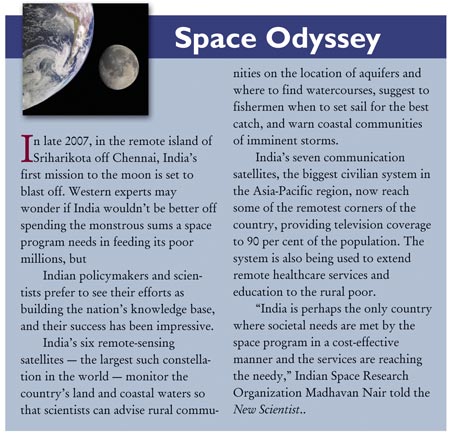 uture holds depends on broader policy decisions and their execution. No nation has become a sustainable scientific superpower without figuring out how to bring its masses out of poverty. For that, the market will be a valuable tool, but significant and accountable public assistance will be pivotal in key areas like education, health and economic sustenance.
 Chairman of Wipro Limited, Azim Premji, rang the closing bell at the New York Stock Exchange Feb. 25.
  Telecom regulator TRAI has served a show-cause notice to Videsh Sanchar Nigam Ltd for violating license conditions by selling international calling cards — Tata Indicom Outbound Prepaid Calling Card — stating that VSNL cannot sell these cards directly to consumers.
  Concerned over the alleged scam involving hundreds of millions of rupees in the rerouting of international calls, the country’s premier investigation agency Central Bureau of Investigation has launched a probe into the working of Reliance Infocomm and some other top private telecom operators.
  IT services giant Cognizant Technology Solutions Feb. 24 said it will invest $76 million in building new development centers in India in 2005 and 2006, which includes $28.7 million for a centre in Bangalore to house 2,250 software professionals.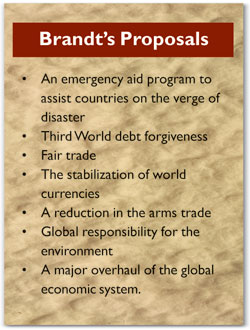



 Talat Hasan (inset), chairman of the Indian Community Center in Milpitas, Calif., talks about the fundraiser benefit event:





 Safety features on board the Magnum include auto-reverse windows, which should protect little fingers from the risk of being pinched. Front air bags are advanced multi-stage bags, with sensors that will inflate the air bags with a force that is appropriate to crash severity. Side side curtain air bags extend additional head protection to front and rear seat passengers. Crush zones and stiffeners have been engineered into the passenger cabin, to help better absorb crash-force energies, and the steering column is energy-absorbing.