!-- Start Alexa Certify Javascript -->
|
|||||||||||||||||||||||||||
|
|||||||||||||||||||||||||||
|
|
|||||||||||||||||||||||||||
|
|||||||||||||||||||||||||||
|
|
|
|
|
|

NOVEMBER 2005 |
|
||||||||||||||||||||||||||||||||||||||||||||||||||||||||||||||||||||||||
|
EDITORIAL:
Global Sympathy for Quake-hit Pakistan Sometimes a natural disaster is so harrowing in its intensity, so heartbreaking in the toll it takes in human lives and suffering, that we forget for a moment all our geopolitical prejudices and realize the essential humanity that binds us all in one big global human family. The devastating earthquake that struck Pakistan and parts of Indian Kashmir is such a disaster. The 7.6 earthquake hit Pakistan Oct. 8, but the death toll continues to climb. The death toll is 80,000 at press time and will surely climb by the time the magazine hits the newsstands. U.N. officials say 3.3 million people are homeless. As the entire world has reached out its hand in sympathy, it has to be said that the support that has been forthcoming falls far short of the enormous need. Yet this is also a time when not only Pakistanis have rallied within and outside the country to the support of their beleaguered countrymen, but archrival India is also making warm, compassionate gestures. In addition to rushing relief in the immediate aftermath, it has offered $25 million in aid and is considering opening three aid centers on the Line of Control to allow Pakistani quake victims to seek medical care or meet their relatives on the other side of the border. Of the toll, the suffering, the relief operations, the continued need, there has been blanket coverage in the media. We at Siliconeer thought we would ask a Pakistani Silicon Valley resident to talk about what it all looks like from his vantage point. We are very grateful to Sabahat Ashraf for sharing his reflections on not just the earthquake, but what new realizations has dawned on him about his country, his people, and the rest of the world in the aftermath of the worst natural disaster his country has ever faced. Sandeep Pandey will not be an unfamiliar name to our regular readers. Previous issues of our magazine have carried articles by this Magsaysay award-winning engineer-turned-activist who founded the nonprofit Asha which supports numerous basic education projects in India. Pandey was recently here to be honored by Indians for Collective Action, the Bay Area nonprofit group that nurtured and mentored Asha when he founded it with three fellow graduate students at the University of California at Berkeley. Sandeep’s commitment to the cause of the marginalized has resulted in his giving up a cushy job at IIT Kanpur and moving to an ashram in a village in Uttar Pradesh. He continues to work and assist the people around the ashram as well as he can; he writes about a recent campaign he organized during the Panchayat elections to demand accountability of disbursement of government funds. COVER STORY: After the Quake: The Web and Expatriate Support - By Sabahat Ashraf As his own efforts to mobilize communication, assistance and free flow of information on the Web gathered momentum following the devastating earthquake that hit Pakistan and also India, amid the heartrending tragedy of incalculable loss and suffering are also heartening stories of an outpouring of support, writes Sabahat Ashraf. 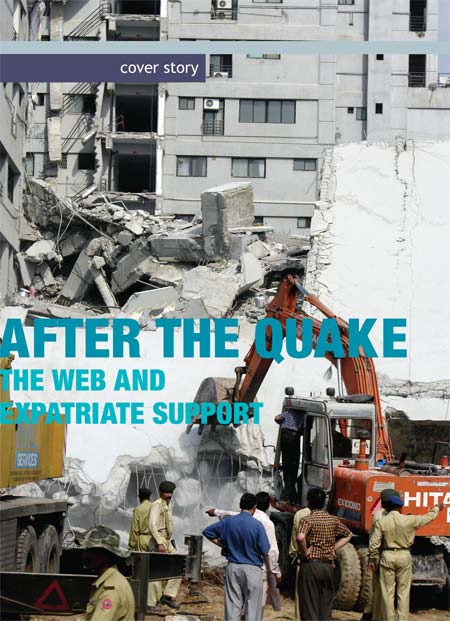 A photo of Magala Towers in Islamabad taken soon after the earthquake Oct. 8. The building collapsed and about 80 flats were demolished as a result. Since it was the morning, most of the people were in their flats, and at the time the photo was taken, were under the debris. Police and Army teams were trying to rescue them. (M. Bukhari photo) According to the netizen’s reference of choice, the Wikipedia, the recent earthquake hit South Asia 08:50:38 Pakistan Standard Time (03:50:38 UTC/ 09:20:38 India Standard Time) on Saturday, October 8th, 2005. It was Friday night here in California and, as a lot of us are wont to do, before I turned in to sleep, I happened to glance at Yahoo! News headlines. There was mention about a quake in Pakistan. It seemed like a pretty serious natural disaster—though, at the time, we had no idea quite how serious. For about six months, I have been working on a project called WikiPakistan (pakistan.wikicities.com), a “Pakistan Information Database” hosted on WikiCities, a system run by the same foundation that runs the WikiPedia. (The WikiPedia is a free and “Open Source” encyclopedia based on the new “Wiki” technology for developing Web sites.) Up to that point, this project had been moving rather slowly, with me trying to get people interested and entering information in between holding down a Silicon Valley day job, managing two kids both of whose parents have professional jobs, and trying to keep my blog up to date. But as I read the news about the quake, I realized that this was exactly the kind of situation that this project could address. I created a page on the site devoted to the quake. Then I sent an e-mail to several mailing lists I am on and to friends informing them and inviting them to contribute, and went to sleep. By then, it had a couple of news links, a couple of links to technical information about the quake, and some empty sections for links to personal accounts, organizations working to provide relief, governments’ response, and some other useful links. It was 2:08 a.m. Pacific Standard Time, and about 2:00 p.m. in Pakistan when I made my last edit that night. It had been a little over five hours since the earthquake hit. By the next morning, of course, the world was buzzing with news, views, interviews and information about the quake, relief efforts, statistics, and the like. Over the next few days, I fell into the routine of following what I could from mailing lists, e-mails being sent around, news sites, and the like and adding information to the wiki site. Very soon, others joined in—not least, people on the ground in Pakistan. Of course, while I was hunched over my computer trying to engage with the situation like the geek I am, in the outside world, the response can best be described with hackneyed phrases like “massive outpouring of compassion” and “international mobilization” and so on. Those phrases seem trite or clichéd, but they are the only ones that come close to doing justice. I had followed some earlier trends, like the mobilization in the South Asian and Muslim communities around Hurricane Katrina, but what happened around the earthquake was, if anything, in an order of magnitude that was much larger in scope and size. And having already organized around that issue just a short time before, there were structures to build on. Muslim groups around the U.S. had coalesced into the Muslim Hurricane Relief Task Force. This very soon transformed itself into the Muslim Task Force for Disaster Preparedness and Relief. In the lead was the Silicon Valley-based organization called Hidaya (www.hidaya.org). Hidaya is a non-profit organization headed by Waseem Baloch with its roots mainly amongst Muslim South Asians in Silicon Valley trying to live up to their religious and cultural traditions of sadaqah, or charity. They started out coordinating monetary and material help for needy groups in Pakistan and have, over the last few years, expanded operations to where they now “implement educational, social welfare, and charitable projects in economically depressed areas of Pakistan, India, Bangladesh, West Africa and North America.” They have, to a large extent, become the Silicon Valley Muslim South Asian’s alternative to the Salvation Army. In the aftermath of Hurricane Katrina, as I mentioned above, they had taken the lead in bringing various Muslim charities around the nation together to coordinate relief in the community. And now an even larger effort was needed where the heart and soul of its core constituency felt a strongest bonds.
And just as the governments of South Asia have been seen working together in the last week or two like they have never done before, the communities and groups working on earthquake relief didn’t just break down boundaries and differences of ethnicity, faith, national boundaries and even corporate competition, they just ignored them. Groups like the Association for India’s Development, which had had a lot of experience in large-scale disaster relief around the tsunami that hit South East Asia just some months previously, reached out to help, advise, and expertise in coordinating relief, raising funds, and any other way they could. And in the world of Silicon Valley, people, whose usual interaction — though always professional and cordial — is usually one of fierce competition, were exchanging notes and e-mails on how to help in the effort. One other aspect not often mentioned, especially in the diaspora, (though even the New York Times seems to have noticed in the last day or two) is that, in a country so often riven by ethnic and sectarian tensions as Pakistan, one where the reaction of the common man to engagement with national issues is often one of extreme cynicism, it was obvious very early in the aftermath of the quake that something very different from the norm was taking hold, at least temporarily. The e-mail loops, and the blogosphere in Pakistan, itself rapidly coming of age in a time of national crisis, was abuzz with information about volunteer efforts, and fundraising, as we say in Pakistan, from Karachi to Khyber. The former cosmopolis, so often exclusively the source of news about ethnic strife, curfews, and violence, had suddenly gotten into high gear as a source of volunteers, monetary contributions, and help for their fellow compatriots. The Metro Blogs for Karachi and Lahore became the best place to go for information on what was going on where. (And in one case, the place to turn to as this correspondent debated whether to wake his mother up at 2 a.m. in the morning and warn her about a 4.0 tremor that had just hit Karachi.) And of course, for those that don’t know, in a time of crisis, there is one place every Pakistani turns to. To a man, woman and child around the globe, the first name on Pakistanis’ lips was “Edhi.” It is name of the founder of an organization most non-Pakistanis — or even second generation members of the diaspora — had never heard about before Oct. 8. It is Pakistan’s FEMA, Salvation Army, Red Cross, and Mother Teresa rolled into one. (Though to be fair, Pakistan does have a proper Red Cross organization — we call it the Hilal-e-Ahmar, or Red Crescent, Society.) The Edhi Foundation — or just Edhi, after its founder and moving spirit, Abdus Sattar Edhi has Edhi Welfare Centers that span the country with services that include emergency centers, free dispensaries, hospitals, maternity homes, child homes and girls hostels. The foundation runs what is now listed in the Guinness Book of World Records as the world’s largest volunteer ambulance organization. Over the last few decades, they have reached out to help in international disaster situations — sending a hundred thousand dollars to help in the first few days after Hurricane Katrina, for example. And yet, the low-key, no-nonsense style of the foundation has meant that although there are now offices and registered charities in the U.S., the U.K., Canada, Japan, Australia and Bangladesh, they do not have the slick, you-can-donate-online kind of Web site most of use have come to not only expect, but, as it turned out in the last couple of weeks, demand from a non-profit. But the faith and deep support amongst Pakistanis for Edhi even surmounted that in the aftermath of the quake. Very soon, the Association for the Development of Pakistan (www.developpakistan.org), an organization headquartered in Boston, provided a way on their own Web site to make a tax-deductible donation to the Edhi Foundation through them (providing the option to donate to the official relief fund as well.) In the last couple of weeks, we saw a Muslim nation come together in a time of need; a nation that others have dismissed as a “failed state” and one of the “Least Developed Countries.” This disaster brought Pakistan and Pakistanis together like never before. (One poster on Metro Blog Lahore pointed out Pakistan’s winning of the 1992 World Cup of cricket as the only other time he felt a similar spirit). It brought friend and stranger alike together to work in a spirit of humanitarianism.
Just one founded and run by an simple, God-fearing, unassuming, plain-spoken man in rubber slippers and basic kurta-pyjama (the dress that is the origin of our modern sleepwear, our pyjamas) who often drives the ambulances himself and makes no religious pretensions. In fact, he is someone who has butted heads over the last five decades with almost every religious and ethnic organization in Pakistan, over the years providing some unconventional welfare services despite severe social and cultural opposition, most memorably placing cradles at Edhi Welfare Centers for abandoned babies — a no-questions-asked policy often controversial even in the most “liberal” of Western democracies. For as this simple man says in his simple language, “My religion is humanitarianism….. Which is basis [sic] of every religion in this world.”
SOCIAL WORK: Cleaning Up Polls: Asha's Grassroots Campaign in U.P. - By Sandeep Pandey Asha Ashram in Uttar Pradesh led a campaign during the recent Panchayat elections in Hardoi and Varanasi districts for accountable government at the grassroots level, taking on corrupt elected officials, writes Sandeep Pandey.  Two women sit at a meeting of elected representatives of panchayati raj and urban local bodies from across the country in New Delhi. At recent panchayat elections in U.P., volunteers of Asha campaigned for candidates who pledged transparency and accountability. (PIB photo) The panchayat elections have just gotten over in the northern Indian state of Uttar Pradesh. Because of Asha Parivar’s role in the Right to Information campaign first in Hardoi district and then in Varanasi district, where information related to income and expenditure of funds coming to village panchayats under various heads and schemes were demanded by the people of these villages, it was quite natural that when it came time to re-elect the pradhans (heads of elected village committees which are responsible for undertaking development works as well as for selecting beneficiaries for various schemes of the government), volunteers of Asha Parivar would be playing an important role. In addition to people who were part of the Right to Information campaign who wanted to contest the elections there were others, who did not participate in the campaign but were interested in Asha Ashram endorsing their candidature as it would improve their standing in the eyes of the electorate. The aspirants were asked to commit themselves to transparency and accountability, honesty and not using any illegitimate means during their campaign.
For the first time Asha Ashram volunteers campaigned in their work area and asked people to vote for candidates supported by the Ashram. There were candidates — corrupt, feudal, criminal — whom the Ashram was opposing and they did not like it. They did everything to foil Ashram’s campaign for cleaner politics. Voter rolls were tampered with, the code of conduct for campaigning was violated. Whenever people brought any of these discrepancies to the notice of Asha volunteers, the district Web site Lokvani would be used to lodge a complaint and the district magistrate would be informed. The present DM Abhishek Singh took prompt action in most of the cases to rectify the situation.
The results were announced. Most of the candidates directly associated with the ashram lost. However, there were about ten pradhans in Hardoi District and another 4-5 in Varanasi who said they would like to work with the ashram. Mukesh, an active volunteer at Mehdiganj working with Nandlal’s anti-Coca Cola movement, was the new pradhan of Village Panchayat Nagepur. He happens to the youngest pradhan in Varanasi district. A ceremony was organized at Asha Ashram, Lalpur, in late September with about 200 people attending including the DM, where several pradhans and panchayat members from Hardoi, Varanasi, Chitrakoot, Ballia, Deoria and Rae Bareli participated in a workshop for better governance and took an oath of “office and transparency” as opposed to the oath of “office and secrecy” delivered for any public office.
A similar exercise was repeated for more pradhans and members only from Varanasi District at Nandlal’s Ashram in Mehdiganj Sept. 28. This meeting was attended by the Member of Parliament from Varanasi, Rajesh Mishra, belonging to the Congress Party. Mishra on this occasion also committed that he would support the people’s campaign for rights over water resources against the Coca Cola bottling plant. Fortunately, both the village panchayats containing the bottling plants in Mehdiganj, Varanasi and Sinhachawar, Ballia now have pradhans who are supporters of the anti-Coca Cola movement. The pradhan at Ballia, Chinta Devi, attended the ceremony at Hardoi in September and she has already declared her intentions of taking on the company. Asha Parivar may not have returned a number of candidates as pradhans or members but put up a tough battle for opponents. More importantly, there is more to the election than immediate electoral victory. The awareness created by the campaign for the Right to Information had a definite role in fair polling and counting of votes. A cooperative DM obviously was a big help. The campaign of Asha Parivar for empowerment of people continues and Asha volunteers and members of the Parivar will continue their vigorous efforts to ensure transparent and good governance in panchayats, whether the pradhans are sympathetic to the Ashram or not. NEWS DIARY: October Roundup  Afghans Outraged | Second Catastrophe Looms after Pakistan’s Worst Disaster | Floods Maroon Thousands | World’s Most Corrupt | Court Battle Over N.T. Rama Rao Kin | N.Y. Bangladesh Cabbie Fighting for Life | Onions from Pakistan | Fishermen Slam Ban | ‘Hurt’ Infosys Founder Quits Airport Job | War on Media | Assam Tribal Feud | Islamist Group Banned | Subversive War | Afghans Outraged | Second Catastrophe Looms after Pakistan’s Worst Disaster | Floods Maroon Thousands | World’s Most Corrupt | Court Battle Over N.T. Rama Rao Kin | N.Y. Bangladesh Cabbie Fighting for Life | Onions from Pakistan | Fishermen Slam Ban | ‘Hurt’ Infosys Founder Quits Airport Job | War on Media | Assam Tribal Feud | Islamist Group Banned | Subversive War |Gas Giants Fight for India Field Afghans Outraged Islamic clerics expressed outrage at television footage that purportedly shows U.S. soldiers burning the bodies of two dead Taliban fighters to taunt other militants and warned of a possible violent anti-American backlash. The footage, captured by Australian TV channel SBS, showed the corpses of two Taleban fighters laid out facing Mecca and then being set alight.
Later footage showed two U.S. soldiers reading from a notebook messages which they said had already been broadcast to villagers. “Attention Taleban you are cowardly dogs,” the message read. “You allowed your fighters to be laid down facing West and burnt. “You are too scared to retrieve their bodies. This just proves you are the lady boys we always believed you to be.” President Hamid Karzai condemned the alleged desecration and ordered an inquiry. The operational commander of the U.S. military in Afghanistan, which launched its own criminal probe, said the alleged act, if true, was “repugnant.” Worried about the potential for anti-American feelings, the U.S. State Department said it had instructed U.S. embassies around the globe to tell local governments that the reported abuse did not reflect American values. U.S. Defense Secretary Donald Rumsfeld has urged military commanders to speed up their inquiry into claims that their troops burned Taleban corpses. He said the longer it took to verify the allegations, the more harm it would do to the country’s image abroad. Cremating bodies is banned under Islam, and one Muslim leader in Afghanistan compared the video to photographs of U.S. troops abusing prisoners at Iraq’s Abu Ghraib prison.
U.N. official Jan Egeland said that millions of lives were at risk, referring to the 3.3 million people left homeless by the 7.6-magnitude quake. “Catastrophe looms large,” said U.N. official Rashid Khalikov. “The danger is there that the loss of life would be very high if the required help does not reach them” before winter. Pakistan’s government raised the official death toll to 54,197, with 78,000 injured. Central government figures have consistently lagged behind those by local officials, which put the death toll in Pakistan at about 78,000. A further 1,350 people died in Indian Kashmir. India has offered aid worth $25 million to Pakistan for relief and rebuilding areas ravaged by this month’s deadly earthquake. The Indian offer was made at the U.N.-sponsored meeting in Geneva. “The government of Pakistan would be welcome to use this contribution for rebuilding homes and rehabilitating people, reconstructing the infrastructure and restoring essential services,” Indian spokesman Navtej Sarna told reporters. “It may also procure supplies of building material such as cement, steel and other items from India. Indian technology for prefabricated, earthquake-resistant shelters will also be made available to Pakistan,” he said. New Delhi’s announcement came two days before officials of the two countries hold talks in Islamabad to discuss steps to open up Indian relief camps for Pakistani victims along the frontier in disputed Kashmir. India has so far sent more than 100 metric tons of emergency supplies to Pakistan.
“The situation is bad in four southern districts, but we are doing everything necessary,” West Bengal Finance Minister Asim Dasgupta said. Officials said at least 10 people had died in the coastal eastern state due to wall collapses and electrocution in the rains and some 50,000 people were cut off by floods. Relief officials warned the situation could get worse for hundreds of thousands of people living in the Sunderbans region, where two rivers were close to bursting their banks. Rains also hit life in Kolkata, eastern India’s main trading hub, which was flooded for a second day after the city’s century-old drainage system failed to cope with the water. Cars and motorcycles floated in waist-deep water, while people waded their way around the city and residents of some low-lying areas used boats. Many shops and business establishments were closed and road traffic was thin. During the monsoon season, floods and mudslides killed more than 1,000 people in western India. The country’s financial hub, Mumbai, was brought to a standstill for four days when a record 94 cm of rain fell in 24 hours. Bangladesh and Chad have been jointly put on top of the list — both having 1.7 points on a scale of 10, 1 being most corrupt and 10 being the least — out some 159 countries of the world.
Last year, Bangladesh and Nigeria jointly topped the list of corrupt nations. In 2001, Bangladesh was first placed at the top slot among the most corrupt countries by Transparency International, raising widespread controversy and condemnation. Trustee board member of the Transparency International, Bangladesh Prof. Mozaffar Ahmed revealed the report at a press conference at Jatiya Press Club. The report was simultaneously released all over the world. This time TI got information from seven sectors of the country against three sectors last year. “Information will be collected from other sectors too next time,” Prof. Mozaffar Ahmed told reporters. Ahmed said Bangladesh emerged top among 146 countries last year and this time the number of countries is 159. The sources of the CPI this year were The Center for International Earth Science Information Network of Columbia University, Economist Intelligence Unit, Freedom House, Information international, International Institute for Management Development at Lausanne in Switzerland, Merchant International Group, Political and Economical Risk Consultancy, United Nations Economic Commission for Africa, World Economic Forum and World Markets Research Center.
Upset with the order of the foreign subordinate court, the Supreme Court has asked solicitor-general G.E. Vahanvati to find out “if diplomatic arrangements can be made so that there is no scope for a superior court’s order in one country to be ignored by a court of another country.”’ Vahanvati has shot off a letter to foreign secretary Shyam Saran to initiate action on the remarks of the bench headed by Justice Arijit Pasayat, which observed that “‘it needs no emphasis that the effect of the court’s order — more particularly a superior court — and its enforceability should not be left to be decided by the perception of a court in another country.” The case involves NTR’s son Nandamuri Jayakrishna and his wife Padmaja seeking custody of their grandchildren — sons of their daughter Kumudini, after she was allegedly driven to death by her NRI husband Srinath Prasad in October 2000. In January 2004, a Chennai court convicted Srinath of abetting the death and sentenced him to 10 years’ imprisonment. He has since appealed the order. The grandparents lost the custody battle in the Supreme Court in 2001, moved a lower court in 2003, alleging that the children were not safe with a person who had driven their mother to death. The lower court ruled that it didn’t have jurisdiction in the matter. Subsequently, the Andhra Pradesh High Court said the lower court did indeed have jurisdiction to adjudicate on the case. Srinath challenged this order in the Supreme Court, which on March 28, 2005, directed him to produce the children in Justice Arijit Pasayat’s chamber on April 25, 2005. Mathew said Rahman was struck without warning while returning to his taxicab from a coffee break early morning Oct 2. The impact of the blow instantly caused a brain hemorrhage. Rahman lapsed into a coma and was fighting for his life. According to a report in The New York Times, Rahman slipped into a coma when a stranger punched him in the head at a gas station in the Upper East Side in Manhattan, New York City, in the early morning of Oct 2. The Times report said the blow caught Rahman by surprise and he fell to the ground, banging his head against the pavement. The assailant was whisked away in a white van. A witness jotted down the van’s license plate number, and called 911. Investigators have tracked down the owner of the van and were “aggressively working” to find the person who punched Rahman. Rahman’s wife told the paper her husband had been driving a cab for a year, working 14-hour days seven days a week. He moved to New York in 1990 from Bangladesh, and received his green card last year. According to NYFTA, “In May, 2000, the U.S. Department of Labor classified taxi driving as the most dangerous job in the country, with taxi drivers being 60 times more likely to be killed on the job than any other worker.” The onions from Pakistan are expected to arrive soon. With the delivery cost working out to Rs. 15 to 17 per kg, by the time they reach the consumer, the cost would be around Rs. 25 per kg. A total of 2,000 metric tons of onions, imported by private parties, are already on their way from Pakistan. Pawar said the shortage was a result of poor yield. “But latest reports say the crop has started arriving in Nasik and Alwar mandis.” “The shortage will continue for the next 10 to 12 days,”’ said Pawar. He added the prices have started to come down. Meanwhile, there are indications that the shortage will last for two weeks at the most. The immediate cause for shortage is last week’s heavy rain in the Nasik belt. Since most fields are water-logged, farmers postponed harvesting. This made things worse as the September crop in Satara and Sangli was damaged. Adding to the unease is the fact that the mandis are closed for a week after Diwali. Seventy percent of the country’s onions comes from the Nasik belt.
Military officials raised the issue of fishermen continuing to refuse the adoption of the “pass” system. Fishermen union representatives said that currently the SLN has imposed a restriction that fishermen who go out to see for night fishing can only return to the shore after 5 a.m. This restriction forces fishermen to stay in mid-sea for more than 10 hours if they go out at 7 p.m, and especially with the prevailing stormy conditions, threat of tsunami and the threat of heavy rains due to the North East monsoon fishermen may be forced to return to shore on emergencies, union officials said. The Navy’s restrictions have placed a tremendous burden on fishermen, they added. Until these urgent needs of the fishermen are addressed and resolved, fishermen are not inclined to abide by the pass numbers and other restrictive procedures, fishermen representatives told security commanders. Murthy said: “I have spent an enormous amount of time and energy interacting with the government in Delhi and in Karnataka to make this work. The records prove themselves.” He said Gowda, who heads Janata Dal (S), a coalition partner in Karnataka’s government, was a constant opponent of IT firms in the state. Last week Gowda asked the state government to set up an inquiry into land allotment for IT companies near the airport. Gowda named Infosys as one of the companies that had been allotted government land at low cost. He has also questioned the jobs IT firms have brought to the state. The consortium, Bangalore International Airport, is overseeing a new airport at Devenhalli. It took seven years to begin construction. At present airlines have to make do with poor facilities at the international wing of the domestic airport. There is just one X-ray machine to screen baggage. Next month three more international airlines, British Airways, Air France and Northwest Airlines will start direct flights from Bangalore.
The raid came on the eve of the FM station’s seventh anniversary. Kantipur has been one of the most outspoken critics of the royal coup in February, when King Gyanendra seized power and installed royalists as ministers. It has been consistently exposing rights violations and corruption in the new regime. The government says Kantipur FM has been violating a decree by the king that forbids simultaneous transmissions from more than one place.
Officials fear the clashes — so far confined to Karbi Anglong district — could spread to neighboring areas. Feuds are commonplace between militias claiming to represent Assam’s tribes in their conflicting homeland demands. Assam police blame militia groups representing the Karbis and Dimasas for the recent killings and arson attacks on villages. Most of the dead are elderly, women or children. Survivors who have fled the fighting desperately need food, medicine, drinking water and physical security, said Suhas Chakma, director of the Asian Centre of Human Rights. Their situation has been made worse by rains and the constant threat of further attacks. Insecurity and indefinite curfews have forced village markets to close down, leading to food shortages in the area. The dominant factions of both militant groups have signed ceasefire agreements with the Indian government. Rajiv Aggrawal, joint secretary in charge of the north-east in the Indian home ministry, said the groups may have to be disarmed “if necessary.” “The government has banned all activities of Harkatul Jihad-al-Islami on the basis of available information,” Bangladesh’s home ministry said in a statement. “It is a self-confessed terrorist organization. Its activities are very sensitive and it has been identified as a terrorist organization,” it said, adding that the ban showed the “government’s firm stand against terror activities.” Mufti Hannan, the group’s top leader, was arrested on Oct. 1 and is now being interrogated, police said. In February, Bangladesh banned Jamaat-ul-Mujahideen and Jagrata Muslim Janata Bangladesh for their unexplained criminal activities. Two people died and at least 100 were wounded when some 500 small bombs rocked Bangladesh Aug. 17. Two more people were killed and 10 injured when bombs went off in lower courts in three district towns this month. The government blamed the attacks on outlawed Islamic militant group Jamaat-ul-Mujahideen and has arrested nearly 450 suspects, mostly members of the group. Violence has increased in recent months and included the killing of the foreign minister in August. The government blamed the rebels for the attack but they denied involvement. The Tigers have been fighting for a separate nation for the minority Tamils in the north and east since 1983. More than 60,000 people have died. The latest killing took place in Jaffna and the army blamed Tamil Tigers for shooting dead a policeman. Gen. Furuhovde said in a speech in Colombo there could be “no military solution to the conflict.” “This is subversive war. Both parties are involved in this. It is alarming. All war is alarming. This is dangerous for the ceasefire and for the country,” he said. “We have seen similar warfare going on Iraq, the transformation of war into something else. “What we see now, it’s not only criminal acts, it’s also acts of war.” General Furuhovde said that if the parties involved did not show restraint, the truce would come to an end. Dozens of policemen, soldiers and rebels have been killed in the sporadic violence which has put the ceasefire under strain. The most prominent victim was Foreign Minister Lakshman Kadirgamar, who was gunned down near his home in August. Peace talks stalled in April 2003, when the Tigers said the government had failed to honor pledges on autonomy in the north and east. Analysts say little movement is expected until after the presidential election in mid-November. Gas Giants Fight for India Field BP boss Lord Browne said the firm wanted to raise its profile in India, and praised the Krishna field. Lord Browne told The Financial Times that BP was looking at a number of options to develop its business in India, spanning exploration, production and refining. “It is an important set of discoveries in a world-class basin,” he said of the Krishna field, which is in the Bay of Bengal. “It would be good if BP were represented there.” Reliance discovered the field in 2002 and subsequently sold a 10 percent stake in it to Canadian firm Niko Resources. However, experts said that Reliance had little experience of deep water exploration and was keen to bring in specialist expertise in this area. Although production is unlikely to begin before 2008, the project is potentially highly lucrative. According to energy analysts Wood Mackenzie, the field holds an estimated 6,000 billion cubic feet of proven and probable reserves, while the ultimate yield could potentially be twice as large. “The field is not very big by international standards, but for India it is the biggest gas discovery since the Mumbai offshore fields in the 1970s,” Praveen Martis, an analyst at Wood Mackenzie, told the BBC. “The returns are big enough for the oil majors to participate, Reliance is happy because of the expertise they will provide and the government is happy because it wants to attract the oil majors into India,” he said. PHOTOGRAPHY: Many-Splendored India: Through the Eyes of Dilip Banerjee 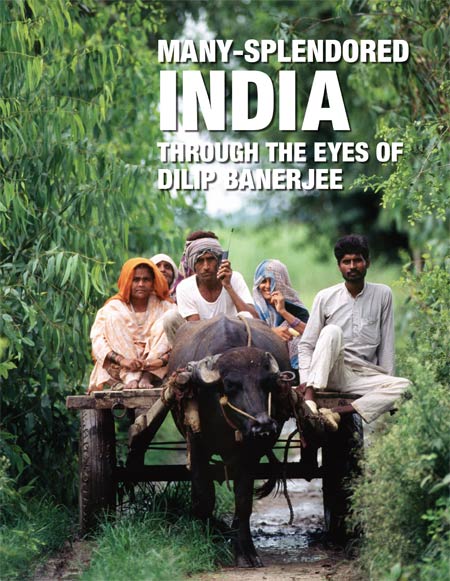 My photographs have often been a reflection of my own human instincts. Capturing fleeting moments or conceptualizing a thought or trend has been my hallmark, writes photographer Dilip Banerjee. My photographs have often been a reflection of my own human instincts. Capturing fleeting moments or conceptualizing a thought or trend has been my hallmark, writes photographer Dilip Banerjee.Left: Farmer with a cell phone on a bullock cart in an Uttar Pradesh village. I started photography as a hobby, which later became at once a passion and a profession. It was while listening to such screen and stage personalities as Mrinal Sen, Mani Kaul and Habib Tanvir during a film appreciation and photography course I took in Kolkata that I became aware of the many ways photography offers of expressing the interface between an individual and the society he lives in. I also discovered that photography could offer a remunerative living. Thus began my love affair with photography in the late seventies. I have had no formal education. For me, education has been a life-long exercise. I have tried to educate myself from my environment, friends, and people from different walks of life with whom I get to interact on a daily basis. There was a point in my life, way back in the late ‘60s and early ‘70s when I had no faith in institutional training. I had no belief in formal or institutional education. To me, this form of education was essentially a process of elimination, which created class differences. At the end of the day I wouldn’t mind admitting that I may have erred. I have had a fair share of awards both at the national and international level, but if you ask me today, I have stopped working towards such awards. I have realized that awards are not just about a good photograph. It’s a different ball game altogether. To me recognition comes in the form of reciprocation from society. To that extent, Recognition to me is when a photograph shot by me has the capacity to touch human life or to stir a social debate.
Political events and the upsurges of Bengal in the ’60s has had a large influence on my life. Being born and brought up in Kolkata, which was then grappling with new social trends, I found myself to be a direct product of the changing order. You may be aware of the changing political situation during this period. It was very volatile and violent. I was a part of this political upsurge. Born in a poor family, which had had to suffer the pains of partition, I had little choice but to take up a job to earn a livelihood. I had to take up a job as a daily wage mazdoor (laborer) in a government organization when I was only 16 years old. But this did not deter me from keeping in touch with my friends, almost on a daily basis. We would assemble at the Calcutta Coffee House, which was the center of the education hub in the city, surrounded by the University of Calcutta, Presidency College and other educational Institutions. My friends often expressed views by writing short stories, poems and even reports for small paper and little magazines. Our conversations — adda in Bengali — at the Coffee House would center on Camus Kafka, Brecht, Godard, Satyajit Ray, Ritwik Ghatak, and Pather Panchali. It ranged from sports to intellectual debates and these sessions turned out to be my tutorials in life.
I have always had a keen eye and have observed human behavior, from moments of sorrow to wit and humor. To me, all this struck me as a fleeting moment of human expression. I was keen to capture these moments of human life. This is when the visual media started playing on my mind. In 1981 I joined a Bengali daily as a photographer. My photographs have often been a reflection of my own human instincts. Capturing fleeting moments or conceptualizing a thought or trend has been my hallmark. My photographs have been best appreciated for the human expression. I have always managed to tell a story through my photographs. And you could call this my style. I draw inspiration from the people around me. Each one of us has a story to tell. HEALTH: Talk, Don’t Wait: Cancer Screening - By Tat S. Lam, M.D. Although most people avoid talking or thinking about cancer, as a doctor he knows how critical it is to talk about possible health problems before they occur, writes Tat S. Lam, M.D.  Have you asked your doctor about cancer screening? Most of us avoid talking or thinking about cancer. As a child I was taught not to mention any word associated with death or illnesses, as if those words were a curse. As an obedient child I following this “rule,” but as a doctor I know how critical it is to talk about possible health problems before they occur. Have you asked your doctor about cancer screening? Most of us avoid talking or thinking about cancer. As a child I was taught not to mention any word associated with death or illnesses, as if those words were a curse. As an obedient child I following this “rule,” but as a doctor I know how critical it is to talk about possible health problems before they occur.From celebrities in the news or local figures to a close family member or friend, we have all been affected by cancer in some way. According to the American Cancer Society, cancer is the second-leading cause of death in the country. One in three women and one in two men will develop cancer. These statistics are frightening, but what they don’t show is that many forms of cancer are treatable when detected early.
So why aren’t more people getting screened for cancer? People may be afraid to talk about it, afraid to learn they have cancer or fear medical tests. People may be confused by the medical system, don’t understand their insurance plans or are uncomfortable in a hospital setting. The medical system is complicated, but instead of avoiding it, I encourage you to seek care for yourself and your loved ones. I have had patients come in for their first doctor’s visit with health insurance cards they’ve had for years. Community clinics offer a range of free services for people without health insurance, including cancer screening. When my patients undergo regular cancer-screening procedures, even if they were nervous beforehand, they are glad they did it. My patients’ tell me that if no cancer was detected, they have earned a peace of mind for themselves and their loved ones. For those who detected cancer early and received successful treatments, they were relieved they had done so. Talk to your doctor about cancer. Many tests are regular once-a-year tests that can be done at your doctor’s office and some are steps we can take ourselves to detect cancers, like breast and prostate cancer. Cancer does not have to be the second highest cause of death. If we set our fears aside and start asking questions, we can take up the opportunity to be proactive about our health. Dr. Lam can be reached at: doctors-word@kp.org.
SUBCONTINENT:
The Greasy Palm: Fighting Corruption in India - By Siddharth Srivastava The recent Right to Information Act is a pointed effort by Prime Minister Manmohan Singh to attack the all-encompassing corruption that has hamstrung India for decades, writes Siddharth Srivastava.  Scandal has dogged the Indian government, both at the federal and state level, for decades (clockwise from top): (i) Former Defense Minister George Fernandes (r), seen here with U.S. Defense Secretary Donald Rumsfeld, was implicated in a defense kickback scandal during a media investigative sting operation (HELENE C. STIKKEL/ US DEFENSE DEPT photo); (ii) Present Railways Minister had to quit as Bihar chief minister after being indicted in a huge fodder scam (PIB photo); (iii) Slain Prime Minister Rajiv Gandhi was tainted by allegations of huge kickbacks in a deal to buy (iv) 155 mm towed howitzers from Bofors like the one shown in Siachen. Scandal has dogged the Indian government, both at the federal and state level, for decades (clockwise from top): (i) Former Defense Minister George Fernandes (r), seen here with U.S. Defense Secretary Donald Rumsfeld, was implicated in a defense kickback scandal during a media investigative sting operation (HELENE C. STIKKEL/ US DEFENSE DEPT photo); (ii) Present Railways Minister had to quit as Bihar chief minister after being indicted in a huge fodder scam (PIB photo); (iii) Slain Prime Minister Rajiv Gandhi was tainted by allegations of huge kickbacks in a deal to buy (iv) 155 mm towed howitzers from Bofors like the one shown in Siachen.It is considered to be Prime Minister Manmohan Singh’s most pointed attempt at curbing corruption in the country that has reached pandemic proportions. The Right to Information Act that has just come into force gives legal rights to people to seek information from the government and curb corruption, placing India among the 55 countries that have such legislation. The new law is meant to curb corruption and inefficiency in the government at various levels and covers all central and state administrations, panchayats, local bodies and non-governmental organizations getting public funds. Under the Act, the authorities are required to respond to queries in as little as 48 hours, if it is a matter of life and liberty. The law aims to ingrain accountability and transparency in public functioning as it specifically provides for hefty fines and disciplinary action against erring officials. The act becomes even more relevant as the government has planned a huge employment generation program estimated to cost over $40 billion per year to be implemented at the behest of public functionaries across the country. The act covers a wide range of information defined as “any material in any form including records, documents, memos, e-mails, opinions, advices, press releases, circulars, orders, log-books, contracts, reports, papers, samples, models, data material held in any electronic form and information relating to any private body which can be accessed by a public authority under any other law for the time being in force.” The most potent aspect is the provision of penalty to ensure that government officials and all public authorities provide high priority to requests for information from citizens. Deterrent penalties have been prescribed for failure to provide information in time or for refusing to accept application for information or for giving incorrect, incomplete or misleading information or destroying information and the like. The act, however, exempts security and intelligence organizations from its purview. The measure couldn’t come a moment too soon. India ranks among the most corrupt nations in the world. Studies by the Berlin-based Transparency International and other indices such as the Corruption Perception Index have consistently ranked India as one of the worst as far as corrupt practices go. In the latest TI report, India secured a lowly spot at number 88 (out of 159 countries surveyed) of the most corrupt places on the planet, keeping some unsavory company with countries such as Gabon, Mali, Moldova, Tanzania and Iran. The World Bank has labeled the Delhi Development Authority — that oversees urban housing and commercial property in the national capital — as the most corrupt organization in India. The list of scams involving public servants, politicians, private businesses, individuals is an unending one — Tehelka (bribe for party funds and defense deals), Telgi (spurious stamp paper), fodder scam (embezzlement of funds for animal husbandry), coffin scam (purchase of coffins for dead soldiers), petrol pump allotment scam, stock market scam, each has been highlighted by the media. Hardly does the furore over the expose of one corruption scandal die before another one surfaces. There is a known mafia that controls tenders for railways, roads, power projects, electricity and property development with any outside or new entrant into this closed field often met with brutal resistance. The case of Satyendra Dubey still rankles — Dubey was an engineer killed when he tried to expose the mafia that controls the national highway development project. Apart from corruption at the institutional level, individual greasing of palms is required to procure a driving license, electricity or water connection, clearance of a residential plan, marriage, birth and death certificates, passport, lodging a report with the police…..The list goes on. According to a recent report by International Finance Corporation, the investment arm of the World Bank, India has the “most bureaucratic red tape” in the South Asian region. “It (India) scores worst in time to register a business (89 days), difficulty of firing a worker (90 out of 100), delay in registering property (67 days), second time for closing a business (10 years),” says the IFC’s report “doing business in South Asia in 2005.” Further, India ranks second in the region for procedures and time required to enforce a contract, the report, said. It takes three months to open a business in Mumbai. Two of the months are spent in obtaining the Personal Account Number from the income tax department. There have been various attempts to put a figure to the dimension of corruption: government loss of $50 billion due to tax evasion; $10 billion due to delay in projects due to bureaucratic red tape; former Prime Minister Rajiv Gandhi famously said that for every rupee spent by the government for development less than a tenth of the amount actually reaches the beneficiary and this, too, is an exaggerated figure. A recent survey said that police officials across the country earn over $400 million through bribes offered by truck drivers. Corruption has been defined by the World Bank as the “use of public office for private profit.” Former Chief Vigilance Commissioner of India N. Vittal says that there are five major players on the corruption scene, interdependent, strengthening and supportive of the vicious cycle. They are the corrupt politician, bureaucrat, businessman, non-government organization and the criminal of the underworld. “A shortage of basic decent human livelihood in India has forced a common person to be corrupt. It is impossible for a common man to own a roof, provide good education to his children and hope for a peaceful retirement in India using normal and honest means. One has to bribe someone to get a good education, to get a deserving job and to avail services which one is entitled as being a citizen of India. A low GDP growth for two decades and explosive population growth in the last fifty years has brought corruption to every sphere of life in India. With such a huge population and massive government control, everything seem to be in short supply,” says Vittal. This is not to say that mechanisms are not being put to place and continuously upgraded to fight corrupt practices. The Indian judiciary, even if very slow and inefficient, does take on an important role from time to time delivering as well as exhorting both private and government players to mind their businesses well in public interest; the Indian media is vibrant and continually highlights instances of aberrant behavior of politicians, bureaucrats as well as private business concerns; vigilance and tax departments raid people with assets beyond their known sources of income; consumer courts have become active and take on cases on behalf of the harassed individuals; computerization as well as introduction of competition in many spheres of activity controlled by the government has brought about a degree transparency as well as an attitude of service to the consumer/customer first. The earlier assumption that the big fish invariably get away has been debunked as the media and the courts come down heavily on aberrant politicians and public servants. Yet, the enduring feeling is that corruption is inherent in our systems and it is better to abide by it than beat it. The Times of India has rejected the IFC finding that the bureaucracy in Pakistan or China may be more business-friendly than in India. “Non-democratic states are by definition adhocracies run not on principles of social equity and respect for law but on the whims of the ruling elite. The very fact that democratic India has codified norms for doing business is a guarantee for fair trade practice which can’t arbitrarily be short-circuited by all-powerful vested interests,” the editorial said. Alas, that guarantee may look great in the lawbook, but in reality it turns out to be a cruel joke given the pandemic level of corruption that continues to thrive. The RTI is being looked as a leap towards cleansing the functioning of public officials, but there is still a long way to go as the Indian bureaucracy is notorious for finding ways and means for its pecuniary survival. There are reports of government officials already looking at the creation of another mesh of information officers across the country. The RTI has clauses and exceptions that can provide an escape route, but there is no doubt the government official is going to be facing some heat, for once. - Siddharth Srivastava is India correspondent for Siliconeer. He lives in New Delhi. |TOP| SOCIAL WORK: Helping Spastics: IICP Kolkata - By Subhra Chatterjee From a modest beginning in 1974, steered by a parent with two children, the Indian Institute of Cerebral Palsy has grown into an organization that supports more than 3,000 families today, writes Subhra Chatterjee. 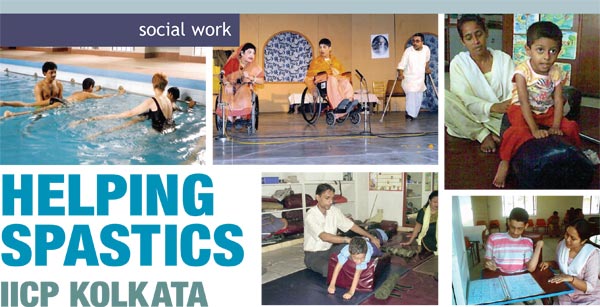 Clockwise from top: Hydrotherapy; annual concert; family services OPD, respite services, and physiotherapy at IICP Kolkata. The Indian Institute of Cerebral Palsy’s pioneering journey began in the year 1974 steered by a parent and with two children in an army barracks in Kolkata. Since then, IICP has grown from a small school to a nationally recognized institute striving for excellence in its Endeavour to bring hope and opportunity to the lives of families and persons with cerebral palsy. The organization today supports over 3,000 families through its varied services. The main objectives of IICP are to undertake manpower training, conduct research and develop service models for persons with cerebral palsy and their families in urban and rural settings. In its mission statement, IICP “seeks to bring about positive changes in the lives of all people with cerebral palsy . . . and give them opportunities to . . . fully participate and contribute to the community and country.” In these last three decades IICP has helped in setting up services in all the districts of West Bengal — services supported and run by the community. IICP has initiated and supported services for 17 affiliate organizations in states across India. In recognition of its efforts, IICP received a National Award from the federal Ministry of Social Justice and Empowerment, and has received a citation from the Rehabilitation Council of India. IICP offers degree and diploma courses in special education and community-based rehabilitation in collaboration with Jadavpur University and the Rehabilitation Council of India. Courses for medical practitioners are held annually. Adults with disability attend computer application courses held at the institute. Trainer training and parent training programs including in-service training for professionals are conducted regularly. IICP takes interns and clinical placements from professional training organizations. Courses for caregivers of children and young adults with disability are held in collaboration with the National Trust of India. IICP received the award for ‘Best Respite Care Service in India’ from the National Trust in 2004.
The Social Services Division plays a crucial role in the various activities that are offered by IICP. The division works closely with both students and their families, counseling them and helping to lessen the trauma and emotional setbacks that may occur. IICP offers quality services through its different divisions. Its Centre for Special Education provides a broad-based holistic learning experience for children with special educational needs, giving them an opportunity to realize their potential. CSE is a demonstration centre for trainees and professionals from all over the country and abroad. CSE is also an accredited centre for secondary and senior secondary courses in Hindi and English of the National Institute of Open Schooling and secondary course in Bengali of the State Open School.
The Diagnostic Clinic admits children with cerebral palsy and multiple disabilities for on-going management. The Out Patients Department provides services to families in Kolkata, the districts of West Bengal, other states and neighboring countries. However, our work would be meaningless and insignificant without those who in the last thirty-one years have learnt with us and taught us to carry on with our work bringing laurels and appreciation, braving their disabilities. Saluting and thanking each of them would run into pages Suffice it to say that we are extremely proud of all our students and care for them deeply. They make all our hard work worthwhile.
|TOP| THEATER: The Story of Lalon Phokir: The Man of the Heart UC Berkeley theater professor Sudipto Chatterjee explores the life and times of Bengal’s beloved mystic Lalon with intellect, music and verve. A Siliconeer report.  Above: Sudipto Chatterjee presenting a solo performance in “The Man of the Heart.” a multimedia play written by him and directed by Suman Mukherjee. You have to marvel at a guy like Lalon Phokir. A rustic villager he might have been, plucked right from the heart of Bengal’s rural bosom, but in his mystical musings he fascinated the likes of Nobel laureate Rabindranath Tagore, the towering colossus of Bengali literature. Lalon, a nineteenth century Bengali wandering minstrel, spoke and sang of a common humanity. He treated religious divides with disdain. Needless to say, this did not endear him to the religious powers that be. Yet he went about his life without changing his ways. Lalon has become an icon of sorts for the progressive Bengali, who loves to point to his disdain for religious divides that seems so modern and humane. Yet if truth be told, it must also be conceded that Lalon is also looked upon as the lovable minstrel, but not taken awfully seriously — he was, after all, a rustic poet when Bengali culture is obsessively focused on the city. In Man of the Heart, director Suman Mukherjee and author/actor/ performer/singer Sudipto Chatterjee use a very spare set and a long piece of white cloth, they present a performance that is at once compelling, energetic, and enormously moving. Chatterjee brings boundless energy to his performance and carries the hour-long multimedia performance on his able shoulders. An excellent actor with superb singing skills, his greatest gift is an ability to shed the urbane persona that makes his Lalon convincing. What’s absorbing about the performance, which is also written by Chatterjee, is the intelligent, inquiring look Sudipto has taken at Lalon. This is no simple narrative but a look from many angles – historical accounts, contemporary Hindu and Muslim jaundiced views – and then goes beyond. What emerges a Lalon that all of us failed to understand perhaps, because of our own limiting preconceptions. Lalon has his own take on the world, mankind, and the Special One — as Chatterjee eloquently brings out in some lovely renditions of his songs. With the beautiful accompanying folk music of Soumya Chakravarti, and Chatterjee’s robust performance, the play is an unforgettable introduction to one of Bengal’s lesser known sages. Director Suman Mukherjee is one of India’s premier young directors and a visiting artist-in-residence this semester at UC Berkeley’s Townsend Center for the Humanities. Chatterjee has said he’s been intrigued by Lalon since the age of 5 or 6, when he heard a Baul singer from the country pass his home every day singing various compositions from Lalon’s rich repertoire, estimated at more than 1,000 songs passed down orally. Lalon angered Hindus, Muslims and others by refusing to answer if he had been born Hindu or Muslim and insisting that what is in the heart matters more than whether someone worships in a mosque, temple, cathedral or synagogue. But since Lalon’s death and ever-growing popularity, he said, Muslims in Bangladesh have built a protective mausoleum over his grave, while the Hindu majority in West Bengal has claimed him as an icon of secularism. Chatterjee has sung Lalon’s songs with gusto, despite some doubt expressed by the Baul community about whether a non-Baul can do so. “I feel like I have an inner connection that goes beyond the urban-countryside divides,” he said. Sudipto Chatterjee is the author of fourteen plays and translations in Bengali and English. He has directed several plays including Nuraldeen’s Lifetime (by Bangladeshi playwright, Syed Shamsul Haq), Girish Karnad’s Hayavadana, Badal Sircar’s Bhoma and J.M. Synge’s The Playboy of the Western World and its Bengali adaptation, Birpurus . Off the stage, he has directed Free To Sing?, and is currently finishing his second documentary on the Pandvani performance tradition of India. Suman Mukherjee has directed – Samay Asamayer Brittanto (2003) Debesh Roy/Mukherjee, Mephisto (2002) Klaus Mann/Arione Mnouchkine/Mukherjee, Teesta Paarer Brittanto (2000) Debesh Roy/Mukherjee, Falguni (Prelude) by Rabindranath, Kalantok Lal Fita (2002); Jaisa-Ka- Taisa (2000) by Girish Ghose; Measures Taken,(1997) by Bertolt Brecht invited by Barnard College, Columbia University, New York,; Gantabya (1997); Coriolanus, a play by William Shakespeare/ Bertolt Brecht; Natir Katha, adaptation of Chekhov’s Chorus Girl ; Dain, a play by Abhijit Sen; Haripodo Haribol and Janani, plays by Indrashish Lahiri. He has performed in the U.S.A, Canada, Bangladesh, Germany, France. EXHIBIT: Real Estate India: Builders from the Old Country - A Siliconeer report India’s first international real estate exhibition Real Estate India 2005 was presented in San Francisco, Chicago and Toronto. A Siliconeer report.  Left: Sandeep Kapoor of RelioQuick, presenters of the exhibit. (SOM SHARMA/DIGITAL IVISION photo). Right: The Indian delegation of realtors led by Amar Singh, MP (in Nehru jacket) at the Real Estate India 2005 exhibit at the Santa Clara Marriott.
On display were state-of-the-art projects from the Greater Noida Industrial Development Authority, New Okhla Industrial Development Authority and Ghaziabad Development Authority — better known by their acronyms GNIDA, NOIDA and GDA. In two-day events Oct. 8-9 in San Francisco, Oct. 12-13 in Chicago and Oct. 15-16 in Toronto, Non-resident Indians got an opportunity to get a first-hand idea of the world-class properties on offer. Visitors at the highly interactive exhibit discussed investment packages and the standard of the Indian real estate industry. As interested Indian Americans flocked to these exhibits at the Santa Clara Marriott, Marriott Chicago-Schaumburg and Wyndham Bristol Place-Toronto, they had an opportunity to meet 21 well-known developers from the National Capital Region. At the Santa Clara Marriott, 1,500 visitors attended the event and about 400 people registered, booking property worth Rs. 50 million. Uttar Pradesh Development Council chairman and Samajwadi Party MP Amar Singh addressed the press and stressed upon the importance of conducting such exhibitions . NOIDA and Greater NOIDA chairman Rakesh Bahadur and NOIDA CEO Sanjeev Saran were on hand. In Chicago, Indian Consul General Arun Kumar welcomed the Indian delegation at a dinner hosted by the Consulate General of India, In Toronto, over 1,100 visitors attended with 315 people registering. The appreciative audience included India’s High Commissioner to Canada Shyamala B. Cowsik and the Indian Consul General in Toronto Satish C. Mehta. The exhibits were conceived and presented by Relio Quick, India’s first TUV Certified ISO 9001:2000 & INS accredited integrated marketing communication solutions provider. CINEMA: Celebrating Ray: Maitra Lecture at Santa Cruz - A Siliconeer Report Satyajit Ray film veteran Sharmila Tagore and art critic Partha Mitter were on hand for a 50th anniversary screening of Pather Panchali. A Siliconeer report.  From left: Sharmila Tagore; Partha Mitter explaining a point while screening a excerpt of “Pather Panchali.” Yesteryear’s Bollywood star Sharmila Tagore and Indian art historian Partha Mitter presented two engaging lectures before the screening of Satyajit Ray’s classic film Pather Panchali at the Music Center Recital Hall at the University of California at Santa Cruz to a packed auditorium Oct. 23.
The Sidhartha Maitra Memorial Lecture — presented by Ray FASC — was established in 2001 by Anuradha Luther Maitra in honor of her husband, who was a scientist, entrepreneur, and admirer of the late Indian film director’s work. Anuradha Maitra, who was on hand, gave a brief and touching speech about how Ray and her husband both epitomized the inclusive, creative and sensitive ethos of Bengali culture. While Tagore spoke about her personal impression of the great filmmaker, under whose direction she had acted in several films including her debut Apur Sansar, Nayak, Devi and Aranyer Dinratri, Mitter brought a perceptive art critic’s perspective as he spoke at some length on the humanity, sensitivity and complex, nuanced characterization in Ray’s classic film, underscoring his points with screened excerpts of the film. On hand were UC Santa Cruz chancellor Denice B. Denton and UC Santa Cruz history Prof. Dilip Basu, founder and director of the Satyajit Ray Film and Study Collection, an archive on the UC Santa Cruz campus that hosts 31 of Ray’s 36 films and more than 7,000 journals, scrapbooks, posters, stills, books, records, and other memorabilia. Ray FASC was founded in 1993 to acquire, preserve, and provide scholarly access to Ray’s films, papers, books, and artwork. The restoration of Pather Panchali was spearheaded by Dilip Basu.
Basu noted that the UC Santa Cruz event culminated a yearlong celebration of the 50th anniversary of Ray’s first film. “We opened our anniversary celebration last December by taking author Salman Rushdie to Kolkata, where we had an exhibition of Ray’s film art and a lecture by Rushdie,” said Basu. “Then in May, we were invited by the Cannes Film Festival to be an official part of this year’s program and launch their Classics series.” Frank Pierson, two-time Oscar-winning director and president of the Academy of Motion Picture Arts and Sciences, accompanied Basu to the Cannes Festival, along with actress Tagore. “The restored print of Pather Panchali screened this past year in such places as London, Germany, Rome, New Delhi, Bangladesh, and Korea,” Basu added. “We are now concluding our yearlong celebration by showing it on campus at UC Santa Cruz as part of this year’s Sidhartha Maitra annual lecture and screening.” More information on Ray FASC is available at its Web site at http://satyajitray.ucsc.edu/ FESTIVAL: A Bengali Traditions: Pashchimi’s Durga Puja Bay Area nonprofit Pashchimi celebrated Durga Puja for five days at the Sunnyvale Hindu Temple. A Siliconeer report.  Clockwise from top left: Woman blowing Shankh; the Durga idol; Sandhi Puja; Devotees offering puja; and performers at Aarti; Dhunuchi Naach; and Mishti Mukh. For the successful expatriate, for all its joys, the Americana Dream exacts a toll. The culture of the old country is often the first casualty. Durga Puja, the premier festival for Bengali Hindus, is a good example. At home it is a five-day-long festival rich in ritual, culture and creative efflorescence, but here in the U.S., the event inevitably gets truncated and moved to the nearest weekend.
Pashchimi’s hosted Durga Puja at the Sunnyvale Hindu Temple this year Oct. 8-12. This is the second consecutive year that Pashchimi hosted the event, with the same meticulous attention to detail, for five full days according to exact timings as stipulated by the religious calendars. The festivities recreated the ambiance of the old country with the traditional decoration of mandap (a temporary structure that houses the deity), the live sounds of a local dhaki (an Indian-drum player), and was authentic also in its details of the worship itself, like the offering of 108 deeps (brass lamps) and flowers to the mother Goddess. Just like the Kolkata pujas, two huge pandals (tents) were put up, one housing the Durga idol and its accompanying set of idols of Ganesh, Kartik, Laxmi and Saraswati, while the other sported a variety of booths selling food, video, books, jewelry and clothes, mainly serving as an adda ghar for attendees to socialize. Attendance was about 2,000 on each weekday, reaching 3,000 people during the weekend. Durga Puja special khichudi (rice-lentil porridge) and labra (mixed vegetable) were served for preeti bhog (lunch) on all days to everyone free of charge. Authentic aratis were performed every evening. People danced to the rhythm of dhak and the smokes of dhuno (incense). Nancy Smith, the current chair for the Sunnyvale Housing and Human Services Commission and the Sunnyvale city mayor-in-running, stopped by and praised the efforts made by Pashchimi and the Sunnyvale temple. Cultural shows, again free of charge, included dances depicting Durga performed by dance schools, a children’s show showcasing dances and dresses of various states in India. Bay Area theatre group ENAD presented Badal Sircar’s Shonibaar. Harano-sur (Lost Melodies), a local Bengali band, performed songs of famous Bengali music directors/singers/musicians of yesteryears. A magic show by MentalWires delighted kids and adult alike, while organizers also hosted a kids’ fancy dress show. Like the previous year, the puja itself was conducted in the traditional Indian style. The priest, Ramen Chakrabarty, said that most of such pujas here usually compromise on authenticity by trying to fit the event within two days over a weekend, but Pashchimi, he was happy to note, was unique in conforming to the true spirit of the worship. One of the organizers said that their idol was the tallest in the Bay Area and has been specially created by a leading artist in Kumartuli in Kolkata. DANCE: Kathak & Tap Dance: India Jazz Suites - A Siliconeer Report Kathak master Chitresh Das and Emmy Award-winning tap danceer Jason Samuels Smith present an exciting jugalbandi at San Francisco’s Cowell Theater. A Siliconeer report.
The one-weekend-only performance features dance by Chitresh Das Dance Company’s artistic director Chitresh Das and Emmy Award-winning tap dancer Jason Samuels Smith. On one side is a 60-year-old master of the traditional north Indian classical dance form kathak. On the other side is a 24-year-old Emmy Award-winning tap dancer. Das and Smith “will collaborate to show the compelling similarities of rhythm, footwork and improvisation that these two dance forms share. Das and Smith will utilize these similarities as well as the differences of Kathak and Tap, and their corresponding musical traditions, to explore new ways of presenting the two forms,” said a press release from organizers. “As opposed to fusion, each artist will dance in his own form and use the common ground of footwork, rhythm, improvisation (such as call and response), and movement to explore and shed new light on the Kathak and Tap traditions and the collaborators’ individual interpretations. Portions of the work will focus entirely on rhythms, with varying combinations of footwork, recitation of North Indian classical rhythmic language, and percussion on tabla and jazz drums.” Das has received numerous awards for his work, including Irvine Fellowships in Dance and grants from the Rockefeller Foundation and National Dance Project. His most recent collaboration, “East as Center,” received a special award for Outstanding Production at the 2004 Bay Area Dance Awards. In India, his performances regularly appear on national television, most recently in January 2005. In the past year he performed at the prestigious American Dance Festival in Durham, North Carolina, was a featured artist at the International Kathak Festival in Chicago and performed for 4,000 Indian soldiers in Fort William in Kolkata. His interview and performance in a historical court in Calcutta were shown in a BBC Series Eighty Treasures Around the World and he also performed on a PBS program. His Kathak Schools are in San Francisco, Boston and Kolkata. Jason Samuels Smith won a 2004 Emmy Award as well as a 2004 American Choreography Award for Outstanding Choreography for the Opening number of the 2003 Jerry Lewis/MDA Telethon. In 2004, he was also named one of Dance magazine’s 25 to Watch. Smith is also a former cast member of the Broadway hit Bring in Da’Noise, Bring in Da’Funk, performing as a principal dancer and understudy to the leading role. He was also an original member of Savion Glover’s N.Y.O.T.’s (Not Your Ordinary Tappers). As a solo performer and host, he has headlined several productions including the 2004 Tap Extravaganza, the 2002 and 2003 Harlem Jazz Dance Festivals, TAAP: The Art and Appreciation of Percussion off-Broadway revue, and the NY Tap Committee/Town Hall’s 21Below! where he performed with Jennifer Holliday. Other credits include The Cotton Club Returns: A Tribute to Great Jazz Legends and the American Institute of Vernacular Jazz Dance Darktown Strutters Ball Gala Events. Jason co-starred with Tap Master Arthur Duncan in Tap Heat, a dynamic short film that has been featured in several international film festivals before its official premiere in the United States. The native New Yorker is currently bi-coastal, heading the tap program at Debbie Allen Dance Academy in Culver City, Calif. He has dedicated his life to educating and perpetuating the art form on all levels and has been teaching tap history and movement classes voluntarily as a part of the L.A. Unified School District’s “L.A. ‘s Best” and the Yo Watts Program. More information on the Chitresh Dance Company is available at For more information about the Chitresh Das Dance Company, visit the Company’s Web site at http://www.kathak.org. For more information about Jason Samuels Smith visit: www.divinerhythmproductions.com COMMUNITY: News in Brief  Visiting Developers Feted | Business Discussion | $5 Million for Temple | Interfaith Iftar | Speed Dating | Be the Change | South Asian Film Fest | Youth Empowerment Visiting Developers Feted
About 50 people attended the event, including local guests, Oct. 9 at Gaylord’s Restaurant at Menlo Park, Calif. The evening’s event included a cocktail hour, a brief presentation and dinner. Entrepreneur and marketing expert Srini Saripalli made an articulate presentation at the event about where Siliconeer magazine is headed. Sandeep Kapoor, part of the visiting Indian delegation, spoke briefly, thanking organizers for hosting the event. This 1-day event offers panel discussions, leading expert moderators and keynotes, a day of networking with other industry professionals and a chance to hear first hand how to use the changing landscape to capture more business. Silicon Valley has been America’s technology center for decades and showed waves of growth in the past year. Recently, there has been a shifting in the market from tradition technology to more “service driven” industries. This shift is shaping up to be the next big opportunity for Silicon Valley and the entire technology industry. “On Demand, Domain Specific Search and outsourcing are three major trends that are starting to really shake the market. In effect, this shift is a balance of the power from the developer to the customer. We’ve pulled together A-list experts in this area to discuss the emerging trends and how businesses can capitalize on it,” said SIPA president Avinash Vaidya. Tickets are $45 ($25 for SIPA members) and first-come, first serve, and include admission to all programs, a brown bag lunch, and a small gift bag. More information at the SIPA Web site at www.sipa.org. The new temple facility will be built on 10 acres of commercial land and a 45,000 sq. ft. building in Norcross, Ga., in the heart of the city. Selvam’s donation includes a cash donation of $1.65 million in cashier’s check, 20 acres land worth $1.5 million, and 10 acres of commercial land in Apple Valley, Calif., worth $1 million. The temple will be unique, the release said, in that 108 Shiva ursavamurthis will be installed when it is completed. Different Hindu gods made out of stone and panchaloka will be installed in the temple as well.
Close to 300 people from these and other religions gathered Oct. 6 in downtown San Jose, Calif., to help Muslims break their fast at sunset and to share a vision for a more peaceful world at an event called “Fasting and Feasting Together: A Family Reunion of Abraham’s Children.” Within walking distance of the Cesar Chavez Plaza with the backdrop of the Fairmont Hotel, Christians of many denominations, Jews and Muslims waited together for the breaking of the fast or iftar at sunset on the second of the month of Ramadan and shared Jewish challah bread, dates and water (as in the time of the prophet) and spicy pakoras along with grape juice. Nearly 250 single men and women from across the country came together to meet each other in their quest to find that special someone at a speed dating event hosted by DesiMatch.com during NetIP National Conference Sept. 3 in Atlanta. DesiMatch.com, a professional matchmaking/speed-dating organization, partnered with NetIP to deliver the matchmaking event to 250 of the NetIP Conferences’ 800 plus paid registrants. The event consisted of an opening icebreaker mingling session, followed by a series of one-on-one “Speed Dates.” Both the ice-breaker and the individual sessions provided attendees an opportunity to meet other Indian professionals and build relationships. DesiMatch.Com is an online dating and friendship site where singles meet, interact and create vibrant relationships. Catering to the South Asian community spread across various parts of the globe, the site creates opportunities for South Asian singles to meet online, find a friend, date or connect with a soul mate. The service day, which originated on the University of Michigan campus in 1997, has become a national event that draws individuals within and outside the South Asian community nationwide. The event offers an opportunity for community members to take actions that reflect Gandhi’s widely-recognized message — “Be the Change that you wish to see in the world.” SAALT is a national, non-profit organization dedicated to fostering full and equal participation by South Asians in American civic and political life. More information available at www.saalt.org top-notch films, the festival will give audiences of all ages and ethnicities the chance to discover new South Asian voices and celebrate established ones. Kicking off with a feature film premiere and opening night gala, the five-day event will present a select combination of full-length films, shorts, and documentaries in a variety of genres. In addition to a retrospective honoring an internationally renowned filmmaker, the festival will attract new films from the entire South Asian continent (i.e. India, Pakistan, Bangladesh, Nepal, Sri Lanka) and the South Asian diaspora. Hosted by influential young and established South Asian guests, the festival will mix in dynamic entertainment, cutting-edge nightlife, and exclusive social events with its slate of high-quality film programming. The South Asian International Film Festival is a not-for-profit organization dedicated to supporting established and emerging artists from India, Pakistan, Nepal, Sri Lanka, and Bangladesh. With a focus on dynamic, visionary independent cinema, SAIFF aims to bring communities together to support these artists and unite in celebration of a common spirit. More information about the festival is available by email at info@saiff.org or phone at (212) 674-6262
The evening of music, art and hors d’oeuvres was held at the Salvador Dali Museum, the permanent home of the world’s most comprehensive collection of the celebrated Spanish artist’s work, in St. Petersburg, Fla. The evening’s youngest entertainers were the Culture Kids, children who have been exposed to world music in Project Ahimsa’s programs at Tampa’s Renaissance Center for the Arts; they performed original songs written for the occasion. Project Ahimsa recently created summer world music programs at the Renaissance Center, an institution that provides music and arts education for children from under-served populations in Tampa. Headlining the entertainment for the evening was Grammy award nominee Shankar, the violinist/vocalist who has collaborated with performers like Peter Gabriel, Phil Collins, Frank Zappa and Zakir Hussain. Performing with Shankar was the LA Drum Cartel, featuring percussionists Ravi Drums and Robin DiMaggio. Project Ahimsa, a global effort to empower youth through music, was co-founded in 2001 by entrepreneurs Tejas Patel, based in Tampa, Fla., and Vijay Chattha and Nihal Mehta, based in San Francisco. Project Ahimsa is dedicated to fostering unity and peace through arts exchange and education. More information is available at the organization Web site at www.projectahimsa.org. INFOTECH INDIA: ROUNDUP  IBM Global Delivery Center | Cisco in India: $1.1 Billion Investment in Three Years | Wipro Second Quarter Profit Up | Infosys Rs. 1.5 Crore Mega Software Campus | Yahoo! Adds Value | Symantec Eyeing Asia, India | Dell Center in Hyderabad | Imation Subsidiary Opens | Ma Foi Academy Launched IBM Global Delivery Center | Cisco in India: $1.1 Billion Investment in Three Years | Wipro Second Quarter Profit Up | Infosys Rs. 1.5 Crore Mega Software Campus | Yahoo! Adds Value | Symantec Eyeing Asia, India | Dell Center in Hyderabad | Imation Subsidiary Opens | Ma Foi Academy LaunchedGlobal Delivery Center  Computer giant IBM announced the opening of a global service delivery center in Bangalore, significantly expanding its existing operations to meet the growing market demand for it outsourcing and management services. Computer giant IBM announced the opening of a global service delivery center in Bangalore, significantly expanding its existing operations to meet the growing market demand for it outsourcing and management services. The center will provide local and global clients with command center services, including remote monitoring of servers, security operations and network operations, data center services, including server hosting, server management and storage management and IT help desk services, an IBM statement said. The GSDC will utilize a centralized model of delivery, which offers clients a greater ability to move work quickly to other locations and reduced risk, thus ensuring very high-value, high-quality service that is delivered consistently across locations, it said. Through the GSDC’s modern infrastructure, clients will have their data housed in a secure environment and be able to tap into virtually limitless computing power on demand and pay for it on a per-usage basis, it said. The new center features a high-performance network infrastructure and leading-edge technology and telephony systems, the statement said. Built with an investment of $10 million, the center covers 31,000 square feet and has a 1,000-seat capacity with room to expand in line with client demand, the IBM statement said. Cisco president and chief executive John Chambers, recently in India, said while announcing the investment that major portion of the funds — $750 million — will go toward boosting research and development activities, particularly at the company’s global research-and-development center in Bangalore. The San Jose, Calif.-based networking giant said it also earmarked $150 million for enhancing leasing options available to its India customers and partners, $100 million for venture capital, and $100 million for improving technical support and opening more spare-part depots. Cisco disclosed its investment plans after Chambers met Indian Prime Minister Manmohan Singh and India’s Communications and Information Technology Minister Dayanidhi Maran. “Cisco believes that the Internet, and related technologies, will be a key enabler for India to achieve its goal of becoming a developed nation,” Chambers said in a statement. “As Indian companies strive to be globally competitive, they have realized the importance of investing in information technology and networking to adapt quickly to rapidly shifting market transitions. “A year and a half ago, Cisco recognized this inflection point in the Indian market and made several strategic investments, which are paying off today.” Cisco, which sells routers and other network infrastructure equipment to telecommunications companies and call centers, has been one of the major beneficiaries of deregulation of the Indian telecommunications market and outsourcing boom in the last few years. Services such as testing and technology infrastructure management returned growth ahead of the overall growth rate of the company. However, its BPO business continued to be a concern. Revenues for the July-September quarter increased by 27 percent to Rs. 2,507 crore. “Looking ahead, for the quarter ending December 2005, we expect revenues from our global IT services business to be around $463 million (growth of 7.5 percent from last quarter),” said Wipro chairman Azim H. Premji. Wipro also announced its decision to open a near shore center in eastern Romania and said the new facility was expected to expand its capabilities for voice, transaction processing and Level 1/Level 2 support for infrastructure management. European business showed a strong double-digit growth for the quarter again. “Our investments in account management have begun to pay off as we saw the number of our million-dollar customers cross 200 for the first time,” Premji said. The NASDAQ-listed software giant has requested the Karnataka Industrial Area Development Board for 845 acres of land, sought by the firm, after securing zoning requirements from the government and complying with the law. Infosys wants two different plots. On the first plot, a software development center will be set up, which will employ 25,000 people, while the second plot is being sought a short distance away, to provide residential facilities for the company’s employees and to set up essential amenities like schools and a hospital. “This will provide Infoscions with a better quality of life and avoid long commutes,” Infosys said in a press release. Infosys also planned to invest Rs. 300 crore to create 6,000 seats in the first phase at Information Technology Special Economic Zone in Mangalore, where the company has been allotted 311 acres. Infosys’ plans were outlined in a press statement, which sought to respond point-by-point to some of the issues raised by former Prime Minister H.D. Devegowda on land allotment to the company. Podcasting, as it is known, provides access to a wide variety of audio content from around the world across the web. “As Web users increasingly become both consumers and publishers of the content, Yahoo will continue to roll out innovative services,” said Geoff Ralston, chief product officer of Yahoo. Only 3 percent of the total consumer product revenues come from Asia. Symantec sees a larger role for itself in India and China but finds India easy to handle because of the language advantage. With new products there is a larger scope for Symantec to tie up with financial institutions and companies that offer e-commerce by deploying its security products on their backend system. With e-commerce retail sales gradually picking up, computer security has become a concern for users. Symantec’’s focus for 2005-06 is to simplify its products and make them more relevant to consumers. For this it has integrated a feature known as Norton Solution center in the new range of products. “It is like a dashboard of a car and will show which areas of a system are unsecured and need to be protected on a continuous basis,” said Jocelyn Chug, senior product manager, consumer and small business group, Symantec Corporation. This marks Dell’s second global development center in India with the first one being in Bangalore, a press release said. Dell’s GDCs are located in Brazil, India and Russia. The GDCs are critical in enabling the company to deploy technology for competitive advantage and grow its business worldwide. “We are encouraged by the growing IT talent in Hyderabad. As Dell’s business continues to grow worldwide, we are faced with a continuous need to increase our IT resources and talent globally to support that growth. Our newest GDC helps us to meet these demands and reinforces Dell’s strong commitment to be a truly global company and a valued part of the communities in which we do business,” said Dell vice-president Laverne H. Council. Subsidiary Opens “This is an important milestone for Imation. India is a growing and challenging market. IT literacy is proficient and leaps ahead of other ASEAN countries. With the supportive government, and liberal and conducive environment for foreign participation, we are confident and eager to expand our foothold in India, and to grow the data storage industry as a whole,” said Nancy Tan, managing director, Imation South Asia Region. Imation India, with its headquarters in New Delhi, will have three other offices in Mumbai, Chennai and Calcutta. “We believe that it is important to come closer to the customer. Therefore, we would appoint partners at the state level. Imation is already on the look out for partners that would value add to our products and customers,” said Ajit Karunakaran, country manager, Imation. Ma Foi Academy Launched Ma Foi Academy provides focused industry-oriented training for freshers covering the actual skill-sets looked for by employers, thus improving employability. The academy has obtained an understanding of the needs of employers to identify the areas of improvement among freshers. Based on the understanding, a team of courseware professionals have designed and developed training courses to enhance the competence of candidates in the job market. Ma Foi Management Consultants places over 2,000 candidates across the country every month and its career training division is the backward integration of its existing business. A strong foundation in the recruitment industry gives Ma Foi first-hand knowledge about the key skill sets that employers look for in candidates as well as the areas in which jobseekers need improvement.
AUTO REVIEW
Safer, Better, Luxurious: 2006 Mercedes ML350 - By Sally Miller Wyatt The new Mercedes ML350 employs the latest in safety features, adds dimensions, and takes on a more aggressive look, writes Sally Miller Wyatt.  Mercedes debuted its M-Class vehicles in 1998, and the high-end sport utility vehicles were among the first to bring luxury to the outback. Now, an all-new version makes its debut for 2006, and this edition employs the latest in safety features, adds dimensions, and takes on a more aggressive look. Yet another surprise involves the shifter. It is not located where you would expect — on the center console. Instead, it employs the latest in electronic control technology, and is now placed on the right side of the steering column, on a small stalk. Lift the stalk up to put the car in reverse; push it back to put the car in drive, push a button to put it in park. It took a bit of getting used to, but eventually you get the hang of it. It also took me a long time to stop confusing the cruise control stalk with the turn signal indicator; they are both located on the left side of the steering column, but the cruise control stalk is in the position one would normally find the turn signal indicator. The 2006 ML350 adds inches to the interior cabin space. More than two inches of leg room have been added to the front, and rear passenger keen and leg room have also been increased by about an inch and a half. What growing family wouldn’t appreciate just a little more wiggle room, anyway? As for safety features, the ML350 adds two-stage adaptive air bags for the driver and front passenger, window curtain air bags, as well as belt tighteners and belt force limiters. A rollover sensor will deploy the belt tensioners and the curtain air bags if the sensors detect an imminent rollover situation. The ML350 also has a reinforced body cage, front and rear crumple zones, and four-wheel traction control. Overall, we found the Mercedes ML350 to be quiet — even at freeway speeds — comfortable and extremely powerful. It offers passengers in all positions a good amount of leg and shoulder room, and is naturally packed with all the safety features and amenities you would expect in a Mercedes. - Sally Miller Wyatt is a freelance writer who writes family-oriented auto reviews for newspapers, magazines and the Web. |TOP| BOLLYWOOD: Guftugu  Dreamgirl’s Birthday | Getting Tamil Nadu All Hot and Bothered | A Tale of Two Remarkable Lives | KwaZulu-Natal, Here Comes Bollywood | Bollywood Pledges Quake Aid | No Birthday Bash | Westward Ho | Volte Face | Dawood Videotape | Mangal Eyes U.S. Dreamgirl’s Birthday | Getting Tamil Nadu All Hot and Bothered | A Tale of Two Remarkable Lives | KwaZulu-Natal, Here Comes Bollywood | Bollywood Pledges Quake Aid | No Birthday Bash | Westward Ho | Volte Face | Dawood Videotape | Mangal Eyes U.S.Dreamgirl’s Birthday  Bollywood dreamgirl and BJP Rajya Sabha member Hema Malini (r) seen here with Amitabh in "Baghban" turned 57 in October. Bollywood dreamgirl and BJP Rajya Sabha member Hema Malini (r) seen here with Amitabh in "Baghban" turned 57 in October.“I don’t feel older, but I do feel that one more year of my life has gone by. Now I feel the need to do a lot of things that I haven’t done already,” the actress told the media in Frankfurt, where she had arrived during a trip to Europe as part of a parliamentary delegation. An acclaimed dancer, she said that she was happy that the Almighty has given her good health. “Thank God, I’m healthy. Otherwise none of my dreams would have stood a chance,” she said. Though she was away from her family, her elder daughter and Bollywood star Esha Deol had sent her a surprise gift. Hema, who has acted with all prominent actors of her time, has recently drawn critical acclaim for her performance opposite Amitabh Bachchan in the Hindi film Baghbaan. Her last birthday was special because she was sworn in as MP on that day. “I think this year my birthday will be special because I will be addressing the media and other political dignitaries as an MP,” she said. Happy Birthday, Hema. Tamil star Kushboo (r), who anchors the popular Jaya TV game show Jackpot, recently made the sensible observation to India Today that pre-marital sex was okay for girls, provided they took measures to prevent unwanted pregnancies and AIDS. She has also said that no educated man could expect his partner to be a virgin. Duh, as they would say here in California. I mean, this is the 21st century, people, and when young people fall in love, they make out, and … all kinds of stuff happen. That’s hardly news, right? In Tamil Nadu, though, all hell has broken loose, and sanctimonious blowhards are coming out of the woodwork, jumping all over the poor hapless Kushboo. The actress has insulted the women of Tamil Nadu, critics are saying. Huh? Making a case for abstinence is a separate issue, but why get angry at an actress for calling a spade a spade? Not only has poor Kushboo had to apologize, now political parties have joined the circus. For Dalit parties like Pattali Makkal Katchi and Dalit Panthers of India, its payback time. Months ago, Kushboo had criticized filmmaker Thanker Bachan for making derogatory remarks against actresses. Bachan, who is backed by these parties, eventually had to apologize. Now these parties are baying for her blood. Meanwhile, defamation lawsuits have been filed against her all over Tamil Nadu. The only sensible remark has come from N. Ram, editor-in-chief of The Hindu, who has said that whether or not one agrees with Kushboo, “the intelligent and experienced” actress’ “forward-looking” views need to be respected. Is anybody listening in Tamil Nadu? Sounds like a sweeping romance made for Hollywood, but actually it’s all true. It’s the story of Shanti Seth and Henny Caro, uncle and aunt of author Vikram Seth (r) seen here with Aamir Khan while signing his book, who has woven it into a history of a violent country seen through the eyes of two survivors as well as an intimate portrait of their friendship, marriage and complex love. Part biography, part memoir, part meditation on our times, the novel is a tale of two remarkable lives “Two Lives” is as an extraordinary tapestry of India, the Third Reich and the Second World War, Auschwitz and the Holocaust, Israel and Palestine, post-war Germany and the Britain of 1970s. “Shanti Uncle had left India in 1931 and arrived in Berlin not knowing a word of German. Within five years, he had acquired a degree in medical dentistry and a PhD, but Nazi regulations did not permit him to practice, forcing him to relocate himself in London and then Edinburgh and requalify,” Seth told an audience in Bangalore at a book signing event. The determination and courage of a one-armed dentist reflects the resilience of ordinary people in extraordinary times, who were forced to face complexities imposed by political turmoil, Seth said. Not only does KwaZulu-Natal have a huge Indian population, with its scenic splendor, multi-cultural society and beautiful beaches it provides an ideal movie location for Bollywood, he said. “I am talking to two producers at the moment and they will visit the province soon to see for themselves,” he said. The interest in KwaZulu-Natal gained momentum after a Tamil movie, Priya Shakti, was selected to be dubbed into Zulu. The movie has a story line that is apparently similar to the Zulu culture. “After holding discussions with an Indian movie producer I decided that the next step is to invite two film directors to visit the province to see for themselves what potential there is in terms of film locations,” he said. Singh said KwaZulu-Natal would gain tremendously if Indian movie producers choose the province for productions. The province would not only see a flood of tourists but also many jobs would be created for technicians and other personnel needed for film productions. They were speaking while visiting the worst-hit Salamabad and adjoining villages near the Line of Control devastated by the Oct. 8 earthquake. Bhatt said he, in association with other Bollywood personalities, will organize fund-raising shows across the country for quake-hit people living on both sides of the LoC. Moved by the plight of the survivors, Bhatt said the corporate sector was not playing its due role in reaching out to the affected people. “We will go back and give a wake-up call to the private industries to play their role in reconstruction of quake-hit areas of the state.” Actor-turned politician Sinha said a lot needs to be done for the quake-hit villages. “Too much devastation and destruction has been caused by the killer earthquake. We need to rise above political considerations to help the survivors to rebuild their homes and hearts.”. Ashok Pandit said, “I belong to this place (Kashmir) and I feel it is my family that is shelterless, hungry and in need of help.” He did not feel it proper to have any kind of celebration when “our own countrymen and the countrymen of our neighboring country have gone through so much stress and strain and trauma,” he said. However, colleagues from the film industry made a beeline for his suburban bungalow, which was flooded with flowers, phone calls and cards. A huge crowd of fans also gathered outside his residence to get a glimpse of their favorite star. An admirer even cycled to Mumbai from Delhi to greet Bachchan while another fan spoke of plans to write a 25-km-long letter to the star and personally hand it over to “Big B.” “I cannot stop them. This is their affection and love and we live for this. And I hope that this love and affection remains with us so that we are inspired to work more and be able to satisfy their desires and expectations,” Bachchan said. The film, Karma, Confessions and Holi will be co-produced by Saregama Films and New York-based Rapture Productions, Inc. Shooting has already begun in New York. “Directed by Manish Gupta, an alumnus of New York Film Academy, this is going to be the first Indo-U.S. co-production bringing Hollywood and Bollywood stars together in mainstream cinema,” Sanjiv Goenka, vice chairman of the RPG group, which owns Saregama Films, said. The star cast also includes Randeep Hooda, Suresh Oberoi, Rati Agnihotri, Suchitra Krishnamoorthi, Deepal Shaw, Drena De Nero and Sticky Fingas. Negotiations were also on with Christopher Walken, Debbie Mazor and Michael Busehimi, Goenka said. Hollywood writer Marcus Guillory was commissioned to rewrite the film, originally written by Manish Gupta, to suit a global audience. A film about Indian families, their relationships with local Americans and their internal conflicts, the film will be in the crossover genre epitomized by Monsoon Wedding and Bend it Like Beckham, Goenka said. After starring in two Bollywood films and making loud supporting noises for joint production of films between the two countries, Meera now says the exact opposite. Indian films, she says, should not be screened in her country. Hullo, will the real Meera stand up? Pakistan’s Cultural Ministry, which has also recommended that the government to keep the ban on screening of Indian movies, said it was “pleasantly surprised.” That’s bureaucrat-ese for “We are so giddy with joy we are jumping up and down.” So what is Meera’s explanation? “India has a different culture, Indians have a different mindset and Indian movies should not be screened in Pakistan,” she told Pakistan’s Daily Times. “We should produce our own movies. We are Muslims and we have to make films that depict our own culture.” Oh yeah? Just what was so different a few months back, madam, when you were saying something totally different? Meanwhile some critics are making the vicious observation that what with the heat she is getting in Pakistan for doing steamy scene, and her two films Nazar and Kasak bombing in the box office, she has decided it’s time to go home. This time the media hype is about videotape showing Bollywood star-turned-politician Govinda (r) with underworld don Dawood Ibrahim. The videotape doesn’t show the time period, but it’s shot in Dubai. And predictably, all the media is in a tizzy about it. Govinda himself has said he was the victim of a political controversy and that he met Dawood “under pressure and threat” 16 years ago in Dubai. Meanwhile, Bollywood stars are coming to his defense. Actor Jackie Shroff said the recent footage showing Govinda hobnobbing with Ibrahim did not speak ill about him while admitting that film stars did face a threat from the underworld. The English version of the Aamir Khan (r) film will be released all over the U.S. early next year, according to the film’s associate producer Varsha Bedi. The English version of the film, which is based on the life of Mangal Pandey, a sepoy of the East India Company who is depicted to have triggered the first war of independence against British imperialism, has already been released in the U.K. and Australia. “The film has done well overseas. It was well received in the Middle East, in the U.K., in Australia. Even in the U.S., where we released the film in a limited number of centers, the film did well, and the response was encouraging enough to go for countrywide release,” said Varsha, wife of producer Bobby Bedi. HINDI CINEMA: Special Diwali Preview: KYON KI  Kareena (l) and Salman in "Kyon Ki" Kareena (l) and Salman in "Kyon Ki"KYON KI Producers: Mukesh Talreja and Sunil Manchanda Director: Priyadarshan Music: Himesh Reshammiya Starring: Salman Khan, Kareena Kapoor, Om Puri, Jackie Shroff and Rimii Give the man his due. Priyadarshan has guts. At a time when Bollywood filmmakers get nervous when releasing a single film, unsure how a fickle, finicky audience is going to treat their multi-million rupee celluloid confection, the man is releasing not one, but two of his films on the same day. Even if it’s expected to be a festive season given the Eid and Diwali combo, only a supremely confident filmmaker would have the guts to release two of his films in a three-pony race (David Dhawan’s Shaadi No. 1 is the other Diwali release.) Priyadarshan is releasing Kyon Ki and Garam Masala. While the latter is a zany comedy which is “inspired” by the Hollywood comedy Boeing Boeing, in terms of audience draw, Kyon Ki is probably the hottest of the three big-name Diwali releases. Set against the backdrop of intense romance, Kyon Ki is a tragic tale of two ordinary people’s rebellion against warped, unfeeling medical ethics and the ossified medical system as a whole. It is all about two supposedly insane people fighting the so-called heartless sanity of the latter. Young and charming Anand (Salman Khan) is in love with Maya (Rimii), a cute bubbly girl. Maya, too, loves Anand but is always out to play a prank on him. Anand and Maya are planning to marry and have a family, but destiny has some other plans for them. Maya’s prankish nature results in a freak accident in which she dies. Unable to overcome the shock, Anand loses his mental balance. He is sent to a mental hospital where he becomes just another patient: Patient No. 36. The strict and old fashioned Dr. Khurana (Om Puri) is the chief of the hospital, who believes that brutal forces and oppression is the only way to tackle insane patients, whereas Dr. Tanvi (Kareena Kapoor), his young petite daughter, and Dr. Sunil (Jackie Shroff) do not approve of this inhuman attitude towards the patients. They feel that patients should be treated with compassion, not aggression. Anand retaliates against the strict hospital regime and rebels against the system. He breaks many rules leading to a series of bitter-sweet incidents. Dr. Tanvi takes up his case and treats him in her own compassionate way. This brings her close to Anand and soon Anand regains his mental balance and is completely cured. During the course of this treatment, Tanvi falls in love with Anand who reciprocates her feelings. When Dr. Khurana comes to know about this, he is outraged. In order to separate the couple in love, he refuses to accept that Anand is cured and gives him shock treatment and Anand deteriorates into a vegetative state. Kyon Ki is based on Priyadarshan’s 1986 super hit Thalavattom, made with Mohanlal, and inspired (wink, wink) by the 1969 Khamoshi as well as Hollywood director Milos Forman’s One Flew Over the Cuckoo’s Nest made memorable by Jack Nicholson. The film is produced by Mukesh Talreja and Sunil Manchanda, and it has music by Himesh Reshammiya, lyrics by Sameer and dialogues by Sanjay Chhel. Priyadarshan has come a long way from his early days in Thiruvananthapuram where he used to dream about making it big in films. Priyan used to skip classes and sit with his friends at the India Coffee House discussing Hollywood films and writing scripts based on them. In Kerala, Piyadarshan drew the audience on the strength of his slapstick laugh riots enacted by superb comedians like Mohanlal, Jagathy Sreekumar and Nedumudi Venu. “When I reworked the same scripts in Hindi, I had talented actors like the late Amrish Puri, Paresh Rawal, Om Puri, Arshad Warsi, Akshay Kumar and others,” he says. Now Priyan is all excited about Kyon Ki and Garam Masala. It is an acid test for Priyan as it is his most serious film in Bollywood. But he is confident. “Today, I am bold enough to say that Kyon Ki will surely work with the multiplex audience who have accepted films like Black, Parineeta and Sarkar. And remember that Salman Khan has the best opening worldwide after Shah Rukh Khan.” Priyadarshan has emerged as a hot-shot director this year as even Bollywood’s top stars Shah Rukh Khan and Saif Ali Khan have expressed their willingness to work with him sometime next year. Garam Masala could do well too, as the chances of a romantic comedy working during the festival season is high. Akshay Kumar and John Abraham play photojournalists who are compulsive flirts, and they get entangled with three airhostesses. It is a remake of a Mohanlal comedy, Boeing Boeing (1985) which again is based on a 1960s Hollywood comedy with the same title starring Tony Curtis and Jerry Lewis. TAMIL CINEMA: Thirudiya Idhayathai: Old Wine in Old Bottle  Director: Murali Krishna Director: Murali KrishnaCast: Rohan, Kunal, Suba Punja, Ramji, Karuppu Raja, Nizhalgal Ravi, Fatima Babu This film will remind those with a theological bent the Biblical observation that there is nothing new under the sun. (Eccleciastes 1:9) Or, as former U.S. President Ronald Reagan would say, “There you go again.” It’s yet another love triangle, with two best friends turning foes with the advent of a girl in their lives, their rivalry further fueled by the machinations of a common friend. There’s nothing fresh or exciting here in script or narration. Although Rohan, for a debutant, is just about adequate (it’s his home production), he has a long way to go by way of emoting. Suba Punja, as she’d revealed in Machi earlier, is uninhibited, totally unselfconscious with an appealing naiveté, wearing whatever wherever! Rohan in a scene ribs her about her wearing revealing outfits in public, as though this would absolve the director of his responsibility of choosing suitable dresses for suitable occasions. The story, such as it is, centers on three childhood buddies, Arun, Ganesh and Victor. Harita, the girl in their lives, is first seen by Arun who falls for her and vice versa. Harita’s photo comes to Ganesh as one of the bridal prospects. Victor, who has his own axe to grind and knowing of Arun’s love for Harita, goads Ganesh into selecting Harita as his bride. When Ganesh does come to know about the truth, he’s not willing to let go, his jealousy further fueled by Victor. After a few scenes of Ganesh manipulating things to his advantage, it’s time to play martyr, first by one and then by the other. As for the acting, the deficiencies are both abundant and diverse. While adding some more expressions in his acting repertoire wouldn’t harm the woefully wooden Kunal (Ganesh), a lot less would make Ramji (Victor) much less insufferable. There’s not much depth in the characters or in the scenes. And there’s no convincing motive either for Victor to play one friend against the other. Furthermore, the shabby way in which Victor treats his girlfriend leaves a bad taste in the mouth. The comedy track is loosely knit and barely generates a laugh. The director goes for a lot of close-up shots of faces in the earlier part, many of them just incidental to the scene. Bharani had composed some very catchy numbers when he teamed up with the director in Parvai Ondre Pothume. Though he hasn’t reached that standard here, the music is the better part of the film, which otherwise has very little much going for it. RECIPE: Mumbai treat: Pav Bhaji - By Seema Gupta Seema Gupta shows you how to make this delicious Mumbai street side treat.  Ingredients
Method - Seema Gupta is a homemaker. She lives in Elk Grove, Calif.
|TOP|
HOROSCOPE: November 2005 Horoscope By Pandit Parashar ARIES (March 21 to April 20): A positive financial trend will continue and you will handle tricky situations diplomatically. Change of residence looks inevitable. You will pay more attention to your health regularly. Children will do well in life and extend a helping hand. TAURUS (April 21 to May 20): A relationship is about to be over. You will finally put your foot down against those you who take undue advantage. You may have thoughts about relocating. It will be a good month for people in the communications industry. You will be assured a promotion. You will lay your hands on some quick bucks. GEMINI (May 21 to June 20): Some of you may start an exciting relationship. A proposal will come on a silver platter from a known source. Your recent exchange of letters will bear results in your favor. You may purchase a car for a family member. Hard work never goes to waste. Do not ignore your health and lookout for enemies. CANCER (June 21 to July 22): You will be stressed as uncertainty looms on your mind. However, you will start seeing profits soar from your recent projects. It is also a good time to make long-term investments. You will be working extra hours and the results will be astonishing. LEO (July 23 to August 22): Prepare for an important business trip. Be confident and you will clinch the deal. Strong Mars in the house of luck provides the Midas touch. Competition will reduce. Handle all legal matters on a top priority. You will be invited to several parties. VIRGO (August 23 to September 22): You will make a big investment this month. You will remain indecisive about an overseas trip. An old health issue will show up again. You will spend on home improvement. Outside interference will cause friction in between you and your partner. LIBRA (September 23 to October 22): Your seniors will put extra pressure on you. Stay calm and hang in there as all of it is just temporary. You will attend an important social event and your efforts will be recognized well. You will earn additional income through some deals. You will sign papers to reduce financial pressure. SCORPIO (October 23 to November 22): You will go beyond means to please others and feel good doing so. Money will be spent towards a future trip. Your vision may cause some concerns. You will be shaky as you make a big investment. Career change is still a distant possibility. SAGITTARIUS (November 23 to December 22): It will be difficult to find a solution to never-ending stress. Expenses will mount with no visible improvement in income. Negotiations will continue but assurance is still a far cry. You will gain popularity in the social circle. Watch out for bad company. CAPRICORN (December 22 to January 19): You may have to take tough career decisions . Mounting pressure will shake your confidence. A property issue will raise concerns. You will prepare for a short business trip. AQUARIUS (January 20 to February 18): You will benefit from partnership projects. An opportunity from a distant place may not sound tempting. You ambitions will lead you into financial risks. Rewards will be good but again, you may not have the patience to sit on them for long. PISCES (February 19 to March 20): Hard work is the only way to keep seniors happy. Expenses will drain your cash flow as you receive a slew of bills in mail. You will have a hard time procuring a loan. You will be calling overseas frequently. Advice from a trusted friend will help ease worries. Bay Area-based astrologer Pandit Parashar can |TOP| |
|||||||||||||||||||||||||||||||||||||||||||||||||||||||||||||||||||||||||
|
|
|
|
Advertise in Siliconeer | Home | Subscribe PRINT Issue | About Us (FAQs) | Contact | Locations | Staff Login | Site Map
© Copyright 2000-2013 Siliconeer • All Rights Reserved • For Comments and Questions: info (AT) siliconeer.com |
|






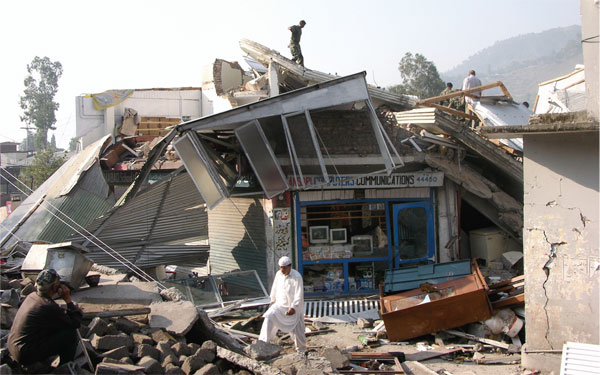
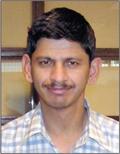 The photographs in the story were taken by photographer M. Bukhari (inset), himself an earthquake victim and survivor. Here’s his remarks on how the earthquake affected him: “I am also one of the hundreds of thousands affected by the earthquake. My wife along with my son were in Muzaffarabad, at her parents’ house at the time of the earthquake. Their house was in the heart of the city — called Madina Market, which totally collapsed, including their house too. My son, wife, mother-in-law, sister-in-law, were all buried in the debris of the collapsed house. My son and brother-in-law were later rescued but everybody else died. As of today, only the dead body of my sister-in-law could be recovered from the debris, the rest of the bodies still could not be found. In my family in total, 10 people died, many were wounded, and about 1,000 became shelter-less.
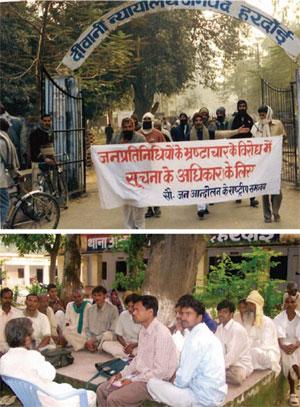
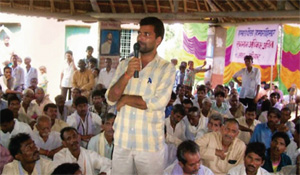
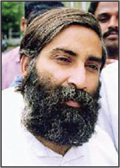
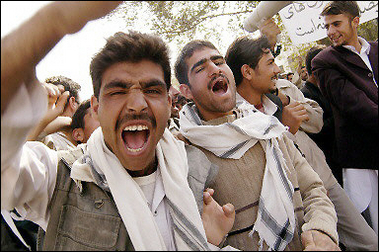
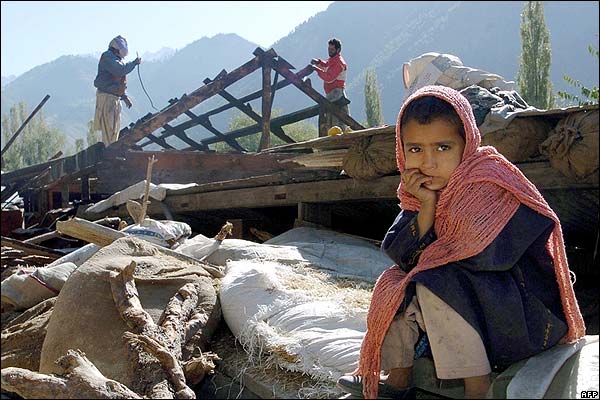
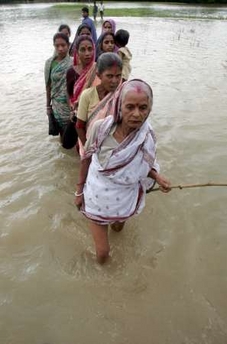
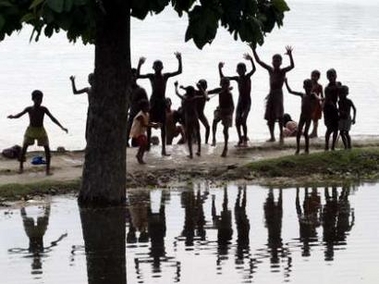
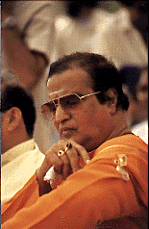
 Biju Mathew of the New York Taxi Workers Alliance said Rahman’s family was praying for his recovery at his bedside at the New York Presbyterian/Weill Cornell Medical Center.
 “We have instructed some of our organizations to go in for imports. We have decided to import from Pakistan through the Wagah border. The prices are high in Pakistan too but we need to take some precautionary measures,” Agriculture Minister Sharad Pawar said.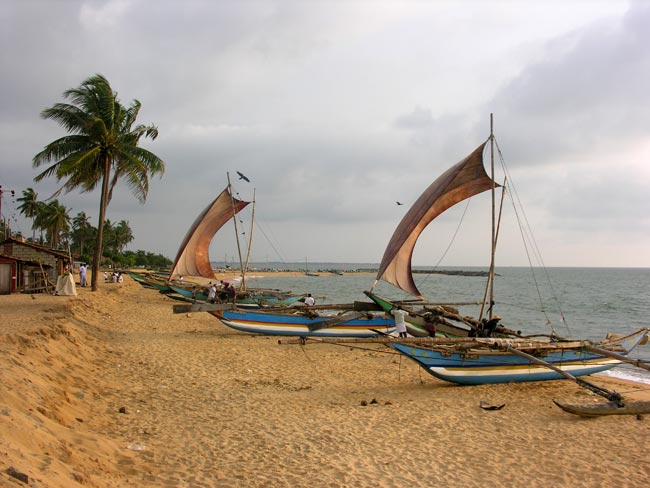
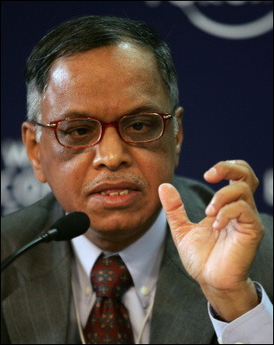
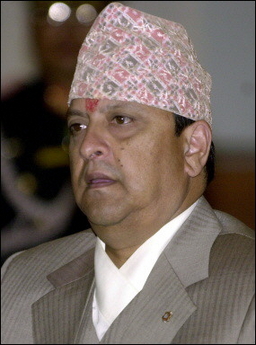
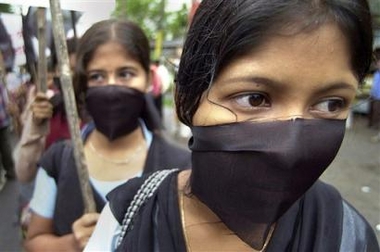


 Energy experts estimate that the field, India’s largest gas discovery in 30 years, is worth $4 billion.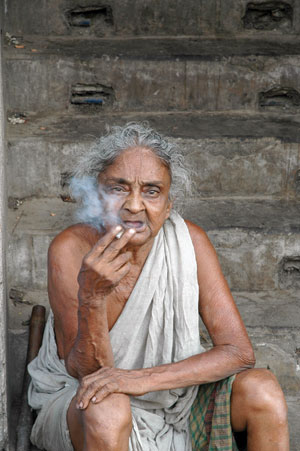
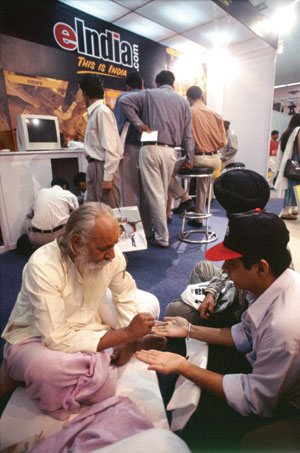
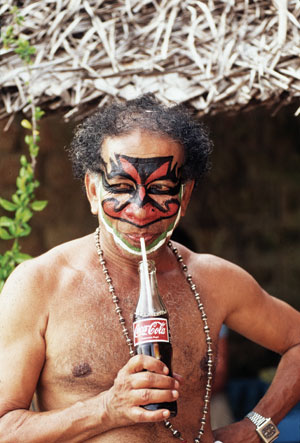
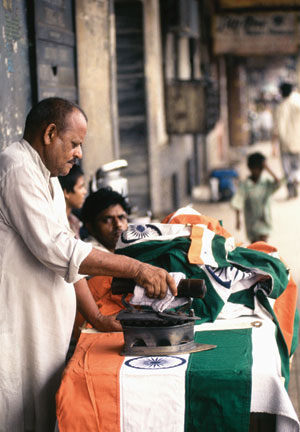

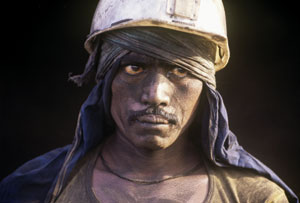
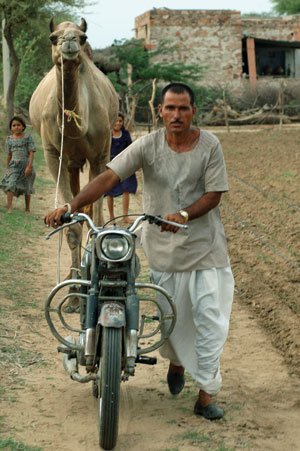
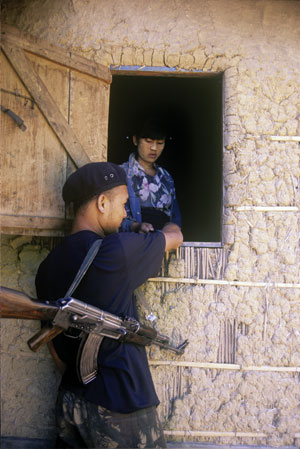
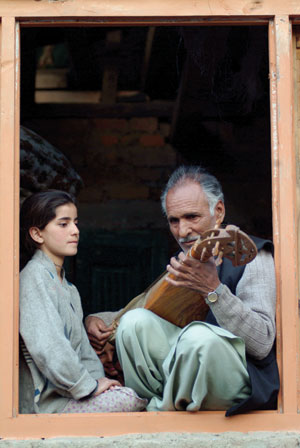

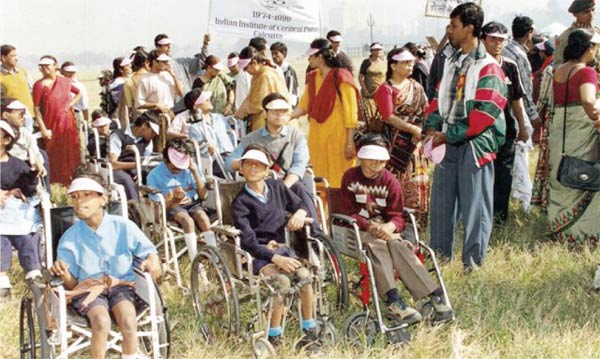
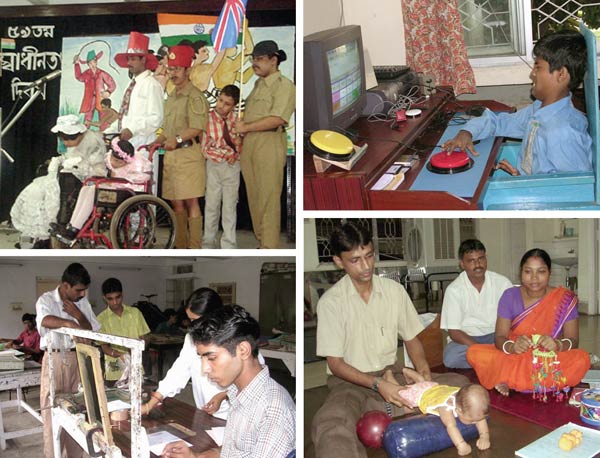

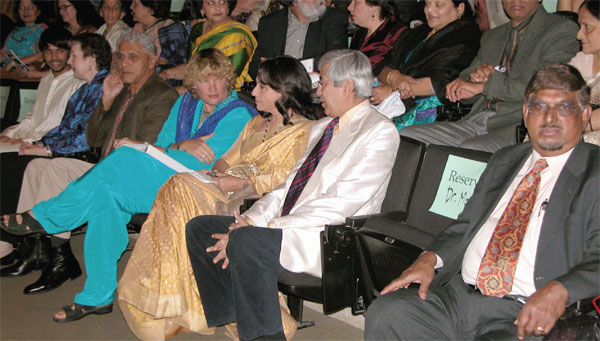
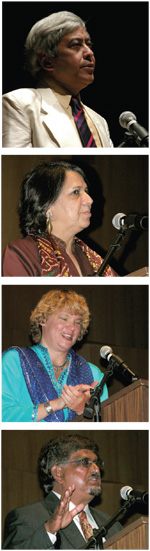

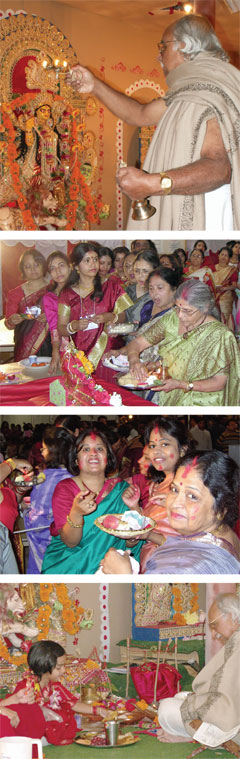
 Kathak master Chitresh Das (r) and Emmy Award-winning tap dancer Jason Samuels Smith (l).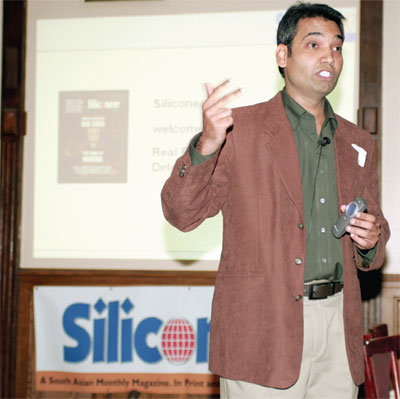
 Southern California-based Swamiji Sri Sri Selvam Siddhar (r) has announced a donation of $5 million to the Hindu Temple of Georgia in a press release. Also known as Commander Selvam, his donation is one of the highest individual donations ever made by an Indian American in the U.S. for a Hindu temple, the release added.

 The second South Asian International Film Festival will take place in Manhattan, New York, according to organizers. This year, SAIFF 2005 will be hosted Dec. 7-Dec. 11, 2005. With several screening locations, a team of high-profile sponsors, and a slate of
 Networking gear maker Cisco Systems has said it will invest an additional $1.1 billion to expand its Indian operations over the next three years.
  Driven by the soaring outsourcing wave that took Infosys and TCS to double digit growth, IT giant Wipro’s second quarter net profit rose by 16 percent to Rs. 478 crore, year on year. The first half year revenues crossed the billion dollar mark.
 Infosys Technologies plans to set up a software development center in Karnataka, which will generate employment for 25,000 people and also establish residential facilities and essential amenities such as schools and a hospital at a total investment of Rs. 1,500 crore in the first phase.
  The Bangalore Software Development center of Yahoo has come up with a new service offering which enables consumers to find, listen, rate and review online audio programs.
  Internet security giant Symantec, after its merger with storage software vendor Veritas, has 25 percent of its global revenues coming from its consumer product division. Out of this, 12-18 percent is being contributed by the Asia Pacific region, where Japan is the largest market, contributing 70 percent of the revenues for the region.
  Dell, an information technology supplier and partner, inaugurated its global development center in Hyderabad in October.
  Imation, a major player in removable data storage media, has announced the setting up of its India subsidiary with an aim to increase its market share in the growing Indian market and better customer service support.
  First impressions leave you with no doubt that this is Mercedes: you can’t miss the distinctive and giant logo on the front grille. The vehicle’s lines are more aggressive-looking, it’s true. You also get the impression that interior cabin space is generous. Oh, but what surprises lie ahead!
 I was also surprised to learn that the ML350 is powered by a V6 engine. When urged to accelerating, the ML350 performs the task with grace and aggression, and yet doesn’t leave you with the impression that it has been pushed it to the limit. For 2006, the engine is a new generation 3.5-liter, four-valve-per-cylinder V6, that delivers 268-horsepower and 258-lb.ft of torque. An even more powerful five-liter V8 is available on the ML500 models, but I really don’t know why you would need that upgrade. The V6 was simply astounding in its power.

 Some nice-to-have standard conveniences include a multi-function steering wheel, an awesome sound system that includes a CD player, two-zone air conditioning and rear air conditioning vents, cruise control, an auxiliary input for MP3 or iPod devices in the glove box, and a rear bench seat that folds in a 60/40 split. That helps when you need to carry more cargo than would fit in the rear cargo area, which is already good-sized.
  Just when you thought that you had heard it all about desi self-delusion and denial about anything related to sex, here comes this bizarre story from Tamil Nadu.
 He was a dentist, originally from India. She was a German Jew. They fell in love, married, but it was the Nazi era, and they left for Britain. He requalified, but lost an arm during a stint at World War II.

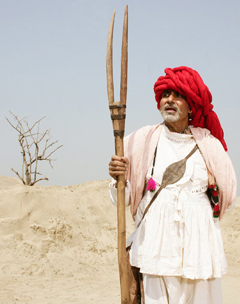 Bollywood icon Amitabh Bachchan (r) seen here in "Paheli" turned 63 Oct. 10, but he called off all celebrations in the wake of the earthquake that struck Jammu and Kashmir and Pakistan, claiming tens of thousands of lives and rendered millions homeless.
  After Aishwarya Rai’s foray into the West, is it the turn of Sushmita (l) to strike out in the West? Our Sush has been signed for a film with supermodel Naomi Campbell (r), no less, in a cross-over film that will highlight relationships between Indians and Americans in the U.S.
 She loves me, she loves me not. Nope, we are not articulating the common cri de coeur of the young lover. We’re talking about Pakistan’s prima donna film star Meera (l) seen here with Ashmit in "Nazar", who appears to be as fickle as they come.
  First it was about Salman and Aishwarya, now they are after Chi Chi. Remember the big splash made about taped phone conversations of Salman threatening Aishwarya — which turned out to be fake?
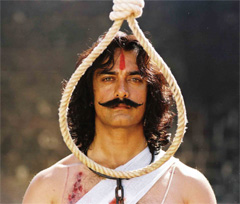 Its box-office performance has hardly been spectacular, but filmmaker Ketan Mehta’s Mangal Pandey: The Rising is all set for a full-fledged release in the United States early next year.