!-- Start Alexa Certify Javascript -->
|
|||||||||||||||||||||||||||
|
|||||||||||||||||||||||||||
|
|
|||||||||||||||||||||||||||
|
|||||||||||||||||||||||||||
|
|
|
|
|
|

SEPTEMBER 2005 |
|
||||||||||||||||||||||
|
EDITORIAL:
WAKE UP CALL FOR INDIAN BPOs The furious hue and cry over breach of confidentiality following leaks from Indian call centers has hit headlines pretty much all over the world. No surprise there. With resentment over the flight of jobs, call centers are the favorite whipping boy for some in the West, so when the London tabloid Sun or the Australian Broadcasting Corporation revealed that confidential personal information can be teased out by a little bribing in the right place, the story resonated in the West. Of course, identity theft is not restricted to India alone, it is a worldwide problem. But that should not in any way exculpate Indian companies which have allowed this breach to happen. A lot of hope and expectation are riding on business process outsourcing, and a lack of goodwill, if allowed to deteriorate, could begin to spell doom. Our cover story takes a close look at the challenge and what the Indian government and business is doing about it. The commission’s scathing indictment of the culpability of the erstwhile Congress government in organized pogroms, particularly in Delhi, brings back harrowing memories for the hapless Sikh community who watched in shock, horror and disgust as some of their countrymen went berserk and looted and killed at will as law enforcement agencies remained mute spectators and those in power, instead of clamping down on the carnage going on before their very eyes, were party to orchestrating it. In this issue we carry the poignant, sobering reminiscences of one survivor of that terrible time who was a young Sikh college student in Delhi at that time. His reminiscences bring vividly to the fore the heart wrenching toll that event has taken on a community’s psyche, leaving painful emotional scars that still endure. The aftermath of the tsunami raises serious concerns about ecological safety in the Bengal Basin and neighboring areas due to possible breach and subsequent pollution of deep aquifers. COVER STORY:  Call Center Scandal: Security Breach in Indian BPO - By Siddharth Srivastava Scandals over the lack of security of personal information at Indian call centers has rocked the Western media at a time of rising antipathy of job flight to India. The Indian government is now planning to clamp down with stiffer penalties and NASSCOM is mulling tighter regulation. It couldn’t come a moment too soon, writes Siddharth Srivastava. It is the kind of attention that India’s burgeoning BPO — business and process outsourcing — industry could have done without, given the angst in the West against jobs being shifted to low cost economies. The Mphasis heist in April this year was the first of its kind in India and many hoped the last for some time to come. Employees at Mphasis, a leading outsourcing firm located at Pune, fraudulently accessed secret passwords and codes of Citibank customers in the U.S. and transferred close to half a million dollars into fictitious accounts in India. Quick action was initiated against the employees by the police as well as the company. Industry observers were hoping that leading BPO companies in India would be able to plug the loopholes and check aberrant employee behavior to prevent such occurrences. But matters do not seem to have turned out very well as more instances of fraud are coming to light. In the latest serious allegation, the Australian Broadcasting Corp has said that employees of a Gurgaon-based call centre are illegally selling personal information of thousands of Australians for as little as 10 Australian dollars (less than $8) per person. ABC TV claimed that its reporters were offered names, addresses, telephone numbers, birth details, medicare numbers, driver’s license numbers, ATM card numbers and even passport information of 1,000 Australians. Earlier, in June this year, the British tabloid Sun, following a sting operation by one of its reporters, claimed that Karan Bahree, an employee of BPO unit Infinity e-Search, divulged personal details of over 1,000 Britons for $5 per head. Predictably, the two latest insinuations have generated a lot of disquiet in the incipient Indian BPO industry, which has grown robustly in the last few years. Today Indian BPO players number over 400, employ more than 400,000 people, growing at over 30 percent; India’s export in this segment in 2004-05 has touched $5.2 billion and the projection for this year is over $7 billion. According to a U.S. Federal Trade Commission study in 2003, 27.3 million Americans have been victims of identity theft in the previous five years, including 9.9 million people in 2002 alone. The survey estimates that identity theft losses to businesses and financial institutions totaled to nearly $48 billion and consumer victims reported $5 billion in out-of-pocket expenses during 2002. Speaking on behalf of the Indian BPO industry, National Association of Software and Services Company president Kiran Karnik has said: “I haven’t seen the ABC program but it just seems to be a follow-up of the Bahree case rather than being a fresh incident. But let me also assure you that India is among the safest processing hubs around. I can assure every Australian customer whose data is being handled in India that in a comparative sense at least, this is among the safest places.” Following the MphasiS and Bahree episodes, there have been several reports that Indian BPOs are putting in place elaborate checks to prevent data theft and fraud. One recent report talks of BPO employees at a Bangalore outfit swiping ID cards, “emptying their pockets and bags and stuff cell phones, PDAs, and even pens and notebooks into lockers as a dour security guard watches.” Staffers ending their shifts have to shred notes of conversations with customers. Even visitors have to sign a four-page non-disclosure agreement. According to cyber lawyer Pawan Duggal: “There is a heightened emphasis on information security and legal compliances, and BPO companies are increasingly looking at how to address the concerns of the clients. Companies today need to work towards establishing appropriate practices, procedures and policies so as to ensure that there are no data breaches of any kind. I believe that the Karan Bahri case may ultimately benefit the Indian BPO industry since it has woken the sector up to the various emerging challenges ahead.” Manmohan had stressed the need to maintain high quality, confidentiality and reliability in the data processing business. ‘‘Indian professionals have built for themselves an enviable global reputation through hard work, dedication and commitment and the occasional misguided acts of some individuals should not be allowed to damage the high reputation of all professionals,” he said. The government is now in the process of changing the Information Technology Act, 2000, with draft proposals ready. The amended Act, with 18 revisions, will include laws against a new range of computer crimes to cover areas like privacy, information protection and harming computer systems through viruses. The whole Section (66) in the IT Act 2000 is proposed to be renamed “Computer-related offences,” taking it beyond the current scope. One of the proposals in IT Act’s Section (72) aims to check the “breach of confidentiality and privacy” with compensation up to $60,000 to the person whose privacy has been infringed by any intermediary (telecom service provider, Internet service provider, cyber cafes et al), without his “consent and with intent to cause injury to him.” Another arena which is being ramped up is quality of personnel. Unlike the IT sector where the skills require to be honed over a period of time through tough degrees obtained from engineering institutes, the skill-set for entry into the IT-enabled sector is rudimentary. A working knowledge of English is often considered sufficient, though India is now seeking to move up the value chain (the term is knowledge process outsourcing) to offer specialized services, such as in accounting, reading medical reports, financial planning, data processing and more. As a response to the Mphasis and Bahree cases, NASSCOM has signed up an agency to prepare a national database of the employees of the IT and BPO industry, who number over a million. A pool of blacklisted people will be created and updated. Existing managers will be retrained. NASCOM has also mooted a GRE-like centralized testing and certification system for BPO employees. The attempt is to protect employers against frauds with regard to educational and professional qualifications of potential employees. Apart from identifying the skills of each individual, the examination will also widen the net of employees which is mostly limited to the four metros of the country There is a lot at stake. India’s export revenues from IT and IT-enabled services are expected to cross $25 billion. A McKinsey report on the IT enabled sector has revised the previous figure of $17 billion to $21-24 billion for India by the year 2008. This is 25 percent of the offshore market with the U.S. the largest source providing 60 percent of business. It would be simply suicidal to allow a few malcontents to kill off the goose that lays golden eggs. - Siddharth Srivastava is the India correspondent for Siliconeer. He is based in New Delhi. |TOP|
SUBCONTINENT: Hussain Haqqani’s Advice: ‘Get Real, Pakistanis - By Ras Siddiqui Journalist, scholar, writer, diplomat and Pakistani political figure Husain Haqqani says Pakistanis must start taking a less defensive and more introspective view and should at least start analyzing mistakes honestly, writes Ras Siddiqui.  Pakistani political analyst Hussain Haqqani (left) wants Pakistanis to take a frank, honest look at themselves. (Right) A Pakistani 50 rupee bill with Bangla text to ease frustration of erstwhile East Pakistani Bengalis: too little, too late. (Top) Two Pakistani girls celebrate Independence Day.  Journalist, scholar, writer, diplomat and Pakistani political figure Husain Haqqani, who certainly wears many hats, was recently on an author’s tour in the San Francisco Bay Area when he took the opportunity to talk with this writer. Haqqani had just completed his speech at a leading area policy institute and had also been received quite well at the prestigious World Affairs Council of San Francisco, where he spoke the day before. He was in the area to promote his new book “Pakistan: Between Mosque and Military” which reflects his passionate interest in the country’s history and more importantly its future. I had started to prepare myself for a standard question-and-answer session with the visiting Scholar at the Carnegie Endowment for International Peace and associate professor at Boston University who has served as advisor to the civilian governments of Benazir Bhutto, Nawaz Sharif and Ghulam Mustafa Jatoi in Pakistan. But it was not to be, because informality set in and he was more comfortable having an open one-on-one discussion. This article will highlight just some of our verbal interaction, which was dominated by his sharp intellect and grasp of the facts from the point of view of an insider. In other words, it was difficult to corner him on anything even though I thought that I was well prepared. “Pakistanis must start taking a less defensive and more introspective view of Pakistan and current developments. What I mean is that we tend to gloss over or totally deny facts. For example, we have not come to terms with what happened in 1971. It is important to recognize that mistakes have been committed. Instead of blaming individuals, parties or groups, we should at least start analyzing the mistakes honestly. It is time to deal with that and Inshallah we will have a good future,” he said. “No other country has gone through some of the traumas that we have gone through but refuse to acknowledge them. And the moment that somebody starts to acknowledge or analyze these things people turn around and say kay ji our image is going to be destroyed. I think that we need to stop worrying about image and start worrying about substance.” Second, I think that Pakistan is a very important country in the world. But we have to get over things that we are emotionally driven by. A sense of proportion is required. For example we tend to stick together. We want to create a glass bowl and in that we want to become the big fish. There is a great big world out there in which we need to keep things in perspective. There is no denying Pakistan’s significance in the global order. But that significance should neither be exaggerated nor underestimated,” he added. “And last but not least Pakistanis must understand as a nation, we all must face the critical issues of global systems,” he said. Haqqani was very critical of the “glibness” of Pakistanis and their immediate denial of problems associated with them. He called for a national self-criticism to balance the criticism that (sometimes unfairly?) comes from outside, especially around the topic of extremism. He stressed the need for Pakistanis to join the global mainstream of ideas. “Our contribution to the global mainstream of ideas is very limited,” he said. He pointed out that it was unfortunate that criticism emanating from Pakistan is often not well thought out and that blaming others limits other healthy exchanges. He pointed out that one Pakistani newspaper’s calling the New York Times the “Jew York Times” does not help matters. “That is not the way to become a part of the global mainstream. We need to go beyond these fantasies of Zionist-Hindu conspiracies in everything,” he added. “The global mainstream of ideas is ideas about politics, it is ideas about society, it is ideas about economics. It is ideas about religious tolerance,” Haqqani said. The author of “Pakistan: Between Mosque and Military” commended the work of Dr. Akbar S. Ahmed here in the U.S. for his efforts. “He is trying to connect with the other Abrahamic faiths,” he said. Haqqani suggested that such an effort by a Pakistani-Muslim scholar like Dr. Ahmed was the need of the times in the global mainstream of ideas. “It is time to stop being inward looking,” he said. “The problems of Muslims and Pakistanis are not problems that we can blame on the rest of the world,” said Haqqani. Pointing out that America had not abandoned Pakistan, he gave examples such as 1971 when America had tried to help but Pakistani rulers themselves created the crisis. “Why are Pakistan’s literacy rates so low?” he asked. He said that outsiders cannot be blamed for that. He compared statistics on literacy rates in Pakistan with its neighbors before revisiting his main point. “It is time to face global realities,” he said. “That is the theme of my book.” - Ras Siddiqi is a Pakistani American community activist and writer. |TOP| NEWS DIARY: August Roundup  India New Auto Hub | BANGLADESH: Bomb Blasts Rock Nation, Unnerve Government | India Renews Historic Ties with Afghanistan | Military Regimes Illegal | Mumbai Collapse Sparks Evacuation | Post-election Muddle | Sri Lanka Bids Tearful Adieu to Lakshman Kadirgamar | Mittal Offers $11.4B Plant | Rebels Making Porn | No to Monarchy | Meeting with ‘Spy’ | Red Army’s Ghosts | Prisoner Accord | Border Trouble India New Auto Hub An increasing number of global car makers are outsourcing their R&D and engineering requirements to India to take advantage of the country’s improving capabilities and low costs.
Global automakers like BMW and the German auto-maker Volkswagen AG, are moving their manufacturing operations to India. Czech car manufacturer Skoda also intends making its Aurangabad plant in India as its manufacturing and export hub for the South Asian region. General Motors also plans to make India an export base. Pusalkar said experts estimate that the Indian capacity to meet global auto component needs is more than $30 billion but the industry needs an investment of $50 billion in capital equipment and infrastructure. “The government needs to be a major catalyst by providing excellent infrastructure setup and transparency in government-related transactions and interfaces,” he added. For Hyundai of South Korea, India is the exclusive hub for exports of its Santro. Maruti Udyog has been a sourcing base for Suzuki Motors for a long time.
Two ministers made very different statements. While Industries Minister and Jamaat-e-Islami leader Moulana Motiur Rahman Nizami, said India’s Research and Analysis Wing may be responsible — drawing a sharp protest from New Delhi — Foreign Minister M. Morshed Khan, of ruling coalition leader Bangladesh Nationalist Party said Nizami’s views were those of Jamaat-e-Islami, not the government. Meanwhile, foreign diplomats are surprised they have not been briefed. “Usually after any major incident they’ll call all the heads of mission into the foreign ministry to reassure them, say ‘please don’t alter your travel advice, please don’t tell your investors not to come’, one diplomat in Dhaka told the BBC. “This time they have not done that. Read into it what you will.” Opposition Activists have protested against the bomb attacks while police have detained over 160 people, some of whom have confessed to links with Jamatul Mujahideen. Opposition activists are demanding the resignation of either one of the two ministers who have made statements that contradict each other, breaking the principle of collective responsibility of the cabinet. Now reporters are having a hard time getting hold of any minister, including Home Minister Lutfozzaman Babar. Mohammed Jehangir, of the Centre for Development Communication, says: “The government is confused about what position they want to take. “Our government is a coalition government, so it is very difficult to take a position against fundamentalists or extremists, because the fundamentalists are with them. “If they say extremists are responsible, members of the coalition will be angry and they will have internal problems.”
“Afghanistan is very keen on Saarc and hopes to be a contributor and receiver (from) that organization,” Karzai told The Hindu newspaper. Singh has used the visit to emphasize Delhi’s commitment towards rebuilding Afghanistan’s economy, infrastructure and democratic institutions. India is Afghanistan’s biggest donor in the region. It has spent over $500m in Afghanistan since the overthrow of the Taleban in 2001. Much of this money has been spent in rebuilding Afghanistan’s infrastructure with regular contributions in sectors like education, health care and power. India has also helped in other areas like transportation, aviation and telecommunications. Delhi is also involved in the training of Afghanistan’s civil servants, diplomats and police officers. Singh’s trip is the first visit to the country by an Indian prime minister for 29 years. However, Delhi has been working hard to develop its ties with the new Afghan regime following the overthrow of the Taleban in 2001. It moved swiftly to establish diplomatic posts in the country, hoping to counter the influence of its long-standing rival, Pakistan. Indeed, land-locked Afghanistan placed strategically between Central and South Asia has long been a backdrop for a Cold War-style Great Game between the two nuclear neighbors. Now with this verdict, the rule of Khandker Mushtaque Ahmed, Abu Sadaat Mohammad Sayem, and Maj General Ziaur Rahman become unlawful. The ruling comes as a morale booster to the Awami League-led opposition and as a setback to the Prime Minister Khaleda Zia and her coalition partners, some of whom are accused of being collaborators in the assassination of Sheikh Mujibur Rahman, the father of the nation. The court noted that history couldn’t be altered and made it clear that the constitution did not permit anyone to assume power by any means other than the ones mentioned in it The verdict came upon a decades-old writ petition filed challenging the Martial Law Regulation 7 of 1977, issued to legalize all illegal acts of the martial law government prior to that time. The High court has however stayed the operation of the judgment to allow the government to file an appeal. Eminent jurist Dr. M. Zahir said, “The judgment has come too late, it should have come earlier.” He however described as admirable the court’s observations on the question of the constitution and the principles.
According to one estimate, there are some 19,000 tall buildings in Mumbai that are “old and dilapidated.” Authorities in Mumbai have ordered an evacuation of dangerous buildings after the second fatal collapse in a week. Almost 900 tenants in 80 buildings deemed dangerous in southern Mumbai will be moved to holding camps within a week, authorities say. The move follows the death of six people in the collapse of a three-storey building on Aug. 28 night. Eleven people died a week before that when a four-storey building came down. It is not uncommon for poorly maintained buildings to collapse during the monsoon rains in Mumbai. Monsoon rains have already caused the deaths of more than 1,100 people in Mumbai and Maharashtra.
“This election was the last straw,” Liaquat Baloch told the BBC news Web site when asked to explain the boycott decision of the country’s main religious alliance —the Muttahida Majlis-e-Amal. Baloch is a senior MMA leader. “It convinced us that democracy and all the processes that go into it simply cannot flourish for as long as General Musharraf remains at the helm. The secular opposition grouping ARD — the Alliance for the Restoration of Democracy — has also expressed a complete lack of confidence in the ability of President Musharraf’s government to hold free, fair and impartial elections. The ARD leaders are meeting in Islamabad to decide on their final response to the conduct of local elections. Now the Supreme Court has weighed in with another spanner in the works — a new judgment bars elected candidates armed only with degrees from unregistered madrassas from holding public office. “The Supreme Court’s decision is vague and confusing,” says Senator Professor Ghafoor Ahmed of the MMA. “Are all madrassa qualified winners automatically disqualified? Or will they get time to pass additional subjects such as English, Urdu and Pakistan Studies? “If yes, will their seats remain vacant till they pass these subjects? What will happen to the local councils in the meantime?”
Indian Defense Minister Pranab Mukherjee and External Affairs Minister Natwar Singh joined delegations from 11 countries to attend the last rites of Kadirgamar. Brushing aside security concerns, President Chandrika Kumaratunga made an appearance where the pyre of the slain leader, born a Tamil Christian, was lit by his sons, Ajitha and Ragee, amidst multi-faith prayers, capping a mile-long funeral procession when national flag draped Kadirgamar’s body was taken in a hearse. Mukherjee and Natwar Singh were seated next to Kumaratunga when the last rites were performed in the presence of cabinet ministers from six countries, including Pakistan, Norway and Bangladesh, and members of Kadirgamar’s family. Sri Lankan Prime Minister Mahinda Rajapakse said September 11 in New York, July 7 in London, the brutal slaying of Rajiv Gandhi and Lankan President Premadasa and assassination of Kadirgamar in Colombo “were events of same magnitude in that they threatened the very fabric of civilized society. “All countries of the East and the West, of developed and developing worlds must and surely will join together to wipe out terrorism and strengthen the norms and values of a democratic life,” he said.
According to a government source, Mittal Steel had submitted a draft memorandum to the local government in the mineral-rich state of Jharkhand. Mittal officials were not immediately available for comment, but in July chairman Lakshmi Mittal had said his company was hopeful of signing a deal with the Jharkhand government in two weeks. Local media reported an agreement was delayed because Mittal Steel had insisted on exporting part of the iron ore, from the mining rights the firm would be given for the venture. Politicians and domestic steel firms had earlier opposed a proposal by South Korea’s POSCO to export iron ore from its proposed mine and steel project in the eastern state of Orissa. Jharkhand’s top bureaucrat, Chief Secretary P.P. Sharma, said the government would not allow exports of iron ore. “We want value addition to happen locally and we have made it very clear to all prospective investors,” he told Reuters. POSCO, the world’s fifth-largest steel maker, signed a deal in June to set up a $12 billion steel project. It was granted 30-year mining rights by the Orissa government to supply 600 million metric tons of iron ore to the new plant. After much dithering, Orissa also allowed the company to export up to 30 percent of high grade iron ore consumed by the Indian plant in lieu of import of low grade ore, which POSCO said was necessary to make high-quality steel. “POSCO deal and the opposition it created are fresh in everybody’s mind, another government official said. “Why should we allow ore exports when we have many Indian companies willing to set up plants?” Former NLFT guerrillas have told police their leaders not only sexually abused tribal girls recruited into the rebel army but also used them — and some male guerrillas — to produce scores of porn films, officials say. “The films were found to be dubbed in Burmese, Bengali, Thai and Hindi, suggesting they were being marketed to many countries in the region,” Ghanshyam Murari Srivastava, Tripura’s police chief told the BBC. He said police have recovered scores of pornographic DVDs featuring young women and men from various parts of the state, including remote areas such as Amarpur and Gandacherra. Such pornographic DVDs have also been recovered from NLFT bases inside Bangladesh after they were raided by the Bangladesh army, the police chief said. Video production houses in Tripura confirm police allegations. “We do get orders to process raw porn shot in remote tribal areas from time to time,” the owner of a video production company in the state’s capital Agartala told the BBC. He did not want to be named. “We get a lot more money , much above our normal rates, to process these films and deliver a sleek final product.” “We know the insurgents are behind these films. When we process their raw stock, we can see boys standing around with automatic rifles and revolvers pulling in girls but we are supposed to cut all that out and just concentrate on the sex,” the owner said. The latest pornographic video that has become sought after by young men in Tripura is Hamjagoi Tongthoklaima, or Our Experiences. Like a feature film, it runs a full cast of “heroes” and “heroines.” Initially it appears to be a love film with boys and girls holding hands and walking past lakes and trees. But soon the video starts featuring close-up shots of the actors undressing and having sex. The king sacked the former government in February, saying it failed to tackle the Maoist uprising. The top executive body of the Nepali Congress, led by four-time former Prime Minister Girija Prasad Koirala, announced its intention to drop its traditional support for constitutional monarchy. The Nepali Congress has supported constitutional monarchy in Nepal since its inception 60 years ago. But now it is a key player in the seven-party opposition alliance against King Gyanendra. There has been a widening rift between the king and Nepal’s political parties since he seized power. The king appears to be anxious that Nepal’s political deadlock could benefit the rebels, who are seeking to replace the current system with a communist republic. The opposition grouping has ruled out an alliance with Maoist rebels, but its leaders have not ruled out holding talks with the rebels. King Gyanendra likened the dispute between the monarchy and political parties to the relationship between a husband and wife, saying that the closer they are the more they quarrel. He said he was ready for talks with the political parties, but insisted that they first had to promise commitment to good governance, fiscal discipline and a fight against terrorism. He also accused the former elected government of failing to address social problems. He said that if the government had addressed some of the demands the Maoists had put to the authorities nine years ago, Nepal would not have plunged into a “ditch.” The king said that his administration was now addressing some of these issues, such as the uplift of lower castes and women.
The rare visit came as officials from the two sides, trying to nudge a slow peace process forward, ended talks to curb terrorism and drug trafficking and said they would exchange dozens of prisoners next month. Manjit Singh was convicted of spying and involvement in bombings in Pakistan that killed 14 people, and the Supreme Court this month upheld the death penalty handed to him in 1991. But the decision triggered an outcry in India where Singh’s family says it is a case of mistaken identity and he is a farmer who wandered into Pakistan while drunk. Pakistan agreed to let diplomats meet Singh as a first step to confirming his identity after members of his family threatened to commit suicide if he was executed. Two diplomats met Singh at Kot Lakhpat Jail on the outskirts of Lahore in the presence of Pakistani jail authorities and interior ministry officials. When the last Soviet tank of the departing Red Army rolled back across the Oxus river in February 1989, leaving Afghanistan for good, they left behind some Cold War ghosts. In the hills of northern Afghanistan, there are still men with pale skin who talk Russian when they are together. Until 1981, Nasratullah was a soldier in the Red Army called Nikolai. Together with two others, now known as Rahmatullah and Aminullah, he survives from a total of five Soviet soldiers known to have been captured and converted to Islam. They went on to fight against their old comrades with the mujahideen. Russia says 13,000 Soviet soldiers were lost between 1979 and 1989. An estimated 1.3 million Afghans, mainly civilians, also died. Nasrullah remains close to the men who first captured him. “We captured Nasratullah during an ambush in Kaligai village in 1981,” recalls his white bearded former commander, Sufi Payda Mohammed, eyes rimmed with kohl. The mujahideen commander remembers “a very terrible fight” during which they killed around 20 Soviet soldiers. Nikolai was the sole survivor, captured after he exhausted his ammunition and hid in a drainage ditch under the road. Nasratullah says he witnessed a massacre of more than 70 civilians at Kaligai. “We swore in the Russian army on the sword and the Bible to help society. It was against the law what was done,” he says. In horror and disgust, he says he simply turned and walked away from his unit. Both sides also agreed to provide better consular access to prisoners, notify each other of arrests and join forces to stamp out terrorism, according to a joint statement. The announcements came after two-day talks between home secretaries from both sides. These decisions came ahead of a meeting between Indian Prime Minister Manmohan Singh and Pakistan President Gen. Pervez Musharraf in New York on Sept. 14 on the sidelines of the U.N. General Assembly session. Bangladesh, however, says that Indian troops opened fire without provocation on workers who had been lifting sand from the Shalda river on the border. India is constructing a barbed wire fence along the border to keep out what it describes as illegal immigrants. The two countries have had several border skirmishes in recent months. A spokesman for the Indian Border Security Force told the BBC that nearly 100 Bangladeshi nationals had been found trying to enter Indian territory at Kamthana in the north-eastern state of Tripura. S.K. Mitra said that the Bangladeshi nationals had opened fire on BSF troops when they were challenged. ENVIRONMENT: Tsunami’s Wake: The Disaster and Its Effects - By Dr. Rash Bihari Ghosh Former Cal EPA scientist Dr. Rash Bihari Ghosh presents the scientific background of the devastating tsunami in December last year and warns about some long-term dangers it has presented.  Hundreds and thousands of people have been killed during the last one century due to tsunamis. According to the U.S. Geological Survey the historic 9.0 magnitude earthquake that caused the tsunami disaster Dec. 26 last year is among the five most powerful earthquakes recorded since 1900 and left an estimated 290,000 people dead or missing from Thailand to Somalia. There is one destructive tsunami in every seven years. According to National Geographic the tsunami wave can be as high as high as 100 feet and some historical data and information indicated it could be much higher than 100 that. A Hundreds and thousands of people have been killed during the last one century due to tsunamis. According to the U.S. Geological Survey the historic 9.0 magnitude earthquake that caused the tsunami disaster Dec. 26 last year is among the five most powerful earthquakes recorded since 1900 and left an estimated 290,000 people dead or missing from Thailand to Somalia. There is one destructive tsunami in every seven years. According to National Geographic the tsunami wave can be as high as high as 100 feet and some historical data and information indicated it could be much higher than 100 that. AAmerican scientists have begun to investigate the historical environmental adversity that occurred in Indian Ocean with the goal of gaining insight into possible consequences if an event similar to the tsunami of December 2004 occurred in California or Florida or anywhere closer to the U.S. According to U.S. scientists who visited the region early this year and investigated the causes and effects of the natural disaster, a surge of seawater more than 90 feet high inundated stretches of the remote western coast of Indian Ocean immediately following the earthquake off the Indonesian island of Sumatra. The Berkeley and Santa Cruz campuses of the University of California, among others, also confirmed this based on analysis of seismographs. Recently, USGS oceanographer Guy Gelfenbaum remarked that debris left behind in the hardwood trees that survived the tsunami provide evidence of the height of the gigantic waves. He added that tsunamis are the most unusual of natural disasters, and least understood among all other natural disasters. USGS geophysicist Eric Geist said, “Any great earthquake in the Pacific Ocean has the potential to generate a tsunami.” According to a group of 50 scientists who conducted an analysis of a field study of the tsunami-affected areas, the tsunami hit the island nation of Sri Lanka hours later, and displaced two million cubic yards of sand and clay — enough to bury a football field 1,000 ft deep following a Dec. 26 earthquake. Thorn Lay, the director of the Institute of Geophysics and Planetary Physics at UC Santa Cruz who organized the scientific teams that conducted a seismic autopsy, said that when the Dec. 26 tremor struck deep beneath the ocean surface, trillions of tons of water were rapidly displaced as one section of seabed dived under another. The quake began some 60 miles off the northwestern shore of Sumatra and ripped along the seabed at an astonishing 1.5 miles per second or 90 miles per minute, traveling for nearly eight minutes, leaving a “rupture zone” stretching nearly 750 miles to the north. It made the entire earth ring like a bell and it was a significant enough warning for every seismic institution to record its behavior. It triggered an 11 minutes’ swarm of 14 small quakes nearly 7,000 miles away and released the energy of 100 billions tons of TNT, more than the power of 1,000 one-megaton hydrogen bombs. As the 90-foot waves crossed the Indian Ocean, the satellites orbiting overhead had no trouble identifying them through radar measurements. Lay says that the tsunami earthquake last December ravaged Sumatra and the Andaman Islands that cross the entire Indian Ocean. The extent of the damage left scientists dazed by the complexity of its disastrous impact upon the earth. Lay further added that a similar or bigger earthquake may be ahead of us and may hit our home ground of California and that our current precautions are not enough to counter the effect of suck a devastating earthquake. A leading geophysicist at the University of Colorado, Roger Bilham, saw the quake as a warning: “This should be a wakeup call that conservative seismic forecasts may not serve society well.” Lay and Bilham are among nearly 50 international seismic scientists who have been analyzing the causes and effects of the December tsunami quakes of 9.3 (estimated) and the completely separate second tremor that stuck at a magnitude of 8.7 the nearby Nias island in March. Both were far larger than anything ever recorded from California’s famous San Andreas Fault. These two quakes brought a new challenge to seismologists all over the world as a result of the complex set of abrupt movements among the miles of thick slabs of the earth crust that make up the constantly shifting tectonic plates of east Indian region, making them particularly vulnerable to serious earthquakes. According to UC Berkeley, USGS and the Institute of Himalayan Geology in India, the quake began just off of Banda Aceh in northern Sumatran island of Indonesia when the ocean floor of the Indo Australian plate suddenly plunged northeastward, diving about 60 feet underneath the Burma plate adjacent to Bengal Basin. This was due to subduction and released strain of many centuries that built up along the unidentified fault. During the process the Burma sub-plate surged upward, moving an enormous mass of ocean water of about seven cubic miles in volume, causing the devastating tsunami which sped through the Indian Ocean to the coast of East Africa. The violent earthquake lasted at least an hour more. According to UC Berkeley seismologist Ronal Bergman the earth is still rocking today. Lay’s group of researchers report that the main shock began at a depth of 16 miles and initiated a continuous violent motion as one plate dived beneath the other. The unnamed fault marking a long and curved boundary between the two plates caused a sideways motion which resulted in a strike slip. Out of the 150 aftershocks, a large number of the seismograph records Lay’s group counted had magnitudes of 5, 6 or more in the Richter scale throughout the fault zone during the four-day period after the main shock. There were thousands of smaller tremors during the last several months throughout the region which may not have caused any visible damage to property or the environment, but have caused a serious concern for the spread of contamination into groundwater through conduits and may be causing irreversible damage to invaluable resources of drinking water throughout the region. The impact of the tsunamis might have brought saltwater far inland where it was absorbed by inland aquifers, especially where the groundwater was exhausted due to overuse. The earthquakes caused deep cracks in the impermeable layer of the earth which accelerated the spread of plumes of pollutants from the surface and from the shallow aquifer into the deeper groundwater production aquifers through already polluted conduits. These conduits will make way for these pollutants to spread to the deeper production aquifers, which are primary sources of safe drinking water. The major industrial cities around the Indian Ocean have also been greatly affected due to the tsunami disaster. These include the cities of the Bengal Basin, Myanmar, India and all other big cities and industrial zones around Indian Ocean. Scientists disagree on how to address problems that have arisen from the recent tsunami disasters. These disasters may have ramifications for people in the afflicted region that have not received significant consideration from scientists. Importantly, it may be possible that seismic movements associated with the tsunami have increased the mobility of contaminated waters concentrated around industrial zones into the larger water table, mainly deep production aquifers, which are the primary sources of drinking water. These aquifers are usually protected by an impermeable layer of thick aquitard. A similar contamination of production aquifers has occurred in the Silicon Valley via conduits from abandoned wells which mainly are found in industrial facilities. The toxic contaminated sites of national priority list or NPL have been mitigated in the Silicon Valley and elsewhere in the U.S. through the U.S. superfund process. Domestic, agricultural and both point and non-point sources of pollution also significantly contribute in water pollution in this region and elsewhere. Contamination of the deep production aquifers in the Bengal Basin would further compound problems due to high levels of arsenic contamination of groundwater in this region, and would thus be especially undesirable. While the acute effects of a tsunami are difficult to mitigate, the long-term effects, including groundwater contamination, could be mitigated, provided that sufficient preventative measures are taken. Relatively inexpensive analysis of groundwater samples from select regions around the Indian Ocean, including industrial zones, taken over periods both before and after the tsunami could shed invaluable scientific light. In light of the importance of identifying such a potential danger and protecting the vital natural resources of people in this region, such experimentation should be supported by the funding committed to the tsunami-affected regions once relief efforts are adequately provided for. - Dr Rash Bihari Ghosh, a former scientist with the Cal EPA, is founder chairman of the International Institute of Bengal Basin. He lives in Berkeley, Calif. |TOP| FLASHBACK: Anti Sikh Riots 1984: Remembrance and Reflection - By Jaskaran Singh  India’s Prime Minister Manmohan Singh apologized in Parliament recently to the Sikh community for the 1984 riots in which 3,000 Sikhs were killed, most of them in New Delhi. His apology came after the report of a government inquiry led by retired Supreme Court G.T. Nanavati said local Congress leaders and workers had either incited or helped the mobs in attacking the Sikhs. India’s Prime Minister Manmohan Singh apologized in Parliament recently to the Sikh community for the 1984 riots in which 3,000 Sikhs were killed, most of them in New Delhi. His apology came after the report of a government inquiry led by retired Supreme Court G.T. Nanavati said local Congress leaders and workers had either incited or helped the mobs in attacking the Sikhs. Jaskaran Singh, who was a college student in Delhi at that time, reminisces on the harrowing moments at that time and reflects on the enduring emotional scars.
We made nothing of some reports of violence against Sikhs, whether it was a taxi driver being beaten up, a scooter or a car burnt. In the evening I was about to go for a stroll with a friend when the watchman at the gate suggested that I not go outside the campus. In fact, he told my friend, I should stay indoors. For the first time I felt that I was different. Reports of violence kept coming throughout the next morning, Nov. 1. In the afternoon we heard of the first killing. Students who went outside the campus, came back and told us about mobs everywhere, attacking Sikhs, their homes, businesses and gurudwaras. Those who witnessed these incidents were shell shocked, and the gory details they told were unbelievable. Then we heard that even those who were sheltering Sikhs were being attacked by mobs, and I was really scared. One of my father’s friends came in his car and offered to take me to their house. But my roommate and others in the hostel said I was safest where I was. I felt lucky to be amongst friends who cared enough to risk their own well being. My father’s friend gave me news of my family and promised to let them know that I was safe too. For three days I stayed indoors. I kept my hockey stick by my bedside.
I think it was on Nov. 4 that some of us went to Shahadra and visited one of the relief camps that had been set up for the victims — survivors, I should say. Students had collected about Rs. 4,000 and bought toiletries, tinned milk for babies and other items of daily use. Everybody talked about how organized the mobs were. The removal of obstacles, breaking locks, the looting, burning, the killings, it was all quite systematic. And people talked about how our police did nothing and how the army could do nothing. There was supposed to be a curfew, but it could not stop the killings. For the first time I understood the stories my Grandmother used to tell of the Partition in 1947, I could feel the horror and the hopelessness. Our family had been lucky. My parents back home in a town in what is now Uttaranchal state were safe and my aunt’s family had a narrow escape, thanks to their neighbors. On Nov. 8 I went to a village in Haryana, about three hours from Delhi. We had many relatives there and I had not been able to get in touch with any of them. There were burnt remains of trucks, buses, cars and scooters everywhere, like rotting carcasses after a natural calamity. On reaching the cluster of houses that belonged to Sikhs, I found them, one after the other, abandoned, bolted, not damaged, but with no one there. This was one of the scariest moments for me, coming after a nerve-wracking bus journey, during which I had not seen another Sikh on the roads. To my great relief, I found everybody in the village gurudwara, and they were as relieved to see me as I was to see them all safe and sound. I knew I should have been thankful to God, but that is not what I remember feeling. I felt something had changed. My position of privilege, that of a student of a prestigious college, suddenly meant nothing. People looked at me differently, like I was an outsider, as if I had betrayed my country. Away from the shelter that the hostel provided, I felt very unsafe. I saw some of the Sikh students cut their hair soon after. I was a small-town kid in Delhi, studying in one of the best colleges in the country and very proud of it. Now, suddenly, I wanted to go home. But it would be weeks before the full enormity of the situation would sink in, slowly, one painful episode at a time. Back home, I got into a brawl with two guys who called me uggarwadi or terrorist. I could not believe this was happening to me in my hometown. The two men were drunk and many people on the street witnessed how they cornered me and attacked me first. But when I fought them off and hurt one of them, the crowd that gathered blamed me and came for me. I ran to a police station and was saved from a lynching. But I knew things had changed at home too. I had never been to the Punjab and we had no relatives there. But a year later when I got a job opportunity in Anandpur Sahib, I jumped at it. For the first time in months, I was happy to be amongst so many other Sikhs, where people did not look at me as if I was an outsider. But more than once I heard comments about Bhapas ( a somewhat disparaging term for Sikhs from cities) arrival leading to troubles for those who had always lived there. I knew I was a refugee. I have been away from India for more than 12 years, an outsider in foreign lands, and have adapted quite well. In the U.S. I had felt safe, till the hate crimes against Sikhs started taking place in the aftermath of 9-11. Come to think of it, Sikhs have faced this many times in history, surviving state-sponsored efforts at extermination during the Mughal regime in India. And like a poet said, “We grew again and again, better, stronger even as we were chopped into pieces.” There is something in the human spirit which can survive all this and more. It’s the same undying spirit that tries to understand and forget and forgive. The spirit that caused non-Sikhs to risk their homes and lives and that of their own families, trying to save their neighbors. The same spirit made non-Sikhs so sad that this had happened to Sikhs, to India. Some wounds have healed, others will take longer. I like to believe that that good spirit will ultimate triumph and all of us will emerge stronger, wiser. - Jaskaran Singh is a Web page designer with layout and graphic design skills |TOP|
SOCIETY: New Delhi’s Cowboys:
Getting Cows Off the Streets - By Siddharth Srivastava Over 50,000 cows and buffaloes jam the roads of Delhi along with hordes of monkeys, camels, pigs and stray dogs. Traffic routinely comes to a halt as animals walk, sleep, defecate and procreate. Now a court order has unleashed cowboys on the streets who are rounding up the vagrant quadrupeds for a cash prize, writes Siddharth Srivastava in this tongue in cheek article.  Greed often scores over all else, including religion. The past few days India’s capital city New Delhi has been witness to a peculiar sight — cowboys (many on motorcycles) with lassos spanning the city to round up cattle. The Indian version of the Pamplona Bull Run has happened following a cash award of $50 per cow caught, announced by the Delhi High Court to rid the city of the traffic menace. Greed often scores over all else, including religion. The past few days India’s capital city New Delhi has been witness to a peculiar sight — cowboys (many on motorcycles) with lassos spanning the city to round up cattle. The Indian version of the Pamplona Bull Run has happened following a cash award of $50 per cow caught, announced by the Delhi High Court to rid the city of the traffic menace. The court has been exhorting the Delhi government for quite some time to rid the roads of cows, but without much success. It is estimated that over 50,000 cows and buffaloes inundate the roads along with hordes of monkeys, camels, pigs and stray dogs, causing traffic jams and accidents. Traffic routinely comes to a halt on highways to allow animals to walk, sleep, defecate and procreate. Several animals are injured with carcasses often lying on the roads. For years, foreign visitors to New Delhi never failed to comment on cows that roam Delhi roads freely. Several foreign dignitaries, businessmen, film stars, pop singers, sportspeople who have visited the country have said that they never expected to see cows on Indian roads, especially the national capital. Somehow, it does not fit into India’s image as a global supplier of scientific manpower, including handling computers and software. Cows and buffaloes can be spotted everywhere — at the busy Ring Road, the Race Course Road where the prime minister lives, Shanti Path which runs through the diplomatic enclave. They graze the lawns that crisscross the wide thoroughfares of India Gate and the Rashtrapati Bhavan where the president of India resides. There has been an intelligence report that stray dogs that live next to the prime minister’s residence are a potential hazard as they move in and out of the high security zone, given their friendly access to the security guards. Any one of the dogs can be stitched up with a remote-controlled bomb. Fed up with stray dogs that bite, the government of the north eastern state Arunachal Pradesh has issued a shoot-to-kill order when the offending canines are sighted. Bulls in rage have gored several people to death in New Delhi. The existence of cows in particular have been due to several factors — as Delhi as developed, several erstwhile villages have fallen in the ambit of metropolitan areas. Land that the cows and buffaloes roamed freely to graze was converted. Owners had no choice but to let their cattle out to fend for themselves. There are also several instances of cattle being left loose once they are old and useless. The one reason that authorities not only in Delhi but several cities and towns of India are unable to launch a crusade to rid the cities of vagabond cattle is religious sensitivities. Cows remain a very touchy subject due to its hallowed place in Hindu faith. The animal is revered by the Hindus and addressed as gau mata ( mother cow). Indian history has several instances of Hindu-Muslim riots erupting over cows being slaughtered, sometimes deliberately to incite violence. Hindus do not eat beef, unlike lamb or chicken that is slaughtered. The latter are usually not seen on the streets. But, apart from religion there are other factors that complicate the task, not least the animal rights activists who make it a point to criticize any government action or inaction. Indians in general are animal lovers and often adopt several stray dogs and cows, putting up a stiff resistance to municipal authorities who try to remove them. Further, Indians are notorious for flouting laws. Laws have been enacted against known infringements as is the norm internationally: There are fines for noise pollution, littering, talking on the cell phone while driving, not wearing seat belts. There’s even a law against peeing in public (“Do not commit nuisance”) which was strengthened after a person was found relieving his bladder on the wall of the house of the municipal commissioner of Delhi. Some observers have said that apart from a general lack of discipline Indians break these minor laws as it gives them a sense of freedom and doing what they feel like in keeping with democratic traditions. Indians living abroad who follow rules to the book, change dramatically when in India, littering the neighborhood with empty ice cream/pizza/drink packets even as they drive. Despite the existence of over 250 free public urinals in New Delhi, most prefer to pee on the roadside. From time to time the authorities try and clamp down, but the task is humongous given the population and cannot be sustained over a period of time. Nobody has yet been hauled up for peeing in a public place. However, to the credit of the New Delhi authorities, they have found solutions to some of the other animal problems. A couple of langurs (bigger sized white monkeys) are tied everyday to the forecourts of the Rashtrapati Bhavan and the adjoining north and south block that houses the main government (including prime minister and home minister) as well as military offices. The langurs keep a check on the smaller Indian brown rhesus monkeys that are a menace in the area, biting government officials, running away with secret files, entering the inner precincts of offices and the president’s quarters. Another practice by government offices, especially the Income Tax and the Delhi Development Authority (that deals with land allotment and development in the capital) has been to assiduously and officially cultivate cats. This is to keep away mice from nibbling the reams of paperwork that has to be stored, in the face of slow computerization of government offices. The latest order on cows with the attendant cash awards seems to have caught the imagination of the people and could well be a success. The response has been akin to hordes logging onto game shows, lucky dips, quiz contests with fabulous awards. But, there seems to be a hitch already as reports surface of a few people have been buying cheap cows from anywhere to win the cash award. The authorities now insist that there should be some proof of where the cattle belong. A cow with proof of residence? Only in India. Kidding aside, the court order on cows is a reflection of the systemic changes that are taking place in New Delhi in contrast to major cities such as Mumbai. Since the unprecedented rains in Mumbai, the city has been under siege. Delhi has changed in the last few years — the roads have been ramped up, flyovers built, an underground metro is in place, buses use clean fuel and illegal development of land has been curtailed. The difference between the two cities is that Delhi has its own elected government just like the major cities of the world with elected mayors. Mumbai’s interests (as also Bangalore in Karnataka or Chennai in Tamil Nadu) are diluted as the responsibility is with the government of the state. That said, India has a long, long way to go. Comparisons of Mumbai with Shanghai or Gurgaon with Singapore are still quite far fetched. For now, it is back to the cowboys, quite literally. - Siddharth Srivastava is India correspondent for Siliconeer. He is based in New Delhi. |TOP| HEALTH: Ready to Start a Family? A Healthy, Happy Pregnancy - By Anjali Tate, MD Pregnancy can seem like a very daunting and scary time for a woman. But with a little preparation and knowledge, it can be a very enjoyable and unique time, writes Anjali Tate, MD.  So you are ready to start a family but where do you start? Pregnancy can seem like a very daunting and scary time for a woman. But with a little preparation and knowledge, it can be a very enjoyable and unique time. So you are ready to start a family but where do you start? Pregnancy can seem like a very daunting and scary time for a woman. But with a little preparation and knowledge, it can be a very enjoyable and unique time.Getting Ready to Have a Baby A good first step in preparing for pregnancy may be a pre-pregnancy or preconception appointment with your doctor. This time can be used to help educate a woman so that she is ready and healthy for pregnancy. A preconception appointment is used review a woman’s reproductive, medical and surgical history. If a medical condition such as diabetes or hypertension exists, this is the time to identify and treat the condition.  However, there are a few things a woman can do for herself before conception. Before considering a pregnancy, you should begin taking a daily vitamin that contains folic acid. Folic acid has been shown to decrease the risk of having a baby with a neural tube defect, such as spina bifida. The U.S. Public Health Service recommends that a woman start taking 400 micrograms of folic acid daily before conception and in early pregnancy. Many over-the-counter prenatal vitamins that do not require a prescription are readily available and contain the adequate amount of vitamins and minerals. However, there are a few things a woman can do for herself before conception. Before considering a pregnancy, you should begin taking a daily vitamin that contains folic acid. Folic acid has been shown to decrease the risk of having a baby with a neural tube defect, such as spina bifida. The U.S. Public Health Service recommends that a woman start taking 400 micrograms of folic acid daily before conception and in early pregnancy. Many over-the-counter prenatal vitamins that do not require a prescription are readily available and contain the adequate amount of vitamins and minerals.You should try to reach your ideal body weight before becoming pregnant. This means losing weight if you are overweight to reduce your risk of high blood pressure complications during pregnancy; or gaining weight if you are underweight to reduce the risk of delivering a low birth-weight baby. An exercise routine can be started during the preconception time. In general, you may continue your normal exercise routine throughout pregnancy unless you are instructed by your doctor to decrease or modify your activities. When planning a pregnancy, it is recommended that you do not have more than two 5-ounce cups of coffee, three 5-ounce cups of tea or two 12-ounce glasses of caffeinated soda a day. Now is the time to stop smoking and alcohol consumption.
A home pregnancy test can be used to detect whether you are pregnant or not. By placing a drop of urine on a chemically treated strip, a home pregnancy test detects human chorionic gonadotropin (hCG), a hormone released by the placenta when a woman is pregnant. Most women will find out they are pregnant at about two months and begin their prenatal care at that time. At the first prenatal appointment a complete physical may be performed including a review of a woman’s medical history. At this time prenatal lab testing will begin. The initial lab tests consist of the mother’s blood type, blood count, rubella immunity, hepatitis screening, syphilis screening, cystic fibrosis screening (optional) and HIV(optional) testing. Subsequent prenatal appointments are typically scheduled about every four weeks if the pregnancy is uncomplicated, with more frequent appointments toward the end of the pregnancy. The baby’s heartbeat is usually heard for the first time at the three month appointment. Many, but not all, conditions that can affect the health of your baby can be detected during pregnancy; often early enough to determine the special care your baby will need both before and after birth. An ultrasound is generally performed for all pregnant women at about 16-20 weeks gestation. This ultrasound will confirm that the placenta is healthy and attached normally and that your baby is growing normally in the uterus. The baby’s anatomy, heartbeat and movement of its body, arms and legs can also be seen on the ultrasound. If you wish to know the gender of your baby, it can usually be determined at 20 weeks. A triple marker blood test screen can also be performed at this time. A mother’s blood is used to detect high levels of hCG, alpha-fetoprotein (AFP) and estrogen. Together these tests screen for an increased risk of a baby with Down’s syndrome (trisomy 21), trisomy 18 and a baby with spinal cord defects. Between 15-20 weeks, women who will be over the age of 35 at the time of delivery or who are at high risk of giving birth to a baby with genetic or chromosomal disorders may chose to have an amniocentesis. An amniocentesis is performed with an ultrasound so that a small sample of amniotic fluid can be removed for genetic analysis. Alternatively, a chorionic villus sampling can be done to detect the same disorders earlier in a pregnancy. At about 24 week’s gestation, a glucose screen is performed to screen for diabetes which occurs in 3 to 12 percent of pregnant women. You are given syrup at the lab which “loads” you with 50 grams of sugar; your blood is then taken an hour after drinking the syrup. Your glucose level is tested to determine your body’s ability to metabolize the sugar. A blood count is also done at this time to screen for anemia. Where does the weight go? About 6 to 8 pounds goes to the baby with 2 to 3 pounds to the placenta and 2 to 3 pounds to the amniotic fluid. The rest of the weight goes to maternal fat stores for delivery and breastfeeding, and increased maternal blood supply. Tennis is a generally safe activity, but changes in your balance during pregnancy may affect rapid movements and make you prone to injuring your knees. Other activities such as jogging can be done in moderation. You may want to choose exercises or activities that do not require great balance or coordination, especially later in pregnancy. Always begin your program with a warm up and keep your peak heart rate below 140 beats per minute. Drink plenty of fluids during your workout. It is important to listen to your body - don’t over exert! - Anjali Tate, MD, is a gynecologist with the Loma Vista Obstetrics and |TOP| HEALTH: A DOCTOR'S WORD Hospital Visits: How to Prepare - By Dan Huynh, MD With a little mental preparation and partnership with your physician, a needed hospital visit can be a healing and positive experience instead of a traumatic one, writes Dan Huynh, MD.  Visiting the hospital is never easy. The anxiety of having to deal with one’s illness, compounded by the commotion in a hospital is overwhelming. You may be surprised by the people talking, machines beeping, intercom announcements and buzzing equipment. Visiting the hospital is never easy. The anxiety of having to deal with one’s illness, compounded by the commotion in a hospital is overwhelming. You may be surprised by the people talking, machines beeping, intercom announcements and buzzing equipment. If you are sick enough to require hospitalization, you have no choice but to be admitted to the hospital. But this doesn’t mean it is out of your control. Visiting the hospital can be a healing and positive experience. The most important thing to do is partner with your physician. It is crucial that you feel comfortable with the decisions your physician makes. Ask detailed questions. If you do not understand why you need to have a procedure done, ask again. Take an active role in your health care and you will have more control over your treatment and recovery. By understanding how a hospital works, you will be better prepared to get the best care. The Admitting Process Ask questions, before you are admitted and during any examination. Inquire about how long you will stay in the hospital. This will help you inform your employers and set up arrangements for a ride home. Know your health care team: your doctor, nurses, and nurse assistants. If you can’t remember their names, write them down or ask them to write it down for you. All health care professionals who come into your room wear ID badges. Make sure you know how to call for help. Know your medications. Ask which medications are available to you.
Being Discharged Make sure you understand discharge instructions, including medications, diet, activity limitations, and follow up care. Ask questions if you do not understand clearly. Make sure you are able to fill your prescriptions. Arrange for a ride home. If you anticipate a problem with transportation, let your nurse or discharge planner know so that they can assist you. If you live by yourself, make sure you inform your health care team so that they can assess your home safety. Your health care team can help you arrange a ride home, a caretaker, or home therapy. I hope that these tips will help ease any apprehension you may have when being admitted to the hospital. Remember that you have direct influence over the kind of hospital care you receive and your recovery. Being informed and involved will help assure that you have a positive hospital experience. |TOP|LIVING: Save Energy, Save Money: Some Useful Tips - A Siliconeer Report Follow these few simple tips, and you can both save money and conserve energy. A Siliconeer report.  As the days grow shorter, energy-efficient lights save money. It’s easy to “see” a light that wastes energy and money. Look for two types of energy-hogs — lights with incandescent bulbs and old fluorescent lights. As the days grow shorter, energy-efficient lights save money. It’s easy to “see” a light that wastes energy and money. Look for two types of energy-hogs — lights with incandescent bulbs and old fluorescent lights.Replace Incandescent Bulbs for Compact Fluorescent Lamps. At work or at home, replace incandescent bulbs for compact fluorescent lamps to save money. The basic bulb invented by Thomas Edison has changed little over the last 100 years. So using a standard incandescent is a bit like driving a Model-T — old fashioned and expensive! Replacing old bulbs with ENERGY STAR-qualified CFLs can save you up to 60 percent of energy and costs. Use Lighting Controls and Commonsense. In places like bathrooms, hallways, closets and outdoor areas where people move in and out all day, install a lighting control that shuts off unneeded lights. Motion sensors, timers and photocells all reduce the number of hours lights are on, which lowers operating costs. Commonsense works, too. Teach employees and family to turn off unused lights with the best control of all — the fingertip! Remember to open curtains or shades as the days get cooler. This lets in daylight, the highest quality light on earth, and it costs nothing. Finally, by using lighting wisely you can also help the State prevent electrical emergencies. If you hear the Flex Your Power NOW! alert, your area is using too much energy. Turn off all unneeded lighting, appliances and equipment. Use Efficient LEDs to Grab Attention. Illuminated signs are good to grab people’s attention, but color works even better. Light-emitting diodes (LEDs) are now widely available in an array of fun colors and make great business and exit signs. An LED exit sign, for example, uses 95 percent less energy than an incandescent one and 80 percent less than a fluorescent one. The LED sign also has a longer life: 25 years or more with little or no maintenance. Replace T12 Fluorescents for T8s. At work, old and inefficient fluorescent lights are all too common. Everyone has seen them — long tubes casting harsh light, often with annoying flickering and humming. Compared to energy-smart T8 fluorescents, old T12s waste as much as 40 percent of the energy used, meaning that these cost you 40 percent too much on your monthly bill. Energy-smart T8s, on the other hand, provide better light at less cost. Colors look more natural and the quality of light feels warmer. And, even better, T8s do not have the horrible flicker and hum. Take Advantage of Free Money and Services. The state, local utilities and other providers offer a range of rebates and incentives to help you improve your lighting efficiency. It only takes a minute to save money. See what programs you are eligible for by visiting the Flex Your Power Web site at www.FYPower.org. Our incentive finder lists more than 1,000 programs offered across the state, some of which replace inefficient lights at no cost to you. COMMUNITY: Independence Day Fest: Indian Americans Celebrate Indian Americans celebrated India’s Independence Day in major cities in the U.S. with colorful parades and cultural events. A Siliconeer report.   (Clockwise from top left) Shatrughan Sinha waves at crowds from an Independence Day parade in New York; A mammoth crowd in New York (Photos by Mohammed Jaffer / SnapsIndia); Grand Marshal Urmila Matondkar (r) welcomes the crowd at the Independence Day parade in Fremont, Calif.; Los Angeles Mayor Antonio Villaraigosa (3rd from r) presenting a proclamation to India Association of San Fernando Valley. Also seen (l-r) Former IASF president Mahesh Parekh, LA City councilman Greig Smith, founding president Inder Singh, president Kumar Jawa and chairman Surjit Bassi; India’s San Francisco Consul General B.S. Prakash speaking at Gadar Memorial Hall. (Clockwise from top left) Shatrughan Sinha waves at crowds from an Independence Day parade in New York; A mammoth crowd in New York (Photos by Mohammed Jaffer / SnapsIndia); Grand Marshal Urmila Matondkar (r) welcomes the crowd at the Independence Day parade in Fremont, Calif.; Los Angeles Mayor Antonio Villaraigosa (3rd from r) presenting a proclamation to India Association of San Fernando Valley. Also seen (l-r) Former IASF president Mahesh Parekh, LA City councilman Greig Smith, founding president Inder Singh, president Kumar Jawa and chairman Surjit Bassi; India’s San Francisco Consul General B.S. Prakash speaking at Gadar Memorial Hall.Gadar Memorial
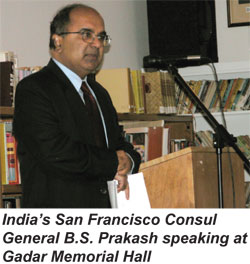 At a low-key official celebration at the historic Gadar Memorial Hall in San Francisco, India’s Consul General B.S. Prakash Aug. 15 unfurled the tricolor in the backyard under a light drizzle and participants sang the national anthem. At a low-key official celebration at the historic Gadar Memorial Hall in San Francisco, India’s Consul General B.S. Prakash Aug. 15 unfurled the tricolor in the backyard under a light drizzle and participants sang the national anthem. As everybody moved inside, Prakash said he would not be reading out Indian President A.P.J. Abdul Kalam’s speech because it was rich in content and deserved to be read with care. Instead he spoke briefly about the emotional power of the venue. India’s independence movement from the British began in California in 1900, long before its national leader Mahatma Gandhi embarked on it, Prakash said during his speech. He said he was moved by looking at photographs of the heroes of the movement that adorned the wall of the hall. San Fernando Valley About 10,000 people gathered on the lawn outside the Oviatt Library at California State University at Northridge, Calif., to attend Independence Day festivities Aug. 13 at an elaborate set of events headlined by Los Angeles Mayor Antonio Villaraigosa. 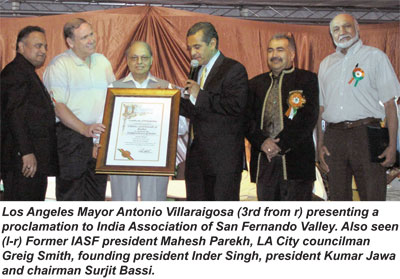
“It’s a wonderful thing for the City of Los Angeles to embrace various cultures,” Villaraigosa said. “It makes us strong.” The mayor also acknowledged the debt owed by the U.S. civil rights movement to India’s independence movement leader Mahatma Gandhi. “The civil rights movement was inspired by an immigrant,” he said. “His theology was the basis of our own civil rights.” Several politicians who attended the event included Rep. Howard P. Sherman, Los Angeles City Councilman Greig Smith and Anaheim City Councilman Harry Sidhu. The day-long festivities included a health fair, a mela and cultural events. Easily recognizable faces in the crowd were those of movie stars Anil Kapoor, Shashi Kapoor, Randhir Kapoor, actor-politician Shatrughan Sinha and MPs from Kerala N.N. Krishnadas and A.P. Abdullah Kutty and Gujarat Assembly opposition leader Arjun Modhawadia. New Jersey Assemblyman Upendra Chivukula also attended. “It is very satisfying to learn that FIA is continuing with its longstanding tradition of organizing India day parade in New York and is celebrating the Silver Jubilee of India day parade this year,” the prime minister’s message said. After the parade, Parikh thanked the guests and participants for making it the largest parade over the past 25 years. There were 41 cultural floats showing the rich tradition of Indian states. In addition more than 70,000 people participated at the ‘mela’ and cultural event held after the parade. On Aug. 14, the festival hosted a colorful parade with floats from the fire brigade, Hindu Swayamsevak Sangh, Aasra, Orissa, AC Transit, Karnataka, Kashmir, Fremont Hindu Temple, and Bay Area Telugu Association. COMMUNITY: Pakistanis Celebrate Independence Day: Sohni Dharti - By Ras Siddiqui Over five thousand Pakistani Americans gathered in front of San Francisco’s Civic Center in patriotic fervor to celebrate the birth of their homeland, writes Ras Siddiqui.  Aug. 14 is a special day. Not just for Pakistan but for the millions worldwide who claim direct or indirect connection to the green and white. Huge gatherings were held in major cities around the world during this past week or so to commemorate the 59th Independence Day of Pakistan. San Francisco became the focal point of Pakistani heritage in Northern California Aug. 14 as over five thousand people gathered in front of the city’s historic Civic Center. They congregated in patriotic fervor to celebrate the birth of their homeland, listen to speeches, taste fine cuisine and take in South Asian entertainment and fashions as the youth and even us older folk swayed to rap, geets, devotional and western infused bhangra music. Aug. 14 is a special day. Not just for Pakistan but for the millions worldwide who claim direct or indirect connection to the green and white. Huge gatherings were held in major cities around the world during this past week or so to commemorate the 59th Independence Day of Pakistan. San Francisco became the focal point of Pakistani heritage in Northern California Aug. 14 as over five thousand people gathered in front of the city’s historic Civic Center. They congregated in patriotic fervor to celebrate the birth of their homeland, listen to speeches, taste fine cuisine and take in South Asian entertainment and fashions as the youth and even us older folk swayed to rap, geets, devotional and western infused bhangra music. To begin, Dr. Khawaja Ashraf set a somewhat somber yet realistic tone for the program, calling on the local Pakistani-American community to police itself. Ashraf called on Pakistanis to rise to the defense of their American homeland as this is very much our home now. “The United States and Pakistan are both our homelands,” he said. “This is our country,” he added. He ended his speech with a call to everyone to remember to visit San Francisco around the 14th of August and to attend this gathering (which is now a tradition for our community from all over Northern California). “God Bless Pakistan and God Bless the United States of America,” he said. Emcee Akhtar Shah echoed the same sentiments in his follow up by calling on Pakistani-Americans to make sure that America remains protected. Maulana Bashir Sialvi in a short speech next expressed the sentiments of many as he said that this was a day of great joy for all of us. Eleven-year-old twins Adeeb and Azeem Khan next took the opportunity to stir up many patriotic sentiments as they sang “Sohni Dharti” (Beloved Land) to not only the delight of their proud parents but all of us in attendance. Their performance was followed by a delightful Pashtu language song (pre-recorded). Zaki Syed next presented his sentiments in Rap form on ABCD’s (American Born Confused Desis). Sultan Riazul Hassan and Salim Mastan struck a more religious note where the former called for a prayer of thanks for the achievement of Pakistan which is our identity while Mastan made a call for fundraising for an Islamic Center in nearby Livermore, which could use community help. The entertainment segment got off to a strong start with Indian singer Alka Bhatnagar accompanied by Raj Sohal. Alka started off with “Allah hi Allah Kiya Karo” and proceeded to sing a number of Pakistani as well as Indian songs. Noor Jehan’s “Nehr Waley Pul Tey Bula Kay” and “Dama Dum Mast Qalandar” were really appreciated by the now fast growing crowd. The fashion show that followed drew a great response as Girl Power appeared to be in charge all the way. Colorful dresses, Pakistani colors and the background music gave this presentation an appeal that made it a commendable effort. It certainly gave “Pakistan Zindabad” a new twist. Sophia Ahmed, Sundas Yaqoob and Sholah Ramish and all the participants deserve to be recognized for brightening up the Civic Center Plaza and this celebration. San Francisco’s (and Lahore’s) own Urdu poet and passionate orator Javaid Sayed next made his speech touch many hearts. Starting off on an appeal for peace between India and Pakistan, Sayed called for a solution of the Kashmir problem and condemned extremism and those that hurt Islam and Pakistan’s image. Consul General of Pakistan in Los Angeles Noor Jadmani, who came to San Francisco especially for this event, presented the messages of General Pervez Musharraf and Prime Minister Shaukat Aziz congratulating all on Pakistan’s Independence Day. He said that the people of Pakistan were dynamic, intelligent and hard working. “Have pride in yourselves as Pakistanis,” was the message from General Musharraf. “Pakistan is a frontline state in the war on Terrorism,” said Jadmani. He added that the community here made Pakistanis all proud and thanked everyone for coming to this gathering and remembering their homeland. Zaki Syed’s passionate presentation, “Humara Pakistan, Tumhara Pakistan,” has to receive a wider audience. Whether the emcee understood it or not, it moved some locals in attendance to tears. Great presentation, Zaki! And the same goes to the Hip Hop Group “Aman” which made a short but solid appearance. Alka Bhatnagar and Raj Sohal came back with some popular Bollywood songs and Sandhu sang “Kurti Mal Mal Di.” And right after them a local who is making a name for himself, “Sir Punj” (the artist formerly known as T.J. Cool) really made a big impact. His three songs sure got some youngsters in the audience going, starting with “Sadda Dil hai Pakistani” (Our heart is Pakistani) and “Aa Ja Goriyay” plus “Kurti.” Sir Punj’s new album “Kehra Pind Tera?” (Where is your home?) is about to be released soon. Imran and the Pehchan Entertainment group closed the Entertainment segment with several crowd favorites. Starting off with a devotional number originally by the late Nusrat Fateh Ali Khan, the group presented several Punjabi songs from Ibrar Ul Haq including the now legendary “Billo Dey Ghar.” Pehchan is quite a high energy act and only the diehard youngsters could keep up with them this late in the day. Current Pakistan Association of San Francisco president Anwer Siddiqui made the closing speech. He thanked everyone for making this occasion a success once again - Ras Siddiqi is a Pakistani American community activist and writer. |TOP| COMMUNITY: News in Brief Garamendi Meets Indus Valley American Chamber of Commerce | Appointed to City Panel | Aiding the Handicapped | Two New Hindi Channels on Dish | New Chief of American Accounting Organization | Tech CU Donates $1,000 | Elected Chairman | Running for Cupertino City Council | South Asian Business Alliance Network Joins Bizcon 2005 | Janamashtami in Sunnyvale Garamendi Meets Indus Valley American Chamber of Commerce 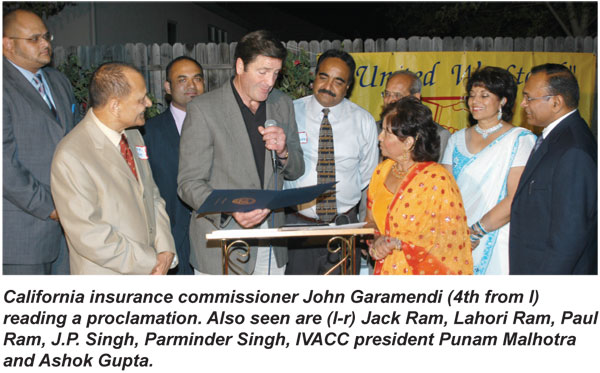 Addressing the Indus Valley American Chamber of Commerce monthly meeting recently, California state insurance commissioner John Garamendi congratulated the Indian community for its rich culture, which he said had thrived amid the state’s diversity. Garamendi, who is running for lieutenant governor, said he was pleased with the community’s participation in the American political system and said that this participation will give them the right position and status in this country. He was introduced by community activist Lahori Ram, who is the economic development commissioner for the state. A beautiful traditional Punjabi Gidda was presented in Garamendi’s honor. IVACC president Punam Malhotra hosted the evening which was filled with music, food, dances, introduction of new members, and social activities. Tejinder Sibia was master of ceremonies, and IVACC secretary Sukh Chain Singh welcomed guests. — By Talat Sattar |BACK TO COMMUNITY NEWS INDEX| |TOP| The program approaches its goal of improving the city’s affordable housing stock in two ways: First, in order to make needed repairs to homes, the program offers low-interest loans to any low-income household that meets the eligibility criteria. Second, in order to fix deteriorating rental units and buildings, the program offers low-interest loans to owners of rental properties where, at the time of the loan, 51 percent of the units are occupied by low-income households at affordable rents. The Committee consists of one city council member (non-voting); one city staff member (non-voting); one Housing & Human Concerns member; and six members. Ahluwalia’s background of an ex-attorney for over nine years and current work as realtor and loan broker means he understand the issues involved. “I am able to put my analytical skills to use and screen the applications and participate in loan approval process which in turn helps the city achieve its objective,” he said. The Sankara Eye Foundation is embarking on fund raisers for four new initiatives named Focus Bangalore, Focus Gujarat, Focus Karnataka and Focus AP, Phase II to address a wider segment of the visually handicapped population. “The SES institution is today synonymous with affordable specialty eye care,” the release added. “SES currently covers three hospitals in the Indian states of Andhra Pradesh and Tamil Nadu, performing over 56,000 free eye surgeries every year.” Readers can find more information at www.giftofvision.org DISH Network now offers 112 international channels from 25 countries in 28 languages, including Arabic, Chinese, Farsi, Korean, Bangla and Kannada. “We are excited to serve as the exclusive pay-TV provider of Sahara One and Sahara Samay channels in the United States,” said Tracy Thompson, EchoStar’s vice president of International Programming for DISH Network. “Sahara One and Sahara Samay add a layer of diversity within DISH Network’s growing lineup of popular Hindi channels and are available to Mega Pack subscribers at no additional cost.” Broadcast from India, Sahara One and Sahara Samay feature a wide array of special programming on politics, business, entertainment and news. Sahara One is a 24-hour Hindi general entertainment channel. Sahara One’s programming includes daily soap operas, mega movies, popular children’s shows, game shows, thrillers, talk shows and much more. Sahara Samay is a 24-hour national Hindi news channel that covers current affairs, politics, sports, entertainment, business, national and regional news, horoscope, fitness and yoga. Sunder is a native of Dankaur, U.P,, and has retained his Indian citizenship while residing in the United States for the last 35 years. He is only the third foreign-born professor to be elected to this office. The American Accounting Association is the premier forum for scholarly interchange in accounting. With 8,000 members throughout the world, it promotes worldwide excellence in accounting education, research, and practice. Sunder’s affiliation with the association has spanned more than three decades. He has served as Distinguished International Visiting Lecturer (2000), Presidential Research Lecturer (1999), and Director of Research (1988-90). In addition, he was honored with the American Accounting Association-American Institute of CPA’s Notable Contributions to Accounting Literature Award (1982 and 1998) and Manuscript Award (1975). A member of the Yale School of Management faculty since 1999, Sunder is a leading accounting theorist and experimental economist. His research contributions include financial reporting, statistical theory of valuation, economic theory of accounting and organizations, dissemination of information in security markets, design of electronic markets, experimental exploration of learning and expectations in monetary economies, minimal rationality economics and Japanese business and accounting. Along with providing users with the ability to search and filter through specific case information, this software allows VCA’s Casework Department to display the most up-to-date information available on their website. Through the use of this software, VCA expects to disseminate more posters, thereby generating more leads to assist law enforcement in locating these children. Technology Credit Union welcomed the opportunity to contribute to this worthy cause by helping advance their technology. While Tech CU’s primary mission is to meet the financial needs of its members, providing support to the communities where its members live and work is also an important priority. Technology Credit Union’s involvement in the community includes charitable donations, food and toy drives, as well as fundraising and volunteer activities. The NYS-IARC will push those initiatives to local politicians on behalf of Indian Americans in New York. What is most exciting is that the second generation is actively getting involved in the political arena, and making a difference for Indian Americans overall. Last year, several dozen elected officials won and lost positions within 6,000 votes — we plan on being involved in those elections to have impact on the political landscape of America. The candidate, local patent attorney Raj Abhyanker, has a background, spanning careers in engineering, business, and law. He has been an electrical engineer at Hewlett Packard in Cupertino, a director-level executive at Silicon Valley success story Juniper Networks, and a successful patent attorney in private practice. “Raj deeply cares about the quality of schools in Cupertino and the preservation of Cupertino’s family-friendly and suburban character,” the release said. “He is concerned that Cupertino schools are not receiving the support from government that they need to continue excellence and is concerned about recent high-rise building developments in Cupertino. He asks for your vote so that he can champion the silent views shared by many Cupertino residents and families.” BizCon 2005 is a project of Orange County Presidents Council, a collaborative effort of over 20 minority chambers and business and government organizations united to promote growth and networking for small businesses outside their individual ethnic communities. “This is the largest ethnic business organization in the country,” said Joel Ayala, president of the Hispanic Chamber of Commerce of Orange County. “People know they can come to us to reach many ethnic communities.” “We are proud that the South Asian business community joined with us this year ….add to our organization the economic diversity, business leadership, and cultural mix they represent and it will surely help us accomplish our mission of working together to propel growth,” said Peter Sinambal, CPA, the president of OCPC. He also mentioned that the highly professional skill and rich cultural heritage of the South Asian business community is an asset to the OCPC. The South Asian Biz Alliance Network secretary Mohammed Islam also expressed his pleasure. “As the newest member, it will benefit our community to promote and develop the businesses in the field of technology, insurance, banking/financing, Marketing, import/export, and other products and services in the county, where half of the population is minority and ethnic diversity,” he said. INFOTECH INDIA: ROUNDUP Novell Acquires Partner | Can India Become the Next R&D Hub? | As MNCs Poach, Indian IT Firms Feel the Heat | Highest in Client Satisfaction | $50Billion Software Exports Bharti, Nokia Ink Deal | Intel to Hire More | Satyam Goes to China | BPO Certification Begins Novell Acquires Partner  Novell, Inc., announced Aug. 25 in Mumbai that it has signed a definitive agreement to acquire the 50 percent stake held by its partner in Onward Novell, its sales and distribution arm in India. The move reflects Novell’s strong commitment to bringing its Linux and identity solutions to the rapidly growing Indian market. As a result, Novell will be able to better serve its Indian customers, while simultaneously enhancing its existing development and technical support operations in the region. Novell expects to close the transaction by the end of its fiscal year. Novell, Inc., announced Aug. 25 in Mumbai that it has signed a definitive agreement to acquire the 50 percent stake held by its partner in Onward Novell, its sales and distribution arm in India. The move reflects Novell’s strong commitment to bringing its Linux and identity solutions to the rapidly growing Indian market. As a result, Novell will be able to better serve its Indian customers, while simultaneously enhancing its existing development and technical support operations in the region. Novell expects to close the transaction by the end of its fiscal year.“In India, Linux and open source are increasingly permeating applications such as mail messaging, file and print, and Web hosting. Identity and access management solutions are also getting increased traction in the IT services and BPO sector in India due to privacy and compliance issues,” said Praveen Sengar, analyst, software and services research, IDC India. “Hence, Novell’s decision to take direct control of its business in India should enable it to have more focus on the Indian market and to deliver Linux and identity and access management solutions more effectively.” Novell has operated in India since 1992 as Onward Novell, a 50/50 joint venture with a local Indian partner. Onward Novell managing director Harish Mehta will continue to advise the wholly owned Novell operation. Rhonda O’Donnell, president, Novell Asia-Pacific, will assume responsibility for the operations, with support from a local senior management team. “Open source is the future of computing in much of the Asia-Pacific region, and Linux is emerging as the de facto standards-based operating platform,” said O’Donnell. “These companies have realized that India is not just a location where clinical trials can be conducted, basic research can also be done there,” he added. Financial experts believe that much of the R&D in India is geared towards smaller projects that complement other innovation centers in Silicon Valley and elsewhere. For the year ending March 31, revenues from product development and R&D services in India stood at $3 billion, up from $2.3 billion a year earlier, according to the National Association of Software and Service Companies, India’s information technology services trade association. (Although that $3 billion figure on the surface is impressive, it is $1.8 billion less than what Intel alone spends on R&D in a year). Still, India faces major challenges as it attempts to grow into an R&D powerhouse. Saikat Chaudhuri, a management professor at Wharton, believes India faces three crucial challenges as it strives to become a global R&D player. “The first impediment, which is steadily improving, is the intellectual property regime, or perhaps its perception,” he says. The second challenge, according to Chaudhuri, is the brain drain. “Even though this has come down substantially (only 30 per cent of IIT graduates now leave India, vs 70 per cent earlier) and we see many reverse brain-drain cases, the fact remains that the very best people often choose to stay abroad.” The third obstacle, said Chaudhuri is the lower levels of basic research. “While there is a set of top universities that teach and research well, it is not sufficient for a country of India’s size.” The pressure is on two fronts — skilled manpower and pricing. IBM, for example, opened its fifth global delivery centre in India in June, while Accenture hired 1,600 employees in May. In fact, Accenture’s Indian employee base now accounts for over 10 percent of its global workforce. Over the next three years, the company plans to add 30,000-50,000 people in India, China and Philippines, says Accenture CEO William D. Green. Holding on to skilled manpower is therefore an uphill task for Indian players, say experts. “Most have been steadily losing employees. Infosys lost nearly 1,400 employees in the quarter ending June,” says an industry expert. And with MNCs becoming more aggressive about their India plans, the problem will aggravate. Most Indian firms, however, are in denial. Alps Management Consultant Harjeet Aulakh says: “Many Indian companies may not be giving the exact picture due to stock market compulsions.” Wipro and Infosys, while announcing their first quarter results recently, said that despite heavy hiring by MNCs and Indian IT providers, attrition rates had actually “gone down.” MNCs are able to attract the best talent, says Pradeep Udhas of KPMG, because of better pay packets and global working conditions. Nasscom’s Sunil Mehta, however, says the situation may not be that bad. ”Look at it this way — both are trying to climb the same mountain from different directions. The good thing is, it’s creating more jobs in India.” This has led to salary hikes and increased expenditure on recruitment and training. A study by NeoIT found that IT salaries in India experienced the most significant growth compared to other offshore/near shore destinations in 2004. The trend is expected to be repeated in 2005. “The shuffling has resulted in talented manpower being recruited by both the MNCs and Indian majors. This may not have been the case earlier,” says Roopesh Shah of MaFoi, a global HR consulting firm. The report cites that while other offshore players are likely to focus more on BPO, Infosys is expected to reach further into the consulting services market. In another report by Forrester, Stephanie Moore recognized Infosys for taking a more strategic approach than other offshore players. Moore states, “Infosys does not bid on deals that it considers non-strategic. It is one of the few Indian vendors that do not do pure staff augmentation engagements, and it is rarely a low-cost bidder, preferring instead to differentiate itself through higher-quality skills, processes and offerings.” Elaborating upon this success mantra, Nandan Nilekani, CEO, president and managing director, Infosys Technologies Ltd. said, “The global delivery model, as pioneered by Infosys, is a true business innovation. It has redefined value for money and demonstrated that the key to growth is scalability and differentiation. Offshoring is no longer a function of cost. At Infosys, our differentiation comes from higher quality skills, and process-centric delivery excellence, as is seen by more than 95 percent of repeat business from our clients.” He said that the sector is looking at achieving a 30-32 percent growth for the current fiscal on top of $17.2 billion registered during fiscal 2005. “We are pretty much on track for that target. To achieve that, the sector has to grow by around 35 per cent year-on-year for the next three years, which should not be much of a problem,” Karnik said. “The first quarter results of FY06 have been encouraging and this trend of robust growth should continue.” He added that the recent reports on data theft from a couple of BPO firms in India is an aberration and there has been no panic whatsoever from any of the clients and markets where Indian software services firm operate. “There are adequate checks and balances in the system and it is being further tightened to prevent such untoward incidents. One of the key highlights of the IT Act which is being debated will ensure that such criminal acts are dealt with severely and it will also enhance the adoption of digital signatures,” Karnik noted. “As per the contract, Nokia will provide managed services and expand Bharti’s Airtel networks in the circles of Mumbai, Maharashtra, Gujarat, Bihar (including Jharkhand) and Orissa for a period of three years,” a statement from Nokia said. The company release added that the expansion would double Bharti’s network capacity, providing reduced congestion and seamless coverage. The phased expansion into these towns and villages would start immediately and was likely to be completed by March 2006, Nokia said. “We continue to invest in India. The development centre is growing...we are continuing to hire and grow...it is part of our existing plan...Our presence in India is growing in terms of number of cities and towns. So, our overall commitment to India just continues to grow,” said Intel India president Ketan Sampat. Parrying questions about the exact number of people to be hired at the company’s India Development Centre in Bangalore, Sampat said, “We don’t divulge specific numbers.” Currently, the centre has 2,700 professionals and it is engaged in design and development of solutions for all major Intel business units. Its new campus is also coming up in Bangalore. Sampat, however, declined to comment on Intel’s plans to set up a manufacturing unit in India. IT minister Dayanidhi Maran had earlier announced that Intel would set up a $400 million assembly test manufacturing plant in India, but the company had denied having arrived at such a decision. Intel had announced $41-million investment in its Intel India Development Centre in 2003. Satyam plans to hire more than 1,000 engineers by 2006 from 250 now and 3,000 by 2007, and it will also build a large research and development centre either in Nanjing, Xi’an, Chengdu or Tianjin, Satyam president Ram Mynampati said. Expressing strong confidence in the company’s growth in China, he said that Satyam does not intend to provide direct service to Chinese firms in the short term. “So why we are here (in China)? Because many of our global customers have set up new businesses in the country and we aim to provide them the same high-quality services here,” Mynampati was quoted as saying by Shanghai Daily. The National Association of Software and Service Companies has announced a three-month pilot of the business process outsourcing certification program. “People think that a BPO job is easy to get, but the reality is not that,” said Sunil Mehta, vice-president at NASSCOM. Even at large BPO companies, only six to eight out of every 100 people who applied for jobs would get recruited, he said. “Another 15-20 could get a job if they had training. We are talking of increasing the employable pool,” Mehta said, adding that the cost of recruitment could be halved. “The training requirement in the industry is also likely to go down,” he said. Helped by cheap telecoms and English speakers working for a fifth of Western wages, India’s back-office services industry employed 348,000 employees at the end of March and posted revenue of $5.2 billion in the year to March 2005.
AUTO REVIEW
Environmentally Smart: 2005 Honda Civic Hybrid - By Sally Miller Wyatt Whether for commuters, or for parents who just pack on the miles as they ferry children back and forth, the Honda Civic Hybrid is simply a smart choice both environmentally and economically, writes Sally Miller Wyatt.  We’ve had to make several trips from Northern to Southern California this summer, and each time the stack of gas bills seemed to grow higher and higher. On this last trip, we actually paid more than $3 a gallon at one location! Too bad we couldn’t have driven the test car we had recently: the 2005 Honda Civic Hybrid. It’s a gasoline-electric hybrid that gets a remarkable mileage rating of 47/city and 48/highway, with a range of more than 600 miles per tank. That means we could have had the ability to drive from the San Francisco Bay Area to San Diego on just one fill-up of gas. The Hybrid is able to get such great gas mileage because it uses Integrated Motor Assist technology. IMA couples a 1.3-liter, four-cylinder engine with a high-output electric motor. The system has a compact nickel-metal hydride battery module, which is automatically recharged every time you use the brake or decelerate. With this electric motor “assist,” the combination allows the Civic Hybrid’s gas mileage to be improved by as much as 30 percent over a non-hybrid Civic. The car uses unleaded regular gas, too, which should have save even more money. How is it to drive a Hybrid? Only a few nuances differentiate this car from its non-Hybrid cousin. The car starts up very quietly, and the dashboard gauges include battery level and “Charge Assist” indicators, in addition to the traditional fuel level gauge. On the road, you’ll notice that the car seems to grab a bit at braking and hesitate somewhat at deceleration, but that’s understandable when you realize that during the act of braking and deceleration you are also charging the battery. Otherwise, the car handles well and accelerates promptly. Road noise is pronounced, particularly at freeway speed. Creature comforts included soft cloth seating, an AM/FM/CD audio system with four speakers, automatic climate control system, power windows and door locks, vanity mirrors in the visors, and cruise control. Even if gas prices fall back down again some day, driving a Honda Civic Hybrid will still be an environmentally and economically wise choice for commuters, or those of us parents who just pack on the miles as we ferry our children back and forth to all their activities. - Sally Miller Wyatt is a freelance writer who writes family-oriented auto reviews for newspapers, magazines and the Web. |TOP| BOLLYWOOD: Guftugu Our Porn-prone Stars  Bollywood siren Mallika Sherawat is now heaving a sigh or relief. Given her penchant for traipsing on screen wearing garbed in the barest essential or less — “bare” being the operative word here — her claims that a porn film allegedly with her in it was a fake was drawing more than a few disdainful snickers. Bollywood siren Mallika Sherawat is now heaving a sigh or relief. Given her penchant for traipsing on screen wearing garbed in the barest essential or less — “bare” being the operative word here — her claims that a porn film allegedly with her in it was a fake was drawing more than a few disdainful snickers. Now the cops have nabbed the double in the bootleg pornographic footage and — er, exposed her, and Mallika feel vindicated. It’s not just poor Mallika. Sushmita Sen, Aishwarya Rai and Bipasha Basu were just three of the many actresses in line for similar ersatz skin shows when the timely raid by Mumbai police on a shop led to the arrest of two brothers responsible for the whole sordid exercise. I suppose the front bench folks enamored of these beauties want to see a lot more of them than healthy, huh? Filmmaker Mahesh Bhatt thinks is the latest circus in town and will fade away, while Koena Mitra feels that the whole thing is like a joke. It all goes back to the old bestseller: sex. Some publicist are all too happy, for instance, to promote steamy potboilers and there are some starlets thriving on a similar image. Take Tanvi Verma, who is joining the ranks of Payal, Meghna and Mona Lisa and is doing two such films. She says she has no qualms about doing bold scenes actually wants to work with Yash Chopra, J.P. Dutta and Karan Johar. The names of her films are just as revealing as the star herself. One is Bokadia’s Bold and another is — we are not making this up — T.L.V. Prasad’s Ek Se Mera Kya Hoga. Really. Historians, villagers from Uttar Pradesh, Conservative Party policymakers in Britain — you name it, all seem to have a beef against the film. Mumbai-based writer Amaresh Mishra says the film is an attempt to cater to “a foreign audience by selling Indian exotica” in the guise of a period film. There never was a William Gordon (Pandey’s friend played by Toby Stevens) or characters played by Rani Mukherji and Amisha Patel, he says. Meanwhile, Oxford-trained historian Rudrangshu Mukherjee says the available evidence shows Pandey was an “accidental hero,” impervious to any winds of nationalism that may have been blowing. Then there’s commentator Swapan Dasgupta who scoffs at the “increasingly silly controversies.” His acid observation: “There are some political cretins who want the film banned because it doesn’t mention Mangal’s Ballia janmabhoomi. Then there are other innocent nationalists who have got all worked up at the images of the Sepoy martyr first downing a lota of bhang and then cavorting with fallen women of indeterminate provenance. Finally, there are the pamphleteers who say the film should have been all about Mangal coming under the spell of some mysterious Wahabi fakir. “The Rising takes charming liberties with history. The question is: So what? The great thing about The Rising is that it has helped rekindle some interest in the events of 1857.” If may sound like one of the sillier daytime soaps, but it’s all sadly true, and the whole sorry mess is being played out in public as Bollywood star Karishma and estranged hubby Sanjay Kapur trade insults in court. In her affidavit filed in response to Sanjay’s petition seeking to restrain Karishma from taking Samaira abroad, the actress said he deserted her. Karishma said the petition is nothing but “a crude attempt to urge and seek redress of matrimonial issues of a disgruntled husband and this respondent (Karishma) by using the minor as a pawn.” Not so, counters Sunjay Kapur. Instead of addressing the issues raised in his writ petition, she has “deliberately urged fabricated and false matrimonial issues,” he said in his affidavit. Sunjay said she was aware that he had taken care of all her expenses within India and abroad, including making payments towards some film producers who she owned money. He didn’t forget to throw in a barb at Karishma’s mother in law, Babita. He said he was ready to reimburse all expenses Karishma might have incurred on Samaira. However, if the actress expected him to run her mother’s house while he was already running the expenses of the matrimonial home, it would be “totally unjustifiable”. The bitchfest continues. On top of that comes the terrible news of his family members in a terrible auto accident that almost killed them. Govinda’s wife Sunita, daughter Namrata and son Yashvardhan are recovering from injuries in a road accident on the Jaipur-Ajmer road Aug. 15. Hospital authorities at Leelavati Hospital said the condition of all three is stable, and they have been moved from the hospital’s intensive care unit. Sunita received head injuries, daughter Namrata had a broken tooth while son Yashvardhan had bruises. Police said that the star-turned-politician’s wife and two children were injured and his friend Rishab Jha was killed when their Qualis van collided head-on with a truck when they were going to Ajmer. The accident occurred on the Jaipur-Ajmer road near Bagru when the driver of the Qualis rammed into the truck coming from the opposite direction while trying to save some children, they said. The actor’s family along with their friend were on their way to the pilgrim town to visit the mausoleum of Sufi saint Khwaja Moinuddin Chisti, police said, adding that the driver of the truck has been arrested. Here’s hoping a speedy recovery for Chi Chi’s family members, so that the zany Bollywood star can smile again. The world would certainly be a duller place without Chi Chi’s toothy smile. So was Preity Zinta, but level-headed lass that she is, she tried to shrug it off initially, hoping the pranksters would go away. The pranksters, though, seemed in no mood to disappear and the abusive messages continued. So Preity complained to the cops. Police at Mumbai’s Khar station, who received the complaint, reprimanded five youngsters from Pune after police nailed them. The fivesome — Arif Mirza, Farooq Sheikh, Tausif Patel, Uday Nikalje and Silven Lobo, were called to the police station in western Mumbai and let off after a strong reprimand, police said. Police officer Amitabh Gupta said initially it was established that the caller and sender were Pune-based, and a subsequent probe revealed that the mobile phone of Arif Mubarak Mirza, 21, from Pune, was used for the purpose. Right in the venue of a Dasgupta shoot in which upcoming Bollywood star Samira Reddy was playing a role turn two Sanjays turned up — pretty much like two bulls in a china shop. One of them is Sanjay Dutt, the other is filmmaker Sanjay Gupta. What’s more, both were quite drunk, and had no qualms about disrupting Sameera’s shoot. Dutt, who was shooting for Parineeta, was in Kolkata, and thought it would be a great idea to say hello to Buddhadeb while he was tipsy. So off he went with Kapur to the sets where Buddhadeb was shooting Kalpurush. No one will blame poor Sameera for thinking this was not exactly a wonderful idea. After all, it was 1 a.m. She locked herself in a room, while the two inebriated Bollywood stars banged at the door and uttered stuff not fit for a family magazine. Ultimately some unit hands decided to end the hungama by letting them meet Buddhadeb. Here, at least some sense prevailed. (About time.) They met Buddhadeb, had a polite chat, and left. The unit hands were shocked all the same. In Kolkata, the shooting sets are treated with respect, and nobody brings booze (or boozy folks) there. Now that’s a sobering thought, isn’t it Sunju baba? Rajnikanth’s latest film, Chandramukhi, which has him in the role of a U.S.-returned shrink, has smashed all existing records down south. The film, released four months back, is still running to packed houses in many parts of Tamil Nadu and elsewhere. His romantic interest in the film is the 21-year-old Nayanthara. The gross earning from Chandramukhi has already crossed a whopping half a billion rupees. And that’s without including theatrical, DVD and satellite TV rights from Malaysia, the UAE and the U.S. The success of Chandramukhi comes not a moment too soon for the 56-year-old star who is still smarting from the box office debacle three years ago of Baba, written and produced by him. Kher withdrew the case in a magistrate’s court after Surjeet’s lawyer Ram Jethmalani wrote a letter saying his client had no intention of defaming him. The letter, produced before the court by the lawyer of the accused, said “the impugned statement making a comment on Kher was merely a political statement referring to policy and not character.” It further said that Surjeet had no intention to harm the reputation of Kher. Kher had filed a defamation case against the veteran CPI(M) leader alleging that in articles published in a party mouthpiece Surjeet had defamed him by describing him as an “RSS agent” and that he (Kher) had saffronized the Censor Board as its chairman. Earlier, the court had issued a bailable warrant against Surjeet for failing to appear in this case. Surjeet moved the High Court which stayed the warrant. Speaking to reporters outside the court, Kher said: “I am satisfied with Surjeet’s response and hence have decided to withdraw the case.” HINDI CINEMA: The Rising 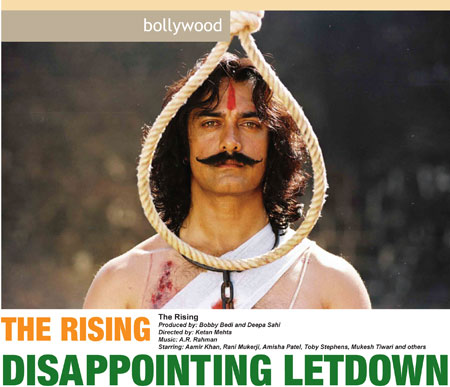 The Rising The RisingProduced by: Bobby Bedi and Deepa Sahi Add to that a filmmaker of Ketan Mehta’s caliber, whose earlier films like Mirch Masala and Bhavna Bhavai showed a superb ability of dealing with period situations and melding a folk ethos with cinematic narrative, and expectations are bound to soar, particularly given the fact that he acquitted himself exceptionally well in a previous historical biopic, Sardar Patel. Then you had producer Bobby Bedi, with films like Bandit Queen and Fire under his belt. With Rs. 400 million poured into it, the film could only be a winner, right? The result, alas is a huge, disastrous letdown. It’s a funny sort of a feeling, though, because the film is said to have done exceptionally well initially in the box office, so maybe film’s producers can dismiss any criticism as the meaningless bile of a bunch of carping critics. Not so fast. While indeed the initial takings of the film are spectacular, it has been followed by a curious tapering off and word has it that takings have nosedived since. So clearly, the blithe contention that the janta has gone for the film won’t wash, because word-of-mouth support—that sure indicator of audience appeal—doesn’t seem to be going the film’s way. Meanwhile, historians are all jumping on the filmmaker for playing fast and loose with the facts, but this is a debate that we think is secondary to the fact that even as a fictional patriotic narrative, the film fails to deliver. But first, a brief note on the story. Mangal Pandey (Aamir Khan) is an Indian sepoy serving Britain’s East India Company. Mangal rescues his commanding officer William Gordon (Toby Stephens) during a battle in Afghanistan and the two men develop a friendship. The Hindi-speaking Gordon has second thoughts of colonial tyranny as his empathy for Indians increases, which contrasts with the lack of feeling of most of his white colleagues. When the British introduce a new set of rifles, the sepoys are required to bite the bullet, but the paper cartridges encasing the gunpowder contain beef and pig fat. Neither Hindu nor Muslim soldiers are prepared to use the new cartridge on religious grounds. Trusting Gordon that the cartridges do not use beef and pig fat, Mangal bites the bullet, but when the sepoys learn the truth, Mangal revolts and leads a rebellion that sows the seeds for the end of the East India Company’s reign. The historical liberties taken in the film have already created a ruckus: there is no historical evidence to suggest characters like William Gordon, or characters played by Rani Mukherji or Amisha Patel existed, and the original setting of Mangal Pandey’s protest, Barrackpore in West Bengal, is completely glossed over, and the action takes place in a mythical neverland more typical of a Bollywood potboiler. In fact it’s embarrassing how much the film ends up aping a Bollywood masala film. Farrukh Dhondy’s script has enough masala to make any Bollywood veteran blush, and that’s saying something. Something went dreadfully wrong in the planning, and it’s very, very tempting to speculate that the filmmaking team, casting a nervous eye on the huge budget, lost their nerve and decided to play it safe. So instead of trying to make a sensitive, historically evocative film, they ended up kowtowing to commercial market demand, with absolutely disastrous results. Instead of the good, even great, historical film they could have made, they ended up making a bad kitschy potboiler. So you have sex thrown at your face the way a cheap Bollywood film would try to do: the prostitute Heera (Rani Mukerji) in sensuous nautch girl scenes, Amisha Patel in a steamy scene with Gordon after being saved from a sati. A man auctioning Heera offers to pull down her ghagra for better product appraisal, a pankhawallah operates a fan for a sleeping British woman with groaning and repeated signs of sexual arousal. All of it distracts from the main story, and Aamir, though impressive in his acting, fails to inject life into his character as effectively as he did in Lagaan’s Bhuvan. Toby Stephens, though, is quite good, and wrests considerable audience sympathy with his powerful portrayal, which hurts the film’s main thrust: the heroism of Mangal. Aamir’s Mangal is too angry all the time, the dialogues are painfully melodramatic or cheesy (sometimes both) to be compelling. Yet the film also makes clear that the basic talent was all there – the technical skills are quite good, but is set to naught due to a lack of a solid synthetic artistic vision. And so in the end, the film is deeply disappointing. It’s not your typical mindless potboiler, it’s just a film that has the basic technical wherewithal but has lost its way. Which is perhaps doubly disappointing. Rating: **1/2 (Average) |TOP| TAMIL CINEMA: Ponniyin Selvan: Well Packaged, Different 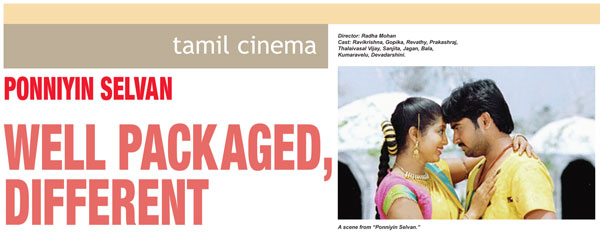 If Azhagiya Theeye was a love story with a difference that held promise of a director who would be trying out different themes, Radha Mohan’s second release Ponniyin Selvan reveals that the director has lived up to the promise. Despite having to make compromises for commercial viability, like the fights and the dance numbers, it’s a sensitively crafted film that centers on the psyche of a youth who is disturbed by his disfigured looks and tries to come to terms with it. The age-old adage about the futility of mere appearances, that beauty is only skin deep, and the value of true bondings have all been conveyed clearly and in a very natural way. Venu’s scarred face hardly mattered to those close to him. Like Ponni, his mother, who could never figure out why her son wanted a change of face, or Guru, his friend and colleague at the factory Venu works in. Or Kani, his spirited neighbor sharing a comfortable bonding with the mother-son duo, holding a torch for Venu, which he doesn’t realize for long. The same is true his friends with whom he hangs out. Even the neighbor feeding her little kid using Venu’s name to scare him into eating had become a routine affair for those around. So when Venu suddenly gets it into his head to go in for plastic surgery, none close to him could really understand his desperation. And it’s the first step of Venu’s alienation from his near and dear ones. To save for the surgery, Venu takes up a job at a pizza joint, hiding his face behind a helmet and a mask. When Priya (a cute Sanjita), the pretty server he falls for there, reacts in spontaneous revulsion when she gets to see his face, Venu throws away the mask and the pretension, but not his intention to get the scars removed. Next, it’s as a night worker clearing garbage from the streets, with no one to look at him. But as the youth steadily moves forward towards his goal, little does he realizes that his new attitude has alienated him from his dear ones. The director brings out the facets of Venu’s relationships with each of the people close to him in a sensitive, natural way. The change in Venu from a mild-mannered pleasant youth, to a high-strung irritable one is also brought out convincingly. Venu’s sudden bursts of temper and his violent reactions to comments on his looks in the latter part of the film have been well contrasted with his earlier taking-it-in-his-stride reactions. And Ravikrishna has fitted into the role perfectly. The actor has brought out creditably the various mood changes in Venu and his mental trauma. His voice and modulation still has a childlike quality, which fortunately suits the character of a youth, yet to mature, one who can still throw childish tantrums and give his mother many anxious moments. Revathi has projected well the character of Ponni, bogged down by life’s problems, a new one added on by her son, and as the fond mother at a loss to understand why her son would need a new face. Gopika is an actress who’s equally at home whether she’s playing the tease or whether it’s the emotional scenes, carrying her role through her sheer talent. A fairly neatly packaged film if you want to go in for something different. RECIPE: Veggie Snack: Grilled Salad Sandwich - By Seema Gupta  Want something in a hurry for yourself or sudden guests? Want something in a hurry for yourself or sudden guests?Seema Gupta shows you how to make this delicious, hot snack. Ingredients: ½ red onion, finely chopped 1 bowl cabbage, finely chopped 1 bowl grated carrot ½ cup yogurt 1 tbsp chopped coriander leaves 2 green chili chopped Salt to taste ½ tsp red chili powder 8 slices White Bread Cooking oil Tomato ketchup Chili sauce Method Serves four. - Seema Gupta is a homemaker. She lives in Elk Grove, Calif.
|TOP|
HOROSCOPE: September 2005 Horoscope By Pandit Parashar ARIES (March 21 to April 20): You will be working towards a major change in career. Things will eventually work out for you. Several brilliant ideas will cross your mind. Financial position will improve all of a sudden as you lay hands on some easy money. You will meet an interesting person. TAURUS (April 21 to May 20): Some of you may grab the opportunity and get ready to relocate. Business trip and meetings will go well with immediate results. You will need special medication to cure a health condition. Great ideas will cross your mind and you will communicate the same in a splendid fashion. An old friend will call. GEMINI (May 21 to June 20): You will reduce unnecessary spending and start saving. There is a fair chance of a large income from a legal channel in the near future. You will be relieved to hear promising news from one of your kids. You will write several important letters. You will be very energetic and will make good use of time. CANCER (June 21 to July 22): You will be rewarded for your hard work and patience. Changes in career will be beneficial in the long run. You will be writing a check to the government. Money could come through stocks trade or a lottery. You will buy some high quality luxury items. LEO (July 23 to August 22): You will be working on a big project. Guidance from a learned person will help you find your way out of a difficult situation. Much needed finances will soon be available. Trip will be relaxing and informative. You will be the center of attraction at a party. You will do religious or charity work. VIRGO (August 23 to September 22): Spouse will spend way beyond budget. Outside influence will cause disturbance in your family life. You will be working on a deal which could earn you extra cash. You will be invited to several parties. You will gain wisdom and actively participate in religious activities. LIBRA (September 23 to October 22): You will be relaxed and look cheerful. People around will notice big change in personality. Some of you will start a new relationship but with some reservations in mind. You will spend a lot of money on kids. SCORPIO (October 23 to November 22): Things will continue to be in your favor and you will achieve another milestone in career. Your efforts will be recognized. Boss will make the necessary recommendations. You will study interesting material that will bring peace to your mind. Anticipated funds will be further delayed. SAGITTARIUS (November 23 to December 22): Do not stretch your limits and do the math before you make a commitment. You will be working towards a big diversion in career. Long overdue money will arrive via mail. You will meet several old friends at a party. You will be frequently calling overseas. CAPRICORN (December 22 to January 19): Spouse will be working hard to meet deadlines. You will hear several encouraging news this month. Things will ease at work as a result of recent changes. You may invite a colleague at your place for dinner. There is a strong probability of your earning big bucks. AQUARIUS (January 20 to February 18): Hard work and patience will pay off and you will finally get several breaks. Positive trend will continue for several weeks so take your chances. You will make some useful contacts which will help in your crusade. You will make money through speculation or may win some in a lottery. PISCES (February 19 to March 20): A big transaction will earn you huge profits. You will take a stand to beat the odds. In-laws will send valuable gifts. You will study useful material. Negotiations will go well and the final word isn’t too far. You will visit an old friend. Bay Area-based astrologer Pandit Parashar can |TOP| |
|||||||||||||||||||||||
|
|
|
|
Advertise in Siliconeer | Home | Subscribe PRINT Issue | About Us (FAQs) | Contact | Locations | Staff Login | Site Map
© Copyright 2000-2013 Siliconeer • All Rights Reserved • For Comments and Questions: info (AT) siliconeer.com |
|





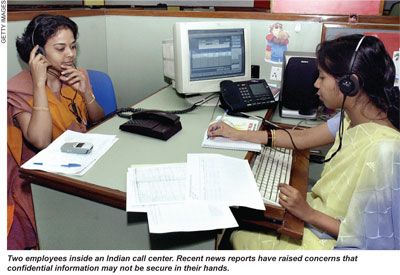 The predominant opinion has been that frauds of the kind that have afflicted the Indian BPO industry are quite common, rather rampant internationally. However, given the strong anti-outsourcing voices abroad, it is very important for India to ensure that the services available from here are better than the best and more secure. This is the only way to stamp out competition as well as political opposition of the kind that was witnessed during the run-up to the presidential elections in the U.S. last year.
  However, apart from the changes being brought about by individual companies, many observers have said systemic improvements that apply to the entire sector have to be implemented. It may be recalled that following the Bahree incident Prime Minister Manmohan Singh had called for changes in cyber laws to strengthen the Indian Information Technology Act, 2000, making illegal transfer of data a punishable offence and also ensure data secrecy.
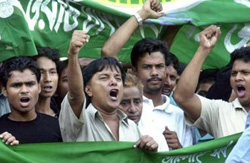
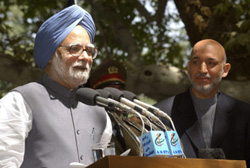
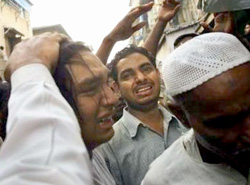
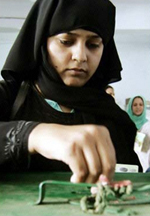
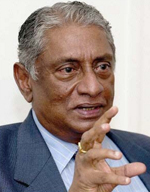
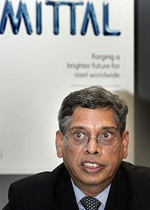
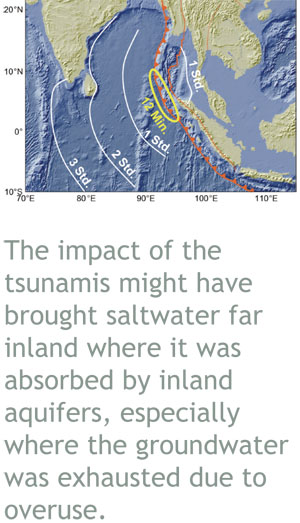 Berkeley Seismology Laboratory scientists have developed theories describing the relaxation of the earth after the violence of extremely powerful quakes. They propose that the effects of the Sumatra Andaman Islands quake will continue moving the crust in this region for years and could trigger more dangerous quakes in the region in the near future. Therefore it is likely that the Bengal Basin and Myanmar may be the most vulnerable areas to be in danger of future large earthquakes. In 1960 an earthquake in Chile registered 9.5, also causing a tsunami but which had a death toll of only 500-2,300 compared to the Sumatra Andaman quake which caused death toll of about 300,000 people.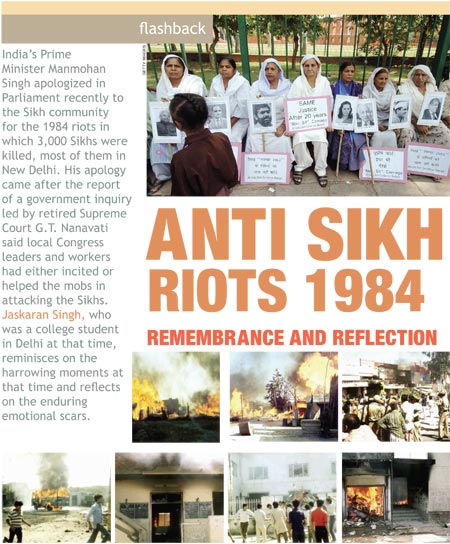


 Celebrity attendees at the event included New York Mayor Michael Bloomberg and Rep. Joseph Crawley while the Indian contingent comprised several Members of Parliament, stars from Bollywood besides hundreds of community leaders led by FIA President Dr. Sudhir Parikh.
 Indian Prime Minister Manmohan Singh sent a congratulatory message that was read out.
  Tens of thousands of people attended the annual Festival of India’s Independence Aug. 13-14 hosted by the Federation of Indian Associations of Northern California, now in its 13th year, one of the main attractions of which was a parade with floats led by Bollywood star Urmila Matondkar.
 Close to 300 people came early Aug. 13 to get a check-up at the Free Health Fair.
  The committee provides loans to Residents of Redwood City whose income falls below the income guidelines for home improvement so that the residents can enjoy home ownership without losing their home. The objective of the program is to maintain safe and attractive housing that is affordable for the city’s low-income population. Increasingly, Redwood City’s housing stock is becoming prohibitively expensive for both low-income owners and renters; and without city assistance, many homes and apartment buildings will deteriorate, often leaving occupants living in hazardous conditions.
 EchoStar Communications Corporation has announced that its DISH Network satellite television service has added two Hindi-language channels — Sahara One and Sahara Samay — to its international programming lineup. With the addition of these two channels, DISH Network currently has 23 South Asian channels available.
 Shyam Sunder, the James L. Frank Professor of Accounting, Economics and Finance at the Yale School of Management, has been named president-elect of the American Accounting Association. This is a three-year appointment to the association’s executive committee. His post as president begins in August 2006.
 IARC will work on a grass roots level working with the State GOP and county committees to make the organization aware of the Indian American community needs and Indian Americans aware of what the Republican Party is doing for the community. President George W. Bush has pushed forward relations by having Prime Minister Manmohan Singh at the White House and working on policies and initiatives ranging from civilian nuclear use, to financial and trade expansion to immigration. This is a historic time for Indian Americans and the Republican Party is bending backwards to work, welcome and satisfy Indian Americans.
 Infosys Technologies has been ranked the highest in client satisfaction in outsourcing services and was among the top three in consulting services among 11 major global IT service providers according to an independent survey report by Forrester Research, Inc.
 Bharti Televentures Aug. 26 entered into a Rs. 5.8 billion deal with Nokia to expand its network in eight circles. Nokia will assist Airtel cover more than 5,000 towns in addition to 2,700 cities already in its fold.
  Even as Intel’s plans to set up a manufacturing centre in India is under a cloud, the global microprocessor giant said it was committed to invest more in the country.
  Indian software major Satyam Computer Services plans to expand its China operations by setting up a large research and development centre as well as hiring up to 3,000 engineers by 2007, a senior executive has said.
 Honda was the first automaker to introduce gas-electric hybrid technology to Americans, back in 1999 when it made the Insight available. The Civic Hybrid hit the market in 2002, and for this 2005 model year, the gas mileage remains unchanged. Even still, those mileage numbers have to be music to any commuter’s ears.

 The Civic Hybrid comes with a long list of standard safety features, including driver and front passenger dual stage air bags, driver and front passenger side air bags, anti-lock brakes, electronic brake distribution, three-point seat belts, side-impact door beams, front and rear crumple zones, keyless remote entry system, theft-deterrent system, and bumpers that can withstand an impact of up to five miles per hour.
  Critics are coming out of the woodworks and taking potshots at Aamir Khan’s Ketan Mehta-directed patriotic blockbuster The Rising.
  Daddy has had a bitter divorce with mommy, and a five-month old baby girl is caught in between. Daddy says he wants to be his little girl’s buddy and goes to court to make sure that happens.
  Spare a thought for our much-harried former Bollywood star Govinda. The poor guy’s honeymoon period after being elected Lok Sabha member is over, and grumbling noises are being heard for his allegedly poor concern shown during the recent Maharashtra floods.
 How would you feel if you were a young attractive woman and you got anonymous calls and SMS messages pestering you, with young punks claiming they were Salman Khan and Shah Rukh Khan? Pretty annoyed, right?
 You might have heard of Buddhadeb Dasgupta, the intellectual Bengali filmmaker (is that a tautology?) who makes off-beat films that make festival crowds swoon. Well, here’s something that happened to make him swoon.
 You think Amitabh Bachchan is big. In the South, it’s a different story. Yes, we are talking about Rajnikanth, the Tamil movie industry’s most enduring crowd-puller who continues to impress as he steps into his fourth decade in films, with a monster hit far bigger than anything anyone has ever seen before.
 They didn’t actually kiss and make up, but they did the next best thing: They decided to bury the hatchet. Bollywood actor and former Censor Board chairman Anupam Kher withdrew a defamation case filed by him against CPI(M) leader Harkishen Singh Surjeet in a local court in Mumbai after the latter stated that he had no intention to harm Kher’s reputation.