!-- Start Alexa Certify Javascript -->
|
|||||||||||||||||||||||||||
|
|||||||||||||||||||||||||||
|
|
|||||||||||||||||||||||||||
|
|||||||||||||||||||||||||||
|
|
|
|
|
|

APRIL 2006 |
|
|||||||||||||||
|
EDITORIAL:
 Re-thinking Knowledge: Re-thinking Knowledge:India’s Economic Future Sam Pitroda is not just one of the most independent and visionary thinkers of India, he is also someone who has a passion for India and its future. An inventor, a technocrat, and a social thinker, the telecommunications whiz made the case that telecommunications – along with substantial food, clean water, and adequate shelter – were a fundamental component in the process of modernization. People dismissed him then, but he has had the last laugh after time has proven him spectacularly right. So we thought who better to ask what he thought about the huge celebratory hype over IT and specially business process outsourcing, which many in the media were touting as India’s next big thing. Pitroda was characteristically blunt. Yes, it was nice jobs were being created, especially in the urban areas, but what was the big deal about BPO? Pitroda said India needed far, far more jobs to address the needs of the millions of new entrants to its rank of unemployed, and the few hundred thousand jobs created by BPO was like a drop in the ocean. In fact, India needed to rethink the whole concept of knowledge, he said. Now that sounded fascinating. So we pressed Pitroda on this, and he elaborated further on India’s Knowledge Commission, which is a unique body of extraordinary Indians who have been successful in various, diverse fields. The Knowledge Commission had taken a close, thorough look at the basic concept of knowledge and where India was headed, and had come up with some innovative concepts about what needs to be done to ensure that India becomes a genuine player in the coming century. In this month, we carry excerpts of an absorbing interview given by Sam Pitroda to Siliconeer. Another entrepreneur and educator is also wondering about India’s coming gap in a pool of knowledgeable workers, and he has his own, ambitious plan to deal with it. Palo Alto, Calif.-based Alo Ghosh knows what he is talking about, because not only has he taught at the Wharton School of Business at the University of Pennsylvania, he has also been involved in creating a hugely successful technology start up in Kolkata and actually headed an educational institute there that conferred bachelor’s degrees approved by the University of London. Ghosh, who keeps a close canny eye on business development around the world, has discovered that increasingly, India’s tea gardens and some spice farms in the south are becoming unviable for a variety of reasons, including the realities of a murderously competitive global market. One person’s problem is another’s opportunity, he figures. Here’s a great opportunity to get large tracts of particularly beautiful, sylvan land, and here is his conceptual masterstroke — why not get the land, turn them into high-end golf resort properties, and then plow in the revenues into building top-class educational institutions that offer solid, practical undergraduate degrees for thousands of young students who can jump in the job market right away. Fully developed, the plan envisages a cluster of four campuses in India and two in China, and could produce tens of thousands of world-class graduates every year. It’s not a pie-in-the-sky theory, either. Due diligence is going on as Ghosh eyes a plot to purchase in Kerala and rounds up potential investors, and he has done all the math. He writes all about it in this month’s issue. India’s Bollywood is a multi-billion dollar filmmaking industry, but cinema is not just about entertainment, says avant garde filmmaker Ashish Avikunthak. The Stanford graduate student has been making films for 11 years, but don’t expect winsome nymphets to dance around bushes in his films. Calling himself a “fringe of the fringe filmmaker,” he says is he not just outside the mainstream filmmaking world, he is not even part of the alternative documentary filmmaking community in India. “I look at films as means of artistic creation driven by deep aesthetic processes, and not a means of entertainment like Bollywood or Hollywood does, nor a means of producing political propaganda as television documentary does.” How does he make films? “That’s easy,” he replies, “I make films using my own savings; people buy houses and cars, I make films.” He is presently finishing a feature film in Bengali but hasn’t been able to complete it because he still needs $20,000. Siliconeer presents a report this month on the work of this unconventional artist and the challenges he faces. Do drop us a line with ideas and comments about how we can make Siliconeer better serve you. |TOP| COVER STORY: The Knowledge Advantage: What India Needs to Do - A Siliconeer report All the hoopla over the hundreds and thousands of jobs created by back office work leaves Sam Pitroda unimpressed. This is just a drop in the bucket, he says. To really get ahead, India needs a total knowledge makeover, because knowledge is not just about education, it is about a whole lot of things. A Siliconeer exclusive interview with Sam Pitroda.  You have recently told the BBC Hindi service that India’s success with BPO has been overhyped. Why? I think BPO has gotten a lot of publicity in India, outside India. Rightfully so, in one way, because it has created jobs in urban areas, in modernized sectors. But at the same time we have lost sight of the fact that it has created only a handful of jobs in a nation of a billion people. We need to create 10 million jobs every year and BPO has created 500,000 jobs, which is really a drop in the ocean. But it affects well-to-do families, urban families . . .
Absolutely. Because they see if they go to a club, they go to a friend’s house, they go to a wedding, and they all talk about “Oh, my son’s working in BPO,” “My brother-in-law’s cousin is working in a BPO.” (That’s) the ecosystem in which they live in, and pretty soon they lose sight of the fact that this is not really India. Let’s talk about the Knowledge Commission that you happen to chair. Has the commission as a whole done any work on this? The commission has not done work on BPO because it’s such a small piece of the puzzle. The commission is really first focused on e-governance. Okay, let me rephrase that question. Give our readers a sense about the organization. It’s a bit odd. You are there, DSE sociologist Andre Beteille, a lot of distinguished, interesting people are there, but we do not know a whole lot about it.
You see, when you look at education, it is one piece of the puzzle. To me there are five aspects of knowledge. One is access to knowledge. Who has access to knowledge? How do you get access to knowledge? In access, we are looking at things like reservations, affirmative action programs, libraries, networks, portals to really improve access to knowledge for large number of people where they are all over in multiple languages. Then second piece is: Knowledge concepts, which is basically education. Primary education, secondary education, university, distance learning, vocational training, all of that. Third piece is creation of knowledge. Where is knowledge created? In science and technology laboratories, in research activities. So that piece also includes intellectual property, copyright, trademark, innovation, entrepreneurship. Fourth piece is application of knowledge. How is knowledge applied? Where do you apply knowledge? Application in agriculture, application in industry and application in health. And fifth piece is knowledge-related services. How knowledge can transform governance. We have really not looked at transforming governance in the last 60 years. We have made incremental changes here and there. If you focus on e-governance, you can really begin to look at transformation of government in a very different way. Take for example, how do you get a birth certificate? Or land records? An issue of perennial fights and arguments. Absolutely. You know, all these processes are set up 70-80 years ago in British period, and today we are computerizing those processes. So Knowledge Commission has looked and said: “We need to really first redo the processes.” In other words, we really need to restructure the processes before we computerize. Today, we have to redo the process of getting land record, process of getting birth certificate, process of applying for admission to a school instead of doing it the same way we have been doing for the past 80 years. So going back to the earlier question: There are really five areas of knowledge. Access, concept, creation, application and services. So we are looking at knowledge horizontally, also vertically. We are also looking at traditional knowledge. We have set up this group of eight prominent people, they have different backgrounds, different sort of experiences. In first couple of meeting (we were) getting to know each other, we all have to click, and see the problem the same way. Then we decided to focus on something like 100 different activities, of which, we said: “Look, we can do only limited things.” So let’s focus on 20 for the first year. Now we are focused on 20 activities. We have set up some working groups, we had some meetings. First was really e-governance. We have submitted our recommendations to the prime minister on e-governance, very different from the way we are doing it today.
Obviously you can’t detail the entire set of recommendations. But can you tell us one or two salient things that you recommended? What do you mean by that? Reservations are a political minefield. How do you propose to navigate in this dangerous territory?
- Sam Pitroda is the chairman of India’s National Knowledge Commission. |TOP|
EDUCATION: The University That Can: Alo Ghosh's UniverCity Amid the celebrations over sky-high projections of the number of skilled jobs that are going to be outsourced to India, former McKinsey consultant Alo Ghosh asks the critical question: Will India be ready? He offers a very compelling answer as well.  Here’s the deal: India’s staggering growth in attracting outsourced jobs from all over the world may be spectacular, but it could well come to a disastrous halt if we don’t create the number of employable graduates with the right skills.
Intrigued? Good. Now please read on as I present my case. The Challenge It’s a good time to be Indian. Gone are the days when the tendency in the West, particularly in the U.S., was to treat the world’s largest democracy with condescension if not contempt. India was known for its poverty, its left-leaning policies, its bureaucratic red tape, its corruption. What a difference a few decades make! The rapid strides in information technology has brought about a dramatic makeover in India’s image. Indian-educated technocrats have come to this country in droves and have either set up or been part of some of the most successful IT firms in this nation. Meanwhile, the likes of Infosys and Wipro have made the world sit up and take notice, and India is now increasingly recognized as a global player not only in terms of its economic prowess but also in terms of the knowledge power of its skilled and educated people who have unleashed a global traffic of jobs to the country. So far, so good. But if you step back and think about it for a moment, there’s a big catch in this rosy picture if India doesn’t plan ahead. And it’s this: When all those jobs come to India, will we be ready? According to a recent study from McKinsey & Co., the number of Indians employed in the BPO sector could potentially swell from 700,000 today to 2.1 million by 2010, with a further 6.9 million being indirectly employed. Salil Tripathi puts it well in a recent issue of The Wall Street Journal: “India produces engineers of both types. The engineers from the IITs, whom multinationals encounter in Silicon Valley, are part of the cream. “Over the past 50 years, some 40,000 of them have left India, usually for the U.S. Some remain in India and some return home, rising quickly to senior positions in multinationals and leading local companies. “That elite is vastly overqualified for most of the outsourced jobs. What the industry needs is a bigger pool of moderately-skilled transactional engineers and workers. But of the 2.5 million Indians who graduate each year, McKinsey estimates that only a quarter possess the skills multinationals want.” Business Week wrote about the problem in graphic terms in November last year: “With India’s economy on a tear, these are heady times for Mumbai-based Larsen & Toubro Ltd. The company, India’s top construction and engineering outfit, has seen its sales jump by 35 percent in the past year as Delhi boosts spending on roads and ports and India Inc. invests in more factories and office parks. But L&T chairman Anil Manibhai Naik isn’t celebrating. That’s because he can’t hire enough mechanical engineers to keep up with all the work. Despite boosting wages for rookie engineers by 25 percent — to roughly $5,700 per year — Naik is still losing potential recruits to the software industry, multinational competitors in India, or rivals in the Persian Gulf that pay twice his current rate. Says Naik: ‘Everyone is growing fast, and India is facing a talent shortage.’” That’s happening right now. Just imagine what the situation will be when the needs grow by the supply doesn’t keep pace. Business Week hits the nail on the head when it points out the deficiencies of India’s education system: “While the country’s elite universities rival schools anywhere, they graduate fewer than 100,000 students annually. The rest of the 14 million people who finish high school each year must choose between lower-level universities and vocational training schools, which haven’t adapted to the requirements of India’s changing economy. Unless the education system can fulfill the aspirations of India’s youth, the current boom could turn into a disaster, warns Rama Bijapurkar, a Mumbai marketing consultant. “Without some changes, the aspirations of India’s employers — who need more and better-trained workers than ever — will remain unfulfilled as well.” The Plan There you have it. So what’s to be done? The old days of the government being the recourse of last resort are gone. Nor is it fair, or even practical, to expect the cash-strapped Indian government to subsidize tertiary-level education which middle-class Indians have been getting for a pittance. Good, college-level education costs money, but this provides a pathway for graduates to raise their income astronomically, so it is perfectly legitimate to require them to pay their way, and a profit can be made. This is not simply theory. I have studied the issue thoroughly, made detailed plans, and am ready to actually launch into it. The World Bank’s International Finance Corporation has verbally agreed to back me, and could well end up financing up to 20 percent of the project. My lawyers are going through due diligence as we speak and we are all set to buy 1,000 acres of land near Kerala’s Periyar Tiger Reserve The completed project in Kerala alone will cost over $300 million. While the opening up of Foreign Direct Investment in the real estate sector in India has generated a rash of investment funds today, their narrow focus on urban housing and office space, given the paucity of land with clear title in India’s largest cities, will likely generate very low return of investment for investors. We take advantage of a recent trend, the WTO induced decline of the tea industry in India, to originate large tracts of tea estate land in the hilly and cooler areas and target them for effecting a novel strategy to generate high return of investment while contributing significantly to the economic development of India. In the process, we hope to create the world’s largest educational institution by enrolment and a role model for employment-focused mass education. 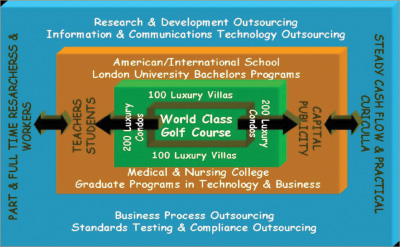 Our strategy is to start with the first property being purchased (1,000 acres near Kerala’s Periyar Tiger Reserve) and build a world-class golf community (along with health-care, yoga practices and ayurvedic healing) as our core return-on-investment component. It will also serve as the basis for attracting the best people to teach, whether as time-share visitors or full-time retirees. We plan to build a 27-hole golf course surrounded by 200 single-unit villas and another 200 apartment condos, priced at $500,000 and $250,000 respectively. Around this 350-acre golf and health-care community is planned a sprawling residential education campus consisting of an American/International School (supported partly by the U.S. State Department), an undergraduate program of B.Sc. degrees by the London School of Economics in business and technology subjects, a diploma program by Cambridge University in business and technology areas, an indigenous medical & nursing school, and future graduate programs in collaboration with some of the top universities in the U.S. The campus is planned to utilize another 350 acres of land. Total student population is planned at 50,000. Finally, corporations will be invited to locate their remote IT, R&D & BP outsourcing outposts in the remaining build-able land area of 350 acres to effect talent based synergies with the student and teacher populations in the campus. This utilization of the remaining vacant land will be in the form of long-term leases awarded to the corporations. Our strategy is to start with the first property being purchased (1,000 acres near Kerala’s Periyar Tiger Reserve) and build a world-class golf community (along with health-care, yoga practices and ayurvedic healing) as our core return-on-investment component. It will also serve as the basis for attracting the best people to teach, whether as time-share visitors or full-time retirees. We plan to build a 27-hole golf course surrounded by 200 single-unit villas and another 200 apartment condos, priced at $500,000 and $250,000 respectively. Around this 350-acre golf and health-care community is planned a sprawling residential education campus consisting of an American/International School (supported partly by the U.S. State Department), an undergraduate program of B.Sc. degrees by the London School of Economics in business and technology subjects, a diploma program by Cambridge University in business and technology areas, an indigenous medical & nursing school, and future graduate programs in collaboration with some of the top universities in the U.S. The campus is planned to utilize another 350 acres of land. Total student population is planned at 50,000. Finally, corporations will be invited to locate their remote IT, R&D & BP outsourcing outposts in the remaining build-able land area of 350 acres to effect talent based synergies with the student and teacher populations in the campus. This utilization of the remaining vacant land will be in the form of long-term leases awarded to the corporations.We plan to replicate this model in the East (Darjeeling/Gangtok), West (Sahyadri/Mahabaleswar), & North (Gangotri/Mussoorie) of India in phases once the golf community is pre-sold & construction has begun in each location during the course of the next 3 years. Expansion into China is also in the works. All of these campuses are planned to be networked into an extensive provider of Distance Education & E-Learning to thousands more at homes in India and China. As of now, only the land in Kerala has been finalized for purchase immediately. We are now embarking on the process of enlisting key investors in the equity of the new corporation being formed that will own and initiate this entire development process during the next three years. We expect to take this entity public at that time when the growth multiple will be in full play. We know the scene very well. I know all of the private players there. There is a huge need to create graduates — the number of employable graduates we have is not very different from Poland or Russia which is kind of painful to hear, because we are so much larger. The idea is that we don’t have to give them a Stanford brand, we don’t have to give them a really bad education — it has to be somewhere in the middle. The biggest problem is infrastructure and the second biggest problem is lack of teachers. Here’s where our future plans of distance education will come into play. India just hasn’t created the number of teachers required. Because we are going from 100s of institutions to tens of thousands. It’s not a joke, right? We have to take the best of teachers and marry distance education to them so that each can reach more number of students. Alo Ghosh can be reached at alo@aloghosh.com. |TOP| NEWS DIARY: March Roundup  Girls to Perform Altar Duties | Three Indian Americans Named Truman Scholars | Scientist Who Fostered Re-think, Wins Stockholm Water Prize | Nuke Deal Tough Sell | Indo-Pak Goods Train | HIV Infection Rates Fall in South India | Medical Tourism Expo | Bollywood Rules Ramp at Fashion Week | Bangladesh Doing Well | Divorce Ruling Hailed | ‘Time’ Lauds Sunita | Pakistan Relocating Quake-Devastated City | Go Kingfisher | Thriving Pak Press | Boost for Lanka Peace | Paintings Fetch $1M | Happy 91st Birthday Girls to Perform Altar Duties | Three Indian Americans Named Truman Scholars | Scientist Who Fostered Re-think, Wins Stockholm Water Prize | Nuke Deal Tough Sell | Indo-Pak Goods Train | HIV Infection Rates Fall in South India | Medical Tourism Expo | Bollywood Rules Ramp at Fashion Week | Bangladesh Doing Well | Divorce Ruling Hailed | ‘Time’ Lauds Sunita | Pakistan Relocating Quake-Devastated City | Go Kingfisher | Thriving Pak Press | Boost for Lanka Peace | Paintings Fetch $1M | Happy 91st BirthdayGirls to Perform Altar Duties Breaking a 2,000-year-old tradition, the Catholic church in southern Indian state of Kerala will permit girls to perform certain altar duties, which have normally been done by boys till now. Girls up to the age of 14 will be allowed to “serve the altar” and assist the priest in liturgical ceremonies like mass functions, which were normally being done by boys, spokesman of the Syro Malabar Church Father Paul Thelakat, told PTI. The altar girls will have specific roles to play during liturgical ceremonies, like lighting the incense, helping with the prayers and the priest to perform certain functions, he said. But this was not a first step towards ordaining women as priests, Father Thelakat said. According to Catholic Church women are not to be ordained. Christ had appointed 12 apostles who were all men. The church believes that priesthood is only for men, he said. All the churches under the Ernakulam-Angamally archdiocese of Kerala have been permitted by Cardinal Mar Varkey Vithayathil to have altar girls to perform the duties. The parish priests have been asked to take a decision after consulting the parish councils. Though the Vatican had allowed this few years ago and a couple of churches have altar girls on occasions, but this is the first time the church has given its consent, he said. The Kerala Catholic Bishops did discuss the matter last month and had stated that if parishoners and the priests had no objections, the girls can be allowed to perform altar duties. Father Thelakat said permitting girls to perform altar duties did not mean that boys were being dissuaded. He said there were certain stipulations to becoming altar girls. Only girls up to the age of 14 would be allowed to perform duties at the altar, they should be properly trained and should wear special vestments while performing their duties. |Back to NEWS Diary| |TOP| Three Indian Americans Named Truman Scholars Three Indian American university students have been named among 75 national Truman Scholars for 2006. Each student will receive a $30,000 scholarship for graduate study. The recipients are: Manasi Abhay Deshpande of the University of Texas-Austin, Mukul Kumar of the University of California-Irvine, and Kunal Malhotra of the University of Massachusetts-Amherst. Former Secretary of State Madeleine K. Albright, president of the Harry S. Truman Scholarship Foundation, announced the winners March 28. They were selected from among 598 candidates nominated by 311 colleges and universities by 19 independent panels on the basis of leadership potential, intellectual ability, and likelihood of “making a difference.” Kumar, a history major at U.C.-Irvine, is involved in nonprofit housing and urban development issues. As a licensed court mediator, he worked to resolve landlord-tenant and small claims court disputes at the Fair Housing Council in Orange County. Deshpande, in the Plan II honors program at the University of Texas, is majoring in economics and math. She works as a supplemental instructor in the economics department and is co-chair of Students for a Sustainable Campus. Malhotra, who grew up in Fairfax, Va., is majoring in history and political science at U-Mass. Since high school he has been interested in community service and environmental issues, culminating in a policy internship at the League of Conservation Voters. He later did organizational work as a legislative coordinator with Massachusetts Public Interest Research Group, where he worked to pass the Energy Efficiency Bill. Malhotra plans to pursue a law degree and an M.A in public policy. Besides the $30,000 grant, scholars also receive priority admission and supplemental financial aid at some premier graduate institutions, leadership training, career and graduate school counseling, and special internship opportunities within the federal government. Congress established the Truman Scholarship Foundation in 1975 as the federal memorial to Harry S. Truman, the country’s 33rd president. |Back to NEWS Diary| |TOP| Scientist Who Fostered Re-think, Wins Stockholm Water Prize India-born scientist Asit Biswas was awarded the $150,000 Stockholm Water Prize for his “outstanding and multifaceted” contribution to the issue of global water resources. The 67-year old Canadian citizen is president of the Mexico City-based Third World Centre for Water Management. Biswas helped foster a critical re-think among United Nations agencies, national governments, professional associations and others about how to improve delivery of water and sanitation services and management of the planet’s water resources, the Stockholm International Water Institute, which administers the annual award, said. Biswas, a tireless water proponent who constantly challenges the “status quo,” has, through his multi-faceted roles as a scientist and educator, acted as an advisor and confidant to policymakers in water and environmental management in 17 countries, to six heads of the United Nations agencies and to other intergovernmental and international organizations. Biswas fostered a new “socio-economic and political climate” that enabled translation of scientific (both natural and social) and technical advances into meaningful measures for people and planet, the institute added. He helped to formulate and promote the International Water Supply and Sanitation Decade in the 1980s which significantly improved the lives of millions of people in the developing world, it said. Biswas is the author of hundreds of books and articles and his work has been translated into 31 languages. |Back to NEWS Diary| |TOP| Nuke Deal Tough Sell The India-U.S. nuclear deal faces particularly difficult times as the U.S. Congress balks at U.S. President George W. Bush to rewrite the law to ratify his nuclear deal with India. Foreign Secretary Shyam Saran has been working Capitol Hill, trying to convince Congressmen on the merits of the Indian agreement, but India’s lobbying exercise with the much-touted India Caucus is faltering. Emphasizing that its nuclear deal with the US was the result of “complex” negotiations, India has cautioned those pushing for so-called changes, including American lawmakers, not to upset this “very, very delicate balance” and that there will be a “loss in terms of expectations” if the pact was not approved. A bill in the Senate and another in the House of Representatives seeks to amend U.S. legislation to ratify the deal, while an opposing bill has also been introduced in the House against the India-U.S. nuclear agreement. The irony is that 10 of the 18 Congressmen who have co-sponsored or supported the opposing bill are members of the India caucus, billed as the largest caucus in the US Congress on any one country. Almost all are Democrats, which is interesting, since most of the Indian Americans have traditionally been Democrat supporters. It is the reticence of New York Democrat Sen. Hilary Clinton that has India deeply disappointed. Clinton, said sources, derives a large amount of campaign funding from Indian Americans, but her silence, verging on opposition is, as one Indian American said, “deafening.” Meanwhile, Saran maintains that India would like to see the deal approved by Congress as quickly as possible, adding that there was “indeed wide support on Capitol Hill for the evolving bilateral relations” and that its culmination straddled both Republican and Democratic administrations. |Back to NEWS Diary| |TOP| Indo-Pak Goods Train With the Samjhauta Express between Attari and Lahore already through, goods train services between India and Pakistan may begin soon to boost trade ties between the two countries. “Relations between India and Pakistan have improved and people-to people-contact got a boost with the starting of the train service under the peace process initiated by Prime Minister Manmohan Singh. Efforts are also on to start goods train services between the two countries,” Union Minister of State for Home Sriprakash Jaiswal said recently. Turning to the border issue, he said fencing was expected to be completed in the next two months in areas where it could not be carried out initially due to some problem. Jaiswal claimed that smuggling activities had stopped due to the fencing along the Indo-Pak border areas. Replying to a question, he said security forces would not be withdrawn from the Indo-Nepal border owing to the recent developments in a reference to the sealing of the Panitanki- Kakarvita check point in West Bengal following a Maoist attack on a Nepalese security force camp across the border. |Back to NEWS Diary| |TOP| HIV Infection Rates Fall in South India The number of HIV infections has fallen by more than a third among young people in southern India, according to a study published in a medical journal. The 35 percent drop in HIV cases among people aged 15-24 was the result of better prevention, researchers from the University of Toronto said in a study published on the Web site of the Lancet, a British medical journal. The researchers singled out efforts by the Indian government, the World Bank and other non-government groups to educate sex workers and men who frequent them about the dangers of HIV, efforts that “appear to have contributed to a drastic decline” in new infections. The study was conducted by a team of Indian and Canadian researchers who found that the prevalence rate in the four southern states of Tamil Nadu, Andhra Pradesh, Maharashtra and Karnataka, which account for about 75 percent of India’s HIV infections, fell from 1.7 percent in 2000, to 1.1 percent in 2004. India has an estimated 5.13 million people with HIV, second only to South Africa. Still, there are fears that ignorance and the stigma attached to the disease could hamper prevention efforts and lead to an explosion in new infections across India. “HIV remains a huge problem in India and we have to remain vigilant,” Rajesh Kumar, one of the authors of the study, said in New Delhi. “We’re not saying the epidemic is under control yet — we are saying that prevention efforts with high-risk groups thus far seem to be having an effect.” In fact, another of the report’s authors, Prabhat Jha, warned: “The not-so-good news is that trends in the north remain uncertain and poorly studied. “We have to identify the hot spots — highways, factories, places where young men gather — and scale up prevention efforts,” said Jha. |Back to NEWS Diary| |TOP| Medical Tourism Expo The second India Medical Tourism Expo, scheduled to take place in London 2-4 June, focuses on India as a global health care and tourism destination and patients traveling overseas for therapy. With increasing waiting times and the prohibitive cost of seeking private medical treatment in the U.K., many patients are now seeking treatment in India. India offers some of the best medical treatments in the world and has experienced a boom in recent years in patients or “medical tourists” as they have become known, traveling there for treatment. Healthcare facilities are among the most cost effective in the world, with private hospitals and clinics offering treatments at a fraction of the price offered by private hospitals in the U.K. Recently, a Briton, who was refused a desperately-needed operation by the National Health Service as he was too overweight, returned home satisfied after undergoing the surgery in India. David Rogers, 62, was told that he was too overweight for the double hip and knee replacements that he desperately needed. Weighing almost 140 kg, he was told that he was about 37 kg too heavy for the surgery. He reduced his weight to about 115 kg but could not go beyond that. The surgery was required as his heavy weight had made his joints immobile. “I was in so much pain I couldn’t lie in bed at night and had to sleep sitting in a chair. It was a vicious cycle because I couldn’t do any exercise, so I struggled to lose any more weight,” Rogers said. His wife had seen a television program about Britons flying to India for medical treatment. Further investigations led her to a website that offered people access to top-class medical treatment in India. Two weeks later, Rogers flew to Bangalore for the first phase of major surgery, a reconstruction of the knee and hip on the right side, costing about 10,000 pounds. “I can’t speak more highly of the nurses and surgeons there. The treatment I received was first class,” said Rogers. |Back to NEWS Diary| |TOP| Bollywood Rules Ramp at Fashion Week Fashion designers seem to have been smitten by the Bollywood bug with the Lakme Fashion Week here featuring a number of Bollywood stars walking the ramp. While John Abraham catwalked for designer Rocky S, it was the presence of Salman Khan that came as a surprise. Later in the evening, celebrated Bollywood designer Manish Malhotra had a large film contingent comprising Jaya Bachchan, Kirron Kher, Malaika Arora Khan, Amrita Arora, Bobby Deol, Karan Johar, Sridevi, Boney Kapoor, among others, cheering his collection titled “Freedom.” Actresses Kajol and Preity Zinta even walked the ramp wearing Malhotra’s designer wear. In the afternoon, the shows of designers Bennu Sehgal and Maheka Mirpuri had Arbaaz Khan and Koena Mitra strutting their stuff on the ramp. The Lakme Fashion Week showcased designers like Ritu Beri, Sabyasachi Mukherjee, Manish Malhotra, Suneet Varma, Wendell Rodricks, Rocky S, Ashish Soni and Priyadarshini Rao. |Back to NEWS Diary| |TOP| Bangladesh Doing Well Bangladeshi farmer Badiuddin Ahmed cultivates his employer’s field with cows at Hothatpara. Bangladesh has outperformed most low-income nations, the World Bank reports. Bangladesh has outperformed most low-income nations and its South Asian neighbors, except Sri Lanka, across a range of social indicators in the past decade despite perceptions of weak and deteriorating governance, the World Bank said. “Bangladesh has recorded impressive economic and social gains in the past decade. The country has doubled per capita growth and taken strides towards reaching many of the Millennium Development Goals,” a World Bank statement said quoting a discussion at its headquarters in Washington DC on the Country Assistance Strategy for Bangladesh for 2006-2009. It said gender parity in school enrollment at both primary and secondary level has been achieved, child mortality has been halved and life expectancy has increased significantly since the 1990s. “These gains have been achieved despite widely held perceptions of weak and deteriorating governance,” it added. “To explain this conundrum we must unbundle governance and recognize that Bangladesh has had both governance successes and governance failures,” said Praful Patel, World Bank vice president for the South Asia Region. The new CAS for Bangladesh places governance at the heart of the WB’s program of support and it envisages a program of around $3 billion over four years. The WB statement said among governance successes, Bangladesh has shown important gains in public accountability, with three successive free elections, an assertive Supreme Court, sound public procurement regulations, an active civil society, and a relatively free media. |Back to NEWS Diary| |TOP| Divorce Ruling Hailed Women’s rights activists in Nepal have hailed a Supreme Court’s ruling to scrap a law that allowed men to seek divorce if their partner was infertile. Under the 43-year-old law, men were able to file for divorce if they could prove through a doctor their wives were unable to conceive for 10 years. Activists said the court verdict was a milestone towards scrapping laws that were discriminatory towards women. The court has issued a number of rulings on women’s rights recently. The latest ruling was made a year after a case was filed by a Kathmandu-based women’s rights group. The group said that the law did not consider the fact that men can also be responsible for a couple not being able to have children. The court said the provision in the divorce law allowing men to divorce their partners on grounds of infertility was against the spirit of the country’s constitution and international law. The court asked the government to scrap the law, and bring in a new one to avoid inconsistencies. The latest court verdict has come in a series of what rights activists have praised as progressive judgments by the Supreme Court. Last December the court asked the government to scrap a “discriminatory” rule that women must ask permission of family members before selling inherited property. The court also eased the regulations for women to obtain passports and ruled that women should not suffer discrimination during the menstruation cycle. |Back to NEWS Diary| |TOP| 'Time’ Lauds Sunita Sunita Narain and Bhure Lal, credited with cleaning up Delhi’s air and help build the world’s cleanest transport system, are among top environmentalists worldwide whose efforts have been praised by Time magazine. The magazine notes it was a lawsuit filed by Narain, director of the Centre for Science and Environment, in mid-1990s to force Delhi’s buses, taxis and rickshaws to convert to cleaner compressed natural gas fuel that set the ball rolling with the Supreme Court largely ruling in her favor. “But busmakers and oil companies, supported by government ministers, objected loudly. So the court formed a committee led by Lal and Narain, to enforce its judgment,” Time writes. And it was largely due to their fight that the last diesel bus had left Delhi by December 2002 and 10,000 taxis, 12,000 buses and 80,000 rickshaws were powered by CNG. Recalling the days when they began the struggle, Narain, told the magazine that air pollution was taking one life per hour. “The capital was one of the most polluted on earth. At the end of the day, your collar was black and you had soot all over your face. Millions had bronchitis and asthma,” said Lal, who was then a senior government administrator. “Delhi leapfrogged. people noticed,” Narain said. |Back to NEWS Diary| |TOP| Pakistan Relocating Quake-Devastated City Pakistan has decided to relocate a quake-devastated city after experts declared any new construction dangerous, a cabinet minister said. Balakot, a scenic town about 120 miles north of the capital Islamabad with a population of 300,000 people, was destroyed when the 7.6-magnitude quake hit the country on Oct. 8. Thousands of people died in the debris and many others were left homeless. Information Minister Sheikh Rashid Ahmed said the government had decided to move the city to a new location. The October quake toppled homes, schools, mosques, hospitals and government buildings in northwest Pakistan, including its portion of Kashmir, killing over 80,000 people and leaving more than 3 million homeless. Many victims are still living in tents donated by the international community. The area has since been plagued by aftershocks, including a magnitude-6.0 quake in November that unleashed landslides near Balakot. |Back to NEWS Diary| |TOP| Go Kingfisher You can’t advertise alcohol in India. But if you think that’s going to stop liquor baron Vijay Mallya, think again. He simply put his brand on an airline. The man himself is a walking brand of sorts. The arrival at Kolkata airport of India’s self-styled “King of Good Times” attracts the kind of attention usually reserved for Bollywood stars. The billionaire liquor baron, chairman of United Breweries and purveyor of Kingfisher beer is known for his ostentatious lifestyle — opulent homes, personal jets, racehorses, yachts and legendary parties — and Mallya delights in shattering traditional attitudes. Now he is taking Indian business in a new direction. In the tradition of Virgin’s Sir Richard Branson, he has shamelessly wedded his lifestyle with his brand. Kingfisher and Mallya are fast becoming household names. “What I’m doing has never been tried before in India,” said Mallya, striding towards a brand-new Airbus that he has bought for his latest venture, Kingfisher Airlines. “We have broken the shackles of conservative socialism. Indians are no longer going to remain subdued and live in a simple fashion. The growing middle classes want the kind of standard of living you enjoy in the West. So what I’m selling is a lifestyle. Young Indians want to be like me. They see that as something to aspire to.” At 50, with a mane of black and grey hair, he looks like an Indian version of the boxing promoter Don King. His trademark jewelry puts even Ali G to shame. Diamonds sparkle from his earlobes and fingers; gold chains and pendants flash in the V of his open shirts and Armani silk suit. Around one wrist dangles a chunky, jewel-encrusted bracelet initialed VJM. “You won’t have to go far to find people with all sorts of opinions about me,” he added, making his way along the airport’s VIP track. “They like to snipe at the way I live. But I make no apologies. I’m a businessman. I work damn hard and I play hard. What’s most important is my stock price. It’s through the roof. I’ve got market leadership everywhere I go.” |Back to NEWS Diary| |TOP| Thriving Pak Press A political cartoon in Pakistan which satirizes the relationship between President Musharraf and President Bush has been proving very popular, reports the BBC. The “Bush and Mush Show” is a spoof of the news conference held during the recent visit of the U.S. president and it is getting a lot of play. The punch line? Bush casually dismisses concerns over Mush’s democratic credentials, in Pakistani street lingo. The lampoon seems to demonstrate a vibrant culture of criticism. Indeed Gen Musharraf claims to have liberated the press, even though he is a military leader. But is the reality really so rosy? The media here does have the freedom to mock the leader — a freedom for which Gen. Musharraf took credit at the real presidential press meet. Television journalism has certainly taken off under his watch. The Aaj TV channel, which specializes in news and current affairs, is just celebrating its first anniversary. But Aaj’s current affairs director Talat Hussein is wary of the president’s claims. He says: “Musharraf certainly gave us licenses, and therefore the private sector channels came up. But, in terms of the tradition of doing critical, incisive journalism, that was always there — embodied in print journalism that we’ve seen in Pakistan.” Indeed the Pakistani press has a history of being combative and taking on authoritarian governments. Despite problems the presses keep churning out the news. But even where there is freedom, its impact is limited, in a system dominated by the military, says Mohammed Ziauddin, the Islamabad editor of the liberal Dawn newspaper. He says: “In order for the media to be effective, you have to have two other social controls as well working in tandem: that is the parliament and the judiciary. “At the moment, both of them are very weak. Both parliament and the judiciary are operating or functioning under the thumb of the military. “So that way, we can report what we see, but it doesn’t make much of a difference.” |Back to NEWS Diary| |TOP| Boost for Lanka Peace The crushing electoral defeat of Sri Lanka’s nationalist Buddhist monks and Marxists, who both oppose Norwegian-backed peace moves, could boost efforts to end ethnic bloodshed, analysts said. Official results of the poll showed that President Mahinda Rajapakse’s People’s Alliance won 225 of the 266 local councils. By contrast, the Marxist JVP barely managed to retain their one council and the JHU all Buddhist-monks party failed to secure one. “No doubt this augurs well for the future and the peace process,” the state-run Daily News said in an editorial. “It is quite obvious that those political parties seen as espousing the interests of specific cultural groups have been rejected.” The JVP and JHU are both coalition partners of President Rajapakse in parliament but each contested the local elections independently. The privately-owned Island newspaper said the Marxists were disappointed by the results as they had expected to control at least half a dozen councils and demonstrate their electoral strength. But the poll had exposed the vote base of the Marxists, Island said, adding that the party had been left with only a “loin cloth”. In an editorial headlined: “Road is clear, Mr. President,” it said the JVP had “overestimated its strength and, worst of all, came to believe in its own propaganda lies. It went to the extent of boasting that it was ready to even take over the country.” There was no immediate reaction from either the monks or the Marxists, but the president’s party invited both to cooperate with him and work towards delivering services to people at the local level. Both parties have a hardline stance against Sri Lanka’s peace broker Norway and oppose concessions to Tamil Tiger rebels, but the peace bid was not an issue during the local election campaign. More than 60,000 people have been killed in Sri Lanka’s drawn out Tamil separatist conflict. |Back to NEWS Diary| |TOP| Paintings Fetch $1M Paintings by two renowned Indian artists, Syed Haider Raza and Tyeb Mehta, have fetched a whopping sum of over a million dollars each at Sotheby’s. At the recent sale, the top lot was Raza’s painting “Tapovan” (1972), which sold to an anonymous bidder for $1.47 million while compatriot Mehta’s “Falling Figure with Birds” (1988) fetched a close $1.24 million. Sotheby’s heavily emphasized the modern works in its sale of Indian and Southeast Asian art which earned an astounding $13.6 million, well above the high pre-sale estimate of $10.7 million. It set a record for the highest auction total ever for Indian and Southeast Asian art, according to the house. Other Indian painters whose works raised record prices included J. Swaminathan, Akbar Padamsee and Ram Kumar. Contemporary Indian art is attracting new buyers, both among non-resident Indians and collectors on the subcontinent. “We’ve seen Indians buying more widely over several categories,” Sotheby’s head of Indian and Southeast Asian art, Robin Dean, was quoted as saying. This year, Christie’s is breaking its modern and contemporary Indian art into a separate catalogue. Its sale of Modern and Contemporary Indian art is estimated to bring between $6.9 million and 9.4 million while its sale of traditional Indian and Southeast Asian art is expected to raise $3.9 million to $5.5 million. The works of Mehta, Raza, F.N. Souza and M.F. Hussain will be on sale. |Back to NEWS Diary| |TOP| Happy 91st Birthday Bailed out of penury by admirers, Bharat Ratna-winning shehnai maestro Ustad Bismillah Khan cut a 91-kg cake in a birthday celebration in Varanasi belated by four days in protest against the March 7 terror strike. Khan turned 91 but deferred the party on account of it being Chehellum, 40th day of mourning of the slaying of Prophet Mohammad’s grandson Imam Hussein, and to protest the Sankat Mochan temple and Cantonment Railway Station blasts that rocked the temple town early this month. Science and Technology Minister Kapil Sibal who was to present the monthly check of Rs. 10,000 he had announced from his personal earnings, could not attend the function due to commitments in New Delhi. However, several hundred people wished the renowned musician “Happy Birthday” while he was presented a cash reward of Rs. 100,000 by Sulabh International president Bindeshwar Pathak and Rs. 50,000 by media couple Shivnath and Nina Jha who are ardent fans. The two, who run a publication in New Delhi, also presented the ustad a monograph of his life promising him royalties from the book as a “token contribution” to help him lead a comfortable life and a silver shehnai weighing 3 kg in recognition of his contributions to classical music. The nonagenarian regaled music lovers with renditions from his vast repertoire and expressed a “last wish” to perform at Darbhanga in Bihar and at India Gate in New Delhi. Listening to classical music would give the people peace and rejuvenation, refresh their bodies and minds and inculcate positive thinking, he said. |Back to NEWS Diary| |TOP| COUTURE: Redifining the Saree: Satya Paul Fashion Show In barely a decade Satya Paul has made its name in India for redefining the concept of the saree with its bold designs and bright colors. Now the designer saree brand comes to the U.S. Som Sharma’s photo essay offers glimpses of some of the designs at a fashion show in Newark, Calif.   |TOP| CULTURE: Avant Garde Cinema: Filmmaker Ashish Avikunthak Amid the overwhelming clout of Bollywood and multiplexes, Ashish Avikunthak has dared to make avant garde, experimental films for 11 years. A Siliconeer report.
Ashish Avikunthak is one such filmmaker. One of the foremost experimental short filmmakers in India, he has been making films for the past eleven years. His works have been showcased in films festivals around the world. A man of many vocations, Avikunthak was raised in Kolkata, and he did his undergraduate degrees in social work and archaeology in Bombay and Pune University respectively. He worked as a political activist for the Narmada Bachao Andolan, a folklorist amongst the Warli tribal community in Maharashtra and as an archaeologist has been part of excavation projects in India, Italy and Peru. Presently he is a doctoral student at Stanford University, finishing his dissertation on the archaeology of the Indus Civilization. After a decade of making short films, Avikunthak has finished a Bengali feature-length experimental film, Formless Shadows (Nirakar Chhaya). The film is a cinematic interpretation of the Malayalam novella “Pandavpuram” by Setu Madhavan. It explores the psychological universe of a lonely woman abandoned by her husband, awaiting a paramour who she imagines will rescue her from the mundane ennui of her daily existence and bring passion into her forlorn life. This yearning stems from both her emotional need to overcome loneliness and a suppressed sexual desire. As the yearning translates into an imagined reality, the film travels through the life of this lonely woman, inhabited by a loving sister-in law and an imagined paramour. “Socially the film is a reflection on contemporary urban society in India which is increasingly faced with the problems of alienation arising from nuclear family units and rising levels of marital separation and abandonment,” Avikunthak says. “In the absence of the support of the larger joint family, this alienation can take on the nature of a psychosis. The film attempts to probe into the complexities of such a state, which blurs the boundaries between reality and imagination.” The film, shot in both black and white and color, is a melancholic contemplation upon the reality of the imagined world that the protagonist of the film creates. The narrative of the film constantly oscillates between real and non-real, heightened by the usage of both black and white and color images to produce an intense emotional experience exemplified by loss and pain. “This film is an interplay about the subtext of desire and secrecy between friends which simultaneously threatens and bonds any relationship,” the filmmaker says. The cultural anthropologist in Avikunthak comes out as the films attempts to deal with cultural complexities relating to religion, sexuality, performance and political identity in postcolonial India. Nirakar Chhaya, like Avikunthak’s earlier films, is a self-financed film made with his savings from the stipend he gets from Stanford University. “This is not a low-budget film, this is a no-budget film,” he notes wryly. The film was shot in Kolkata with a small group of professional cast and crew. “The technicians were friends from my FTII days and the actors were from the vibrant group theatre movement in Kolkata,” he explains. “These are people who believed in my vision of the film and were willing to work on the project without remuneration, driven by a belief in making a work of art.” Shot in three weeks in October 2004, the film took nearly six months to edit because of its complex narrative structure. At the moment, Avikunthak is working with an award-winning Stanford University composer laying the music of the film and doing its sound design. He hopes to get the film ready by the end of this year for the festival circuit next year. Experimental films as a genre does not have existence in India in the way it does in Europe and the U.S. Nonetheless, there have been a few practitioners of this art form in the Indian government-run Films Division in the 1960s -70s. Early Indian parallel cinema directors in the 1970s like Mani Kaul, Kumar Sahani, G. Arvindan are considered by many film scholars to be filmmakers who were making avant garde narrative films. Almost all these film were funded by the National Film Development Corporation, various state governments and the Films Division. With the advent of liberalization in 1991, the state-funded mechanism of funding art cinema died, and with it directors who were making parallel cinema faded away or were subsumed by all-powerful Bollywood. It was in this depressing context that Avikunthak started to make films. Avikunthak considers himself as a “fringe of the fringe filmmaker.” Not only is he outside the ambit of mainstream filmmaking world, he claims he is not even part of the alternative documentary filmmaking community in India. He passionately notes, “I look at films as means of artistic creation driven by deep aesthetic processes, and not a means of entertainment like Bollywood or Hollywood does, nor a means of producing political propaganda as television documentary does.” He says he is an outsider because he works not only outside the logic of commercial or art cinema in India, but also outside the framework of documentary films making tractions, which are supported by television grants or NGO money. Then how does he make films? “That’s easy,” he confidently remarks, “I make films using my own savings; people buy houses and cars, I make films.” A self-taught filmmaker, Avikunthak never went to a film school, but started making films while he was doing his MA in archaeology in Pune, in 1995. He worked with filmmaker friends at the neighboring Film and Television Institute of India, assisted them on their student films, watched classics of world cinema and learnt the craft hands-on. The first film he made was a single shot, single take, conceptual film that shows a man walking nude in a derelict landscape for nine minutes. Shot on 16mm, during the pre-digital days, Ashish made this film with a small sum of Rs. 7,000 that he had saved from writing articles for local newspapers. He has come along way since then. He has made more than half a dozen short films and two videos that have been shown in various film festivals throughout the world In London, New York, Los Angles, Paris, Brussels. One of them, Kalighat Fetish (Kalighat Atikatha) won a top award in 2001 at the Tampere Film Festival, Finland, one of the biggest short film festivals in the world. His films have been showcased at retrospectives of Indian experimental and documentary films in Brussels, and he was recently invited in February 2006, to an avant-garde film festival in Lyon, France — Les Inattendus, a premier experimental film festival in Europe which honored him with a retrospective of his work. Avikunthak’s films are experimental in the sense that they are not about story telling but about image making. “They are about producing ephemeral experiences, and not about telling a linear story with a beginning, middle and an end,” he explains. These are experimentations with both form and narrative, and consist of powerful images tied together in a cohesive montage, through which a cinematic experience is conveyed rather than a story told. Avikunthak conceives of films as a series of images rather than a story or a narrative, but is driven by a thematic focus, which are usually conceptual in nature. For example, Kalighat Fetish deals with the ceremonial performance of male devotees cross-dressing as Kali, interwoven with grotesque elements of a sacrificial ceremony, which forms a vital part of the worship of the goddess. This film is an attempt to negotiate with the duality that is associated with the ceremonial veneration of the Kali, the presiding deity of Kolkata. Avikunthak clarifies that “this film is an exploration of the sexual subtext central to the Mother Goddess cult and ruminates on the nuanced trans-sexuality that is prevalent in the ceremonial performance of male devotees cross-dressing as Kali.” Dancing Othello (Brihannala Ki Khelkali), made in 2002, a film Avikunthak made after he had come to the U.S., explores a moment of imaginative intersection of two seventeenth century classical artistic traditions — Shakespearean tragedy and South Indian dance Kathakali. The director’s statement of this film declares that this is a film in which “Shakespearean theatricality meets the subtlety of Kathakali, subverted in the dramatic space of street theatre to give birth to a performative ‘caliban’ — Khelkali — a hybrid act of articulating the post-colonial irony of contemporary India.” His latest venture, a Hindi short film — End Note (Antaral) — was made last year and was recently shown as the Asian Short Competition at the Bangkok Film Festival in February this year and is scheduled to be shown in film festivals in Canada and Germany. This film is an abstract interpretation of one of Samuel Beckett’s shortest plays — “Come and Go.” Shot in Kolkata, this film deals with nostalgia and loss among three women who reminisce about their times at school and rekindle and affirm old friendships. Avikunthak believes that he would have been able to complete Nirakar Chhaya, his first feature film, last year, but lack of funds, the impossibility of getting a commercial producer in India and the difficulty in getting grant money from a handful of international organizations delayed the completion. At the moment he is still nearly $20,000 short and now looking for support. His friends are organizing fund-raising parties to help him raise funds to finish this film. Avikunthak can be reached by e-mail at avikunthak@gmail.com. |TOP| SOCIETY: The Stark Divide: The Pitfalls of Unequal Growth There is an India that is looking to grow over 10 percent. There is another India which is watching this as an outsider. The tensions are showing, writes Siddharth Srivastava. 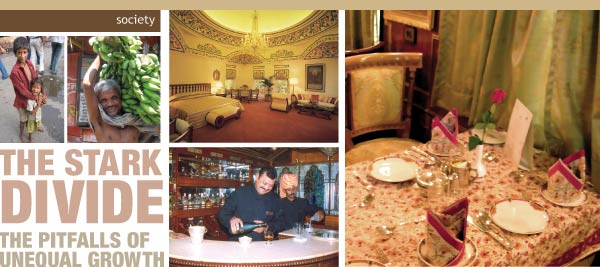 From top, left: For India to sustain its prosperity, some of it must reach people like this Mumbai kid and his sister; A smiling banana seller who hasn’t benefited much from India’s ballyhooed growth; Opulence fit for a Maharajah for today’s nouveaux riches; Not everybody is invited to dinner yet in India’s stratified prosperity; Yesteryear’s feudal luxuries within easy reach of today’s rich. There is an India that is looking to grow at over 10 percent per annum. Prime Minister Manmohan Singh, on a recent visit to Mumbai, reiterated his Mumbai-as-Shanghai dream and talked about full convertibility of the rupee. However, there is another India that is witness to the growth and prosperity without any participation in its fruits. And the tensions are beginning to show. China recently closed one of its longest debates on economic reforms as Beijing approved a five-year plan that seeks to address the income inequalities that separates cities and the countryside. This gap has been related with corruption, land grabs, rise in unrest in the countryside that is home to more than 700 million people who earn a third of the wages of the urban average. India too is simmering, with close to 700 million still out of the ambit of rising incomes. Only recently there has been widespread rioting in New Mumbai, the new outsourcing and information technology hub, in the suburb of commercial capital Mumbai. Though the immediate cause seems to be an incident of sexual harassment of a woman, discontent has been simmering within the local community which has been witness to the economic boom in the area without entirely being a part of it. Employment has been garnered by migrant labor that is a cause for angst. High paying executives driving fancy cars are housed in spanking new buildings that was once farmland. Local residents, mostly young boys, attacked several passing vehicles. As India progresses, so have crimes related to what are considered flashpoints of a consumerist existence. Recently a 29-year old employee of software giant Infosys was killed on way from Pune to Mumbai. His murderers took away his credit card (one of the killers ostensibly shopped for his girlfriend with it). In Delhi, two prominent lawyers, a mother and daughter duo, were found murdered inside their upmarket flat. The police are working on they hypothesis that robbery or a property dispute are possible motives. Car thefts are on the rise, so are credit card frauds and other forms of financial embezzlement. Women have increasingly become targets, with Delhi being declared the rape capital of India, with a record of over 700 reported cases last year. Crime is not just an urban phenomenon. Elsewhere, while the focus is on terrorist attacks in Indian Kashmir, north eastern states and other parts of India, a bloodier battle is being waged in the hinterlands of several Indian states (Andhra Pradesh, Madhya Pradesh, Bihar, Jharkhand, Chhatisgarh, Orissa), where the Maoists and Naxalites rule with the gun. Close to a hundred deaths have been reported this year from just one district of Dantewada in the central Indian state of Chhatisgarh due to Maoist violence. 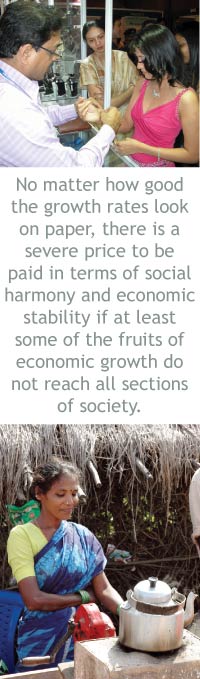 Recently, communist rebels captured a train with over 60 passengers in a remote part of Jharkhand. The passengers had a miraculous escape as it seems that the Naxals only wanted to convey a message of the extent of damage they can inflict. In February, Maoists attacked a truck convoy in Chhattisgarh, blowing up one of the vehicles and setting two on fire. Twenty-four people were killed, and 32 injured. Recently, communist rebels captured a train with over 60 passengers in a remote part of Jharkhand. The passengers had a miraculous escape as it seems that the Naxals only wanted to convey a message of the extent of damage they can inflict. In February, Maoists attacked a truck convoy in Chhattisgarh, blowing up one of the vehicles and setting two on fire. Twenty-four people were killed, and 32 injured. To be sure, many conflicts are results of local issues, but one of the main reasons for the festering of the Naxalite problem has been the absence of land reforms. The Maoists feed on the cadres of tribals and dalits (considered to be of the lower castes) who have been dispossessed of their lands with the indifferent state machinery adding to the alienation. The police and landlords remain the two biggest targets of the Maoists. A study by the federal home ministry study said murders of police personnel by the guerrillas jumped 53 percent to 153 in the year to March 31, 2006, while 516 civilians were killed, an 11 percent increase on the previous year. “As many as 76 districts in nine states ... are badly affected by Naxal violence although in a varying degree,” the report said, adding that the banned groups have also established inter-state logistics and communications links among its cadres. Since 1991 India has been following a path of economic reforms and industrial liberalization, unshackling what was called the license permit raj. The reform process included the free entry of private players in areas hitherto controlled by the government, invitation of foreign direct investment and divestment of public sector behemoths that were set up as the commanding heights of a planned Indian economy, as envisaged by India’s first Prime Minister Jawaharlal Nehru. In the past decade, a broad consensus has developed about the entry of private players who now play an active role in sectors ranging from telecom, banks, health, automobiles, airlines, consumer durables, computer hardware, finance, retail, property development and more. The consumer has been the beneficiary due to competitive pricing and better customer service. Airline fares, telecom rates, prices of consumer durables have been on a downward spiral the past few years. However, India’s recent political history is strewn with leaders who were at the forefront of economic reforms and yet lost in elections. These include former Prime Minister Atal Behari Vajpayee and former chief ministers of Karnataka and Andhra Pradesh, S.M. Krishna and Chandrababu Naidu, respectively. Their successes in engendering growth and changing the lives for some created resentment among the many more who witnessed tall buildings, flashy cars and swanky lifestyles, but had no access to any of this. Although China has announced its intention to look at the countryside now, New Delhi has been looking at this aspect for close to a year now. Keeping the angst of those left behind in mind the Manmohan government launched a rural upliftment project last August that will cost over $40 billion per year. The aim is to provide a human face to India’s economic reforms. As per the contours of the anti-poverty scheme, the government will provide a minimum wage of close to $1.5 per day to all rural households in 200 districts for a period of 100 days. 90 percent of the expenditure will be borne by the center and the remainder by the states. New Delhi has also announced an urban renewal scheme in December that has a provision for disbursing funds to upgrade the infrastructure of 63 selected cities. Over $12 billion has been earmarked for the project and will be disbursed over seven years. Both the schemes translate into a cost and scale the government believes it can pull off by cross-subsidizing via taxation from the high-growth areas. This is one of the reasons that the government has hiked the service tax from 10 to 12 percent. The service sector now contributes more than 50 percent of the GDP. Indeed, the sobering realization has dawned on both policy makers as well as India’s political bosses that no matter how good the growth rates look on paper, there is a severe price to be paid in terms of social harmony and economic stability if at least some of the fruits of economic growth do not reach all sections of society. That’s not a very fashionable viewpoint in these days of market-worshipping free-market ayatollahs of the Washington consensus, but India’s political leadership knows better, because to India’s eternal credit, it is a democracy with real teeth, where the poor actually vote, and have a disconcerting habit of throwing out the government if all the fruits of growth accrue to the wealthy and they are obliged simply to watch the tamasha. Growth cannot be uni-dimensional. In order to guard against social unrest, every effort has to be made to spread out the gains through institutional reform and decentralization. - Siddharth Srivastava is India correspondent for Siliconeer. He lives in New Delhi. |TOP| COMPETITION: Meeting Derek O’Brien: How Smart Are You? Indian quiz master Derek O’Brien, popular television host and prolific author, will conduct a series of quiz shows in different parts of the U.S. with a high number of Indian Americans. A Siliconeer report. 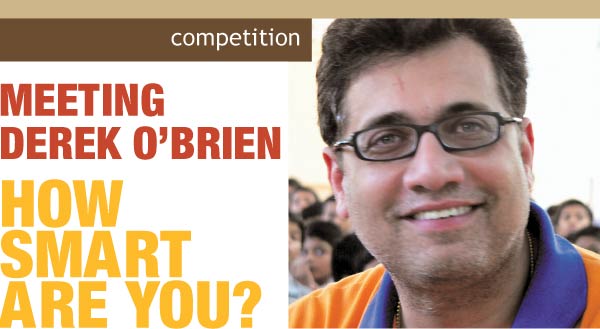 Renowned Indian quizmaster Derek O’Brien will conduct a quiz in several U.S. cities in a show hosted by ICICI Bank, according to a press release from the bank. The quiz show will be open for people of Indian origin in the U.S. The quiz will cover a variety of subjects related to India such as history, heritage, language, mythology, geography, politics, science and arts. “Quizzing is the best form of purposeful recreation that integrates general knowledge and creativity,” the ICICI release added. “Through this quiz show, ICICI Bank aims to combine competition and entertainment for the entire family.” The quiz will be held in cities/states with a high Indian American population, such as, New Jersey, New York, Chicago, Atlanta and Sunnyvale. The first show will kick off on March 25, 2006 in New Jersey and the quiz will end in Sunnyvale on May 20, 2006. The quiz show will be conducted by Derek O’Brien. Participants can register in two categories — Junior (Grades 5 through 8) and Open (Grades 9 and above), and the participants can form teams of three on the day of the quiz at the venue. The elimination round will be a written test and six teams will advance to the final round. There will be two final rounds (one each for the Junior and Open categories), which will be conducted live on stage by Derek O’Brien. More information is available on the bank’s Web site: www.icicibank.com ICICI Bank is listed in the New York Stock Exchange and is India’s second largest bank and its largest private sector bank. With over 50 years of financial experience and with assets of $47 billion, the bank offers a wide range of banking products and financial services to corporate and retail customers through a variety of delivery channels and through its specialized subsidiaries and affiliates in the areas of investment banking, life and non-life insurance, venture capital and asset management. ICICI Bank has over 15.5 million retail customer accounts, a network of over 610 branches and extension counters, and 2,121 ATMs. ICICI Bank Limited set up its international banking group in fiscal 2002 to cater to the cross-border needs of clients and leverage on its domestic banking strengths to offer products internationally. Its international presence spans 12 countries and includes three wholly owned subsidiaries in the United Kingdom, Russia and Canada, offshore banking units in Singapore, Hong Kong and Bahrain, a branch in Sri Lanka and representative offices in the United States, China, United Arab Emirates, Bangladesh and South Africa. |TOP| HEALTH: A Living Dangerously: Heart Disease and Indians Why is the risk of heart disease increasing with the Indian American population? What can each of us do about it? Kavita Sharma, M.D., offers some answers.
 Why is the risk for coronary heart disease higher — and increasing — for Indian Americans? In January’s issue, we took a look at general factors concerning a healthy heart. In this issue we go into more specifics, particularly why the risk of heart disease is increasing with the Indian American population, and what each of us can do about it. Why is the risk for coronary heart disease higher — and increasing — for Indian Americans? In January’s issue, we took a look at general factors concerning a healthy heart. In this issue we go into more specifics, particularly why the risk of heart disease is increasing with the Indian American population, and what each of us can do about it.Upon initial reflection, one would not expect Indians in the U.S. to be more susceptible to heart disease than any other group. This is because many Indians are vegetarians and do not smoke. They are also highly educated and less obese. However, the incidence, prevalence and mortality from coronary heart disease among Indian Americans have been 50 to 300 percent higher than Europeans, Americans and other Asians in the U.S. The high rates of coronary heart disease in Indians appears to be a global phenomenon, shared by the inhabitants of the four countries of the Indian subcontinent (India, Pakistan, Bangladesh, and Sri Lanka) as well as immigrants from these countries to various regions of the world. The death rates from coronary heart disease among overseas Indo-Asians have also been higher than other populations, irrespective of gender, religion, or social class. Indo-Asians also have a higher risk of coronary heart disease at a younger age. During the past three decades, the average age of a first heart attack in the U.S. increased by 10 years but decreased by 10 years in India. About 50 percent of all heart attacks among Indian American men occur in those under the age of 55 and 25 percent occur in those under the age of 40. Indian Americans have a 5-10 year earlier onset of first heart attack than other populations. In those under 40, there is also a 5-10 fold higher rate of heart attacks and death than other populations. Indian American women are not immune as coronary heart disease rates are as high or even higher in the women as men. In Indian American women, the heart disease is often premature (occurring before menopause), more sever and aggressive, and often follows a more malignant course. Why Heart Disease is Increasing. The higher rates of coronary heart disease among Indian Americans are seen despite half of them being life long vegetarians and despite the low rates of traditional risk factors such as hypertension, smoking, and obesity. The excess burden of coronary heart disease among Indian Americans has been linked to lipid disorders. The typical disorder seen is low high density cholesterol (HDL), borderline elevated low density cholesterol (LDL) and total cholesterol (TC), and high levels of triglycerides (TG). Diabetes and insulin resistance has also been commonly seen. Furthermore, there is higher prevalence of emerging risk factors such as high levels of homocysteine and lipoprotein (a).  High Density Cholesterol (HDL). Low levels of HDL are a strong predictor of occurrence and recurrence of heart attacks. Low levels have also been associated with premature heart disease as well as severe heart disease involving multiple vessels. It is also found be associated with poor survival rates after bypass surgery. Low HDL levels are defined as <40mg/dl for men and <50 mg/dl for women. Approximately 50 percent on Indian American men and 65 percent of Indian American women have low HDL levels. High Density Cholesterol (HDL). Low levels of HDL are a strong predictor of occurrence and recurrence of heart attacks. Low levels have also been associated with premature heart disease as well as severe heart disease involving multiple vessels. It is also found be associated with poor survival rates after bypass surgery. Low HDL levels are defined as <40mg/dl for men and <50 mg/dl for women. Approximately 50 percent on Indian American men and 65 percent of Indian American women have low HDL levels.Total Cholesterol (TC). The optimal total cholesterol level is 160mg/dl with a doubling of heart disease seen for every 40mg/dl increase in TC. However, among Indian Americans, lower levels of TC seem to carry the same risk of heart disease as higher levels in other populations. For example, a TC level of 200mg/dl in Indian Americans carries the same risk for heart disease as a TC level of 280 mg/dl among white Americans and a TC level of 320mg/dl among Japanese Americans. TC to HDL ratio. This seems to be a better predictor of heart disease risk than TC or LDL levels alone, especially among Indo-Asians. A TC: HDL ratio > 5 has a two-fold higher risk of heart disease than a ratio < 4. The risk increase to 5 fold for a ratio > 8. Among Indian Americans, a TC: HDL ratio > 5 was found in 60 percent of the population when TC levels and LDL levels were near normal. Thus the ratio helps identify more people at higher risk for heard disease. Triglycerides (TG). High TG levels >130mg/dl are found in nearly 50 percent of the Indo-Asian population and may be associated with a diet high in carbohydrates. High TG levels are associated with higher risk of heart disease. Homocysteine. Homocysteine is an emerging risk factor for coronary heart disease. The risk for heart disease increases two-fold when homocysteine levels are >12mmol/l and 12 fold if two other risk factors for heart disease are present. Indian Americans have higher levels of homocysteine with one study showing 77 percent of the population being affected. Low vitamin B-12 levels, possible due to a vegetarian diet may be a contributing factor to this. Lipoprotein (a) – Lp (a). Lp (a) seems to a major risk factor for developing premature heart disease. Lp (a) levels are largely genetically determined but high intake of trans fat through fried foods may also raise Lp (a) levels. Indian Americans around the world have high levels of Lp (a), second only to blacks. More than 40 percent of Indo-Asians have levels >0.5 - 0.7 mmol/L. What to do About It. Testing is important in determining the health status of an individual Among Indian Americans, homocysteine and Lp (a) appear to be as common, if not more common than traditional risk factors. So in addition to the standard lipid profile (TC, HDL, TG), homocysteine and Lp(a) should be measured in all Indian Americans <65yrs once in a lifetime, but need not be repeated if found to be optimal. Fasting blood glucose levels and blood pressure measurements should also be done. Therapeutic Goals. (Lower for Indian Americans than those recommended for other Americans) Treatment. Lifestyle changes include exercise, no tobacco use, decreased saturated fat intake, and weight loss, especially reduction in waist size. Statin drugs are good for lowering TC, LDL and TG levels. Little elevation of HDL levels is seen. Niacin is good for lowering Lp (a) levels and has modest results in raising HDL levels. Vitamin preparations containing folic acid, B-12 and B6 can lower homocysteine levels. Treatment of high blood pressure and diabetes is crucial. Conclusion. Conventional risk factors do not fully explain the excess burden of coronary heart disease in Indian Americans. Therefore, conventional approaches to testing and treatment of risk factors are not sufficient in this population. A more aggressive approach to all risk factors, including HDL, Lp (a), TG, and homocysteine is warranted. |TOP| HEALTH: Taking Care of Yourself: Health Tips for Immigrants When it comes to your health, be aggressive and get the help you need, advises Thuan L. Tran, M.D.  When Mr. Pham first noticed the mole on his back had grown, he didn’t think much of it. It occurred to him to call a doctor, but since he moved to the U.S. from Vietnam he wasn’t sure how to set up an appointment. Mr. Pham worked hard as an elementary school janitor during the day and at a restaurant at night to put his two children through college. Time passed and he forgot about the mole. When Mr. Pham first noticed the mole on his back had grown, he didn’t think much of it. It occurred to him to call a doctor, but since he moved to the U.S. from Vietnam he wasn’t sure how to set up an appointment. Mr. Pham worked hard as an elementary school janitor during the day and at a restaurant at night to put his two children through college. Time passed and he forgot about the mole.Months later, Mr. Pham collapsed at work and was rushed to the hospital. Before the collapse, his health had begun to decline. Weeks earlier he had begun coughing, losing weight and his legs felt weak. Doctors found a large melanoma — a tumor in the skin — on his back. The tumor had spread to his spinal cord, lungs and liver and was no longer treatable. Mr. Pham died a few months later. Among the challenges facing people new to the U.S. is learning how the health care system works. Health care systems work differently in every country, and in the U.S. patients need to be proactive with their medical care. The system here is complicated — with insurance, co-payments and paperwork — and the best way to get the care you need is to be aggressive. Don’t be intimidated. Doctors, nurses and receptionists are there to help you, even when they’re busy. You have the right to be treated with respect and dignity. Don’t be embarrassed about your symptoms or timid about any lack of medical knowledge. If you don’t understand instructions, ask again. Don’t leave with any question unanswered.
Make an appointment to see your doctor rather than dropping in. Your doctor needs an adequate amount of time to thoroughly evaluate your medical problem. Make a list of items and questions to discuss with your doctor before the appointment, especially if it’s the first visit. Ask the receptionist what you need to bring. Be patient. The doctor may not be able to solve or to address all of your concerns in one visit. Request a professional interpreter rather than rely on family members to translate. A mistake in interpreting can lead to a misdiagnosis. U.S. law says you have a right to an interpreter during any medical encounter. Tell your doctor what other treatments you use, especially herbal products. Herbs and supplements can mimic internal diseases or interact with prescribed medications. Don’t be afraid to tell your doctor if a treatment isn’t working. Your doctor needs to know so he can adjust it accordingly or try something else. Don’t buy your doctor gifts or presents. Doctors in America are paid well and would appreciate a thank-you note more than a material gift. Above all, don’t ignore your symptoms. Early detection is crucial for many health problems, and delaying a doctor’s evaluation can be tragic, like in the case of Mr. Pham. You work hard to be successful in life. Don’t let any barriers between you and the health care system affect your American dream. |TOP| SURVEY: Immigrants Take on Congress: NCM Multilingual Poll A majority of 26 million legal immigrant oppose new Congressional proposals to restrict illegal immigration, according to a multilingual poll. A Siliconeer report.  Immigrants protesting a recent draconian bill passed in the U.S. House of Representatives that criminalizes any assistance to undocumented workers. Immigrants protesting a recent draconian bill passed in the U.S. House of Representatives that criminalizes any assistance to undocumented workers.A majority of legal immigrants — numbering 26 million Americans — are strongly against new Congressional proposals, including measures passed by the House of Representatives last December, to restrict illegal immigration, according to a multilingual poll whose results were released March 27. Solid majorities of legal immigrants from Latin America, Africa and Asia oppose current proposals and legislation that include criminalizing and deporting the undocumented, building a wall along major sections of the Mexican border, and prosecuting advocacy and religious groups that help illegal immigrants. “This poll is significant because it takes the temperature of those closest to the current immigration debate,” said Wade Henderson, executive director of the Leadership Conference on Civil Rights, a co-sponsor of the poll. “The survey results are striking and reinforce the call for responsible immigration reform worthy of a nation built by immigrants.” Legal immigrants also expressed alarm over the tone and substance of the debate about immigration policy in Congress and the national media. Two-thirds of them believe that an “anti-immigrant” sentiment is growing in the United States and many report that it has affected their families negatively. A large majority believe that this sentiment is fueled by racism against immigrants from Latin America and Asia. These are key findings of a poll of 800 legal immigrants, from 43 different countries, conducted in nine different languages (English, Spanish, Cantonese, Mandarin, Korean, Vietnamese, Tagalog, Hindi, and Haitian Creole) and in 47 states. The poll was conducted by Bendixen & Associates for New America Media, a national association of ethnic news outlets. “The poll results remind me of similar findings in California in 1994 when immigrants from Latin America complained about racism, discrimination and disrespect against them and their families because of the xenophobic message of the supporters of Proposition 187,” says pollster Sergio Bendixen. “The poll gives immigrants the first chance to participate in the debate rather than be targets of the debate,” says Sandy Close, executive director of New America Media. “The country’s top dozen ethnic media dailies — along with the major in-language broadcast network — published the results simultaneously March 27 in a coordinated effort to ensure that these key voices are part of the national discourse.” “The need for fair and comprehensive immigration reform is too important for the debate in Washington to be conducted based on misinformation and prejudices,” said Dan Restrepo, senior policy advisor at the Center for American Progress, a co-sponsor of the poll. “It is essential that policymakers understand the true views of our immigrant communities and this poll is a leap forward in that regard.” |TOP| CONTROVERSY: The Textbook Controversy: Hindu Group Sues Calif. State Board The Hindu American Foundation has sued the California State Board of Education, saying the latter has approved sixth grade history textbooks that demean and stereotype Hindus. A Siliconeer report.  The Hindu American Foundation has filed suit against the California State Board of Education in California Superior Court in Sacramento March 16. A press release from HAF said that after months of correspondence with the SBE and California Department of Education, HAF filed suit as the foundation contends that a fair and open process was not followed in adopting textbooks that introduce Hinduism to sixth grade students. HAF sued the SBE for failure to perform those duties required by the California Education Code and the Standards of Evaluation of Instructional Materials with respect to Social Content. “Today Hindu Americans have taken a stand against not only the illegal machinations of the SBE and unfair treatment Hindus received during the textbook adoption process, but also the inaccurate and unequal portrayal of their religious tradition in school textbooks,” said Nikhil Joshi, Esq., member of the HAF board of directors. “This is about treating Hindus in America and their religion with the same level of sensitivity and balance afforded to other religious traditions and their practitioners.” The HAF complaint alleges that the SBE violated the law when it approved textbooks for sixth grade history-social science that tend to demean, stereotype, and reflect adversely upon Hindus; that portray Hinduism as undesirable; that hold Hindu beliefs and practices up to ridicule or as inferior; that inaccurately describe and characterize Hinduism; and discourage belief in that religious tradition. HAF identified five areas where the foundation holds that the staff recommended edits were not only inadequate, but also inconsistent. HAF asks in the lawsuit that 1) the description of the role and status of women in Hinduism be neutral and consistent with the treatment accorded this issue in the context of other religions; 2) the description of the caste system and the social practice of “untouchability” be historically accurate and consistent with descriptions of social inequities in other societies that are falsely perpetrated by some in the name of religion; 3) description of Hindu theology and its understanding of divinity be consistent with the understanding of practicing Hindus; 4) Hinduism not be unfavorably compared with other religions or made to appear as a more regressive or archaic belief system; and 5) the text present the Aryan Invasion or Aryan Migration Theory as one possibility, along with the prevailing view among Hindus that Hinduism is indigenous to India. On Dec. 2, SBE’s Curriculum Commission initially approved several Hindu edits that addressed these issues. The SBE decided to ignore the Curriculum Commission only in regards to the edits suggested by Hindu groups. HAF further argues that the SBE violated the California Open Meeting Act among other procedural violations when it made numerous private determinations that effectively subverted the public process. The Bagley- Keene Open Meeting Act requires that certain state agency meetings be conducted openly so that the public may remain informed. HAF is seeking a temporary restraining order to halt the publishing of the textbooks until the issue of whether the textbooks meet the state standards have been resolved by a court of law. “We’re dealing with hundreds of millions of taxpayer dollars here,” stated Suhag Shukla, HAF Legal Counsel. “We need to ensure that the suggested edits by the Hindu American community are given due consideration and that ultimately the text is fair and accurate before it goes to the print.” A hearing for injunctive relief is scheduled for April 21. A copy of the complaint and exhibits are available on www.hinduamericanfoundation.org |TOP| CINEMA: A Spoonful of Spice: South Asian Films at SFIAAFF Amid the 126 films and video from 21 countries, the 24th San Francisco International Asian American Film festival had a marvelously diverse group of films of South Asian interest. A Siliconeer report.  Top, left: A scene from Deepa Mehta’s “Water.” ; Right: A scene from Buddhadeb Dasgupta’s “Memories in the Mist.” ; Middle: A scene from “Leaving Lhasa,” a film by Ritu Sarin and Tenzing Sonam; Bottom, left: Misu Khan in “Punching at the Sun.” This year the San Francisco Asian International Film Festival’s South Asian offerings ranged from cinema verite-style feature films (Punching at the Sun) made on a shoe-string budget to Hollywood-backed and lavishly produced (Water), with a spicy Bollywood morsel thrown in — the period romance Parineeta. If truth be told, without taking anything away from Deepa Mehta’s Water, for this reviewer it was the independent shoe-string projects like Punching at the Sun and Leaving Lhasa that were easily the most affecting, notwithstanding the admittedly uneven quality of their production values. No wonder Punching in the Sun won the Best Narrative Feature Award in the festival. Siliconeer presents reviews of some of the rich South Asian fare presented here. PUNCHING IN THE SUN. Director: Tanuj Chopra. Producer: Tanuj Chopra TRIBUTE: Pak Star Mohammad Ali Dies: Mera Pyar Yaad Rakhna Mohammad Ali, who with his wife Zeba formed an immortal romantic pair during Pakistan’s golden years of cinema, died recently. Ras Siddiqui offers a tribute.  Pakistani cinema superstar Mohammad Ali died March 19 in Lahore after prolonged illness. He was either 69 or 71 years old, depending on which report one follows (a phenomenon not uncommon in Pakistan since the late melody queen Noor Jehan was reported to have at least two different birth names i.e. Allah Rakkhi and Allah Wasai when she died a few years ago). Pakistani cinema superstar Mohammad Ali died March 19 in Lahore after prolonged illness. He was either 69 or 71 years old, depending on which report one follows (a phenomenon not uncommon in Pakistan since the late melody queen Noor Jehan was reported to have at least two different birth names i.e. Allah Rakkhi and Allah Wasai when she died a few years ago). Pakistanis worldwide, especially those who remember the golden age of Pakistani Cinema during the 1960s and early 70s, will mourn his passing. The Pakistani Urdu film industry is in a pathetic state of decline. Piracy and easy access of Indian films has made it very difficult for Pakistani films to compete.
Fifty-two Urdu movies were released in 1966, 41 in 1970, 30 in 2000 and 13 in 2005, according to a Pakistani film magazine. Whatever this slow decline of Urdu films indicates, Ali-Zeb films will always be remembered with fondness by us old folks. We also thank our stars for Pakistani television and the survival of our music in an increasingly intolerant environment. Mohammad Ali started his film career in director Fazal Karim Fazli’s film Chiragh Jalta Raha which was inaugurated by Fatima Jinnah in 1962. He gained critical acclaim in Hassan Tariq’s Kaneez in 1964 but it was not till he acted in director Humayun Mirza’s Aaag Ka Darya in 1966 that he shot to full stardom. The year 1966 can be spoken of as one of the finest years for Pakistani films because Waheed Murad’s blockbuster Armaan was also released the same year. Mohammad Ali made his last (?) film Dam Mast Qalandar in 1995. He married the leading lady of the Pakistani film industry Zeba in 1968. During his illustrious career he acted in over 250 films and won numerous Nigar awards. The late 1970’s and early ’80s movies Salakhen, Aawaz and Kiran Aur Kaali were possibly his last memorable films. His acting abilities were utilized to their fullest in a number of films but in my humble opinion his role in Shabab Kairanvi’s Insaan Aur Aadmi was the best work that he had ever done. As Noor Jehan sang in the film “Tu jahan kahin bhi jaye mera pyar yaad rakhna.” Pakistanis worldwide mourn his loss as our heart goes out to Zeba and Samina. We will miss you, Mohammad Ali. |TOP|
PERFORMANCE: Colors of Culture: CCF’s Raas-Garba DANCE Contest Now in its 14th year the annual raas-garba folk and film dance festival by the Charitable Care Foundation has become the premier cultural event for the Indian community in the Bay Area. Shashi Desai presents a photo essay of the many splendored celebration of folk culture by enthusiastic contestants of all ages.   |TOP| |