!-- Start Alexa Certify Javascript -->
|
|||||||||||||||||||||||||||
|
|||||||||||||||||||||||||||
|
|
|||||||||||||||||||||||||||
|
|||||||||||||||||||||||||||
|
|
|
|
|
|
JULY 2006 |
|
|||||
|
EDITORIAL: THE MUMBAI TRAGEDY  The Fourth of July is a time when this nation takes a look at its history. We thought this is an excellent time to look at the experience of early Indian American immigrants in the U.S. who faced hostility, racism and legal barriers. They couldn’t buy land, they couldn’t get U.S. citizenship. However, they never gave up, but instead, steadfastly stood their ground. In the end, they triumphed, and one by one, all of the legal hurdles against naturalization were overcome. The Fourth of July is a time when this nation takes a look at its history. We thought this is an excellent time to look at the experience of early Indian American immigrants in the U.S. who faced hostility, racism and legal barriers. They couldn’t buy land, they couldn’t get U.S. citizenship. However, they never gave up, but instead, steadfastly stood their ground. In the end, they triumphed, and one by one, all of the legal hurdles against naturalization were overcome. Indian Americans today often tend to wallow in a self-congratulatory hubris. Inder Singh’s poignant, informative essay is a salutary reminder that the going was not always so easy, and it is incumbent on today’s community to remember the tribulations of the past and express solidarity with many less privileged who faced similar hardships today.
What is less well known is the fact that Indians, predominantly Sikhs, signed up for the British Indian Army in droves and fought with great valor all over the world. July 1 was the 90th anniversary of the Battle of the Somme. We commemorate the occasion with an account of the Sikh soldiers in World War I. The connectivity of the globalized world has become a cliché; but just how much of this is relevant to vast expanse of the world where the relatively underprivileged live? Well, for a change, a bunch of innovative researchers at the University of California at Berkeley and Intel Corporation are helping thousands of villagers of Tamil Nadu get access to top quality eye care. What the high tech researchers have done is to provide a low-cost Wi Fi connectivity to several vision centers in rural Tamil Nadu that is associated with Aravind Hospitals. As a consequence, villagers are spared the hassle of traveling several miles and can consult with a specialist doctor from their own village vision center. We carry a detailed story this month. On a more personal note, we are delighted to welcome Shobha Hiatt, a long-time women’s rights activist and cofounder of the South Asian women’s helpline Narika. Shobha will be covering cultural events for us from time to time and also write on various issues. Welcome aboard, Shobha! Do drop us a line with ideas and comments about how we can make Siliconeer better serve you. |TOP| COVER STORY: A Long Journey: Early Indian Immigrants in U.S. As Americans celebrate 4th of July, this is a good time to remember and pay tribute to the first Indian immigrants who weathered outright racial hostility and discrimination and fought tenaciously for their right to U.S. citizenship, writes Inder Singh. 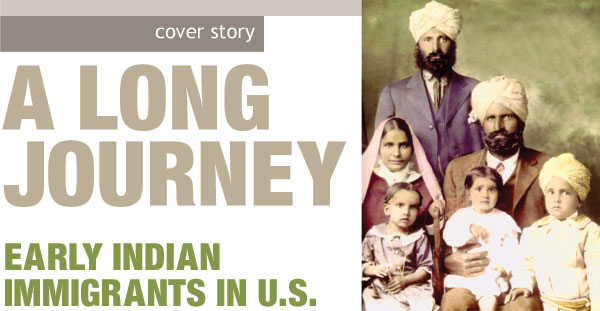 A Sikh immigrant family in California. 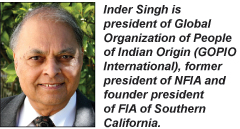 A brief history of immigration to the United States reveals prejudice, hostility and blatant discrimination against the people of Indian origin. The Luce-Celler Bill signed by President Harry S. Truman on July 3, 1946, gave citizenship rights to the Indian immigrants in the U.S. President Roosevelt also had supported the bill and wanted an end to “statutory discrimination against Indians” but he died before the bill could be enacted into law. A brief history of immigration to the United States reveals prejudice, hostility and blatant discrimination against the people of Indian origin. The Luce-Celler Bill signed by President Harry S. Truman on July 3, 1946, gave citizenship rights to the Indian immigrants in the U.S. President Roosevelt also had supported the bill and wanted an end to “statutory discrimination against Indians” but he died before the bill could be enacted into law. From the declaration of independence in 1776 to 1882, the U.S. government had an open borders policy towards immigration or emigration. The U.S. constitution, adopted in 1789, did not have any provision, nor were any laws enacted for almost 80 years, regulating immigration to the United States. The U.S. nationals were of European ancestry, so there probably was no need for laws to regulate immigration from Europe. However, when Asians started arriving, the U.S. passed the Naturalization Act of 1870 that denied Asians the right to become naturalized citizens. That new law was the first piece of discriminatory legislation against the people of Asia passed in the U.S. Congress. The Europeans came to America through Ellis Island, while Asians landed on the West Coast where there was no Statue of Liberty to welcome them. The employers, however, welcomed cheap Asian labor for their lumber mills, railroad construction and farms. The Chinese were the first among the Asians to come in search of economic opportunities. The unskilled white labor and their unions vehemently opposed the import of cheap Asian labor, and in 1882 America passed the Chinese Exclusion Act, the first law in U.S. history to restrict immigration. The labor unions and conservative politicians were not completely satisfied, so they continued to agitate against employment of “cheap” Asian workers. During the next few years, many laws were passed to restrict employment opportunities for Asians or to bar their immigration to the United States. An
The first trickle of Indians in search of economic opportunities came to California at the end of the nineteenth century. On April 5, 1899, four Punjabis who had worked in the British Royal Artillery in Hong Kong, landed in San Francisco and were allowed to stay in the U.S. by the Immigration Service. The grant of permission gave the signal to others to follow those four pioneers. In 1897, Queen Victoria of England, the then Empress of India, included a Sikh regiment from the Indian Army for her Diamond Jubilee celebration in London. On their return journey to India, the Sikh soldiers traveled via Canada. They were fascinated with the potential for farming opportunities in this far-away land and dreamt of returning after retirement from the army. The famine of 1899-1900 devastated the state of Punjab. Drought conditions of 1905-07 made living a virtual hell, forcing people to think of leaving their homeland. Canada and the United States of America, though half a world apart, were strong and attractive magnets for Punjabis to emigrate. India and Canada were both British dominions, so there was no need for visa to travel to Canada. Thus Canada became the destination of Punjabi immigrants who quickly found jobs in lumber mills. The new immigrants were hard working and accepted lower wages, so some Canadian companies publicized the economic and job opportunities to entice more cheap labor from India. During the first few years, about 2,000 immigrants, mostly Punjabi farmers and laborers, were permitted to come annually. As the number of immigrants increased, the locals felt threatened by labor competition from the hardy, low paid and adventurous Punjabis. Fear of labor competition led to racial antagonism and demands for exclusionary laws from Asian workers. In 1909, severe immigration restrictions virtually ended legal Indian immigration to Canada. By 1907, Indian immigrants saw the doors closing on them in Canada while America had an abundance of jobs in the lumber industry and building of railroads. There was plenty of land to farming land throughout the Sacramento, San Joaquin and Imperial valleys of California. Also, there were no restrictions in crossing the border between Canada and the United States, so Indians started coming to the U.S. Those Indians who had planned to come to Canada also decided to emigrate to the US. Indians admitted legally to the U.S. during the first six years of the 20th century numbered about 850, and from 1907 to 1911, 5,400 more immigrants were allowed. However, the total number of Indians in the country was much larger as many had come directly from Canada. Most of these early immigrants were Punjabi veterans or peasants who had come either directly from India or from other countries, such as Hong Kong. The United States had also welcomed qualified Indian students seeking admission to American universities. However, upon graduation, they were not able to get jobs commensurate with their qualifications. The discriminatory practices were against the very ideals of liberty and freedom they had experienced during their university days. The Indian students attributed the racial prejudice and discrimination to their being nationals of a subjugated country. Indians in the United States and Canada were called “East Indians” to avoid confusion with native Americans, who were known as “American Indians.” But they were more commonly called “Hindoos,” (Hindus) irrespective of their faith. The majority of the arrivals from India were Sikhs who preserved their religious beliefs and practices by keeping their beard, long hair on their head and wore turbans. They were easily distinguishable from the rest of the immigrants, but unfortunately, they were called “rag heads,” a derogatory term used for the Indians at that time. Their very presence in America provoked hostility from the Asiatic Exclusion League which carried propaganda against the “Hindu invasion of America” and persuaded the media to write against “The Tide of Turbans.” Indians had come here chasing their dream in a land of opportunities but they found the chase very challenging. They were eager workers, accepted low wages, poor working conditions and many times traveled from place to place in search of work. They did not want to turn down opportunities despite the many harsh difficulties they had experienced. The employers preferred the Indians to the whites but the unions despised them. As the number of Indian workers increased within a span of few years, they started encountering rampant prejudice and widespread hostility. In 1907, they became the victims of racial riots perpetrated against them. A mob of about 500 men assaulted boarding houses and mills, forcefully expelling Hindus from Bellingham, then a milling town in the state of Washington. The chief objective of the racial attack was to “scare them so badly that they will not crowd white labor out of the mills.” The town had a small police force which was overpowered by the white mob. The Indians had come in search of a chance for a better life for themselves and their families but the nightmarish incident forced about 300 Indians employed in various mills to leave the town in fear. 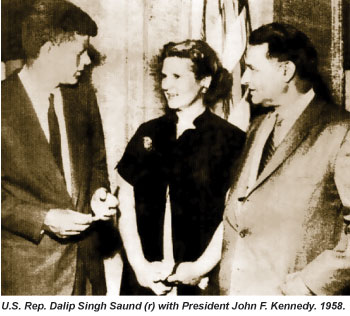 The Bellingham race riots had a devastating impact on the Indian community in the Pacific Coast. The Asiatic Exclusion League and other similar groups, however, became emboldened and wanted to prevent further immigration from India and force those already in the country to go back. Anti-Indian immigration groups also succeeded in getting the Alien Land Law passed in 1913, a new law that prevented “aliens ineligible for citizenship” to own property in California. The Indians responded by transferring, buying or leasing land or property in the name of American friends who sometimes deprived them of their harvest. A few Indians married Mexican women who were U.S. citizens, and leased property in the wife’s name. But some landowners hesitated to lease land to an Indian’s wife for fear of violating the Alien Land Act. In response to pressure, the U.S. passed the Cable Act of 1922 that stipulated that if an American woman married an alien ineligible for citizenship, she would lose her own citizenship. Right of citizenship would nullify the effect of the California Alien Land Law but it was an elusive dream for Indians. The Bellingham race riots had a devastating impact on the Indian community in the Pacific Coast. The Asiatic Exclusion League and other similar groups, however, became emboldened and wanted to prevent further immigration from India and force those already in the country to go back. Anti-Indian immigration groups also succeeded in getting the Alien Land Law passed in 1913, a new law that prevented “aliens ineligible for citizenship” to own property in California. The Indians responded by transferring, buying or leasing land or property in the name of American friends who sometimes deprived them of their harvest. A few Indians married Mexican women who were U.S. citizens, and leased property in the wife’s name. But some landowners hesitated to lease land to an Indian’s wife for fear of violating the Alien Land Act. In response to pressure, the U.S. passed the Cable Act of 1922 that stipulated that if an American woman married an alien ineligible for citizenship, she would lose her own citizenship. Right of citizenship would nullify the effect of the California Alien Land Law but it was an elusive dream for Indians.The continuing pressure of exclusionary forces and various American labor organizations against the importation of labor from Asian countries resulted in the imposition of further restrictions. In 1917, a very restrictive and discriminatory Immigration Act was passed over the veto of President Woodrow Wilson. The new law virtually barred all Asians from entering the U.S. legally. It created the “Pacific Barred Zone,” which included many Asian countries, natives of which were declared inadmissible to the United States. It also imposed English literacy restrictions, allowing only those to immigrate who could read and write English. After the passage of the law, some Indians left the U.S. in disgust while the number of new arrivals from India dwindled drastically. The U.S. citizenship conferred many rights and privileges but only Caucasian immigrants were eligible to apply. Among the Asians, Indian nationals were considered to be Caucasian, so sixty-seven Indians acquired U.S. citizenship from 1908 to 1923 in different states. For Bhagat Singh Thind, a veteran of the U.S. army, the granting of citizenship in 1920 by an Oregon District Court was a joyous occasion but it was short-lived. The Immigration and Naturalization Service challenged the court decision granting citizenship to Thind. In 1910, in the U.S. vs. Balsara case, the lower federal court had held that Indians were Caucasians. In 1922, in the U.S. vs. Ozawa case, the U.S. Supreme Court had officially equated “white person” with “a person of the Caucasian race.” Thus in view of the decisions in the two cases, the granting of citizenship to Thind should not have warranted any challenge. Shockingly, however, Justice Sutherland of the U.S. Supreme Court, the same judge who had declared whites as Caucasians in Ozawa vs. U.S., pronounced on February 19, 1923, that Thind and other Indians, though Caucasians, were not “white” and thus were ineligible for U.S. citizenship. The judge obviously decided the first case on the basis of race, the second, on the basis of color; but neither on the basis of law of the land. The Supreme Court decision had a demoralizing effect on many Indian nationals. All the sixty-seven Indians who had given up their Indian citizenship to become American citizens became persona non grata, nationals of no country as their American citizenship status was revoked. The economic impact for land and property owning Indians was devastating as they had to liquidate their land holdings at dramatically lower prices. Many U.S. citizens, who were formerly Indian citizens, were forced to surrender their American citizenship. For years to come, Indian nationals continued to suffer humiliation and hardships because they could not obtain citizenship of the United States. There were about 2,000 or possibly 2,500 Indians, who could benefit by becoming citizens of the US. A legal challenge to the Supreme Court interpretation of the law was ruled out as a possibility. An amendment to immigration laws by Congress appeared an alternative worth pursuing. But the majority of the Indians were very skeptical if Congress could pass a major bill aimed at upsetting a historic decision of the Supreme Court. “It was not that they did not want citizenship rights, but they had suffered so many hardships and been knocked about so much that it was very difficult for them to believe that there was a chance of their winning,” said Dalip Singh Saund, later the first Congressman of Indian descent. Nevertheless, Indians continued to seek ways to regain citizenship rights, particularly when the Chinese had been granted such rights through legislation. It was a major undertaking to convince the elected representatives of the American people to introduce a bill in Congress for the granting of U.S. citizenship to a handful of Indian nationals. Saund traveled all over California to mobilize the Indian community, mailed out thousands of letters hand written in Punjabi and raised funds for the Indian group in New York to lobby on Capitol Hill. The mobilization took quite some effort but soon it gained momentum and Indians in the U.S. were ready for an all-out effort to re-gain their citizenship rights. J. J. Singh of India League of America, Mubarak Ali Khan of the Indian Welfare League, Anup Singh, Haridas Muzumdar, Taraknath Das, and from California, Dalip Singh Saund of the India Association of America led the lobbying effort. They were able to successfully convince Connecticut Republican Congresswoman Clare Booth Luce and New York Democrat Congressman Emanuel Cellar, chairman of the House Judiciary Committee, to jointly introduce a bill in Congress for the granting of U.S. citizenship to Indian immigrants. However, selling this concept to the majority of the members in the U.S. Congress was an uphill task, more so as the passage of the bill could open the door for other Asians who were similarly deprived of citizenship rights. For four years, the bill languished in the Congressional Committees and Indians continued running into obstacles in finding a powerful ally to push it through Congress. Although President Roosevelt wrote letters to Congressmen and Senators but some die-hard members of Congress and the American Federation of Labor would not relent in their opposition. Fortunately, in 1946, President Truman took special interest in its passage and the Luce-Cellar Bill was enacted into the Immigration Act of 1946, conferring the right of citizenship on the natives of India. President Truman invited some prominent Indians to the White House, including Sardar J.J. Singh of Washington DC, president of the India League and Dr. Anoop Singh of New York and signed the bill on July 3, 1946, which truly should be celebrated as the Independence Day by Indian Americans. It was a great triumph for the Indian community that their relentless struggle for 23 years reversed the Supreme Court’s racial interpretation of the word Caucasian. 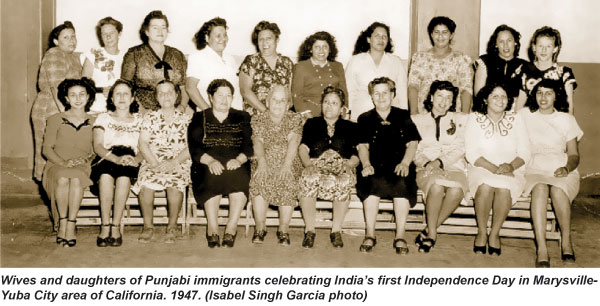 The granting of citizenship rights opened new opportunities for Indian nationals. They could lease or own land, which previously they could not under the Asiatic Exclusionary laws or take part in an election or even run for public office. They could go back for a visit to India or bring their spouses and minor children to the U.S. There was no more a bar on love or relationships; an Indian could marry an American citizen. Indians could immigrate legally up to 100 people per year and acquire U.S. citizenship. Since the passage of the Luce-Cellar Bill in 1946, immigration laws have been modified several times. The Immigration Act of 1965 liberalized immigration, increasing per country quota to 20,000 people irrespective of race, color or creed. The new legislation, while ending the period of selective discriminatory immigration to the U.S., encouraged a new wave of Indian immigrants who were educated and skilled and have profited from their knowledge. The increased quota has also resulted in the exponential growth in the number of Indian immigrants and the wave of new arrivals still goes unabated. At the turn of 20th century, many Indians packed their few possessions and headed towards America but their dreamland did not offer a friendly landscape. The Punjabi pioneers initially found only menial jobs in factories and lumber mills to ensure their survival. They lived in abandoned homes, slept under the open sky or in crumbling structures. The paths they took were varied, but their dreams were the same and would not have come to fruition without sacrifice, vision and difficult trade-offs. Many switched to the profession of their forefathers — agriculture, and some of them became very successful farmers. The US proclaims “liberty and justice for all.” But Indians became victims of violence, experienced bigotry, encountered discrimination and suffered humiliation, and went through a long and painful struggle for parity, equality and dignity until they gained the right of citizenship. Each individual faced unexpected and harsh challenges, but gradually discovered new possibilities, and realized his or her own dreams that contributed to a brighter future for them and their next generations. |TOP|
IN MEMORIAM: Valor in Battle: Indians in World War I July 1 was the 90th anniversary of the Battle of the Somme, the scene of ghastly, gruesome bloodletting that claimed a million lives. Indians enlisted in the British Army in droves and fought valiantly here as well as in many other fronts during World War I. Siliconeer presents a tribute. 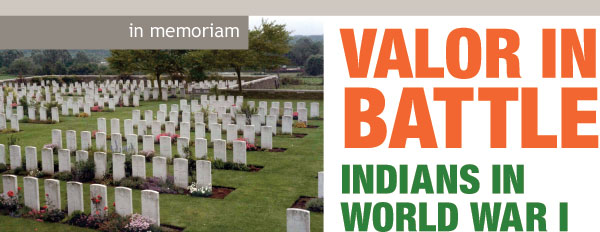 La Chapelette Cemetery (Peronne, France) has graves of Sikh soldiers who died in World War I. The 90th anniversary of the Battle of the Somme was on July 1. The Battle of the Somme was one of the most significant campaigns of World War I. The Allied Forces attempted to break through the German front line in northern France in 1916.
A Sikh soldier, Indar Singh, fighting on the Somme in September 1916, wrote home: “It is quite impossible that I should return alive. [But] don’t be grieved at my death, because I shall die arms in hand, wearing the warrior’s clothes. This is the most happy death that anyone can die.” The Indian Army fought in every major theatre of operations during World War I. In August 1914, as the German Army advanced through France and Belgium, more Allied troops were desperately needed for the Western Front. The Indian Army, 161,000 strong, seemed an obvious source of trained men, and the Lahore and Meerut infantry divisions were selected for service in Europe. In October, shortly after they arrived, they were fed piecemeal into some of the fiercest fighting around Ypres. Losses were heavy. The average Indian battalion had 764 men when it landed; by early November the 47th Sikhs had only 385 men fit for duty. Sikhs made up nearly 20 percent of the British Indian Army despite being only 2 percent of the population. It was the estimate of Sir John Maynard that the contribution of the Sikh community in men and material was ten times that of any other community of India. These soldiers fought disease, filth, gas attacks, and the onslaught of German and Turkish troops and maxim guns with only their turbans to protect them from head wounds and their unshorn hair and long beards, as prescribed by their religious faith, in disease infested, muddy trenches. The troops were taken out of the line and rested in early 1915, but were soon back in the trenches and involved in the heaviest fighting. The Indian Corps provided half the attacking force at the Battle of Neuve Chapelle in March. Flanders was a perpetual battleground in World War I. The Sikh regiment was the first Indian contingent to land in Europe. “Unique stalwarts from the east,” remarked the press. The Lahore Division was thrown into the counter-attack at the Second Battle of Ypres in April. Morale seemed to pick up in the spring of 1915, only to decline towards the end of the summer when it became clear that an end to the war was not in sight. The 14th Sikh was virtually wiped out in Gallipoli as it lost 379 officers and men in one day’s fighting in June 1915 when, as part of the combined Anglo-French forces, they tried to assault the Turkish defenses. It is said that some Sikh POWs, captured in Belgium, were believed to have been Muslims by the Germans and taken to Turkey to fight along side their fellow Mohammedans. However, they still remained loyal to the British Crown and escaped on a long trek to the British posts in Afghanistan, from Turkey through the Middle East, to once again fight under the British flag. In total, 800,000 Indian troops fought in all the theatres of the war with 1.5 million volunteering to fight. They fought in most theatres of war including Gallipoli and North and East Africa. In all 47,746 were classed as killed or missing with 65,000 wounded. The Indian Corps won 13,000 medals for gallantry including 12 Victoria Crosses. Khudadad Khan won the Corps’ first Victoria Cross. Such was the cost of the war that India’s economy was pushed to near bankruptcy. The Indian support given to Britain’s cause surprised the establishment in Britain. The Times wrote: “The Indian empire has overwhelmed the British nation by the completeness and unanimity of its enthusiastic aid.” |TOP| NEWS DIARY: June Roundup  Stealing PM’s Whisky | Berkeley Poet Honored by Uttar Pradesh | Urdu Literary Giant Dies | Million Jobs | Bangla Woman Fends Off Tiger All by Herself | Call for Negotiations | India’s Satellite Dream Comes Crashing Down | Experts Join Crash Probe | Happy Birthday! Darjeeling Toy Train | British Muslim Soldier Killed | Flourishing Pak Women | Ceasefire to Extend | Labor Alleges ‘Slow’ Progress | Martyr Reburied Stealing PM’s Whisky | Berkeley Poet Honored by Uttar Pradesh | Urdu Literary Giant Dies | Million Jobs | Bangla Woman Fends Off Tiger All by Herself | Call for Negotiations | India’s Satellite Dream Comes Crashing Down | Experts Join Crash Probe | Happy Birthday! Darjeeling Toy Train | British Muslim Soldier Killed | Flourishing Pak Women | Ceasefire to Extend | Labor Alleges ‘Slow’ Progress | Martyr ReburiedStealing PM’s Whisky The Indian national airline Air-India is to take action against 14 crew members for allegedly stealing alcohol from the prime minister’s plane. The incident is said to have taken place in April during a visit by Prime Minister Manmohan Singh to Germany. Angry officials from the civil aviation ministry had questioned why it took Air-India so long to report the incident, accusing them of a “cover-up.” During the visit last April, the prime minister’s security detail on board India’s equivalent of Air Force One panicked when they discovered that one of the aircraft’s cabinets had been broken into just before take off. A security alert was immediately sounded as secret service agents and intelligence officials scoured the aircraft for a possible bomb. But all that they uncovered was the disappearance of several bottles of whisky. They were eventually discovered in the luggage of the crew. The airline said that its internal inquiry had established beyond doubt that the alcohol had been stolen during Singh’s visit. Fourteen crew members were found carrying 29 bottles of top-grade Scotch whisky with the aircraft’s captain — who is also a senior airline director — and a flight attendant found in possession of five bottles each. When the captain was confronted, he said he had bought the whisky. He is now likely to be charged with smuggling since Indian customs regulations only permit two bottles of alcohol to be brought in to the country by each passenger. |Back to NEWS Diary| |TOP| Berkeley Poet Honored by Uttar Pradesh 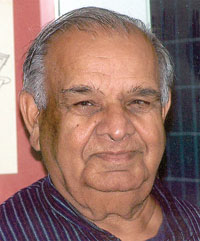 Ved Prakash Vatuk Ved Prakash VatukBerkeley, Calif., resident and poet Dr. Ved Prakash Vatuk has been named the recipient of this year’s Jaishankar Prasad Award by the Hindi Sansthan, which is run by the Uttar Pradesh government. This Jaishankar Prasad Award is given for the best epic of the year. Dr. Vatuk was given the award for his epic poem “Bahubali.” The award carries a citation and a cash prize of Rs. 25,000. Vatuk will receive the award at a special awards ceremony on Hindi Diwas Sept. 14. Hindi Sansthan previously honored Vatuk with its Pravasi Bharatiya Hindi Sahitya Bhushan Samman, an award given to a Hindi writer residing outside India. Vatuk was the first person to receive that award in 1996, the year the award was initiated. This year’s award has been given to Dr. Krishna Kumar, who lives in the United Kingdom. “Bahubali,” is a story in verse — a khanda-kavya — borrowing a unique story from a myth from ancient India. This story is about Bharat and Bahubali — the two sons of the apostle of non-violence and peace, the adi tirthankar Rishavdev. The elder brother Bharat, the ruler of Ayodhya, girded his loins to conquer the world in the name of world peace and found the Chakravarty rajya. However, his younger brother Bahubali, the ruler of Podanpur, considered sacrificing the lives of his subjects to protect his kingdom a policy preferable to accepting the primacy of his elder brother. The battle between these two feuding brothers could have been as horrific as the war in Mahabharat, had not the blameless subjects and its leaders stood up to protest the imminent bloodshed of the innocent in the impending dharmyuddh. This message of the pointlessness of war and lust for power, and the proposal of an alternative, nonviolent society — this is the essence of his poem. |Back to NEWS Diary| |TOP| Urdu Literary Giant Dies 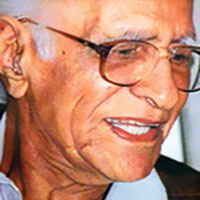 Ahmad Nadeem Qasimi Ahmad Nadeem QasimiOne of the major literary figures in the Urdu language, Ahmad Nadeem Qasimi, has died in Lahore at the age of 89. In a career spanning almost 70 years, Qasimi published over 50 books and distinguished himself as a poet, writer, critic and journalist. He was a leading member of the Progressive Writers Association, and between the 1950s and 1970s was arrested frequently and twice jailed. In the last 40 years he edited several literary journals and magazines. Qasimi was also credited with introducing several new trends in Urdu literature. It was the publication of his first collection of Urdu short stories, “Chaupaal” in 1939, followed by an anthology of poems, “Dhadkanen,” that established him as a formidable writer. In later life, Qasimi was the secretary-general of the PWA’s Pakistan Chapter, which often brought him into conflict with the authorities and his imprisonment on two occasions. The authorities at the time regarded the PWA as an offshoot of the outlawed Communist Party. Qasimi had three spells as editor of some of the best known Urdu journals that published creative writing. |Back to NEWS Diary| |TOP| Million Jobs  Mukesh Ambani Mukesh AmbaniLeading Indian businessman Mukesh Ambani says he plans to create a million new jobs through an agrarian and retail revolution by building an Indian version of Wal-Mart, the world’s largest store chain. Ambani, head of petrochemicals giant Reliance Industries, said in an interview he wanted to revolutionize the country’s backward farming and retail sectors and to become a supplier to the world’s supermarkets. He plans a network of stores in India with an annual sales target of 25 billion dollars by 2011 to make his company “a Wal-Mart in India,” he told Newsweek magazine. Wal-Mart of the United States is the largest retailer in the world, having revolutionized the business through a super efficient management system overseeing thousands of suppliers. “We are rebalancing the world. We are in fact lucky to be at the right place at the right time, contributing to our self-confidence as Indians. That’s what energizes me,” Ambani said. He said the company, Reliance Retail, would work with farmers to improve productivity and build $20 billion of agricultural exports every year. “We are also creating something that is totally missing in India: an efficient distribution system linked to supermarkets across the world. “This will generate up to one million new jobs and make us the largest private-sector employer in India,” he told the magazine. Retail giants like Tesco of Britain and Wal-Mart of the United States have shown great interest in India. However, the government has so far allowed 51 percent foreign direct investment in retailing by companies which sell only a single brand like Reeb. |Back to NEWS Diary| |TOP| Bangla Woman Fends Off Tiger All by Herself  A Royal Bengal tiger A Royal Bengal tigerArmed with just an oar, a Bangladeshi teenage woman fended off a Royal Bengal tiger which was attacking her husband, according to police. The intrepid escape occurred near the Sundarbans mangrove forest. Eighteen-year-old Nazma Akhter and her husband Anwarul Islam, 25, were fishing for shrimp in a canal on the fringes of the Sundarbans. Tigers kill about 20 people a year in Bangladesh, mostly in the Sundarbans. Police chief A.S.M. Zahid said the tiger bit the man on the knee and was dragging him off into the forest when his wife set about the big cat with her oar. “This woman is extraordinarily courageous, because she alone fought the tiger and saved her husband,” he told the BBC. “I salute her for her courage.” Zahid said that Akhter kept the tiger at bay for 10 minutes. Local newspapers reported that such was the beating it received from the paddle that it was forced to beat a retreat into the forest. Islam is reported to be recovering from minor injuries following the attack. Police and forest officials said the incident comes after two fatal attacks on women in the Sundarbans area recently. Tigers are believed by experts to be killing more people in the Sundarbans in recent years as pressure on their territory grows because of human encroachment. Some scientists argue that they may also have become more aggressive because of the high salt content in water of the area which affects their mental stability. The mangrove forest — which stretches across the border into the Indian state of West Bengal — covers an area of 5,800 square kilometers (3,590 square miles). It is the largest mangrove forest in the world. |Back to NEWS Diary| |TOP| Call for Negotiations Sri Lankan President Mahinda Rajapakse has said that the Tamil Tiger rebels must re- enter the process of negotiations as it was the only path to achieving peace in the island nation. Addressing the inaugural session of a special advisory committee aimed at recommending a constitutional solution to the country’s long drawn out separatist armed conflict, Rajapakse said: “All our sincere attempts at bringing the LTTE (Liberation Tigers of Tamil Eelam) to the negotiating table have failed so far.” The advisory committee meeting was boycotted by the main opposition United National Party but was attended by 13 other political parties represented in the national parliament. Rajapakse stressed that Sri Lanka needs to devise a home-grown solution to the conflict that had claimed over 64,000 lives over the last three decades, say that “finding a political and constitutional solution to the national question requires a multi-party and an inclusive approach.” Neither the Tamil Tigers nor their proxy political party, the Tamil National Alliance are taking part in the proceedings which have come as part of an all-political party forum called by Rajapakse to achieve broader southern consensus on the violent conflict. Nearly 900 people have died since Rajapakse assumed presidency last November as the Tamil Tiger rebels stepped up violence against government troops. The rebels in turn are accusing the government of unleashing violence against them. The atmosphere of violence has put in jeopardy the Norwegian backed peace process. Rajapakse wants the special advisory panel convened to come up with a political package aimed at ending the conflict. |Back to NEWS Diary| |TOP| India’s Satellite Dream Comes Crashing Down  GSLV spins out of control. GSLV spins out of control.India’s attempt to place its latest communication satellite in space failed after the rocket carrying it veered off its trajectory and disintegrated due to a motor failure. The rocket, GSLV-FO2 (geosynchronous satellite launch vehicle) was to have placed Insat 4-C in a geo synchronous transfer orbit. Indian Space Research Organization chairman G. Madhavan Nair told reporters at the Sathish Dhawan Space Centre, Sriharikota, that ISRO had issued a destruct command after it found that the rocket was not following its intended path. What’s even more intriguing is that the government and ISRO didn’t insure the satellite. This puts the entire burden of the loss on ISRO and the government. While ISRO insures the satellites it places using other’s launch vehicles (France’s Ariane, for example), it doesn’t go for cover of launches made in India, an ISRO official said. The crash means a loss of Rs. 2.56 billion, including Rs 1.6 billion for launch vehicle and Rs 960 million for the satellite. Bimalendu Chakrabarti, chairman, New India Assurance, confirmed that the satellite was not insured with his company. New India Assurance has been the traditional insurer for the government’s space programs and has been covering satellite launches since 1990, including the INSAT-2E series. Although New India has been issuing the policies, the risk was borne by international reinsurers such as Spaceco of the Allianz group who have the expertise in satellite insurance. Industry sources said that one of the reasons for not insuring could be that the premiums are very high. Even for developed countries with the best track record the premium is over 25 percent of the sum insured. Although India has placed geo synchronous satellites in orbit earlier, 4C was by far the most ambitious venture. |Back to NEWS Diary| |TOP| Experts Join Crash Probe 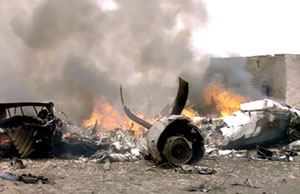 The crash site of a Pakistan International Airlines plane in Multan. The crash site of a Pakistan International Airlines plane in Multan.A three-member team of foreigners visited the Fokker plane crash site in Pakistan’s Multan in a bid to ascertain the causes of the July 10 tragedy that left 45 people dead. The team included Holger Litzenberg, the aircraft accident investigator, and Mike L. Webber, the principal investigator engineering, both from Rolls Royce, the company that manufactured the engines used in Fokker planes, and Arthur Reekers, the air-worthiness certification engineer from Fokker. Captain Shahnawaz Dara, the senior vice president of PIA Flight Safety and Health Safety Environment, said that the black box or the Digital Flight Data Recorder and Cockpit Voice Recorder would be sent to Aircraft Accident Investigation Board, U.K., to decipher the recording from DFDR and CVR. “They have an advanced technology and sophisticated equipment to do this and a request to seek time from AAIB will be sent.” He said that the engine of the ill-fated Fokker had reached Karachi where it would be examined in an effort to ascertain the cause of the accident. The team of foreigners would also visit Karachi where it would hold meetings with PIA experts and Civil Aviation Authority officials, said Captain Dara. He said the crash site would now be cleared of the plane wreckage as the investigation teams had completed their visits and over 1,000 photographs had been taken besides a detailed video footage. He said the PIA and CAA had the expertise to find out causes of the accident but given the magnitude of the tragedy it was appropriate to seek opinion from foreign experts. |Back to NEWS Diary| |TOP| Happy Birthday! Darjeeling Toy Train  The Darjeeling Toy Train The Darjeeling Toy TrainThe Darjeeling Toy Train just completed 125 years. The Darjeeling Himalayan Railway, as the toy train is officially known, is the first, and still the most outstanding example of a hill passenger railway. Opened in 1881, it applied bold and ingenious engineering solutions to the problems of establishing an effective rail link across a mountainous terrain of great beauty. It is still fully operational and retains most of its original features intact. The DHR ascends 6,850 feet from New Jalpaiguri, the climb begins at Sukna, continues uninterruptedly to Ghum (7,407ft) and descends the final 5 miles to Darjeeling. After independence, India’s partition resulted in the isolation of the Northeast region. Consequently, the DHR was merged into Assam Railways, it was closed for the construction of the Assam-Bengal link line and one of its extension lines to Kishanganj was converted to meter gauge. DHR’s other extension line to Kalimpong got washed away due to floods. On re-opening, the DHR was merged with Northeastern Railway in 1952 and later into Northeast Frontier Railway in 1958. DHR’s genesis is significant both economically and in engineering terms. It was the first railway in India built exclusively with Indian capital. Its construction is one of the greatest engineering feats of the 19th century. To overcome natural obstacles, follow the hill cart road, avoid the necessity of big bridges, avoid tunnels, keep the investments low and maintain the steep gradient by adhesion only, great ingenuity was shown. The DHR achieved worldwide fame for a variety of reasons. It provided a gateway to spectacular Himalayas; the tiny 4-wheeled steam engines of the 19th century are living legends for sounds, fragrance and romance of a bygone era; and the curves, loops, “Z’s” and steep grades crisscrossing the road are a work of genius and a traveler’s delight. |Back to NEWS Diary| |TOP| British Muslim Soldier Killed 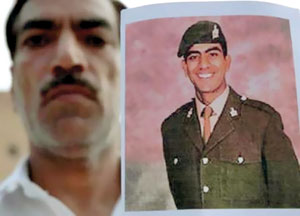 Javed Iqbal holds a photo of his nephew, British Pakistani Muslim soldier Lance Corporal Jabron Hashmi. Javed Iqbal holds a photo of his nephew, British Pakistani Muslim soldier Lance Corporal Jabron Hashmi.British soldier Lance Corporal Jabron Hashmi of 3 Para Battlegroup has been killed in Sangin, Helmand province, in Afghanistan on July 1, becoming the first British Muslim soldier to be killed in the “war on terror.” Hashmi’s family said that he had been committed to bringing peace to Afghanistan. Hashmi, 24, a devout Muslim, died during an attack by Taliban fighters on a British base. His family came to Britain from Pakistan when he was 12 and he joined the Army 10 years later, in 2004. After moving to the Intelligence Corps he was posted to the Royal Signals last January and finished his training six weeks before being sent to Afghanistan. Relatives said that despite having to face rebels from his own faith, he was determined that his tour in Afghanistan would end in success and that the Army could help to secure peace and democracy in the country. His brother, Zeeshan Hashmi, 27, said: “The military was his passion, it had been for a long time. Ever since he was a little child he had wanted to be an Army commander. He was so happy when he got in and saw going to Afghanistan as a chance to build bridges between the East and the West. “Jabron was a committed soldier and a committed Muslim. He was fiercely proud of his Islamic background and he was equally proud of being British and was very proud to live in Britain. My mother is absolutely devastated and all she wants is her son back.” |Back to NEWS Diary| |TOP| Flourishing Pak Women 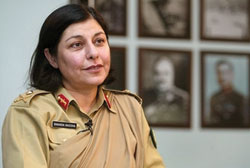 Pakistan Army doctor Maj. Gen. Shahida Badsha Pakistan Army doctor Maj. Gen. Shahida BadshaTime was when the only job for a woman in Pakistan’s military was nurse. Now there are paratroopers, jet pilots and even an army general. The profile of this Islamic country’s armed forces is slowly changing. The 4,000 women in the military make up less than one percent of its 550,000 personnel, but opportunities are opening. “We don’t have cultural constraints to prevent women from modeling or acting, so why soldiering?” said Maj. Gen. Shahida Badsha, an army doctor who became Pakistan’s second female general in January. In April, the first four women pilots got their wings in the air force. A couple of weeks later, the air force’s first two women paratroopers completed their training, leaping out of a plane to mark their graduation. Now the army is enrolling 30 women officers into the signal corps and engineering, computing and legal branches. In the past, women could join only the army’s medical corps. “It’s a good step to provide equal opportunities to both genders,” said the chief army spokesman, Maj-Gen. Shaukat Sultan. “Every day, Pakistan is becoming a more open society. It’s a basic requirement of a democracy.” Critics are skeptical. Despite mouthing support for women, President Pervez Musharraf hasn’t revised Islamic laws that make it virtually impossible to prosecute a rape, and punishment is rare for the hundreds of “honor killings” of women slain by male relatives over alleged infidelities. Critics pooh-pooh the participation of women in the armed forces as a cosmetic move that will have little impact in wider society. Only 35 percent of women can read and write, compared to 62 percent of men. Be that as it may, the photos of the new airwomen inducted into the air force — in flying suits, posing by T-37 training jets — were splashed across every daily newspaper and covered by most Pakistani TV networks. Even the president of neighboring Afghanistan voiced admiration. |Back to NEWS Diary| |TOP| Ceasefire to Extend 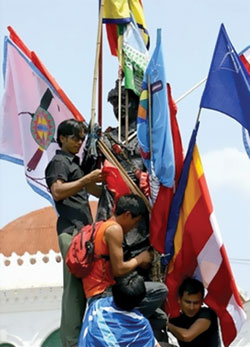 Nepalese pro-democracy activists during a rally in Kathmandu. Nepalese pro-democracy activists during a rally in Kathmandu.Nepal’s Maoist rebels are likely to extend a ceasefire due to expire in to support peace talks aimed at ending an insurgency which has killed thousands, a top guerrilla leader said. The Maoists — whose decade-long fight for a Communist state has left more than 13,000 dead — declared a three-month truce in April after King Gyanendra bowed to weeks of protests, handing over power to an interim multi-party government. With peace talks between the interim government and insurgents in progress, Maoist leaders say they hope to renew the truce which ends soon. “Since the peace process is moving ahead positively I think the ceasefire will be extended,” Ananta, a deputy commander of the Maoist army, told Reuters. He said Maoist chief Prachanda would meet Prime Minister Girija Prasad Koirala to discuss the controversial issue of monitoring arms held by the Maoists and Nepal’s army. The rebels have said they will not surrender their arms. The government this month called on the United Nations to monitor weapons held by both sides, but Ananta said the 36,000-strong rebels should merge with government troops under a new constitution to be prepared by a specially elected assembly. “Until then our PLA will stay in the camps with their arms,” Ananta said. Last month, Koirala agreed to include the rebels in an interim government to oversee elections for the special assembly to map the country’s future political set up, a key rebel demand to end the revolt. Impoverished Nepal, wedged between China and India, should be turned into a republic — a federation with nine autonomous regions representing the oppressed classes, nationalities and genders, Ananta said. |Back to NEWS Diary| |TOP| Labor Alleges ‘Slow’ Progress 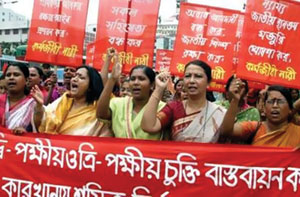 Members of the Karmojibi Nari (Working Women) organization carry placards stating their demands during a protest in Dhaka. Members of the Karmojibi Nari (Working Women) organization carry placards stating their demands during a protest in Dhaka.The labor front Bangladesh Jatiya Sramik Jote alleged slow progress in implementing both the tripartite deal among garment owners-workers-government and bilateral accord between owners and workers. Garment workers’ frustration recently led to repeated violence and massive destruction of property. Workers’ say the unrest is the result of long-simmering resentment caused by exploitation, while factory owners allege a hand of foreign forces or the opposition. BJSJ is planning a rally and will stage a human chain program in different industrial areas across the country demanding speedy implementation of the accords. The announcement came from a press conference organized by BJSJ at Col. Taher Auditorium in city’s Bangabandhu Avenue. At the conference, BJSJ president Shirin Akhter presented a recent survey conducted to evaluate the post-agreement situation of 100 garment factories in Dhaka and its surrounding areas. BJSJ conducted the survey after the tripartite deal was signed on June 12. Shirin Akhter said they would soon sit with the garment owners and the government to discuss the findings of their survey. She hoped that the wage board, formed to fix minimum wages for the apparel sector workers, would announce the wages by Sept. 25 as announced by the Commerce Minister. Akhter said there is no scope of bypassing the garment workers’ movement by terming it “a conspiracy of foreign force or opposition or government.” “No one should do politics with the apparel industry. Even if anyone does so, we shall make all-out efforts to foil it,” she said. A BJSJ survey shows that workers have to work for 16 hours a day in three garment factories, 15 hours in four factors, 14 hours in 55 factories, 13 hours in six factories and 12 hours in 18 factories in total violation of labor law. Some 42 factories disburse the monthly wages in the second week of the month, 31 others in the third week and two in the fourth week, while there is no regular date of wages disbursement in two factories. The survey also shows that there is no weekly holiday in 68 factories. And of the 100 factories, female workers of 63 factories do not get any maternity leave. |Back to NEWS Diary| |TOP| Martyr Reburied 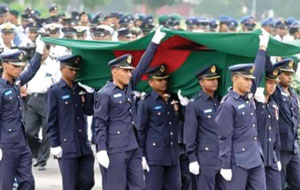 Bangladesh Air Force officers carry the coffin of war hero Motiur Rahman. Bangladesh Air Force officers carry the coffin of war hero Motiur Rahman.Air Force jets flew past and bugles played the last post as the 1971 Liberation War martyr Flight Lieutenant Birshreshtha Motiur Rahman was reburied in his homeland 35 years after he died with highest state honor amid 40 gun salutes. The remains were brought back from Pakistan recently. Eight air force flight lieutenants carried the national standard-covered coffin to the grave while a contingent of army, navy and air force offered the honor guard ahead of the reburial of Motiur Rahman in a military ceremony. Jute and Textile Minister Shajahan Siraj, minister without portfolio retired Air Vice Marshal Altaf Hossain Chowdhury, Acting Speaker Akhtar Hamid Siddiqui, State Minister for Liberation War Ministry Professor Rezaul Karim, State Minister for Civil Aviation Fakrul Islam Alamgir, Army Chief Lieutenant General Moin U. Ahmed, Navy Chief Rear Admiral Mohammad Hasan Ali Khan and Air Force Chief Air Vice Marshal Fakrul Azam and the family members of the veteran joined the ceremony. Earlier, the body remains were carried to Liberation War Veterans Graveyard at Mirpur in a military motorcade while it was laid to the grave amid the last post in air force bugle. Five air force jets flew past the scene while eight air force men fired 40 gunshots from rifles as part of the state honor. Earlier, Acting President Barrister Muhammad Jamiruddin Sircar placed wreaths on the coffin. Ministers, parliament members, leaders of different political parties, chiefs of the three services, senior civil and military officials, freedom fighters and retired officials of the armed forces attended the ceremony. |Back to NEWS Diary| |TOP| FUNDRAISER: Picking Mangoes: Project Ahimsa’s Hollywood Benefit Over 300 people in Hollywood danced to the music of BBC Radio 1 DJ Bobby Friction to raise $5,000 for Project Ahimsa, a non-profit organization dedicated to the empowerment of youth through music. A Siliconeer report.  Over 300 people danced to the music of the evening’s headlining performer, Bobby Friction, and other DJs at Los Angeles’ Standard Hotel Hollywood’s Lounge June 26. Over 300 people danced to the music of the evening’s headlining performer, Bobby Friction, and other DJs at Los Angeles’ Standard Hotel Hollywood’s Lounge June 26.Friction is a U.K.-based DJ/Artist who has represented the British Asian sound as a DJ all over the world and has built a reputation as a genre-mixing Asian turntablist from Asia to the U.S., and from the Middle East to the whole of Europe. His British Asian Urban compilation “Friction” has already sold 120,000 copies in India since its release and stayed at number 1 for 14 weeks. The event, “Pickin Mangoes,” was Project Ahimsa’s third benefit event in the Los Angeles area. Previous Project Ahimsa fundraisers featured artists such as The Black Eyed Peas, 311, Lily Hayden, Ravidrums and Lal Singh Bhatti. Proceeds from the event will benefit the Manav Sadhna and Project Ahimsa Mahatma Gandhi Community Music Center in the city of Ahmedabad in Gujarat, India. The Center will be built inside the Rampir No Tekro, the largest slum in Gujarat, across the street from Mahatma Gandhi Ashram in Ahmedabad. The Center will house facilities for healthcare, education, women’s empowerment and micro credit, in addition to the Community Music Center. The benefit event marked the beginning of the ArtWallah 2006 weekend. Held in downtown Los Angeles¹s Little Tokyo neighborhood, the ArtWallah Festival is an annual showcase of the South Asian diasporic arts featuring dance, film, music, spoken word, theater and visual arts from artists from around the world. Project Ahimsa is a global effort to empower youth through music, with offices in San Francisco and Tampa, Florida. Since its inception in 2001, the organization has reached nearly 10,000 children around the globe through music education grants and musical instrument donations. To learn more, visit www.projectahimsa.org. |TOP|
COMMENTARY: A Year After the London Bombings: Unsurprising Reflections As arrogant Western politicians remain unrepentant and bigots of every stripe spew their venom, moderate, progressive Muslims have no place to go, laments Sabahat Ashraf.  The top of a Number 30 double-decker bus blown clear in Tavistock Square in central London July 8, last year. (DYLAN MARTINEZ / AFP/Getty Images photo) The top of a Number 30 double-decker bus blown clear in Tavistock Square in central London July 8, last year. (DYLAN MARTINEZ / AFP/Getty Images photo)Were you surprised when you learned that the 7/7 bombers were British born and bred?” That is one of the questions I have been going around here in the United States asking community activists, a few academics, and one person who was visiting from Britain. While this is not a statistically significant sample, or a scientific or academic analysis, the results, quite frankly, have not been surprising. My sample itself has not been a balanced one. What I have been doing, you see, is looking for people who share what often seems like a quixotic position. I have been talking, for the most part, to people who are not involved in the religious side of things. I have not been talking to folks whose main social engagement has been centered around Da’wah, the word one hears very often nowadays amongst Muslims as the most important activity they engage in with respect to their faith. I have friends who, particularly before 9/11, would express an interest in social activism if and only if it overtly involved an element of Da’wah, or outreach to non-Muslims. Evangelization, if you will.  But these are not the folks I have been talking to. I have been talking to people who, while for the most part being of very strong faith and often engaged with their faith communities, are also very interested, and engaged in what is often called the secular well-being of the community. Enterpreneurial networks, professional groups, educational foundations and the like. But these are not the folks I have been talking to. I have been talking to people who, while for the most part being of very strong faith and often engaged with their faith communities, are also very interested, and engaged in what is often called the secular well-being of the community. Enterpreneurial networks, professional groups, educational foundations and the like.What I am trying to say is that my sample has been of people who, one would assume, has a broader view of things and is not overly focused in being defensive about their faith and their faith communities. But like I said. The results have been rather unsurprising. But that is not to say that they are positive or that they make me happy. For the majority has said, simply, “Yes.” The same people who have always argued with me that there is no such right-wing tilt in the American community — or the ones who looked at me as if I had two heads when I suggested that there might be — have been the ones that expressed the most surprise about the bombers being local kids. And, interestingly, though not really surprisingly to me at least, the ones who say they are not surprised are often the folks within Muslim communities that are consciously moderate or progressive. These are the folks that are not the ones arguing that there is no such thing — or no need for such terms — as “Moderate Islam” or “Progressive Islam.” And the blind spot is not one-sided. As the anniversary of the bombings in London comes around, I see the same stubborn refusal to get real, on most sides of this discussion and on both sides of the Pond, so to speak. British Prime Minister Tony Blair’s recent statement has me tearing out my hair, too. His complete dismissal of any role for his country’s foreign policies in even giving fanatics an excuse for their acts is mind-boggling. His and other peoples’ dismissal of such things is what makes the “moderate” Muslims’ job of countering extremist tendencies within our communities close to impossible. It is this mulish refusal to accept responsibility that had people like me so despondent that when 9/11 came around, we were sitting on the sidelines with our heads in our hands. As we say back home, you either think your listeners are completely foolish; or you are trying to make fools of them; or you are foolish yourself. None of those choices are pleasant or augur well for our planet.  And for every Lord Nazir Ahmed going on the BBC saying that he was “very surprised” that the British bombers were, well, British, there’s the bishop and his comment about a “false ideology.. I know that is his Anglican way of saying “evil ideology.” No surprise here. Dismissing something as being “false” in the theological sense, or “evil” in the plainspeak of the American frontier, stems from the logic in a lot of religious systems where anything that isn’t exactly the same as your point of view about the road to salvation is false, the work of the devil, and evil, and so on. But isn’t the equation of things that are false from one’s point of view with “evil,” and “satanic” what we are all talking about here? And for every Lord Nazir Ahmed going on the BBC saying that he was “very surprised” that the British bombers were, well, British, there’s the bishop and his comment about a “false ideology.. I know that is his Anglican way of saying “evil ideology.” No surprise here. Dismissing something as being “false” in the theological sense, or “evil” in the plainspeak of the American frontier, stems from the logic in a lot of religious systems where anything that isn’t exactly the same as your point of view about the road to salvation is false, the work of the devil, and evil, and so on. But isn’t the equation of things that are false from one’s point of view with “evil,” and “satanic” what we are all talking about here?Is the Right Reverend Archibishop of York trying to tell us that acts like 7/7 and 9/11 would be less heinous and evil if they were done in support of an ideology that is not false/evil/what-have-you? George Bush says similar things all the time. And it was the man he puts up as his icon, and our governor here in California, who did the most to give currency to the phrase “One man’s terrorist is another man’s freedom fighter.” I am sorry but that is not a morally defensible position. It seems to imply that if a person who is otherwise committing a terrorist act does it for a valid cause like fighting for freedom, it is okay, or at least less “evil.” Let me say this as plainly as I can: To this moderate-to-progressive Muslim, it is not okay. Even if someone commits an act of terror for my personal, social, or national benefit, it is my moral, religious and legal responsibility to call it out as exactly that. An evil, yes, evil, indefensible act. And then it is my duty to either stop it, denounce it, or at least recognize it as such. The Islamic canon says it is a sign of how strong one’s faith is to either put it right with one’s hand, speak against it, or at the lowest level of faith, to know it is evil in my heart. So where does all this leave the folks we often refer to as the silent majority of the Muslims? Stuck between a rock and a hard place. Usama and the local Mullah. And between “community leaders” in business suits who say they were “very surprised” that the 7/7 bombers came from their communities and the elected politicians who say that there is no way their policies could make anyone angry. One can only shake one’s head in un-surprise.
|TOP| CULTURE: Bangla Fest in Sacramento: Anandamela
A sold-out cultural event paid homage to the rich heritage shared by Bangla-speakers all over the world. A Siliconeer report.  (Left): A traditional Bengali dance performance. (Left): A traditional Bengali dance performance.(Below): Some young performers dressed in traditional red and white outfits performing a dance sequence. A full house at the Natomas High School auditorium in Sacramento, Calif., July 8 greeted the participants of Anandamela, a cultural variety show presented by Bangla-speaking immigrants in the Sacramento area. The evening’s cultural festivities were preceded by a smallish mela or fair where food, apparel, and books from the old country were on offer. It’s a testament to their love of culture that about a hundred Bangla-speakers (the number swelled substantially later) braved the scorching hit of a Sacramento summer day. Later in the evening, a cultural show presented the usual mix of a typical Bangla function: a few dances, some songs by Tagore and Nazrul. It’s not fair to be too exacting a critic of shows of this sort—the pool of talent in a small expatriate community isn’t that big. 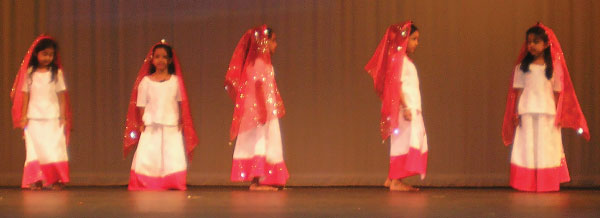 What’s remarkable is the zest the organizers bring to their efforts. It clearly pays off: It’s no mean achievement to sell out a cultural show to amateurs. What’s truly laudable about the entire effort, really, is the inclusive humanist spirit of Bengal the organizers and participants celebrate. At a time of bitter and violent ethnic and religious schisms, just how the organizers managed to bring together Bangla-speakers of West Bengal and Bangladesh is something to marvel at, and well worth emulating. San Francisco Bay Area Bengalis, learn from Sacramento. “Because of Anandamela, our kids are taking more interest in Bangla language and culture; this is truly unprecedented,” the organizers say in their brochure. “In addition, we can be proud about the bridge of friendship that has been built over the past three years between the communities of two Bengals. It is a testament to our age-old bonds of souls, which have surpassed the many differences among us. This has been made possible through the effort of many artists and volunteers.” |TOP|
Porshi, the monthly Bangla magazine published out of San Jose, Calif. is throwing a party Aug. 12 in Palo Alto, Calif., that includes a talent search, dance drama, mela and light Bangla vocal by Tapan Choudhury. A Siliconeer report.  The Bangla monthly Porshi is a testament to the passionate love for Bangla language and culture of three Bangladeshi expatriates who live in the San Francisco Bay Area and own the magazine. Over the years the magazine has managed to develop a small but avid following; now the magazine owners are about to celebrate five years of publication. The Bangla monthly Porshi is a testament to the passionate love for Bangla language and culture of three Bangladeshi expatriates who live in the San Francisco Bay Area and own the magazine. Over the years the magazine has managed to develop a small but avid following; now the magazine owners are about to celebrate five years of publication.Like a good porshi (the word in Bangla means neighbor), the magazine has reached out to all Bangla-speakers. To its credit, it has managed to break down the benign apartheid that seems to separate Bangla-speakers from Bangladesh and West Bengal, and its five-year celebrations reflect that in no small measure. Its festival sponsors include the Bay Area-based organization of West Bengal expats Sanskriti, the Sacramento, Calif., Bengali association that includes both Bangladeshis and Bengalis from West Bengal. Sanskriti will present a dance drama. Sacramento Bengalis will present some cultural performances. Porshi itself will present a performance of “Nakshi Kanthar Math” (The Field of the Embroidered Quilt) a famous poem of Jasimuddin. In addition, there will be a mela and a talent search for kids. In its earlier celebrations, Porshi has brought famous artists like Runa Laila, Baby Nazneen and the first Bangladeshi pop band Zinga. Given the near-impossible logistics of hosting a half-way decent Bangla event (it is simply impossible to recoup costs of even bringing over a single artist, given the reluctance of the Bengali audience here to pay a high ticket price), Porshi deserve credit for both persevering and continuing to host cultural events despite the daunting challenges. Interested readers can get more details from the Web site at www.porshi.com. |TOP| |