!-- Start Alexa Certify Javascript -->
|
|||||||||||||||||||||||||||
|
|||||||||||||||||||||||||||
|
|
|||||||||||||||||||||||||||
|
|||||||||||||||||||||||||||
|
|
|
|
|
|

MARCH 2006 |
|
|||||||||||||||||||||||||||
|
EDITORIAL:
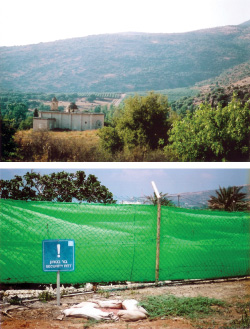
A Tangled Web: India, Israel and Palestine The Middle East may be geographically distant from both India and the United States, but that doesn’t mean any nation today can avoid the toxic effect of the misery visited upon the hapless Palestinians. Besides, in a globalized, interconnected world, there is no longer a cordon sanitaire for any nation or individual. Indian scholar Sunaina Maira’s perceptive, sensitive account of her trip to Israel illustrates this poignantly. Maira not only saw first-hand the oppression and dispossession of a people, but also their forbearance, dignity, warmth and humanity. The Palestinians in Israel are a people who are walled off within their own land by both physical and invisible barriers, yet they are also a people who refuse to go away, clutching their dream of nationhood as if their lives depend on it, because it does. The more fascinating side of Maira’s account is how India’s relations with the two nations amid changing geo-political dynamics plays out. It’s a complicated but absorbing tale. Older Palestinians remember India’s Jawaharlal Nehru and Indira Gandhi with great fondness as a tried and tested supporter of their freedom struggle, and love Bollywood films, especially Shashi Kapoor and Amitabh Bachchan of yesteryear. But recently another apparently paradoxical development has taken place: India has become chic in Israel. Indo-Israeli relations have also warmed considerably, and this has ramifications in the United States as well, Maira writes. What are the moral implications of all this for India and Indians? Is a callow tendency to get on the victor’s bandwagon overcoming India’s long-standing principled stand to offer unstinting support to all oppressed peoples, no matter what the geopolitical price is, be it Palestine or the African National Congress? Maira leaves us with a lot to think about. Environmental scientist Dr. Rashbihari Ghosh is aghast at recent reports that despite billions of dollars raised for tsunami victims, the overwhelming majority of marginalized survivors of the devastating tsunami that hit Asia in December 2004 are without adequate care. Reports from a San Francisco non-profit draw an appalling picture of hundreds of thousands of tsunami survivors not only without adequate shelter, but condemned to live that way in the foreseeable future. A separate UN report also draws similarly bleak conclusions. UN official Milon Kothari lamented: “Even in the face of such an overwhelming tragedy, governments have failed to uphold the human rights of their most vulnerable citizens.” Crawfordsville seems less like a travel destination than nowheresville. And that is exactly its charm. Far off the beaten track, it’s small-town Americana at its best: friendly, warm, picturesque, and full of the sort of individual character that is increasingly difficult to find in the larger metropolitan areas where everything from housing to shopping has become thoroughly homogenized. COVER STORY: A Passage to Israel: An Indian Perspective - By Sunaina Maira Even though she went to Israel, she discovered Palestine and found India, and hopes both will find their way to each other again in a time of war and occupation, writes Sunaina Maira.  A defiant Palestinian slogan on an Israeli barrier built to keep out Palestinian attacks. This summer, I visited Israel for the first time,. and I encountered things that were disturbing as well as inspiring. For two months, I lived in a village that was inhabited entirely by Palestinians who have Israeli citizenship and are living on ancestral land that was occupied by Jewish settlers in 1948 when the state of Israel was created. There are 1.2 million Palestinians who live inside the borders of Israel, comprising 19 percent of the Israeli population, in addition to the 3.25 million Palestinians who live under Israeli occupation in the West Bank and Gaza, and whose situation is often not as widely discussed. I had actually visited the West Bank the previous year, in the summer of 2004, to see for myself what life in Palestine was really like. As someone who grew up in India, I had recollections of seeing photographs of Yasser Arafat smiling warmly with Indira Gandhi on his visit to India. India was the first non-Arab state to recognize the PLO as the representative of the Palestinians and there was a Palestinian embassy in New Delhi in 1988. I had always recognized Palestine as a nation that was struggling against Western colonization and I wanted to visit the West Bank to learn more about what the reality was like on the ground.  Visiting Palestine was an amazing experience. On the one hand, I knew that there were checkpoints on the roads that Palestinians had to use, that were different from the Israeli settler roads, and that Palestinians trying to go to work or school were held up at the checkpoints or had to take dusty detours through fields if the roads were blocked, missing appointments, exams, or court dates. It was very hot in July, and I had to sit in sweltering heat in the service-taxis with other Palestinians going to Ramallah or Bethlehem or Jerusalem, as people were subjected to frustrating and humiliating searches and interrogation. I was struck by how calm and focused people were on trying to live their daily lives in the face of the checkpoints, road closures, and the ever-expanding Israeli wall slicing through their land. I knew about the wall that was being built to segregate Palestinian villages and towns from Israeli areas, and saw how it had annexed Palestinian land in many areas where it was built not on the 1967 border, but inside Palestinian territory. There are many cases where people are cut off from their farmlands and source of livelihood because of the wall, and travel in and out of towns encircled by the wall, such as Bethlehem or Jenin, is increasingly difficult. The segregation and racism of the Israeli occupation are visible in the West Bank. Visiting Palestine was an amazing experience. On the one hand, I knew that there were checkpoints on the roads that Palestinians had to use, that were different from the Israeli settler roads, and that Palestinians trying to go to work or school were held up at the checkpoints or had to take dusty detours through fields if the roads were blocked, missing appointments, exams, or court dates. It was very hot in July, and I had to sit in sweltering heat in the service-taxis with other Palestinians going to Ramallah or Bethlehem or Jerusalem, as people were subjected to frustrating and humiliating searches and interrogation. I was struck by how calm and focused people were on trying to live their daily lives in the face of the checkpoints, road closures, and the ever-expanding Israeli wall slicing through their land. I knew about the wall that was being built to segregate Palestinian villages and towns from Israeli areas, and saw how it had annexed Palestinian land in many areas where it was built not on the 1967 border, but inside Palestinian territory. There are many cases where people are cut off from their farmlands and source of livelihood because of the wall, and travel in and out of towns encircled by the wall, such as Bethlehem or Jenin, is increasingly difficult. The segregation and racism of the Israeli occupation are visible in the West Bank.But what I didn’t know was that Palestine would be so culturally familiar to me as a South Asian and that the hospitality and warmth of all the people I met would be so overwhelming. Given the conditions of hardship and frustration that Palestinians in the West Bank face daily, their generosity and helpfulness was even more striking. People went out of their way to walk me through checkpoints, to help carry my bags, to invite me to their houses, to share their meals with me in the midst of their daily battles for survival. I think that this is the other face of Palestine that doesn’t often get talked about, and the warm and open welcome I received made me feel right at home.
This past summer, when I visited a Palestinian village inside Israel, I was struck by something else, for I realized that Palestinian Israelis live in a society with invisible walls and checkpoints, in addition to real fences and gates. There was no concrete wall around the village of Kafr Yasif, in Galilee in northern Israel where I was staying. Yet it was clearly a segregated Palestinian village in a segregated society, for the residents were entirely Palestinian — Muslim and Christian — as is the case in other Palestinian towns and villages where there are no Jewish residents. There are towns and cities that have both Jewish and Palestinian Israelis, but the Arab quarter is segregated from the Jewish neighborhoods. The Jewish Israeli towns are clean, well-kept, with wide new roads and lovely gardens; in fact, many of them would put American suburbs or gated communities here to shame. Many Jewish towns and kibbutzim are built on confiscated Palestinian land or on destroyed villages, where the original residents are not legally allowed to return. Palestinian villages and towns, in stark contrast, have narrow roads, few social services, and meager recreational facilities for they are underfunded by the central government. Kafr Yasif, to me, was much more similar to poor towns in India than to Jewish towns or settlements next door in Israel. There were no parks, playgrounds, or libraries for young people, who ended up hanging out in the streets. Palestinians in Israel do not have the same access to housing, employment, education, and social services through policies that discriminate against them directly and indirectly. They also face racism and cultural stereotyping in the media and everyday discourse that perpetuates this state-sanctioned discrimination and inequality, even if there are individual Jews and progressive segments of Israeli society who would like to live in a society based on equality. As an organizer of a leadership training program for Palestinian Israeli youth told me, Palestinian youth are made to feel “not just that they are second-class citizens but they are second-class human beings,” that their lives and dreams and futures do not matter and are worth less than others’ lives. Apartheid in Israel is not publicly acknowledged so it is a complex issue to describe. However, the basis of apartheid is enshrined in Israeli law, for full citizenship in Israel is only for “Jewish citizens” and Palestinians do not have claims to the rights of full citizenship afforded to Jewish Israelis, even though they are living on their own land. The paradox is that Palestinian Israelis are citizens without citizenship. This is the painful contradiction of apartheid. One young man at a youth center in Nazareth said, he recognized it would be difficult “to change the situation of living with Jews” but that he and others in his generation wanted was to find “national autonomy, culturally and politically, and to control our own destiny.” He said, “I want others to know that I am Palestinian, that my grandfather was Palestinian, the land was Palestinian before they came here, it didn’t belong to them.” Loving India, Hating Palestinians  I also realized while living and traveling in Israel that the reality of colonization is difficult for Israelis to acknowledge on a daily basis. Most people are not born to hate or dominate, and so the truth of what was done to the native inhabitants of the land and their rich and ancient history is suppressed and denied. Textbooks in the state-run schools present history from the Jewish Israeli perspective. One young Palestinian Israeli woman said, “When we go through education in Israel and we open the textbooks, what we see is nothing about our own identity or our culture.” Here and there, however, one notices the melancholy remains of destroyed Palestinian villages dotting the land, an archway of what was once a home or a lonely minaret or church dome rising above fields and olive trees. These are poignant traces that have not been completely erased of the Palestinians who have lived here for centuries, contrary to Israeli Prime Minister Golda Meir’s statement that Israel was a land without people for people without a land. The Palestinians did not simply disappear from the land, as some Zionists had hoped. Their efforts to fight for equality and representation in Israel and their ongoing struggle in the occupied territories expose the myth that Israel is the “only democracy” in the Middle East. I also realized while living and traveling in Israel that the reality of colonization is difficult for Israelis to acknowledge on a daily basis. Most people are not born to hate or dominate, and so the truth of what was done to the native inhabitants of the land and their rich and ancient history is suppressed and denied. Textbooks in the state-run schools present history from the Jewish Israeli perspective. One young Palestinian Israeli woman said, “When we go through education in Israel and we open the textbooks, what we see is nothing about our own identity or our culture.” Here and there, however, one notices the melancholy remains of destroyed Palestinian villages dotting the land, an archway of what was once a home or a lonely minaret or church dome rising above fields and olive trees. These are poignant traces that have not been completely erased of the Palestinians who have lived here for centuries, contrary to Israeli Prime Minister Golda Meir’s statement that Israel was a land without people for people without a land. The Palestinians did not simply disappear from the land, as some Zionists had hoped. Their efforts to fight for equality and representation in Israel and their ongoing struggle in the occupied territories expose the myth that Israel is the “only democracy” in the Middle East.There is also a struggle in Israel on the cultural terrain of colonization as well. While denying the history and culture of Palestinians, and portraying them as backward, irrational, fanatical, violent, and untrustworthy, Jewish Israelis have adopted Palestinian and Arab food, music, and clothing as their own. Ironically, Israeli restaurants now claim that falafel, a typical Arab dish from the region, is an “Israeli national food.” As a Palestinian woman from Haifa said, “They have stolen our culture, not just our land.” Knowing the history of British colonization in India and elsewhere, I recognized this as a typical practice of the colonizers, who take from the colonized elements of their culture what they find appealing and claim it as their own. There is always cultural exchange and borrowing between communities, of course, but the difference in the case of Israel is that it is a colonial power appropriating the culture of the natives who were displaced and dispossessed. It is also a country that was invented as a home for people who chose not to live with the natives as equals, but to dominate them as a community with special rights and with a presumably superior, “Western” culture. Indo-chic
A Jewish-owned store that I visited in Haifa sold colorful curtains, pillowcases, and other home furnishings that they were now producing in Bombay and Delhi. Palestinian-owned cafes and stores were also likely to have an Indian-inspired theme, but they were generally not involved in business or outsourcing ventures themselves because they do not have the financial resources of Israeli entrepreneurs. Indo-chic in Israel mirrors the fashionability of Indian style in the U.S., and I found that even the street markets that sold discounted clothes and shoes carried exactly the same Indian-inspired items that are being sold in American stores. But Indo-chic in Israel is also partly due to a confluence of political and cultural currents that are specifically about Israel, and its new friendship with India. There are two main developments that underlie the emergence of Indo-chic in Israel. One is the Oslo accords of 1993 that led to a normalization of diplomatic and economic ties with Israel for many countries. This facilitated relationships with countries such as India that had opened its markets to foreign trade after economic liberalization, which the Israeli business sector has been quick to capitalize on in its search for cheap commodities and labor. India’s non-military trade with Israel was $1.27 billion in 2002, a six-fold increase over the previous decade, and India is now Israel’s second-largest trading partner in Asia. The second important historical shift is that India established full diplomatic relations with Israel in 1992. The Bharatiya Janata Party government deepened the military and intelligence cooperation between the two countries that had already been in place, but covertly, since the 1950s. By 2004, Israel had become India’s largest arms supplier, and India emerged as Israel’s biggest arms market. Underlying this new alliance is a deeper issue of ideology and political orientation in the current moment. India and Israel have begun to emphasize a common enemy in their respective “anti-terrorism” operations which were framed by both nations as a battle against “Islamic militants,” a framework that gained global currency with Bush’s launching of the War on Terrorism. India and Israel’s new honeymoon reversed India’s historical stand of support for the Palestinians who were still living under occupation and apartheid and ignored India’s own experience with colonization. Despite some criticism of this new India-Israel axis and symbolic gestures toward the Palestinian Authority, the United Progressive Alliance government has continued the policy of strengthening ties with Israel. This is despite the fact that Israel continues to maintain its military, political, and economic stranglehold on Palestinians who still do not live in a fully sovereign state in the West Bank and Gaza, or in a truly democratic nation in Israel. At the same time as the alliance between India-U.S.-Israel formed a new political triangle, a parallel development has occurred in the U.S. Hindu right-wing groups, such as the Indian American Political Action Committee and the Hindu American Foundation, linked to the Vishwa Hindu Parishad America and overseas branches of the RSS, have forged alliances with powerful pro-Israel lobby groups such as the American Israel Political Action Committee and the American Jewish Committee. Hindutva groups are meeting Zionist organizations to learn about strategies to advance religious nationalist agendas and suppress any criticism of their political movements. These U.S.-based groups have helped strengthen India-Israel ties and propagate the notion that Hindu and Jewish Americans are victims of a common enemy defined as “Islamic terrorism,” for example, through organizations such as Democracies against Terror which is an alliance of Zionist and Hindutva activists based in Fremont, Calif. Yet as these links were being forged in the U.S., Indian Americans, and South Asian Americans more generally, have had similar experiences of racial profiling and anti-immigrant sentiment with Arab Americans and other immigrant groups, especially after 9/11. The “war on terrorism” has targeted South Asian, Muslim, and Arab Americans as automatic suspects and potential terrorists. Experiences of FBI surveillance, detention, deportation, and discrimination in airports, workplaces, schools, and public spaces have persisted well beyond 9/11. As these communities continue to be targeted in the U.S., Indian and South Asian Americans need to find common cause with Arab Americans and other minority groups to fight for our civil rights, instead of embarking on a campaign based on racist and exclusionary ideas. Clearly, there is a need for all communities to live in peace and security, but this will not happen by ignoring or denying the right of people to freedom and human rights. At the same time as I was grappling with the politics of hate spanning three continents — in the U.S., Israel, and India — I also puzzled at the curious place that India had in the imagination of many Israelis. In many instances, it seemed that India represented a land of spirituality and exoticism, much as it does in the West generally. One Israeli store-owner in Haifa commented, “Israelis love the Eastern style.” But the New Age fascination with India in Israeli culture plays a somewhat different role than it does in the U.S. or Europe. For one thing, Israel is a nation that is in the East, technically, but the culture of the nation created by Jewish settlers is not Eastern. Most of the Jewish settlers in Israel were Ashkenazis from Eastern Europe, and while there have been later arrivals from Russia, Africa, and the Arab world, Israeli Jewish culture remains a blend that is primarily European and American with Arab and African culture remaining marginal,. I wondered if the turn to India is an attempt to create an Eastern culture for a nation that was created by European minds but carved out of Arab soil. The second, equally ironic but even more troubling, distinction of Israel’s Indo-chic is that it fetishizes an image of pacifism in a culture that is overwhelmingly militarized. I was struck from the moment I stepped out of the Palestinian village at the overwhelming presence of Israeli soldiers. On sidewalks, at bus stops, sitting in cafes, lounging by the beach — everywhere I turned, there were soldiers standing, talking, strolling, and all carrying arms. I was reminded, however, that even those Israelis not wearing military uniform were would-be soldiers or had-been soldiers, for by law, all Israeli men as well as women have to do two to three years of military service when they turn eighteen. The distinction between civilians and soldiers is blurred in Israel, and militarism penetrates every corner of public space. Israelis travel to India to relax after doing their reserve duty since the 1990s when many young Israelis began flocking to Goa to do drugs and dance at raves on the beach. An Indian friend who has traveled and hitchhiked extensively in India said that she saw an increasing numbers of young Israelis traveling and doing drugs in India and Nepal. The famous camel fair at Pushkar in Rajasthan, already a popular destination for Western tourists seeking experiences of the “exotic,” has become flooded with signs in Hebrew and with marijuana smoke. Many of these Israeli nirvana-seekers overdosed on drugs and the Israeli government set up detoxification programs for them in India, recognizing that this was becoming a serious problem. On my last trip to India in 2005, I noticed groups of young Israeli tourists dressed in neo-hippie garb. At Delhi airport, an Israeli woman held up a portrait of her son, proudly explaining to other passengers that he was a soldier who was now living and traveling in India. What does it mean for India to be the place where Israeli soldiers can overdose and detox and find nirvana for cheap? Have we sold out in supporting the Israeli military and economy through trade, arms deals, and intelligence cooperation? It is true, of course, that not all Israelis are going to India to do drugs such as ecstasy or find nirvana after serving in the army and that India cannot, and should not, police motivations for tourism. However, the larger picture is one in which India is now supporting and enabling the Israeli military occupation, directly and indirectly, and where Israeli soldiers are a much more common sight in Delhi than the Palestinian refugee students of yesteryear. That past era of Indian-Palestinian connection is one that many Palestinian Israelis I spoke to remembered fondly. Everyone in Kafr Yasif, and all the other Palestinians I met whether inside Israel or in the West Bank, were universally thrilled to know that I was Indian. Palestinians expressed a very different relationship to India than the Israelis I met. Some would begin singing riffs from Hindi film songs, while others would murmur reverently, “Amitabh Bachchan,” “Zeenat Aman,” or “Shashi Kapoor.” Indian films were very popular in Palestine, as is commonly the case in the Middle East and North Africa, and many had grown up on a diet of Bollywood movies. They spoke of admiring Amitabh Bachchan in the 1970s because they saw him as the common man’s hero, fighting against corruption, injustice, and class inequity. Many also related to the themes of family, loyalty, and honor, and to a cultural and social milieu that was much more recognizable to them than the world portrayed in Hollywood. The cultural recognition between Palestine and India is a mutual one. There was also a generation of Palestinians whose eyes would light up when they heard where I was from, and who would ask me about Indira Gandhi, and particularly, Jawaharlal Nehru. For these older Palestinians, Nehru symbolized Third World solidarity with decolonization struggles, including their own, and the alliance with Egyptian nationalist hero, Gamal Abdul Nasser, during the Non-Aligned Movement of the 1950s. This was a time when countries such as India, Egypt, and Indonesia came together at the Bandung conference of 1955 to oppose Western colonialism and strengthen cultural, economic, and political ties in the face of Cold War polarization. Back to the U.S.A. The world of Arafat and Gandhi, Nehru and Amitabh — at least the hero in bellbottoms — no longer exists. It is a different moment in history, and we cannot indulge in nostalgia for a very different political time. The question for me, as I drove to the airport in Tel Aviv on my way back to the U.S., was rather: what kind of role India is hoping to play on the world stage and what principles are we going to represent? Are we going to be a beacon of principled support for sovereignty and democracy, and recognize other anti-colonial struggles in a different time and place as echoing our own fight for independence from colonization? Are we going to publicly oppose Israeli apartheid and try to support Palestinians in the West Bank and Gaza or reach out to Palestinians inside Israel through economic, political, or educational exchange? In the U.S., are we going to see in the targeting of South Asian, Arab, and Muslim Americans a common cause for civil rights, or are we going to join forces with movements that want to expand the targeting of communities based on racist cultural assumptions and denial of humanity? When I returned to the U.S., I was struck by how much it increasingly reminded me of Israel every time I went through security checkpoints at American airports. But there are also moments when I go to a film about Palestine or Iraq, or to a meeting to discuss immigrant rights in the U.S., and someone from the region will ask me if I have seen the latest Hindi movie or if Indians care about what is happening to the Arabs, here and there. That is when I realize that even though I went to Israel, I discovered Palestine and found India, and that both will hopefully find their way to each other again in a time of war and occupation. - Sunaina Maira is associate professor of Asian American studies at the |TOP|
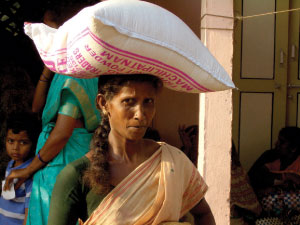
ENVIRONMENT: A Continuing Tragedy: Tsunami Relief and Disaster Preparedness A The plight of marginalized tsunami victims of the 2004 December tsunami is a disgrace, given the billion dollars raised for relief; nor is adequate attention being given to disaster preparedness in the event of a future tsunami, writes environmental scientist Dr. Rashbihari Ghosh.  (Left): “Rebuilding from the Tsunami,” a patachitra story scroll by Raheem Chitrakar, West Bengal. (Right): A tsunami survivor with her grandchild in Tamil Nadu. A recent UN report reveals that countries devastated by the tsunami have wasted millions of dollars in aid and neglected thousands of victims affected by the 2004 December Tsunami disaster. It has been over a year, yet the victims who are the most needy were not being helped despite resources. Hotels and big businesses have been allowed to build beach resorts without the proper environmental impact analyses, while many families have been uprooted and forced to live in shacks. In India the government has failed to provide food, water and shelter for the most underprivileged. The Sri Lankan government has paid compensation only to men, sometimes ex-husbands, while mothers struggling to raise families have been left penniless, the report said. About $10 billion, of which a small country like Britain alone contributed $600 million, was raised to rebuild the countries hit by the earthquake and tidal wave. Aid experts who have visited the towns and villages where people were affected by the disaster have been shocked after seeing how basic rights of food, health, shelter and housing, work and compensation were neglected. In Thailand, the report said, authorities forced villagers out of their traditional homes in favor of commercial interests and the local land mafia. UN official Milon Kothari lamented: “Even in the face of such an overwhelming tragedy, governments have failed to uphold the human rights of their most vulnerable citizens.” Ramesh Singh of Action aid International added: “Emergency help should reach all those who need it, not a selected few. They should be ashamed of their record.” This raises serious credibility questions for emerging economies. The sad fact is that while resources lie idle and incompetence and outright corruption rule the roost, there are vital environmental crises looming in many areas in the Bengal Basin that need urgent support, both financial and technological. I have been struggling to address the water and environmental crisis in Bengal Basin and seeking funds and many aid organizations are considering a proposal to bring Dhaka, Delhi and Kathmandu together to address the problems jointly for the greater good of the citizens of the region. But the post-tsunami scandals raises valid questions about whether we can handle the funds even if it is made available to us. \
Kolkata groundwater has been exhausted many years ago and it has come to a stage that it can provide no more fresh water. The situation is so bad that it may be beyond restoration. The replenishment of ground water takes time and care and money and proper technology. All of these are available today including proven technology to mitigate such conditions through artificial injection of fresh water, but how to get that technology to West Bengal and Bangladesh? Investigating the Tsunami A tsunami wave is not like a huge flood of water due to a storm or hurricane which comes and goes. A tsunami is a killer wave, a wall of a million tons of water that keeps coming and coming. The tsunami produced 60 times more force than the recent hurricane Katrina in the U.S. The earthquake began at 7:58 a.m., and two hours later the first wave hit the island of Indonesia. The tsunami wave moved around the world three times. The movement of the wave was twice the speed of a jet liner. A team of scientists conducted a 17-day expedition to the Indian Ocean in May of 2005, four months after the tsunami. The expedition party consisted of a multidisciplinary team of experts from Canada, America and Europe, lead by Dr. Kate Moran and co-directed by Dave Tappin. The purpose of the expedition was to develop a computer model to predict the behavior of future tsunamis. No one had explored this area of the Indian Ocean before the massive evidence left by the recent earthquake. Tsunamis are caused by friction between the tectonic plates, a geological condition that may continue for thousands of years. There are two theories to explain the cause of the tsunami: A giant underwater landslide may have been the cause, or the scraping of the tectonic plates caused the land to rupture creating what is called a megathrust, a dramatic outward thrusting of the seafloor. Giant Landslide Theory In Latuya Bay, Alaska, there is a coastal area where the trees are younger compared to the other trees. What could have destroyed the trees? It was an underwater landslide that caused a giant wave to wash away all the trees. The team searched for and found evidence of a giant landslide while exploring the region of the Indian Ocean floor above the epicenter of the tsunami. It turned out, however, that the landslide was an old one. The team found a lot of other evidence pointing to a previous landslide and thus, the team concluded that the tsunami was not triggered by a landslide. Underwater landslides usually trigger tsunamis that are not so gigantic. Most tsunamis are caused by earthquakes and not landslides. Megathrust Theory By examining the ocean floor the team discovered a dramatic outward thrusting of the ground. Many cracks exist in the area and many of them are remarkably big but the recent uplift of the ocean floor connected with the tsunami is a very distinct formation in that area of the Indian Ocean. It looks like a staircase or cliff face, thrusting upwards. The total vertical shift is 2 feet to 40 feet, over a stretch of land 750 miles long. The team concluded from the evidence that this megathrust caused the tsunami. It is apparent now that the source of this killer wave was in fact an event 20 miles below the sea floor. Half of the fault had ruptured and the other half may also erupt anytime in the near or far future. A similar fault exists in the Pacific Northwest called the Cascadia Fault. The Cascadia Fault is 40 miles away from the shore, even closer than the one that hit Banda Aceh Island in Indonesia, and would impact at least 500 miles of coastline. Using the computer model, a similar 9.2 magnitude earthquake in the Cascadia Fault will produce the following:
The continental tectonic plates slide one over the other and the continuous friction between the plates over many years releases sudden huge energy. Frequent, mild earthquakes in the range of 2 to 4 Richter scale help to release energy and may result in a reduced risk of bigger earthquakes. Work is currently underway to ease the pressure on the fault lines. There is a $100 million project that will drill the ocean floor to measure stress levels as well as to pump fluid into the earthquake zone to produce smaller quakes.
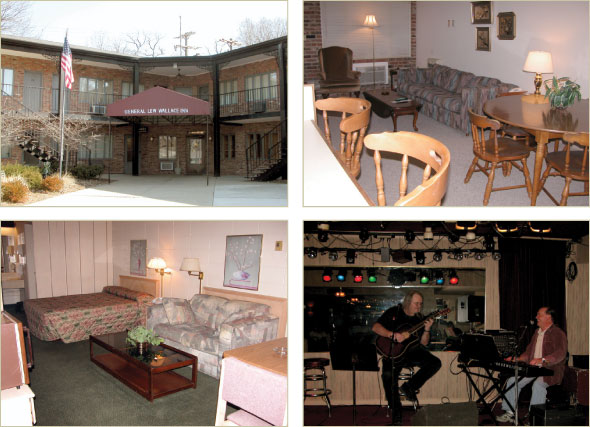
NEWS DIARY: February Roundup  Uma’s New Party | Both Sides Claim Victory in Textbook Row | Two South Asians among Top 20 U.S. College Students | Despite Tsunami Funds, Victims Languish | Don’t be Chicken, Grab a Bite | Bangla Islamist to Face Sedition Charge, Death Penalty | Historic Nuclear Accord | Pak Blocks Blogs | Godhra Train Fire Accidental, Panel Rules | U.S. Okays Iran Pipeline | Pak Clashes Kill Dozens | Ambush Kills Tamil Tigers | Bengal Tiger Tagged | Doctors Sacked | Indian Bank Eyes Rupali Uma’s New Party | Both Sides Claim Victory in Textbook Row | Two South Asians among Top 20 U.S. College Students | Despite Tsunami Funds, Victims Languish | Don’t be Chicken, Grab a Bite | Bangla Islamist to Face Sedition Charge, Death Penalty | Historic Nuclear Accord | Pak Blocks Blogs | Godhra Train Fire Accidental, Panel Rules | U.S. Okays Iran Pipeline | Pak Clashes Kill Dozens | Ambush Kills Tamil Tigers | Bengal Tiger Tagged | Doctors Sacked | Indian Bank Eyes RupaliUma’s New Party 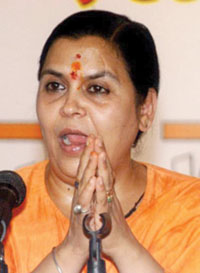 Who Umaji?” was the terse response of BJP spokesman Prakash Javadekar when asked about the expelled party leader’s plans to launch a new political party March 21. Who Umaji?” was the terse response of BJP spokesman Prakash Javadekar when asked about the expelled party leader’s plans to launch a new political party March 21.Javadekar declined to comment on Uma Bharti’s announcement in Indore to launch her party, indicating the party’s indifference towards her after her expulsion and outbursts against the top BJP brass including former Prime Minister Atal Behari Vajpayee, Leader of Opposition L.K. Advani and party chief Rajnath Singh. “We have nothing to say,” said Vishwa Hindu Parishad senior vice-president Acharya Giriraj Kishore. During her visit to Ayodhya as part of the Ram Roti Yatra, the former Madhya Pradesh chief minister had stayed at the VHP complex at Karsewakpuram. Asked whether VHP would support her if she launches a Hindu party, Kishore said, “Let her launch the party first. We will react thereafter.” Bharti’s latest move seems to have pretty much closed the door on a future return to the BJP. Ruling out the possibility of her return to the party fold, BJP general secretary Pramod Mahajan said that “so long as the reasons for her going out remains, till then there is no scope for any change in this decision.” |Back to NEWS Diary| |TOP| Both Sides Claim Victory in Textbook Row  Both sides claimed victory after the California Board of Education said it would accept the recommendations of its own panel following a bitter argument over proposed edits for California history textbooks. The edits were proposed by the Hindu Education Foundation and Austin, Texas-based Vedic Foundation who said the books as they stood denigrated Hinduism unfairly and gave inaccurate information. Critics, including South Asian activist groups, dalit groups and academic South Asia experts, said the HEF-led effort masked a Hindu nationalist agenda championed by the Sangh Parivar. HEF was founded by the Hindu Swayamsevak Sangh, a sister organization of India’s Rashtriya Swayamsevak Sangh. Both sides claimed victory after the California Board of Education said it would accept the recommendations of its own panel following a bitter argument over proposed edits for California history textbooks. The edits were proposed by the Hindu Education Foundation and Austin, Texas-based Vedic Foundation who said the books as they stood denigrated Hinduism unfairly and gave inaccurate information. Critics, including South Asian activist groups, dalit groups and academic South Asia experts, said the HEF-led effort masked a Hindu nationalist agenda championed by the Sangh Parivar. HEF was founded by the Hindu Swayamsevak Sangh, a sister organization of India’s Rashtriya Swayamsevak Sangh. Supporters and opponents of the edits gathered in force at a public meeting in Sacramento, where a number of university faculty South Asian experts, many of them of Indian descent, unanimously opposed the proposed edits suggested by HEF. The final recommendations were based on a compromise between Harvard Sanskrit expert and philologist Michael Witzel and Cal State Northridge emeritus Prof. Shiva Bajpai. “On behalf of the Hindu community, we have done significant progress to correct the biases and distortions in the textbooks,” HEF spokesperson Khanderao Kand told India-West newspaper. “We need to work further. There are gross inaccuracies.” Friends of South Asia, an activist group opposed to the HEF and VF campaign, said: “This decision is a victory for community organizations such as Friends of South Asia, the Ambedkar Center for Peace and Justice, the Federation of Tamils on North America, and the Coalition Against Communalism, who have worked diligently to ensure that ahistorical and sectarian content proposed by Hindu right-wing groups is removed from California textbooks.” |Back to NEWS Diary| |TOP| Two South Asians among Top 20 U.S. College Students  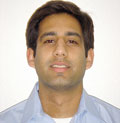 University of California at Irvine student Vivek Mehta (l) and Johns Hopkins University student Hari Prabhakar (r) are the two South Asians among the top 20 USA Today 2005 College Academic All-Stars. University of California at Irvine student Vivek Mehta (l) and Johns Hopkins University student Hari Prabhakar (r) are the two South Asians among the top 20 USA Today 2005 College Academic All-Stars. Four times a year, USA Today honors outstanding students and educators with the All-USA Academic and Teacher Teams. Students named to first teams receive $2,500; runners-up to the second and third teams receive certificates of achievement. Mehta, 21, is majoring in biochemistry and molecular biology. In addition to basic science research on the human immune system, he won, as a volunteer, a $10,000 grant to organize anti-obesity health education seminars; he also volunteered at medical camps in Mexico and India. Hari Prabhakar, 20, is majoring in public health and writing. He formed the Tribal India Health Foundation to support existing tribal health initiatives and launch a sickle-cell disease research project and screening center at a tribal hospital in south India. He is also a founding president of the Kranti Indian a cappella group and started a Students for Organ Donation chapter. Four South Asians were named to the Second Team: Rohan Krishnamurthy, Kalamazoo College, Michigan; Lakshmi Krishnan, Wake Forest University, Winston-Salem, N.C.; Nelupa Sulani Perera, Carleton College, Northfield, Minn.; and Nina Vasan, Harvard College, Cambridge, Mass. The South Asians named to the Third Team were: Sohang Gandhi, University of Central Florida, Orlando; Neelima Vidula, University of Illinois-Chicago. Kathleen Dass, Wayne State University, Detroit; Janaka Lagoo, University of North Carolina at Chapel Hill; and Sunjay Mathur, Case Western Reserve University, Cleveland, Ohio, won honorable mention. |Back to NEWS Diary| |TOP| Despite Tsunami Funds, Victims Languish Pic: A Sri Lankan tsunami survivor at a candlelight vigil.  A recent survey shows that a large percentage of those affected by the tsunami Dec. 26 2004 still live in makeshift tents and that some of them could remain there for another ten years. Ironically, it is not for lack of funds. A recent survey shows that a large percentage of those affected by the tsunami Dec. 26 2004 still live in makeshift tents and that some of them could remain there for another ten years. Ironically, it is not for lack of funds.San Francisco-based non-profit Fritz Institute found that of 2,300 people surveyed a year after the tsunami, 100 percent of respondents in the hardest-hit parts of the Indonesian island Sumatra, 92 percent in India and 78 percent in Sri Lanka were still in tents or temporary shelters. British charity Oxfam International estimates that 80 percent of the 1.8 million people left homeless by the disaster were still without “satisfactory permanent accommodation.” Meanwhile, as the coffers are overflowing at the global charity organizations that have promised tsunami reconstruction, it is small, unknown groups that are outdoing the global charity giants in building permanent shelters for tsunami survivors. A report on the tsunami-related funding activities of the major U.S. private charities in the first nine months after the disaster reveals that less than half of the $1.8 billion they received from American donors has been spent. The report, which is a study of 62 well-known aid organizations, including American Red Cross, CARE USA, and Habitat for Humanity, and Operation USA and World Vision by the umbrella group InterAction, showed that the consortium had spent only $743 million through Sept. 30. |Back to NEWS Diary| |TOP| Don’t be Chicken, Grab a Bite Pic: Two men eat chicken during a food fair to promote chicken in New Delhi 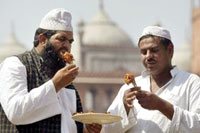 Who says there’s no free lunch? After the bird flu outbreak sent demand for chicken, eggs and other poultry products plummeting nationwide, the country’s poultry farmers have hit the Indian capital big time with a one-off offer — Come eat your fill of fried chicken, chicken biryani and fried eggs. Who says there’s no free lunch? After the bird flu outbreak sent demand for chicken, eggs and other poultry products plummeting nationwide, the country’s poultry farmers have hit the Indian capital big time with a one-off offer — Come eat your fill of fried chicken, chicken biryani and fried eggs. All free, courtesy of the Poultry Federation of India. Since bird flu was confirmed in India Feb. 18, the poultry industry has been losing Rs 450 million a day. Though senior government officials publicly chewed on chicken at the height of the flu scare to prove it was safe if cooked well, it hasn’t helped. So this time around poultry farmers have decided go to the public. Around 5,000 kg of chicken, 400 kg of rice and 5,000 eggs were used to prepare dishes by expert cooks. And if initial reports are to be believed, it might just be working. “I did not know that a chicken festival was organized at the market. I saw so many people eating chicken and so joined in,” said Shazeb, a software engineer who had come for Sunday prayers at the Jama Masjid. “They are not going to charge anything for the food,” said Mohammed Sharif. “We had stopped eating chicken but will soon start because I think it is now safe to eat.” “The dishes were absolutely delicious and I am taking two plates of biryani home,” said delighted homemaker Parveen Kapoor, who lives in the old city. “As soon as I came to know about the festival, I invited all my friends,” she said. It couldn’t happen a moment too soon for chicken farmers. “It is a Rs. 300 billion industry in the country and we are facing huge losses for the past few weeks,” laments PFI secretary Shyam Kumar. |Back to NEWS Diary| |TOP| Bangla Islamist to Face Sedition Charge, Death Penalty 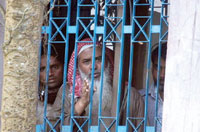 Shaikh Abdur Rahman (r), leader of the banned Islamist organization Jamaat-ul-Mujahideen, has been arrested after he surrendered following a long siege in a house in the eastern town of Sylhet. Shaikh Abdur Rahman (r), leader of the banned Islamist organization Jamaat-ul-Mujahideen, has been arrested after he surrendered following a long siege in a house in the eastern town of Sylhet. Officials blame him for a wave of attacks in which at least 28 people have died and say he will face sedition charges. Convictions in sedition cases are very rare in Bangladesh, but the charges carry the death penalty. Abdur Rahman had been accused of involvement in dozens of attacks even before his dramatic arrest following a 33-hour siege at his hideout. The charges so far brought against him include murder, and supplying explosives to the members of his JMB group. But opposition and human rights groups have been demanding that Rahman be charged with sedition, because the wave of bombings had targeted the country’s courthouses. His banned Islamic group is also seeking to abolish Bangladesh’s secular laws in order to replace them with strict Sharia laws. Bangladesh Home Minister Lutfozzaman Babor said the acts committed by Rahman amounted to a war against the state. “He must face sedition charges for what he did against the country,” he told the BBC. Babor said the security forces have stepped up an operation to arrest Rahman’s deputy, Siddiqul Islam, who is better known as Bangla Bhai. The United States welcomed the arrest. “The United States applauds the arrest by Bangladeshi security forces of Abdur Rahman, the leader of the Jamayetul Mujahideen in Bangladesh,” State Department deputy spokesman Adam Ereli said at a news briefing. “His capture is an important step in confronting extremism in Bangladesh.” |Back to NEWS Diary| |TOP| Historic Nuclear Accord 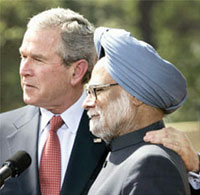 The United States and India signed a nuclear deal after talks in Delhi between President George W Bush (l) and Indian Prime Minister Manmohan Singh (r) that Bush, on his first visit to India, called “historic.” The United States and India signed a nuclear deal after talks in Delhi between President George W Bush (l) and Indian Prime Minister Manmohan Singh (r) that Bush, on his first visit to India, called “historic.” According to the deal energy-hungry India will get access to U.S. civil nuclear technology and open its nuclear facilities to inspection. If ratified by Congress, the nuclear deal will end years of international isolation for India over its nuclear policy. However, the deal must be approved by the U.S. Congress, by no means an easy task. “It’s a necessary agreement. It’s one that will help both our peoples,” Bush said after the agreement. “Congress has got to understand that it’s in our economic interests that India has a civilian nuclear power industry to help take the pressure off the global demand for energy.” Critics both inside and outside the U.S. Congress say India has not signed the Nuclear Non-Proliferation Treaty, and rewarding India sets a bad precedent for nuclear proliferation, particularly at a time of growing concern about Iran’s nuclear ambitions. In India, Communist parties and Muslim groups opposed Bush’s visit and led protests across India, but generally Bush was warmly welcomed by many other Indians. |Back to NEWS Diary| |TOP| Pak Blocks Blogs  Pakistan telecom authorities have blocked several Web sites inviting people to draw cartoons of the Prophet Muhammad. Instructions were issued to internet service providers across Pakistan to block about a dozen Web sites of various origins. Pakistan telecom authorities have blocked several Web sites inviting people to draw cartoons of the Prophet Muhammad. Instructions were issued to internet service providers across Pakistan to block about a dozen Web sites of various origins. The ban comes amid protests in several Muslim countries against the cartoons, first published in Denmark last year. Islamic tradition prohibits images of the Prophet. Bloggers in Pakistan became first became aware of the ban Feb. 28 when they were unable to access a popular blog hosting site, Blogspot. One of the blocked sites is hosted on Blogspot, which led to the blocking of all Web journals hosted on the site. Pakistan bloggers found their blogs blocked, even though their blogs are not connected with the cartoons. They say they have still been able to edit and update their blogs, but not able to read them. Many are using anonymizers — a service which allows people to surf sites without being identified — to access their sites, while the U.S. blogging community has sent out suggestions for ways in which Blogspot can be accessed. The blocking is unlikely to turn into a major freedom of expression issue in Pakistan as there seems to be a consensus against allowing such freedom to extend to irreverent treatment of religious figures. |Back to NEWS Diary| |TOP| Godhra Train Fire Accidental, Panel Rules Pic: The burned coach in Godhra 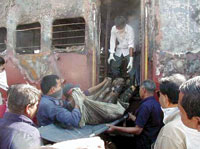 An Indian government panel has ruled that the fire in a coach which sparked communal riots in Gujarat in 2002 was accidental. An Indian government panel has ruled that the fire in a coach which sparked communal riots in Gujarat in 2002 was accidental. The incident Feb.27, 2002 led to the death of 59 kar sevaks, and amid allegations that they were killed following a pre-planned attack by Muslims, Gujarat erupted in one of the worst communal violence in independent India’s history which claimed the lives of over 2,000 Muslims. Now the panel led by Justice U.C. Banerjee says the fire in S-6 coach of the Sabarmati Express was accidental. In his latest report, Justice Banerjee ruled out the theory that petrol was poured into the coach S-6 to set it ablaze. Based on his commission’s findings, he said when the coach caught fire there was first a smell of burning, followed by dense smoke and flames. That sequence is not possible when petrol is set alight inside the coach, or if someone threw a burning object into the coach from outside, he said. The Sangh Parivar in Gujarat has described the report as a “mere eye-wash and an attempt to please the political bosses,” while human rights activists claimed it to be the “final outcome of the whole truth.” Gujarat Chief Minister Narendra Modi’s government, which has appointed the G.T. Nanavati and K.G. Shah judicial inquiry commissions to probe the incident, refused to comment. Meanwhile, the Communist Party of India-Marxist asked Modi to resign. “In all these years neither the then Home Minister L.K. Advani (of the BJP) nor the Modi government have been able to provide a shred of evidence to back their theory of a pre-planned conspiracy against kar sevaks,” the CPM politburo said in a statement. |Back to NEWS Diary| |TOP| U.S. Okays Iran Pipeline Pic: An engineer in Iran’s South Pars gas field in Assaluyeh.  U.S. President George W. Bush says he had no objections to a proposed pipeline to supply Iranian natural gas to India and Pakistan, marking a change in Washington’s position on the project. U.S. President George W. Bush says he had no objections to a proposed pipeline to supply Iranian natural gas to India and Pakistan, marking a change in Washington’s position on the project.“Our beef with Iran is not the pipeline, our beef with Iran is in fact they want to develop a nuclear weapon and I believe a nuclear weapon in the hands of the Iranians will be very dangerous for all of us,” Bush told a news conference. The United States had previously said it was “absolutely opposed” to the natural gas pipeline project linking Iran with Pakistan and India. Pakistan and India are negotiating with Iran on the gas price and project structure. The three nations will meet for the first time to finalize strategy over the 1,600-mile pipeline costing more than seven billion dollars. Iran, the second-biggest producer in OPEC after Saudi Arabia, is accused by Western powers of seeking nuclear weapons under cover of a civilian energy program. |Back to NEWS Diary| |TOP| Pak Clashes Kill Dozens Pic: Pak troops patrol in a North Waziristan town. 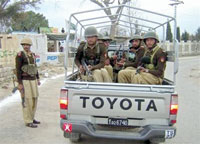 Pakistani troops battled pro-Taliban fighters near the Afghan border in clashes which have killed more than 50 people. Pakistani officials said 46 militants and five soldiers died, although some reports put the death toll at over 70. Pakistani troops battled pro-Taliban fighters near the Afghan border in clashes which have killed more than 50 people. Pakistani officials said 46 militants and five soldiers died, although some reports put the death toll at over 70. Clashes are over and the security forces are back in control of the town of Mir Ali, an army spokesman said. Reporters say it is the fiercest fighting since the army went into the area in 2003 to drive militants out. The violence began when a group of more than 100 tribal militants attacked a military post in Mir Ali. Security forces fought back, killing more than 20 militants. Soon the clashes spread to Miran Shah, where several hundred militants tried to storm the main headquarters of the paramilitary troops. The army sent helicopter gunships after tribesmen traded mortar and gunfire with security forces. Clashes reportedly petered out but later on helicopter gunships pounded mountains to the east of Miran Shah, sending plumes of smoke into the sky. “Now the writ of the local administration is restored and the said area is under complete command of the security forces” said army spokesman Major General Shaukat Sultan, speaking of the situation in Mir Ali. He said some residents had been moved to “safer areas” because of the fighting. “We cannot rule out the killing of civilian people because militants have their hideouts in populated areas” he said. |Back to NEWS Diary| |TOP| Ambush Kills Tamil Tigers Pic: A Sri Lankan army soldier secures a street in Jaffna. 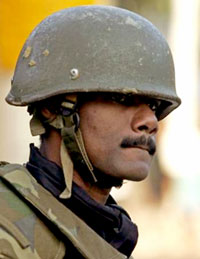 Tamil Tiger rebels say two of their fighters have been killed in an attack by the Sri Lanka army in the eastern Sri Lankan town of Batticaloa. The Sri Lankan army denies the allegations. Tamil Tiger rebels say two of their fighters have been killed in an attack by the Sri Lanka army in the eastern Sri Lankan town of Batticaloa. The Sri Lankan army denies the allegations. It is the first incident of violence since the rebels and the government met in Geneva recently and agreed to abide by the 2002 ceasefire. The talks followed a recent upsurge in violence which cost at least 120 lives. The Sri Lanka Monitoring Mission, which is monitoring the ceasefire between the rebels and the government, confirmed there had been an incident in which one rebel fighter died. “We saw one dead body early this morning... shot to death,” said Hagrup Haukland, head of the SLMM. “There were a couple of houses burning.” said. The rebels say there were nearly 10 rebel fighters on duty at the Batticaloa check post when the armed group attacked. They say the fighters guarding the check post also retaliated. A pro-Tiger Web site said two rebels were killed “when a heavily armed group of attackers... launched an ambush.” The report also said that a gunfight “ensued for more than 10 minutes and the attackers withdrew towards Vavunathivu Sri Lanka Army base.” The military spokesman, Brig Sudhir Samarasinghe, said that the report was “rubbish” and rejected allegations that the army was involved in the incident. |Back to NEWS Diary| |TOP| Bengal Tiger Tagged  Pic: A Royal Bengal tiger Pic: A Royal Bengal tigerBangladesh wildlife experts have fitted a radio collar on a second Royal Bengal tiger living in the Sunderbans to learn more about the elusive cat. The tiger, called the Queen of Shaplakhali, was the second to be fitted with the collar after the first died suddenly. Tagging the eight-year-old Queen of Shaplakhali would help experts learn more about the animals’ sexual habits and prey targets, chief forest officer of the Sunderbans said. Little is known about the habits of an estimated 668 Royal Bengal tigers living in the Sunderbans. Adam Barlow, from the University of Minnesota, is leading the radio collar study team. Through a satellite antenna and a computer program, the team will observe the tiger’s whereabouts for seven months. |Back to NEWS Diary| |TOP| Doctors Sacked 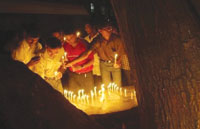 Pic: Resident doctors light candles during a protest in Mumbai. Pic: Resident doctors light candles during a protest in Mumbai. Nearly 350 doctors in Mumbai have been suspended for six months for going on a strike, according to local civic authorities. The post-graduate medical students, who work in municipal hospitals, went on strike after one of them was assaulted by a patient’s relative. The doctors demanded better salaries and greater security for doctors inside the hospitals. A doctors group said they will continue their strike despite suspension. Additional municipal commissioner Vijay Singh Patankar said the doctors had been suspended as they refused to listen to the government and return to their jobs. He said the government needed time to look at the doctors’ demands. A spokesman for the Maharashtra Association of Resident Doctors, Dr. Shrikant Pandit, said the doctors will not be able to continue their studies or practice medicine during the period of their suspension. The doctors will go on a hunger strike until the state government gives a written assurance that it will agree to their demands, he said. But the civic authorities plan to continue taking action against the doctors if the strike continues, Patankar said. |Back to NEWS Diary| |TOP| Indian Bank Eyes Rupali The State Bank of India is in the midst of negotiations on acquisition of Rupali Bank of Bangladesh at a cost of $100 million within the next two months. “Discussions are on for acquisition of an overseas bank. It is likely to be finalized in two months time,” SBI chairman A.K. said in New Delhi. Purwar had earlier said that the bank is now eying acquisition of a medium-sized bank and was willing to spend up to US$100 million for the buy-out. The SBI has identified the bank in Bangladesh for acquisition, but is tight-lipped as it has to abide by local laws until the deal is clinched. However, the Privatization Commission has already decided to go for road-shows at home and abroad to sell the 67 percent shares of the already partly-divested Rupali Bank. “We will arrange the road-shows in the different parts of the world including Dubai, Kuala Lumpur and London in the current month for seeking international buyers for the loss-making bank,” a senior PC official said. Meanwhile, the PC has extended the date for submission of the expression of interest letters for smooth completion of the whole process. The PC will prepare a short list after receiving the EoIs for floating the tender to sell the Rupali Bank, the official added. On the other hand, the SBI DFHI Limited, a subsidiary company of the SBI, has also shown interest in expanding its business in Bangladesh through establishing a unit in Dhaka. The SBI DFHI Limited has already applied to the Bangladesh Bank for issuing a primary dealer license to deal in the government-approved securities and bonds in the local market. Senior officials of the SBI DFHI Limited have already met the high-ups of the BB to discuss the existing rules and regulations for issuing PD license in Bangladesh, sources said. Earlier, the United Bank of India (UBI) showed its willingness to open a representative office in Dhaka. Sources in banking sector said a high-powered team of the UBI visited Bangladesh for assessing the market size and possible growth of the banking sector in the country. |Back to NEWS Diary| |TOP| TRAVEL: The Athens of Indiana: Crawfordsville Home to Gen. Lew Wallace, a Civil War veteran who wrote “Ben Hur,” and Wabash College, Crawfordsville, Indiana, is a slice of charming small-town Americana. A Siliconeer report.  (Top): Gen. Lew Wallace, who fought for the Union in the Civil War, was the first governor of the New Mexico and authored the Biblical novel “Ben-Hur: A Tale of the Christ. (Bottom): The 100-year-old General Lew Wallace Study and Museum, where General Lew Wallace wrote his famous novel ‘Ben-Hur.’ (Right): A view of the Court House Building and the Civil War Memorial. Never heard of Crawfordsville, Indiana? But that’s the whole point. You could go to popular vacation destinations where everybody else goes — and all you will find is vacationers like you, hundreds of them. Or you could go to some quaint offbeat place where you could actually soak in the local atmosphere. So what’s it going to be? You could do what most people do: Take a trip to Disneyland, where you stand in line for 45 minutes to catch a three-minute ride; or visit Yosemite National Park, where the entire desi janta from Fremont, Calif., seems to descend like some weird migratory flock of birds. Or you could try something different. Like Crawfordsville.  Located 47 miles northwest of Indianapolis, Crawfordsville is an easy drive on Interstate 74 and less than three hours from Chicago on Interstate 65. A charming yet prosperous community of 15,000, Crawfordsville ranks as 43rd on the roster in “The Best 100 Small Towns in America” according to author Norman Crampton’s second edition of the book. Founded as a town in 1834, Crawfordsville is home to Wabash College, a private, all-male, liberal arts college with an immaculate campus gracing Crawfordsville’s west end. The college surely contributed to Crawfordsville’s traditional surname — The Athens of Indiana — in recognition of the many notable writers who have resided here. Located 47 miles northwest of Indianapolis, Crawfordsville is an easy drive on Interstate 74 and less than three hours from Chicago on Interstate 65. A charming yet prosperous community of 15,000, Crawfordsville ranks as 43rd on the roster in “The Best 100 Small Towns in America” according to author Norman Crampton’s second edition of the book. Founded as a town in 1834, Crawfordsville is home to Wabash College, a private, all-male, liberal arts college with an immaculate campus gracing Crawfordsville’s west end. The college surely contributed to Crawfordsville’s traditional surname — The Athens of Indiana — in recognition of the many notable writers who have resided here.The city’s most famous son was Gen. Lew Wallace, who fought for the Union in the Civil War, was the first governor of the New Mexico Territory where he commissioned Pat Garrett to bring Billy the Kid to justice, and authored the Biblical novel “Ben-Hur: A Tale of the Christ.” The General Lew Wallace Study and Museum, where General Lew Wallace wrote his famous novel ‘Ben-Hur,’ is a highlight of a trip to this small town. His personal library is in the heart of Crawfordsville, at the Ben-Hur museum, a National Historic Landmark Just a short distance away is the historic Lane Place, a restored 19th century antebellum home. Just a few blocks from the Lane Place is the Old Jail Museum, featuring the world’s only operating rotary cell block constructed in 1882 and listed on the National Register. The city stands on the banks of scenic Sugar Creek and is the departure point for canoeists as they paddle their way downstream through Shades and Turkey Run state parks. You can rent a canoe, from Clements Canoes, for a trip down Sugar Creek. Sugar Creek also boasts some of the most famous crinoids beds. Military historian and collector Fred Ropkey recently moved his Ropkey Armor Museum from Indianapolis to a rural Crawfordsville site. The museum includes one of the largest private collections of tanks and other armored vehicles in the world. Ropkey has more armored vehicles in his collection than do some small countries. The museum is open Mondays through Fridays from 10:30 a.m. to 4:30 p.m.
Lew Wallace Although he would have much preferred to be remembered as a highly successful military hero, Lew Wallace has been thwarted in this ambition and is best known as an author. Born in Indiana, he had worked as a clerk and early displayed a fascination for Mexico which would affect him in later years. In 1849 he was admitted to the bar in his native state and seven years later entered the state senate. With the outbreak of the Civil War he offered his services and he eventually rose to command the 8th Corps, Middle Department. At the close of the war he sat on the court-martial which tried the Lincoln conspirators and presided over that which sent Andersonville chief Henry Wirz to the gallows. As a prolific writer, who often drew upon his own experiences, he is best remembered for Ben Hur — A Tale of the Cbrist, one of the most popular novels of the nineteenth century. Wabash College Wabash College is located in a 60-acre wooded campus containing 25 buildings predominantly of Georgian architecture. Caleb Mills taught the first class of Wabash students in 1833 in Forest Hall. Built in 1836, Caleb Mills’ House hosts various college functions. Also built in 1836, Hovey Cottage, home to the College’s second faculty member Edmund O. Hovey, houses the Wabash Center for Teaching and Learning in Theology and Religion. Wabash College was founded on November 21, 1832. According to early records, the next day a group of the men chosen as trustees of the college knelt in the snow and conducted a dedication service. The college would be located in the frontier town of Crawfordsville, Indiana, with the resolve “that the institution be at first a classical and English high school, rising into a college as soon as the wants of the country demand.” The first faculty member of Wabash was Caleb Mills, a graduate of Dartmouth College and Andover Seminary, who arrived in 1833 and immediately established the character of the school. As noted by Byron Trippet, who was associated with Wabash College for forty years as student, teacher, dean, and president, “by his ideals, his vision, and his abundant energy [Caleb Mills] gave to this college a sense of mission, which it has occasionally neglected, but has never completely lost.” Caleb Mills later became the father of the Indiana public school system and worked tirelessly to improve education in the entire Mississippi Valley. Each fall, Caleb Mills’ bell is used to “ring in” the freshman class as students of Wabash College, and each spring the bell “rings out” that year’s class of Wabash men as they move on to new challenges.
|TOP| REMEMBRANCE: Heroes in a Foreign Land: Indians in Eritrea During World War II Pravin Desai pays tribute to World War II veterans from India who fought valiantly in a critical battle in a small town in Eritrea.
They are the Indian soldiers — men and women from Rajputana Regiment, Marathas, Garhwals, Gurkhas as well as a dozen other military wings of the Indian Army — men and women who were united in a great cause. They served as soldiers, sailors, fliers, doctors and nurses in World War II. Thousands of them were never able to return to the motherland they had left to serve in the Allies’ long struggle 1941-42 as they fearlessly took on Italian aggression and occupation. They were buried, cremated throughout in north-east African nations of Sudan, Eritrea and Ethiopia. Keren is a small town in Eritrea dominated by lofty heights, where thousands of Indian soldiers valiantly fought a battle which turned the scales in favor of the Allies in the Second World War. Sixty years have passed, and as we look back at Keren as a picnic spot and garden city now, I do not want Indians losing sight of the heroism and bravery of the Indian Army, and I want those who are still with us to know that we will never forget what they did to safeguard our pride and prosperity. So here’s a previously untold story from 1941-42 of the liberation of Eritrea in one of the greatest battles of World War II that was fought in Keren. Indian soldiers fought and died and sacrificed their lives to liberate unknown land. I hope this help readers understand a little better the intensely personal nature of every battle in the war. It may have been a global conflict, but a soldier’s universe existed only a few feet to either side — perhaps only as far as his buddy to the right, or the bullets screaming by, or the explosions rocking the earth beneath his boots. The battle of Keren in Eritrea of North-East Africa took place in early 1941. Few military historians have adequately recorded the action in Eritrea in which only 19 Indian and British battalions stormed an impregnable mountain fortress defended by 42 battalions of crack Italian troops. The battle merits recognition not only on account of the heroic infantry action in the toughest of terrains, but also because it changed the complexion of the war on the African front. Had it not resulted in victory, the Red Sea route to Egypt would have been blocked and there would have been no way of reinforcing the British desert army. Once the North African flank was secured, the Allied forces could blunt the Nazi offensive across Libya and defeat the Axis armies in Africa.
Indian troops entered Ethiopia to assist its people in their struggle for liberation from the Italians occupying the country since October 1935. In 1940 the Italians had an army of 300,000 and 200 aircraft in Ethiopia. The Italians offered stiff resistance at the Gojjam mountains, where they were entrenched with heavily armed Italian forces, and in Eritrea, Rome’s so-called “firstborn” colony, particularly at the well-nigh impregnable natural fortress of Keren. The fall of Keren is universally credited to the velour of the Indian troops, who spearheaded the assaults on the jagged peaks and dizzy precipices rising to about 1,300 meters above sea level. Though the officers in command were mostly British, the soldiers were mainly Indian. They comprised battalions belonging to the 9th and the 10th Indian infantry Brigades, the 10th Baluchi Regiment, the 18th Baluchi Rifles, the 1st Punjab Regiment and the 5th Maratha Light Infantry Regiment. All the while, battalions of the 2nd Punjab Regiment were guarding the long lines of communications. The 3rd Battalions of the 1st Punjab Regiment, supported by tanks, proved the decisive element in the defeat of the Italians at Agordat, (a small town lies north of Keren). Others active in a supporting role were the Garhwal Rifles, the Frontier Force Regiment, the Sikh Regiment, the State forces and a number of general service regiments, besides sappers and miners of the Rajputana Rifles. The Battle of Keren began on February 1, 1941 and ended when the Italians raised the white flag of surrender on March 26. During that period Indian forces suffered a loss of 5,000 men and many wounded. The Rajputana Rifles displayed exemplary courage while capturing the heights and the Punjabis surprised the Italians by advancing against heavily fortified defenses. The Sikhs stormed the Italian positions with improvised armor and the Marathas, with their “Har Har Mahadev and Shivaji Maharaj Ki Jai” war cry, streamed through enemy lines with their glittering bayonets. The Garhwalis suffered heavy casualties, but kept scaling the peaks. In fact, with every soldier displaying the highest standard of velour, the Indians won many decorations. Yet many an act of gallantry also went unnoticed in the fog of the war. The velour and resource of the Indian soldiers may be illustrated by an instance quoted in the official report of the “Abyssinian Campaigns” written by the late G. L. Steer, press correspondent with forces under Lt. Gen. William Platt. The posthumous award of the Victoria Cross was the crowning glory of Subedar Richpal Ram. As second-in-command of the leading company, on Feb. 7, 1941, he led an attack on an enemy position. The company commander having been wounded, he assumed command. In the face of withering fire, he rushed to his objective at the head of about 30 men and captured it. Though completely isolated, they beat back six enemy attacks between midnight and 4:30 a.m. on February 12. He had another attack in the same position and passed on fearlessly, despite very heavy fire. His right foot was blown off and later he suffered further wounds to which he ultimately succumbed. While lying wounded, he ignored his own suffering and continued waving his men to advance. His last words were, “We shall achieve the objective.” The Indian forces at Keren lived dangerously, courting death in the best of martial traditions. The 4th Battalions of the Rajputana Rifles is today known as “Outram’s” with the motto: “Veera Bhogye Vasundhara” — Krishna’s advice to Arjuna on the eve of the fateful battle of Mahabharata at Kurukshetra. Keren is a small town about 90 kilometers north of Asmara, the capital of Eritrea.
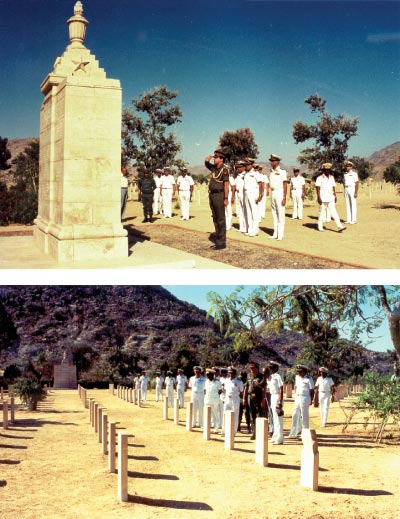
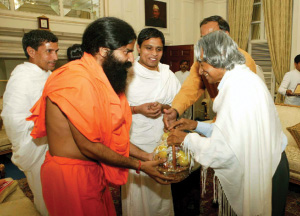
The Keren Cremation Memorial standing in the cemetery is a reminder of the Indian soldiers killed in that fateful battle of 1941. Here both Hindu and Muslim veterans of World War II lie together. The cemetery is maintained by the Commonwealth War Graves Commission through the British Embassy in Addis Ababa/Ethiopia. Every year the second Sunday of November is observed as Poppy Day to honor the soldiers killed in the historic battles of World War I and II. In November 1986 Indian Western Naval Command’s I.N.S. Ganga and I.N.S. Ranjit paid a courtesy call at the Red Sea port of Massawa, led by Rear Admiral V.S. Shekhawat. Commanding officers of the Indian naval ships joined by the military attaché at the Indian embassy in Addis Ababa Col. Bhupinder Singh came along with senior officers of the Ethiopian Navy to pay military respect to the Indian soldiers who fought and died in World War II. The entire world owes a debt of gratitude to these unsung heroes who died in a foreign land to free the world of fascism. |TOP| SUBCONTINENT: India’s First Tele Guru: The Swami Who Scoffs at Coke When Swami Ramdev, India’s first television guru of yoga who has built a $50 million business around his teachings, takes on soft drink giant Coca-Cola, it’s Coke that gets scared, writes Siddharth Srivastava.  Swami Ramdev conducting a mass pranayam session. He is one brand that has multinationals quaking in their boots. Swami Ramdev may be unknown to the West, but in India his vast yoga empire is valued over $50 million and is said to have touched 100 million people. The Swami is blunt in his derision of colas, junk food and drug companies selling allopathic medication as he seeks to generate health consciousness through spiritual and simple breathing exercises (called pranayam) particularly useful in dealing with lifestyle diseases (such as diabetes, high blood pressure, cardiac problems arthritis, cholesterol, overweight, kidney disorders, cancer) and aging. His take on cola giants Pepsi and Coca Cola is that these carbonated drinks should be used to clean toilets, not consumed. The swami’s mantra is that the majority of diseases can be controlled by right breathing and diet (essential tenets of yoga), ayurvedic medicines, though regular drugs are essential to cure some diseases and during emergencies. Such is the impact of Ramdev, who uses mass television to reach his dedicated followers, that yoga classes have mushroomed across the country alongside cyber cafes, gymnasiums, coffee shops and glitzy retail outlets of foreign brands such as Nokia, Nike or Reebok. Ramdev has revolutionized the lifestyle of Indians and drawn them away from junk food, non-vegetarianism, and made millions, including youngsters, wake up early in the morning to listen to his sermons on TV. India’s advertising guru Alyque Padamsee says that his advertising mantra rivals David Ogilvy’s. Ramdev’s live pranayam sessions (he holds more than 150 in a year) could put any rock star to shame, drawing tens of thousands who fill up the biggest stadiums. The swami has an earthy narrative style that connects with people as he coaxes them to continue with their deep inhalations while he talks. During his shivirs (live gatherings), many wax eloquent about the benefits of his exercises, though some yoga practitioners criticize Ramdev for being too simplistic. Nobody, however, doubts that Ramdev is India’s first tele-guru. Ramdev’s sermons are part of a slew of such shows on spiritual channels such as Aashtha (with Ramdev as the mascot), Zee Jagran, Quran TV, God TV (beamed from Israel) and Sanskar that have gained remarkable popularity in the recent past, with advertising revenues crossing $2 million. Surprisingly, television ratings show that people in the age group of 15-35 years comprise over 35 percent of the viewers.
Recently, an unseemly spat ensued between prominent Left leader Brinda Karat and the swami. Karat, angered by allegations of labor law violations at a drug unit run by the Guru, said that some of the medicines being manufactured by Ramdev used human/animal body parts. Ramdev lashed out at Karat, accusing her of “championing multinational drug companies to undermine comparatively cheaper Ayurvedic medicines.” Karat had to beat a hasty retreat when politicians across the spectrum, including her own party, spoke in favor of Ramdev. The Bharatiya Janata Party, a long-time supporter of the guru, sought to give it a swadeshi (indigenous) versus videshi (foreign hue). Railways Minister Lalu Yadav said: “If herbal medicines help, it hardly matters if they contain bones, whether human or demon.” Karat finally had to sing the virtues of ayurveda and yoga publicly. Ramdev has not only managed to teach the virtues of yoga to so many, he has also turned it into a selling proposition. “He is a fitness guru with an Indian twist. He uses the Indian religious language to sell the idea of fitness to masses,” said Santosh Desai, president of ad firm McCann Ericson, in an interview to the Economic Times. Yoga is already a $30 billion business in the U.S. with Western followers familiar with the meditation techniques of Deepak Chopra, Sri Sri Ravi Shankar of the Art of Living and Bhagwan Rajneesh who appealed to his audience through a modern interpretation of Buddhist philosophy. Maharishi Mahesh Yogi and Sri Satya Sai Baba also have loyal followers, but the numbers do not compare to Ramdev. Ramdev has moved beyond the abstract ministrations of the mind propounded by these West-based gurus to actual physical exercises that are seen to provide succor to increasingly stressful lives, a result of the advent of consumerist lifestyles and the proverbial rat race in India. It is estimated that close to 20 million Americans practice yoga, with majority of fitness clubs offering instructions. Retailers such as Wal-Mart and Rei stock up on yoga accessories such as DVDs, apparel, mats and other equipment. The average yoga practitioner’s annual expenditure for enlightenment turns out to be $1,500. It is ironic that the benefits of yoga, which owes its origin to Indian traditions that are 4,000 years old, has been so successfully packaged in the West and not in India. That is, until the Ramdev came along and showed everybody how to do it. - Siddharth Srivastava is India correspondent for Siliconeer. He lives in New Delhi. |TOP| DISSENT: The Cartoon Controversy: A Critique of Islamism Islamism kills equality, freedom and secularism, write dissidents including Salman Rushdie and Taslima Nasreen.  Top: Demonstrators in Pakistan protest the publication of cartoons of Muhammad in a Danish periodical. Top: Demonstrators in Pakistan protest the publication of cartoons of Muhammad in a Danish periodical.Bottom: From l: Salman Rushdie, Taslima Nasreen, Irshad Manji, Ayaan Hirsi Ali, Bernard-Henri Levy and Mehdi Mozaffari After having overcome fascism, Nazism, and Stalinism, the world now faces a new global totalitarian threat: Islamism.
Its victory can only lead to a world of injustice and domination: men over women, fundamentalists over others. On the contrary, we must ensure access to universal rights for the oppressed or those discriminated against.
CONTROVERSY: A Muslim Artist and Hindu Ire: Brouhaha over M.F. Husain While it is no surprise that M.F. Husain’s portrayal of Bharatmata in the nude caused offense, it’s a sad commentary that extremist Hindus, self-appointed culture vigilantes, run amok at the slightest provocation, writes Siddharth Srivastava.  A painting (l), of India’s quirky, bestselling painter M.F. Husain (r) who has reportedly courted controversy by painting Indian goddesses in the nude. A painting (l), of India’s quirky, bestselling painter M.F. Husain (r) who has reportedly courted controversy by painting Indian goddesses in the nude.Thankfully, there have not been virulent protests in India against the publication of cartoons of the Prophet Mohammad in European newspapers, though close to 150 million Muslims reside in the country. However, Hindu fundamentalists took umbrage to India’s top artist M.F. Husain who has also been booked by the police for hurting sentiments of people by paintings that depict “nude Gods.” The tirade against Husain also puts into question the often-held perception that Islam is the least tolerant of all religions to any act that is perceived as blasphemy. Fringe elements exist everywhere, though it is also true that the extent and intensity of protests by those who follow Islam does set the religion apart. Husain is India’s top painter. Last year, his painting, titled “The Last Supper,” sold through an online purchase for $2 million, the highest ever by an Indian. He is over 90 years old, sprightly, very creative, known for quirks such as walking barefoot and having an obsession for Bollywood actresses, prominent being Madhuri Dikshit, who he has painted as well as made a movie. He is not new to controversy and has invited the ire of right wing activists in the past because of his nude paintings of various Hindu deities (Durga, Sita, Draupadi, Saraswati), though such depictions are very much part of Indian heritage whether at Khajuraho or the Konark Sun Temple. The fact that Husain is a Muslim who chooses to depict Hindu Gods the way he wants has always angered Hindu extremists. This time the fury is over a painting that depicts Bharatmata (India, revered as the mother) in the nude. The painting is part of a series themed Mission Kashmir that were auctioned on the Internet to raise funds for victims of the earthquake that struck the state last October. Other prominent artists such as Anjolie Ela Menon and Sanjay Bhattacharya also participated. Main opposition party Bharatiya Janata Party has severely criticized Husain, with party general secretary Vinay Katiyar demanding the arrest of the painter. Extremist Hindu organizations have been more aggressive. “Being a good Muslim, Husain should know the worldwide reaction over caricatures of Prophet Mohammed in European newspapers. He, too, should refrain from repeatedly hurting the sentiments of Hindus,” fumed a former Bajrang Dal chief. A case has been registered against Husain in Mumbai and Thane by radical Hindu organizations the Hindu Janjagruti Samiti (Association for Hindu Re-awakening) and the Vishwa Hindu Parishad for hurting sentiments of people. The HJS has also appealed to President A.P.J. Abdul Kalam and Prime Minister Manmohan Singh to take action against such “anti-national and perverse attitude of great artists.” The deputy chief minister of Maharashtra R.R. Patil has said that state police are conducting a probe into the allegations. The HJS has also organized protests in Goa, Karnataka and Andhra Pradesh. Husain, meanwhile, has apologized and though the offending painting has been withdrawn from the Web site, it has already sold for about $175,000 that will bring some succor to the victims of the earthquake. At one level such intolerance to free expression is a reflection of the way India is — a multi-layered and cultural cauldron of classes, castes and religion, liberal and conservative opinions. It is also a sad commentary that radical and extremist elements hold people to ransom whenever they wish, a wasted vengeance that is often indulged by politicians with an eye on their own narrow gains. Like in any other society, one has to live with culture vigilantes and they are well within their rights to protest through legal means. However, it is the extent to which they cause violence, disrupt normal existence and even cost lives that make them a real socio-political hazard. 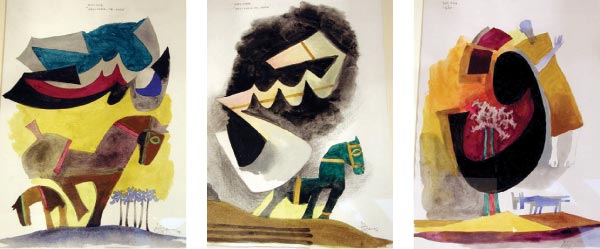 A series of paintings by M.F. Husain combines the image of the horse he is famous for with Arabic calligraphy. Such trouble mongers are publicity seekers who lack popular support. Even if one were to consider the hypothetical situation of Husain deliberately trying to hurt Hindu sentiments (many say this is unlikely), ignoring him is better punishment, with those who buy his art left to take their own decisions. Hindus militants, cadres of the VHP or the Rashtriya Swayamsevak Sangh, Shiv Sena have attacked cinemas that screen controversial films, art galleries (including Husain’s exhibition) protested India-Pakistan cricket matches, couples holding hands, women wearing jeans and celebrations linked to western influences such as Valentine’s Day, in the name of cleansing society for a higher social value system. Last year, Sikhs protested against the Bollywood film Jo Bole So Nihaal starring film star Sunny Deol. What followed were bomb blasts, believed by the police to be the handiwork of Sikh extremists, at cinemas in New Delhi that killed and crippled many. Muslim clerics are not to be left behind, either. Like their Hindu counterparts, they too have criticized the Husain paintings. The Muslim religious leaders claim to understand the sentiments of Indian Muslims and the correct interpretation of Islamic tenets. Political parties are averse to take them on as somehow a view has gained ground that siding with the religious heads conveys an image of being pro-Muslim. Emboldened, Muslim clerics continue to issue irrational diktats. Recently one cleric issued a fatwa after the alleged rape of a Muslim woman Imrana by her father-in-law. Clerics declared that Imrana should treat her husband as a son and move in with her alleged rapist. In another recent case, Muslim women were asked not to contest in local elections in the state of Uttar Pradesh and those who went out to vote were ordered to wear veils. India’s tennis sensation Sania Mirza has been a victim as well. While Sania is a national icon due to her tennis victories, fatwas that she “covers up” have continued to fly, issued by known and unknown Muslim clerics. They want Sania to wear long pants and full-sleeved shirts, the way it is with sportswomen of Muslim countries such as Iran or Pakistan. Issues related to sex can create a surprising amount of controversy in a nation where the issue remains taboo. Recently, Khusboo, rated among the top actresses in south India with temples dedicated to enable fans to worship her, said in an interview to a magazine that pre-marital sex is okay provided it is safe, consensual and between adults. The resulting outcry included statewide protests, rallies, burning and beating of her effigies with chappals and court cases. Local politicians keen to play the caste card due to upcoming elections in the state fanned the fire. A local court even issued a non-bailable warrant against the beleaguered actress who was at pains to explain that her views have been blown out of proportion. In another instance, an Israeli couple who kissed after marrying according to Hindu rituals in Pushkar in Rajasthan were in for shock and harassment after priests filed a complaint with the police that the couple had defied Hindu religious norms. There have been other reports of foreign couples being victimized by priests at Pushkar as well. A hotel was forced to shut down in Chennai following pictures that appeared in the media of a couple kissing at a party in the premises. In the past, Hindu fanatics have attacked cinemas showing the movie Fire that dealt with a lesbian relationship. While the right to protest and express one’s opinion should be guaranteed in any society, with proper channels of legal redress that address popular emotions and sentiments, it behooves a society to keep in mind that excessively unseemly or ugly protests, whether it’s against Husain’s paintings or Danish cartoons, can exact a steep price in terms of loss of public image for entire societies or communities. Cooler heads need to prevail to ensure that inflamed passions, no matter how outraged they are, are not allowed to provoke behavior that violates the norms of civilized behavior, or else entire societies or communities will invite opprobrium brought upon by the actions of what is often only a fringe, extremist minority. This is hardly the sort of image Indians would like to project for their nation which, after years of condescension by the West is now regarded with respect and even trepidation as it flexes its brainpower and begins to attract millions of jobs of increasing sophistication. To continue the flow of jobs critical for its economic wellbeing, India has to convince the West that civilized behavior prevails. Otherwise, in a globalized world, any Western country will look for — and find —other takers. That is exactly what may happen if the confidence of the West in India is shaken. Once shaken, that confidence will be very hard to reestablish. - Siddharth Srivastava is India correspondent for Siliconeer. He lives in New Delhi. |TOP| CAREER: New Vistas: Is the Software QA Job Market Back? Software QA is a unique job niche in many ways: Maturity is an asset in software testing unlike other IT fields, and Whatever your prior education or work experience, it is likely to be an asset because there is likely to be software that specializes in your field of expertise, writes Mikhail Portnov.  The profession of software testing emerged in the early nineties when personal computers became more popular as they became more affordable. The fast-growing population of PC users created new opportunities for software companies as well as strong competition for the consumer’s business. The new generation of software users quite naturally expected their applications to work as advertised. At the same time, market forces encouraged the fast release of new software often at the sacrifice of thorough testing. Defective software does not sell. The software industry soon recognized that, to achieve success, they would have to set quality standards prior to release and create thorough end-user testing procedures in-house. The profession of software testing emerged in the early nineties when personal computers became more popular as they became more affordable. The fast-growing population of PC users created new opportunities for software companies as well as strong competition for the consumer’s business. The new generation of software users quite naturally expected their applications to work as advertised. At the same time, market forces encouraged the fast release of new software often at the sacrifice of thorough testing. Defective software does not sell. The software industry soon recognized that, to achieve success, they would have to set quality standards prior to release and create thorough end-user testing procedures in-house.In 1992, I got my very first job as a Software QA Engineer literally by accident — an old friend introduced me to a small startup company in Newark where he worked at the time. My job there was to identify functionality and performance problems in a client-server database application. I searched for fellow testers for professional networking; but I found none. I approached over two dozen software developers asking if they knew of anyone who tests software for a living. They had never heard of software testers and could see no use for them since they tested their own software. I found myself wondering what growth potential, if any, there may be in this career. In particular, I wanted to know how much I could earn as a software tester. I approached our VP of Engineering with this question. He suggested that, if I stay with the company for five years and do really well, I might hope to make up to $40,000 a year. A small group of developers who had heard this exchange were clearly skeptical. I read the look on their faces, “That’ll be the day!” In May of 1993 the startup I worked for collapsed. In the course of a week, there were five advertisements in the San Jose Mercury News for software QA positions. I sent a resume to each, which resulted in two job interviews the following week and one on-the-spot job offer. My new employer was a multimedia startup. And guess what — that job paid 25 percent more than my previous one. Three months later I got a raise, which brought me to a $40,000 salary, exactly the projected five-year target thought to be unrealistic. My new employers were exceptionally successful. They sold the company profitably six months later. The new owners restructured the business and I was back in the job market again. What I discovered in my new job search amazed me. Where I had found only five software quality assurance listings over the course of a week, I was now finding 10-12 listings a day. I had 3-4 interviews a week, sometimes two interviews a day, and received many offers within a month. The market had grown dramatically within a single year and the demand for software testers far exceeded the supply. I chose the company that offered me strong exposure to automated testing, my passion at the time; but I could not help mulling over the amazing growth in demand for software testers and the equally amazing lack of supply. I soon realized that the gap could be narrowed with a training program that prepared students for QA positions quickly and effectively. Software testing, however, was not to be found in the college curriculum. That knowledge inspired me to start a school in August, 1994 with a single objective: teach software testing skills to qualified students, do it within 2 to 3 months, and help my graduates find a job in QA.  In the mid-90s, software testing was still a new profession. Between 1994 and 1997, half of my graduates became the first person in their companies specifically hired as software testers. Today, most software companies have a dedicated quality assurance department with one or more managers and a staff ranging from junior testers to senior quality assurance engineers. Opportunities abound. In the mid-90s, software testing was still a new profession. Between 1994 and 1997, half of my graduates became the first person in their companies specifically hired as software testers. Today, most software companies have a dedicated quality assurance department with one or more managers and a staff ranging from junior testers to senior quality assurance engineers. Opportunities abound.Before the recent recession, our graduates earned a starting salary of about $60,000 on average with 2-3 weeks spent on job search. Those who liked to change jobs every year or so as they acquired experience, saw their salaries grow to $90,000-95,000 within two-three years. When the recent recession hit Silicon Valley, there appeared to be no jobs at all for the inexperienced software tester. As the perceived job opportunities disappeared, so did the training schools that had flourished in Silicon Valley. In the year 2000, I could easily count 20 such schools. We may be the only one that survived. But in the year 2006, the recession is over. On average, our graduates are getting 2 job interviews a week. It seems to take only 3 or 4 interviews to land an offer. Several local companies are also offering internships to our graduates. Finding a QA job today seems to be no more difficult than it was in the 90s. What better job market could you want? And yet, I meet people caught in the 2003-2003 mindset. They circulate the same, tiresome three myths that become their excuse for inaction:
Fortunately, I also meet people who can see that the job market is back, even for a software tester with only two–three months training. Many of our students are new immigrants from a wide variety of backgrounds trying to establish themselves in Silicon Valley and the Bay Area. Many have concerns about finding work without lengthy and expensive retraining. Some are concerned about their age fearing they are too old to start a new career while others fret over their ability to learn and adapt to a new profession. We have been able to prove to them that software QA is a viable option for their new careers.
Testing is not a difficult concept to learn. We all have some experience testing something. We test new recipes, test-drive cars, double-check our change at the convenience store. In each case we are testing to see that the actual result meets our expected result. HEALTH: Keep the Soul, Cut the Fat: Healthy Eating Favorite “soul foods” — be it Indian, Filipino, Latin American, American or Korean —have one thing in common: fat. However, often these dishes can be made with healthier ingredients and methods, writes Debra Gould, MD.  Crispy pata, refried beans, imperial rolls, fried tocino, tempura, flautas… the list of favorite “soul foods” — be it Filipino or Latin American, American or Korean — from all cuisines have one thing in common: fat. However, often these favorite dishes can be made with healthier ingredients and methods to make healthier meals. Soul food African American cooking comes from a traditional Southern diet. Even here in California foods like fried fish, Jamaican jerk chicken, and gumbo are common dishes on our dinner tables. One of the biggest health issues for African Americans is that our traditional recipes are fried instead of baked, use fatback pork to flavor food and are high in salt and sugar. According to the Centers for Disease Control, obesity has doubled for kids between ages two and five and tripled among teenagers since the 1970s. Kids have begun developing type II diabetes, a serious form of diabetes that until recently was only seen in adults. For the health of our families, we need to start eating less fast food and cooking with healthier ingredients. The best way to keep your family healthy is to exercise and eat a nutritious diet. You don’t have to give up your favorite foods to be healthy. There’s a movement among chefs to create healthier versions of traditional recipes. When singer and chef Patti Labelle was diagnosed with diabetes, she wrote a book on how to cook healthier versions of her favorite recipes. Here are a few tips that make meals tasty and healthy. Parsley, Sage, Rosemary, Thyme… Use herbs as the main seasonings in your foods. Taste the food before you add salt; it may need just a little or none at all. Flavor food with smoked turkey instead of lard or fatted pork.
Bake, Don’t Fry. Fried foods are part of most cuisines, but fried foods contain a lot of fat. Try “oven fried chicken” recipes that get that same great crispiness without the fat and opt for baked beans rather than refried beans. Eat less sugars and sweets. Drink water instead of sodas or juice. Opt for whole fruit instead of juice. You may not realize it, but juice contains a lot of sugar. Remember to eat five servings of fruit and vegetables each day. Sunshine and vitamins. Make sure you’re getting lots of Vitamin D and calcium in your diet. Even though people with melanin — the pigment that makes skin darker — produce more Vitamin D than others, it’s still important to get lots of Vitamin D through our diet to help our body build strong bones. Milk is a great source of Vitamin D and Calcium, and drinking non-fat or 1 percent milk instead of whole milk is a healthy choice. Exercise! Make sure your kids run around and play for at least an hour every day. Adults should exercise at least 30 minutes three to four times a week. Walk to the store rather than bus or drive. Make exercising a family activity. |TOP| CINEMA: A Sikh Grapples with 9/11: 'The Gold Bracelet' Written, produced, directed and also starring Kavi Raz, The Gold Bracelet is a film based on real events that made national headlines. A Siliconeer report.  (Left): Kavi Raz as Arjun Singh and Ari Barak as Mirza Khan in “The Gold Bracelet.” (Right): Mehrunnisa Hassan as Simrun Kaur in “The Gold Bracelet.” Longtime Hollywood star Kavi Raz recently screened his new feature film The Gold Bracelet at the Academy of Television Arts and Sciences, according to a press release from the film production company that made it. The 600-seat prestigious venue, home to big studio screenings, was full, and over 350 could not get in due to an overwhelming demand for seats, the release added. In The Gold Bracelet, Raz highlights an ordinary life as an American till a moment comes that changes things for ever. “Written, produced, directed and also starring Raz, the film pays tribute to the many victims of the 9/11 aftermath and it is the first motion picture based on these real events that made national headlines,” the release adds. “These victims were targeted because of their skin color and appearance. The violence prompted the leaders of India to lobby President Bush to protect the civil rights of U.S. citizens of East-Indian descent.” Raz said the story is American as apple pie. “It’s an American story no different from any other, no different from the ones two-hundred years ago, no different from two years ago,” he said. “It’s what’s happening right now, today, in Phoenix, New York, Los Angeles. I just want people to watch this film. They can make up their minds without my having to preach about it. “Watch the actors, tell me how different these Americans are from the rest.” The films stars newcomer Sonny Mandal, Bollywood’s Archana Puran Singh, Mehrunissa Hassan, Arsh Singh, Joseph Whipp, Ari Barak, and Ellen Geer. When the lights came up, Raz was greeted by a standing ovation. He spoke briefly about the importance of the story’s message, taking a moment to thank those who helped make the film a reality. “The characters of The Gold Bracelet shared their moments of laughter, sadness, joy, anguish and tears with you all,” Raz said. “I hope we as the actors truly held the mirror up to nature and what you saw came across as real and believable. And it touched your heart, your soul. ”I am so grateful to this wonderful cast. Meher, Archana, Sony, Arsh, Ari, Joseph and so may others for your amazing performances. You breathed life into my silent words and made them real.” After inviting the cast to join him on stage, the audience was invited to ask questions. “I found the film poignant, it achieved what “Crash” tried to do, a sense of prejudice that courses through our hearts in a very believable manner,” said Bob Katz, an audience member. |TOP| CULTURE: Sacred Space: Nrityagram’s Odissi Odissi performers trained at Nrityagram, a performing artists’ village founded by Pratima Gauri, presented a spectacular performance at the Yerba Buena Center for the Arts in San Francisco. A Siliconeer report.  A dancer from Nrityagram. (Pic: Sonia Machanda) A dancer from Nrityagram. (Pic: Sonia Machanda)If it takes a village to raise a child, it may also take a village to reinvigorate an ancient art. Odissi is one of the primary Indian dance styles has reached new heights as it is nurtured in Nrityagram, the realization of a dream by Odissi dancer Pratima Gauri, the former wife of film star Kabir Bedi who later died tragically in a plane crash. “With life-altering beauty, the all-female Nrityagram Dance Ensemble offers contemporary interpretations of the classical Odissi form” announces the Yerba Buena Center for the Arts. “At a sensational 1996 New York debut, the ensemble, who live communally in a village devoted to the study and preservation of all classical Indian dance forms, stunned audiences with their skill and sensuousness. “They have since earned international acclaim for their artistic mastery and their deft touch in developing a gorgeous, modern dance sensibility from within this ancient form.” For its San Francisco premiere, Nrityagram performed Sacred Space, which incorporates music and poetry in choreography that bridges sacred rituals and contemporary performance. Choreographer Surupa Sen has said, “Both the temples and the dance are but a medium for the ‘pilgrim soul’ searching for its mate in boundless space.” Odissi may be rooted in the past, but it can also stretch into timelessness.” Nrityagram, located close to Bangalore, has become a place in which both tradition and innovation thrive. Physical and philosophical training are rigorously traditional, but the company also has its feet in the 21st century. At Nrityagram dance village, dance is a way of life. Gauri converted 10 acres of farmland into a setting for the study, practice and teaching of classical dance. It is a creative space where dancers, musicians and choreographers live together, sharing their skills and developing their art. The dancers study yoga, meditation, the martial arts as well as Sanskrit, mythology and literature. Since their New York debut in 1996, they have toured the U.S. annually. Odissi is characterized by sensuousness and lyricism. With motifs that reflect the Orissa temple sculpture, it captures drum rhythms, melodies as well as the poetic meaning of songs taken from the vast canon of Oriya music. “Temples make me think of traditions,” notes dancer and choreographer Surupa Sen. “Sacrosanct. Immovable. But traditions are not divided by immovable membranes. They interflow into one another. It is often difficult to isolate elements as belonging to the one or the other.’ ‘Sacred Space’ grew from foundation to shikhara (pinnacle of a temple) gathering layers upon itself in physical and emotional spaces, Sen adds. “Odissi and temple architecture are traditions,” she says. “But they have grown, transformed, and integrated with their environment, without losing their essential seed. One of impossible beauty and powerful selflessness.” |TOP| CINEMA: Movie Masti: Asian Film Fest The 24th San Francisco International Asian American Film Festival Mar. 16-23 presents a number of South Asian films including Deepa Mehta’s award-winning Water, Buddhadeb Dasgupta’s feature Memories in the Mist (Kaalpurush) and Bollywood hit Parineeta starring Saif Ali Khan and Vidya Balan. A Siliconeer report.  A scene from “Water” The 24th San Francisco International Asian American Film Festival, planned for Mar. 16-23 in San Francisco, will screen more than 126 features and shorts from 21 countries, making the festival the largest and most prestigious showcase for movies by and about Asia and Asians. In addition, the festival will host panel discussions, a music program, and competitions for best dramatic feature and documentary. South Asian highlights include:
Other offerings include Charles Sobhraj titled Sobhraj, or How to Be Friends with a Serial Killer (March 17 and 19) and a number of provocative short films.
COMMUNITY: News in Brief  ‘Lo Aaya Samir’ (Here Comes Samir) Premieres in Fremont | TechCU's Supercharged Online Banking | SA Bar Association Annual Banquet | International Gujarati Convention in New Jersey | Abhinaya Concert | Congressional Honor ‘Lo Aaya Samir’ (Here Comes Samir) Premieres in Fremont | TechCU's Supercharged Online Banking | SA Bar Association Annual Banquet | International Gujarati Convention in New Jersey | Abhinaya Concert | Congressional Honor'Lo Aaya Samir’ (Here Comes Samir) Premieres in Fremont  Pic: Samir Bhatnagar (r) lead actor and co-star Avi Kumar at the screening of “Lo Aaya Samir.” Pic: Samir Bhatnagar (r) lead actor and co-star Avi Kumar at the screening of “Lo Aaya Samir.”About 200 people attended the premiere screening of the Gujarati comedy Lo Aaya Samir, according to a press release from organizers. The screening was held at Naz 8 Cinema in Fremont, Calif. The film’s story revolves around Samir, a second generation Indian living in America . He hopes to become a Star in Bollywood films. Since childhood, he has actively taken part in theater, dance performances, TV ads and runway/ramp shows. Samir’s parents moved to the United States to give him a better opportunity, but Samir sees himself on the big screen in India. Being determined to follow his dreams, Samir drops out of Computer Engineering and leaves for Bollywood against his parents will. The film is directed by Jitender Kheterpal, who started his career as an actor in Bollywood. He ventured into direction in the year of 2002 where he made a short-film, Virar to Churchgate, based on the struggle in Mumbai. Samir Bhatnagar, who plays the lead role, has been performing on stage since childhood and has taken active part in fashion shows, cultural dances and theater. He was born in India, raised in California, and obtained a degree in computer science from University of California at Berkeley. However, he simply felt that acting was his calling in life and he decided to move to Bollywood and follow his dreams and ambitions. Samir attended Kishore Namit Kapoor for grooming his acting skills. Modeling served as an interface to jump start Samir’s career, as he has done major campaigns for Denim cologne, Times Card, Southern Comfort, Tata Mobile, VJ for Channel V and music video for known singers like Asha Bhosle. | BACK TO COMMUNITY NEWS INDEX | |TOP| TechCU's Supercharged Online Banking Superior security and enhanced convenience are the hallmarks of the latest improvements made to Technology Credit Union’s Online Banking, says a press release from the Silicon Valley credit union. Tech CU recently announced additional features to its robust online banking software to further enhance users’ experience. “As a financial provider for Silicon Valley professionals, our members expect the latest and greatest technology from us,” says Michael Luckin, senior vice president of delivery systems. “The introduction of these new features is one of the ways we seek to fulfill our members’ ever-growing expectations.” With expanded eStatements, members can view their statements online dating back as far as 13 years, enabling members to research their account and payment history electronically even before the advent of eStatements. Expanded Tech CU history via Quicken and Money allows members to download up to 14 months of Tech CU activity directly into Quicken and Money. Enhanced Bill Pay software is a more interactive interface and better navigation ensure increased efficiency. Time stamp will allow members to verify the last time they logged on to Online Banking, adding an extra layer of online security to help thwart phishing and pharming attacks. In addition to the new enhancements, other online features that set Tech CU apart include: direct download of 1098 and 1099 forms to TurboTax and secure, innovative login security process (two-way, two factor authentication). Technology Credit Union is a member-owned, full-service financial provider that offers services to technology and business professionals in California and their families. More information is available at www.techcu.com. | BACK TO COMMUNITY NEWS INDEX | |TOP| SA Bar Association Annual Banquet The South Asian Bar Association of Southern California’s Public Interest Foundation will honor two individuals who have made significant contributions to the field of law at its third annual banquet March 9, the organization has announced in a press release. The foundation will honor Judge Sanjay Kumar of the Los Angeles County Superior Court with its Trailblazer Award and honor Najeeba Syeed-Miller with its Public Service Award. Judge Kumar is the first South Asian American judge appointed to the Superior Court. Syeed-Miller is the executive director of the Western Justice Center Foundation, an organization that teaches peaceful conflict resolution to children in order to empower them and prevent youth violence. The foundation will give out these awards at its Third Annual Banquet to be held in Beverly Hills March 9. Proceeds from the banquet will go to the foundation, the charitable arm of SABASC. In 2005, the foundation made grants totaling $15,000 to community-based non-profit organizations to finance public interest projects related to domestic violence, low-wage labor, health care and immigration. More information is available at www.sabasc.org/foundation | BACK TO COMMUNITY NEWS INDEX | |TOP| International Gujarati Convention in New Jersey The Vishwa Gujarati Samaj, India, along with the Federation of Indian Associations and other Gujarati Samaj and Associations of Gujarati origin from the U.S. and other parts of the world will host the first international Gujarati convention July 7-9 in Fords, N.J., according to a press release. “The event is being organized as an effort to bring the people of this prosperous Indian state together and will be held at the at Royal Albert’s Palace,” the release added. “Featuring dignitaries from all over the world, the event is the first of its kind for this Indian region to be held in the U.S.” The three-day agenda will feature a cultural program, live music, social networking, and seminars dwelling on investment, ayurveda, literature, and politics. A centerpiece of the event will be a gala banquet, Raas Garba and folk dances. “This is an effort to bring our community together, and FIA is proud to participate with Vishwa Gujarati Samaj, India and other organizations,” said Jayesh H. Patel, the president of FIA-tri-state. “We are planning to go all-out in support of this unique event and seek the community support that we know will ensure it becomes a great success.” More information is available at (732) 688-2658 or on the Web at www.fianynjct.org | BACK TO COMMUNITY NEWS INDEX | |TOP| Abhinaya Concert The Abhinaya Dance Company of San Jose will continue its 2006 season with two performances, March 18 and 19, at the Louis B. Meyer Theater at the University of Santa Clara, according to a press release. The March 18 concert will feature solo performances and choreography by the next generation of Bharatanatyam dancers and a special presentation by Abhinaya artistic director and founder Mythili Kumar as well as longtime company member Sharada Sripadam. The March 19 performance will feature a student recital with more than 65 dancers depicting the ancient epic Ramayana. The March 18 Next Generation concert features Rasika Kumar and Preeti Vissa in solo numbers. Rasika Kumar, daughter of Mythili Kumar has been a student of Abhinaya since 1987 and performed her arangetram in 1996. Rasika has toured with Abhinaya to India and throughout the United States. Preeti Vissa has been learning Bharatanatyam from Mythili Kumar for more than ten years and performed her arangetram in April 1999. She has participated in a number of Abhinaya productions, such as “Revelations,” “The Life of Annamacharya,” “Mayiladum Azhagan,” and “Power of Saturn”. The March 18 performance will be accompanied by musicians: Asha Ramesh (vocals), N. Narayan (mridangam and kanjira) Shanthi Narayan (violin), Raja Sivamani (veena) Mythili Kumar and Malavika Kumar (nattuvangam) More information is available at www.abhinaya.org | BACK TO COMMUNITY NEWS INDEX | |TOP| Congressional Honor  Pic: Dr. Sudhir Parikh (r) with President A.P.J. Abdul Kalam Pic: Dr. Sudhir Parikh (r) with President A.P.J. Abdul KalamRep. Frank Pallone, Jr., D-N.J., and Rep. Joe Crowley, D-N.Y., Feb 15 inserted into the Congressional Record a two-page statement honoring Dr. Sudhir Parikh, a New Jersey-based allergist and philanthropist recently chosen for the Pravasi Bharatiya Samman, the highest civilian honor bestowed by the Indian government on Non Resident Indians. The action began as one of the representatives took the floor of the House and declared, “Mr. Speaker, we rise today to congratulate a Dr. Sudhir Parikh, a prominent Indian American physician, activist, and philanthropist, who was selected earlier this year to receive the prestigious Pravasi Bharatiya Samman Award for 2006, the highest civilian honor bestowed by India on non-resident Indians.” The statement highlighted numerous important accomplishments made by Dr. Parikh, who has contributed to making a significant difference in U.S.- India relations. | BACK TO COMMUNITY NEWS INDEX | |TOP| INFOTECH INDIA: ROUNDUP  Bush Signs Tech Accords | Hyderabad Pips Bangalore to win $3 Billion Project | HCL, Cisco to Share Revenue | Integrating TV, Web | Google Enters India | Microsoft to Train Teachers in Rajasthan | TCS Eyes China | Satyam to Expand in China | Accenture to Expand in India | Outsourcing Budgets to Rise | Lenovo’s Share of India Market Grows | India to WTO: Open Up Markets Bush Signs Tech Accords | Hyderabad Pips Bangalore to win $3 Billion Project | HCL, Cisco to Share Revenue | Integrating TV, Web | Google Enters India | Microsoft to Train Teachers in Rajasthan | TCS Eyes China | Satyam to Expand in China | Accenture to Expand in India | Outsourcing Budgets to Rise | Lenovo’s Share of India Market Grows | India to WTO: Open Up MarketsBush Signs Tech Accords President George Bush’s visit to India has yielded a range of bilateral partnerships in technology, aerospace and intellectual property. During a visit to Hyderabad, Bush also said there would be no curbs on outsourcing from the U.S., stating that he was in favor of more competition, not less. Among the agreements concluded during his current visit are the Bi-National Science and Technology Commission that will generate collaborative partnerships in science and technology. The project is likely to be funded at $50 million, and private funding is also being sought. The partners said they will promote innovation through a vibrant intellectual property rights regime. The IP rights initiative will include capacity-building activities, human resource development and public awareness programs. An aerospace agreement permitting the launch of U.S. satellites and satellites containing U.S. components by Indian space launch vehicles will also be concluded soon. Two U.S. instruments will fly during India’s planned lunar mission in 2008. The Indian Space Research Organization and NASA are expected to conclude a detailed agreement soon. | BACK TO INFOTECH INDEX | |TOP| Hyderabad Pips Bangalore to win $3 Billion Project In a stunning coup, Hyderabad beat IT heavyweight Bangalore to bag the Fab City project, which will host India’s first major silicon chip manufacturing facility. The project will see a veritable watershed of foreign investment in Shamshabad, with $3 billion to be brought in by the anchor company SemIndia in collaboration with global chip giant AMD, and more by other chip manufacturers. SemIndia alone is likely to create 5,000 jobs directly and thousands more indirectly through the influx of about 200 suppliers and ancillaries. “We have decided to position Fab City in Hyderabad,” announced SemIndia president and CEO Vinod K. Agarwal, the statement hit the press conference like a streak of lightning at Chief Minister Y.S. Rajasekhara Reddy’s camp office. Hours earlier, Union IT and Communications Minister Dayanidhi Maran had declared that Hyderabad — a brash pretender to Bangalore’s primacy as a destination for IT investment had won the race for the prestigious project. In a delicious irony, Maran’s announcement was made in Bangalore. Agarwal said three states had been shortlisted to host Fab City — Andhra Pradesh, Karnataka and Tamil Nadu. “However, Tamil Nadu did not evince much interest. After careful consideration of all the relevant factors, we decided on Hyderabad,” he said. These factors included the weather, roads, availability of a semi-skilled work force, electricity, water and proximity to an international airport. Fab City is to be located on 1,200 acres of land to be given by the AP government in Maheshwaram mandal near Shamshabad. The groundbreaking ceremony will take place in a month’s time. The project is to be executed in two phases, the first involving investment of $1 billion and the second $2 billion. | BACK TO INFOTECH INDEX | |TOP| HCL, Cisco to Share Revenue  HCL Technologies has entered into a revenue-sharing agreement with Cisco Systems for the products the Indian software giant develops or enhances for the latter. The move, which shifts some of the risk from Cisco to HCL, comes on the back of escalating software development costs, HCL chairman and CEO Shiv Nadar said. HCL Technologies has entered into a revenue-sharing agreement with Cisco Systems for the products the Indian software giant develops or enhances for the latter. The move, which shifts some of the risk from Cisco to HCL, comes on the back of escalating software development costs, HCL chairman and CEO Shiv Nadar said.Nadar said the new royalty model represented the maturity of its relationship with Cisco. “We started with a cost-based model 10 years ago. With mutual trust and industry knowledge developed over all these years, the relation has matured into a revenue-sharing model.” The agreement will work at two levels. HCL will exclusively license the intellectual property developed outside the HCL-Cisco relationship, share the revenues and maintain the patent. In case of enhancements made to Cisco’s existing network products, HCL will get part of the revenues based on its investment and efforts, senior HCL officials said. Cisco Systems joined hands with HCL in February 1996 with the setting up of its first offshore development centre — Cisco Offshore Development Centre — in Chennai with an initial team of 30 dedicated engineers. Now, the centre employs over 1,100 people. The Cisco ODC in the city is the largest product engineering site for Cisco outside the United States, HCL said. | BACK TO INFOTECH INDEX | |TOP| Integrating TV, Web  HP Labs India is working on technology to integrate satellite TV with the Web, according to an executive at the lab. The company will soon be testing with broadcasters a technology that lets a user click on hyperlinks embedded in TV content, which will take the user to a Web site. HP Labs India is working on technology to integrate satellite TV with the Web, according to an executive at the lab. The company will soon be testing with broadcasters a technology that lets a user click on hyperlinks embedded in TV content, which will take the user to a Web site. The opportunity for HP and providers of these services is to monetize the clicks on TV content. The return channel for the TV viewer could be a satellite uplink, a broadband connection, or a dial-up telephone line. HP Labs India is also doing field trials with the Indian Space Research Organization in Bangalore and the Karnataka state government on technology that will enable satellite TV viewers to print out documents from their TV screen at the press of a button on the TV remote control. | BACK TO INFOTECH INDEX | |TOP| Google Enters India  With an eye on the booming online ad market in India, the world’s largest search engine company Google has formally launched its operations in India by setting up a dedicated sales and marketing office for the Indian market. With an eye on the booming online ad market in India, the world’s largest search engine company Google has formally launched its operations in India by setting up a dedicated sales and marketing office for the Indian market. Google Online India will work to increase its advertising revenue out of India by leveraging local presence. “Though small in absolute amount so far, our ad revenue from India is growing at a rapid pace. This initiative is aimed at giving a further push to this,” says Ashish Kashyap, country head, Indian sales operations. He refused to share any financial figures or exact growth numbers. Google has opened offices in Delhi and Mumbai. The new offices are designed to enable Google to develop business opportunities, provide locally relevant products and services and deliver advertising services to its users throughout India. | BACK TO INFOTECH INDEX | |TOP| Microsoft to Train Teachers in Rajasthan  Software giant Microsoft India in association with the government of Rajasthan has launched an IT academy in Jaipur to serve as a pivotal point for giving IT training to teachers across that state. Software giant Microsoft India in association with the government of Rajasthan has launched an IT academy in Jaipur to serve as a pivotal point for giving IT training to teachers across that state. The Microsoft IT Academy is a key result of the accord signed between the company and the state government in August last year for the implementation of Microsoft’s Partners-in-Learning program as part of the Rajasthan Education Initiative. The IT Academy is equipped with an IT lab complete with latest hardware, software, curriculum and staff. To ensure wider participation and local relevance, the IT training courseware is translated into Hindi. Microsoft aims to accelerate IT integration in education amongst 8,000 teachers and over 400,000 students (from Class III to Class XII) across 3,000 government schools in Rajasthan over the next five years. The software company will offer a 12-day training program free of cost for participating teachers to equip them to use technology in teaching students in a classroom environment. Rajasthan Chief Minister Vasundhara Raje inaugurated the academy. Ghanshyam Tiwari, minister of education, Vasudev Devnani, minister of state for education, Peter Moore, managing director of the public sector division of Microsoft Asia Pacific and Rohit Kumar, country head of the public sector division of Microsoft India were present. | BACK TO INFOTECH INDEX | |TOP| TCS Eyes China  Aiming to garner a better share of the world’s IT and IT enabled services market, Tata Consultancy Services is planning to set new centers in China and Israel. Aiming to garner a better share of the world’s IT and IT enabled services market, Tata Consultancy Services is planning to set new centers in China and Israel.In an interview with PTI, TCS managing director and CEO S. Ramadorai said that his company also has big expansion plans in the Asia Pacific region and the Middle East in addition to the company’s large presence in American and European continents. “We have got expansion plans for a delivery centre in China where we have, at present, about 350 professionals. Now we are expanding capabilities in China through operations in Shanghai and Beijing,” he said. Without revealing the amount that the company plans to invest, Ramadorai said TCS’ investments would be in the order of wage and people that it would be recruiting. “The whole thing is that we would be able to scale up to a couple of thousands in the next two to three years,” he said. | BACK TO INFOTECH INDEX | |TOP| Satyam to Expand in China  As part of its plan to set up a large development center in China, Hyderabad based IT giant Satyam Computer Services will set up its operations in Guangzhou. As part of its plan to set up a large development center in China, Hyderabad based IT giant Satyam Computer Services will set up its operations in Guangzhou.“Satyam has plans to increase its presence in China. The setting up of our operations centre, though in a small manner, is the first step before we set up a large development centre in China,” Satyam corporate headquarters senior vice president V. Murali said. An agreement to set up the operations centre was signed by Satyam Managing Director B. Rama Raju and Guangzhou Mayor Zhang Guanging in Bangalore, he said. Being one of the first Indian firms to enter China, Satyam currently has over 250 associates across Shangai, Dallan and Beijing, he added. | BACK TO INFOTECH INDEX | |TOP| Accenture to Expand in India  Just like all other multinational IT companies in India, Accenture, too, is planning to expand its footprint in the country. The roll-out will include expansion in head count, location and capabilities. Just like all other multinational IT companies in India, Accenture, too, is planning to expand its footprint in the country. The roll-out will include expansion in head count, location and capabilities.“We have been firing on all cylinders in 2005 and have now achieved a critical mass. We want to continue our growth this year too,” said Chet Kamat, managing partner, India Delivery Centre Network, Accenture. Accenture, which currently has delivery centers in Bangalore, Hyderabad, Chennai and Mumbai and a consulting office in New Delhi, will set up more centers in the next 6-12 months, Kamat said, adding that the company is in advanced talks for two out of three cities. While declining to specify the new locations, he said, “We have three of our locations in the south. So we would like to rightsize our footprint across India.” The IT major will continue to hike its employee strength at a 50-55 percent growth rate this year. Accenture at the end of last fiscal (ended August ’05) had 15,000 people. Taking this figure, a 50-55 percent growth would mean that the company will employ about 23,000 people by August ’06 across IT services, BPO and consulting. The Indian operations will also be strengthened elsewhere. | BACK TO INFOTECH INDEX | |TOP| Outsourcing Budgets to Rise Patni Computer Systems announced that a recent survey of top decision makers on corporate technology and spending revealed that 89 percent plan to increase their outsourcing budget over the next 12 months. “Thirty-nine percent said they expect to increase budgets by up to 20 percent over their current spending, while 11 percent plan a 50 percent or more increase,” a press release from Patni Computer Systems said. The survey was conducted at Patni’s annual user conference, PatniConnect which brought together more than 100 global CIOs and business leaders from the company’s customer base in the U.S., U.K. and Asia-Pacific regions. The survey also revealed that pricing is not the most important factor in selecting an outsourcing partner. Cultural fitness and quality of service ranked the most important. | BACK TO INFOTECH INDEX | |TOP| Lenovo’s Share of India Market Grows  After IBM’s personal computer business came under China-based Lenovo its share of Indian market has grown, senior company officials said. After IBM’s personal computer business came under China-based Lenovo its share of Indian market has grown, senior company officials said.“We have grown the share of Indian market,” Lenovo South Asia Managing Director Neeraj Sharma said. While refusing to divulge exact figures, Anil Philip, the company’s director of marketing and strategy said the company is the second largest player in India in terms of revenues and that much big in terms of volumes. To build on the growth Lenovo has recently launched computers for home and small businesses under its own brand in India. This follows the recent introduction of Lenovo-branded PCs worldwide. With the today’s launch the company announced Bollywood actors Saif Ali Khan and Soha Ali Khan as its brand ambassadors. To penetrate the market the company is now looking at significantly ramping up its retail presence in India, Philip said. The company currently has 38 exclusive stores and retails from 100 multi-brand outlets. It is also looking at launching products suited for the Indian market and strengthening after sales service network. | BACK TO INFOTECH INDEX | |TOP| India to WTO: Open Up Markets India has submitted requests for opening up of markets in computer services, health services, energy and architecture and engineering services in the first round of the ongoing negotiations in services at the World Trade Organization in Geneva. Requests have been submitted by the country in two of the four modes being negotiated which cover cross-border movement of services like outsourcing and movement of professionals from one country to the other. | BACK TO INFOTECH INDEX | |TOP|
AUTO REVIEW
Sporty Option for Parents: 2006 BMW 325xi Sport Wagon The new BMW Sport Wagon is a sporty solution to get the kids to all their events and still keeps the parent feeling pampered on the road, writes Sally Miller Wyatt.  Not every vehicle spends its days strictly ferrying the children around. Any parent who has to commute is probably concerned that the family car is also able to stand up to the wear and tear of jam-packed freeways. Commuting parents in the market for a new vehicle may want to consider the BMW 325xi Sport Wagon. Not only do you have five seat belts and a good-sized cargo area with this car, but also a whole host of road-safety features packed into a vehicle that really thrives at freeway speed. The 325xi is appropriately named: It’s a sporty wagon and, as such, will certainly appeal to those who really love to drive. And, if you’re on the road a lot, why not be pampered by a true road machine that is packed with plenty of comforts and conveniences? The BMW 325xi comes equipped with a healthy list of standard features. Heading that list is a powerful and responsive 3.0-liter DOHC, 24-valve six-cylinder engine, engine-speed-sensitive variable assist power steering, and sporty suspension. State-of-the-art braking technology is on board, including Dynamic Stability Control, Dynamic Traction Control, and all-wheel drive. Standard safety features include dual-threshold “smart” air bags for driver and front passenger, front seat side-impact air bags, and a front and rear-seat head protection system, which consists of a tubular-shaped inflatable device that protects occupants’ heads from intrusions into the passenger cabin, should an accident occur.  Convenience features include ground lighting in the door handles, which helps you to see the curb when opening the door, power and heated mirrors, automatic climate control with separate temperature settings for the driver and front passenger, six-way adjustable front seats, and a two-way power moon roof that is “panoramic” in size. That means it is larger than most traditional moon roofs and, when fully opened, borders on near-convertible-like openness. Convenience features include ground lighting in the door handles, which helps you to see the curb when opening the door, power and heated mirrors, automatic climate control with separate temperature settings for the driver and front passenger, six-way adjustable front seats, and a two-way power moon roof that is “panoramic” in size. That means it is larger than most traditional moon roofs and, when fully opened, borders on near-convertible-like openness. On our test car, the automatic transmission was a $1,275 option. Other options on the test car included a $2,900 premium package with leather upholstery, BMW’s Assist System and services, an interior auto-dimming mirror with compass, power lumbar support and power seats with memory. A $1,200 sport package added 17-inch alloy wheels with all-season tires, leather trimmed steering wheel and front seats with side bolsters. The driver’s door is heavy and a bit difficult to open widely and, coupled with those bolsters, makes it a little more difficult to easily get out of the car. The test car was also equipped with an optional navigation system ($2,000), a premium sound system ($1,200) and Active Cruise Control ($2,200). The BMW 325xi’s rear tailgate opens easily, exposing a lowered cargo floor. This makes lifting and loading packages, suitcases and golf clubs into and out of the trunk area a bit easier. The cargo area is protected from prying eyes by a retractable cargo cover that you need to reset before you close the tail gate, or the cover will block visibility out the rear view mirror. Behind the wheel we found a no-frills-looking dashboard that does takes some time getting used to. In fact, don’t pull out of the driveway before you’ve become familiar with how to manipulate the audio system, because it is somewhat confusing. The dial to select audio, communication, entertainment or climate features is far from where you would expect it to be; it is actually located in the center console, while the volume control is a tiny knob located on the lower dashboard.  On the road you’ll find that seats are firmly supportive in all positions. Leg room is good for front seat passengers, and okay for rear outboard, but tight for the rear middle position. Visibility for all is good. On the road you’ll find that seats are firmly supportive in all positions. Leg room is good for front seat passengers, and okay for rear outboard, but tight for the rear middle position. Visibility for all is good. The BMW is really quite at home at freeway speed and road noise is barely discernible. For those who live on a hilly street or have a steep driveway, BMW’s Start-off Assist feature will be a welcome addition. It prevents the car from rolling backward on angled roads. Overall, the BMW was a very fun car to drive, which is no surprise given its autobahn lineage. For commuting parents, it could be a sporty solution to get the kids to all their events and still keep you feeling pampered on the road. - Sally Miller Wyatt is a freelance writer who writes family-oriented auto reviews for newspapers, magazines and the Web. |TOP| BOLLYWOOD: Guftugu  Loss for Dubya | The Stealth Indian Presence at the Oscars | Studmuffin Gets One Year for Shooting Deer | Aamir v. Filmfare | ‘Black’ and Blackout: Bhansali’s Triumph, Sony’s Glitch | Bollywood Chalo | Bye Bye, Land Cruiser | Back to Acting | Catholics Go to Bollywood | Rajkumar Hospitalized Loss for Dubya | The Stealth Indian Presence at the Oscars | Studmuffin Gets One Year for Shooting Deer | Aamir v. Filmfare | ‘Black’ and Blackout: Bhansali’s Triumph, Sony’s Glitch | Bollywood Chalo | Bye Bye, Land Cruiser | Back to Acting | Catholics Go to Bollywood | Rajkumar HospitalizedLoss for Dubya The speeches were nice, the food great, but still, visiting U.S. President George W. Bush missed out on something special at the state dinner hosted in his honor by Prime Minister Manmohan Singh. Why, you may ask. Because the great Indian beauty Aishwarya Rai couldn’t make it. Oh our Aish was invited all right, but in a typical bureaucratic screw-up, she got the invite at the very last moment. “We received a phone call from the protocol officer in MEA seeking her presence at the lunch, 40 minutes after she left for Brazil,” Rai’s secretary Hari Singh said. Singh said Aish had already left for Brazil when a request that she attend the event came from the Ministry of External Affairs. “We have informed the ministry via e-mail that she would not be able to attend the event, Singh said. Rai is in Brazil to shoot for the sequel to the popular film Dhoom, called Dhoom 2. What is one to say? The loss is dubya’s and the “credit” is certainly the Ministry of External Affairs. | Return to Bollywood | TOP | The Stealth Indian Presence at the Oscars  Yes the Oscars were glitzy and fun, and yes, India was nowhere to be seen. So what’s new? Nobody is surprised that Amol Palekar’s Paheli failed to make even the nominations. Yes the Oscars were glitzy and fun, and yes, India was nowhere to be seen. So what’s new? Nobody is surprised that Amol Palekar’s Paheli failed to make even the nominations.But why dwell on that stuff anyway? Let’s look at a brighter side. Do you know that a pair of Indians has had a stealth Oscar presence for the fourth time? Yep, the aquamarine sherwani in which Best Actress Nominee Dame Judi Dench reveled was designed by India’s Abu Jani and Sandeep Khosla. Jani and Khosla designed the hand-embroidered aquamarine sherwani, a long formal coat dress, for the British actress, the fourth time she wore one of their creations on the Oscars red carpet. Jani showed Dame Judi a sketch of their design during a chance meeting in Britain three weeks ago while she was taking a break from filming of the latest James Bond movie Casino Royale, said Mumbai-based Khosla. Dench said she loved it, and would wear it for the Oscars. “It makes us feel proud. No other Indian designers have had their clothes on the red carpet so often.” No money passed hands, he said, and the pair is likely to release a “watered down” version of the dress for retail. Dame Judi secured her fifth Academy Award nomination for Mrs Henderson Presents. She also won best supporting actress in 1998 for Shakespeare in Love, when she was wearing one of the pair’s creations. | Return to Bollywood | TOP | Studmuffin Gets One Year for Shooting Deer  Will Bollywood’s beefcake matinee idol now do time in jail? All of Bollywood is buzzing after a Jodhpur, Rajasthan court has slapped a one-year jail term on the film star for shooting two rare black buck deer. Will Bollywood’s beefcake matinee idol now do time in jail? All of Bollywood is buzzing after a Jodhpur, Rajasthan court has slapped a one-year jail term on the film star for shooting two rare black buck deer. “The court has sentenced Salman Khan to one year’s imprisonment. He also has to pay a fine of 5,000 rupees (113 dollars),” his lawyer Vimal Sarswat said. The actor will appeal and apply for immediate bail. The lawyer said the eight other accused, including actor Satish Shah, were acquitted. You could say trouble is the middle name for this Bollywood studmuffin. There’s the charge of manslaughter after a road accident in 2002 left one person dead and four injured. Dark rumors have it that he was drunk and had no license when he was driving. These stories follow older stories of his getting rough with Bollywood beauty Aishwarya Rai, leading to their split. Bollywood actor Vivek Oberoi has also accused Salman of making threatening calls to him and Rai. Rai was reported to be dating Oberoi after she split with Khan. Will the jail sentence finally calm the guy down? His well wishers certainly hope so, but don’t hold your breath. | Return to Bollywood | TOP | Aamir v. Filmfare  Bollywood star Aamir Khan is demanding a cool Rs. 210 million from the folks at Filmfare awards as well as a newspaper. Bollywood star Aamir Khan is demanding a cool Rs. 210 million from the folks at Filmfare awards as well as a newspaper.What’s his beef? Aamir is pissed off because the half page advertisement for Filmfare awards that appeared in a newspaper Feb. 20 used his photograph. He has served a legal notice through his lawyer Anand Desai. Aamir says in the notice that the photograph and the quote were used without his permission. Neither prior consent was obtained from him to use them nor had he communicated about it to anyone. In the notice, Aamir demanded that “the respondents publish an apology prominently in the newspaper within a week and refrain from publishing his photograph in order to promote or endorse any event or product in any manner other than with his written consent and also to refrain from attributing to him any words which he has not uttered or communicated.” In plain English, it means: “Stop using my name without paying me, you jerks.” | Return to Bollywood | TOP | 'Black’ and Blackout: Bhansali’s Triumph, Sony’s Glitch  You can’t blame filmmaker Sanjay Leela Bhansali for grinning ear to ear. His offbeat film Black ruled at the 51st Filmfare awards held in Mumbai. You can’t blame filmmaker Sanjay Leela Bhansali for grinning ear to ear. His offbeat film Black ruled at the 51st Filmfare awards held in Mumbai.Bhansali himself won the third best director award after earlier awards for Hum Dil De Chuke Sanam and Devdas; Big B won Best Actor award, Rani Mukherjee walked away with the Best Actress prize. Amitabh and Rani won the Critics’ Awards as well for the movie, and child artist Ayesha Kapoor got her hands on the best actress in a supporting role title. It can’t get any sweeter for Black, can it? Meanwhile Abhishek Bachchan won the Best Actor in a Supporting Role award for his performance in Sarkar, and the Lifetime Achievement Award went to Shabana Azmi. However, the accidental or not-so-accidental blackening out of Abhishek Bachchan’s performance and acceptance of award during telecast has left Big B maha gussa with Sony TV. “Every time he came on stage the TV went blank saying ‘No Signal’. And just as he went off, the telecast returned to normal,” he fumed. “It happened twice — once when he went up to get his award for best supporting actor and then during his live act. “This happened all over the country. We received complaints about Abhishek’s blacked-out presence from Delhi, Chennai, Patna . . .” A contrite Sony has announced its plans to rebroadcast the awards ceremony. | Return to Bollywood | TOP | Bollywood Chalo Get this: Bollywood-crazy Poles are heading to India in droves. Yes, you heard that right. Indian spirituality is also attracting Poles, who until a few years ago were looking only towards Western Europe and the U.S. “In the last few months, the Indian embassy has been issuing close to 1,150 visas a month, which is an increase of over 50 percent over the corresponding months last year,” says Anil Wadhwa, India’s ambassador to Poland. Well, Bollywood is returning the compliment: It’s also coming to Poland — to shoot. Zakopane, Poland’s premier mountain resort, is one of the locations of the upcoming Aamir Khan-Kajol starrer Fanaah. As for Poles, they have been bowled over by Bollywood films, particularly Shah Rukh Khan’s movies Main Hoon Na, Kal Ho Na Ho and Kabhi Khushi Kabhie Gham, have also proved to be great hits in this country. An increasing craze among Polish youngsters for Indian films and songs is being addressed on television and radio. Meanwhile, Poland is trying to make the interest mutual. On March 1, a large number of tour operators and travel and tourism representatives from India attended a reception hosted by the Polish ministry of economy, the Polish tourism organization and the Polish chamber of tourism. Poland is keen to have more Indian tourists in order to boost not only its conventional but also health tourism. Possibilities of starting chartered flights in addition to direct flights between the two countries are being explored. | Return to Bollywood | TOP | Bye Bye, Land Cruiser  Pity poor Sushmita Sen. The Bollywood starlet has been through more than her share of ups and downs, and just when she was getting ready to sit back and bask in the critical acclaim to her performance in Kalpana Lajmi’s Chingari, the folks at the Directorate of Revenue Intelligence decide to come and confiscate her car. Pity poor Sushmita Sen. The Bollywood starlet has been through more than her share of ups and downs, and just when she was getting ready to sit back and bask in the critical acclaim to her performance in Kalpana Lajmi’s Chingari, the folks at the Directorate of Revenue Intelligence decide to come and confiscate her car. So poor Sush has to contemplate life without her imported luxury Land Cruiser and she has been asked to shell out Rs. 2 million as customs duty. DRI sources are blunt. The Land Cruiser was imported in March last year with accompanying documents stating its date of manufacture as December 1998 while the actual date of manufacture was 2003, DRI sources say. “Therefore, the value of the vehicle was declared less with a customs duty of Rs. 0.9 million being paid on the vehicle. The importer and the broker tampered with the chassis number of the vehicle that has a market value of Rs 5.6 million,” a source said, adding that the duty payable was actually Rs. 2 million. “We sought original manufacturing information from the manufacturer Toyota to ascertain the actual date of manufacture and conduct scrutiny of the vehicle and Toyota confirmed that it was manufactured in 2003,” the source said. How poor Sush is feeling, we can only imagine, because she isn’t willing to talk about it. The folks at DRI say it’s nothing personal. DRI is also keeping a tab on several such imported cars and is “expected to seize many more such imported vehicles in the near future,” the source added. | Return to Bollywood | TOP | Back to Acting  After recent surgery for intestinal problems, Amitabh Bachchan plans to resume acting soon. After making his first public appearance at the Filmfare awards function he said he was fit and plans to resume acting soon. He had surgery two months ago, and the second version of Kaun Banega Crorepati had to be cut drastically because of his medical problems. After recent surgery for intestinal problems, Amitabh Bachchan plans to resume acting soon. After making his first public appearance at the Filmfare awards function he said he was fit and plans to resume acting soon. He had surgery two months ago, and the second version of Kaun Banega Crorepati had to be cut drastically because of his medical problems.Dressed in black, Bachchan received the award for Best Actor for his performance in the much acclaimed Black. The superstar was greeted by a standing ovation as he received the award, the first time this has happened at the Filmfare awards. | Return to Bollywood | TOP | Catholics Go to Bollywood  The movie may look like just another Bollywood film — disco-beat songs, a hip-swiveling dance number and the hero and heroine cavorting in the rain in drenched, revealing clothes — but Aisa Kyon Hota Hai? is produced by the Roman Catholic Church in India. The movie may look like just another Bollywood film — disco-beat songs, a hip-swiveling dance number and the hero and heroine cavorting in the rain in drenched, revealing clothes — but Aisa Kyon Hota Hai? is produced by the Roman Catholic Church in India.The newly released feature film, which centers around the twin themes of safe sex and inter-religious harmony, is written by Rev. Dominic Emmanuel, spokesman for the New Delhi archdiocese. Sure, it’s not the church’s normal way of entertaining its flock, he said. “It is all about using a medium, in this case film, which is not only the most popular in India, but also available to people across the country,” Emmanuel said. Increasingly concerned about changing values in Indian society, especially among young people, the Catholic Church is hoping to reinforce the message that long-term relationships and commitment can curb the spread of HIV. “We did not want to sound preachy. A whole film on HIV would be too boring. At the same time we wanted to hold the attention of the audience,” said Emmanuel, who first thought about doing a television show but decided a movie would be more effective. Made on a comparatively low budget of $450,000, the film opened in New Delhi cinemas in late February and has had a “fairly good response,” Emmanuel said. | Return to Bollywood | TOP | Rajkumar Hospitalized  South Indian actor Rajkumar was admitted to a private hospital here after he complained of severe chest pain, breathing difficulty and sweating but a team of doctors attending on him said his condition was stable and there was no cause for anxiety. South Indian actor Rajkumar was admitted to a private hospital here after he complained of severe chest pain, breathing difficulty and sweating but a team of doctors attending on him said his condition was stable and there was no cause for anxiety.The 78-year-old actor, a revered figure in the state, was rushed at 4:00 a.m. to Wockhardt Hospital and “we managed to avert major problems,” his personal physician and cardiologist Ramana Rao said. The veteran actor, who made his debut in cinema nearly five decades ago, was suffering from “multiple medical problems,” including lung infection. A team of doctors — Ramana Rao, Dr. P. Ranganatha Nayak and Dr. K.S. Satish — were attending on him. To a query, Rao admitted that much of Rajkumar’s health problems now were caused by “a lot stress he is undergoing following the recent demise of his younger brother Varadaraj.” “He (Rajkumar) was very, very close to him — they were very attached. He is under a lot of stress. The death of his younger brother brought out the (health) problems in him,” he added. Dr. Nayak clarified that Rajkumar had not suffered a heart attack. “He (Rajkumar) had an episode of angina,” he said. Rajkumar underwent angioplasty about one-and-half-years ago. | Return to Bollywood | TOP | HINDI CINEMA: Cliché-peppered Potboiler: Humko Tumse Pyaar Hai  Humko Tumse Pyaar Hai Directed by: Bunty Soorma, Vikram Bhatt Music: Anand Raj Anand Starring: Bobby Deol, Arjun Rampal, Amisha Patel, Suhansini Mulay, Parmeet Sethi and Kanwaljit Singh You have to wonder about Bollywood’s masala filmmakers. Will these guys ever learn? The writing is on the wall. Film after film is going down like lead balloons, and they still think they can tie together a few hackneyed clichés, throw in a dollop of bathos, and pull a fast one with the fond hope that the bechara audience won’t notice. Now Bollywood buffs are the world’s most forgiving audience in the world, and by God, they have had to pay for it. Intellectually-challenged filmmakers have continued to ply them with some of the most inordinately inane drivel over the years, and they still continue to pile it on. This film is no exception. One is tempted to paraphrase our esteemed president’s slogan and dub it: “No cliché left behind.” Not just that. The story has more holes than a slice of Swiss cheese, and these holes are glossed over by a slew of implausible coincidences enough to make even a Bollywood-hardened buff blanche. You have to admire the filmmaker’s chutzpah. With very little star value—with the possible exception of Amisha Patel—the film is a living advertisement of all that is silly about your run-of-the-mill Bollywood potboiler. No tired Bollywood trick is missed: A village the likes of which exists only in the febrile imagination of the filmmaker, a poor village lass who sports the latest fashions (backless ghaghra cholis and chiffon sarees), that hoary old chestnut of two guys in love with one woman, and a storyline so predictable that you can tell what’s going to happen blindfolded. The film’s storyline, such as it is, rehashes the oldest of gambits, a love triangle, made famous in classic oldies like Mehboob Khan’s Andaz and Raj Kapoor’s Sangam, but the film falls flat on its face because it lacks the commercial filmmaking skills of the old masters.  The story begins in a village in Rajasthan, where Durga (Amisha Patel), a blind girl, lives with her mother (Suhasini Mulay). Durga makes beautiful clay statues, a skill she picked up from her late father. When Rohit (Arjun Rampal) sees Durga, he is blown over by her beauty and talent. And … need we say more? Love happens. Never mind that your normal Rajasthani village belle would be too shy and rightly suspicious to trust a stranger in such a short time. But let that pass. There’s only three hours, and a director has got to pack in so much stuff, so have a heart. The story begins in a village in Rajasthan, where Durga (Amisha Patel), a blind girl, lives with her mother (Suhasini Mulay). Durga makes beautiful clay statues, a skill she picked up from her late father. When Rohit (Arjun Rampal) sees Durga, he is blown over by her beauty and talent. And … need we say more? Love happens. Never mind that your normal Rajasthani village belle would be too shy and rightly suspicious to trust a stranger in such a short time. But let that pass. There’s only three hours, and a director has got to pack in so much stuff, so have a heart.Rana (Parmeet Sethi), a village ne’er-do-well who has just returned from Dubai, attempts to get to know Durga in the biblical sense, if you get my drift. Durga’s mother, luckily, saves Durga from rape. However, Rana isn’t done yet. He learns of Rohit and in a jealous fit, decides to kill him. Again, Durga’s mother stands in the way, but this time around she is not so lucky. She dies, and Rana is arrested. Rohit takes Durga to an eye hospital, where Dr. R.K. Prasad (Kanwaljeet) operates upon her eyes. No prizes for guessing — the operation is a success. However, before the bandage is taken off Durga’s eyes, Rana and his goons try to kill Rohit. The fight kills both of them. Durga is so heartbroken, she attempts suicide. Dr. Prasad saves her. Dr. Prasad, a father figure, and Durga move to Switzerland for a change. Here Durga meets a business tycoon, Raj (Bobby Deol), and you guessed it — Raj falls in love with Durga. Turns out that it’s a small world. Raj and Rohit are best friends. At Dr. Prasad’s urging, Durga agrees to marry Raj. Now here is a plot twist that would make even U.S. daytime soap screenwriters blush. It turns out that Rohit did not die after all. Raj brings the undead Rohit home and introduces his fiancée. Rohit recognizes his Durga and is stunned, but Durga is blissfully unaware of what’s going on. And so the story goes, awash in oceans of tears. In fact, Durga has a disconcerting habit of bursting to tears at the slightest pretext, and she has a field day. Only if you have been in Mars would you fail to guess the ending—but still, in the unlikely event that you might want to go and see the film, let’s leave what happens in the end unsaid. Suffice it to say that it is oddly befitting that the film ends the only way such a film could—with a twist that is the mother of all clichés. Amisha tries to breathe life into this sorry little film as she lets open the waterworks, but it’s a Herculean task ill suited for her frail shoulders. The story line is too hackneyed and the script too predictable to make the audience really care. We’ve heard the story too many times to be moved. You can’t make the same soufflé rise twice. The film is filled with engagement and wedding songs that are poor imitations from earlier blockbusters by Karan Johar Yash Chopra. Outdated narrative twists will likely draw a yawn from much of the audience, and there is something strangely odd about using the sort of melodrama that seems to be plucked right out of ’70s Hindi films. Well, I have news for the filmmakers. This sort of effort simply won’t do. As we have said repeatedly in these pages, Hindi moviegoers are now a savvier, smarter lot. Their tolerance for drivel is not infinite. Add to that the lure of satellite television and the exorbitant price of movie tickets, and you are left with only conclusion: Nobody wants to shell out good money for awful films. Nothing, not star value, nor last-minute sleazy item songs, will salvage a film that is poorly made. Humko Tumse Pyaar Hai will most likely join the long parade of dreadful films from Bollywood that have had a mercifully quick death in the box office. The message is clear: Either get your act together, make sure you have an intelligent script backed by decent production values, or get out of the film business. If you don’t, the audience will throw you out, and good riddance. |TOP| TAMIL CINEMA: Careless Direction: Kalvanyn Kadhali Director: Thamizhvanan Cast: S.J. Surya, Nayantara, Vivek, Sada, Arya, Sharat Babu, Pyramid Natarajan, Manikka Vinayakam  The story is about the philandering scion of a wealthy family, the gradual change in him after he meets a girl, her alienation when she learns the truth about him, and the final reconciliation. The film is scripted and directed by debutant Thamizhvanan, and has S.J. Surya in his first film as a hero for an outside director. Oddly enough, the narrative style, the etching of the scenes, the use of camera angles at times as a voyeur, the sexually suggestive lines and shots are uncannily similar to the ones we are used to seeing in an S.J. Surya-directed film with an A certificate. It’s a more toned down performance from S.J. Surya, compared to his earlier ones, though there is still room for better voice modulation. It would do no harm if he toned down his make-up a little as well. One can find a marked improvement in his dance numbers too. Surya plays Satya, a playboy who uses and discards women, many of them living in the fast lane like him. Then Harita, a simple girl with traditional values, enters his life. Satya gets into his act, but this time it’s a different experience for him. Harita, who takes all his wooing and expressions of love seriously, falls for him, and before he realizes it, even gets her parents’ approval of him. A desperate Satya tries to ward her off, but Harita is persistent, taking his evasive attitude and indifference as a petty lover’s quarrel. From here on it’s a predictable scenario. When the now reformed Satya (too sudden a change here) realizes he’s really in love, his past catches up with him when he least expects it. A few reels later, Harita who’d withdrawn from him in hurt and anger at his duplicity, is made to realize his sterling qualities. These scenes could have been filmed a bit more convincingly. Nayantara gets a substantial role here, her dresses more suitable this time, and she acquits herself fairly well. Kalvanyn Kadhalai could have certainly improved with a bit more directorial attention. |TOP| RECIPE: Cocktail Snack: Baked Paneer - By Seema Gupta Here’s a simple but delicious cocktail snack that guests will love. Seema Gupta shows you how to make it.  Ingredients
Method - Seema Gupta is a homemaker. HOROSCOPE: March By Pandit Parashar ARIES (March 21 to April 20): Efforts will not go to waste and things will start to pick up slowly. Timely action can bring extra cash through stocks. You may also receive a big refund in mail. Help from an expert will guide you in the right direction and towards safer grounds. You will buy many items for your home. Relocation will not be helpful rather will make you repent. TAURUS (April 21 to May 20): You will probably ending a relationship. Changing your diet can improve your health. There will be unnecessary delay in ongoing legal matters and you may have to wait for several weeks for a decision. You will meet several important personalities at a party. Have patience and be diplomatic to get the job done. Decisions taken in haste could be harmful. GEMINI (May 21 to June 20): Your hands will be full with a lot of ongoing issues. Take things one at a time and assign projects to people around you. Financial pressure will keep building up slowly. You will be sending some payment to government in shape of a fine or penalty of some kind. You will go on an important business trip and wait for response. Make use of time and take care of piling paper work. CANCER (June 21 to July 22): Be careful and pay attention to your health. You will be on the move and try to enjoy life as much as possible. You will be slowly working on an exciting trip to a totally new destination. Money will just keep flowing out of your hands. You need to be patient with an ungrateful person. Help will be hard to find. Do not carry a lot of cash. LEO (July 23 to August 22): It is going to be a very fruitful week. You will be happy with new developments. You will will be able to get things done with ease. You will spend money on car and may need to change some big ticket gadgets. You will arrange a small party and invite few old friends and close relatives. It will be better to give close family members a free hand. VIRGO (August 23 to September 22): You will buy valuable gifts for a close friend or relative. Dispose off the profit making stocks and wait till next month. You might plan an overseas trip. You may have some unnecessary fears about your job and health. You will get useful tips from a trustworthy person. Unexpected problems can be resolved with spiritual help. LIBRA (September 23 to October 22): Big change in career becomes clearly visible now. You will be rewarded for your patience. Spouse will keep charging on cards and collect interesting items for the house. You will spend quality time with old friends at the party. Knowledge and training received now will come handy soon. You will be paying more attention to your health also. SCORPIO (October 23 to November 22): You will receive tips from an interesting person. Relocation will open new doors for you. Be prepared to pay a small price for a big reward. You will be exploring a new relationship. Advice from a learned person will give you the needed confidence. Your expertise will bail some one out of a mess. SAGITTARIUS (November 23 to December 22): You have money coming your way, long over due payments should also arrive in mail. Your actions will be wasted and a trip will be fruitful. Some one will try to drag you into an unnecessary argument. You will turn the tables on people who have been bothering you in the past. Do not underestimate any one and try to be cautious with strangers. CAPRICORN (December 22 to January 19): Things will come under control and there will be stability in career as well as life in general. You will get some refund checks in mail. You may dispose off some assets and pocket the money. You will use strong words in a letter to send the message across and get the work done. Some of you will diversify and launch a new project. AQUARIUS (January 20 to February 18): There is an overseas trip in the making. You will be relaxed as you enjoy company of a close relative and family. Uncertainty about career will disappear and you will be a strong candidate for a major promotion. Sign all documents after careful scrutiny. Telephone bills will be high. You will be asked to mediate in an ongoing dispute among close relatives. PISCES (February 19 to March 20): You will be compelled to take some tough decisions. Financial situation will improve but it is yet to get out of the red. You may find another job with the help of a friend. In-laws will bring great gifts and the party will be entertaining. You will miss someone who was close in the past. A spiritual person will help ease a lot of stress. Bay Area-based astrologer Pandit Parashar can |TOP| |
|
|
|
|
Advertise in Siliconeer | Home | Subscribe PRINT Issue | About Us (FAQs) | Contact | Locations | Staff Login | Site Map
© Copyright 2000-2013 Siliconeer • All Rights Reserved • For Comments and Questions: info (AT) siliconeer.com |
|