!-- Start Alexa Certify Javascript -->
|
|||||||||||||||||||||||||||
|
|||||||||||||||||||||||||||
|
|
|||||||||||||||||||||||||||
|
|||||||||||||||||||||||||||
|
|
|
|
|
|

MAY 2006 |
|
||||||||||||||||||
|
EDITORIAL:
 Narmada: Narmada:Continuing Tragedy The controversy over Narmada refuses to go away. The conventional wisdom, particularly among expatriate Gujaratis, is all for the dam. Yet thanks to a committed band of activists, the debate has refused to go away. The neglect and apathy for those dispossessed by this grandiose scheme have been brought home to us time and again as these protesters, working under the broad rubric of the Narmada Bachao Andolan, have cried foul. “Even in the few cases where families had been given land, the ministers heard from hapless evacuees that the land granted was either uncultivable, water-logged, subject to multiple claims, or that the land was distributed in such a way as to forcibly disperse family members to different areas,” writes Anu Mandavilli in this month’s cover story. “The ministers also heard, first-hand, complaints that the displaced families were being pressurized to accept cash (in direct violation of laws regarding land-for-land compensation) and that corrupt public officials were demanding bribes before releasing the compensation checks.” Will the dam really deliver on its promises? Activists charge that Sardar Sarovar Project engineers have taken to hyping false claims. “The builders of the Sardar Sarovar dam in Gujarat, India are advertising unrealizable benefits in terms of power and irrigation and luring their nation to increase the dam’s height to 121.9 meters despite the fact that 35,000 families are still living in the submergence zone without rehabilitation,” according to a challenge issued by scientists and engineers. We carry this thoughtful essay for the sobering conclusion it provokes: What is touted as development in a starkly stratified society like India can often imply policies that benefit the already privileged elite at the expense of the underprivileged, and it is incumbent on us to cast a meticulous, critical eye on all such projects. India has been hitting headlines for its prowess in IT and outsourcing, but mountaineering? Well, Silicon Valley entrepreneur and mountaineer Gautam Patil is about to make the world sit up and take notice. Patil is all set to scale seven top summits of the world including the biggie, Mount Everest. And it’s not idle talk either, he has already scaled five of the seventh summits:— Denali (North America), Aconcagua (South America), Kilimanjaro (Africa), Vinson Massif (Antarctica) and Elbrus (Europe). “In mountaineering as in life, human potential is vast, and in many ways it is truly unlimited,” he writes in this month’s issue. “Getting committed is the first imperative. Tenacity, physical and mental, conscious and focused efforts, shifting and expanding paradigms, continuous learning from one’s experiences, both big and not so big, can support in reaching avowed goals.” What does a Vietnamese ecological and human tragedy inflicted decades ago have to do with South Asians in America? To quote from an old African American spiritual song: “We’re in the same boat, brother.” Here we are, ethnic minority groups in this vast, multi-colored crazy quilt of a country. Notwithstanding the opportunities that are open to all immigrants, one of our pet peeves is the perceived lack of cultural and social sensitivity in a country which is predominantly Caucasian. Yet take a close look at almost any ethnic minority —Chinese, Japanese, Korean, African American — and you will discover an ethnic insularity that is no less hidebound than that of Caucasians. How can we, in good faith, ask Caucasians to respect our cultural and social heritage when we ourselves are unwilling to look beyond our own ethnic ghetto? It’s not enough to seek multicultural tolerance and respect, we need to live it. Siliconeer has started to take a look at issues that are important to other ethnic communities, and will, from time to time, inform our readers about our ethnic neighbors. Among the horrors of the U.S. war in Vietnam is the fallout from the millions of gallons of toxic Agent Orange dumped in Vietnam by the U.S. Thirty years after hostilities have ended between the U.S. and Vietnam, relations remain strained by one of America’s most notorious actions. The Vietnamese believe that the powerful weed killer - the use of which was intended to destroy crops and jungle providing cover for the Vietcong - is responsible for massively high instances of genetic defects in areas that were sprayed. Award-winning Vietnamese American author Ky-Phong Tran writes about his journey back to Vietnam after 27 years of separation from his family and the terrible toll taken by Agent Orange. As the victims of Agent Orange continue to struggle for justice, they deserve the sympathy of all people of good will. Do drop us a line with ideas and comments about how we can make Siliconeer better serve you. |TOP|
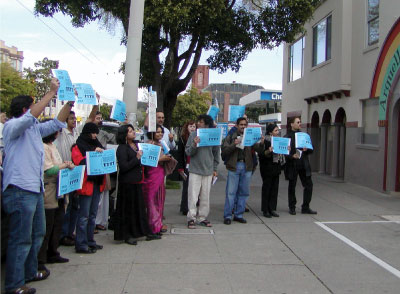
COVER STORY: The Narmada Debacle: Bad News for Everyone? Not only are the dispossessed being shortchanged, engineers are now making false claims about the project, while the Indian government and the judiciary have completely abdicated their responsibility, writes Anu Mandavilli. 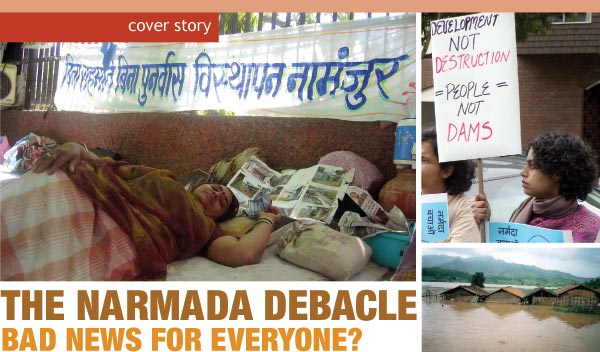 (Above): Bhagavati-behn from Nisarpur, Madhya Pradesh, on a hunger strike in New Delhi. Her village is threatened total submersion by the Narmada dam project. (Right): Indian activists protest in front of the Indian Consulate in San Francisco in support of the hunger strike in New Delhi. (Photo: Pei Wu) (Bottom): The village in Domkhedi, northern Maharashtra, is submerged by the Sardar Sarovar Project. (Photo: NARMADA BACHAO ANDOLAN) The struggle over the dams on River Narmada is a landmark in developmental politics that compels us to re-think our positions on several key issues — from the environmental sustainability of dominant developmental strategies, to the tension between our ethical responsibilities to the underprivileged and corporate notions of economic efficiency. But most important of all, recent developments in the Narmada struggle, including the Indian government’s silence in the face of large-scale collective civic action, highlight a breakdown in the mechanisms of accountability and a compromised democratic process. Over the last two decades, social scientists, policy makers and activists have presented various arguments, including irrefutable statistical evidence, showing that the supposed benefits of the dams are highly overstated and that the material and human costs of the dams largely exceed their putative benefits. Decades of struggle by people’s movements has provided ample evidence that the Adivasis and peasants of the Narmada Valley are resisting displacement from their ancestral lands, alienation from their traditional forms of livelihood and the disintegration of their social and cultural environments. The Narmada Bachao Andolan, in particular, has been quite successful in building mainstream public opinion on the issue owing to its significant support base among urban middle-class groups, students, professionals etc. Yet, the most recent actions of the Indian government and the Supreme Court reflect a complete abdication of their responsibility to the people and a repudiation of all concerns for social and economic justice. For example, why is the Narmada Control Authority allowed to blatantly violate judicial rulings regarding the rehabilitation process? Why is it acceptable for public officials, including engineers working on the Sardar Sarovar Project, to fabricate data in order to exaggerate the supposed benefits of the dam? Are these attempts to “persuade” the public through fake data not a violation of all norms of democratic public debate? Why has the press been silent about such cynical attempts by politicians to manipulate public opinion?
The state’s apathy towards the people’s needs is one thing — but how is one to explain the prime minister’s ignoring of the opinion of his own ministers, including that of Saifuddin Soz, the minister of water resources, and Meira Kumar, minister of social justice and empowerment? These two ministers were part of the group of ministers that toured resettlement and rehabilitation sites and whose report is a clear indictment of the rehabilitation process, and which exposes rehabilitation as being only “largely paperwork.” While the official status reports by the state government claim that resettlement is complete, the group of ministers found that on a majority of sites, there was no sanitation, no drinking water, no system of sewage, no roads, and certainly no other facilities like hospital, water reservoir, school, post office etc. Even in the few cases where families had been given land, the ministers heard from hapless evacuees that the land granted was either uncultivable, water-logged, subject to multiple claims, or that the land was distributed in such a way as to forcibly disperse family members to different areas. The ministers also heard, first hand, complaints that the displaced families were being pressurized to accept cash (in direct violation of laws regarding land-for-land compensation) and that corrupt public officials were demanding bribes before releasing the compensation checks. The inaction of the Prime Minister’s Office and the efforts to delay the publication of the ministers’ report are particularly inhumane given that several leaders of the NBA had already been on an indefinite hunger strike for 10 days specifically in regard to the resolution of the matter by the PM’s office. (The ministers’ report was published in The Hindu April 17, 2006 and can be accessed online here: http://www.hindu.com/2006/04/17/stories/2006041705231100.htm)
Recent events also raise grievous questions about the credibility and integrity of the judicial system as a whole. The NCA’s decision to raise the height of the dam to 121 meters on March 8, 2006 is in direct violation of the Supreme Court’s orders (issued in March 2005) that the height of the dam cannot be increased unless those subject to submergence are rehabilitated first. Further, the Narmada Tribunal award also required that rehabilitation should be completed 6 months before submergence. Yet despite the NCA’s failure to comply with the law, it was not the functionaries of the NCA that were arrested, but people like Medha Patkar and Jamsingh Nargave who were engaged in non-violent protest against the NCA’s decision! News that over 5,000 petitions are pending with the Grievance Redressal Authority and that the head of the office has never visited the affected village raises deeply troubling questions about the Adivasis’ access to the justice system and the ability of the system to respond to their concerns. The contempt for the judicial system and for the suffering of the people of the Narmada Valley shown by the NCA and the GRA is a violation of all democratic and humane principles of governance.
The English press in India, (despite its self-congratulatory cheering about its “free” status) remains largely pro-globalization and has had precious little support to offer to the people of the valley. For example, in a recent article in the Indian Express titled “Dam: Doable and must be done” the reporter bemoans the “waste of public funds” caused by the delay in building the dam but is unable to express any sympathy for the plight of the displaced families. No doubt emboldened by this further lack of accountability the politicians and the Sardar Sarovar Project technocrats have taken to fabricating data about the extent of the rehabilitation and the purported benefits of the dam, such as the one about the amount of power that will be generated by the SSP that overstates benefits by about 300 percent. In the absence of any challenges from the press to such falsification of data, various NGOs and other civil society groups have been working to expose the deceptive claims of the government, (See Box: An Open Challenge to Narmada Engineers).
|TOP|
MOUNTAINEERING: Seven Summits: Scaling the Top Peaks In mountaineering as in life, human potential is vast, and in many ways it is truly unlimited, so getting committed is the first imperative, writes Gautam Patil, the first Indian to have stood atop five of the world’s seven summits – the tallest point on each of the seven continents.  Silicon Valley entrepreneur and mountaineer Gautam Patil scaling Mount Denali in North America (above) and holding the Indian tricolor in Mount Vinson Massif in Antarctica (below)
My father was one of seven siblings and their father was a tough disciplinarian. He bought them one pair of shoes in Dassera and by the time summer came, the shoes were worn out. But, the summer hikes at Patalpani near Indore were still mandatory. They tied leaves to their feet and went hiking. Immersing in nature was a part of growing up for us, too. Tulsi Lake and the Western Ghats were our favorites. Then, in 6th grade, I saw the Sherpa Tenzing documentary and also saw Everest from Tiger Hill in Darjeeling. I was awestruck and still am. Since then, I have used all the opportunities I got to hike and climb – this includes places like Gaumukh, the hills near Leh in India, the Adirondacks in New York State, and mountains in the Sierra Nevada in California. In 1998, I decided to start working on Mt. Everest as a goal. I figured I would climb the seven summits so I could gain more experience and training. If I traveled on my own, I would also get to connect with peoples of the world first hand. So the journey began – a journey to high mountains, new cultures, and self-realization. Little did know that I was going to be the first man from India on several of these. That is just a bonus. I am very proud of having grown up in Mumbai. I think growing up in a cosmopolitan place, with Hindu parents, a Jesuit school, and friends from all language groups and religions has a tremendous value to it. A Mumbaiite is a world citizen! My college was in Pennsylvania – those days were completely different. I studied finance and economics and spent most of my free time earning money to make ends meet. All jobs were fair game, from cutting lawns and washing cars in the summer, to working in the college computer lab year round. College life was a lot of hard work and character building. I am grateful for the opportunities America has given me and the scholarship that the university provided. Mountaineering is a mind based endurance game. How much can you take? The truth is a lot more than one really imagines. For the climber, the main strength is mental – tenacity and endurance – it continues over to cardiovascular fitness – there is no substitute for adequate training and then on the leg strength which is often part of cardiovascular training. Mountaineering begins with the mind. Might sound like you’ve heard it before but I’ve seen people live or die because of it. Hard decisions have to be made, one has to persevere in tough conditions, and moreover stay calm when life and death seem divided by a thin line. For example, when I was on Aconcagua in January 2000, for reasons beyond my control I had to solo to summit. After a long, hard climb I made summit and was returning when I faced one of those decisions. It was near summit at roughly 22,500 feet and an older German man was still climbing to the top. He had no business being there! Given his age and the lateness of the day (it was almost dark) and being alone - was incredibly unsafe. I knew he couldn’t make it back so I told him to return. He knew that I was the last person he would see between then and when he returned to camp and all he wanted from me was to take his photograph with the summit in the background. I did. Given the low levels of oxygen, I was having a hard time figuring out if I was talking to him or simply thinking it. He didn’t listen to my stern advice. It was 40 below zero, getting pitch black, and windy. The wind chill made it feel like -95 or so. This was no time to dally. 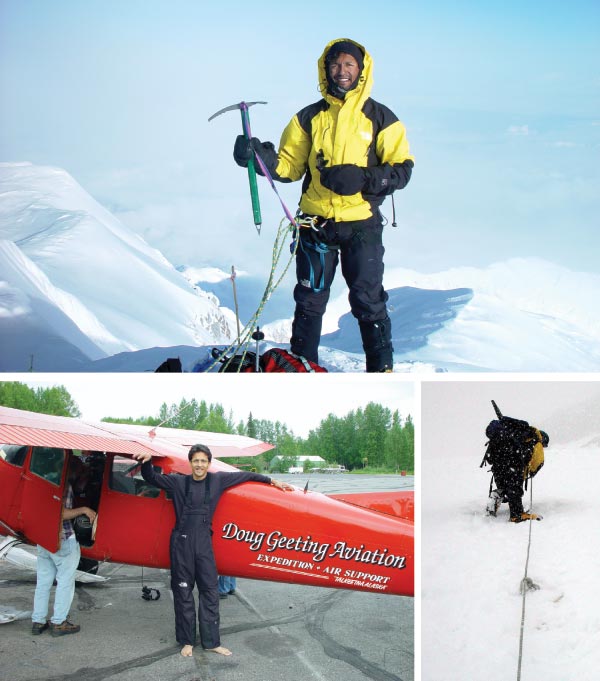 (Top): Gautam Patil on the summit of Mount Denali, Alaska. Mount Denali is the highest peak in North America. (Bottom, l): Patil on his way to fly towards base camp for Mount Denali. (Right): Patil heading towards Mount Denali. Lower on the Canaleta – a steep section of sandy rock – another man was struggling back. I had to choose – stand there and help the German man down to camp. And, risk losing life or make a dash back to camp and try and give the other guy a hand. I chose the latter. He turned out to be a Dutch guy in his early 40s. He was very afraid despite the fact that he had a headlamp. He wanted to take shelter in a resin coated emergency blanket and spend the night behind some rocks. There was no way he would make it – that was an absurd idea but people can be very irrational in these situations. I insisted that he kept moving. The night was clear and I was feeling very good. Perhaps that was a neuro-deficit too but it worked! To cut the story short, we miraculously got to camp around 2 a.m. and immediately sent for the rescue team for the other climber. (Rescue could not leave for another day due to bad weather. They reportedly found him collapsed above 22,000 feet, brought him to high camp, revived him and brought him to base camp. He was in borderline condition. On the third day, as I was leaving the mountain, I saw a helicopter pull the German man away. I hope they are both well.) I have an endless stream of such stories. These are the situations that mountaineering is all about. You never know! In mountaineering as in life, human potential is vast, and in many ways it is truly unlimited. Getting committed is the first imperative. Tenacity, physical and mental, conscious and focused efforts, shifting and expanding paradigms, continuous learning from one’s experiences, both big and not so big, can support in reaching avowed goals. Gautam Patil has climbed five of the top seven summits in seven continents — Denali (North America), Aconcagua (South America), Kilimanjaro (Africa), Vinson Massif (Antarctica) and Elbrus (Europe). He now plans on climbing atop the final two by June 2006: Kosciusko (Oceania) and Everest (Asia). More information is available at his Web site: www.isummitworld.com |TOP| Agent Orange and Bhopal: Fight for Global Environmental Justice Continues Agent Orange and the Bhopal disaster reminds him of slash-and-burn farming, where land is deforested, farmed, and then abandoned after its nutrients have been depleted and it can no longer produce, writes Ky-Phong Tran.  A U.S. plane spraying Agent Orange in Vietnam (above). Millions of gallons of the toxic defoliant were sprayed, with harrowing results, like children born with birth defects (left)
In the fall of 2002, I journeyed to Vietnam for the first time and it changed my life. I met my family after twenty-seven long years of separation--dozens of aunts and uncles, cousins, and family friends. We hosted a banquet on the floor of my paternal grandfather’s house and the memory still lingers with me--the click and clack of spoons and chopsticks, the tipsy laughter of family, the blue tarp we all sat on. I also visited the aging white church my parents were married in, the dilapidated hospital where my siblings were born, and the three-story house where I was conceived. But on a trip to the War Remnants Museum in Saigon, my pilgrimage to reclaim my past took a significant, powerful turn. In an indiscreet corner, I was stunned by photos of mangled babies, twisted like pretzels, floating in jars of yellow liquid. Photos of teenagers with huge, bulging eyes and giant foreheads. Photos of limbless adults smiling, trying their best to look happy. I went back to Vietnam looking for myself and instead, I found a cause: Justice for the Vietnamese victims of chemical warfare. Justice from the manufacturers and the government that sprayed them. Justice for the victims of Agent Orange. Operation Hades During the Vietnam War, the US military sought to destroy dense jungle areas in South Vietnam to eliminate enemy cover and food supplies. The Pentagon commissioned a number of herbicides from manufacturers including Dow Chemical and Monsanto, but the most “successful” was Agent Orange, named after the orange stripe that was painted on the barrels it was stored in. Between 1964 and 1971, US forces sprayed an estimated 19 million gallons of Agent Orange on Vietnam, Cambodia, and Thailand. It was later discovered that the chemical mixture also produced dioxins, a deadly chemical that is a known carcinogen and teratogen. These were the chemicals responsible for the images of the deformed children I had seen in Saigon. The military operation had various names, including Operation Trail Dust and Operation Ranch Hand. For a time, it was also known as Operation Hades. I find that sickly fitting, as it did bring a certain kind of hell to the innocent people it was sprayed on and the land that continues to sprout its poisons to this day. Judgment Day In 2004, three representatives of the Agent Orange Victims Association in Vietnam brought suit in a Federal New York court against the chemical companies, claiming that they were responsible for the human and environmental damage caused by Agent Orange. A year later, Judge Jack Weinstein of Brooklyn Federal Court dismissed the lawsuit filed against the chemical companies that produced Agent Orange which they knew was tainted with high levels of dioxin. Judge Weinstein ruled that the use of these chemicals during the war, although they were toxic, did not in his opinion fit the definition of ‘chemical warfare’ and therefore did not violate international law. Ironically, in 1985, the same Judge Weinstein presided over a $180 million settlement between US Veterans and the same companies to assist with the veterans’ medical needs caused by Agent Orange. The truth of the ruling is this: If the billion-dollar, globally powerful, and politically connected chemical companies lost and were forced to make amends for their war crimes, it would have opened up a Pandora’s Box of litigation for companies all over the world who had done harm to war time civilians and in this current political system, that is unacceptable. I guess corporations need justice too. After the ruling, a delegation of Agent Orange victims and supporters was organized by the Vietnam Agent Orange Relief & Responsibility Campaign and toured eleven US cities to highlight their struggle An appeal has been filed with the Second Circuit Court of Appeals in Brooklyn and arguments began in April 2006. Bhopal  The Agent Orange campaign bears an ugly, striking resemblance to the Bhopal disaster in 1984, where a Union Carbide pesticide plant released toxic chemicals that killed over 15,000 Bhopal residents and injured another half million. The Agent Orange campaign bears an ugly, striking resemblance to the Bhopal disaster in 1984, where a Union Carbide pesticide plant released toxic chemicals that killed over 15,000 Bhopal residents and injured another half million.Though the victims were compensated financially in an out of court settlement, the land is still infected to this day. Because of the plant’s central location and rain run-off that pollutes underground water supplies, toxics are responsible for kidney, liver, and nervous system problems among many Bhopal residents. And in a coincidence that would be Hollywood movie-laughable if it were not true, Dow Chemical, the manufacturer of Agent Orange, is also the owner of Union Carbide. Slash and Burn The use of Agent Orange and the Bhopal disaster reminds me of slash-and-burn farming, where land is deforested, farmed, and then abandoned after its nutrients have been depleted and it can no longer produce. The Union Carbide plant manufactured pesticides in India for cheap profits with shoddy regulations. After the explosion, after Bhopal could not produce, the plant was sold. Unfortunately, environmental clean-up is expensive and produces no profit for shareholders. Vietnam was about something more than profit, it was about power. According to the Domino Theory, if Vietnam fell to Communist forces so would all of Southeast Asia. Or maybe, the dominoes were all the other colonized regions of the world that were fighting for their own self-determination. After the Vietnam War, Vietnam was no longer useful politically or environmentally, literally de-forested by chemicals, and thus abandoned. The United States lost that battle, and again, clean up is expensive, especially for the little ‘S’ shaped country that blemished this country’s previously unbeaten war record. Privilege in the New World The other day, my roommate asked me if I was a Democrat or Republican. I laughed at him and told him I was neither, though I vote Democrat. I told him, elections rarely affect me. I am an English-speaking, college educated, US Citizen. I have direct access to steady work, health insurance, and a home. I vote Democrat because their policies tend to aid people whom I am related to or those whose struggle I support: the poor, working families, the uninsured, immigrants. It’s the same with the Agent Orange Campaign. In truth, it does not directly affect me, but somehow knowing that it could have been me contaminated with Agent Orange, that there are people who look like me, talk like me, and have the same name as I do who are suffering--I feel committed to them. For me, what’s the point of having all this privilege if I don’t use it for something good, something bigger than me? Sometimes, I wonder if this campaign is possible. Can the victims of Agent Orange win justice 11,000 miles away in a New York court? Can justice be had from an unjust war? But history tells us it can happen. After decades of organizing, Japanese Americans won reparations and a national apology for internment. A few weeks after the dismissal of the Agent Orange Victims’ case, the US government paid 25 million dollars to compensate for losses after US soldiers looted a train and warehouse that contained Jewish family heirlooms that were stolen by Nazi-allied Hungarian soldiers. I was pleased that they won, but the proximity of the cases broke my heart. To me it only confirmed that justice in this country is not just about justice, it is about influence. As Vietnamese America grows, as it elects government officials and churns out millionaires, as it produces college graduates and white-collar professionals, I hope it can remember its own brothers and sisters across the Pacific Ocean. I hope it can balance its ambition with its sense of community and consider people over profits. I believe that there will be a settlement and that it will add further closure to the Vietnam War. But most of all, a settlement might make life a little bit easier for a crippled child back in Vietnam and cleanup will prevent further suffering. It can be done because it must be done. For more information, contact The Fund for Reconciliation and Development (www.ffrd.org) and Vietnam Agent Orange Relief & Responsibility Campaign (www.vn-agentorange.org) |TOP| NEWS DIARY: April Roundup  Academic Decathlon | U.S., Pakistan Relationship Strategic: Pak Envoy | Space Mission | Pramod Mahajan Dies | Say it Ain’t So, Kaavya | Trouble in Baroda | Lodi Man Convicted of Terrorism Charge | Mobile Phones Boosts Bangla | Maoists Name Peace Team | Ex CEO Pleads Guilty | ‘Build-a-Bear’ in India | Taliban Kills Indian Engineer Academic Decathlon | U.S., Pakistan Relationship Strategic: Pak Envoy | Space Mission | Pramod Mahajan Dies | Say it Ain’t So, Kaavya | Trouble in Baroda | Lodi Man Convicted of Terrorism Charge | Mobile Phones Boosts Bangla | Maoists Name Peace Team | Ex CEO Pleads Guilty | ‘Build-a-Bear’ in India | Taliban Kills Indian Engineer Academic Decathlon 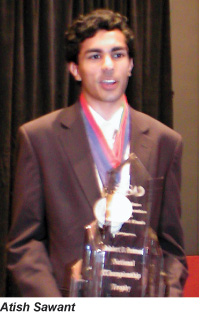 Atish Sawant, a senior at Taft High School in Woodland Hills, Calif., led his school team to a first-place finish in the 2006 United States Academic Decathlon, held April 26-29 in San Antonio, Texas. Atish Sawant, a senior at Taft High School in Woodland Hills, Calif., led his school team to a first-place finish in the 2006 United States Academic Decathlon, held April 26-29 in San Antonio, Texas. The Taft team scored 51,659 points out of a possible 60,000, beating Plano Senior High School of Plano, Texas, which finished second with 48,720 points. The 18-year-old Stevenson Ranch, Calif., native posted the top individual score in the competition — 9,062 out of possible 10,000. This was also the second highest ever score in his category. Sawant received nine medals and three extra awards: highest scoring student, speech showcase and top score in his academic category. Students are tested in 10 categories: art, economics, essay, interview, language and literature, mathematics, music, science, social science and speech. This year’s topic was “The European Renaissance: Renewal and Reform.” There were 337 students competing this year representing 38 states. A recipient of the Caltech Signature Award, the National AP Scholar with Distinction award and the Academic Achievement Award, he is also a National Merit finalist. He is the son of Suresh and Hashuka Sawant. Also on the Taft team was Bangladeshi American Farhan Khan, 18, of Encino, Calif. |Back to NEWS Diary| |TOP| U.S., Pakistan Relationship Strategic: Pak Envoy 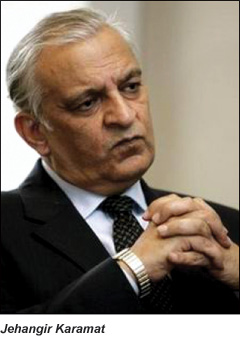 Pakistan’s U.S. envoy Jehangir Karamat made a whirlwind tour of Northern California recently during which he addressed gatherings at the University of California at Berkeley, the World Affairs Council in San Francisco and at Stanford. Pakistan’s U.S. envoy Jehangir Karamat made a whirlwind tour of Northern California recently during which he addressed gatherings at the University of California at Berkeley, the World Affairs Council in San Francisco and at Stanford. Both introductions of Ambassador Karamat, by Prof. Neil Joeck in Berkeley and Douglas Bereuter (president of the Asia Foundation) in San Francisco, mentioned his distinguished career as a soldier-diplomat and as a scholar. Karamat retired as chairman of the joint chiefs of staff and chief of army staff of Pakistan in 1998. He has also been a visiting fellow at Stanford University and Brookings Institution. Karamat said that there are two different perceptions to the U.S.-Pakistan relationship. One is that the U.S. is going to leave after the War on Terror is over (like in the past after the Soviet withdrawal from Afghanistan). The other perception is that the relationship between the two countries is for the long-term. “We think that it is a strategic relationship,” he said. He said that Pakistan was focusing a great deal on economic and trade issues with the United States. “We were looking at a free trade agreement between the U.S. and Pakistan. This has not happened yet,” he said, but added that the dialog has been moving forward. On Pakistan’s own foreign policy, Karamat said that it has a relationship with Iran, its own policy on Iraq and has opened up a dialogue with Israel which will go further when the Israeli-Palestinian peace process makes progress. The Pakistani-American community will soon bid farewell to Karamat as he is slated to leave his post in Washington in the next couple of months. He will be remembered as a humble, articulate and soft-spoken figure, a well-read soldier and a credit to the military profession. He once chose to uphold democracy in Pakistan in spite of being in a situation where he could have taken over. — Ras H. Siddiqui |Back to NEWS Diary| |TOP| Space Mission 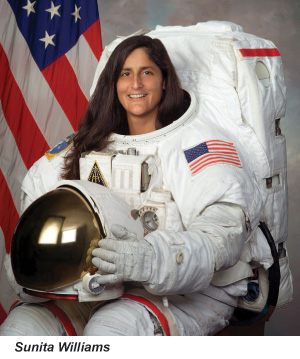 Three years after Kalpana Chawla’s tragic space expedition, another Indian American, Sunita Williams, will make her maiden journey to the International Space Station as part of NASA’s six-month mission. Three years after Kalpana Chawla’s tragic space expedition, another Indian American, Sunita Williams, will make her maiden journey to the International Space Station as part of NASA’s six-month mission.The U.S. space agency’s 14th expedition to ISS would begin this fall and the U.S.-born Williams will serve as a flight engineer, NASA announced. NASA astronaut Michael Lopez-Alegria will be the commander of the expedition and the station science officer while Russian cosmonaut Mikhail Tyurin will serve as flight engineer and Soyuz commander. Williams will join Expedition 14 in progress after traveling to the station on space shuttle mission STS-116. Born in Euclid, Ohio Sept. 19, 1965, Sunita is married to physicist-turned-U.S. deputy marshal, Michael J. Williams. She is the daughter of Deepak Pandya, a physician from Gujarat who migrated to the U.S. in the 1960s and now works at a veterans hospital. A graduate of Florida Institute of Technology, she received her commission as an ensign in the U.S. Navy from the U.S. Naval Academy in May 1987. She was designated a Naval Aviator in 1989, and graduated from the Naval Test Pilot School in 1993. Williams was selected for the astronaut program by NASA in June 1998, in part because of her extensive experience on more than 30 different aircraft. She has logged more than 2,770 flight hours in 30 different types of aircraft. |Back to NEWS Diary| |TOP| Pramod Mahajan Dies 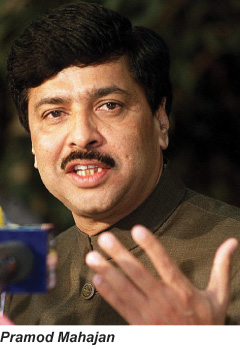 Pramod Mahajan, one of the brightest luminaries in India’s main opposition Bharatiya Party’s Generation Next constellation and a cabinet minister in the previous government, died at the Hinduja Hospital 12 days after he was fatally shot at by his younger brother who pumped three bullets into him. Pramod Mahajan, one of the brightest luminaries in India’s main opposition Bharatiya Party’s Generation Next constellation and a cabinet minister in the previous government, died at the Hinduja Hospital 12 days after he was fatally shot at by his younger brother who pumped three bullets into him.The 56-year-old BJP general secretary is survived by his wife Rekha, son Rahul and daughter Poonam who were at his bedside when he died. Mahajan was shot at by his youngest brother Praveen at the BJP leader’s Worli residence on April 22. He underwent a four-hour emergency surgery to deal with critical injuries to his liver, lower chest, abdomen and pancreas. Three bullets that caused extensive damage to his vital organs and massive bleeding were not removed. Mahajan had been on life support and dialysis for the last few days. He was cremated at Shivaji Park crematorium. Senior BJP leader L.K. Advani and party president Rajnath Singh cut short their political tours and flew to Mumbai. Former Prime Minister Atal Behari Vajpayee and other party leaders also rushed to Mumbai. Both President A.P.J. Abdul Kalam and Vice President Bhairon Singh Shekhawat said Mahajan’s death was a personal loss for them. Prime Minister Manmohan Singh and Congress president Sonia Gandhi as well as other leaders across party lines recalled Mahajan as a great leader. |Back to NEWS Diary| |TOP| Say it Ain’t So, Kaavya 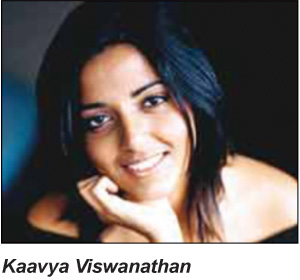 Amidst fresh charges of plagiarism against Indian-American author Kaavya Viswanathan, the publishers of her first novel finally decided to withdraw the book permanently and cancel the deal for her second work. Amidst fresh charges of plagiarism against Indian-American author Kaavya Viswanathan, the publishers of her first novel finally decided to withdraw the book permanently and cancel the deal for her second work.“Little, Brown and Company will not be publishing a revised edition of `How Opal Mehta Got Kissed, Got Wild, and Got a Life’ by Kaavya Viswanathan, nor will we publish the second book under contract,” Michael Pietsch, Little Brown’s senior vice president and publisher, said in a statement. This was a dramatic comedown after a flurry of adulatory publicity that greeted the Harvard sophomore after she got a $500,000 advance for a two-book deal when she was 17. Her novel came out in March to widespread attention. Earlier, similarities were reported between the teenage author’s novel and Megan F McCafferty’s novels “Sloppy Firsts” (2001) and “Second Helping” (2003). In the aftermath of the allegations surfacing, Kaavya asserted that she had read the books of McCafferty and had “borrowed” from her two books “unconsciously and unintentionally.” Now there are reports that at least three portions of her novel has striking resemblances to a second book, “Can You Keep a Secret,” by Sophie Kinsella. While the plots of the two books are distinct, the phrasing and structure of some passages is nearly identical, reports say. Meanwhile, New Jersey’s Record newspaper is saying that it is investigating the articles she wrote when she was an intern in the paper in 2003-2004. |Back to NEWS Diary| |TOP| Trouble in Baroda  The recent violence in Baroda in Gujarat, has led to an increase in tension between the city’s Hindus and Muslims. The recent violence in Baroda in Gujarat, has led to an increase in tension between the city’s Hindus and Muslims. Six people died in the violence which followed the demolition of a 200-year-old Muslim shrine by the city’s authorities, who said they needed to demolish it for a road-widening project. The demolition led to widespread protests by Muslims. The controversy illustrates the sharp divisions that exist between the two communities, who have lived together for centuries, Suvojit Bagchi reported in the BBC online news site BBC News. Many of the city’s Muslims now say they are living in constant fear. Sabera Biwi, who lives in the heart of Baroda, asks angrily: “The police are telling us to go to Pakistan - and you are asking me whether I am safe?” Taxi driver Rathod Firoz says many issues have divided the two communities. “Communities are sharply polarized here. It gets flared up easily,” he said. Baroda police commissioner Deepak Swarup echoed his thoughts. “Even a simple neighborhood problem is termed here as a communal clash now.” Isaqbhai Chinwala lives in the old city’s Mogulwara area and is a well-known social worker. “After the 2002 riots in Gujarat, we moved to this area. There used to be a few Hindu families here. They moved out,” he said. He says he never wanted to stay in a “Muslim ghetto.” “I am a disciple of Gandhi. How can I accept this kind of geographical polarization within a city? “To me it’s not merely physical - it is an emotional and moral question too,” he says. But Chinwala was forced to move out by his family from his ancestral home, which was in a predominantly Hindu area, after his house was ransacked. |Back to NEWS Diary| |TOP| Lodi Man Convicted of Terrorism Charge 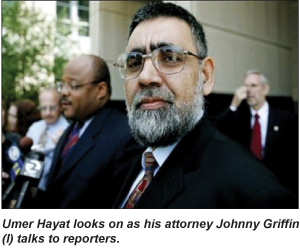 In a case cited by America’s top intelligence official as an example of a “homegrown jihadist cell,” a federal jury in Sacramento April 25 convicted a Lodi man on terrorism charges. In a case cited by America’s top intelligence official as an example of a “homegrown jihadist cell,” a federal jury in Sacramento April 25 convicted a Lodi man on terrorism charges.Hamid Hayat, 23, was found guilty on one count of providing material support to terrorists by attending a training camp in Pakistan in late 2003 and three counts of lying about it to the FBI. Earlier, the case against his father, Umer Hayat, 48, a Lodi ice cream truck driver, ended in a mistrial when a separate jury couldn’t reach a verdict on whether he lied to the FBI about his son’s alleged training. Hamid Hayat’s defense attorney Wazhma Mojaddidi said, “I’m disappointed in the decision the jury has come to. I believe they are wrong. Hamid Hayat never attended a terrorist training camp. The fight is definitely not over.” She said she would file a motion for a new trial. Hayat faces up to 39 years in prison when he is sentenced July 14. In the elder Hayat’s case, the jury of eight women and four men deliberated nearly eight days before saying it could not reach a verdict. The jury sent a note to U.S. District Judge Garland E. Burrell stating they were “decisively deadlocked.” Defense attorney Johnny L. Griffin said he was “very pleased that the jury did not find our client guilty. Our position from day one was that Umer Hayat was not a terrorist.” Later, federal prosecutors announced they will retry Umer Hayat. Judge Burrell has set June 5 as the new trial date for Hayat. |Back to NEWS Diary| |TOP| Mobile Phones Boosts Bangla  Bangladesh’s booming mobile phone industry has emerged as a key driver of the cash-strapped nation’s economy, creating nearly 240,000 jobs and adding $650 million to gross domestic product. Bangladesh’s booming mobile phone industry has emerged as a key driver of the cash-strapped nation’s economy, creating nearly 240,000 jobs and adding $650 million to gross domestic product. “The cell phone industry in Bangladesh employs 237,900 people directly and indirectly. These are well-paid jobs with salaries many times the national average,” said a study by the international consultancy firm Ovum. Bangladesh is one of the world’s poorest nations with nearly half its 140 million population surviving on less than a dollar day. Around 70 percent depend on agriculture to make their living. The study commissioned by the GSM Association, a global industry body of 690 operators, found that the mobile services industry contributed $650 million to Bangladesh’s GDP annually. Bangladesh has witnessed explosive growth in mobile telephony over the last few years with the number of subscribers leaping from 200,000 in the first quarter of 2001 to 11 million in early 2006. Analysts say the boom will continue amid falling mobile phone prices. Last year alone call charges fell by 30 percent, injecting faster growth to the industry. Over seven percent of the population now has a mobile phone, up from a mere 0.2 per cent four years ago, the study said, describing the growth as “extraordinary.” |Back to NEWS Diary| |TOP| Maoists Name Peace Team
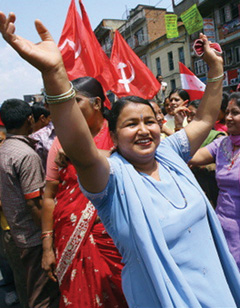
“The team would be led by the spokesman for the party Krishna Bahadur Mahara, and central committee members Dev Gurung and Dinanath Sharma are also part of the team,” the Himalayan Times reported in its online edition. The team was selected after a three-day meeting of the Maoist central committee in Mahendranagar, 430 miles west of Kathmandu, the English-language Web site reported. Maoist leader Prachanda was present at the meeting. The government has said it would announce a peace talks team of up to seven people by the end of the week, and is debating a code of conduct for the ceasefires declared by each side. The interim multi-party government was appointed late last month after weeks of mass protests crippled the nation and forced King Gyanendra to hand back power to parliament. The new government has matched a ceasefire declared by the Maoists and agreed to a key rebel demand -- for an election to form a body to redraft the constitution and decide the future of the monarchy. |Back to NEWS Diary| |TOP| Ex CEO Pleads Guilty
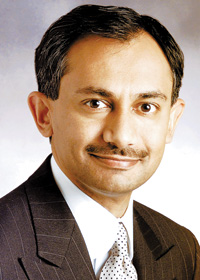
The plea by Kumar, 44, a Sri Lankan immigrant who moved up the corporate ranks to become the right-hand man of company founder Charles Wang, is the culmination of an accounting scandal that staggered the enterprise software company. According to The Wall Street Journal, the defense decision to admit guilt followed the arrest April 21 of Thomas M. Bennett, a former senior vice president of business development at CA. Bennett, who worked for Kumar, was charged with conspiracy to obstruct justice for spending $3.7 million of company money to allegedly bribe a potential witness who had helped erase the hard drive on Kumar’s personal computer in 2003, according to the Bennett indictment. The obstruction of justice charges carry maximum prison sentences of up to 20 years each, while the fraud charges carry maximum sentences of 5 to 10 years each. Sentencing is set for Sept. 12. Charged in September 2004 with manipulating CA’s sales in the 1998-2000 period by helping backdate contracts and book bogus sales, Kumar also lied to federal investigators and even to his attorneys to cover up his actions, the indictment said. |Back to NEWS Diary| |TOP| 'Build-a-Bear' in India Build-A-Bear Workshop Inc, a franchise chain that specializes in customized stuffed animals, will open its first store in India this year through its new international franchisee The Murjani Group. The first store in India, where customers can create their own customized stuffed animals, will be located either in Mumbai or New Delhi. “We are looking forward to the exciting growth Murjani Group can help us achieve. Mohan Murjani’s 35-plus years of proven brand management and retailing experience is a wonderful asset for Build-A-Bear Workshop,” chairman and chief executive of Build-a-Bear Maxine Clark said. Murjani Group chairman Mohan Murjani said the company was “pleased to bring this wonderful, loving concept and look forward to sharing lots of teddy bear hugs with the young and old, throughout India.” The Murjani Group, with its headquarters in New York, is focused on apparel industry and brand name development. The group’s brands account for retail sales over $5 billion. It launched Gloria Vanderbilt followed by Tommy Hilfiger in 1984 and became the first Indian company to develop and market designer brands in the international market place. |Back to NEWS Diary| |TOP| Taliban Kills Indian Engineer Indian engineer K. Suryanarayana, abducted by Taliban in Afghanistan, was killed by his kidnappers, provoking strong condemnation by New Delhi which termed it as a “pre-meditated” and “brutal” act of terrorism by the militia and “its sponsors.” The beheaded body of the 41-year-old Suryanarayana was found by a police patrol this morning in Hassan Karez area in southern Zabul province where he had been kidnapped along with his Afghan driver. Taliban had threatened to kill the engineer, who was working for a Bahrain-based company, if their demand that all Indians leave Afghanistan was not met. The news of his killing was received with shock by his family in Hyderabad and his wife Manjula slumped while their three children wept inconsolably. Suryanarayana’s mother Ananthalaxmi became hysterical on hearing the news. India’s President A.P.J. Abdul Kalam and Prime Minister Manmohan Singh condemned the incident. Singh said killing of an innocent Indian civilian was an “inhuman act.” Confirming his death, Foreign Secretary Shyam Saran said the “brutal” killing was a “pre-meditated” act committed before the Indian team could reach there which demonstrated that the Taliban were not interested in negotiations. |Back to NEWS Diary| |TOP| TRAVEL: City of Light: Another Side of Paris Exploring Paris doesn’t have to be expensive, writes Al Auger, who stuffed his backpack with cheeses, some Dijon, a baguette, a bottle of vin de pays and something sweet and headed for the Seine, and that’s just one of countless ways to experience this beautiful city.  Landmarks like the Eiffel Tower (right) may be what Paris means to tourists, but its real charms lie in cozy cafes like the one above. April in Paris” is a classic big band number wonderfully rendered by Count Basie, but only a metaphor for the time of beauty to be in Paris. For me I find this wonderful city at its very graphic best in the beginning months of fall. The magical light of Paris is still luminous but diffused, everything is softened to the eye while the colors become almost diaphanous. The City of Light lives larger in spring and fall. At night, it is a brilliant explosion of neon yellows, greens, reds with sidewalk tables of the cafes and restaurants bulging with locals, dissecting the latest gossip, the World Cup surprise, or the lone woman sitting at the end table. Has she a story to tell? The Paris I wander, a transplanted flaneur, are these neighborhoods populated by a citizenry who love their city even more than I do. These are the people who make up what I think of as the “real” Paris: the neighborhoods and the people who make Paris live. Unlike the newly born neighborhoods on the edges of this over 2,000-year-old city such as the Rive Gauche project along the Seine or the Bobigny-Pablo Picasso complex of middle class apartment towers, it’s the older residential environs that glue Paris together. Self-sustaining, they have a history and story unique to themselves. It’s in the neighborhoods the traveler meets the people of Paris. “I absolutely love walking Paris,” Mark said. A resident of Amsterdam, Mark had just returned to the hostel from a 10-mile roundtrip “stroll” to the Eiffel Tower. The day before he walked the Champs-Elysees from the bottom to the Arc de Triomphe. Mark, along with myself, as well as a number of travelers from all over the world had settled in the hostel Maison Internationale des Juenes in one of the most enduring neighborhoods of Paris called the Quartier Faubourg-San Antoine, a community originally known for nearly 400 years as the Quartier des Artisans located in the 11th arrondissement. In 1673, Maximilian Titon, manufacturing director for the Royal Army of France, set up headquarters on the Rue de Montreuil. It followed that artisans flocked to the neighborhood, from paint makers to cabinet makers and fine furniture designers. Bordered by the Boulevard Voltaire and the Quartier Bastille, the historical streets that twist and turn higgledy-piggledy through the quartier, are still inhabited by the ateliers of the artisans working with wood, the street names distinctly describe the quartier’s history: Rue Titon, Rue de Ameublement (avenue of furniture makers). Ranging from the basic kitchen cabinet to designer furniture to the retrofitting of antique flotsam, the artisans work their specialties in shops that can be a small hole with a door to the multi-room shop of artisan/carpenters. One of the biggest events in the neighborhood every October is the Les Ateliers Ouverts de la Bastille — a sort of open house of the artists’ and artisans’ workplaces that range from the Place de la Bastille to the Faubourg Saint-Antoine border — that was being held on the following weekend. “There will be over 100 artists, sculptors, cabinetmakers, furniture makers, artists and artisans of all kinds, displaying their works in their studios and open to the public,” a local explained.  Living in a Paris neighborhood also reverses one of the most popular tourist activities. Instead of sitting at a sidewalk cafe and watching the world pass by, I would sit in the mini-park in the center of the main shopping district and watch the Parisians at their tables sipping aperitifs, a cold beer and nibbling on wonderful food goodies. Couples would quietly share the intimacy of the tiny table, holding hands, never taking their eyes off each other. Friends would be demonstrating their points of view with dramatic hands and arms gesturing wildly in the air. Living in a Paris neighborhood also reverses one of the most popular tourist activities. Instead of sitting at a sidewalk cafe and watching the world pass by, I would sit in the mini-park in the center of the main shopping district and watch the Parisians at their tables sipping aperitifs, a cold beer and nibbling on wonderful food goodies. Couples would quietly share the intimacy of the tiny table, holding hands, never taking their eyes off each other. Friends would be demonstrating their points of view with dramatic hands and arms gesturing wildly in the air. This is France and food and eating is as much an art as it is a necessity. Walking the street of the quartier, the life forces were palpable with the smells and sounds emanating from the outdoor cafes and restaurants. Here was l’Auberge, a quiet inn that would be more at home in the south of France instead of the bustling streets of the quartier, where dinner began with a prices a bit beyond my budget restraints, so we opted for a small restaurant around the corner called “The Barbecue,” where there was no barbecue to be seen so we opted for a three-course prix fixe meal of small salad, delicious mussels in a garlicky sauce and dessert. The least costly in neighborhood restaurants is the popular plat du jour. Like so many of the local restaurants, the Barbecue was small — on the verge of tiny, seating only about 8-10 couples. But, the 11th arrondissement is far more than 4-star and no-star dining. The population is a true melting pot of cultures, languages and traditions. The Rue Faidherbe main boulevard, for instance, is chock-a-block with the expected French restaurants, but also boasts a number of foreign restaurants including a wonderful Lebanese restaurant, an imposing Indian vegetarian diner and a colorful Vietnamese eatery. As my fractured French began its slow journey back I found myself getting more and more into the neighborhood. One evening I made my daily stop for a beer at one of the many cafes in the square. It took only minutes before I was in conversation with Paul, my neighbor at the bar. Catching me taking photographs on the street he called, “Ah, un journaliste, oui?” I began to press him for his spin on Paris, but he seemed to take it for granted that I was already deeply in love with Paris and for nearly an hour the subjects were of his choice were San Francisco, Woody Allen, Jerry Lewis and jazz. The French citizen is full of hubris mellowed by a sense of self-cynicism and whimsy. They are curious and love to talk about anything and everything; once you have engaged a conversation, prepare for a long stay.
Certainly, Paris is deservedly proud of having the most sophisticated and viable urban transit system in the world. There are a number of discount packages that can make the cost of a journey to any part of Paris as little as fifty cents. The Metro covers Paris top to bottom (literally) and side to side, not missing a corner. These discount packages are accepted on both the underground trains and surface transportation. There’s another serendipitous facet to traveling the Metro. Paris is a city filled with the sounds of music, and the bowels of the Metro are filled with this music. On one of my very first excursions on the Metro, I found a young woman in the Bastille station playing lovely violin classics. Another time in the Faidherbe-Chaligny station close by my residence, a woman was serenading the travelers on a lyre. Number one on my list of Metro entertainment was two concertina artists who rode my Metro car clear across Paris playing French and Italian love ballads. And what better way to see the beauty of Paris than through its many heroic edifices along with a meal al fresco? I would stuff the backpack with cheeses, some Dijon, a baguette, a bottle of vin de pays and something sweet and head for the Seine — via the Metro, of course. Sit on a bench below an over-arching tree and watch the bateau mouche tour boats slowly break the calm of the river. A family is setting up an al fresco lunch on their nearby houseboat while another houseboat owner goes about her duties of cleaning the decks, breaking the routine now and then to pet her dog or just sit for a while looking out at the Paris afternoon skyline. Al Auger is a freelance writer. He lives in Redding, Calif. |TOP| FINANCE: Private Banking: Making it More Accessible Thanks to credit unions, private banking is no longer the exclusive preserve on the super wealthy. A Siliconeer report.  |TOP| Private banking is no longer the exclusive domain of the super wealthy. It is becoming more accessible through new services offered at credit unions. Take, for example, Technology Credit Union based in Silicon Valley, home to the sixth largest concentration of millionaires in the country according to a recent report released by Kiplinger’s Personal Finance magazine. The success of the many world-famous tech companies and startups in the valley has created a class of highly-paid talent and executives who are seeking wealth management services. Tech CU, which has long serviced professionals in the area, launched one of the first credit union-based private banking programs in the world in 2001. Tech CU’s premier members are invited into the program based on their combined balances with the credit union, including deposit, mortgage and other loans and investment accounts. The program offers the same benefits offered by other banks and wealth management firms, but for members of Tech CU, the threshold for getting into the group is reasonably attainable. The average requirement for a private banking program in the U.S. hovers around $25 million in investible assets for most firms (though that figure can vary). The average private banking member at Tech CU has between $5 and $15 million in liquid and invested assets with the credit union. Currently there are over 1,500 members in Tech CU’s private banking group, and its managers oversee more than $400 million in assets. The program is so popular, in fact, there is a three-month waiting list to join. “We knew these services were needed, but had no idea our private banking would grow so quickly,” says Kim Vu, associate vice president of private banking at Tech CU. THEATRE: Lalon Goes to New York: Off Off Broadway Production of “Man of the Heart” Sudipto Chatterjee has taken his multi-media inquiry into the life and times of one of Bengal’s most fascinating sages to New York’s Off Off Broadway. A Siliconeer report.  (Left): Sudipto Chatterjee performing “Man of the Heart” in New York City. (Left): Sudipto Chatterjee performing “Man of the Heart” in New York City. Man of the Heart,” Sudipto Chatterjee’s passionate, music-filled inquiry into the life of one of Bengal’s most beloved yet enigmatic sages, Lalon Phokir, has recently been performed in New York’s Off-Off Broadway. The three-week run at the 99-seat Kraine Theatre was presented by East Coast Artists and its founder and artistic director Richard Schechner. The play was produced by Nalanda Group LLC, a California-based company supportive of the performing arts. Lalon spoke of a common humanity and treated religious divides with disdain. This did not endear him to the religious powers that be, but he went about his life without changing his ways. First performed in Berkeley, Calif., last year, Siliconeer wrote in its review: “In Man of the Heart, director Suman Mukherjee and author/actor/ performer/singer Sudipto Chatterjee use a very spare set and a long piece of white cloth, they present a performance that is at once compelling, energetic, and enormously moving. Chatterjee brings boundless energy to his performance and carries the hour-long multimedia performance on his able shoulders. An excellent actor with superb singing skills, his greatest gift is an ability to shed the urbane persona that makes his Lalon convincing.” More information is available at: www.lalon.org. |TOP| GLOBAL TRADE: India Triumphant: Hanover Fair? India’s growing cachet in the West was confirmed again as it was made a partner country at the world’s leading industrial trade fair in Hanover, Germany. A Siliconeer report.  (Left): An Indian delegate talks about his firm’s manufactured products to a German visitor. (Right): Indian Prime Minister Manmohan Singh and German Chancellor Angela Merkel at an Indo-German business summit in Hanover. (Bottom): Indian Prime Minister Manmohan Singh (r) and German Chancellor Angela Merkel opening the Hanover Fair. India was the partner country for this year’s fair. The world’s biggest industrial and technology fair, the Hanover Trade Fair, came to an end April 28 against the backdrop of growing confidence about the global economic outlook and deepening ties between Germany and India. After a break of more than 20 years, India was the five-day trade show’s sponsor, giving the world’s second fastest growing economy the chance to showcase its new industrial might and a platform for its companies to build on their global aspirations. Federation of German Industry chief Juergen Thumann said there had been a top mood prevailing at the fair and among its 5,200 exhibitors. More than 341 Indian companies mounted exhibitions at the fair, which ended a week of surveys pointing to signs that the world economy was gaining strength. Indian Prime Minister Manmohan Singh joined German Chancellor Angela Merkel in officially opening the fair with Indian and German businesses signing a string of contracts, including a co-operation deal between the two nation’s railway authorities. This included assistance from Germany’s Deutsche Bahn AG to Indian Railways in helping India to modernize its railway network and signaling system. Indeed, with India’s economic growth expected to top eight per cent this year, the challenges of meeting the nation’s enormous infrastructure demands also emerged as a major theme of the fair. The Indian ambassador in Germany, Meera Shankar, expressed pleasure with the presentation of her country at the fair which she said had contributed to drawing India and Germany closer together. India’s representation also helped to break up the otherwise normally serious-minded world of the Hanover Trade Fair with a little bit of local Indian color. In addition to a restaurant offering Indian food, fair organizers mounted an Indian pop concert and fashion show. Even Merkel was given a sari to mark her visit to the fair. With a population of 1.1 billion, India ranks as one of the world’s biggest growth markets, fair organizers said. Exhibitors from India demonstrated their productivity and technical expertise on some 10,000 square meters of hall space, with the focus on products and services relevant to automation and energy – the key sectors at the fair. “The investment bank Goldman Sachs predicts that India will become the world’s fourth-largest economy by 2007. Experts are moreover projecting annual growth rates of more than seven percent beginning in 2006,” the organizers said in a brochure. “As a nation at the crossroads of tradition and modernity, India has taken up the challenge of globalization. India’s spirit of enterprise permeates all economic sectors, with IT services growing the fastest. Other sectors poised for increased trading volumes include automotive subcontracting, fine chemicals and pharmaceuticals, electrical engineering and electronics and mechanical and plant engineering. According to the German Federal Ministry of Economics, Indo-German trade was up 22.5 percent in 2004, reaching an absolute volume of Euro 6.2 billion.”
However, some analysts say India has some ways to go in attracting global companies. India’s largest ever participation at this year’s Hanover Fair may have succeeded in projecting the manufacturing prowess of the country, but when it comes to business, it has failed to drive global companies towards a partnership with their Indian counterparts, The Financial Express of Delhi commented. At the end of the five-day event, almost all of the companies which participated in the fair managed to sign deals of just over $1.3 billion, besides enquiries amounting to $100 million, the newspaper reported. But the deals were concentrated largely to big corporate houses and government organizations like the $1-billion agreement for supply of aircraft between Kingfisher Airlines and Airbus, the deal between Mann Age and Force Motors for manufacture of buses and coaches and an MoU between Deutsche Bahn and the Indian Railways. Smaller companies failed to make significant inroads into the global market, doing spot sales of about $15 million and enquiries of around $85 million. Russia, as a partner country last year, is believed to have struck deals worth several times than that done by the Indian companies. Nevertheless, India, as a partner country, left a huge impression at the fair. For the first time, the manufacturing sector of the country came to the centre stage, attracting the attention of the world. The universal view of the participants was that though business was thin this year, India was noticed this year and that would result in larger deals in coming years. Moreover, this year, over 35,000 business men visited Indian stalls. “We are very satisfied with our participation. India was able to project itself not only as a services hub but also as a country which is progressing very rapidly in industrial processing and manufacturing,” India’s Ambassador to Germany Meera Shankar said at the press conference here. The main organizer of the Indian show at Hanover, the Engineering Export Promotion Council also expressed satisfaction at the successful conclusion of the event. According to EEPC chairman Rakesh Shah, the success of the fair should not be judged only through spot business, as it has prepared ground where participants would continue to receive enquiries and proposals for business deals even after the event was over. EEPC also signed a joint-venture agreement with the apex German association for machinery manufacturing VDMA for the development of trade and investment between the countries as well as to co-organize trade and market research. India’s economy is racing ahead at high-octane growth rates amid increasing worries that big gaps in the nation’s infrastructure could check the pace of the nation’s economic transformation, according to Indian experts who spoke at the fair.. While growth rates of eight percent have helped to underpin India’s new global economic aspirations and to tackle the nation’s high poverty levels, leading Indian industry figures attending the Hanover Trade Fair expressed concerns about the impact of the nation’s expansion on its enormous infrastructure needs. “If we really want to move millions out of poverty and into mainstream life, the economy must grow at 10 percent,” said Arun Bharat Ram, chairman of the Indo-German Consultative Group and chief of the Indian manufacturing group SRF Ltd. But he went on to say: “The biggest hurdles are the infrastructure or the lack of infrastructure.” He was speaking at an Indo-German Business Summit held at the fair. While industry observers say that India’s well-regulated banking system and capital markets are helping to meet the challenges of the nation’s economic change, it is the transport and power sectors where the inadequacies of the country’s infrastructure are the most glaring. In particular, this includes ports, railways and electricity generation with airport and airline ground services having failed to keep pace with the nation’s new open skies policy. “The opportunity for infrastructure growth is immense,” said Ram. |TOP| HEALTH: Checklists: Track Your Health Follow these three important checklists, and you will take care of your health, assures Dr. Arnel Reyes, MD.  Checklist #1: Before Visiting your Doctor Checklist #1: Before Visiting your DoctorKnow your healthcare insurance and benefits. If you don’t have health insurance, find out where you can go for free or low-cost medical care. Write a list of questions to ask your doctor so you don’t have to remember all the details during your visit. Write down your symptoms: What are the symptoms and when did they start? Have you had this problem before? If so, when and for how long? What did you do for it? If you saw a different doctor, what did he or she recommend? Have there been any recent major changes in your life? Prepare a list of the medications you take. Better yet, bring the actual medication bottles labeled with the dosage and instructions. Call ahead (or ask someone to call for you) and request an interpreter if you are more comfortable speaking in a language other than English. Ask a friend or family member to come along with you if possible. Double-check your appointment time and directions. Allot sufficient time to get to your appointment. Checklist #2: At the Doctor’s Office
If this is your first visit, ask yourself if you can trust this provider and if you could see yourself establishing a good doctor-patient relationship with him or her.
Make sure all your contact information is up-to-date and correct with the clinic receptionist. These checklists will help you start tracking you and your family’s health care. Talk to your doctor about developing a checklist specific to you. For more information, visit www.kaiserpermanente.org. Email Dr. Reyes at: doctors-word@kp.org Dr. Arnel Reyes, MD is a physician at Kaiser Permanente’s |TOP| ART: Anjolie Menon’s Art: Asian Art Museum to Exhibit San Francisco’s Asian Art Museum will present a selection of eleven paintings by the acclaimed contemporary Indian artist Anjolie Ela Menon May thru December. A Siliconeer report.  (Top, above and right): Paintings by Anjolie Ela Menon The Asian Art Museum will present a selection of eleven paintings May 9 by Anjolie Ela Menon, one of most acclaimed contemporary Indian artists. The paintings will be on display through Dec. 17. Admirers of the artist will have an opportunity to hear her speak as UC Santa Cruz Prof. Melissa Gwyn interviews Menon May 18 in the Carriage House of the Montalvo Arts Centre in Saratoga, Calif. The event is free and open to the public. At the Asian museum exhibit, the centerpiece of the installation is “Yatra” (2004), a large oil painting on masonite board recently acquired by the Asian Art Museum. This triptych depicts various figures that can be identified as participants in a particularly well-known north Indian Hindu pilgrimage, or yatra. Menon’s interest in these pilgrims stems from both a sense of admiration and from her view of their devotional act as an unbroken bridge linking India’s ancient past with its rapidly modernizing present. Accompanying “Yatra” are 10 other paintings drawn from Menon’s most recent body of work — all borrowed from Gallery ArtsIndia, New York. These convey a sense of the artist’s rich artistic repertoire, while also highlighting her sustained engagement with the aesthetic and intellectual themes evident in “Yatra.” These themes — the past and the present, tradition and modernity, and the interplay between popular and elite practices and prejudices — have guided Menon’s work throughout her long career. Anjolie Ela Menon was born in West Bengal state in 1940. She studied at the Sir J.J. School of Art in Mumbai, Delhi University, and the Ecole des Beaux Arts in Paris. She has had over thirty five shows in India, the United States, Russia, Germany, France, and England. Her works have been acquired by several museums in India and abroad, and the Padmashri-winning artist has represented India at various international Biennials. In 2002, a retrospective of her work was held at the National Gallery of Modern Art, Mumbai. The artist lives and works in Delhi. Interested readers can get more information by calling the museum at (415) 581-3500, or visiting its Web site at www.asianart.org. PERFORMING ARTS: Masters of Percussion: Zakir Hussain’s Concert Tour Tabla maestro kicked off a 13-city North American tour at Berkeley in memory of his legendary father Ustad Allarakha, where he was joined by his two brothers and a stunning, eclectic ensemble of percussion artists. A Siliconeer report.  (Clockwise from left): Tabla maestro Zakir Hussain headlined a riveting, eclectic percussion ensemble at the University of California at Berkeley to kick off a 13-city North American tour; dancers of the Manipuri Jagoi Marup, a folk dancing and drumming troupe from Manipur, India; Zakir Hussain in performance with brother Fazal Qureshi on tabla and Sultan Khan on sarangi. (All photos: Susana Millman / www.mamarazi.com) With an astonishingly diverse array of sounds, an ensemble of percussion artists under the able leadership of tabla maestro Zakir Hussain stunned the several thousand-strong audience at the cavernous Zellerbach Hall April 29 at the University of California at Berkeley. Zakir Hussain’s “Masters of Percussion” performance in Berkeley kicked off a 13-city North American tour. The evening was dedicated to Ustad Allarakha, the legendary tabla exponent and Zakir’s father, on what would have been his 87th birthday had he been alive. Today, three of his sons are all established tabla exponents in their own right — Zakir, of course, has a worldwide following; his brother Fazal Qureshi, based in Mumbai, is an exponent of classical tabla; and brother Taufiq Qureshi, whose ensemble performances present an engaging blend of a variety of percussion instruments and traditions. Whether it was the playful but insistent clickety-clack of Rajasthani folk artist Khete Khan’s khartal or the deep, ponderous notes of Bhavani Shankar’s pakhwaj, or the visual spectacle as well as the percussion wizardry of the drummers of the Manipur Jagoi Marup, the audience was treated to an evening of rhythm in its manifold, diverse, wonderful manifestations, crowned by a joint performance by Zakir Hussain and his brother Fazal Qureshi. Ustad Sultan Khan, one of the top performers of the sarangi, provided able accompaniment to the two tabla players. Zakir’s younger brother Taufiq Qureshi was something else again. Using instruments as different as the Carnatic kanjira and Western drums (and using vocal sounds as well) he presented a colorful, engaging ensemble percussion composition that seamlessly blended eastern and Western traditions. The concert showcased both melodic (raga) and rhythmic (tala) music of India, as well as the athletic dancing drummers of Manipur mixing martial arts, dance and drumming. The sarangi maestro Ustad Sultan Khan’s performances and collaborations with Hussain have delighted both classical music and world music aficionados. The concert featured the traditional repertoire of North Indian drumming on tabla in solo and duets, and explored the frontiers between traditional and contemporary, folk and classical. Zakir Hussain, a classical tabla maestro, has established himself with consistently brilliant performances as one of India’s most renowned cultural ambassadors and an international phenomenon. The favorite accompanist for the greatest classical musicians and dancers of India, Hussain also has been a chief architect of the world music movement with his prodigious, incomparable and historic collaborations. For example, in “Sangam,” released in April, Hussain collaborates with renowned jazz saxophonist Charles Lloyd and drummer Eric Harland. The foremost disciple of his father Allarakha, Hussain was a child prodigy who began his professional career at age 12 and was already touring internationally by age 18. Hussain has received many honors including the Padma Bhushan, the Padma Shri, the Sangeet Natak Akademi Award and the 1999 National Endowment for the Arts’ National Heritage Fellowship, the United States’ highest award for traditional arts masters. Fazal Qureshi began his training early under the keen eye of his father and guru, Ustad Allarakha. With encouragement and inspiration from his elder brother Zakir, Qureshi has developed a style distinguished by a fine sense of rhythm, versatility and eloquence. He has performed both as a soloist and as an accompanist in prestigious Sangeet Sammelans in India as well as major festivals abroad. Taufiq Qureshi, an ace percussionist of India, is also an acclaimed composer. He is a son and disciple of Ustad Allarakha. Taufiq Qureshi’s performances showcase the traditional flavor and intricacies of Indian rhythm and the sparkle of contemporary world percussion. His trademark style incorporates body and vocal percussion to create unique rhythmic motifs spanning cultures. His tone and command over a wide variety of percussion instruments and styles are phenomenal. His albums have been released internationally and he has performed at prestigious music festivals all over the globe. While studio music keeps Taufiq Qureshi constantly engaged creatively, he is continuously evolving as a percussionist in live performance. More information on the current “Masters of Percussion” tour is available on this Web site: www.momentrecords.com/tourinfo.html |TOP| TRANSPORTATION: Delhi’s Shiny Metro: Mass Transit Gets Facelift The state-of-the-art metro service of New Delhi has emboldened the Indian government to explore ambitious plans to improve mass transportation nationwide, writes Siddharth Srivastava.  (Left): A Delhi Metro railway station. (Right): At the inauguration of Delhi Metro, seated (l-r): Prime Minister Manmohan Singh and wife Gursharan, Delhi Chief Minister Sheila Dikshit and Jammu and Kashmir Chief Minister Ghulam Nabi Azad. It is like being in a plane,’’ a quote attributed to a young commuter in the national capital’s spanking new metro, sums it all. For long, commuters in Delhi have had to do with huge traffic jams and filthy buses. Until, the clean air-conditioned metro that caused its own share of traffic problems during an almost never-ending construction period has been put in place. Traffic is reduced by up to 50 % in areas of operation and importantly allows office-goers to travel in cool comfort that is nothing short of being inside a plane, given the heat. The income tax department in its efforts to persuade people to pay taxes has taken to running advertisements featuring the Delhi metro, to show for the money being well used. Predictably, there is a clamor for more with other cities and states demanding their own rapid transit systems. The first stretch of the Delhi metro was inaugurated in December 2002, the tireless effort of one man E Sreedharan who heads the Delhi Metro Rail Corporation (DMRC) and is a national hero. Sreedharan is a former railway officer and set up the Konkan railways in south India. He took on the bureaucracy, politicians to implement the Delhi metro. It is Sreedharan’s enormous reputation that he was appointed by the previous Bharatiya Janata Party (BJP) but continues under the new Congress party dispensation. The Delhi metro has been built as a joint effort between the federal and state government. Sreedharan recently said that surveys have been completed in the cities of Mumbai, Hyderabad, Kochi and Bangalore, with construction due to begin in 2006-07. Delhi now has an elaborate metro plan in place that will likely crisscross the city and extend to the suburbs of Noida and Gurgaon before the 2010 Commonwealth games in the capital. Currently, more than half a million people use the Delhi metro everyday that covers a distance of 60 kilometers. This will significantly increase in the future to over 400 km. Delhi is a city crammed with 1.5 million cars. It is being said that the modern, aesthetic designed metro system has changed behavior patterns of users, usually given to spreading litter, graffiti and spit. Incidentally, India’s first metro was launched over two decades back in Kolkata and has been quite successful in decongesting traffic. The social benefits are seen to far outweigh the commercial loss that the operations entail. The second metro, in Delhi, has taken a long time in coming and is a reflection of the slow decision making processes that stifled the Indian economy in the past. Careful not to suffer a backlash from citizens at other places, the Congress government has sanctioned over $ 1 billion to implement mass transit systems in more than 60 cities and attract foreign capital. Over $ 12 billion has been earmarked for highways, metro and flyovers and will be disbursed over seven years. Smaller cities such as Lucknow, Patna and Bhopal could pitch either for monorail networks from Germany or metro rail systems from Japan. 35 cities in India have crossed the one million population mark with several others on the verge. Last month New Delhi signed a MoU with the Japan Bank Officials for International Cooperation (JBIC) for a loan of over $ 300 million for the execution of the Bangalore metro rail project. The new chief minister of Karnataka H.D. Kumaraswamy, unlike the intransigence of his father Deve Gowda, has been pushing for development. Kumaraswamy has said that the work on the $ 1.3 billion Bangalore metro rail will begin as per schedule. The Bangalore Metro Rail Project has a total length of 33 km and is expected to carry over 1 million passengers a day. Mumbai’s too is now pressing hard for an ambitious metro rail project and wants to secure a soft loan from Japan. According to reports Maharashtra chief minister Vilasrao Deshmukh is likely to visit Tokyo by the end of the month. Recently, Sreedharan presented details of the first phase of the project to Deshmukh. In the first phase three lines have been proposed — Colaba to Charkop (the longest route over 38-km, cost $ 1.5 billion), Versova to Ghatkopar and Bandra to Mankhurd. The Mumbai Metro is estimated to cost over $ 4 billion and the state has set 2021 as the deadline for all three phases. Prime Minister Manmohan Singh recently said that his government is committed to seeing that Mumbai got world-class public transport system. The federal government is encouraging foreign capital and partnerships. “Ministry is working on a new set of guidelines to facilitate foreign companies to invest in public transport system in cities,’’ a senior urban development ministry has been quoted. It is expected that the DMRC model will be followed. DMRC adopted the global bidding programme for consultancy and contracts, with at least one partner being Indian to facilitate technology absorption. The consultants are a consortium from Japan (that financed two-thirds of the cost through a soft loan); the signaling and fare-collection systems are French, the rolling stock Korean. Sreedharan has ensured a completely objective system of tenders, so much so that the government roped in the DMRC chief to rule whether the process of the recent Mumbai, Delhi airport privatization was fair. Sreedharan has been clear from the beginning about the need of foreign partners, due to the lack of indigenous expertise in the field. The firms involved in DMRC include Kumagai Gumi Company, Shimizu Corporation, Itochu Corporation, all Japanese companies; Skansaka International Civil Engineering, Sweden; Dyckerhoff & Widmann, Germany; Samsung Corporation, Korea; and IRCON International, Hindustan Construction Company, Larsen & Toubro, Indian companies. Others included, ROTEM, Korea, and Mitsubishi Corporation and Mitsubishi Electric Corporation, Japan. Four international giants working on this project are Alstom Transport, India, France; Alcatel Portugal; and Sumitomo Corporation, Japan. American multinational companies have failed to win a major contract, though Parsons Brinckerhoff (PB) Asia, a subsidiary of New York City-based PB International, are general engineering consultants. Recently, the federal cabinet approved the proposed national urban transport policy that aims at ensuring “safe, affordable, quick, comfortable and sustainable access” across the country. In a significant decision that will hasten the process, operation and maintenance of metro rail systems and the choice of gauge will be the domain of state governments. The metro plans come in the wake of some good news about the Indian Railways, long known for abysmal service, financials and lax safety standards. After being on the brink of a debt trap the world’s second largest rail network has close to $ 2.5 billion in fund balances, from $78 million in 2001 and has announced huge plans to invite investments, from within and outside, to ramp up a creaking infrastructure. Siddharth Srivastava is India correspondent for Siliconeer. He lives in New Delhi. |TOP| FESTIVAL: Baisakhi in LA: Mayor Joins in Revelry Over 15,000 people attended the West Coast’s largest Baisakhi celebration in Los Angeles, and L.A. Mayor Antonio Villaraigosa put on a turban and joined in. A Siliconeer report.  (Top): Seen at the Sikh Baisakhi festivities in Los Angeles (l-r): Sikh community leader Surinder Singh Sidhu, Los Angeles Mayor Antonio Villaraigosa and Rep. Brad Sherman, D-Calif. (Bottom): Seen with a facsimile of the $75,000 check donated by Golden Temple, Inc. (l-r): Golden Temple, Inc. CEO Kartar Singh Khalsa, Los Angeles Regional Food Bank executive director Michael Flood and Los Angeles Mayor Antonio Villaraigosa. Los Angeles Mayor Antonio Villaraigosa “Singh” and other prominent politicians joined over 15,000 Sikhs from California in celebrating Baisakhi April 16 at the Los Angeles Convention Center, according to a press release from the Los Angeles-based Guru Ram Das Ashram. Organized by 13 different Sikh organizations and temples in the Southern California area, the celebration included Sikh devotional music, addresses by visiting Sikh leadership from India and the United States and by California dignitaries, and a colorful parade. In addition, Golden Temple, Inc, a Sikh-owned business, donated $75,000 worth of Peace Cereal to the Los Angeles Regional Food Bank. The day began with hours of Kirtan — Sikh devotional music. All who came were fed at no cost in langar — the tradition of the free kitchen for the Sikhs. And the day ended with a colorful parade. Over 13 floats traveling through the heart of downtown Los Angeles. The Sikh religion is the fifth largest religion in the world, with 23 million adherents world-wide. 500,000 Sikhs live in the United States – and 50,000 – one-tenth of the US Sikh population resides in California. Villaraigosa was joined by Rep. Brad Sherman, D-Calif., Los Angeles country sheriff Leroy Baca and California Assembly Member Judy Chu, D-Monterey Park. “The elected officials were honored by the Sikh community for their continued work against hate crimes, and their commitment to embracing the diversity of Los Angeles County,” the release added. During a press conference held during the event, Kartar Singh Khalsa, the CEO of Golden Temple, affectionately called the mayor “Antonio Singh” in honor of the mayor’s turban. Organizers said this was the largest Baisakhi celebration of the West Coast. In attendance were not only Sikhs from California, but from across the country. Sikh leaders from India flew to Los Angeles especially for the event. |TOP| OBITUARY: In Memoriam: Birjinder Anant, Scholar Activist Oakland, Calif.-based activist Birjinder Anant died in December last year. As Anant grew up in a small town in Texas, he overcame racism with thoughtfulness and humor. Later, he grew up to be a compassionate and tenacious activist whose commitment withstood the siren calls of the dot-com boom. Anirvan Chatterjee offers a tribute.  (Left): Birjinder Anant with other WT-No! activists from the San Francisco Bay Area in Hong Kong to protest against the World Trade Organization. (DRAGONLY.LIVEJOURNAL.COM) Birjinder Anant (GUARDIAN) Oakland, Calif., resident Birjinder Anant died in late December 2005; he was 31. Growing up in a small town in Texas, he faced some racism as a young Sikh wearing a turban, but he dealt with it with thoughtfulness and a sense of humor. Later, he got an undergraduate degree in physics from UC Berkeley. Birjinder graduated during the dot.com boom, and started working as a software engineer straight out of school. Later, he got a master’s degree in computer engineering from UC Santa Cruz. Our story could have started and ended right there: the comfortable job in Silicon Valley, the commute, the starter home, the angst of rising up the corporate ladder. But it didn’t. September 11, 2001, happened, and as a Sikh, Birjinder was impacted both by terrorism and the subsequent backlash. He chose to confront it rather than retreat. He joined the Alliance of South Asians Taking Action. He worked to contact post-9/11 detainees, and helped organize free legal clinics for immigrant men targeted by the U.S. Special Registration program. He still worked in the technology field, but he spent almost all of his free time during the first two years after September 11, 2001 to support targeted communities (South Asians, Arabs, and Muslims), and end unjust wars in the Middle East. Birjinder evaluated his priorities and went back to school to study economics at San Francisco State University, eventually getting a master’s degree. He joined ASATA’s coordinating group, and became actively involved with the Asian and Pacific Islander Coalition Against the War. Birjinder’s horizons broadened; he started working for an anti-poverty group in Oakland and went to Mumbai to investigate working conditions in the call center industry.
He realized local issues of justice and equality were linked to global structures of economic power; so he helped organize WT-No!, an Asian American delegation advocating global economic justice at the Hong Kong WTO ministerial in December 2005. He died in late December, shortly after his return from Hong Kong. Birjinder Anant was a tenacious scholar-activist, an Amol Palekar fan, a good listener, an adventurous cook, a heavy reader, and a desi engineer. At an April memorial event, his friends talked about his penchant for drinking sugary iced tea and telling bad jokes. In truth, Birjinder wasn’t very different from many people we know, except that when faced with a crisis, he took the difficult path, moving from ideals to theory and action. That makes his story all the more important for those of us who believe that there’s more to life than our home mortgages, dinner parties, and 9-5 jobs. A group of Bay Area residents are developing a prize in Birjinder Anant’s name to support thoughtful community-based activism in his spirit. For details, please contact x.birjinderanantprize@chatterjee.net.
OBITUARY: Rajkumar: Death of a Kannadiga Icon Never short of either love, fame, adulation or media attention, revered as a demi-god by millions of Kannadigas who bestowed on him the title of Nata Saarvabhowma (the emperor of acting), Rajkumar died after a distinguished career spanning five decades. A Siliconeer tribute.  (Above, right): Rajkumar, seen with Jayaprada in Kannada film “Shabadavadi” and (left) with Vandana in Kannada film “Rajashekhar.” Teeming multitudes (bottom) gather in Bangalore to mourn Kannadiga icon Rajkumar (far left). To his millions of fans who called him annavaru (elder brother) and nata saarvabhowma (emperor of acting), Kannada film star Rajkumar’s appeal remained undiminished despite his break from films — his appearance on the marquee was always greeted with wolf whistles, uninhibited hero worship and mass hysteria — even for films that hit the screen after a long hiatus. The name Rajkumar came later. He was born Mutturaju Singanalluru Puttaswamayya on April 24, 1929 at Gajanur, Tamil Nadu. He was given the name Rajkumar for the Karnataka film industry by director H.L.N. Simha, who discovered the would-be-matinee idol at a bus depot and signed him on as hero for the film Bedara Kannappa in 1954. The discovery not only changed the destiny of 25-year-old Muthuraj but also the film history of the Kannada film world for the next 50 years. Having inherited his theatre artist-father Sinanallur Puttaswamaiah’s acting skills, he ruled the Kannada film industry for five decades. His fame grew with his influence beyond films — his love for the Kannada language and rural Karnataka endeared him forever to his fans. A strong advocate of Kannada, he espoused the cause of his mother tongue with passion and his affinity for rural India and that of Kannadigas transformed him into a larger than life figure. In films, the roles he played were astonishing in its diversity. From donning diamond-studded crowns and silken robes, commanding armies to playing suave roles of an Indian James Bond in films like Jedara Bale opposite actress Jayanti, Rajkumar single-handedly delivered box office hits to the delight of his producers. It was subtle acting, his spontaneous style and his flair for breathing life into his characters that helped him survive the onslaught of time, age and changing demands of the celluloid world. In addition to acting prowess, his voice as a playback singer in Sampathige Saval propelled him to the position of an ace singer-actor. Rajkumar eventually won a national award as the best singer for the classical rendition of the song “Naadamaya ee Lokavella” in the film Jeevana Chaitra. To be sure, it was his film roles that remain etched foremost in the minds of his many admirers. He played mythological characters and historical figures and carried them with élan in films like Bhakta Kumbara, Satya Harishchandra, Bhaktha Cheta, Bhaktha Kanakadasa, Ranadheera Kanteerava (1960) Immedi Pulikesh (1967), Sri Krishnadevaraya (1970) or Mayura (1975). Later, he moved from mythological and historical films to neo-realism; marching along with the times, polishing his skills as he went along, and marking many a milestone. His role as a village simpleton in films like Mannina Maga, Anna Thangi, Chandavalliya Thota, Doorada Betta, Mayor Muththanna drew mass adoration. The endearing image of Rajkumar riding a buffalo, singing a popular song in the film Sampattige Saval, created indelible images of rural India. From the Padma Bhushan and Dadasaheb Phalke Award to nine state awards, 10 Filmfare awards and even a national award in the best singer category, the honors conferred on him were many — equally remarkable was the outpouring of public affection, whether manifested in mass hysteria at his kidnapping by a forest thug or the mass celebration after his release. |TOP| |





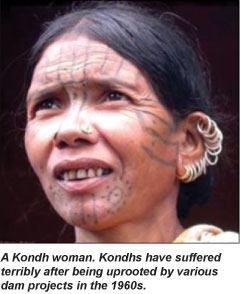 If you are to suffer, you should suffer in the interest of the country.” Jawaharlal Nehru, India’s first prime minister told villagers protesting displacement from the Hirakud dam, India’s first major river valley project. It is by now clear that what are presented as national interests in such exhortations are interests of the urban-industrial elite, and that such appeals to patriotism and to the greater common good are based on a cold calculation that the submergence and destitution of marginalized tribal populations is a fair price to pay for “development.” Nehru also famously declared that dams are “the modern temples of India,” and it is a sad but entirely accurate extension of the metaphor to claim that the 40 million persons displaced by India’s hydroelectric dams are the sacrificial offerings on an altar of “progress.”
  The Association for India’s Development (