Siliconeer: September 2006

The ONLY Color Glossy Monthly General Interest Magazine
in West Coast U.S.A. for South Asians
Ranked #1 U.S. Print/Web South Asian Publication
(Based on Alexa.com Survey

Silicon Valley | San Francisco | LA | Sacramento | New York
Web www.siliconeer.com

icon


icon


SEPTEMBER 2006
Volume VII • Issue 9

OTHER STORIES
EDITORIAL: The Healthcare Mess
NEWS DIARY: Round up
HEALTH: Soy and Your Health
EDUCATION: Reason Rules
BUSINESS: Coffee, Anyone?
LIVING: Kids Save Oakland
CULTURE: Enad’s Aniket
EXHIBIT: A Home Back Home
TRAVEL: Wonders of Turtle Bay
EVENT: Antakshari in Sunnyvale
PAGEANT: An Ode to Beauty
CULTURE: Porshi’s Panchotsav
CONCERT: Sonu Niigam Live
COMMUNITY: News in Brief
INFOTECH INDIA: Round-up
AUTO REVIEW: 2007 Saturn Sky
BOLLYWOOD: Guftugu | Film Review: Lage Raho Munnabhai
TAMIL CINEMA: Vettaiyadu Vilayadu
RECIPE: Balu Shahi
HOROSCOPE: September


EDITORIAL:
TACKLING THE HEALTHCARE MESS

Members of the medical profession are enormously respected in the Indian American community. As the Indian American community tries to find its bearings in mainstream politics, Indian American doctors have led the way.

While the community has taken pride as Indian American medical doctors have hobnobbed with federal and state lawmakers, the time has probably come to ask whether the impressive clout of this professional fraternity is being used to further anything beyond its own narrow group interests.

Few analysts question the fact that the American healthcare system faces a crisis. Costs are ballooning, a substantial part of the population does not have health insurance, and insurance accounting is a logistical nightmare.

Yet where is the voice of the profession when it comes to suggesting solutions to this national crisis? To be fair, the response of the mainstream medical profession has not been particularly edifying, either.

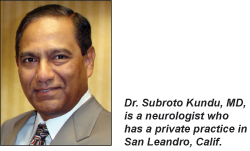
This is why we find the efforts of a Bay Area-based neurologist so remarkable. Dr. Subroto Kundu, MD, is one of those rare medical doctors willing to stick his neck out and willing to call a spade a spade. He has planned an open meeting inviting experts and lawmakers like Rep. Pete Stark, D-Calif., and general members of the public to explore possible solutions. Dr. Kundu is willing to at least look at the problem honestly and explore possible solutions. In this issue, we carry an interview with Dr. Kundu where he offers his frank views.

A relatively simple, even innocuous law has become the bane of corrupt bureaucrats in India. It’s called the Right to Information Act, and you would be hard-pressed to find any power-hungry Indian bureaucrat or politician who loves it.

Now the law gives something to the people which is theirs by right in any democracy: The right to hold government officials accountable. It is not a novel idea, but crafty bureaucrats and politicians in India have hitherto paid lip service while using all means at their disposal to avoid true accountability.

As soon as it became law, bureaucrats began to feel the heat. Ordinary people began to investigate what was happening to files and public money and pretty soon people found that they could actually hold bureaucrats accountable.

However, soon the empire struck back. The government proposed a number of amendments to take the bit of the law, including attempts to take a number of official proceedings out of the public purview and making the proposed Information Commission subservient to the government.

Sandeep Pandey, a Magsaysay Award-winning activist and a Siliconeer editor, joined a mass movement against the government effort. He went on a five-day fast, relenting only after Left politicians promised not to allow the amendments to pass. Ultimately, the government gave in to public pressure, and the amendments are on the back burner. We carry an essay by Sandeep this month.

In today’s world of sectarian schisms and fundamentalist religious fervor, Bangladesh presents an interesting case study. A predominantly Muslim country, it embraced secularism as official government policy when it became independent in 1971 after a bloody war and made the song of a non-Muslim, Rabindranath Tagore, its national anthem.

Many years have passed since then, and Bangladesh’s commitment to secularism has come under a cloud after Islam was accepted as the state religion, but it is also true that Tagore is still revered in Bangladesh, as is Kazi Nazrul Islam, both of whom were in their writings champions of an inclusive Bengali identity that had little tolerance for sectarian or religious divisions.

Rezwana Choudhury Bannya and Khairul Anam Shakil are two Bangladeshi artists who epitomize this cultural spirit, and they performed in Berkeley, Calif., recently. Not only are both wonderful artists, but their message of a cultural identity that transcends religious and political divides is a soothing, reassuring antidote to the increasingly shrill, acrimonious and menacing schisms that divide the world.

Presented by the Berkeley-based nonprofit International Institute of Bengal Basin, the concert cast a spell on the audience where the artists not only sang some beautiful songs of Bengal’s two finest poets, but also provided a fascinating commentary on their lives and work.

In the end, perhaps the most effective way of combating sectarian strife, whether in the domestic or international arena, is by promoting the transcendent bonds of culture that bring us together, focusing on one of the more humane aspects of what Nobel laureate economist Amartya Sen has called a multiplicity of identities that define each one of us.

Do drop us a line with ideas and comments about how we can make Siliconeer better serve you.
|TOP|


COVER STORY:
The Health Care Mess: Understanding the Basics

Most analysts agree the American health care system is facing a crisis. Costs are ballooning, a chunk of the population has no health insurance and the paperwork is a nightmare.

But what is to be done about it? In an exclusive interview with Siliconeer, Bay Area-based neurologist Dr. Subroto Kundu, MD, says that it is essential for ordinary people to understand the fundamental financial and political dynamics of how the health care system works before they can intelligently assess what can be done or whose interest any proposed legislation serves. Dr. Kundu hosts a public seminar this month with invitees including Rep. Pete Stark, D-Calif., to discuss the issue.

Why did you decide to do this seminar?

It has to do with the appreciation of the problem and dealing with the frustration of the inability to express opinion. Even though it might appear that we have wide access to the media, in practical terms you will find that it really is difficult to project a logic or a thought process which unfortunately has to be funded. It does turn out that molding public opinion is a very difficult task. It also turns out that public opinion tends to be molded by people who have the financial ability to do so and that turns out to be the industry. So here you are as a practicing physician, you are doing your job, you are trying to do the best you can, you are up against the constraints of the system at every point on a day-to-day basis. You are confronted with the problems faced by patients, you are confronted with the difficulties of management of a medical practice, and essentially of all aspects of functioning of a physician, and you recognize the points where these problems are created mainly by the industry and yet you have this frustration that you cannot express yourself in saying that such and such changes would benefit everybody concerned.
What kind of changes are you exploring which is not getting out there because it hurts established interests?

It all boils down to the control of money. It is shameful that this idea is sold to everybody else as a control of medical care. It is not a control of medical care, it is control of the money. So the physicians, even though they are part of the process of medical treatment, they actually are not in the control of the industry because the industry, like any other industry, is controlled by the people who control the finances, and physicians happen to be a small speck on that landscape, because they are nowhere in the chain of command that controls the money.

Who controls the money?

That’s the problem. The money is controlled by the insurance companies. So whatever you see as being the ills of the system comes back to the issues of the control of money by the insurance companies who are actually the final repository of all the problems and therefore would also be the point to look at for solutions. Somewhere in there, one would assume, that there would be independent regulatory bodies, namely the government. However, there is a problem here.

I believe that when you look at the whole process of forming a legislation, the input that is given to legislators are given by people who have the time and energy to bring that message. It does turn out, therefore, that those kinds of inputs are again funded by the industry.

This process of legislation is in fact feeding information into the people who make the laws that ultimately will translate into our day-to-day life and therefore it is incumbent upon people to give feedback to their legislators. For example people like being Congressman Pete Stark and Ellen Corbett, who is running for state senate. These are people who will be legislating. So let them hear from real patients, real doctors and other people who are independent and who will give what they perceive and let that be countered if that is to be countered by whatever the industry has to say.

That would be my way of bringing it out to the legislators and at the same time I think that there is in fact a bigger goal for me, because I am aware that at least the people that I had personally invited, Congressman Stark and our state senator-to-be Ellen Corbett, these are people who are already to a large extent aware of the problem. My problem is that people in general are completely unaware of the problem because ultimately I find that it doesn’t matter who you are trying to influence, the most important are the people themselves who are actually the recipient of the bad system and yet they have no clue about where the solution is going to come from.

Why is that?

Because nobody is there to tell them. There are doctors who probably perceive the problem and have a little better understanding, but they really have no time in their daily lives to bring this message to the community. Therefore, it is incumbent on people like me to take the initiative and use whatever organizing skills we have, whatever organizational assets we have and look to community organizations to just give us a platform to at least have a discussion on this. That is really my motive for trying to arrange this seminar.

Why aren’t organizations like the American Medical Association or American Association of Physicians of Indian Origin raising this issue?

One has to begin with issues of motives. My impression after all these years of dealing with these organizations has been that there unfortunately is a question that physicians’ groups which supposedly represent me and everybody else may or may not actually represent my interests.

At least with my experience with AMA, I have to say that at times I am forced to conclude that this organization may not be truly representing me.

If you look at the numbers of what we see by way of representation you will see that not even 20 percent or 25 percent of physicians in general are members. Then you see that the physicians themselves have different interests. You may find that certain physicians spend a significant amount of time in representing these organizations. Now I see that to represent these organizations what you have to do. You have to be in Sacramento. Now you ask the question, how much of my time can I take away out of my daily life? I shut my practice and I am in Sacramento or I am traveling somewhere in Washington or I am meeting some other people and some other groups asking them for vote for me and I am taking time out of my practice, then you have to really ask the question: Am I a doctor or am I a businessman or am I a politician? So it turns out that everybody who has seen his or her own doctor in private practice these are people, doesn’t matter how much you perceive that they are playing golf, it just seems to be that they are sometimes walking the hospital floor in 2 o’clock in the morning and then at 6 o’clock they are making rounds and then they are in hospital most of the day and you see them answering calls at 7:00-8:00 pm, they are coming home at 10 o’clock, how does that gibe with the fact that the same person is called upon to be in Sacramento for three days because of a certain conference? Or in one of the legislative sessions being held out there?

So therefore it turns out that indeed there are physicians who have the time because they are probably businessmen. Or they are employed by the insurance companies themselves and the administrations and things like Kaiser and Sutter who are able to host these physicians who are in fact nebulous physicians and nobody has any way of knowing what time they need to return home, or what time they need to go to work.

So the representation is skewed, I believe, towards people who are not here in the trenches. They are not making rounds in the ER, the ICU and the hospital wards and staying there in offices from morning till night. This is the voice that actually has no access because they are too busy.

The people who are really are affected do not even have the time to make their voices heard and the people whose voices are heard do not happen to be true doctors because either they are businessmen or they are executives of the insurance industry in disguise as doctors or administrators which is about the same thing.

It is unfortunate but true that the so-called physicians’ organizations, particularly organized medicine at the national level such as AMA and at the state level as for example the California Medical Association are heavily skewed by voices of people who owe their allegiance to the organized segments of medical practice, namely the major groups that can afford to keep their people under directions of where they go and spend their 24 hours.

Particularly it has happened with Kaiser which has automatically made every member of their physician group — and that’s a huge number. The moment they are hired they become members of California Medical Association. So right now California Medical Association by default is weighted heavily towards a single HMO namely Kaiser. The same is true for HealthNet, for Sutter and these hospital groups and their organizations like California Managed Health Association — there a large number of similar associations who represent one thing, they represent the interests of people who hold the reins of financial management of health care.

These are the forces which are stacked against the interests of the physicians in private practice, in daily work doing patient care work versus doing administrative jobs. Therefore the interest of the patient is the one that is hurt most.

A physician is a professional and at some point may have some discretionary power in how he chooses to spend his time and he may in fact opt out of the whole question of medical care by using his skills in some other way to get out of patient care responsibility and we see that more and more. People are choosing to make an alternate living and get out of patient care. What that does mean? That means that patient care is still more constrained. These forces are acting in diametric opposite directions where the interests of people who control the money of health care is opposed by the interests of physicians and the patients.

My goal in arranging for this seminar technically to show my community that these are the forces, how they are lined up, and it is for you to see where you find yourself in which corner and thereby understand your interest better when somebody presents you with an option. You have a little more understanding to go back to the basic principles on this triangular relationships between physicians, providers in one corner, patients in one corner and the managers in one corner. If you can understand this, it becomes so much more easier to analyze that is such and such step beneficial to this corner or not.
|TOP|


SUBCONTINENT:
The Right to Know: Keeping Government Accountable
With the Right to Information Act, people have realized that they can actually assert their rights as masters of democracy, which they are. So it is no wonder the ruling elites tried to make the act toothless, writes Sandeep Pandey, who went on a five-day fast to protest the attempt.

(Clockwise from top): Protesters from all over India join Magsaysay Award winner Sandeep Pandey (l) who went on a five-day fast to protest the proposed ammendments to the Right to Information Act;
(Bottom, left):
Sandeep Pandey is India Editorial Consultant for Siliconeer. He won the Ramon Magsaysay Award in 2002.

Over the last month or so we witnessed an upsurge of protest from the people and people’s organizations over the proposed amendments by the Union Cabinet to the Right to Information Act, 2005 from all over the country. The people had realized the importance of this Act. This Act, for the first time since independence, gives people the right to change the equation between themselves and the ruling elites. The governed can now ask questions about virtually every aspect of governance from the class which has claimed to govern them for 59 years and created a mess in every department and ministry. The people have realized that they can actually assert their rights as masters of democracy, which they are, but the ruling elites never let them be. They are filled with a sense of empowerment and the bureaucracy for the first time is feeling under pressure to be accountable to the people. Nobody believed that the bureaucracy and politicians could be reined in but the Act has provided a glimpse of that possibility and therefore people are elated.

People began filing applications under the RTI Act asking questions about various things, from accounts of village panchayats to enquiries of progress on their pending files in government departments. Since there was a time limit within which the bureaucracy had to respond, otherwise it faced the risk of a penalty, things started moving.

Consider the following examples:

Santosh Bahadur Singh, an advocate in Rae Bareli, Uttar Pradesh, was trying to get an illegally built structure on the Collectorate campus removed. He had successfully gotten a court order in his favor but was not able to get the administration to comply with the order. He filed an application under RTI Act asking why the court order was not being complied with and who was responsible for negligence. The district magistrate of Rae Bareli had to get the construction demolished overnight. Santosh Bahadur Singh proudly video recorded the demolition exercise.

Ajay Kumar Singh, a disabled person in Varanasi, had obtained a job with the Nagar Nigam but he was not being asked to join. He had been running around for about a year and a half but his plea fell on deaf ears. He filed an application under the RTI Act asking why he was not being asked to join in spite of having secured a job with the Nagar Nigam and who would be held responsible for the loss that he had suffered because of this.

An attendant from the office went searching for him and told him to come and join from the next day.

When a former inspector general of police S.R. Darapuri in Lucknow obtained the details of expenditure of 3 MP and 8 MLA Local Area Development funds using the RTI Act, it was discovered that our people’s representatives buy a laptop computer at about three times the price for which it is available in the market! Gross corruption is being uncovered. This is the power of the RTI Act.

Fearing that the people would use the RTI Act to take away what the bureaucracy has considered its prerogative for all these years — to take decisions in arbitrary manner — they hastened to clamp down the Act. The bureaucracy came up with seven proposed amendments to the Act which were approved by the Union Cabinet. They did not want file notings, cabinet decisions, information related to processes of examinations and selections to be made public. They wanted the identities of officials conducting enquiries, submitting recommendations, etc., to be kept secret. They did not want the basis for transfers and postings of officials to be revealed to the people. In matters in which decisions were under consideration they wanted not just file notings but any kind of information to be excluded from the Act. And the most damaging proposed amendment was to take away the independence of the Information Commissions. Information Commissions presently enjoy the same status of autonomy as Election Commissions. However, the proposed amendment said that in case of any dispute the decision of the government was to be considered final. The amendments proposed by the government intended to make the Act toothless. As MP from Deoria Mohan Singh put it, the government should have avoided the trouble of trying to explain the amendments and instead brought a one-line motion to the Parliament saying that they intended to withdraw the Act.

People were quick to realize the implications of the proposed amendments even though the Prime Minister’s Office issued a clarification that the amendments were meant to bring about more transparency. There was a backlash in the country and people protested vigorously. Some politicians, former judges, serving honest public servants and one Information Commissioner spoke out against the attempt to tamper with the Act. The government would have been foolish to go ahead with tabling the proposed amendments in the Parliament. It appears that for the time being they have unofficially dumped the “amendments.”

This is a victory of the democratic spirit that is India. The politicians and bureaucrats must know that people of this country do not tolerate arbitrary decisions for very long. They have fought passionately to save their democratic right in the past and will do so once again if the need arises. The people with mala fide intentions who think they can mislead the common people have hereby been sent a clear message. If they make an attempt to dilute the Act in any way, now or later — inside or outside the Parliament, they will be met with serious resistance. The illiterate and half literate masses of India have demonstrated, time and again, that you can trust their political consciousness.
|TOP|

NEWS DIARY: Roundup

Bismillah Khan Dies | Macaca Flap Could Cost Sen. Allen the Race | Bangla Mine Row | Doctor Couple Donates $1M to UC Merced | Farmer Suicides | Goodbye, Prince of Kolkata? | Alzheimer’s Hope


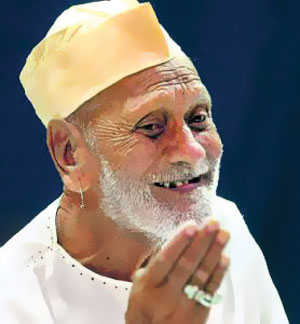
Bismillah Khan Dies
Ustad Bismillah Khan, who died recently, gained worldwide acclaim for playing the shehnai for more than eight decades.

He was credited with helping the shehnai attain a higher status in Indian classical music and taking it to a world stage. It had earlier considered to be an accompanying instrument.

In 2001, he was awarded India’s highest civilian honor, the Bharat Ratna.

The shehnai is traditionally played at Indian weddings and ceremonies and its high-pitched notes and heart-tugging sound are considered auspicious.

A devout Muslim, Khan was a symbol of India’s religious pluralism and a symbol of harmony for people of different faiths.

He was often seen playing at various temples and on the banks of the holy river Ganges in the northern Indian city of Varanasi, his home town.

He was particularly proud of playing outside the famous Vishwanath temple in Varanasi.

Born in March 1916 in a small village in Bihar, Khan belonged to a family of court musicians. His ancestors were musicians in the princely state of Dumraon in Bihar.

He started his formal training under his uncle, Ali Bux Vilayatu, who was a shehnai player attached to the Vishwanath temple.

Khan’s 1937 performance at the All India Music Conference in Kolkata brought shehnai to the centre stage of Indian classical music.

Among the high points in his career was when he played at Delhi’s Red Fort on the eve of India’s Independence in 1947.

Since the time of India’s first Prime Minister, Jawaharlal Nehru, Khan performed every Independence Day and state-owned television has shown his live performance immediately after the prime minister’s address to the nation.
|Back to NEWS Diary| |TOP|

Macaca Flap Could Cost Sen. Allen the Race
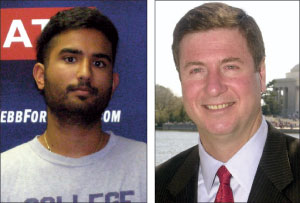
S.R. Sidarth (l) and Sen. George Allen

It was an obscure comment made in an obscure part of the country. The audience actually laughed at the comment, but now the person who made it is in deep trouble.

Sen. George Allen, R-Va., referred to University of Virginia student R.S. Sidarth as a “macaca,” a derivation of the French word macaque, or monkey, at a campaign meeting Aug. 12. Sidarth was at the rally to videotape his speech for the campaign of Allen’s Democratic opponent Jim Webb.

In Francophone African countries, the word is used as a racial slur against Africans. Allen has a close relative who spent in the North African Francophone country Tunisia.

Allen has subsequently apologized, but the issue has spiraled into a big political controversy with his poll numbers taking a precipitous dip. A poll in that showed him with a hefty lead over Democratic opponent Webb, now a poll shows Webb ahead for the first time, though the difference is within the margin of error. Several other polls have shown the difference between the two contestants to have shrunk dramatically.

Meanwhile, his comment has drawn sharp editorial rebuke.

The huge spate of publicity has also played a role. A News-7 SurveyUSA survey found that a majority of Virginians (56 percent) had heard about Allen’s remarks to the Webb campaign volunteer.

Of the 309 people who were familiar with the story, two-thirds (67 percent) thought it was inappropriate for Sen. Allen to refer to the college student of Indian descent as “macaca,” but the respondents were more evenly divided over whether the comments were a racial slur.

In a tough uphill battle that the Republicans face to keep control of Congress, Allen has found to his lasting regret that even a comment made in jest can come back to haunt the person. Activists and minority rights advocates say that is exactly the way it should be.
|Back to NEWS Diary| |TOP|

Bangla Mine Row
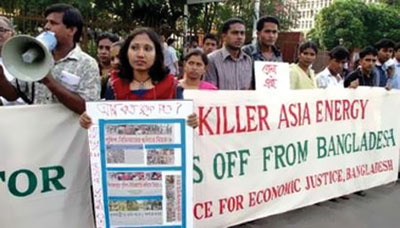
A Dhaka rally protests the killing of people in police firing during a demonstration over a coal mine planned by a British company.

A deal has been reached in Bangladesh over a controversial coal mining project that has sparked clashes. Protesters and negotiators say that under the terms of the agreement, the four-day protest against the British firm Asia Energy will be halted.

In return, negotiators are to recommend to the government abandoning the mining project in the north of the country.

Families of victims killed and hurt in the clashes will also be compensated.

Protesters are angry over the mining project, at Phulbari in Dinajpur district, 220 miles north-west of capital, Dhaka, which they say will displace thousands of families and damage the environment.

Asia Energy says it will adequately compensate those affected if allowed to develop the mine.
Asia Energy is planning to operate an open-cast coal mine which will entail relocating an estimated 40,000 people from their homes.

The proposed mining area will affect more than 100 villages - among them communities of the Santhal, Munda and Mahali tribes - and the destruction of acres of fertile agricultural land.
|Back to NEWS Diary| |TOP|

Doctor Couple Donates $1M to UC Merced
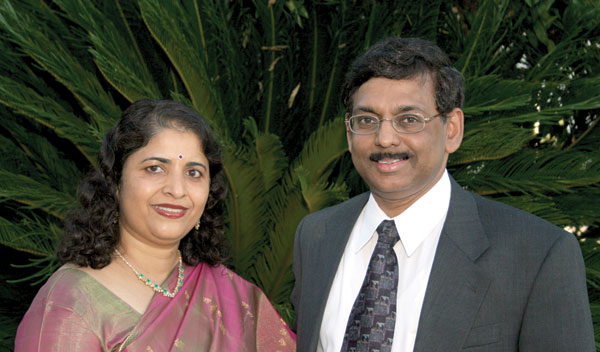

Dr. Madhu Kris and Dr. Vijaya Tangella

Merced physicians Dr. Madhu Kris and Dr. Vijaya Tangella has donated $1 million to the University of California at Merced to start a scholarship fund for high-achieving students and to build a new lecture hall, according to UC Merced. They have dedicated the gift to their parents, Nagaratnamma and Venkat Krishnaiah and Lakshmi Kanthamma and Tangella Pattabhi Ramayya.

The couple’s gift will endow four four-year scholarships. The supplementary scholarships will be awarded based on merit and without regard to need.

Jan Mendenhall, director of development and university relations at UC Merced, said that part of the Kris-Tangella gift will also go towards the construction of a new lecture hall.

The university has generated $61.8 million in private donations since fundraising began in 1998. In the past year, it has reported $19.6 million in private gifts.

The Kris-Tangella donation has been accompanied by several other generous donations from Indian American families in the past year. Hanimireddy Lakireddy and his family recently gave a $1 million naming gift for the campus’ Lakireddy Auditorium, and Rajender and Jhansi Reddy gave a $1 million donation for the campus’ student health center.

UC Merced brings the University of California’s historic commitment to excellence in teaching, research, and public service to the state’s great San Joaquin Valley.

UC Merced opened Sept. 5, 2005, as the tenth campus of the renowned University of California system and the first American research university to be built in the 21st century. Chancellor Carol Tomlinson-Keasey has headed the university since 2000, and announced that she will step down from the position this fall. UC Merced is now conducting a search for a new Chancellor.

Like all campuses in the UC system, UC Merced operates under the direction of the UC President and is governed by The Regents of the University of California, a 26-member board established under the California Constitution.

UC Merced offers a range of undergraduate and graduate programs and is projected to grow to a 25,000-student enrollment at full build-out by approximately the year 2030.
|Back to NEWS Diary| |TOP|

Farmer Suicides

An Indian farmer reflects on his drought-hit land.

More than 200 farmers have committed suicide in India’s Maharashtra state since Prime Minister Manmohan Singh visited in July, campaigners say.

August alone saw 110 despairing farmers in India’s cotton belt take their lives — the highest monthly figure since the debt crisis began nine years ago.

Activists put the rising deaths down to official apathy and farmers’ despair.

Singh announced a relief package worth $815m. But many farmers say help has yet to reach them.

The state’s cotton-growing region of Vidarbha is home to 3.2 million farmers, more than 90 percent of whom are heavily in debt.

They owe money to government banks as well as to local money lenders.

On average, one Vidarbha farmer commits suicide every eight hours.

As part of the package, the prime minister announced the waiver of interest payment on loans to banks, but most farmers have taken substantial loans at very high interest rates from private moneylenders too.

Kishor Tiwari, who has been fighting for the farmers’ rights for several years, says despair and hopelessness, borne out of official apathy, is the main reason for the increase in suicide cases.

He says the Indian government needs to take emergency measures to tackle the problem which is acquiring epidemic proportions.

The suicides have left thousands of widows in the region, many of them between the ages of 19 and 25 with two to three children.
|Back to NEWS Diary| |TOP|

Goodbye, Prince of Kolkata?
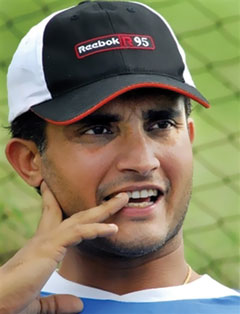
Sourav Ganguly

Cricket history is replete with improbable comebacks but the national cricket selectors may have ended Sourav Ganguly’s long and checkered career by ignoring him for the ICC Champions Trophy.

The country’s most successful captain ever finds himself left out in the cold after a high-voltage confrontation with coach Greg Chappell and poor form (average just 4.8 runs) during his county stint in England this summer.

One of the most stylish Indian left-handers to grace the field, Ganguly has scored 10,123 runs from 279 one-day internationals at an average of 40.65 after making his ODI debut against the West Indies in 1992.

His career seemed headed to doom before he resurrected it with an enthralling century in his Test debut at Lord’s in 1996. Later the same year, he was asked to open the innings in one-dayers with Sachin Tendulkar and together they formed one of the most destructive opening pairs in cricket history.

Entrusted with captaincy in 2000 after Tendulkar stepped down, the “Prince of Kolkata,” as he was affectionately known, took on the job with aplomb, his natural aggression adding spice to his role as the leader of the side.

Credit should also go to the Bengal batsman for putting together a strong team packed with youngsters. He backed to the hilt players like Harbhajan Singh and Virender Sehwag who have made no secret of the fact that they miss Ganguly in the dressing room.

Under Ganguly, India started winning Test matches abroad -- a distant dream for most of his predecessors. One of the factors that contributed to India’s success was Ganguly’s aggressive streak, which at times got on to the nerves of rival skippers, most notably Steve Waugh’s.

It was this instinct which perhaps saw India make it to the World Cup final in 2003 for the first time in 20 years and win its first ever series against arch-rivals Pakistan the following year.

The abiding images will be his classic cover drives which prompted a commentator to say that on the off side there is God and then Ganguly.
|Back to NEWS Diary| |TOP|

Alzheimer’s Hope

A split-view image showing PET scans of a normal brain (l) and a brain with Alzheimer’s disease.

British and Indian scientists are examining ancient Indian ayurvedic medicine for possible use in drugs to treat Alzheimer’s disease.

Researchers say ayurveda works in the same way as conventional drugs for boosting mental agility in the disease.

They found that the plants used in ayurveda acted to improve memory and concentration in Alzheimer’s sufferers.

Alzheimer’s disease is a progressive, degenerative and irreversible brain disorder. There is no known cure.

The disease causes intellectual impairment, disorientation and eventually death.

Researchers from King’s College, London and Jadavpur University in Kolkata, studied five plants commonly used in ayurvedic medicine.

They found that the plants acted to prevent the breakdown of neurotransmitters, improving memory and concentration in people with Alzheimer’s disease - the most common form of dementia.

The scientists are now trying to identify the chemical compounds responsible so they can be used to develop more effective drugs.

Ayurveda is a 5,000-year-old Indian tradition of herbal and alternative medication.

Ayurvedic medicine uses herbs and spices like basil, turmeric, garlic, ginger and aloe vera, as well as yoga exercises, to treat physical and psychological problems.

The causes of Alzheimer’s disease are not yet fully understood.

There are some very rare inherited cases caused by genetic mutations, but these account for around 1 percent of people with Alzheimer’s.

A variety of drug treatments have been shown to benefit patients. None are a cure, but they can temporarily relieve some of the symptoms in some patients.
|Back to NEWS Diary| |TOP|


CONCERT:
Bangla Magic: Songs of Tagore, Nazrul
Rezwana Chowdhury Bannya and Khairul Anam Shakil presented a stunning performance of some exquisite songs of Rabindranath Tagore and Kazi Nazrul Islam, two of the most celebrated Bangla poets. A Siliconeer report.

(Left): Rezwana Chowdhury Bannya
(Top, right): Khairul Anam Shakil during a performance.
(Bottom, right): UC Berkeley theatre prof. Sudipto Chatterjee introducing Rezwana Chowdhury Bannya (r) and tabla player Ashok Maitra.


Two top singers presented the wondrous music and lyrics of Rabindranath Tagore and Kazi Nazrul Islam, two cultural icons of Bengal, at the University of California of Berkeley Aug. 27 at the Rabindra-Nazrul Sandhya, an evening of songs of Tagore and Nazrul. UC Berkeley theatre professor Sudipto Chatterjee ably conducted the event, which was hosted by the International Institute of Bengal Basin, a Berkeley, Calif.-based nonprofit that works on environmental issues in West Bengal and Bangladesh. Monthly Bangla magazine “Porshi” and theatre group “Enad” supported the concert.

Rezwana Chowdhury Bannya and Khairul Anam Shakil, both visiting from Bangladesh, charmed the audience not only with their music, but with their thoughtful comments.
Bannya walked the audience through the various stages of Tagore’s creative life, and performed songs from his various phases. Her anecdotes were particularly engaging and informative, and added considerably to the pleasure of listening to her perform.

Likewise, Shakil, who performed earlier, also prefaced his presentations with thoughtful, relevant comments on the life of Nazrul and the circumstances of writing a particular song. Both artists were not only superb performers, but also spoke with knowledge, poise and grace.
Tagore, Asia’s first Nobel laureate, is celebrated not only for his poetry or music in Bengal. A litterateur of astonishingly versatile talent, he is revered as a poet, philosopher and an architect of modern Bengali language and culture.

Nazrul is also much beloved, and his songs in particular display a superb command of Hindustani music as well as a remarkable creative ability to borrow from diverse musical sources, ranging from classical music to the more popular genres of ghazals and Bangla folk music.

(TOP): At the sponsors dinner (l to r): IIBB volunteer Ashfaque Swapan, UC Berkeley theatre prof. Sudipto Chatterjee, Indian Consul General B.S. Prakash and a guest.
(BOTTOM): At the sponsors dinner (r to l): UC Berkeley Center for South Asian Studies chair Raka Ray, Indian Consul General B.S. Prakash, Bangladesh Consul General Shamsul Haque and other guest.

The broader significance of both of these literary giants is in promoting a Bangla cultural ethos that is humanist, quintessentially Bangla, and inclusive. Their influence has weathered the many political and sectarian schisms that have bedeviled the Bangla-speaking peoples as well as the Indian subcontinent.

In the 1971 war of independence for Bangladesh, for instance, the songs of Tagore and Nazrul, written several decades ago, provided inspiration to the Bengalis of erstwhile East Pakistan who were smarting from the oppression of a vicious genocidal military Pakistani junta. When Bangladesh became independent, it made Tagore’s “Amar Sonar Bangla” (My Golden Bengal) its national anthem. Nearly a quarter century ago, India made another Tagore song, “Jana Gana Mana,” its national anthem.

While age mellowed Nazrul and he wrote some exquisite romantic songs, in his youth his staunch stand against oppression earned him the title of the Rebel Poet.

Repeatedly jailed by the British during colonial rule, his poems and songs of protest have always sustained Bangla-speakers who fought oppression, particularly during the prolonged struggle for cultural and economic autonomy that led to the independence of Bangladesh.

While stylistically distinct, Tagore and Nazrul share a humanist, inclusive conception of what it means to be a Bengali, which to this day informs the culture of Bangla-speakers both in West Bengal and Bangladesh.

The two artists epitomize this. Bannya was born and raised in Bangladesh, but received training in Tagore’s music at Santiniketan, the university Tagore himself set up in Bolpur, West Bengal. Her music and persona transcends political divides, and it is reflected in the audience she attracts abroad: In this concert as in many other concerts outside the subcontinent, the audience members were predominantly from West Bengal.

Shakil embodies Nazrul’s staunch humanism and secular values best in the organization he represents, Chhayanaut. He has been the secretary of the organization for over a decade. Throughout the decades in erstwhile East Pakistan as well as today’s Bangladesh, Chhayanaut has been the champion of a Bangla cultural identity that is inclusive, humanist and rooted in the land, history and rich cultural heritage of Bengal. There has been a price for this: several years back, fundamentalist Muslims attacked a Chhayanaut ‘Pahela Baisakh’ open-air concert where Shakil was performing.

Shakil and Chhayanaut, however, had the last word — their Pahela Baisakh event, an open-air early morning concert that is free and open to the public, drew tens of thousands the following year, and is now an established cultural event in Bangladesh as it is broadcast live on television all over the world.

“Although our main work is on exploring solutions for the environmental challenges faced by the Bengal Basin, a region comprising Bangladesh and West Bengal, cultural events like these are very important as well,” said Dr. Rashbihari Ghosh, founder chairman of organizing institution IIBB. “Both of these artists are wonderful ambassadors of the fact that notwithstanding political divisions Bangla-speakers share a deep and rich cultural kinship, and we hope this realization will help them work together on environmental problems which respect no boundaries.”

Although the concert itself was superb barring some organizational flaws in the beginning, the turnout was somewhat disappointing.

“A mea culpa is in order here,” said IIBB volunteer Ashfaque Swapan, who helped organize the concert. “This is the first time we organized a huge concert like this, so it has been a learning experience for us.”

Swapan thanked the sponsors whose generous support helped IIBB avoid huge losses, and promised that IIBB would bring noted Bangla artists from Bangladesh and India next year.

|TOP|

HEALTH:
Soy and Health: Facts and Myths

Soy products are now widely promoted as beneficial in helping prevent cardiovascular disease, breast and prostate cancers and as an alternative hormone supplement for women. The reality is more mixed, writes Dr. Thuan L. Tran, MD.


Over the last decade, the number of families in the United States who eat soy products has nearly tripled. Why the sudden interest in a bean? 

The FDA in October 1999 approved the use of health claims on products that link soy protein with a reduced risk of coronary heart disease. Sales of soy foods and supplements rose from $852 million in 1992 to $3.7 billion in 2002. Soy products are now widely promoted as beneficial in helping prevent cardiovascular disease, breast and prostate cancers and as an alternative hormone supplement for women. 

For Asians soy has long been a major element of our diet, in tofu and other foods. In Japan, where the average consumption of soy per day is 55 grams compared with less than 5 grams per day in the United States, the cardiovascular mortality rate is half of that for Americans for both men and women. 

Many scientists have conducted studies to evaluate the health benefits of soy, and the results are mixed. Two studies from Japan and Singapore found that consumption of soy foods was associated with a reduction in breast cancer risk. In contrast, a study in China did not find any relationship between soy intake and breast cancer. A study on Asian women in the United States found that tofu consumption was related to a lowered breast cancer risk, but only in women born in Asia and not in women born here. Similarly, clinical trials on the effect of soy protein on prostate and colon cancer have shown conflicting outcomes. 

Most studies do show that the risk of these diseases increases with diets high in fat and alcohol and decreases with diets high in green-yellow vegetables and legumes -- and as diets in Asian cultures become more westernized, the rate of these diseases rise. These observations suggest that the lowered risk of cancer in Asian population was due to an overall lifestyle with diet high in vegetable and legumes and low in fat and alcohol rather than a single food. 

The results don’t prove soy is a miracle food, but they do show that when combined with fresh vegetables, fruits and whole grains, soy can be beneficial to your overall health. Get the full benefits of soy by consuming at least 25 grams of soy protein per day through foods such as edamame (green soy beans), tempeh, tofu and soymilk rather than from pills or extracts. 

Soy is an excellent source of nutrition with its high fiber and unique protein content. When consumed as a substitute for animal proteins, it can lower cholesterol levels and help minimize your risk of cardiovascular disease. However, as a doctor, the best advice is that eating soy should be part of an overall healthy lifestyle plan. 

|TOP|

EDUCATION:
Reason Rules: A Comprehensive Defeat for Hindutva History
The Superior Court in Sacramento has just handed a defeat to the Hindu American Foundation’s challenge to the contents of the sixth-grade history-social science textbooks, coming down unambiguously on the side of reason and scholarship, writes Raju Rajagopal.


The Superior Court in Sacramento has just handed a clear and unambiguous defeat to the Hindu American Foundation and its Hindutva allies in their challenge to the contents of the sixth-grade history-social science textbooks. The court ruled that the books “broadly and accurately describe the outlines of Hindu religious belief”; that “petitioners have not demonstrated that the challenged textbooks violate applicable legal standards…”; and that “The relief…shall not include…requiring respondent to rescind its approval of the challenged texts or take steps to remove them from use.”

In short, Hindutva groups lost their substantive arguments that the textbooks were inaccurate and that they did not treat Hinduism on par with other religions. Even more importantly, it means that California’s 495,000 students, who had been held hostage to Hindutva’s view of history, will soon have the new textbooks in their hands — minus the Hindu Education Foundation and the Vedic Foundation’s blatantly sectarian and flawed versions of history.

The court’s ruling in each of the areas contested by HAF were very much in line with the arguments made by South Asian scholars and South Asian advocacy groups.

Here are some of the highlights from Hindutva’s defeat in Sacramento, in the words of the Superior Court

The Caste System. “The caste system is a historical reality, and indisputably was a significant feature of ancient Indian society. Nothing in the applicable standards requires textbook writers to ignore a historical reality of such significant dimension, even if studying it might engender certain negative reactions in students. Indeed, it appears to the court that to omit treatment of the caste system from the teaching of ancient Indian history would itself be grossly inaccurate.”

“Just as the regulation does not require textbooks to ignore unpleasant historical realities, it does not require them to present such realities in an unnaturally positive light…the texts…have satisfied the requirement of neutrality.”

Women’s Status in Ancient India. “The Court reaches a similar conclusion with regard to the texts’ discussion of the status of women in ancient Indian society…These discussions appear on their face to be neutral, objective, dispassionate, factually accurate, not derogatory or accusatory in their tone, and not such as would instill prejudice against the Hindu religion or believers.”

“…the possibility, or even probability, that some students might react negatively, based on their own religious, political or social beliefs, to what they read in these books does not make the books legally invalid. The law does not insure against negative reactions or prejudices, it merely requires that the textbooks not instill them. The challenged books meet that requirement.”

Treatment of Hinduism vs. other religions. “Petitioners’ contention that the textbooks have the effect of comparing the Hindu religion unfavorably to other religions is also unpersuasive. Where the books describe the development of Buddhism, for example, as in part a reaction against certain Hindu beliefs and practices, they do so in an objective and dispassionate manner that has not been demonstrated to be historically inaccurate. Moreover, the books also appear to accept the idea that Buddhist teachings reflected and accepted many Hindu ideas.”

“Similarly, petitioners have not persuaded the Court that the textbooks tend to favor religions such as Christianity or Judaism over Hinduism…The fact that the discussion of Christianity and Judaism is longer than that of Hinduism, or that one religion or another is illustrated by more pictures (or, allegedly, more attractive pictures)…by itself does not establish a violation of the applicable legal standards. As noted above, the essential inquiry is whether the texts appear to be neutral. In this case, the Court finds that they are…”

Inaccuracies. “Petitioners claim that there are a number of significant inaccuracies in the challenged texts, such as the listing of the ‘Major Hindu Deities,’ the identification of a particular Hindu deity in a picture caption, and the translation of certain words, among others…The Court finds that petitioners have not demonstrated that respondent’s approval of the challenged texts should be invalidated on this basis…there is substantial evidence to show that where actual errors were involved…the inaccuracies have been corrected in the final versions of the texts.”

“In other cases, such as the list of major Hindu deities, the description of a certain text as the ‘most sacred’ in the Hindu tradition, or the translation of the word ‘namaste’, there is not any gross inaccuracy, but at most a difference of emphasis or opinion.”

“It is true that the books do not explore these topics in great scholarly detail, but there is no legal requirement that such a level of detail be contained in grade-school school textbooks. In the Court’s view, the books broadly and accurately describe the outlines of Hindu religious belief, which is all the law requires.

The Origin of Aryans. “Petitioners also argue that the books are inaccurate in their treatment of the so-called ‘Aryan invasion’ or ‘Aryan migration’ theories…[which] are the subject of debate among scholars in the field, and that such debate should be acknowledged explicitly in the books. This argument is not persuasive…First, it appears…that the publishers…have in fact been directed to recognize the ultimate uncertainty of these theories…More fundamentally, even if such direction had not been given, the texts would not be invalid for that reason. While some scholars may question the Aryan invasion or migration theories, there is no showing that such theories are not widely or even generally accepted at this point, such that presenting them without significant qualification would be grossly inaccurate.”

“Moreover…the History-Social Science Content Standards…specifically require sixth-grade students to study and recognize the significance of the Aryan invasions of India. Those standards are not challenged in this action. At some point, the state of historical research and the scholarly consensus in the field may change to the point where it would no longer be accurate to refer to a viable Aryan invasion or migration theory in a discussion of ancient Indian culture. Petitioners have not demonstrated that such a condition exists now. The Court therefore does not find that the references to Aryan invasions or migrations make the textbooks grossly inaccurate or otherwise in violation of law.”

Other remarks. “…petitioners argue that the texts violate legal requirements because their descriptions and depictions of the Hindu religion are not neutral, but tend to portray the Hindu religion in a negative light or even as inferior to other religions… In this area, petitioners’ argument is not based on alleged inaccuracies in specific facts, but on the overall ‘read’ of the passages regarding the Hindu religion, evaluated in their entire context by themselves…”

“Having reviewed all of the selections from the challenged textbooks that have been put before it by the parties, the Court finds that the manner in which the books treat the Hindu religion does not violate this standard. The various texts appear to the Court on their face to be dispassionate and neutral with regard to religion, objectively describing the features of the Hindu religion and others without overtly or covertly ‘taking sides’ with one over another. Moreover, the Court finds nothing in the way of derogatory language or examples from sacred texts or other religious literature that could be classified as derogatory, accusatory or that would instill prejudice against the Hindu religion or its faithful.”

To put it very simply, Hindutva groups lost on all of their substantive allegations with regard to the contents of the textbooks.

Hindutva groups, I am sure, will make much of the court’s ruling directing the State Board of Education to prepare more formal regulations governing the future adoption process. “...respondent has not complied with a specific statutory mandate that it enact regulations governing its textbook approval process as formal regulations pursuant to the Administrative Procedures Act.”

The State of California already bends over backwards in its process to allow communities to comment on textbooks — which allowed even sectarian groups like the Vedic Foundation and RSS groups like the Hindu Education Foundation, which claimed to speak on behalf of all Hindus, to attempt to inject their colored versions of history. So, it is not altogether a bad idea for the state to better regulate the future textbook adoption process to ensure that there is a smoother integration of scholarly consensus with community viewpoints.

As Diane Ravitch, who was apparently on a committee that revised California’s History curriculum in the 1980’s, wrote in the Los Angeles Times (May 16, 2006): “Telling publishers that their books must instill pride only guarantees a phony version of feel-good history…Certainly, textbooks should accurately portray society in all its complexity. But to impose contemporary political requirements on how the events are portrayed only ensures that the history we teach our students is inaccurate and dishonest…What the state should expect of publishers is that they produce books that are as honest and accurate as possible. Such narratives would be far likelier to instill humility, a recognition of human folly, an understanding of conflict and differences and a sense of our common humanity rather than a sense of pride.” The Superior Court in Sacramento seemed to echo her view that books should be honest and accurate and not overly pander to the “pride” of various communities.

It is time for Hindutva groups to stop manipulating Hindu students and parents by appealing to their baser instincts with a contrived sense of “Hindu pride.” It is time for the South Asian scholarly community to get more intimately involved in the preparation of school curricula, instead of merely reacting to Hindutva onslaughts. And it is time for concerned Indians to join together in contributing to narratives of Indian history that are reflective of the plurality of Indian and Hindu thought, and which do not elide over the lived reality of women, Dalits and other lower castes, and religious minorities.

|TOP|


BUSINESS:
Coffee, Anyone?: Starbucks Eyes India

Seattle-based Starbucks has announced that it is set to enter India in 2007, writes Siddharth Srivastava.
U.S.-based coffee retail giant Starbucks Corporation has announced that it is set to enter India in 2007. Incidentally, its plans have coincided with the owners of Indian coffee retailer, Barista, that clones its coffee bars on the original Starbucks, which has declared its intention to invite new investors and dilute the existing stakes. So far Barista has ruled out Starbucks as a potential partner in India.

Starbucks spokesperson T. Kulthol announced in Seattle that the company is excited about the great opportunities that India presents to the company. “We are looking forward to offering the finest coffee in the world to customers in this country (India) within the next 18 months,” she said.

Reports suggest that Starbucks has zeroed in on Delhi and Mumbai for its first retail outlets in India. The company is also in talks with a number of leading companies, including the existing players in the market and others who are planning a foray into the retail market. These could include private sector giant Reliance, telecom player Bharti or the Rahejas, who are big in construction.

Some reports say that Starbucks has been closely negotiating with the Raheja Group. The Economic Times reports that Starbucks is in talks with Anil Ambani who heads a portion of Reliance companies hived off from brother Mukesh.

“When we open a new market, we take time to make sure we have the right joint venture partner or licensee to help develop the brand,” Kulthol said.

Earlier, Starbucks CEO Howard Schultz said that the company plans to expand into Brazil later this calendar year, India and Russia next year, and boost new-store openings to 2,000 worldwide in fiscal 2006 up from 1,800 as previously forecast and 2,400 in fiscal 2007. This is the first time that the company has announced that a roll out plan is in place.

Referring specifically to India, Schultz said, “As India is the second most populous country, with more than 1 billion people and growing at 6 percent per year, we see unique and great opportunity for bringing the Starbucks experience to this market.’’

Starbucks powers a lot of money muscle and is known for quick and efficient setting up of its outlets.

At over $6 billion the company’s annual sales only represents one-fifth of the two big cola producers’ sales, but Starbucks has the potential to catch up.

Analysts’ estimates for Pepsi and Coke sales show revenues should grow between 5 percent and 7 percent annually by 2010. Meanwhile, Starbucks’ management expects that its sales will go up by at least 20 percent each year, given the growing trend of coffee drinkers who prefer to hang out at glitzy café lounges.

As of July 30, Starbucks had 11,946 stores in 37 countries. It opened 559 stores in the latest quarter, 395 of them in the United States and 164 internationally.

The Indian market holds promise, as there is more money in the hands of Indians. The annual per capita income in India has risen 62 percent in the past six years. Fortune group’s Business 2.0 magazine recently recognized the economic power of India’s 300 million strong middle classes.

India is also the largest recipient of remittances by overseas workers, estimated at $21 billion — up almost 150 percent since 1995, says a study by investment bankers J P Morgan.

In the Asia-Pacific Salary Increase survey by Hewitt Associates, India has been ranked number one with 14 percent salary increase in the last two years followed by the Philippines (8.1 percent), China (7.9 percent), Korea (6.9 percent), Thailand (6.4 percent), Singapore and Taiwan (4.2 percent).

The number of high net worth individuals, each worth more than $1 million in India, rose by nearly 20 percent last year, among the highest rate of growth of millionaires in the world, according to the annual World Wealth Report. The report says that Indian consumer purchasing habits and behavior patterns have broken past spending norms. The luxury trends report from Ledbury Research advises companies to start focusing on India.

The household income survey from the National Council of Applied Economic Research estimates that the number of families with annual incomes of more than $230,000 (Rs.10 million) has doubled from 20,000 in 2001-2 to 53,000 by the end of 2005 and will grow to 140,000 by 2010.

All of these trends have translated into high consumption expenditures. The demand pressures are reflected most in the retail sector. According to the KPMG report, “Consumer markets in India — the next big thing?” on the Indian retail sector’s future, organized retail is expected to rise by 20-25 percent by 2010 and the retail sector will grow faster than GDP.

Mukesh Ambani, who heads Reliance Industries Limited, recently said he wants to create a million new jobs by revolutionizing the country’s farming and retail sectors and becoming a supplier to the world’s supermarkets. Ambani is planning a network of stores in India, with an annual sales target of $25 billion by 2011 to make his company “a Wal-Mart in India.” Reliance has announced that it plans to invest nearly $6 billion in setting up a retail subsidiary that would cover 1,500 cities and towns in India and open 1,500 supermarkets and 1,000 hypermarkets.

“There are about 300 new malls, 1,500 supermarkets and 325 departmental stores being built in the cities very soon,” says Research & Markets, one of the world’s largest market research resources.

The over $150 million organized coffee retail business, too, is coming into its own, fed by rising incomes and economy. Coffee consumption has increased from 55,000 tons to 75,000 tons after decades of stagnation. Industry sources say the niche coffee retail format is growing at 10 to 12 percent a year, with branded coffee accounting for 53 percent sales, unbranded 40 percent and cafes 7 percent.

Today, there are an estimated 550-café outlets in the organized sector, but retail consultants KSA Technopak have said that the potential is over 2,000. Retail brands say it is between 3,000-5,000

The federal Commerce Ministry is working towards increasing the domestic coffee consumption to 1,60,000 ton by 2016. The Indian Coffee Board has hired the services of Carlos Brando, the Brazilian coffee consultant, to chalk out promotional strategies.

Brando was actively involved in promoting coffee in Brazil that doubled annual domestic consumption. His mantra for India is competitive pricing (vis-à-vis tea), transparent labeling, highlighting health-enhancing qualities, easy to make at home and establishing a coffee drinking culture.

The foreign players in India include Costa coffee (plans over 300 outlets, with investment over $33 million in India), Gloria Jeans Coffee (plans 750 outlets in India), Coffee World (over 20 outlets, investment $3 million), while the Indian ones are Café Coffee Day, Barista and Qwiky’s.

Barista, owned by billionaire dealmaker C. Sivasankaran, said recently that it plans to sell a stake and spend Rs. 500 million to increase the number of its outlets by half this financial year. Barista (with over 130 espresso bars) pioneered the branded coffee culture in India, but despite the first mover advantage, it has lost ground to arch rival CCD, a 300-odd-outlet chain owned by the Bangalore-based Amalgamated Bean Coffee Trading. CCD is planning 100 more outlets in the near future.

The competition is going to be stiff. The entry of Starbucks will only make it keener. For the Indian consumer, this is a great moment to get up and smell the coffee.


|TOP|

LIVING:
Youth Energy: Kids Save Oakland

For struggling residents in the poor, drug-infested neighborhoods of Oakland, young people provide invaluable help by making their appliances more energy efficient and saving them money, writes Mark Schurman.
(Clockwise from top right): Save water and energy. Da’Ron grins as he demonstrates the efficient-flow showerhead he installed; A bright idea: Kaliesha installs a compact fluorescent lamp for a CYES client; Noah and Cristal were CYES energy specialists at different CYES offices in Berkeley and the Fruitvale District of Oakland. When needed, staff at each site assist and support their cross-town partners; Anthony and Elijah wiring a solar panel to power a garden fountain.

Zania lives with her three children in a small, neat two-bedroom apartment on the second story of a rundown building. Living in the Fruitvale district of East Oakland, Zania struggles to keep the place in order, but it’s an uphill battle. Garbage is strewn across the neighbors’ yards. Rats and spiders scurry in and around the building. At night, drug dealers out front are both a temptation and danger to her children.

It’s no easier to keep order inside. Zania’s appliances are old and the building is poorly insulated. Her doors and her windows leak and need to be replaced. She says she doesn’t want to cause trouble, but her landlord hasn’t taken care of the problems.

“My PG&E bill was outrageous in the winter,” says Zania. “It hurts, nothing gets done around here.”

Shawn Gray, age 18, and Angelina Ramas, 17, have just finished replacing Zania’s light bulbs. The new energy efficient bulbs will cut down dramatically on electrical use. A twenty-watt, energy efficient light bulb radiates the equivalent light of a 75-watt conventional bulb. An energy efficient light bulb can last anywhere from 5 to 7 years, and may cut electrical output by at least 15 percent.

Both the light bulbs and the labor are free of charge.

Angelina and Shawn, both Oakland natives, are outreach workers for the California Youth Energy Services, a hybrid youth employment and energy awareness program funded by the Public Utilities Commission of California.

CYES is the flagship program of the Rising Sun Energy Center, a non-profit organization dedicated to inspiring communities to use energy and water more efficiently. CYES is based in Berkeley, Calif., and has seven offices throughout the East Bay and Marin County.

Along with energy efficient light bulbs and water efficient spouts and showerheads, CYES provides retractable cloths lines for laundry and does assessments for energy efficient attic insulations. All costs are covered by PG&E for low-income residents who qualify.

“It’s the first time that PG&E has ever done anything for me” says Zania.

Ori Skloot, executive director for Rising Sun Energy Center, sees the positive long-term effects that educating both the young employees drawn from these neighborhoods and their clients will have.

“For people with lower incomes, utility costs are a disproportionately large part of their income,” says Skloot. “CYES is trying to get these services out to the people who really need them.”

Save natural gas: Mohamed installs a retractable clothesline, an alternate to a gas clothes dryer. (Top): Reading the meter: Marilyn and Anthony help a client assess their water usage.

CYES started in 2000, with a small grant from the city of Berkeley after students from Berkeley High School responded to lectures on renewable energy and signed up to go door to door asking residents to sign up for home energy efficiency programs. The program grew exponentially from there.

The project has faced some skepticism in the communities it’s come to be based in since expanding beyond its Berkley offices says Sara Nuño, program manager at the CYES West Oakland office.

“Apartment managers were afraid they were going to be billed later,” she says. But Nuño says the feedback has been spectacular. “These are paid positions where kids can learn customer and communication skills, introduce abstract ideas, learn improvisation and have base knowledge of home construction,” as well as a familiarity with energy efficiency, says Liz Penny, Rising Sun Energy Center’s program manager

The majority of CYES clients, says Liz Penny, come through word of mouth referral.

In an East Oakland apartment, Leah Rollins, 16, and Darius Crosby, 20, check the water flow in Allan Boozes’ shower. Booze heard about the program through his work as a janitor in the building where Rising Sun Energy Center’s offices are located.

Leah holds a water assessment bag under the showerhead for five seconds and explains that the bag shows how much extra money is spent in a year due to excess water flow. Booze pays the water bill in his apartment, and the showerhead costs him an extra $145.00 per year. Leah installs a new showerhead with an aerator and flow stopper that will cut down on the excess water flow. Booze beams at Leah and Darius and asks about their schooling as they move from fixture to fixture, replacing all the light bulbs in his apartment.

In Fruitvale, Zania steps out of her apartment to thank Angelina and Shawn. She sees her neighbor down at the far end of the hall and in Spanish tells her about her new light bulbs and shower head and how it’s going to help her save money. She also tells her it’s all free.

Her neighbor is interested. Angelina, who speaks fluent Spanish, walks down the hall to set up an appointment.

Rising Sun Energy Center was founded in Santa Cruz, Calif. in 1994. The primary objective of RSEC was to provide a demonstration site and education center for renewable energy and conservation techniques.

In 2000, RSEC moved to Berkeley, Calif., and expanded its objectives to include both education and direct services. Its programs now include:

Direct installation of efficiency hardware and renewable technology in residences. Training and employment of young people ages 15-21 years old as Energy Specialists. Education workshops that promote resource literacy at our main office in Berkeley.

On why it focused on energy, the organization says in its Web site: “We believe that the effects of our nation’s energy and water use threaten our well-being. Social, environmental and economic instability are all exacerbated by our nation’s consumption of 40 percent of the world’s oil production. So long as the price of energy and water is only reflected in our utility bill, our society seems to be complacent. But increasingly, we as a society are recognizing the connection between our non-sustainable consumption of resources and the real price we pay: wars with foreign countries, global warming, health issues, etc.”

For more information on how to save on your energy bill, visit www.fypower.org.

|TOP|

CULTURE:
ENAD’s Aniket: Bangla Theatre
Bangla theatre group ENAD’s latest production “Aniket” is about a young couple who return to Kolkata from the U.S. with high hopes and how they deal with unexpected and unanticipated challenges. A Siliconeer report.

Scene from a previous production of Enad

ENAD is an acronym for Ekti Natoker Dol, which, means “A Theatrical Bunch.”

ENAD began its journey in 2000 with its first production, Badal Sircar’s “Pagla Ghoda.” It will be staging its eighth production in the Fall of 2006.

During this time, ENAD has grown organically with the addition of like-minded people and experiences of varied productions. While there were already a few informal groups staging Bengali plays during the Puja, ENAD was formed by its founding members with the goal of becoming a group focused entirely on theater. The defining principle of ENAD is to create an awareness of quality Indian drama in the San Francisco Bay Area, and its members go to considerable lengths to achieve that quality. From light design to set construction, from fund raising to background music composition, from play reading sessions to theater workshops and even writing original scripts – each such activity plays its part in defining a continuous learning process for ENAD members. In fact, the scripts of their third production “Chhenra Collage” and fifth production “Robotana” were indigenously developed in the ENAD’s workshop and so is the script of this year’s production, “Aniket,, to be staged Oct. 28t at Cubberley Theatre, Palo Alto.

The story of Aniket is very relevant for Indian professionals currently living in the U.S. It is about a young couple who decide to return to Kolkata from the U.S. with a vision to build a high-flying career and a hope to be near their families and be a source of support for their parents. “Aniket” explores how the resolve and dreams of the protagonists hold up in the face of a series of misfortunes and changed relationships with near and dear ones. It is a tale of hopes, anticipation, frustrations and of a conflict of dreams with reality.

For the last six years, ENAD has concentrated on producing plays in Bengali, primarily since most of its performers were most comfortable in that language. Going forward, ENAD will be diversifying into other Indian languages, as to extend the experience of ENAD productions to the local population who do not follow Bengali.

All profits from ENAD’s productions benefit non-profit organizations like ASHA for Education, Promise Worldwide, Agami, the erstwhile Indo-American Community Service Center, and “Safe Water for All” project in the state of West Bengal in India.

Interested readers can visit the ENAD Web site at www.enadonline.org or email info@enadonline.org for more information.


|TOP|

EXHIBIT:
A Home Back Home: India Property 2006
Some of the top names in Indian developers brought a property road show to three U.S. cities. A Siliconeer report.

(Above): Attendees exploring investement opportunities at the India Property 2006 show at the Santa Clara Convention Center, Aug. 27.

The fact that many Indian expatriates have pretty deep pockets is old news. What is new is that after delegations from the union government and various state governments making a beeline in the U.S. trying to woo Indian Americans to invest in the old country, now property developers in India are getting into the act.

A team with representatives from some of the top developers of India under the auspices of the Confederation of Real Estate Developers Association of India and Maharashtra Chamber of Housing Industry brought an exhibit of properties available for purchase in Santa Clara, Calif., the Chicago suburb of Schaumburg, Ill., and Edison, N.J. The Santa Clara exhibit was held Aug. 26–27, the Chicago exhibit Aug. 30-31 and the Edison exhibit Sept. 13. The exhibit is supported by Union Ministry of Urban Development.

Why invest in property back home? Organizers made a compelling pitch to potential expatriate customers, and here are some of the points they made:
  • India’s GDP, capital appreciation and real estate growth is attracting global attention
  • Property transactions and formalities have become transparent and safe
  • Indian construction standard is now as per global standards and international style
  • Foreign Direct Investment opportunities in Real Estate, JV/partnership opportunities
  • Rental income opportunities and real estate capital appreciation
  • After 8 Indian and 7 Overseas exhibitions (UK, UAE, Hong Kong...) USA gets its first Official Indian property exhibition by Govt of India recognized bodies, CREDAI (Confederation of Real Estate Developers Association of India) and MCHI (Maharashtra Chamber of Housing Industry)
  • Premier Financial Institutions for Spot Loan approvals
  • The exhibition features CREDAI approved developers and their commercial and residential properties across Mumbai, Delhi, Bangalore, Pune, Goa, UP, Jaipur, Kerala and Kolkata.

Interested readers can get more information at the following Web site: www.buyindianproperties.com.

|TOP|


TRAVEL:
Wonders of Turtle Bay: North Bay Museum
The stunning $84-billion Turtle Bay Exploration Park and Sundial Bridge, dedicated to the North Bay, its history, its environment, its mining and logging background and its future is an experience you will remember f or a long time, writes Al Auger.

(Clockwise from top left): The visible river: Peek into the 22,000 gallon Turtle Bay Museum aquarium; The Sundial Bridge at Turtle Bay; Visitors enjoying the Oak Tree Sculpture, Oak Hall, Turtle Bay Museum.

Whether Redding is a point passing by or a night’s stay on your way to a further destination, a stop to see the stunning Turtle Bay Exploration Park and Sundial Bridge is an experience you will remember for a long time. This $84-million gem opened in September of 2002 with a dramatic three-month-long exposition of a privately-held collection of Ansel Adams prints and a controversial story of the local Wintu Native Americans called “On the Trail of Justice.”

Turtle Bay is a dedicated to the North Bay, its history, its environment, its mining and logging background and its future. Regular features are a unique aquarium, living exhibitions of the flora and fauna of the area, a human-shaped medicinal garden and much more. Turtle Bay Exploration Park has become world famous with the completion of the soaring $23 million Sundial Bridge.

In the 1980s three Redding museums began talks to construct a museum complex on 60 acres of Sacramento riverfront property donated by City of Redding.

In 1990, the Alliance of Redding Museums formed to direct construction and to mount a $20 million capital campaign. The McConnell Foundation pledged $10 million to ARM’s capital campaign.

In 1995 the capital campaign reached $20 million through broadly based community and regional support, and adopted the new name: Turtle Bay Museums and Arboretum on the River.

On July 4, 2004 the Sundial Bridge is open to the public with a celebration and dedication from city officials and world-renowned Spanish architect Santiago Calatrava, who designed the bridge.

Entrance to the Turtle Bay Museum (l) and the Sundial Bridge at Turtle Bay, grand opening.


The bridge is the first free standing bridge in the United States. Spanning the Sacramento river, the towering pylon and harp-like cables gives the bridge a sense of ballet grace as it reaches for the sky. This air of lightness is enhanced by a walkway of glass as it crosses the flowing river. At the museum entrance to the bridge is the Café at Turtle Bay where a light lunch and beverages are available.

At the northern end of the Sundial Bridge is the McConnell Arboretum and Gardens, a 20-acre plot of pure colorful delight featuring flowers, bushes, trees and other exotic plants from around the world. On a bright, sunny spring day there is no finer place to stroll and find some peace in a hectic world. But the Arboretum is but a small part of the full 200 acres. A riparian forest and oak savannah is being restored with indigenous species. A series of walking trails and bicycle paths will lace the forest.

At the Turtle Bay Butterfly House complex is an enjoyable, tactile experience for families and especially kids. This is the unique Butterfly House where 600 to 800 beautiful and colorful butterflies representing more than 15 species flying free while you stroll amidst the bright flowers and greenery. Children are enthralled when a burnished orange and black monarch butterfly land on their shoulder or hand. Next door is the Paul Bunyan’s Forest Camp and children’s park and the recently restored Monolith.

Just a short five miles up Interstate 5 from Redding is a secluded and imaginative haven for the weary traveler. Once the family home of Greg Ramsey, he and his wife, Teresa, have created the O’Brien Mountain Inn, a quiet and charming retreat in a verdant pine forest on 47 acres of Shasta-Trinity National Park land guarded over by O’Brien Mountain and surrounded by flora and fauna of every description.

Wintu dancer, Turtle Bay Museum, June 2002.

A professional musician, Greg and Teresa have turned out each of the four rooms in the central house with a musical theme: Jazz, Classical, Folk and World Beat. outside, sitting nestled among pine trees above the forest floor is the most recent addition, the inimitable Tree House. Inside is a vaulted sky windowed ceiling and a fireplace that is also opened to the bath with its oversized Jacuzzi tub of muted woods, stone and tile.

Guests are greeted each day with fresh home baked muffins and coffee in their room, and a full breakfast an hour later in the main room. Some of the treats one can expect include tomato/potato frittata with feta cheese, chicken-apple sausage, grilled portabella mushrooms. The Ramseys take special care to pamper their guests with ironed sheets, soft robes, fresh flowers, personal patios and home cooked meals.

Golf courses, from championship design to nine-holers are everywhere in the central North Valley, from Fall River Mills to Weaverville, numbering eighteen in number. Ten states and on Federal fishery “herd” millions of salmon returning to spawn three times a year. All are open to the public with tours and docents during the spawning season.

IF YOU GO

O’BRIEN MOUNTAIN INN BED & BREAKFAST
Four charming suites plus the Tree House. Rates: $135 to $275 including full breakfast. Dietary needs accommodated, all rooms have computer data p orts, full concierge service, weddings a specialty. Write: O’Brien Mountain Inn, POB 27, O’Brien, CA 96070; 530-238-8026 or 888-799-8026; Fax: 530-238-2027; www.obrienmountain.com.

TURTLE BAY BUTTERFLY HOUSE
Located at Paul Bunyan’s Forest Camp on Auditorium Drive just outside downtown Redding. Take Highway 273 west towards central Redding to Park Marina exit, turn right over bridge.

TURTLE BAY EXPLORATION PARK & ARBORETUM & GARDENS
Open daily (closed Tues. Nov.-Feb.) 9 to 5. Admission: Adults, $11; children (4-15), $5; seniors (65+), $9; Monday is Senior Day with half-off admission.

REDDING CONVENTION & VISITORS BUREAU
777 Auditorium Drive, CA 9 6001; phone: 800-874-75 62/530-225-4100; Fax: 530-25-4354: E-mail: info@visitredding.org; www.visitredding.org.

|TOP|

EVENT:
Antakshari: Annu Kapoor at Hindu Temple in Sunnyvale, Calif.
The Indo American Society of Bay Area presented NRI Antakshari 2006 on Aug. 27.Several hundred people attended the event hosted by Annu Kapoor, Naladri Debnath and Archana Falguni. A photo essay by Shashi Desai.


|TOP|

PAGEANT:
An Ode to Beauty: Mr/Miss/Mrs India America
Sahara One’s Mr/Miss/Mrs India America 2006 contest, produced by JIN Model Management and Mehta Entertainment, was held Aug. 19 at the Scottish Rite Center in Oakland, Calif. Thirty-five semi-finalists participated in ramp walks and talent show. Mellanie Kannokada and Bhavik Vasa were named Miss and Mr India America. A photo essay by Som Sharma.


|TOP|

CULTURE:
Panchotsav: Porshi Celebrates Five Years
San Jose, Calif.-based Bangla monthly ‘Porshi’ celebrated five years in style with a mela, exhibits, kids’ contests and a cultural show where they brought in two other groups, one from West Bengal another from Sacramento, Calif. A photo essay by Sharif Ahmed.


|TOP|

CONCERT:
Sonu Niigam Live
Versatile performer and Bollywood playback singer Sonu Niigam was in town Sept. 2. His smash-hit performance in San Jose, Calif., is part of a U.S.-wide national tour. Here are some glimpses of the San Jose, Calif., show. A photo essay by Som Sharma and Sharif Ahmed.


|TOP|

COMMUNITY: News in Brief
Pepsico CEO | Takes Over as President | U.S. India Investment Seminar and Business Expo | $102K for Charity | India Parade | IT Icon Joins TiE | Yogi Bhajan Birthday | Pakistani Civic Council | Great Expectations: Multilingual Poll | Essay Contest


Pepsico CEO
Indra Nooyi (Pic: Zack Seckler/Bloomberg News)

Indra Nooyi, once described as one of the “most powerful women in America,” has been named the next CEO of U.S. multinational PepsiCo. The Chennai-born executive will take charge Oct. 1, succeeding Steve Reinemund, who said that he is retiring to spend more time with his family.

In a statement, outgoing CEO Reinemund said, “Indra’s record of transforming PepsiCo speaks for itself, and she has been an invaluable partner and ally throughout my time as CEO.”

Nooyi joined the $33 billion global convenient foods and beverages company in 1994 and has served as president and chief financial officer since 2001, when she was also named to PepsiCo’s board of directors.

An alumna of the Indian Institute of Management IIM-Calcutta, she has directed the company’s global strategy for over a decade and was the primary architect of PepsiCo’s restructuring, including the divestiture of its restaurants into the successful Yum brand.

She was instrumental in the spin-off and public offering of company-owned bottling operations into anchor bottler Pepsi Bottling Group, acquiring Tropicana, and the merger with Quaker Oats that brought the Quaker and the sports drink Gatorade businesses to PepsiCo.

After graduating in science from Madras Christian College, Nooyi joined IIM-C and then to Yale University for a degree in management. Prior to joining PepsiCo, Nooyi held senior management positions in Motorola and ABB. She had started her career in 1980 with the Boston Consulting Group.

Fortune magazine had named her among the “50 most powerful women in America”. In 2005, Wall Street Journal named her in its list of 50 women to watch.
| BACK TO COMMUNITY NEWS INDEX | |TOP|

Takes Over as President
Shyam Sunder

Shyam Sunder, the James L. Frank Professor of Accounting, Economics and Finance at the Yale School of Management, has begun his term as the 2006-2007 president of the American Accounting Association.

The American Accounting Association is the premier forum for scholarly interchange in accounting.

Sunder is a native of Dankaur, U.P., and has retained his Indian citizenship while residing in the United States for the last 35 years. He is only the third foreign-born professor to be elected to this office.

In his presidential address, delivered at the AAA 2006 Annual Meeting in Washington, D.C., Sunder spoke about the “Imagined Worlds of Accounting.” He said, “Accounting scholarship examines the way things were and are, and how they might be. The theme of the 2007 AAA meeting will be to celebrate and explore the power of accounting in both these domains.”

Sunder is a leading accounting theorist and experimental economist. In addition to his teaching and research at Yale, Sunder served as director of the Yale Center for Corporate Governance and Performance during its first year of start-up activity in 2005.

He is the author of three books including Theory of Accounting and Control, co-author of Experimental Methods: A Primer for Economists, and has edited several volumes, including Japanese Style of Business Accounting.

Sunder attended IIT Kharagpur and graduated at the top of his class from the Indian Railways Institute of Mechanical and Electrical Engineering in Jamalpur. Before joining Yale in 1999, Sunder taught at Carnegie Mellon, the University of Minnesota, and the University of Chicago.
| BACK TO COMMUNITY NEWS INDEX | |TOP|

U.S. India Investment Seminar and Business Expo

FICCI president Saroj Kumar Poddar (l) with Indian ambassador Ronen Sen

The U.S.-Asia Business Forum, a not-for-profit alliance of businesses established to encourage trade between the U.S. and India, presented prominent guest speakers at its inaugural US-India Investment Seminar and Business Expo 2006, August 21-22, at the Los Angeles Convention Center.

The event was organized by the USABF, in association with the Office of the Mayor of Los Angeles, Antonio R. Villaraigosa, the U.S. Department of Commerce, and the Federation of Indian Chamber of Commerce and Industries, to enhance the business climate and to build relationships that will result in mutual prosperity.

Government leaders who participated in the speakers’ series, include Los Angeles Mayor Antonio R. Villaraigosa, California Lieutenant Governor Cruz M. Bustamante, Rep. Ed Royce, R-Calif., former Co-Chair of Congressional Caucus on India and Indian Americans, as well as Indian officials and successful Indian business leaders including Consul General of India, San Francisco, B.S. Prakash, FICCI secretary general Dr. Amit Mitra, FICCI president Saroj Kumar Poddar, USABF president Gurbax Bhasin and USABF executive director Kevin Kaul.

This influential group of leaders joined forces just months after U.S. President Bush and the Indian Prime Minister Manmohan Singh issued a joint agreement stating that the countries will double their bilateral trade in three years by reducing trade and investment barriers.

“By enhancing the business climate, building relationships and motivating and facilitating individuals in the pursuit of prosperity, we all win with stronger economies,” said Mayor Antonio R. Villaraigosa.

“Through our historic event, we hope to win through stronger economies, widen our appreciation for each other’s cultures and strive for an enhanced quality of life,” said USABF president Gurbax Bhasin.

The Indian market and its one billion plus population presents lucrative and diverse opportunities for U.S. exporters with the right products, services and commitment. India’s GDP is currently growing at around 7 percent, making it one of the fastest growing economies in the world.

More information is available at www.usasiabusinessforum.com.
| BACK TO COMMUNITY NEWS INDEX | |TOP|

$102K for Charity

Some participants and guests at the Bonfare fundraiser.

The 21st annual golf tournament held to raise funds for the Bonfare Market Charitable Foundation, an annual event, raised $102,000 in a single evening, according to a press release from organizers. The net proceeds will go to various charities in the local community promoting education.

For Jag Kapoor of Kapoor Enterprises, being associated with a three-and-half-decade old charity is not about donating, but about participation itself. The Bonfare Market Charitable Foundation is something that his company got associated with following their acquisition of the parent company Bonfare Markets Inc., more than a decade ago.

For the first time, the San Jose Sharks turned up as one of the key sponsors and that automatically meant the presence of star Kyle McLaren, whose famous #4 jersey, along with a team signed jersey went up for auction for $2,400 dollars.

“It is a great moment for us as it is for the Bonfare Market Foundation, which has been in the business of charity for 21 years in giving back to the community,” said Charlie Faas, executive vice president and CFO of San Jose Sharks.

NBA star and Power Forward (The Sixers) Chris Webber’s jersey was also auctioned the same evening. The net proceeds from the evening’s program would go to The Sharks Foundation, Silver Creek High School and other charities in promoting education and improve schools in local community.

Another beneficiary is the California Highway Patrol 11-99 Foundation, said Harpreet Chadha, chairperson of the golf tournament and president and CEO of Legacy Resource Groups. The tournament was sold out three weeks in advance and had a record participation with over 155 players hitting the greens.

“We even had a million dollar shoot out sponsored by Expertquote.com. Amongst other hole- in-one prizes were a Bentley Car, Hummer and four Harley Davidson bikes,” Chadha said adding that several participants came close to winning.

Vice Mayor Cindy Chavez and Superior Court Judge Dolores Carr were the guests of honor at the evening banquet.
| BACK TO COMMUNITY NEWS INDEX | |TOP|

India Parade
Bollywood star Amisha Patel (l) and yesteryear star Poonam Dhillon at the India Day parade in New York. FIA past president Sudhir Parikh (r) is also seen.

Indian Americans took over the streets of Manhattan Aug. 20 as the Big Apple reverberated to patriotic chants, music and dances on the occasion of the annual India Day parade to celebrate the 59th Anniversary of Indian Independence, according to a press release from organizers.

The Indian tri-color was omnipresent across Madison Avenue where thousands of people of Indian origin descended to rub shoulders with top politicians, celebrities and eminent Indian Americans.

Marching to the chants of “Vande Mataram,” the participants at the event, conducted by the Federation of Indian Associations marched through the streets of Manhattan to the sound of trumpets, drums and cymbals.

Celebrity attendees at the event included Bollywood actress Amisha Patel, who was the Grand Marshal while yesteryear’s actress and popular television star Poonam Dhillon was the chief guest. Others who graced the occasion included senior political leaders from India , stars from Bollywood besides hundreds of community leaders led by Immediate Past President Dr. Sudhir Parikh.

The parade began around mid-day with enthusiastic youth leading it from the front. The bands played non-stop along with colorful floats depicting the cultural diversity of India .

Ambassador Ronen Sen, Consul General Neelam Deo, Deputy Consul General A K Ghanshyam, New York City representatives, Air India Regional Director A. K. Mathur and Karnataka Pradesh Congress Committee secretary Manjunath Bhandari were among guests.

Besides the 32 cultural floats that depicted the rich cultural tradition of Indian states, there were more than 30,000 people who participated in the mela and cultural event held after the parade.
| BACK TO COMMUNITY NEWS INDEX | |TOP|

IT Icon Joins TiE
N.R. Narayana Murthy

India’s IT icon and Chief Mentor of Infosys Technologies N.R. Narayana Murthy will join the Board of Trustees of TiE Inc, a world-wide network of entrepreneurs and professionals dedicated to fostering entrepreneurship, according to a press release. TiE, one of the largest entrepreneurial organizations, has 44 chapters in nine countries and a membership base of over 12,000.

“We’re delighted to have an icon and role model like Mr. Narayana Murthy join our Board as a trustee and are looking forward to his wisdom and vision to help us take TiE to the next level of helping entrepreneurs and industries meet the changing needs of the business world” said Apurv Bagri, Chairman of TiE Global.

Murthy, has been a strong supporter of TiE since its inception in 1992 and has a long association with the organization by way of his presence at various functions as a keynote speaker and panelist. He also hosted Microsoft chief Bill Gates at the TiE Forum in New Delhi.

While accepting his appointment as a member of the TiE board, Mr. Murthy said he had seen the evolution of TiE from very close quarters over the past few years and was now looking forward to working with “an exceptional group of individuals” who are part of a truly global network.

“I first met Murthy when Infosys had revenues of $3m Between then and now where Infosys has grown to a $2bn+ company, the one constant has been Murthy’s vision, commitment to values and focus on execution. We at TiE are honored to have his guidance as we build to the next level and beyond,” said Sridar Iyengar, president of TiE Global.
| BACK TO COMMUNITY NEWS INDEX | |TOP|

Yogi Bhajan Birthday

Ben Lujan with some other attendees

The annual birthday celebration for Siri Singh Sahib Bhai Sahib Harbhajan Singh Khalsa Yogiji, or Yogi Bhajan, was held at Hacienda de Guru Ram Das Ashram, in Espanola, N.M. In a village style setting with large white tents, the celebrations featured a bazaar of legacy businesses and services established through his inspiration and guidance, entertaining activities for children, and an international buffet food court, the release said.

Government officials joined with interfaith representatives and 600 guests from all over the world to enjoy and participate in the program, including New Mexico House of Representatives Speaker Ben Lujan, the former First Lady of New Mexico Dee Johnson, and other distinguished dignitaries of New Mexico representing the Supreme and Appellate Courts.

Highlights of the program included film clips illustrating the legacy and teachings of Yogi Bhajan, a performance by tabla master Murli Manohar from Guru Nanak Dev University in India, a lively bhangra performance, greetings by Bibiji Dr. Inderjit Kaur, wife of the late Yogi Bhajan, and by community and state leaders.
| BACK TO COMMUNITY NEWS INDEX | |TOP|

Pakistani Civic Council
A meeting pulled together by Pakistani American activists Abdur Rahman Rafiq, Farrukh Shah Khan and with some contribution from blog writer Sabahat Ashraf launched the Silicon Valley Pakistani Civic Council on Aug. 14, the day Pakistan celebrates independence.

“A meeting that aspired to bring together at least some folks from the Pakistani and Pakistani American community and whoever else might want to attend, to, well, discuss any and everything in the Pakistani context,” writes Ashraf in his blog. “I could go on for hours on why anyone else should care--or think this is a good thing. In short, I think there just isn’t enough social and cultural energy in the South Bay and environs that isn’t around the mosque or directly and, I dare say, aggressively sectarian.”

The next meeting is scheduled for Sept. 11, “but not for the reason you might (if you’re not familiar with Pakistan) think,” writes Ashraf. Sept. 11 is also a national day in Pakistan, as it is the death anniversary of Mohammed Ali Jinnah, the founder of that country.
| BACK TO COMMUNITY NEWS INDEX | |TOP|

Great Expectations: Multilingual Poll
The New America Media along with pollster Sergio Bendixen, presented the results of a poll conducted on education amongst minorities in California Aug. 23 at the California State Capitol.

Call it a “Melting Pot” or sometimes even a “Salad Bowl” if you must, but California has within its borders just about every ethnic group representative that one can imagine.

“Great Expectations: Multilingual Poll of Latino, Asian and African American Parents Reveals High Educational Aspirations for Their Children and Strong Support for Early Education,” said the press release. Beyond the response, other interesting facts were also revealed after 602 interviews conducted in English, Spanish, Mandarin, Cantonese, Vietnamese and Korean. 200 African Americans, 201 Latino and 201 Asian households were polled. The majority of youngest age group of parent responders were Latino.

In terms of education, 66 percent of the Asian responders were college graduates compared to 26 percent of African Americans and only 15 percent of the Latinos. These figures represent significant variations not only in education but also in household incomes.

From the poll results on a range of issues such as affordable housing, quality of public education, illegal immigration, the economy and unemployment, access to health care, traffic congestion and public safety, all three groups polled were almost equally concerned (give or take a few percentage points), except that Latinos expressed more concern about illegal immigration than the other groups and Asians expressed more interest on traffic congestion. African Americans were slightly more concerned about the quality of public education than the other two groups.

On the rating of public schools in California 65 percent of Latinos said that they were excellent/good versus only 24 percent for African Americans and 33 percent amongst Asians. About 65 percent of African Americans rated their schools as mediocre or poor compared to 59 percent for Asians and only 33 percent for the Latino community.

On expectations for their children, 80 percent of Latinos expect their kids to go through college versus 86 percent for African Americans and a whopping 90 percent for Asians.

The findings of this Bendixen & Associates poll are not surprising and it is refreshing to note that in collaboration with NAM, these polls are conducted both in English and the native language of selected population segments. In all probability, the South Asian (Bangladeshi, Indian and Pakistani) community response will be close to that of the Asians polled here, but one cannot be absolutely certain of that. Maybe we too should volunteer to be polled in English, Bengali, Hindi, Punjabi and Urdu for NAM and Bendixen’s next effort?

- Ras H. Siddiqui

| BACK TO COMMUNITY NEWS INDEX | |TOP|

Essay Contest
The winners of an essay contest titled, “How Does Democracy Arise, Survive and Thrive?” were presented awards at a ceremony Aug. 11 in Stamford, Conn., by the Connecticut chapter of the Global Organization of People of Indian Origin, according to a press release from GOPIO Connecticut, Diane Farrell, First Selectwoman of Westport and Democratic candidate for the 4th Congressional district in Connecticut presented the awards.

The winners of the contest are Mallika Vora (Stamford High School), Maya Chakravarti (Stamford High School), Amit Mehrotra (Bently College) and Manasi Raveendran (Boston University). First prize winners Mallika and Amit received $1,000 each and second prize winners Maya and Manasi received $500 each.

Most democracies “were born out of insurrection”; “the earliest use of democratic systems was found in the republics of ancient India,” and “A country is democratic if the people elect their governments in free elections” are some of the thoughts of the winners of the essay contest.

The evening also celebrated India’s Independence Day, with participation and a message by Dr. Neena Malhotra, counselor at the Consulate General of India in New York.

Following the award ceremony, Farrell had an interactive session with members and friends of GOPIO-CT, in which she covered major issues including terrorism, the Iraq war, Social Security, immigration and outsourcing. The audience actively participated with questions and comments. Farrell also made a commitment to join the India Caucus if elected to the Congress.
The interactive session with Farrell was moderated by Dr. Thomas Abraham, chairman of GOPIO International.

“We believe that it is vital to persuade and motivate the younger generation to actively think about it and participate in democracy. We were delighted at the participation and look forward to holding additional events for our youth,” said Sangeeta Ahuja, president of GOPIO-CT.
| BACK TO COMMUNITY NEWS INDEX | |TOP|


INFOTECH INDIA: ROUNDUP
Microsoft: Hyderabad Campus | Infosys: Rs. 1 Trillion Market Cap | Intel: Layoffs Ahead? | IBM: Outpacing U.S. Rivals | NIIT: Virtual Classroom | EADS: European Giant | MindTree: $70M IPO | Bangalore: Wireless Broadband City | Nanocity in Haryana | Infotech Week | Membrane Technology | CCS Infotech: Rs. 10M Order
Microsoft: Hyderabad Campus
Andhra Pradesh Chief Minister Y.S. Rajasekhara Reddy Aug. 30 inaugurated the second phase of Microsoft campus in Hyderabad. The 395,000-sq ft. facility, completed in 13 months, has come up at the 50-acre campus at Gacchibowli.

The campus, which can seat 3,000 employees, hosts three major businesses of Microsoft in the country — Microsoft India Development Centre, Microsoft Global Delivery Centre India and Microsoft Global Services India.

The new building will house the teams of GDCI and MGSI. The first phase was built on 360,000 sq. ft. of office space.

The two buildings are five-storey rectilinear structures and reminiscent of the Microsoft campus in Redmond, Wash., equipped with high bandwidth network infrastructure and world-class facilities.

Speaking on the occasion, the chief minister said his government would provide all assistance to the IT sector. “This state-of-art campus is one of the best I have seen in the world and I am extremely impressed by the amenities Microsoft is providing for its employees,” he said.

Srini Koppolu, vice president and managing director of MSIDC, said Microsoft would provide 7,000 jobs by 2007 in India in addition to the 4,000 people currently employed in Delhi, Mumbai, Bangalore, Kolkata, Chennai and Hyderabad.

“The new building reinforces our continued commitment to Andhra Pradesh and our long-term investments in India. All the six business units of Microsoft in India are making strategic and innovative contributions to Microsoft’s global business growth and helping India take a leadership position in the emerging knowledge economy,” he said.
| BACK TO INFOTECH INDEX | |TOP|